Among all the strange and pathetic love-stories of the Revolution, when hearts were won within prison walls and wedded by the guillotine, is there another as fantastic and wonderful as that of Adam Luchs? (Source)
Adam Lux (as he’s better known, and a fitter name to his character could hardly be invented), German Republican turned French Revolution representative, was so lovestruck by the arresting figure of Charlotte Corday that it was downright … mortifying.
Many were men to whom the Norman maid played muse, like the poet Andre Chenier.
But Lux was something else.
Thrilled by this chaste heroine’s sacrificial blow against the Revolution’s monster, Lux was supposed to have fallen madly in love with the murderess the one time he actually saw her, on her serene way to the scaffold.
Eros thus yoked to Thanatos, the besotted fellow promptly hurled himself after the exaltation of death. Imitation, after all, is the sincerest form of flattery.
Certainly knowing it to be fatal, Adam Lux published under his own name a vindication of Ms. Public Enemy #1 and her “tyrannicide,” and generally went extravagantly mooning about in this sort of vein as he prepared to get his head cut off this date in 1793:
The guillotine is no longer a disgrace. It has become a sacred altar, from which every taint has been removed by the innocent blood shed there on the 17th of July. Forgive me, my divine Charlotte, if I find it impossible at the last moment to show the courage and the gentleness that were yours! I glory because you are superior to me, for it is right that she who is adored should be higher and more glorious than her adorer!
Adam came off a little needy, you’d have to say.
Not surprisingly, he didn’t get the girl in the end.
Red is the garb thou wearest, red is the deed thou hast done,
And red on a land of blood rises the morning sun.
Kings have ridden this road, conquerors mailed in gold,
But none in such red triumph as this that we behold.
Rose, thro’ a rose-red dawn, go to thy valourous fate,
Queen of all roses thou, splendid and passionate.
And lo ! at thy feet I fling, here, in the gallows-cart,
Passionate even as thine, the rose-flower of my heart.
Turn but a moment toward me, stoop in thy raiment red,
I answer thee look for look, I am warmed and comforted.
Twins are we of one womb, fated sister and brother,
Nursed on the bare bruised breasts of Freedom our great Mother!
Thou, whom none could master, proud and glorious head,
Come, O Rose, to my bosom, come when thou art dead!
They have shorn the beautiful hair, they have bound the strong fair hands,
Signal me with your eyes that love still understands!
Signal, and I will follow : I dwell where thou must dwell,
I shall know thy blood-red raiment either in heaven or hell!
Lo! at thy feet I fling, here, in the gallows-cart,
Passionate even as thine, the red rose of my heart!
Humans bear up to proximity of death with every psychological defense in the book, but even if surprisingly few die in naked terror, make no mistake this Halloween: there’s a reason the executioner is scary.
Shot Through the Heart
Habitual criminal John Deering had a date with a Salt Lake City firing squad this date in 1938.
If anyone should be nonchalant about being ripped open by bullets, it’s a guy who eschewed a prison sentence in Michigan and confessed to murder to get himself extradited to Utah to face capital murder charges — saying that he and the world would both be better off with him dead.
The 39-year-old put on a cool front, but how steady was he, really? In a weird experiment, Deering agreed to be hooked to an electrocardiogram that measured his heart rate during his last moments.
Here comes the science!
The heart of John W. Deering, holdup murderer, beat three times faster than normal just before he was put to death today by a firing squad in the state prison here. The unprecedented recording was termed valuable to heart disease specialists as it showed clearly the effect of fear.
An electro-cardiograph film, recorded with the condemned man’s permission, showed that Deering’s heart beat jumped from normal 72 to 180, although he appeared outwardly calm. It maintained that rate for the several minutes required to complete preliminaries for the execution.
When the doomed man was asked for a last statement his heart beat fluttered wildly, then calmed after he spoke until bullets ended his life. The heart beat stopped 15.6 seconds after the bullets struck, but he was not pronounced dead until two and a half minutes after the five shots rang out. (Chicago Tribune, Nov. 1, 1938)
On this date in 1666, a hapless French watchmaker was hanged at Tyburn for starting the Great Fire of London — his obstinate confession in the face of all other evidence making him the convenient fall guy for an accidental cataclysm.
though the Chief Justice told the King, ‘that all his discourse was so disjointed that he did not believe him guilty;’ nor was there one man who prosecuted or accused him: yet upon his own confession … the jury found him guilty, and he was executed accordingly. And though no man could imagine any reason why a man should so desperately throw away his life, which he might have saved, though he had been guilty, since he was only accused upon his own confession; yet neither the judges, nor any present at the trial, did believe him guilty, but that he was a poor distracted wretch weary of his life, and chose to part with it this way. Certain it is, that upon the strictest examination that could be afterwards made by the King’s command, and then by the diligence of Parliament, that upon the jealousy and rumour made a Committee, who were very diligent and solicitous to make that discovery, there was never any probable evidence, (that poor creature’s only excepted,) that there was any other cause of that woeful Fire, than the displeasure of God Almighty.
More Great Fire images, including a map of the destroyed area, here.
Was London lucky to have the Great Fire?
Yes, I suppose so. Lots of people have sort of argued that London missed an opportunity to make more changes, but they just didn’t have the money to do them at the time.
There were a lot of improvements made. They widened the streets. The city was rebuilt in brick instead of wood, although that rule was in place from before 1666. The regulations were restated and extra ones were added in; a lot of people think that it was because of the Great Fire that people started building in brick, but that regulation already existed from earlier in the 17th century.
You’ve got acres and acres and acres of land that have been reduced to rubble during the Great Fire, and en masse, all these new buildings are going up. But yes, it made life more healthy & more pleasant in the city. You had pavement put in for the first time. All these little things you wouldn’t think of, like the houses had to have gassers for the first time, as opposed to just spouts that would spray water on you if you walked down the street. The Great Fire gave people the opportunity to get rid of all those inconveniences.
And they were able to do other things, like the slope down to the River Thames was quite steep, and they were able because of all the rubble to ease the slope.
How did it reshape London? What might have been different about the subsequent life of the city if it had never occurred?
Within days of the fire going out, various architects like Christopher Wren were supplying architectural plans to rebuild London, perhaps around an American grid plan, or European-looking piazzas.
What they really wanted to do was get people moving back into London and rebuilding their houses as quickly as possible, so they kept the medieval street plan and instituted new regulations, like the streets had to be widened, and they could no longer build the houses hanging into the street. The size of the house you could build was proportional to the size of the street you were on, so if you lived on a main boulevard instead of a small lane
Where’s the best place in London to catch a glimpse of that world, as it looked then?
It’s kind of a hidden thing because of course we were bombed in the Second World War, but there are places, like behind St. Paul’s Cathedral, in Amen Court.
So who is Robert Hubert?
He’s a French watchmaker from Rouen, and he was seized in Essex apparently attempting to flee the country. There were various other foreign people who were seized as well, but Hubert confessed to starting the fire.
But his evidence* was very conflicting; he kept changing his mind of what he’d done. He said he’d been part of 23 conspirators and put a fireball through the window of the bakery where the fire started. The baker himself said there wasn’t a window there.
The jury really thought that Robert Hubert was mad, but he was so insistent that he’d done it.
The following year, they discovered that he hadn’t actually arrived in London until two days after the fire started.
Lucky for the baker! He didn’t end up catching any blame for burning down the city?
Hubert was a very convenient scapegoat, and Thomas Farynor** of the bakery was incredibly relieved. Right from the start, Farynor had said “I put my oven out that night, it can’t possibly be me, it must be arson.”
I’ve had a little look at the records of Pudding Lane to see whether he rebuilt his house, and he did.
One of the interesting resources on your site deals with the going fear of “Catholic incendiarism” (pdf), and the use of the Great Fire as a touchstone for the succession conflicts of the 1680’s. Would it have been conventional wisdom by that time, a generation or so after the event, that the Great Fire was a Catholic plot?
It becomes all caught up in the contemporary politics of the time, so it’s really got nothing to do with the fire. It’s people not liking James II for being a Catholic. It’s the fictional Popish Plot, completely fabricated. It’s probably not a coincidence that at the height of the Popish plot that they put up the plaque on the side of the bakery saying that the Fire came from “the malicious hearts of barbarous Papists.”†
Given the combustible material all about, why wasn’t something like the Great Fire a more regular occurrence?
There were six serious fires in the 17th century before the Great Fire happened; one of them was a great explosion of gunpowder.
Fires were sort of a common hazard. The thing about the Great Fire was that there was sort of a whole load of circumstances. There was a drought, so it was dry; there were storm winds coming in from the east, so it blew the fire on faster than it would have; it started at 1 o’clock in the morning, so people were in bed. I think the problem is that it’s all these circumstances combining together. Maybe if it happened at 3 o’clock on Monday when it was raining, it wouldn’t have gone beyond the block.
Logistically, how did the society and the state handle the mass homelessness and unemployment that followed? Where did all these people live right after the fire, and how smoothly were they reintegrated?
People were camping out in the fields outside of London; others were moving into areas that were unburnt but having to pay hugely inflated rents. Some people had to move into other towns. There was evidence that people were still living in shantytown tented accommodations up to eight years after the fire, because there’s another rebuilding regulation in the 1670s that addresses that.
In the first year after the fire, only 150 houses are rebuilt; the rebuilding happens over 10 years, though some houses took up to 30 years. Some people were in very desperate circumstances, so formerly very wealthy people who had lived off their rents might now be working as servants. People coped, a lot of times in reduced circumstances from what they were used to.
There was a particular man you can read about in Samuel Pepys’ diary, and he threw himself into a pond in an attempt to commit suicide because he was so indebted.‡
As curator of an exhibit, what do you hope visitors take away from London’s Burning?
One thing that I really wanted people to understand as they go around the exhibition is the effect on people. You learn about it at school, but you don’t really focus on how people cope and how they rebuild.
There’s also a lot of urban myths about the Great Fire, like the ‘fact’ that the fire is supposed to have ended the Great Plague, which is not the case (pdf); those are things we wanted to dispel.
* There’s some original documentation from the examination of Hubert and others after the Fire here.
** Also spelled Thomas Farriner — or Faryner, or Farryner.
Christopher Wren’s monument to the Great Fire of London.
† An inscription on the base of the Great Fire monument itself (only chiseled out in 1830), once read:
This pillar was set up in perpetual remembrance of the most dreadful burning of this protestant city, begun and carried on by the treachery and malice of the popish faction, in the beginning of September, in the year of our Lord, 1666, in order to the carrying on their horrid plot for extirpating the protestant religion, and old English liberty, and introducing popery and slavery. (Source)
Alexander Pope savaged this civic pamphleteering with the couplet,
Where London’s column, pointing at the skies,
Like a tall bully, lifts the head and lies.
Poets and elites might think what they like, but Lord Clarendon recorded a popular anti-foreigner freakout as England reached
a universal conclusion, that this Fire came not by chance … the wicked authors … were concluded to be all the Dutch and all the French in the town, though they had inhabited the same places above twenty years. All of that kind, or, if they were strangers, of what nation soever, were laid hold of; and after all the ill usage that can consist in words, and some blows and kicks, they were thrown into prison. And shortly after, the same conclusion comprehended all the Roman Catholics, who were in the same predicament of guilt and danger … In the mean time, even they [the King’s Privy Councilors], or any other person, thought it not safe to declare ‘that they believed that the Fire came by accident, or that it was not a plot of the Dutch and the French and Papists, to burn the City;’ which was so generally believed, and in the best company, that he who said the contrary was suspected for a conspirator, or at best a favourer of them. (Source)
the story is that it seems on Thursday last he went sober and quiet out of doors in the morning to Islington, and behind one of the inns, the White Lion, did fling himself into a pond, was spied by a poor woman and got out by some people binding up hay in a barn there, and set on his head and got to life, and known by a woman coming that way; and so his wife and friends sent for. He confessed his doing the thing, being led by the Devil; and do declare his reason to be, his trouble that he found in having forgot to serve God as he ought, since he come to this new employment: and I believe that, and the sense of his great loss by the fire, did bring him to it, and so everybody concludes.
Although the man survived the drowning, he caught his death from the attempt and died in bed; Pepys intervened to see that the desperate suicide’s remaining estate would not be confiscated from his widow for his “self-murder.”
Mary Standford was convicted of privately stealing a shagreen pocket book, a silk handkerchief, and 4 guineas from William Smith on July 11, 1726. After her conviction, she strongly rejected transportation to the American colonies as an alternative to execution.
Early Years
Standford was raised just outside of London by good parents who sent her to school and educated her in the principles of Christian values. Standford, however, showed more interest in the “Company of Young Men,” so she was sent to London to become a servant, where she lost several positions due to her behavior. In her last position she was seduced by a footman, which subsequently forced her into prostitution.
Standford quickly fell in company with Mary Rawlins, “a Woman of notorious ill fame,” and the two of them walked the streets between Temple Bar and Ludgate-Hill looking to empty the pockets, one way or another, of gullible men. Later, they had considerable success targeting sailors who, after returning from their voyages, had money to spend for their favors. Standford eventually married a man with the last name of Herbert, but after a year and a half she left him or, by her account, he abandoned her. Soon afterward, she had a child out of wedlock from another man, who was a servant.
Standford’s Arrest
With two mouths to feed, Standford set out to practice prostitution on her own, and it was then that she was arrested for theft. William Smith, who brought her to trial and was surprisingly frank in his testimony, related that he was walking along Shoe Lane after one o’clock in the morning when he was approached by Standford, who offered him to “take a Lodging with her.” He spent 2 or 3 three hours with her, all the while ordering drinks to be brought up from downstairs. He soon realized that he was missing money, and when he confronted Standford about it, she bolted from the room.
A constable caught Standford running away from Smith in the street. He picked up one of Smith’s guineas after Standford had dropped it, and he found another in her hand and two in her mouth. He also discovered Smith’s handkerchief and pocket book on her. In his testimony, the constable called Smith a “Country Man” and described him as very drunk at the time.
Standford’s version of the event was quite different. She claimed that Smith was drunk when she met him, and that he forced himself up to her room. There, he placed the four guineas one by one in her bosom and then threw her onto the bed. In the struggle, she speculated that his pocket book must have fallen out of his pocket, and when she discovered it after he left, she ran after him to return it. Not believing her story, the jury found her guilty, and she was sentenced to death.
A Rejection and a Defense of Transportation
After receiving her sentence, Standford’s friends pleaded with her to ask for a pardon in exchange for transportation. Standford refused, “declaring that she had rather die, not only the most Ignominious, but the most cruel Death that could be invented at home, rather than be sent Abroad to slave for her Living.”
The author of the Lives of the Most Remarkable Criminals was baffled by Standford’s position and presents a lengthy defense of the institution of convict transportation:
such strange Apprehensions enter into the Heads of these unhappy Creatures, and hinder them from taking the Advantage of the only possibility they have left of tasting Happiness on this side the Grave, and as this Aversion to the Plantations has so bad Effects, especially in making the Convicts desirous of escaping from the Vessel, or of flying out of the Country whither they were sent, almost before they have seen it. I am surpriz’d that no Care has been taken to print a particular and authentick Account, of the Manner in which they are treated in those Places; I know it may be suggested that the Terrour of such Usage as they are represented to meet with there, has often a good Effect in diverting them from such Facts as they know must bring them to Transportation, yet . . . if instead of magnifying the Miseries of their pretended Slavery, or rather of inventing Stories that make a very easy service, pass on these unhappy Creatures for the severest Bondage. The Convicts were to be told the true state of the Case, and were put in Mind that instead of suffering Death, the Lenity of our Constitution, permitted them to be removed into another Climate, no way inferiour to that in which they were born, where they were to perform no harder tasks, than those who work honestly for their Bread in England do, and this not under Persons of another Nation, who might treat them with less Humanity upon that Account, but to their Countrymen, who are no less English for their living in the New, than if they dwelt in Old England, People famous for their Humanity, Justice and Piety, and amongst whom they are sure of meeting with no variation of Manners, Customs, &c. unless in respect of the Progress of their Vices which are at present, and may they long remain so, far less numerous there than in their Mother-Land. I say if Pains were taken to instill into these unhappy Persons such Notions . . ., they might probably conceive justly of that Clemency which is extended towards them, and instead of shunning Transportation, flying from the Countries where they are landed, as soon as they have set their Foot in them, or neglecting Opportunities they might have on their first coming there, be brought to serve their Masters faithfully, to endure the Time of their Service chearfully, and settle afterwards in the best Manner they are able, so as to pass the Close of their Life in an honest, easy, and reputable Manner; whereas now it too often happens, that their last End is worse than their first, because those who return from Transportation being sure of Death if apprehended, are led thereby to behave themselves worse and more cruelly than any Malefactors whatsoever (Vol. III, pp. 287-289).
The author’s cheery account of life as an indentured servant in the American colonies certainly makes transportation sound like a compelling alternative to execution. The reality of life overseas under such conditions, though, does not match this picture, and some criminals valued their liberty over enforced servitude, even if it meant their own death.
Execution
In his account of her execution, James Guthrie, the minister at Newgate Prison, described Standford as “grosly Ignorant of any thing that is good.” He went on to say that “she was neither ingenious nor full in her Confessions, but appeared obstinate and self-conceited.” Standford continued to maintain her innocence in the affair with Smith, and she appeared indifferent about the fate of her child, expressing to Guthrie the hope that the parish would take care of it. Guthrie claimed, however, that “she acknowledg’d herself among the chief of Sinners.”
Mary Standford was executed on Wednesday, August 3, 1726 at Tyburn. She was 36 years old. Executed alongside her were 3 other criminals. Thomas Smith and Edward Reynolds were both sentenced to die for highway robbery. John Claxton, alias Johnson, was put death for returning twice from transportation before his 7-year sentence had run out.
Resources for this article:
Lives of the Most Remarkable Criminals. 3 vols. London: John Osborn, 1735.
On this date in 1977, a 19-year-old royal adulteress and her paramour were executed in a Jeddah parking lot by the order of the girl’s powerful grandfather.
Princess Misha’al‘s fate has been obscured by secrecy and the Rashomon-like interpretations imposed upon it by observers.
In its outline (and the first stock interpretation we’re imposing) it’s that timeless human tragedy, the love story, in which headstrong royal daughter and suffocating traditional family square off over the seditious power of the feminine libido.
The princess, in a youthful arranged marriage by most accounts, took up with a Saudi boy while both were studying abroad in cosmopolitan Beirut, and dangerously attempted to maintain the affair back in the royal kingdom to the point of a quixotic (and obviously foiled) escape attempt. Whether under color of a judicial proceeding — the story says Misha’al refused to walk away by simply renouncing her lover and defiantly brought down the death sentence by confessing adultery — or simply on his own authority, the girl’s staunchly conservative* grandfather exercised his right as tribal patriarch to inflict an honor killing for the disgrace they had brought on the family.
The execution in Jeddah — she by gunshot,** he by a very clumsy beheading — that is supposed to have occurred on this date was public, but quiet; news of it got abroad only slowly and incompletely. Small wonder that, once it did, the blended motifs of Romeo and Juliet, harem titillation and oil politics made dynamite material for high-, middle- or lowbrow exploitation.
In 1980, the affair became the subject of one of the most notorious television programs ever aired, the docudrama Death of a Princess. This film’s airing in Britain in 1980 led Riyadh to expel the British ambassador, and cost £200 million of lost revenue for the UK from canceled orders and product boycotts by the Saudis.†
It was aired on in the United States on PBS in 1980 to similar controversy, as oil companies rushed to distance themselves from it.
Rebroadcast in 2005, Death of a Princess is available online for your judgment (as is this partial script): is this a muckraking expose of a shameful crime? orientalist heavy petting? “a sensitive and thoughtful exploration of the Arab dilemma,” as per its own advance publicity? and what did the official apologies (and in only a few countries, censorship) say about the political weight of the petroleum industry?
These, meanwhile, are the western reactions, already removed from events by a further layer of mediation, a forest of axes seeking grinding. If the writer who composed this piece is to be believed, the executed girl has posthumously achieved a sort of universal symbolic gravity in the Arab world, standing for the plight of any hopeless cause of justice dashed against authoritarian power.
* For the House of Saud, it must be recalled, the personal was political in the problematic confrontation between tradition and modernity athwart the desert kingdom’s sea of oil.
** “Princess Misha’al” was executed fully veiled, which permits the rumor that the slain woman was actually a surrogate and the onetime royal favorite lives on incognito somewhere.
On an uncertain date in February (perhaps) 1613 — so says a cherished Russian national legend — a villager met a Polish army intent on deposing the Russian tsar, offered to guide it on a “shortcut,” and proceeded to lead it into a forest or fen where it succumbed to the elements.
A monument to Ivan Susanin in Kostroma. Image courtesy of Barbara Partee (Barbara adds: to help prevent future executions of the wrongly convicted, check out the Innocence Project.)
That peasant, Ivan Susanin, is supposed to have been put to death as the army realized its folly and imminent doom — the fate one would expect, although also not the sort that would leave a lot of corroborating witnesses.
Though the particulars are of doubtful veracity, Susanin’s son-in-law was awarded estates for the man’s tortures by enemy armies seeking the tsar — so the story is not completely baseless.
It was tsarist public relations, however, that gave us Susanin in his dramatic, familiar* form with the trackless wilderness.
This Susanin embodies the Russian people’s sacrificial love for their autocrat … and more specifically, since this was the Time of Troubles when the Russian crown’s succession was contested, for the Romanov dynasty whose first scion chosen in February 1613 would have been the Poles’ target.**
But Glinka and Ivan proved up to the shifting needs of authority as the tsar gave way to the Politburo, and that to the post-Soviet state.
In a fascinating 2006 academic disquisition,† Marina Frolova-Walker dissects A Life for the Tsar‘s transmutation into Ivan Susanin, a Stalin-era opera with the same score but a libretto altered to expunge the tsar — and the success this adaptation of a national classic enjoyed vis-a-vis Soviet artists’ original creations under the impossible aesthetic and political restrictions of official censorship.
Not only did this now-nationalist composition thrive in the USSR, it has been successfully re-staged in its Soviet form, or as a fresh amalgamation of Stalin and Glinka, in the Putin era.‡
From the days of serfdom via the days of the gulag past the fall of the Iron Curtain, here’s Ivan Susanin‘s stirring finale performed by the Russian army at the Vatican, and broadcast on Russian television.
* Familiar to Russians, certainly, and you can call one who gets you lost “susanin”.
† Marina Frolova-Walker, ‘The Soviet opera project: Ivan Dzerzhinsky vs. Ivan Susanin’, Cambridge Opera Journal (2006), 18:2:181-216
‡ In the Yeltsin era, the opera was staged in its pre-Soviet form. Frolova-Walker argues that the version incorporating Stalinist edits actually speaks to contemporary Russia more aptly than the original, an operatic mirror of the state’s re-adopting the Stalinist national anthem after having used a tsarist piece (written by Glinka!) during the 1990’s.
The reappearance of these cultural tokens is occurring because high Stalinism provides the most easily assimilable model for Russian nationalism today: it is less remote than its nineteenth-century counterpart … The eclectic and confident nationalist of the new Susanin contains the appropriate message for those Russian citizens wealthy enough to attend the Bolshoi today.
Two years ago today, Japan resumed executions after a break of more than a year with four hangings.
Septuagenarians Yoshio Fujinami (wheelchair-bound) and Yoshimitsu Akiyama (partially blind) both needed the guards’ assistance to reach the trap at Tokyo Detention Center, a mere hour after they were informed of their imminent demise.
Two other prisoners, 64-year-old Michio Fukuoka and 44-year-old Hiroaki Hidaka, were simultaneously hanged in Osaka and Hiroshima, respectively.
Hidaka, a serial killer, had dropped his appeals and thus died a mere 12 years after his crimes. Fukouka died maintaining his innocence of three murders from 1978-81 he said police torture had forced him to confess. The oldest men were on the hook for killings dating to 1975 and 1981. (Much more from The Japan Times.)
Talk about justice delayed.
In Japan’s strange death penalty system, the condemned might await death for decades only to be hanged, as these were, with next to no warning. Their families and supporters did not hear about it until after the deed was done.
These hangings, though protested, were not altogether unexpected, for a break in the Japanese Diet around the end of the year often heralds an appearance on the public stage by the gallows. (Look for them in 2008 as the Diet goes out of session starting today.) And a turnover at the top of the Justice Ministry had replaced a pol disinclined to authorize any hangings, the source of the long break between executions during a decade when Japan’s use of the death penalty has generally been intensifying.
Although at least one particularly pressing motivation for this date’s hanging will not be present this year. After the long hiatus, an anonymous official told a newspaper,
We absolutely wanted to avoid ending the year with zero executions.
On this date in 2004, Mamoru Takuma was hanged for one of the most notorious crimes in modern Japan — the Osaka school massacre.
On June 8, 2001 — a day the 11-time arrestee was due in court for assaulting a bellhop — Mamoru Takuma (English Wikipedia entry | Japanese) entered the Ikeda Elementary School in Osaka and knifed 20-plus people, killing eight young students.
Even when taking on 7- and 8-year-old children, that’s an astonishing body count for a guy packing only a blade. Some staff at the school finally tackled the guy.
“I want others to know the unreasonableness that high-achieving children could be killed at any time.”
Takuma had been institutionalized even more often than he had been arrested, so the shocking crime pitted public outrage against the judiciary’s capacity for handling mentally ill offenders.
Guess which won out. In the wake of the crime, in fact, the government toughened laws on crimes committed by mentally ill offenders.
Takuma was hanged barely three years after the attacks, and even though he pushed for his own execution, the lightning-fast completion of the sentence (most death penalty cases in Japan drag on for decades — here’s an extreme example) raised misgivings both domestic and international.
Though his case remains an outlier, those concerns already seem a bit passe: Takuma also turned out to presage the distinctly more aggressive pace of executions in Japan in recent years.
Sixteen hundred years ago today, the general whose talents were the last bulwark against barbarian conquest of the Western Roman Empire submitted for the sake of civil peace to execution at the hands of a callow boy-emperor.
The half-Vandal patrician Stilicho comes to the notice of posterity late in the reign of Theodosius the Great, the last Roman to rule both Eastern and Western Empires. At Theodosius’s death in 395, his two sons ascended the separate thrones.
Honorius, a 10-year-old child, took the purple in the west and somehow held it for 28 lackluster years that saw Rome’s long erosion finally set the realm on the slide into collapse.*
An apt commander, Stilicho had held Visigoth king Alaric at bay in two invasions of Italy (the crucial Battle of Pollentia stanched the first).
Stilicho and his wife Serena, with their child: two were executed, one was murdered.
Distrusted because of his part-barbarian parentage — and hated by the still-significant pagan community for burning the Sibylline Books — Stilicho’s service never made him popular. Because Alaric had escaped his battlefield defeats, it was whispered that Stilicho had connived with him … and Stilicho’s alliance of his legions with Alaric against other barbarians in Illyrium and Burgundy only heightened the suspicions.
We have little reliable basis to judge the possible truth of these accusations; the fundamental fact was that Rome no longer exercised its accustomed hegemony, and its principals needed to balance interests, cut deals and allocate scarce resources in ways that would have been unthinkable a century or two before.** The army itself was mostly barbarian; Alaric himself had once been a Roman officer.
In the story as related by Zosimus — a later Byzantine historian, a pagan famously abusive towards Christians and elsewhere critical of Stilicho, here softening his stance as he turns to savage his executioners — a wormtongued advisor got the ear of the still-youthful emperor and turned him against the general who was holding back the cataclysm.
Stilicho … was not conscious of any ill intention either against the emperor or the soldiers, [but] Olympius, a native of the vicinity of the Euxine sea, and an officer of rank in the court-guards, concealed under the disguise of the Christian religion the most atrocious designs in his heart. Being accustomed, because of his affected modesty and gentle demeanor, to converse frequently with the emperor, he used many bitter expressions against Stilicho, and stated that he was desirous to proceed into the east, from no other motive than to acquire an opportunity of … placing the empire in the hands of his own son, Eucherius. … Olympius, accustoming himself to visit the sick soldiers, which was the master-piece of his hypocrisy, dispersed among them, likewise, similar insinuations. … they were excited almost to madness … then dispersing themselves about the city, killed as many of the magistrates as they could lay hands on, tearing them out of the houses into which they had fled, and plundered all the town. … The tumult continued till late in the night, and the emperor fearing lest any violence should be committed against his own person also, for which reason he withdrew. … There likewise perished so great a number of promiscuous persons as is beyond all computation.
When intelligence of this reached Stilicho, who was then at Bononia, he was extremely disturbed by it. Summoning, therefore, all the commanders of his confederate Barbarians, who were with him, he proposed a consultation relative to what measures it would be most prudent to adopt. It was agreed with common consent, that if the emperor were killed, which was yet doubtful, all the confederated Barbarians should join together, and fall at once on the Roman soldiers, and by that means afford a warning to all others to use greater moderation and submissiveness. But if the emperor were safe, although the magistrates were cut off, the authors of the tumult were to be brought to condign punishment. Such was the result of the consultation held by Stilicho with his Barbarians. When they knew that no indignity had been offered to the person of the emperor, Stilicho resolved to proceed no further in punishing or correcting the soldiers, but to return to Ravenna. For he reflected both on the number of the soldiers, and that the emperor was not steadfastly his friend. Nor did he think it either honourable or safe to incite Barbarians against the Roman army.
It came to a bad end, Stilicho nobly refusing the prospect of his allies upholding his cause by arms:
Stilicho being therefore filled with anxiety concerning these circumstances, the Barbarians who were with him were very desirous of putting in force their former resolutions, and therefore endeavoured to dissuade him from the measures which he afterwards thought proper to be adopted. But being unable to prevail with him, they all determined to remain in some place until they should be better apprized of the emperor’s sentiments towards Stilicho, … In the meantime Olympius, who was now become master of the emperor’s inclination, sent the imperial mandate to the soldiers at Ravenna, ordering them immediately to apprehend Stilicho, and to detain him in prison without fetters. When Stilicho heard this, he took refuge in a Christian church that was near, while it was night. His Barbarians and his other familiars, who, with his servants, were all armed, upon seeing this expected what would ensue. When day appeared, the soldiers, entering the church, swore before the bishop that they were commanded by the emperor not to kill Stilicho, but to keep him in custody. Being brought out of the church, and in the custody of the soldiers, other letters were delivered by the person who brought the first, in which the punishment of death was denounced against Stilicho, for his crimes against the commonwealth. Thus, while Eucherius, his son, fled towards Rome, Stilicho was led to execution. The Barbarians who attended him, with his servants and other friends and relations, of whom there was a vast number, preparing and resolving to rescue him from the stroke, Stilicho deterred them from the attempt by all imaginable menaces, and calmly submitted his neck to the sword. He was the most moderate and just of all the men who possessed great authority in his time. … he never conferred military rank for money, or coverted the stipend of the soldiers to his own use. … In order that no studious person, or astrologers, may be ignorant of the time of his death, I shall relate that it happened in the consulship of Bassus and Philippus, during which the emperor Arcadius submitted to fate, on the twenty-second day of August.
This date is the end of the line for Stilicho, but hardly the end of the troubles that laid him low. A spasm of mob violence against barbarians on the peninsula ensued; the executed general’s son was among those murdered. Teutons, many of them Roman soldiers, in turn flocked to the banner of Alaric, who promptly swarmed into the enfeebled Italian lands and for the first time in 800 years sacked Rome.
The first emotions of the nobles, and of the people, were those of surprise and indignation, that a vile Barbarian should dare to insult the capital of the world: but their arrogance was soon humbled by misfortune; and their unmanly rage, instead of being directed against an enemy in arms, was meanly exercised on a defenceless and innocent victim. Perhaps in the person of Serena, the Romans might have respected the niece of Theodosius, the aunt, nay, even the adoptive mother, of the reigning emperor: but they abhorred the widow of Stilicho; and they listened with credulous passion to the tale of calumny, which accused her of maintaining a secret and criminal correspondence with the Gothic invader. Actuated, or overawed, by the same popular frenzy, the senate, without requiring any evidence of his guilt, pronounced the sentence of her death. Serena was ignominiously strangled; and the infatuated multitude were astonished to find, that this cruel act of injustice did not immediately produce the retreat of the Barbarians, and the deliverance of the city. That unfortunate city gradually experienced the distress of scarcity, and at length the horrid calamities of famine.
* Such, at least, is the conventional assessment of Honorius. For a take friendlier to the emperor (and less so to Stilicho), see here.
** Stilicho, incidentally, called home the second-last legion of Roman troops from Britain for use closer to home, and the island’s remaining Roman presence was cut off by barbarian incursions into Gaul during his lifetime … setting that island on its independent way (into, if you like, the Arthurian age); Honorius would later answer a plea for help from those lands with a note to the effect of, “good luck on your own.”
At 7:14 a.m. on this date in 2001, Oklahoma City bomber Timothy McVeigh was executed at the federal penitentiary in Terre Haute, Ind.
More ink has been spilled about the 33-year-old Gulf War veteran and his infamous crime than this space can possibly hope to summarize. Books can be — and have been — written debating whence McVeigh sprang and whether he was rightly convicted.
McVeigh tended to keep coy about his version of his activities on April 19, 1995,* but he was never less than frank about his philosophy.
Though his avowed motive, the Waco slaughter that occurred two years to the day before Oklahoma City, has never exactly been secret, the way he’s connected those events has also never been particularly welcome. And McVeigh would say that the fact that he suffered execution while the only parties punished in the Waco siege were the survivors makes his point.
For all its moral monstrosity, the Gulf War veteran’s critique of his violent actions vis-a-vis those the state claims legitimacy for makes discomfiting reading, and is not always so easy to answer. From our distance of time, knowing that three months after McVeigh’s execution another terrorist act to beggar Oklahoma City would propel the United States back into Iraq, it strikes eerily prescient notes.
In a 1998 essay, McVeigh savaged the government for its hypocritical posture towards the country he had once fought, Iraq:
The administration has said that Iraq has no right to stockpile chemical or biological weapons (“weapons of mass destruction”) — mainly because they have used them in the past.
Well, if that’s the standard by which these matters are decided, then the U.S. is the nation that set the precedent. The U.S. has stockpiled these same weapons (and more) for over 40 years. The U.S. claims that this was done for deterrent purposes during the “Cold War” with the Soviet Union. Why, then is it invalid for Iraq to claim the same reason (deterrence) — with respect to Iraq’s (real) war with, and the continued threat of, its neighbor Iran?
…
If Saddam is such a demon, and people are calling for war crimes charges and trials against him and his nation, why do we not hear the same cry for blood directed at those responsible for even greater amounts of “mass destruction” — like those responsible and involved in dropping bombs on [Dresden, Hanoi, Tripoli, Baghdad, Hiroshima and Nagasaki]?
…
The truth is, the use of a truck, a plane, or a missile for the delivery of a weapon of mass destruction does not alter the nature of the act itself.
These are weapons of mass destruction — and the method of delivery matters little to those on the receiving end of such weapons.
Whether you wish to admit it or not, when you approve, morally, of the bombing of foreign targets by the U.S. military, you are approving of acts morally equivalent to the bombing in Oklahoma City. The only difference is that this nation is not going to see any foreign casualties appear on the cover of Newsweek magazine.
It seems ironic and hypocritical that an act viciously condemned in Oklahoma City is now a “justified” response to a problem in a foreign land.
[T]his bombing was also meant as a pre-emptive (or pro-active) strike against those forces and their command and control centers within the federal building. When an aggressor force continually launches attacks from a particular base of operations, it is sound military strategy to take the fight to the enemy. Additionally, borrowing a page from U.S. foreign policy, I decided to send a message to a government that was becoming increasingly hostile, by bombing a government building and the government employees within that building who represent that government. Bombing the Murrah Federal Building was morally and strategically equivalent to the U.S. hitting a government building in Serbia, Iraq, or other nations. Based on observations of the policies of my own government, I viewed this action as an acceptable option. From this perspective what occurred in Oklahoma City was no different than what Americans rain on the heads of others all the time, and, subsequently, my mindset was and is one of clinical detachment.
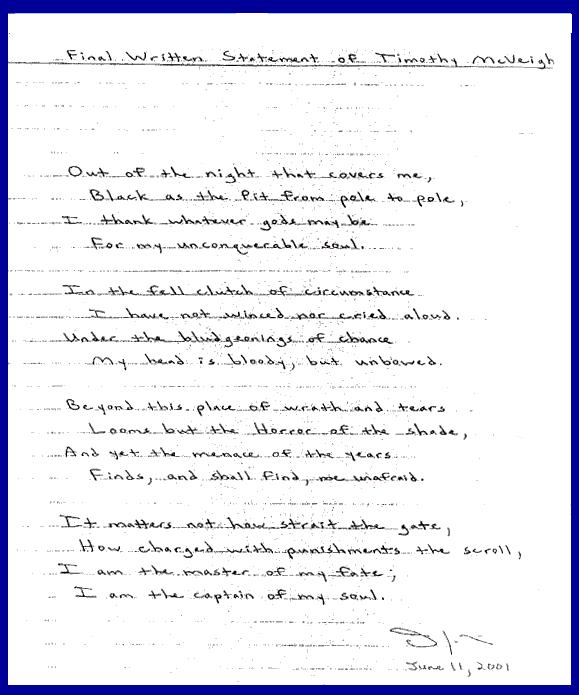
He broadcast clinical detachment in the execution itself — the first conducted by the federal government since 1963, technically imposed for the eight federal employees among his 168 victims — from his waiver of appeals to his unnervingly unblinking death mask to the stoic 19th century poem “Invictus” that formed his written (and only) final statement.
* Also — coincidentally or not — the execution date of Richard Snell in Arkansas, a militia man (and white supremacist, which McVeigh was not) who had once tried to blow up the Murrah building himself.


 So who is Robert Hubert?


 On June 8, 2001 — a day the 11-time arrestee was due in court for assaulting a bellhop — Mamoru Takuma (
 Though his avowed motive, the