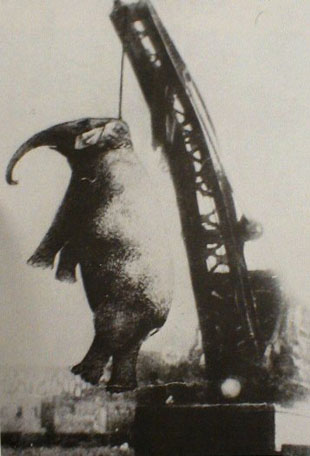
On this date in 1916 — true story — this happened.
Five-ton circus elephant Mary (yes, she has her own Wikipedia page) was in Kingsport, Tennessee on the chintzy fairgrounds touring circuit with Sparks World Famous Circus.
Billed as as “The Largest Living Land Animal on Earth,”* this exotic creature was a prime draw for the circus — and also a beloved pet of the Sparks family.
Unfortunately, this valuable asset was placed in the temporary stewardship of an inexperienced “under keeper” whom the circus had had to scoop up at a recent stop to cover staff turnover. Between shows on September 12, that fellow somehow (accounts conflict) enraged Mary, and (again according to one version among several) she
“collided its trunk vice-like [sic] about [the under keeper’s] body, lifted him 10 feet in the air, then dashed him with fury to the ground … and with the full force of her biestly [sic] fury is said to have sunk her giant tusks entirely through his body. The animal then trampled the dying form of Eldridge as if seeking a murderous triumph, then with a sudden … swing of her massive foot hurled his body into the crowd.”
It’s apparent in this report that the facts of an already-sensational event almost instantly began disappearing into its spectacle. See the largest land animal on earth! See it maul its handler to death! But what happened next lifted Mary all the way to legend.
The owners knew they had to euthanize the “mankiller,” or if they didn’t know they were soon persuaded by mushrooming press attention and towns threatening to ban the Sparks circus.
But how? They couldn’t shoot Mary to death — she apparently survived gunshots from the vengeful crowd in the immediate aftermath of the trampling; firearms just didn’t pack the wallop to put down a pachyderm in 1916. The area didn’t have the sort of electrical juice available that Thomas Edison had once used to drop a circus elephant during his weird campaign for the electric chair.
The choice for the baleful logistical task of killing a 10,000-pound evildoer was hanging, selected over “crushing it between railroad cars.”
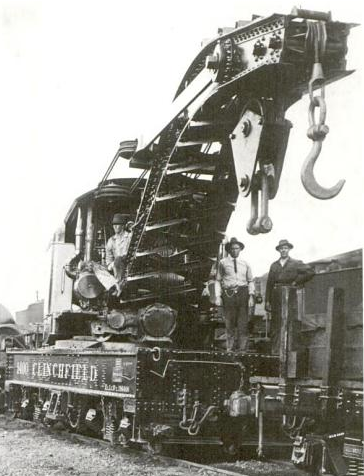
And for stringing up “Murderous Mary”, you need no ordinary gallows. No, for this job, you’re using the hoist on a train derrick and an industrial-strength chain for a noose.
The actual train derrick that hanged Mary the elephant. The leftmost man, seated on the machine, is the “executioner” who worked the controls, according toThe Day They Hung the Elephant.
The railroad was game for the operation, provided the circus would come to it. So on this date, the circus train cars loaded up for the nearest usable train derrickscaffold at Erwin, Tennessee.
There, a procession of all five Sparks elephants — the routine was supposed to keep Mary compliant, and it did the trick even though some observers later remembered the condemned creature behaving unusually skittishly — marched to the railyard.
There Mary was noosed with a 7/8″ chain and hoisted up. The chain broke, and the animal shattered its hip crashing to the ground; another, still larger, chain, did the trick on the second try.
There’s something about this event abidingly piteous, even shameful. It may be for that reason that it’s also abidingly mysterious. The particulars about what happened on the day they hanged the elephant and what became of the body (a steamshovel dug a grave, but the exact location was never marked and there’s a wild story that it was dug up later for ivory) are the topics of conflicting, nth-hand rumors. Some in Erwin don’t to this day want to discuss the matter. Others, just the opposite.
Image (c) John Pugh of SourceToSea.net and used with permission.
* Sparks evidently kept the “largest living land animal” marquee in use for Mary’s successor, as indicated by this 1919 poster (pdf) for the show.
On this date in 1851, three men were publicly hanged from a scaffold at Fourth and O Street in Sacramento, California: John Thompson* and James Gibson legally, and William Robinson under color of lynch law.
According to Ken Gonzales-Day’s Lynching in the West: 1850-1935, all three had been condemned to death under the brand-new state‘s brand-new Criminal Practices Act, making theft a capital offense.
They had assaulted and robbed a guy on the streets of Sacramento a few weeks previous, and the local vigilance committee had already made plain its impatience with the matter: upon the granting of a legal motion to stay the trial three days in order to allow the defense to actually prepare, an orderly posse had firmly forced the court back into session to proceed with the speediest of trials. Any outcome other than death could scarcely have come to pass.
Nonetheless, California governor John McDougall made bold to stay one of the hangings, that of William Robinson.**
The San Francisco-based Alta California — which had previously (August 1, 1851) editorialized in strong support of the forced trial: “If our courts would in all cases act, the people would have no occasion for assuming the responsibility of ferretting out criminals, and awarding them their proper punishment” — narrated (September 1, 1851) a, er, popular veto of that gubernatorial mercy.
The Executions in Sacramento City
The Sacramento papers of Saturday are filled with accounts of the exciting scenes that have transpired in that city within a few days past.
We condense from the Sacramento Union, a decription [sic] of the occurrences of Friday last.
THE SCENES OF YESTERDAY. — By daylight yesterdat morning, teams, horsemen and pedestrians, were seen pouring into the city from every direction, and at an early hour the city was crowded with miners and strangers from the country, who had come in to witness the execution of the three culprits, Thompson, Gibson and Robinson.
Soon after nine o’clock, a rumor ran through the city, that a respite of Robinson’s sentence had been received from the Governor, and that the day of his execution was to be postponed until the 19th day of September. …
As the hour for the execution drew nigh, the crowd around the Station House became immense, and there was evidently a fixed determination in the minds of the populace that the prisoner, Robinson, should suffer the same penalty as the other two culprits, and that, too, in spite of the Governor’s proclamation …
The Sheriff, after reading the reprieve, ordered the two prisoners, Gibson and Thompson, to be taken to the place of execution, and likewise commanded the “Guards” to convey the prisoner, Robinson, to the Prison brig. The former two were then placed in a wagon, with their arms securely pinioned, and driven rapidly off, in company with the officers, to the scaffold.
The “Guards” then brought out Robinson, and attempted to convey him to the prison brig, but were compelled, on the corner of 2d street, to deliver their prisoner to the people, who placed him in a cart, and thus, surrounded by the “Guards,” were escorted to a grove near the place where the scaffold was erected.
A committee was appointed who were to take charge of the execution of Robinson after the legal authorities had performed their duty.
While these proceedings were going on at the grove, the final peparations for the execution of the unfortunate men, Gibson and Thompson, were progressing. …
The prisoners bore themselves with the greatest fortitude throughout the whole of this tragical scene, and not the slightest agitation was perceptible. At the moment the cord was cut, a cry was heard — “Now for Robinson.” The shout went up from the dense throng, “Hang the scoundrel!” — “Bring him here!” — “Let him hang too!”
The scene which followed was the most terrific we ever witnessed. The thronging crowds rushed for the station house in the greatest excitement, and on all sides was heard the thrilling cry, “Hang the rascal!” In the mean time the Sheriff, having performed his duty efficiently and faithfully, retired from the scene, as did also the officers with whom he was connected.
The muffled drum of the Guards announced that the culprit Robinson was approaching. The crowd gave way, the Committee with their prisoner slowly and solemnly ascended the scaffold, and the Guards formed a hollow square around it below.
Robinson appeared perfectly cool and collected, and on being requested to address the crowd, came forward, and in a clear voice made another confession. He evidently appeared desirous of creating a sensation, and accordingly commenced by alleging the grossest and most unfounded charges against men who stand high in this community … we do not feel ourselves justified on such evidence as this, in proclaiming to the world that officers who have heretofore been deemed perfectly upright and honourable, are no better than felons.
…
After the events of Friday, a portion of the excited populace assembled during the evening, and hung John McDougal in effigy. This proceeding, perhaps, was more the result of a hasty and excited spirit on the part of the few, than the calm reflection of the public mind, although the Union apologizes for the act by observing that persons engaged in it did not desire to cast obloquy on the office, but to exhibit their contempt for its incumbent.
* Thompson’s real name was evidently McDermott. The Espy file of historical American executions calls him “Thornton,” though it’s not clear whether this was yet another alias or simply an erroneous entry in the database.
** According to a different article in the same September 1, 1851 Alta California, the governor’s grounds for clemency were “the conviction of about thirty men … that Robinson was quite guiltless of the offence with which he stood charged. That false testimony had been trumped up to convict him, that he was not a hardened man, had fought the battles of his country, and finally, (as stated in a letter from a clergyman) he was quite a promising youth, of pious education, and possessing a ‘good understanding of the Christian doctrines.'”
On this date last year, the Taliban carried out the public stoning of an adulterous couple who had attempted to elope in northern Afghanistan.
“Even family members were involved,” the New York Times reported, “both in the stoning and in tricking the couple into returning after they had fled.”
as a Taliban mullah prepared to read the judgment of a religious court, the lovers, a 25-year-old man named Khayyam and a 19-year-old woman named Siddiqa, defiantly confessed in public to their relationship. “They said, ‘We love each other no matter what happens,'” [local farmer Nadir] Khan said.
The executions were the latest in a series of cases where the Taliban have imposed their harsh version of Shariah law for social crimes, reminiscent of their behavior during their decade of ruling the country. In recent years, Taliban officials have sought to play down their bloody punishments of the past, as they concentrated on building up popular support.
“We see it as a sign of a new confidence on the part of the Taliban in the application of their rules, like they did in the ’90s,” said Nader Nadery, a senior commissioner on the Afghanistan Independent Human Rights Commission. “We do see it as a trend. They’re showing more strength in recent months, not just in attacks, but including their own way of implementing laws, arbitrary and extrajudicial killings.”
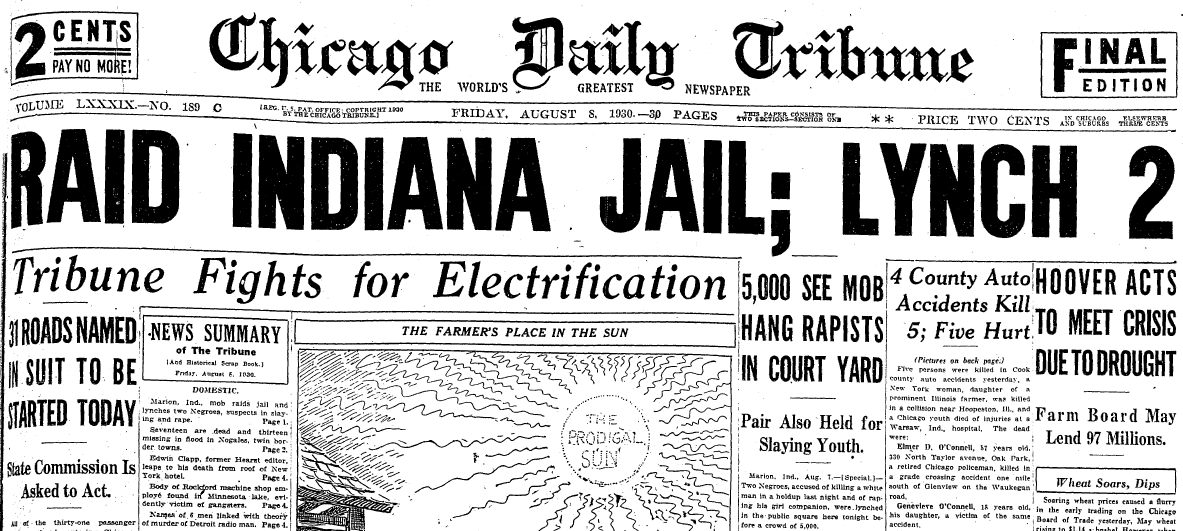
On this date in 1930, two black youths were lynched in Marion, Indiana for murdering a white man and raping his girlfriend.
(The rape allegation — although it, and not the homicide, seems to have been the thing that triggered the lynching — was subsequently withdrawn, and there were even rumors that the white girlfriend was a lover and confederate of one of the lynched men. It’s just one strand in the very human tapestry around the “last classic lynching north of the Mason-Dixon line” explored by Cynthia Carr in Our Town: A Heartland Lynching, a Haunted Town, and the Hidden History of White America.)
Shipp, who is said to have confessed killing the white man, Claude Deeter, 23, of Fairmount, Ind., was hanged from an elm tree in the courthouse yard. Smith, whom the girl identified as her assailant, was thrown from a third floor window of the jail with a noose around his neck and strangled.
…
Reports of the crimes and confessions, published in Marion newspapers this afternoon, stirred this quiet community of 23,000 to intense excitement. There was no hint of the impending violence, however, until 8:30 p.m., when a motorcade of Deeter’s fellow townsmen arrived from Fairmount.
The Fairmount delegation, numbering about 100, gathered in the public square, openly displaying their guns and shouting for a lynching … The sheriff led his deputies to the front door, argued a moment with the leaders of the mob and then ordered the tear bombs thrown. Blinded, the lynchers fell back for a few minutes, but returned and began the sledge hammer siege which forced the jail doors within ten minutes. No shots were fired on either side.
Following the lynching the mob gathered in the square for an hour, some proposing to drive the 2,000 members of the Negro colony from the city and burn their dwellings. Peace officers from Indianapolis, Kokomo, Fort Wayne, and other towns were arriving however, and gradually the mob broke up.
The corpses hung in the square for hours, attracting throngs of gawkers — including a photographer able to snap this picture:
Teacher/poet Abel Meeropol ran across this photo of the Shipp-Smith lynching a few years later in a magazine, and it so “haunted” him — his word — that he penned the anti-lynching poem “Strange Fruit”. You know it from Billie Holiday‘s arresting vocal rendition.
Southern trees bear strange fruit
Blood on the leaves
Blood at the root
Black bodies swinging in the southern breeze
Strange fruit hanging from the poplar trees
Pastoral scene of the gallant south
The bulging eyes and the twisted mouth
The scent of magnolia sweet and fresh
Then the sudden smell of burning flesh
Here is a fruit for the crows to pluck
for the rain to gather
for the wind to suck
for the sun to rot
for the tree to drop
Here is a strange and bitter crop
Abel Meeropol was no passing sentimentalist himself, but a prolific left-wing activist. During the McCarthy years, he adopted the children of the Rosenbergs when the latter were electrocuted as Soviet spies. As faithfully as those two orphaned boys have carried the torch for their lost birth parents, they also still carry an adoptive surname: Michael Meeropol and Robert Meeropol.
A third person was almost lynched in the same Marion, Ind., incident, but 16-year-old James Cameron (sometimes called “Herbert” or “Robert” in the 1930 news reports) managed to convince the mob that he wasn’t involved. Just how he managed this feat and what he’d really been up to is another strand of Carr’s tapestry: many of the Marion blacks as well as whites she interviewed overtly mistrusted Cameron.
At any rate, the crowd let him off with a beating, and Cameron served time as an accessory to the crime.
After release, he became an anti-lynching activist in Indiana and, later, Wisconsin — where he founded a (since-shuttered) Black Holocaust Museum. He started several NAACP chapters.
In the more immediate aftermath, it was far from a given that this date’s effusion of summary justice wouldn’t cascade into a generalized racial pogrom.
As the Tribune article notes, the lynch mob mulled attacking the black community, ultimately dissuaded by the gradual arrival of lawmen. By the next day, the Indiana national guard had occupied Marion. The Tribune on Aug. 10 reported the town “peaceful to all outward appearances but acutely aware of an undercurrent of racial antagonism that it feared might flame into open warfare at any moment.”
Lest this seem a bit over-the-top, recall that all this went down just a few years since a lynch mob in Tulsa had metastasized into one of America’s most notorious race riots. The prospect of wholesale bloodletting was very real.
When the local attorney general and grand jury waved away the small matter of punishing mob leaders, several of whom were publicly known by name, Indianapolis attorney general (and Marion native) James M. Ogden drove up to town and personally filed indictments, to the fury of white residents.
“It was astonishing to see and feel the mob atmosphere that still prevailed nearly seven months after the murder,” wrote a correspondent for The Nation. Ogden’s deputies were “looked upon as enemies of the community, not only by the mob, but also by most of the court officials.” After all-white juries acquitted the first two people tried, the state dropped its remaining indictments.
The maelstrom of race and politics and history that emerged from that first fatal transaction — a brutal but banal Lover’s Lane heist — grew so far beyond the original cast of criminal and victim that they practically became secondary to the story.
On August 8, 1930, a wire story datelined Fairmount, Ind., ran in the Indianapolis Star (but not the Marion papers):
Deep regret that the negro slayers of their son Claude, were lynched in Marion last night by a mob, was expressed today by Mr. and Mrs. William Deeter, members of the Apostolic faith, a sect similar to the Quakers.
“God should have been the judge,” said the elderly Deeter. “They had no right to do it,” his wife assented.
Both are opposed to capital punishment and did not want to see the negroes put to death for their crime.
On August 6, 1942, in the Warsaw Ghetto, Polish/Jewish hero Janusz Korczak marched with his orphans to the death trains and into legend.
The man, his activities in the ghetto, and above all his famed final walk to the Umschlagplatz, are mentioned in many books and memoirs about the ghetto.
Korczak’s real name was Henryk Goldschmidt. He took the name Janusz Korczak (pronounced “ya-nish kor-chok”) for his writing and it wound up taking over his entire life, a la Mark Twain.
Born in an observant Jewish household in Warsaw (which was then Russian Territory) in either 1878 or 1879,* he became man of the house after his father suffered a nervous breakdown in 1889 and eventually had to be hospitalized.
By thirteen, bored by school, he was writing poetry and learning foreign languages by himself. He went to medical school and served as a military doctor with the Russian Army in the Sino-Japanese War of 1905-1906. Eventually he was promoted to the rank of major.
Korczak’s true calling wasn’t in medicine, however, but in writing and in working with children. He found himself drawn to neglected and abused youngsters, and believed in treating every child with honesty and respect.
While he was in China with the military, his first book, Child of the Drawing Room, became famous in Poland. He didn’t realize he was a celebrity until he returned home.
He tried to distance himself from his writing and his fame and be an ordinary pediatrician, but people wanted to see him, to the extent that they would pretend their children were sick in order to entice him to their homes.
Korczak wrote later that one woman claimed her sons had the flu and, when he made a house call, insisted on serving him tea.
“Have you been writing anything lately?” she asked.
“Prescriptions,” he replied, and left, realizing he’d been had.
In 1910, he gave up his medical practice to start an orphanage for Jewish children age seven to fourteen. His institution was very different from most of that time and place, for Korczak had very democratic ideas: the children wrote their own newspaper and had their own parliament and court system.
If one child had a falling-out with another, the urchin could “sue” and bring a case to be decided before the orphanage court, which met once a week. (Even teachers and other staff members could be sued.) The orphanage court also held trials for children accused of violating one of the home’s rules.
Children were rewarded for good behavior, and spanked only as a last resort. Every child had a private, lockable drawer to hold their most precious belongings. Korczak carefully monitored the children’s health and also acted as a sort of informal therapist, encouraging them — most of them orphans from backgrounds of desperate poverty and abuse — to talk about their feelings. The children called him Pan (“Mister”) Doctor.
When World War I broke out, Korczak left the orphanage to serve in the Army again. He left it in good hands, however, in the care of teachers and staff he had trained himself.
“All the world is submerged in blood and fire, in tears and mourning,” he wrote sadly of his war experiences.
It was while in the trenches on the Eastern Front that he began writing a book on child development, titled For The Love of a Child. In 1918, the war finally ended, Poland became a free and independent nation, and Korczak returned to his orphans in Warsaw.
He stayed busy, setting up a second orphanage in 1919, and afterwards writing King Matt the First. The novel, a children’s story about a young boy who becomes king and puts the country’s children in charge, became a bestseller throughout the country in the wake of the calamity lately unleashed by the grown-ups. The sequel, King Matt on the Desert Island, was also a commercial success.
Korczak continued to work for his children, however; he consulted at Warsaw’s juvenile court, and in 1928 founded third orphanage, called Our Home, which had attached dormitories for teachers-in-training and was intended for Catholic children.
In 1925, Korczak wrote another book called When I Am Little Again, told from the point of view of a middle-aged teacher and meant to be read by both children and adults.
He started a children’s newspaper, the Little Review, in 1926. Saying he wanted to “defend children” in his new paper, he invited children from all over Poland to write and tell him the stories of their lives. The newspaper lasted until 1939.
He also hosted a hugely popular radio show, using the name “Old Doctor.” The program was terminated in 1937, however, after only a couple of years; Korczak’s employers with the radio station were reluctant to keep a Jew on the air. When his identity became known, the right-wing press castigated him, saying that as Jew he could never be a real Pole and shouldn’t be allowed to educate Polish children.
Like any public figure, Korczak had his critics. Anti-Semites called Our Home “a new nest of Masonry and potential Communism erected in the heart of the capital.” Communists said his institutions weren’t Communist enough; Zionists criticized him for not directing the children towards a life in Palestine; religious Jews said there wasn’t enough religion in the orphanages while assimilationist Jews said there was too much.
Yet Korczak’s methods worked.
In a follow-up study he conducted of all the former residents 21 years after the first of his institutions was opened, he found that only a few had turned to crime or prostitution as adults. The same could not be said for children who graduated from other children’s homes in Poland.
During the 1930s, many of Korczak’s friends encouraged him to move to Palestine to escape the growing problems in Poland. He actually visited a kibbutz there, but he couldn’t make up his mind whether or to go; he had trouble leaning Hebrew and wasn’t sure a man of his age could start a whole new life.
“I don’t have forty years to spend in the desert,” he wrote to a friend.
Germany’s invasion of Poland in 1939 settled the question for him; leaving the country was no longer an option. Korczak volunteered for the Army again, but was turned down due to his age.
As the Nazis tightened their strangehold around Poland and Poland’s Jews, Korczak did the best he could to shied his orphans from the chaos, suffering and bigotry around them.
He turned his pen to appeals for funds for the children. As a protest against the occupation, he walked around the city openly in his old Polish Army uniform as well as the required Star of David armband.
The uniform proved surprisingly useful: he told a friend that when he went door to door asking for money for the children, “Some people are generous, but not everyone. If they’re difficult, I just undo my coat and reveal my Polish uniform. They get so nervous about having someone in uniform in their place that they give me something just to make me leave.”
The Warsaw Ghetto opened in 1940, and the orphanage was outside its boundaries, so they had to move. (Later, the Germans reduced the size of the ghetto, and Korczak’s orphanage had to relocate again.)
The Warsaw Ghetto was a kind of hell for Jews; allotted rations of only 800 calories a day — if they could get that — people died in droves of starvation and related diseases, including typhus and tuberculosis, as well as deliberate murder by the Nazis and their collaborators.
As recorded in Betty Lifton’s biography, a gentile friend, Igor Newerly, offered to help Korczak escape this fate:
“Everyone’s worried about your going into the ghetto with the children,” Newerly told him. “Just say the word and we’ll get you false identity papers to live on our side.”
“And the children?”
“We’ll try to hide as many as we can in monasteries and private homes.”
Korczak put down his cigarette, took off his glasses in their cheap round metal frames, and began wiping them with his handkerchief as he always did when he was stalling for time.
Finally, he asked: “Do you realize how difficult it would be to hide one hundred and seventy Jewish children — that’s that’s how many we have now.”
“We’d try,” Newerlv repeated.
“But can you guarantee me that every child will be safe?”
Newerly shook his head sadly: “I’m afraid that’s impossible. We can’t guarantee anything” — he
paused — “even for ourselves.”
Korczak thanked his friend, but turned him down. He would take his chances in the ghetto. His decision was sensible for the time — the “Final Solution” had not been conceived of, and no one knew what the eventual fate of the ghetto residents would be.
Lifton records:
On the day they were scheduled to depart, November 29, the children lined up in the courtyard as rehearsed, while Korczak made a final inspection of the wagons filled with the coal and potatoes that he had so arduously procured on his daily rounds. The children waved goodbye sadly to the Polish janitor, Piotr Zalewski, who was staying behind to care for the house. His face was swollen almost beyond recognition from the beating he had received the day before when he and the laundress had applied to the Nazi police for permission to go into the ghetto with the orphans. The Germans had thrown the laundress out, but detained Zalewski for questioning. Didn’t he know that Aryans were no longer allowed to work for Jews? When the janitor replied that after twenty years of service he considered the orphanage his home, the Germans thrashed him with whips and rifle butts.
[…]
The orphans tried to sing as they marched out of the courtyard and into the street, clutching their few possessions. The green flag of King Matt, with a Jewish star on one side, flew over the little parade as it made its way through the teeming streets the short distance to 33 Chlodna Street. When they reached the place where the wall cut along Chlodna, slicing its “Aryan” half off from the ghetto, they found German and Polish police at the gate demanding identification, as if they were crossing a foreign border.
Within the ghetto, Korczak continued his activities for children’s welfare.
He tirelessly solicited aid for the orphanage to keep the children clothed and fed. He and others held benefit concerts and poetry readings, and put posters all around the ghetto saying “OUR CHILDREN MUST LIVE” and “A CHILD IS THE HOLIEST OF BEINGS.”
He took the job as director of a hopelessly underfunded shelter that housed a thousand children; in spite of his efforts, the mortality rate there was sixty percent.
Everywhere children were dying of starvation and disease on the streets or in filthy, overcrowded hovels; Korczak lobbied for the creation of a sort of hospice where they could at least breathe their last in clean, quiet surroundings.
For himself he functioned mostly on pure willpower. It was hard for him to eat when he knew the children were hungry. Five shots of pure alcohol a day, mixed with water, provided precious calories.
Yet his health was failing. His friends noticed how emaciated he had become: “ill, wasted and stooped.” He had a persistent cough and a doctor who examined him diagnosed him with pulmonary edema. Nightmares interrupted his sleep. “How hard it is to live,” he wrote, “how easy to die!”
Yet he carried on.
In the summer of 1942, it became increasingly apparent that the ghetto would be liquidated. Igor Newerly approached Korczak again and offered to help save whoever he could.
Korczak declined his offer again, but gave him his diary for safekeeping — a sign that Korczak, too, knew the end was coming. He had decided to throw his lot in with the children.
In July, the Nazis announced that there were “too many Jews” and they were sending away the children, the old, the sick and anyone else who could not work. Orphans, of course, would be at the top of the list. Resettlement meant death, and many of the ghetto residents knew it, although a substantial number clung to the hope that they would be placed in work camps and find someway of surviving a little longer.
Adam Czerniaków, the Warsaw Ghetto Chairman and Korczak’s personal friend, took his own life rather than supervise the deportations.
For the next few weeks, people were marched or dragged to the death trains, packed inside and driven off to the Treblinka Extermination Camp for gassing.
Many people tried to hide, for the most part unsuccessfully, to escape being deported. Some of the ghetto residents were so hungry that they volunteered to go, because the Nazis promised bread and marmalade to anyone who reported of their own accord.
Korczak’s orphanage’s turn came on August 6. He and the staff had made up their minds earlier: all of them would go together. And they would go quietly, in an orderly fashion, so as not to frighten the children.
Their walk to the death trains, witnessed by thousands, has passed into Holocaust legend.
Lipton records:
The Germans had taken a roll call: one hundred and ninety-two children and ten adults. Korczak was at the head of this little army, the tattered remnants of the generations of moral soldiers he had raised in his children’s republic. He held five-year-old Romcia in one arm, and perhaps Szymonek Jakubowicz…
Stefa followed a little way back with the nine- to twelve year-olds. There were Giena, with sad, dark eyes like her mother’s; Eva Mandelblatt, whose brother had been in the orphanage before her. Halinka Pinchonson, who chose to go with Korczak rather than stay behind with her mother. There were Jakub, who wrote the poem about Moses; Leon with his polished box; Mietek with his dead brother’s prayer book; and Abus, who had stayed too long on the toilet.
There were Zygmus, Sami, Hanka, and Aronek, who had signed the petition to play in the church garden; Hella, who was always restless; big Hanna, who had asthma; and little Hanna with her pale, tubercular smile; Mendelek, who had the bad dream; and the agitated boy who had not wanted to leave his dying mother. There were Abrasha, who had played Amal, with his violin; Jerzyk, the fakir. Chaimek, the doctor; Adek, the lord mayor. , and the rest of the cast of The Post Office, all following their own Pan Doctor on their way to meet the Messiah King. One of the older boys carried the green flag of King Matt, the blue Star of David set against a field of white on one side. The older children took turns carrying the flag during the course of their two-mile walk…
The young protagonist of Jerry Spinelli’s novel Milkweed described it this way:
The orphans were going by. They were marching. Their heads were high and they were singing the song I had learned. I sang along with them. Not one was dressed in rags. Everyone wore shoes. Doctor Korczak lead the way…
“The very stones of the street,” wrote Yehoshue Perle, another chronicler, “wept at the sight of the procession.”
As the group waited for the trains to leave, Korczak’s many friends were seeking out anyone with influence, desperately trying to get them out of Umschlagplatz and back to the orphanage to die another day.
It was said that a German officer, who had been a fan Korczak’s King Matt books as a child, offered him the chance to leave — without the children. Korczak refused.
His presence kept the children calm; if he left them they might panic. He knew what was coming, and he knew he could not force the children to face death alone. The fact that he was in such poor health and probably would not have survived the war in any case does not make his sacrifice any less.
Eventually the orphans and the staff boarded the train and were hauled away. There were no survivors. His name is listed on a memorial stone at the site where Treblinka once stood — the only such stone with a name on it.
Korczak’s legacy is not just in books; his name and image have been used in a lot of memorabilia over the years, and have appeared on stamps in Poland, Israel and Germany. In 1991, Polish filmmaker Andrzej Wajda made a film about Korczak and his last march. There are four statues of him in Warsaw, and a school for street children in Thailand is named after him.
From Andrzej Wajda’s Korczak.
* His year of birth is uncertain; Korczak himself may not have known it.
Jensen’s counterattack [during the Battle of Chochiwon in the opening days of the Korean War] in the afternoon [of July 10] uncovered the first known North Korean mass atrocity perpetrated on captured American soldiers. The bodies of six Americans, jeep drivers and mortar-men of the Heavy Mortar Company, were found with hands tied in back and shot through the back of the head. Infiltrating enemy soldiers had captured them in the morning when they were on their way to the mortar position with a resupply of ammunition. An American officer farther back witnessed the capture. One of the jeep drivers managed to escape when the others surrendered. (Source, specifically)
Sometime in July 1943, a lucky accident saved the lives of thirteen-year-old Halina Birenbaum and a group of other girls and women, all of them inmates at the Majdanek Concentration Camp outside of Lublin, Poland.
Halina’s mother was sent to the gas chambers immediately upon their arrival at Majdanek. The daughter was spared to work and endure the torture that was daily life in the camp. “We were tormented day after day by roll calls, starvation, slave labor, beatings and vermin,” she recalled later in her memoir, Hope Is the Last to Die. “Lice devoured us at night.”
After two months of this, Halina was selected and sent along with her sister-in-law, Hela, and other female inmates to an empty hut in the men’s camp. The women had no idea what the Nazis wanted them for; there was nothing to do but wait.
When it was dark outside, the Storm Troopers locked the hut and switched off the light. I nestled up to Hela, and we both fell asleep on the floor, dreaming of a better camp, easier work, tolerable living conditions…
In the middle of the night, the SS noisily threw open the hut door, arousing us with their shouts and beatings; they began herding us out, making sure that no one hid or escaped. A fearful confusion ensued.
Sleepy, frightened to death, we crowded to the door, pushing and trampling one another in the darkness and panic. The Storm Troopers ran around like mad dogs. They made us form fours, lit electric lamps and counted us, swearing.
“They are taking us to the crematorium!” The terrible news fell on us like a thunderbolt and spread like lightning through the ranks.
My heart beat rapidly. I could not believe it. Once again I could not believe that death was possible, as months earlier, on the WarsawUmshlag, when the Nazis set up a machine-gun in front of us … And I did not yield to the general panic and despair.
The SS gave an order and we moved off … in the direction of the crematorium. Some women were weeping, others tearing their hair, praying, or bidding farewell to mothers or sisters.
They herded us into a hut, the interior of which resembled a bathhouse. Despite the darkness, we observed stacks of empty gas containers on the ground in front of the hut. There was a strange sweetish odor in the air. There was no doubt now that they were taking us to execution. The women went out of their minds … They groaned, wailed, had convulsions.
They herded us into the bathhouse, and barred the door behind us. Now we had to carry out an order given previously: undress and hang out clothes up on hooks on the wall. Obediently we undressed in silence. We knew there was no way out. We hung out clothes up, then sat down on benches along the walls, waiting in extreme agitation … When and how would death come?
Time passed. Hour followed hour. But nothing happened. No one came. It was silent both inside and outside the bathhouse. Perhaps they had forgotten us? A faint hope slowly began emerging … Toward morning they came back; after the nightmare of waiting for death in the gas chamber, we went outside. They counted us again (as though anyone could have escaped from that locked building!), and took us back to the men’s camp, to the same hut as the day before. There we learned from the prisoners that the supplies of gas has unexpectedly run out during the night … We had been spared on account of this accident.
Later that day, Halina and her fellow inmates were put on a truck and taken to Auschwitz.
Several times more she escaped death by the skin of her teeth. She would survive the war, move to Israel, and become a writer, poet and translator.
On this date in 1934, in the coda to Hitler’s Night of the Long Knives purge of the Nazi party, the emerging dictator had his longtime ally shot.
Bavarian World War I veteran Ernst Röhm (Roehm) had been a National Socialist brawler of the earliest vintage: after the armistice, he was among the Freikorps paramilitaries to topple the short-lived Munich Soviet. He joined the NSDAP’s predecessor, the German Workers’ Party, before Hitler himself, and he stood trial with the future Fuhrer after helping Hitler attempt the Beer Hall Putsch. They were so tight, Hitler politely ignored Röhm’s open homosexuality.
But most importantly, Röhm was the energetic organizer of the Sturmabteilung, or SA — the party’s private army ready at arms for street battles with Communists, roughing up Jews, Praetorian Guard duty for party brass, and various and sundry other unpleasantries.
An SA brownshirt tosses a book on the pyre at a May 10, 1933 book burning.
Röhm grew the SA like a weed. At well over 4 million men by the time of Hitler’s Chancellorship, it greatly outnumbered the army itself.
This gave Röhm personal designs on absorbing the army into his paramilitary instead of the other way around, and it gave Röhm the literal boots on the ground to manifest his own commitment to the “Socialist” bits of the “National Socialist” project. His noises about the “second revolution” to come after the Nazis had already obtained state power were most unwelcome.
“One often hears voices in the bourgeois camp to the effect that the SA have lost any reason for existence, but I will tell these gentlemen that the old bureaucratic spirit must yet be changed in a gentle or, if need be, an ungentle manner.”
Well, those gentlemen weren’t about to wait around to be changed in an ungentle manner. Hitler was induced to sacrifice the man who raised him to power in favor of those who could keep him there, personally arrested his old friend and aide-de-camp as the June 30 purge got underway.
A sucker for nostalgia, Hitler didn’t have Röhm killed outright — the fate of many others in those terrible hours — but instead shipped him to Stadelheim Prison in Munich.* After due consideration, though, the treacherous chancellor did what he was always going to do.
Hitler ordered a revolver to be left in his cell, but Röhm refused to use it: “If I am to be killed, let Adolf do it himself.” According to an eyewitness at the 1957 Munich trial of those involved, he was shot by two S.S. officers who emptied their revolvers into him at point blank range. “Röhm wanted to say something but the S.S. officer told him to shut up. Then Röhm stood at attention — he was stripped to the waist — with his face full of contempt.”
A nice twist of the Long Knife by its wielders: they justified the purge on the grounds of an imminent coup attempt by the dead SA boss,** branding the murders of Röhm and his comrades … the Röhm-putsch.
In the dark hours this date in 1934, a bargain with the devil was sealed in blood.
Months before, even mere hours before, it was still possible for longstanding adherents of the National Socialist Workers’ Party to demand the “Socialist” part of the program.
The SA and the SS will not tolerate the German revolution going to sleep and being betrayed at the half-way stage by non-combatants. … It is in fact high time the national revolution stopped and became the National Socialist one. Whether [the bourgeoisie] like it or not, we will continue our struggle — if they understand at last what it is about — with them; if they are unwilling — without them; and if necessary — against them.
Populist, not Bolshevik. (In fact, stridently anti-communist.) Nevertheless, a distinct menace by the have-nots against the haves.*
Especially so because they were the words not of some impotent scribbler but of Ernst Roehm, commander of the the Nazis’ paramilitary brownshirts. And threatening, too, for Adolf Hitler for this same reason: his ascension the previous year to the Chancellorship had entailed terms with a German elite who needed but mistrusted the man’s mass party. Something was going to have to give.
The Communist exile Leon Trotsky’s 1933 analysis of the infant Nazi Germany’s dynamics proved prescient.
The banner of National Socialism was raised by upstarts from the lower and middle commanding ranks of the old army. Decorated with medals for distinguished service, commissioned and noncommissioned officers could not believe that their heroism and sufferings for the Fatherland had not only come to naught, but also gave them no special claims to gratitude. Hence their hatred of the revolution and the proletariat. At the same time, they did not want to reconcile themselves to being sent by the bankers, industrialists, and ministers back to the modest posts of bookkeepers, engineers, postal clerks, and schoolteachers. Hence their “socialism.”
…
German fascism, like Italian fascism, raised itself to power on the backs of the petty bourgeoisie, which it turned into a battering ram against the organizations of the working class and the institutions of democracy. But fascism in power is least of all the rule of the petty bourgeoisie. On the contrary, it is the most ruthless dictatorship of monopoly capital. … The “socialist” revolution pictured by the petty-bourgeois masses as a necessary supplement to the national revolution is officially liquidated and condemned.
The Night of the Long Knives this date took those blades to the “socialists”, to the men like Roehm whose dreams of redistribution were reckless enough to picture his working-class militia supplanting the German army proper.
As its price of power, the Nazi leadership purged these dangerous elements.
At 2 a.m. this date, Hitler flew to Munich to personally arrest Roehm on the pretext of averting an imminent coup by Roehm’s SA.** Elsewhere in the Reich, coordinated arrests and summary executions destroyed the Nazi party’s “left”, and throughout this date, and continuing into the next, did not scruple to sweep up whatever other conservative elements Hitler considered unreliable.
It was a dangerous but ultimately decisive move. Albert Speer saw Hitler on July 1, and remembered him ebullient at the triumph.
Hitler was extremely excited and, as I believe to this day, inwardly convinced that he had come through a great danger. … Evidently he believed that his personal action had averted a disaster at the last minute: “I alone was able to solve this problem. No one else!”
The final death toll is uncertain. Hitler copped to 77 in a speech to the Reichstag two weeks later which chillingly claimed that “in this hour I was responsible for the fate of the German people, and thereby I became the supreme judge”; it is likely that the true number is much higher. But its effect went far beyond those immediately killed: it tamed the SA’s independence, and permanently subordinated it to the military; and, it brought Adolf Hitler the dictatorial power that would make the succeeding years so fruitful for this blog.
Roehm himself died on July 2, initially spared for his many good offices for the Nazi cause before Hitler realized he could not leave him alive.
The armed forces, apparently the day’s big winner, would pay a price of their own for the arrangement.
“In making common cause with” the murderous purge, observed William Shirer in The Rise and Fall of the Third Reich, “the generals were putting themselves in a position in which they could never oppose future acts of Nazi terrorism.” As the quid for the quo, soldiers were soon required to swear “unconditional obedience” to Adolf Hitler, and this oath would give countless Wehrmacht officers sufficient reason or excuse to eschew resistance to their leader until much too late.
Barely a month after the Night of the Long Knives, the ancient German President Hindenburg died in office. Hitler, who now commanded the clear allegiance of his nation’s elites and had savagely mastered his own party besides, succeeded the powers of Hindenburg’s vacant office along with those of his own Chancellorship and became the German Fuehrer.
* When the Nazis were knee high to the Weimar Republic, their party program sought such radical stuff as abolition of rentier income, generous old-age pensions, and nationalizing trusts.
** The historicity of any actual coup plot is generally dismissed, although the event is still known in German by the expedient sobriquet the Nazi leadership gave it, Roehm-putsch.
On this date in 1381, a mob’s summary execution on Tower Hill of some nobby English lords marked the acme of that country’s most noteworthy peasant revolt.
The trigger for the revolt was an onerous poll tax levied to finance the realm’s escapades in the Hundred Years’ War, but as Barbara Tuchman notes,
the fundamental grievance was the bonds of villeinage and the lack of legal and political rights. Villeins could not plead in court against their lord, no one spoke for them in Parliament, they were bound by duties of servitude which they had no way to break except by forcibly obtaining a change of the rules. That was the object of the insurrection, and of the march on the capital that began from Canterbury.
Late medieval England was in the throes of economic, and therefore social transformation.
Manorial lords’ traditional power over their peasants had become untenable for a labor pool depleted by the Black Death, survivors of which found themselves consequently in-demand and suddenly blessed with leverage. As one chronicler recorded,
There was so marked a shortage of labourers and workmen of every kind in that period that more than a third of the land in the whole realm was left idle. All the labourers, skilled or unskilled, were so carried away by the spirit of revolt that neither King, nor law, nor justice, could restrain them. … The entire population, or the greater part of it, has become even more depraved… more ready to indulge in evil and sinfulness.
Rentiers put a forceful kibosh on “sinfulness” like rising wages and labor mobility, legislating backwards feudal rights and pre-plague wage levels.
Who Then Was The Gentleman?
It was a ground fertile for insurrectionary sentiment, like the class-warfare sermon of subversive Lollard preacher John Ball:
When Adam delved and Eve span, Who was then the gentleman? From the beginning all men by nature were created alike, and our bondage or servitude came in by the unjust oppression of naughty men. For if God would have had any bondmen from the beginning, he would have appointed who should be bond, and who free. And therefore I exhort you to consider that now the time is come, appointed to us by God, in which ye may (if ye will) cast off the yoke of bondage, and recover liberty.
This cry for justice anticipated the Levellers by almost three centuries.
Poll Position
But these 14th century downtrodden had some rough levelling of their own in mind, and when the poll tax set spark to tinder, the conflagration spread with terrifying rapidity.
[T]here were some that desired nothing but riches and the utter destruction of the noblemen and to have London robbed and pilled; that was the principal matter of their beginning, the which they well shewed; for as soon as the Tower gate opened and that the king was issued out with his two brethren and the earl of Salisbury, the earl of Warwick, the earl of Oxford, sir Robert of Namur, the lord of Vertaing, the lord Gommegnies and divers other, then Wat Tyler, Jack Straw and John Ball and more than four hundred entered into the Tower and brake up chamber after chamber …
These guys were after, above all, John of Gaunt,* the Dick Cheney of 14th century England right down to the malevolent name and underwhelming military achievements: the throne at this time held the posterior of 14-year-old (in 1381) Richard II, and the widely reviled uncle John ran (and freely looted) the realm with a council of loathsome optimates.
London Calling
Luckily for John, he happened to be off at the Scottish frontier when the Peasants’ Revolt rolled into London; the mob settled for destroying his opulent Savoy Palace on June 13.
The next day, it rampaged through the Tower of London
… and at last found the archbishop of Canterbury, called Simon, a valiant man and a wise, and chief chancellor of England, and a little before he had said mass before the king. These gluttons took him and strake off his head, and also they beheaded the lord of Saint John’s and a friar minor, master in medicine, pertaining to the duke of Lancaster, they slew him in despite of his master, and a sergeant at arms called John Leg; and these four heads were set on four long spears and they made them to be borne before them through the streets of London and at last set them a-high on London bridge, as though they had been traitors to the king and to the realm.
Simon’s severed, and incredibly well-preserved, skull has been resident in a cubby at St. Gregory’s Church of Sudbury for lo these six hundred years. It made news recently when it was retrieved for a CT scan to (among other things) reconstruct Simon’s real-life appearance.
Right, these executed-today guys.
Simon of Sudbury, Archbishop of Canterbury and Lord Chancellor of England, and Robert Hailes, Lord High Treasurer, neatly concentrated in their persons the political, financial, and religious power exercised by “the unjust oppression of naughty men.”
Still better, they were the advisors most directly connected to the poll tax. As a reward, they got their polls axed.
This was no mere provincial riot. A lower-class revolt had massed an overwhelming force in the very capital of the kingdom, with most of the main government ministers trapped therein — holed up and inconclusively debating one another about how to get out of this jam. And the movement aimed itself at the conquest of power: Tuchman (citing Benedictine chronicler Thomas Walsingham) says that rebel leader Wat Tyler was anticipated that “in four days’ time all the laws of England would be issuing from his mouth.”
In the end, the last thing between history and King Wat — and, if you’re willing to dream an anachronistic dream, a Commune of London — was the peasantry’s foolhardy reverence for the person of the pimply king.
Foreshadowing a later era’s “if only the tsar knew” naivete, the rebels who thirsted for the blood of Richard’s advisors fancied the king their champion. Young and handsome; regal; charismatic; and plausibly not implicated in the villeins’ grievances … you can understand why they thought that. But disarmed thereby of the ruthlessness necessary to strike him, Wat Tyler’s band instead went the way of the typical peasant rising.
Richard the Lionheart
The king’s own nerves were steel in this moment, when a lesser adolescent would have quailed from the perilous task of safeguarding the divinely ordained oligarchy with his own person. Richard was, at this point, still in his minority: other men took the country’s decisions in their own hands. Richard would one day have to fight them for his own kingly rights; but, on the evidence of this crisis, he had already grown up, and fast.
Perhaps reasoning that royalty is the best shroud, Richard invited the rebels out to Smithfield the very next day, June 15. When the royal teenager was in personal parley with Tyler, the king’s buddy William Walworth got into a scrape with the peasant and
gave him a deep cut on the neck, and then a great cut on the head. And during this scuffle one of the King’s household drew his sword, and ran Watt two or three times through the body, mortally wounding him. And he spurred his horse, crying to the commons to avenge him, and the horse carried him some four score paces, and then he fell to the ground half dead. …
when the commons saw that their chieftain, Watt Tyler, was dead in such a manner, they fell to the ground there among the wheat, like beaten men, imploring the King for mercy for their misdeeds.
(This source says that Tyler was retrieved from hospital for a summary execution of his own that same day. Others, such as Froissart, indicate that he died straightway from the wounds he suffered in the fray.)
Brazenly wielding the dread sovereign power over the minds of his subjects, Richard braved death by riding unprotected towards their lines, styling himself their “captain,” commanding their obedience. Peasant archers and pikemen who on that day might have turned English history on its head instead lowered their weapons and submitted themselves.
Though the ensuing bloodbath was a bit less wholesale than the one attending France’s recent Jacquerie, it went rough for the leaders, and concessions the king had made the rank and file vanished along with the danger to his crown. “Villeins ye are,” he would later tell a delegation of petitioners imploring him to effect his pledge to abolish serfdom, “and villeins ye shall remain.”
* John of Gaunt also kind of got the last laugh out of those tumultuous years: though John brokered compromises between the king and his rival nobles, John’s son was one of those rival nobles. After dad’s death, that young man overthrew Richard and established the Lancastrian dynasty as King Henry IV.



 The man, his activities in the ghetto, and above all his famed final walk to the Umschlagplatz, are mentioned in many books and memoirs about the ghetto.

 Halina’s mother was sent to the gas chambers immediately upon their arrival at Majdanek. The daughter was spared to work and endure the torture that was daily life in the camp. “We were tormented day after day by roll calls, starvation, slave labor, beatings and vermin,” she recalled later in her memoir,
  Bavarian World War I veteran