1941: Mirjam Sara P., T4 victim

(Thanks to Meaghan Good of the Charley Project for the guest post. -ed.)

On or about this day in 1941, a twenty-two-year-old woman known only as Mirjam Sara P. was executed/murdered by means unknown, probably gassing.

The notice of her death was postmarked “Cholm Insane Asylum.” However, as psychiatrist Robert Jay Lifton notes in his book The Nazi Doctors: Medical Killing and the Psychology of Genocide, there was no such place: “As far as can be determined, the Cholm Insane Asylum was a fiction.”

Yes, Mirjam was Jewish. This certainly could not have helped her case, but she was actually killed as part of another genocide: the T4 program, the Nazi policy of involuntary euthanasia on people suffering from deformities, incurable illness, mental illness or anything else that made them into “useless eaters.”

Begun in 1939 with the killing of five-month-old Gerhard Kretschmar, who’d been born blind and missing two or three limbs, the T4 program would end the lives of over 200,000 people, about two-thirds of them after the program officially ended in 1941.

T4 had six death institutions, called “state nursing homes,” which were equipped with gas chambers. The operation was supposed to be a secret, but it was too big to be concealed and before long the German people thought they had a pretty good idea what was happening to their disabled loved ones.

Open criticism of a fascist government is not advisable if you like your life, so the families were limited to publishing heavy hints in their relatives’ newspaper obituaries.

Perhaps the saddest part of Mirjam’s story is that she should have survived. Of course, none of the T4 victims should have been killed, but Mirjam had excellent odds of surviving the Nazi era … until a particularly boneheaded decision by Child Welfare Services and the immigration authorities in Palestine in October 1936.

What’s Palestine got to do with it, you ask? Mirjam P.’s story is told in Tom Lampert’s documentary history, One Life, and it begins in 1933:

This Adolf Hitler guy made Mirjam’s mother uneasy, and she decided to get her family to safety as soon as possible. Mirjam, fifteen years old, long considered a “difficult child,” had been staying in a juvenile reformatory school and sanitorium for the past eighteen months when her mother called her home. She had been sent there after she stole money from her mother and ran away from home.

Mirjam, her mother and her stepfather emigrated to the city of Tel Aviv in Palestine in September 1933, nine months after Hitler was sworn in as chancellor of Germany.

Palestine didn’t agree with Mirjam; she hated the weather and had trouble learning Hebrew and Arabic. A year after her arrival, she went to live with her father in Haifa. She left after only a couple of days, however, returned to Tel Aviv and embarked on a spree of petty crimes. Her mother asked for help from Child and Welfare Services, who had two doctors examine Mirjam.

The first doctor pronounced that Mirjam had

… an advanced case of severe psychopathy with pronounced ethical defects. She lies, incurs debts, and has stolen repeatedly from her mother and her friends. She has run away from home multiple times … She roams the streets and is in danger of becoming morally depraved as a result of her strong sexual drives. In order to avoid further violations of the law, she must be admitted to a mental institution as quickly as possible. Since such an institution does not exist here, it is absolutely essential that she be sent back to Germany immediately.

The second doctor agreed:

P. is a psychopath with severe ethical defects and insufficiently developed powers of judgement. She tends to thievery and vagabonding, incurs debts, and has already developed the traits of a swindler … In order to avoid the threat of moral depravity, it is urgent that she be admitted to a remedial educational home … I know that no such institution exists in Palestine or in the neighboring countries. Therefore, it is absolutely necessary that the patient be sent back to Europe without delay …

Child Welfare Services provided a private tutor for Mirjam, then sent her to a group home for girls, but she didn’t fit in there and was sent back to her mother. Very quickly she fell back into her old habits. She was arrested and put on probation, but she just got arrested again. In a remarkably stupid move by the authorities, she was expelled from the country and sent back to Germany in October 1936. Perhaps Palestine thought they’d given her enough chances.

Back to Germany.

The same country she had fled from to escape Hitler. The same country where by now, under Hitler’s regime, Jews had been banned from public high schools, universities, the civil service, the army and the medical field, where Jews had been deprived of their citizenship and the rights that went with it, where Jewish-owned businesses were boycotted, where things showed every sign of becoming worse and did.

To Germany Mirjam had been sent, to prevent “serious damage to … herself, to her family, and to society as a whole.” She was eighteen years old.

Mirjam spent a few weeks with her grandmother in Berlin, but she left because she was afraid (justifiably so) that the Nazis would put her in an “education camp.”

For the next several weeks she traveled around Europe, going to Luxembourg, Belgium, the Netherlands and Switzerland. She tried to find a job but she lacked the necessary papers. In March 1937, she was arrested in Zurich for borrowing money under false pretenses and not repaying it. After twelve days in jail, the Swiss dropped her off at the German border.

Back at square one, Mirjam got into trouble again for petty crimes and served eight months in prison. Then she confessed to having sex with a German boyfriend, in violation of the Law for the Protection of German Blood and Honor. Mirjam’s boyfriend was prosecuted and claimed he hadn’t known she was Jewish; Mirjam stated she had told him shortly after she met him. He was acquitted in December 1937.

After her release from jail, Mirjam was admitted to the Heckscher Psychiatric Hospital and Research Institute in Munich. She had her intelligence tested and performed poorly. Nurses at the hospital stated Mirjam was a demanding patient, she was lazy, she left her room a mess, she would not take responsibility for her mistakes, and she didn’t have realistic expectations for the future.

After three weeks there, the hospital sent a report to the Jewish welfare office in Munich, which indicated she hadn’t changed much since she was evaluated in Palestine:

In our judgment, P. is a mediocre but normally endowed, weak-willed, unrestrained, and asocial psychopath. Predominant are her physical urges, her limited powers of judgment and insight, and above all her lack of ethical and moral inhibitions. She is incapable of leading a responsible and purposeful life … External compulsion might gradually teach her the value of regular, long-term work and an orderly, honest life.

The evaluator suggested Mirjam be sent to the work unit of the State Mental Institution and Nursing Home.

A 21st-century reading of these evaluations suggests Mirjam was suffering first from Conduct Disorder and then its adult equivalent, Antisocial Personality Disorder. Conduct Disorder is noted “by a pattern of repetitive behavior wherein the rights of others or social norms are violated. Symptoms include verbal and physical aggression, cruel behavior toward people and pets, destructive behavior, lying, truancy, vandalism, and stealing.”

Antisocial Personality Disorder is diagnosed only in adults and is defined as “a pervasive pattern of disregard for, and violation of, the rights of others that begins in childhood or early adolescence and continues into adulthood.”

Both disorders are marked by impulsivity, recurring trouble with the law, persistent stealing and lying, and lack of empathy for other people, all traits Mirjam had. These conditions, while serious, would not by themselves merit inpatient psychiatric treatment today — although, in these days of managed care, almost nothing does.

In April 1938, Mirjam escaped from the psychiatric hospital and quickly found herself in jail — petty theft again. Writing from jail during her pretrial detention in May, she asked to be expelled from Germany so she could go live with her father in Palestine, because “as a Jew it is impossible for me to amount to anything here.”

Instead she was sentenced to fourteen months in prison. After her release, in mid-June 1939, the court committed her to the Philippshospital in Goddelau. It was her next-to-last stop on the road

On February 1, 1941, the Charitable Ambulance Service (a tool of T4) picked up 29 Jewish patients from Philippshospital. On February 4, 67 Jews, including the 29 Philippshospital patients, were registered in the logbook at the T4 death institution Hadamar.

Their names were not recorded, but chances are Mirjam was among the group. At Hadamar,

Up to 100 victims arrived in post buses every day. They were falsely told to disrobe for a medical examination. Sent before a physician, instead of examining them he assigned one of a list of 60 fatal diseases to every victim, then marked them with different-colored band-aids for one of three categories: Kill; kill and remove brain for research; kill and break out gold teeth.

Ten thousand people would die there before the end of the war, through gassing, starvation and deliberate drug overdoses.

The district attorney’s office inquired as to her whereabouts and received a death notice from Cholm Insane Asylum: “We wish to inform you that the patient Mirjam Sara P. died here on May 27, 1941. Heil Hitler!”

In fact, she was probably killed earlier than this; the death dates of T4 patients were often pushed forward so the institutions could continue to charge fees for their care.

On this day..

1911: Laura and Lawrence Nelson lynched

A century ago today* Laura Nelson and her son Lawrence were lynched outside Okemah, Oklahoma.

“Two weeks ago,” mused the May 26, 1911 Tulsa World “Deputy Sheriff George H. Loney went to the Nelson home in search of some stolen meat. He found it and started to make an arrest when he was shot and killed. Both the Nelson woman and her son at first claimed to have fired the fatal shot, but it was later admitted that it was the son who fired it.”

So Laura found her way into the annals of lynched women by that most quintessentially maternal act: attempting to protect her child.

The bodies were posted partway down the road to a nearby all-black township — one little incendiary signpost en route to Oklahoma’s coming racial explosion.

As is typical in lynchings, the perpetrators remained permanently wink-wink “unknown”; indeed, the resulting investigation contributed some outstanding exemplars of racist patronizing — like the investigating judge’s charge to his grand jury of “the duty devolv[ing] upon us of a superior race and of greater intelligence to protect this weaker race from unjustifiable and lawless attacks.”

Thanks?

At least that compared favorably on the sympathy scale to the state’s governor, who slated the NAACP for stoking mob violence when the latter pressed for more vigorous anti-lynching action.

If your organization would interest itself to the extent of seeing that such outrages as this [i.e., the appointment of black federal officials in the state] are not perpetrated against our people, there would be fewer lynchings in the South than at this time, and you can do a great deal more to aid the Negro by seeing that other people of our section of the country are considered in these matters than you can issuing abusive statements against this country when a crime of this kind is committed.

Actually, a tweak here and there and that paragraph could go right into a present-day stump speech. The past, as they say, is not even past.


View Larger Map
The site of the lynching: present-day Route 56 where it crosses the North Canadian River west of Okemah.

One face in the crowd — his exact role in the lynching seems to be unknown — was a local real estate hustler by the name of Charley Guthrie.

This blustery conservative southern Democrat would, the next year, name his third child for the Confederate-friendly academic Woodrow Wilson, who was then making a run for the White House that would see the U.S. to the nadir of its race relations.

Young Woodrow Wilson Guthrie — you know him as Woody — grew up with some different principles from dad; the counterculture folk troubadour was sufficiently haunted by his father’s proximity to this horrific exercise of mob justice to expiate it in song.

* Many web sites give the date as May 23, but the primary sources are unequivocal; the correct date is May 25.

On this day..

1909: Jesus Malverde, narco patron saint

On this date in 1909, a Mexican bandit was executed by the police. Maybe. Unusually for these pages, the date is quite certain but the existence of the executed man is not.

If he existed — and this caveat is standard in practically every profile of the fascinating cultural phenomenon fathered by the man or phantom — Jesus Malverde was a Robin Hood-esque “social bandit” who preyed on Mexico’s plutocratic agricultural lords and distributed the spoils to the poor.

According to Patricia Price (“Bandits and Saints: Jesus Malverde and the Struggle for Place in Sinaloa, Mexico”, Cultural Geographies 2005; 12; 175), the Malverde of legend entered the world as Jesus Juarez Mazo, but his

own parents died of hunger or a curable illness, and that this was the catalyst for his turn to a life of crime. While Malverde was said to have worked variously on the railroads, as a carpenter, or as a tailor, he soon joined the ranks of bandits that roamed Mexico’s countryside at the end of the nineteenth century. He reportedly stole gold coins from the rich hacienda owners living in Culiacan and threw them in the doorways of the poor at night.

Truly a figure who, if he did not exist, it were necessary to invent.

All the particulars about his legendary exploits are a bit fuzzy, right down to his end on May 3, 1909 — possibly gunned down, possibly left to die of exposure with his feet hacked off, or possibly (and certainly more picturesquely) summarily hanged from a mesquite tree by a posse.

(In a version that appealingly combines these threads, he’s said to have been dying of gangrene after being shot, and in a last act of charity prevailed upon his friend to bring in his body to collect the reward. The police gibbeted his corpse.)

In the years since, Malverde has become a popular divine intercessor for the marginal social classes who could identify with such a figure, like Sinaloa’s poor farmers of corn and beans.

And other cash crops.

Malverde is also the patron saint — decidedly unofficial, of course — of the region’s robust narcotics trade.

His shrine stationed across the way from a government compound in Sinaloa’s capital city draws a bustle of devotees.* Offerings like produce and shrimp share space with icons of marijuana and AK-47s, and votive notes appreciating “how things turned out, and how nobody was grabbed.” Breaking Bad gave him a shout-out from the mouths of disdainful DEA agents north of the border.

The underworld angle may draw the gawking Yankees, but Jesus Malverde — man, legend, shrine, all — is a genuine civic institution who meets a genuine need for solace not unlike his very namesake. In the words of a researcher quoted by Price, Malverde draws

the poorest, the handicapped, pickpockets, thugs, prostitutes, drug traffickers and drug addicts, in sum, the stigmatized who, in civil or religious iconography don’t find anyone who looks like them, in whom to confide and in whose hands to put their lives.

We’ll drink to that.

* So does Malverde’s Facebook page.

On this day..

1655: Massacre of Waldensians

On this date in 1655, Catholic forces under the Duke of Savoy carried out a notorious massacre of Waldensians* in the Piedmont.

This interesting, excommunicate sect had persisted for centuries in those hard-to-reach places in Alpine foothills, intermittently ignored and hunted. After Martin Luther, many Protestants inclined to see them as a proto-Reformation movement, or even a counter-papal apostolic succession reaching back to ancient Christianity.

At any rate, they sure weren’t Catholic.

And our friend the Duke decided — perhaps piqued by the murder of a missionary Catholic priest, or for whatever other reason — to mount one of those heresy-extirpating sorties and make them Catholic in 1655.

On April 17, the Marquis of Pianezza appeared with an overwhelming force of mixed Piedmontese, French, and Irish** troops. They conducted a few skirmishes, then made nice with the Waldensian civic leaders and induced them to quartering their troops temporarily further to some expedient pretext.

Alas! alas! these poor people were undone. They had received under their roof the executioners of themselves and their families. The first two days, the 22d and 23d of April, passed in peace, the soldiers sitting at the same table, sleeping under the same roof, and conversing freely with their destined victims …

At last the blow fell like a thunderbolt. At four of the clock on the morning of the 24th April the signal was given from the Castle of La Torre. But who shall describe the scenes that followed? On the instant a thousand assassins began the work of death …

Little children were torn from the arms of their mothers, and dashed against the rocks; or, more horrible still, they were held betwixt two soldiers, who, unmoved by their piteous cries and the sight of their quivering limbs, tore them up into two halves. Their bodies were then thrown on the highways and the fields. Sick persons and old people, men and women, were burned alive in their own houses; some were hacked in pieces; some were bound up in the form of a ball, and precipitated over the rocks or rolled down the mountains … Some were slowly dismembered, and fire applied to the wounds to staunch the bleeding and prolong their sufferings; some were flayed alive; some roasted alive; others were disembowelled; some were horribly and shamefully mutilated, and of others the flesh and brains were boiled and actually eaten by these cannibals.

Source, whose atrocity accounts channel those in this French tome

Without doubting the capacity of man’s inhumanity to man, the cannibalism charge reminds that we’re dealing with propaganda alongside historiography. And what great propaganda — like, babies-torn-from-incubators great.

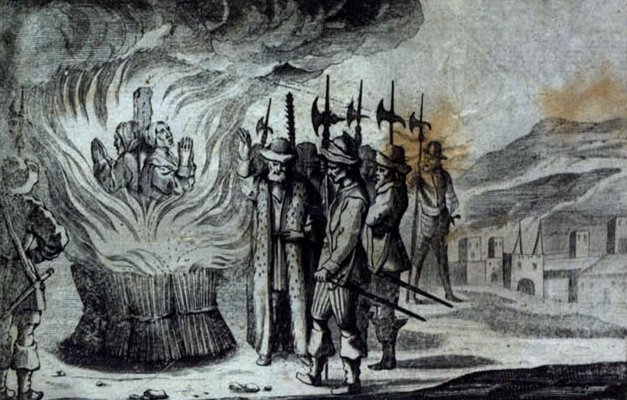
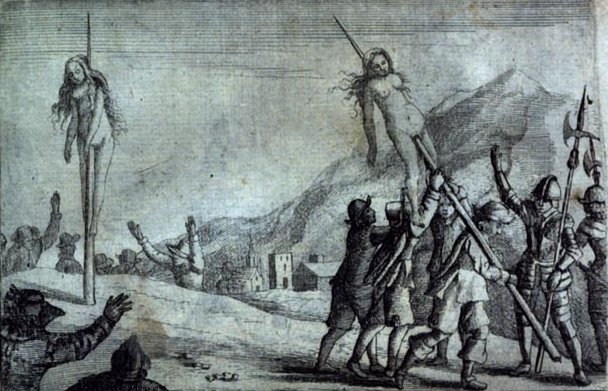
Thumbnails (click for a larger, disturbing view) of selected images of this date’s atrocities from Samuel Morland’s The History of the Evangelical Churches of the Valleys of Piedmont

And there’s little doubt as to the overall savagery of the affair, which could well have become the opening salvo in a full-scale sectarian cleansing campaign. (A later addendum to Foxe’s Book of Martyrs narrates the ensuing Piedmontese armed struggle, petering out before any definitive resolution in the field.)

Outrage at this hecatomb spread in Protestant Europe — which would also refer to the day’s doings as the “Bloody Easter,” since it corresponded with the eve of that celebration as reckoned by the Julian Calendar (source).

It was felt especially in Protectorate England, which intervened diplomatically.

A “day of solemn fasting and humiliation” was promulgated in Albion, along with collections for the relief of the survivors. Oliver Cromwell personally put £2,000 into the kitty.

More importantly, he dispatched diplomat Samuel Morland† to force the House of Savoy to lay off the persecution; in fact, he threatened to disrupt high statecraft between England and France unless the French twisted arms on behalf of the Waldensians.

Written correspondence for Morland’s diplomatic tour addressed to Louis XIV of France and various other continental potentates, as well as a fiery bit of oratory that Morland delivered to Savoy, all seem to have originated from the pen of Republican scribbler John Milton — the future author of Paradise Lost.‡

Milton, for whom the whole thing was more than just a day job, was further moved to put his umbrage at the slaughter into sonnet form:

Avenge O Lord thy slaughter’d Saints, whose bones
Lie scatter’d on the Alpine mountains cold,
Ev’n them who kept thy truth so pure of old
When all our Fathers worship’t Stocks and Stones,

Forget not: in thy book record their groanes
Who were thy Sheep and in their antient Fold
Slayn by the bloody Piemontese that roll’d
Mother with Infant down the Rocks. Their moans

The Vales redoubl’d to the Hills, and they
To Heav’n. Their martyr’d blood and ashes sow
O’re all th’ Italian fields where still doth sway

The triple Tyrant: that from these may grow
A hunder’d-fold, who having learnt thy way
Early may fly the Babylonian wo.

* The Waldensians in question here are interchangeably known as the Vaudois for their geographic region, actually above the Piedmont and abutting the Swiss region also known as Vaud. (These pages have visited the latter.)

** Fresh from being on the receiving end of another infamous massacre.

† Morland is more regarded for his post-Restoration labors as an inventor; he created an early calculator and internal combustion engine.

‡ The speech in particular is not definitively attributed; see Robert Fallon, “Milton in Government: Denmark and Savoy,” Milton Quarterly, May 1989.

On this day..

Unspecified year: Snowball’s animal fifth column

“Four days” after an unspecified “early spring” date in George Orwell’s classic allegory of Soviet communism, Animal Farm, a show trial and mass execution of animals purporting to work for the book’s Trotsky figure signals the titular farm’s unmistakable collapse into dystopia.

In the book, a revolution of animals displaces the farm’s human owner, Jones — the hated ruler of the ancien regime.

The farm’s early cooperative elan soon shatters, with a pig bearing the unsubtle name of Napoleon becoming the revolution’s autocrat, and fostering a paranoid security climate against phantasmal plots by his fellow swine and onetime comrade, the exiled Snowball.

Let’s watch.

Napoleon ordered all the animals to assemble in the yard. When they were all gathered together, Napoleon emerged from the farmhouse, wearing both his medals (for he had recently awarded himself “Animal Hero, First Class”, and “Animal Hero, Second Class”), with his nine huge dogs frisking round him and uttering growls that sent shivers down all the animals’ spines. They all cowered silently in their places, seeming to know in advance that some terrible thing was about to happen.

Napoleon stood sternly surveying his audience; then he uttered a high-pitched whimper. Immediately the dogs bounded forward, seized four of the pigs by the ear and dragged them, squealing with pain and terror, to Napoleon’s feet.0 …

The four pigs waited, trembling, with guilt written on every line of their countenances. Napoleon now called upon them to confess their crimes. … Without any further prompting they confessed that they had been secretly in touch with Snowball ever since his expulsion, that they had collaborated with him in destroying the windmill, and that they had entered into an agreement with him to hand over Animal Farm to Mr. Frederick. They added that Snowball had privately admitted to them that he had been Jones’s secret agent for years past. When they had finished their confession, the dogs promptly tore their throats out, and in a terrible voice Napoleon demanded whether any other animal had anything to confess.

The three hens who had been the ringleaders in the attempted rebellion over the eggs now came forward and stated that Snowball had appeared to them in a dream and incited them to disobey Napoleon’s orders. They, too, were slaughtered. Then a goose came forward and confessed to having secreted six ears of corn during the last year’s harvest and eaten them in the night. Then a sheep confessed to having urinated in the drinking pool — urged to do this, so she said, by Snowball — and two other sheep confessed to having murdered an old ram, an especially devoted follower of Napoleon, by chasing him round and round a bonfire when he was suffering from a cough. They were all slain on the spot. And so the tale of confessions and executions went on, until there was a pile of corpses lying before Napoleon’s feet and the air was heavy with the smell of blood, which had been unknown there since the expulsion of Jones.

When it was all over, the remaining animals, except for the pigs and dogs, crept away in a body. They were shaken and miserable. They did not know which was more shocking — the treachery of the animals who had leagued themselves with Snowball, or the cruel retribution they had just witnessed. In the old days there had often been scenes of bloodshed equally terrible, but it seemed to all of them that it was far worse now that it was happening among themselves. Since Jones had left the farm, until today, no animal had killed another animal.

Animal Farm was published in 1945. In this 1954 British animated feature, the downer of an ending — with the corrupt pig rulers becoming literally indistinguishable from people — was dumped in favor of an ending where the animals revolt again.

On this day..

1868: The native prisoners of Emperor Tewodros II

On this date in 1868, on the eve of his rout at the hands of a British expeditionary force, the frustrated Emperor Tewodros II had hundreds of prisoners executed en masse.

Our setting is the 1868 British Expedition to Abyssinia, “one of the most expensive affairs of honour in history.” And it all got started from a bad experience with technical support.

Tewodros — generally known to the Europeans as Theodore — had risen from a humble station to the throne of Abyssinia, but by the 1860s held it but tenuously against various rival warlords. Tewodros lodged appeals for aid with a number of European powers, including the British, who evidently took the emperor’s letter for Queen Victoria and stuck it indefinitely in a file called “Pending”.

After two years without an answer, Tewodros took hostage the British consul Charles Duncan Cameron, a missionary named Henry Stern (whose unflattering report of Tewodros’s mean origins particularly enraged the monarch), and other Europeans.


Illustration of the hostages from Henry Stern’s The Captive Missionary.

And then he took hostage the Ethiopian sent to negotiate their release.

He wasn’t “Pending” any longer.

Gaze not into Abyssinia

Tewodros, perhaps, had depended on the notoriously treacherous Ethiopian highlands to protect him from any effective reprisal. But when the Brits decided in 1867 to let men with guns resolve the dispute, they spared no expense at all.

Months of planning and millions of pounds were poured into the operation, which landed 13,000 soldiers and 40,000 animals organized by the Bombay Army.

“For a total cost of about £9,000,000,” writes Harold Marcus in a biography of another former Tewodros hostage, the future Emperor Menelik II, “Napier set out to defeat a man who could muster only a few thousand troops and had long ago ceased to be Ethiopia’s leader in anything but title.”

The forces converged on Tewodros’s last stronghold, Magdala, with the mercurial king refusing repeated demands of the invader to release his European captives.

Angrily refusing, at least according to the accounts of the hostages who were the subject of all this … and whose accounts have just enough consciousness of the privilege their own skin has given them as they witness these bloodlettings.

On April 8, the king put to death seven of the native prisoners in his train. These prisoners comprised generally people on the political outs with Tewodros, adherents of once-rebellious chiefs and the families of those adherents. It was no mean thing to slaughter a few of them arbitrarily.

But much worse was to come the following day, when the hunted emperor espied the British advance guard reconnoitering his position.

According to a report by European hostage W.F. Prideaux in the May 21, 1868 London Times, the Emperor

had seen the British troops descending the Bashilo, and had remarked among them four elephants and some white animals, which we surmised to be Berbera sheep. A short time afterwards a friend of ours (for we had a few friends at Magdala) … implored us to keep within our tents, for the King was in a fearful passion, and was then issuing an order to kill all his native prisoners, who were confined in a few houses a couple of hundred yards off. The repeated discharge of firearms, which we heard soon afterwards, confirmed the sad story, and it was with many misgivings that we asked ourselves, “What next?” At dusk, however, the King returned, and we returned to our tents comparatively at our ease. From what I have heard it appears that the King rushed down mad with rage and arackee, and calling out one of the prisoners hacked him to pieces with his own sword. Another speedily met the same fate. The third was a boy about ten years of age. His youth and innocence (for it was his father who had been the offender) were no protection. He was mangled in the same way as the two others. The cutting and slashing went on in this manner for some time, when the King, finding this mode of execution too slow for his impatient spirit, ordered out the musketeers. The remainder were then quickly shot down, and thrown over the low cliff, the force of the shock in several cases opening the chains of the wretched victims. Those whose quivering limbs showed any signs of life were fired on from above till the murderous work was completed.

The account of the Rev. Stern:

[W]e were suddenly startled by the sound of an intermittent musketry. … The rattle of musketry blended with the yells of despair, and the shouts of rage fell, however, with an ominous and appalling horror on our ears. “What is the matter?” I inquired of my neighbour. “Hist,” was the response, “the king is killing all the prisoners.” These terrible words diffused an aguish chill through my very heart. … The sun had already disappeared from the horizon, and twilight spread a dismal, dusky hue over the scene around, and still the firing continued unabated. With night it gradually diminished, and then only isolated shots reverberated across the panic-stricken camp.

The slaughter lasted about three hours, and during that interval three hundred and seven human beings* were, unwarned, and perhaps unprepared, hurled into eternity. Some of the prisoners did not unresistingly yield to their woeful doom. One, Immer Ali, a native of Ferga, near the Tzana Lake, formerly a chief of consideration in his province, in spite of hand and foot chains, with a convulsive grasp dragged his executioner towards the precipice over which he was to be hurled. The hangman, who dreaded the doom which he intended to inflict on his fellow man, shouted for help. On hearing the cry the tyrant, tiger-like, sprang forward and with his gory sword literally hacked the man to pieces.

And to hear Stern tell it, it was by dint of nothing but great fortune — or in his view, divine providence — that saved the British hostages from joining them.

One victim after another lay writhing and quivering in the last pangs at the foot of the dizzy precipice, and still the tyrant’s rage was un-appeased. “Bring the white men, and let their blood flow, mingled with that of my own subjects,” was the order that fell from his lips. Already, we were informed, whole bands of ruffians stood prepared to seize the intended prey, when several chiefs, no friends of the foreign captives, stepped forward, and requested that our execution might be deferred till next day. “Your Majesty,” they respectfully remarked, “the white men do not deserve the easy death of the sword and bullet; no, keep them till to-morrow, and then let the slow torture of a flaming hut put an end to their existence.” “You are right,” was the response.

Since the next day was Good Friday, the Christian Tewodros, “though a perfect fiend and coarse blasphemer, repaired, from a superstitious impulse, at a very early hour to church,” Stern says. The decisive British attack began later that day, and would end with the un-executed hostages liberated, and Tewodros taking his own life rather than fall captive.

Among the spoils of war was the crown of the dead emperor, which in 1925 King George V would personally present to Haile Selassie.

* The provenance of the very precise figure of 307 is not apparent in Stern’s account; presumably, he knew through his friendly contacts (of from relieving the boredom of captivity in recreational head-counting) the overall number of prisoners beforehand.

On this day..

1918: Robert Prager lynched during war hysteria

On this date in 1918, German coalminer Robert Prager was lynched near Collinsville, Ill., for making disloyal utterances against the United States as his adoptive country entered World War I.

Basically the most visible and famed victim of patriotic anti-German bellicosity, Prager ironically is rather difficult to reconstruct as an unambiguous anti-war activist. After his mob execution, a baker would even come forward to say that he had been thrown in the clink when Prager accused him … of badmouthing a patriotic display. Prager himself had tried to enlist in the Navy and been rejected for medical reasons.

“Prager was, in fact, as loyal to the United States as any native-born citizen, and his innocence was attested to by many who knew him,” according to Donald Hickey in the summer 1969 Journal of the Illinois State Historical Society. “Two of the men with whom he boarded attested to Prager’s loyalty. One said that although Prager was a radical socialist, he had said he was ‘all for the United States’ when this country entered the war.”

But he was a socialist, and a German, and seems like the sort whom others might have found personally unpleasant. It is in the midst of a tiresome local dispute with a union leader (the union also rejected him) that Prager came to the unwelcome attention of the rabble: the union leadership accused him of being a spy, which led Prager to post handbills around town denouncing this lot for their scurrilous accusation. This obviously did him more harm than good and as the public conviction that Prager was disloyal took hold, it overran the halfhearted efforts of the town’s putative authorities to keep a semblance of order.

A mob on April 4 captured Prager at his home, paraded him, made him kiss the flag — momentarily rescued and hustled off to jail by police and a mayor who tried to talk the mob out of its design — then shanghaied from his “protective” custody cell and taken to the outskirts of Collinsville for hanging on a tree.

Eleven men stood trial for the affair over three weeks. Once the matter was finally rested with the jury, they were instantly acquitted.

There was wild applauding and cheers from ‘most everyone present. Relatives, friends and acquaintances rushed toward the bar to shake hands with the defendants. …

There was a peculiar coincidence at the trial Saturday. The Jackie Band was in Edwardsville for a patriotic demonstration.

When a shower of rain came up the musicians were sent to the court house where it had been arranged to give a program. At 2:40 o’clock judge Bernreuter ordered a recess after the completion of arguments and before reading the instructions.

Then word was sent that the band might play until court re-convened. The first number of all concerts is the Star Spangled Banner and it was played Saturday.

The strains from the Jackie Band caused tears to flow down the cheeks of Riegel. He was still crying when he returned to the court room.

As the jury came in with its verdict the band was at the head of a procession of draft boys and in passing the court house played “Over There.”

While Prager’s murder stands as the most emblematic event of anti-German intimidation during America’s months in the Great War, it was far from the only one: many others nearly as ugly stopped just this side of homicide. Papers were rife with reports of German immigrants being made to kiss the flag; clapped in jail for suspect utterances; of being menaced by mobs.

Outrageously, Germany made propagandistic use of these events, which the virtuous Entente powers would certainly never do.


Washington Post, April 11, 1918.

A number of federal lawmakers, as well as former presidents William Howard Taft and Theodore Roosevelt, condemned the lynching, mostly in the familiar coded terms with which lynchings were opposed in those days: one would rather let justice take its course. Mob rule is itself disloyal. Etc. (See Hickey)

But the right-thinking potentates of the war party were also finding themselves relieved that a polity which had re-seated the current president on the slogan “he kept us out of war” would so pliably turn towards bellicosity. This charade so mechanically familiar in our time was still an arcane and uncertain art in America’s imperial adolescence.

“The recent lynching of a German in Illinois and violent outbreaks of the same character in other parts of the country,” intoned the Washington Post, “have awakened the Department of Justice to the need of a law which will enable government officers to prosecute pro-Germans rather than leave them to be dealt with by mob law.”

Oh. Danke very much.

An unsigned editorialist in the paper’s April 12 edition opined so nauseatingly brutal and specious that in another age it would have earned its author an immediate contract with Fox News:

Stamping Out Treason

The question whether or not the laxity of the laws against treasonable utterances has been responsible for the people’s acts in taking the law into their own hands has been much debated of late.

While sedition may have been encouraged to some extent because of the comparatively mild risks involved, it is quite probable that the pro-German intrigues would have been carried on if the risk had been greater. This suggests the thought that other reasons must be looked for to account for the general revulsion of public sentiment against the treason spreaders and the prompt punishment meted out to them in so many instances.

A plausible explanation is found in the fact that the open and ingenuous American mind had been fed up on German lies to the point where it broke out in fierce revolt. At the beginning of the war, and even after the entrance of America into it, there remained debatable points in many minds. Though of a minor nature and scarcely affecting the larger issue, these points were emphasized by enemy agencies which had been at work from the beginning. But as the truth has been laid bare the indignation of the people has grown stronger. The fact that the rounding-up process has been most vigorously conducted in the middle West tells its own story in this respect. It was that section which was slowest to wake up. There the enemy propaganda apparently worked with most success. So it is there that the people have arisen unitedly in their righteous wrath against the treason talkers.

The comparative absence of outbreaks of this character in the East is explainable on the same theory. In the East the public mind toward the war was much earlier divested of errors. Consequently the enemy agents were more wary in their utterances, not because of any greater stringency of the law, but because of their appreciation of the temper of the people.

In spite of excesses such as lynchings, it is a healthful and wholesome awakening in the interior part of the country. Enemy propaganda must be stopped, even if a few lynchings may occur. The people know what they want. They are not seeking to subvert law and order.

Other powerful institutions were not quite so sanguine as the Post: the lynching was discussed hours after it occurred in the U.S. cabinet, no doubt mindful that it was also being denounced in the German Reichstag. And indeed all concerned marshaled these animal spirits of the populace towards killing men by the thousands under the auspices of the state rather than singly by drunken small-town mobs.

Fears of German reprisals against American prisoners never seem to have materialized; neither is there any other documented lynching in the short course of America’s World War I involvement that was conducted on unambiguously “patriotic” grounds.

* Any number of other papers joined the Post in this campaign, including the St. Louis Post-Dispatch and the Chicago Tribune. A few weeks later, they got their wish — the Sedition Act, under which the Socialist Eugene Debs was arrested for speaking against the war.

On this day..

1942: Not Hersh Smolar, saved by Genesis

(Thanks to Meaghan Good of the Charley Project for the guest post. -ed.)

On this day in 1942, the Nazis issued an ultimatum to the Judenrat of the Minsk Ghetto in Belarus: turn over Hersh Smolar for torture and execution by noon, or they would all face execution themselves.

Smolar, a dedicated Communist who was a writer and editor in civilian life, had been a problem for the Germans for quite some time. He was a leader in the resistance of the Minsk Ghetto, and that resistance was a force to be reckoned with. Smolar and others like him formed an underground organization that printed leaflets about Soviet successes in the war, occasionally hid non-Jewish Communists and escaped Russian prisoners of war within the ghetto (the infectious disease ward of the hospital was a great hiding place: the Germans never went there), and above all tried to save the lives of as many Jews as possible.

The Minsk Ghetto underground formed links with underground resistance organizations on the outside and they worked together. Unlike the rest of Eastern Europe, the general population of Belarus was as a whole sympathetic and helpful to the Jews. The result was that Jews were able to escape the ghetto and join partisan groups in the forest by the thousands, surviving and taking out Nazis at the same time.

The Minsk Ghetto leaked like a sieve. By the time it was liquidated, 10,000 of its residents had joined partisan groups in the forest.

Smolar, of course, had tried to keep his activities a secret from the Nazis, but he couldn’t avoid their attention forever. Unfortunately the Minsk Ghetto Underground wasn’t very good at keeping itself a secret and twice it was decimated by mass arrests.

By the spring of 1942, Smolar was a hunted man, and in hiding. On April 1 he was in the hospital’s infectious disease ward, disguised as a typhus patient, meaning his face could be covered. (Typhus patients suffer extreme sensitivity to light.) The Judenrat paid him a visit and told him about the Nazis’ ultimatum.

Some of the Judenrat members were prepared to turn Smolar in, so only one person would have to die. Of course, the ideal solution would be where no one would die. They turned to the Tanakh for guidance, specifically the story of Joseph. When Joseph’s brothers sold him into slavery in Egypt and told their father he had died, they dipped his coat in the blood of a kid and presented this as proof of his death.

Displaying the sincerest and brassiest form of flattery, one of the Judenrat members took a blank passport, filled it out with Smolar’s photograph and details, smeared it with blood from a recent Nazi victim, and took it to the Gestapo officers. He explained that they had apparently gotten Smolar in a random shooting, as the passport had just been found on a mutilated body at the cemetery.

And the Germans actually fell for this. April Fools!

Barbara Epstein’s excellent book The Minsk Ghetto 1941-1943: Jewish Resistance and Soviet Internationalism records the rest of the story: Smolar remained in hiding in the hospital for another four months. Eventually he left the infectious disease ward and moved to a specially constructed hiding place in the attic chimney, which was only large enough to stand in.

Presumably he was very happy in August 1942, when the time came for him to leave the ghetto and join a partisan group in the forest. He survived the war … as did about 4,500 other Jewish partisans from the Minsk Ghetto.

Smolar wrote a memoir about his experiences and the Minsk Ghetto Underground in general, titled The Minsk Ghetto: Soviet-Jewish Partisans Against the Nazis. He died in Israel in 1993, age 88.

On this day..

1393: John of Nepomuk, Bohemian rhapsody

This is the date in 1393 when the Catholic patron saint of Bohemia, John of Nepomuk (or John Nepomucene) was tossed from Prague’s Charles Bridge into the Vltava River to drown at the order of the Holy Roman Emperor Wenceslaus.

Baroque statue of John Nepomuk on the Charles Bridge from which he was hurled. (cc) image from Jaguar Julie

A relief detail ((cc) image from Charles Hoffman) on this statue depicts the moment of Nepomuk’s martyrdom.

This Wenceslaus — not be confused with the good King Wenceslaus of song — had a tetchy relationship with powers ecclesiastical and temporal.

But although Wenceslaus did martyr a fellow by the handle of John of Pomuk or Nepomuk, the latter makes this blog because of political tension centuries afterward. Despite the date of his corporeal death, John of Nepomuk is really a counter-reformation saint.

Between the late 14th century and Catholic Austria’s bloody 17th century triumph over Czech nationalism the historical Nepomucene parted company pretty definitively.

The real John of Nepomuk was the General Vicar of the local archbishop, John of Jenstein (or Jenzenstein), whose skirmishes with Wenceslaus over the boundaries of royal authority caused historian Albert Wratislaw to draw a Thomas a Becket comparison.*

In the event, the latest manifestation of that disputatious relationship — the king’s attempt to seize some monastic revenues — caused Wenceslaus to completely fly off the handle and arrest several of the archbishop’s advisors, among whom was our sainted martyr.

Wenceslaus personally oversaw their torture and ordered their drowning, but someone talked him out of the execution part. The king at that point had a sort of mini-Guantanamo Bay situation: he had in hand several people whom he had arrested arbitrarily and tortured, whose release would only further embarrass his own royal self. He therefore prevailed upon them to trade their silence for their liberty.

The other arrestees counted their blessings and accepted this expedient exchange. John of Nepomuk, perhaps because he was already tortured near to the point of death, refused. He was consequently “dragged through the streets to the bridge, there his hands were tied behind him, a piece of wood was thrust into his mouth, his feet were tied to his head in the form of a wheel, and he was thrown into the river.”*

The Nepomucene’s legend really grew after his death: in its most splendidly devotional form, as the proto-martyr for the seal of the confessional, which he supposedly kept as the queen’s confessor when Wenceslaus suspected her of infidelity. (An ironic inversion to say the least, since it was actually John’s more timorous co-accused who distinguished themselves with their silence.)

This is a much more edifying martyrdom altogether, so little wonder that the sourcing on John of Pomuk over the succeeding centuries is a hot mess; later scholars would actually speculate as to whether there might not have been two priests of this name who were both martyred by Wenceslaus, so dissimilar were the legends.

Nepomuk’s elevation to legend, and thereafter to the patron saint of Bohemia, would come in part thanks to a great Czech religious reformer who arose at the end of Wenceslaus’s reign — Jan Hus.

This other, heretical John became woven into the emerging Bohemian national sense; he still remains there today. When the Catholic authorities beat back a Protestant and nationalist revolt in 1620 and imposed Catholicism from above,** Saint John of Nepomuk, martyr, was ready at hand for propagandists of the new order. At least, the legendary, confessional-keeping Nepomuk was ready … because this was not a job for the random cleric-bureaucrat who’d been done to death in some forgotten dispute over rent.

For three hundred years two holy men have been rivals for the reverence of the Cech people. One of them, Saint John Nepomuk, was exalted by the Jesuits, who after the battle of the White Hill in 1620 sought to win back the Cechs to the Roman obedience. … His rival for the position of national hero has been Jan Hus, who, during the reign and under the favour of that same king Wenceslas, led the revolt of the Cechs against the ecclesiastical domination of Rome and the secular domination of Germany, and was martyred as a heretic and rebel at the council of Constance in 1415. From that date until the extinction of the independent Bohemian state by the forces of the Empire and the Counter-Reformation in 1620, Hus was publicly honoured by his fellow-countrymen as the champion of national and religious liberty. From 1620 to 1918 his rival was exalted in his place …†

John of Nepomuk today is depicted in statuary on the Charles Bridge (the spot on the bridge where he was thrown over is also marked with a plaque) and is well-represented throughout Catholic central and eastern Europe. Owing to his patronage portfolios of bridges and flood victims, you might also find the Nepomucene in many a topical posting throughout the world — like the very spot of Christianity’s European triumph, Rome’s Milvian Bridge.

(Somewhat less gloriously, the promulgation of this saint’s name and fame mean it also attaches to John Nepomuk Schrank, a Bavarian immigrant to the U.S. who attempted in 1912 to assassinate former president cum presidential candidate yet again Theodore Roosevelt.)

* Wratislaw, “John of Jenstein, Archbishop of Prague, 1378-1397,” Transactions of the Royal Historical Society, Vol. 7 (1878), pp. 30-57. Wratislaw wrote a now-public-domain book about St. John available here.

** Bohemia’s Catholicization is perhaps the classic case in early modern Europe of the Reformation being rolled back from above and from afar. The recent (and none too affordable) book Converting Bohemia: Force and Persuasion in the Catholic Reformation takes a nuanced survey of Bohemia’s transformation from a Protestant to a Catholic bastion … and as the title suggests, finds many of the Catholic components home-grown.

† R.R. Betts, “Jan Hus,” History, Volume 24, Issue 94 (September 1939), pp. 97–112.

On this day..

2006: The family of Abeer Qassim Hamza al-Janabi

On this date in 2006, a family of Iraqis was taken prisoner and shot by a group of American soldiers.

This date’s entry is, to be sure, well into and even across the zone of borderline executions: it was crime whose authors are serving long prison sentences (although they ducked execution themselves).

It has the barest trappings of execution, enough to give that name descriptively to the killings — but maybe a little more than that, too, for this is the story of an occupation army whose “bad eggs” are endowed with the power of life and death over their subject population

“We’ve all killed Hadjis, but I’ve been here twice and I still never fucked one of these bitches.”

This is an excerpt of a London Guardian article called “The blackest hearts: War crimes in Iraq,” which is itself an excerpt from a book its author published titled Black Hearts: One Platoon’s Descent into Madness in Iraq’s Triangle of Death.

Barker had already picked the target. There was a house, not far away, where there was only one male and three females during the day – a husband, wife and two daughters. One was young, but the other was pretty hot, at least for a Hadji chick. Witnesses were a problem, though; they knew they couldn’t leave anyone alive. Barker asked Green if he was willing to take care of that, even if women and kids were involved. “Absolutely,” Green said. “It don’t make any difference to me.”

Green — Steven Green — is the troubled private who would do the shooting, and the one over whose life a jury wrangled over for 10 hours before finally sparing him lethal injection.

Sneaking up on the house, the soldiers corralled the whole family into the bedroom. After they had recovered the family’s AK-47 and Green had confirmed it was locked and loaded, Barker and Cortez left, yanking Abeer behind them. Spielman set up guard in the doorway between the foyer and living room, while Cortez shoved Abeer into the living room, pushed her down, and Barker pinned her outstretched arms down with his knees.

As Green was executing the family, Cortez finished raping Abeer and switched positions with Barker. Green came out of the bedroom and announced to Barker and Cortez, “They’re all dead. I killed them all.” Cortez held Abeer down and Green raped her. Then Cortez pushed a pillow over her face, still pinning her arms with his knees. Green grabbed the AK, pointed the gun at the pillow, and fired one shot, killing Abeer.

The men were becoming extremely frenzied and agitated now. Barker brought a kerosene lamp he had found in the kitchen and dumped the contents on Abeer. Spielman handed a lighter to either Barker or Cortez, who lit the flame. Spielman went to the bedroom and found some blankets to throw on the body to stoke the fire.

The four men ran back the way they had come. When they arrived at the TCP, they were out of breath, manic, animated. They began talking rapid-fire about how great that was, how well done. They all agreed that was awesome, that was cool.

Only after Green was discharged did the crime come fully to light.

At Green’s sentencing in the anomalous confines of Kentucky — he was the first former soldier prosecuted in U.S. civilian court for crimes committed overseas under the Military Extraterritorial Jurisdiction Act — a cousin of Abeer’s murdered parents

spoke last, praising his slain family members and criticising the jury’s reluctance to execute Green. He concluded by turning to Green and saying, “Abeer will follow you and chase you in your nightmares. May God damn you.”

This incident is the subject of the 2007 film Redacted.

On this day..