1982: Suriname’s “December murders”

This was the date in 1982 of the “December murders” (“Decembermoorden”), when 15 opponents of Suriname’s military dictatorship were shot at Fort Zeelandia.

(The 15 people shot each have an entry on the Dutch Wikipedia, accessible through its Decembermoorden entry.)

Though the killings weren’t secret at the time, their circumstances have always been murky, beyond the plain fact of being murders of political dissidents — “counterrevolutionaries,” in the parlance of the “Socialist Republic”.

President Desi Bouterse had seized power in a coup in early 1980, and some of the casualties this day might have been suspected of plotting to pull the same trick on him: at least, several were made to read statements to that effect. Others were regime opponents of a less existential menace: dissident university professors; critical journalists; a prominent former footballer. (When in Paramaribo, take in a match at Andre Kamperveen Stadion, which is named for him.)

Bouterse took political responsibility for the slaughter while claiming not to have ordered it. But it’s long been said that Bouterse was actually present for the shootings, personally interviewing/interrogating/”judging” the prisoners. (That’s what the massacre’s lone survivor, the since-deceased Fred Derby, said. (Dutch link))

Decades later, Bouterse — now an ex-dictator — is finally facing trial for the December murders, including fresh evidence of his involvement in the day’s notorious affair.

On this day..

1876: The samurai leaders of the Hagi and Akizuki rebellions

Unless you’re a Jedi knight, feudal warrior castes and industrial civilization go together like sashimi and fries. So, when the Meiji Restoration made its choice for Japanese modernization, it gained the enmity of the samurai it necessarily dispossessed.

A news nishiki-e woodblock depicting the defeat of the Hagi Rebellion, with the conquering Miura Goro on horseback. (Click for a wider, three-panel image.) From here.

In many cases, said samurai were especially burned at having initially backed the restoration’s restoration of the emperor and attendant jingoistic sloganeering, only to find themselves on the outs as soon as the new government got its feet under it.

Over the 1870’s, the samurai caste was essentially abolished, and it lost its sword-toting privileges along with (come the advent of a new conscript army) its military import.

Small wonder that once-haughty military folk fought this unwelcome progress katana and wakizashi.

In 1876, the Shimpuren Rebellion helped spark sympathetic retrograde uprisings both named for their locations, Akizuki and Hagi. In all of these, the aggrieved samurai made desperate bids to reassert their lost position and reverse Japan’s westernization.

In all of these, they failed.

Leaders of both the Akizuki and Hagi Rebellions — Wikipedia gives it as two from the former (Masuda Shizukata and Imamura Hyakuhachiro) and seven from the latter (notably Maebara Issei) — were beheaded together this date in Fukuoka.

On this day..

1781: The slaves of the Zong, for the insurance

Beginning this day in 1781, the captain of the slave ship Zong began throwing his cargo overboard in a still-notorious case combining the horrors of the Middle Passage with the cruel rapacity of capital.

The Liverpool-based ship was en route from Africa to Jamaica, there to exchange its human chattel for New World produce bound for the European market.

Characteristically for slave ships, it was inhumanly packed: more economical for a slaver to overcrowd its captives and write off the ones who died than to maximize slaves’ chances of survival. And on this particular ship, malnutrition and disease claimed more than 60 slaves (as well as seven crew members).


Underwater sculpture off Grenada commemorating slaves thrown overboard during the Middle Passage.

With many more in danger of expiring, Captain Luke Collingwood reasoned that the cargo would be a loss if it succumbed, but that shippers’ insurance would reimburse the firm “when slaves are killed, or thrown into thrown into the sea in order to quell an insurrection.” Over a three-day span beginning Nov. 29, 1781, Collingwood had 133 still-living but sick slaves cast overboard;* “the last ten victims sprang disdainfully from the grasp of their executioners, and leaped into the sea triumphantly embracing death.” (Source)

This gave the ship’s owners — the good captain himself was not among them — the chance to attempt an insurance scam.

This historical-philosophical book (review, a pdf) analyzes the Zong affair as the emblematic “inauguration of a long twentieth century underwritten by the development of an Atlantic cycle of capital accumulation.”

When the Zong landed having lost in total more than half of its original 440 slaves (and Collingwood himself, that fastidious servant of his shareholders), its owners did indeed attempt to recoup the many who had been intentionally killed. Smelling fraud, the insurer refused to pay.

There followed the signal case of Gregson v. Gilbert, a dry insurance trial that also became a beacon of the slave system’s blood-chilling jurisprudential logic.

After a jury sided with the claimant shippers against the insurers, the matter hit a wide public on appeal before Lord Chief Justice Mansfield when abolitionist activists Granville Sharp and Olaudah Equiano seized upon its conscience-shocking quality.

While Sharp and Equiano agitated unavailingly for a homicide investigation, the insurer — which was itself in the very same business of human bondage as the shipper — self-righteously posed “as counsel for millions of mankind, and the cause of humanity in general.” (Source) Its interests, after all, would be served by the least possible indemnity for slaves murdered in passage.

Solicitor-General John Lee — “the learned advocate for Liverpool iniquity,” in Sharp’s estimation — successfully insisted upon limiting the case to its commercial considerations.

What is this claim that human people have been thrown overboard? This is a case of chattels or goods. Blacks are goods and property; it is madness to accuse these well serving honourable men of murder. They acted out of necessity and in the most appropriate manner for the cause. The late Captain Collingwood acted in the interest of his ship to protect the safety of his crew. To question the judgment of an experienced, well-travelled captain held in the highest regard is one of folly, especially when talking of slaves. The case is the same as if horses had been thrown overboard. (Quoted here; Wikipedia has it “as if wood had been thrown overboard.”)

Lord Mansfield agreed, “(though it shocks one very much) that the case of slaves was the same as … horses,” and simply found with the insurers that no liability attached them since the killings were voluntary rather than necessary.

Nobody was ever prosecuted.


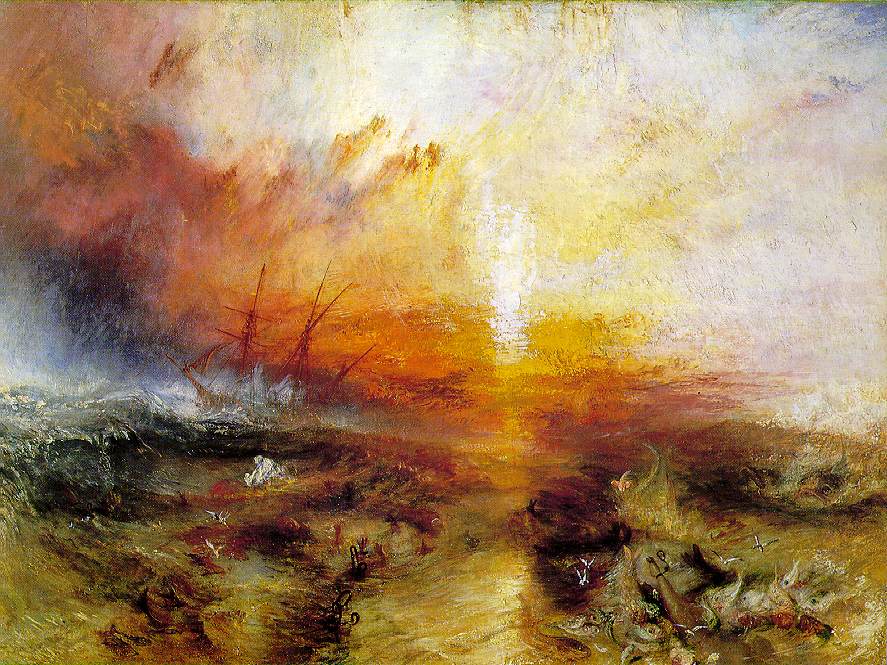
The disturbing 1840 Turner seascape “Slavers throwing overboard the Dead and Dying – Typon [sic] coming on”, also known simply as “The Slave Ship”, is widely thought to have been inspired by the Zong episode. The allusion would have been well-known to his contemporaries.

* One of the 133 survived by climbing back aboard the ship.

On this day..

1974: Black Saturday in Ethiopia

November 23, 1974 was “Bloody Saturday” in Ethiopia for that day’s* surprise purge of some threescore politicians and soldiers by the ruling Derg.

It was barely ten weeks since the Derg — an Amharic word meaning “committee”, in this case a leftist military junta — had formally overthrown Emperor Haile Selassie, so ancient that he was already middle-aged back when he’d been leading Ethiopia’s resistance against Mussolini.

It’s strange to say in retrospect, but having spent the best part of a year systematically supplanting the political authority of the decrepit ancien regime with widespread public support, the Derg had engendered hope that its revolution would be accomplished without slaughter.

“Ityopiya tikdem/yala mimin dem” — “Let Ethiopia progress/Without any bloodshed” — became the popular slogan of that heady time. (pdf source)

Black Saturday turned the leaf on all that, and opened the sanguinary chapter of Ethiopian history today evoked by the name of the Derg.

What went wrong with Ethiopia's bloodless revolution?
“The prospect,” concluded the analysis that appeared under this headline in the Nov. 29, 1974 London Times, “is that the mass executions will be followed by further drastic action aimed at consolidating the control of the new military rulers.” The same author, Michael Knipe, had written on Nov. 16 that “the firmness of [the military’s] control appears to be matched by an overall moderation of approach, which holds promise for Ethiopia’s future.”

The Derg long remained a shadowy body, its members largely unknown and its internecine factional politics only guessed-at. The executions this date are generally read as the consolidation of the coup’s “radical” elements as against its “moderates” and the first signal event in Derg member Mengistu Haile Mariam‘s eventual conquest of supreme authority.

The crucial issue that separated radicals from moderates at the revolution’s early stage appears to be their approach to the ongoing struggle of coastal Eritrea — then still a province of Ethiopia.

Ethnically Eritrean officer Aman Michael Andom, the first titular head of the Derg who had been deposed from his position only a week ago, was a noteworthy advocate of negotiating a peacable settlement with Eritrean agitators. He was among the casualties of Black Saturday. (Aman was later reported to have been killed resisting arrest, rather than actually executed; many of the available accounts of this massacre have slightly varying numbers and particulars.) Henceforth, military force would be Addis Ababa’s only approach to the Eritrean problem.

A few other Aman supporters in the Derg shared his fate in a political wipeout. But more numerous among the 29 civilian and 31 military men announced as casualties the next morning — and there had been no prior warning that executions were imminent — were aristocrats and officials of the Haile Selassie government, including:

  • Two former Prime Ministers, Endelkachew Makonnen and Aklilu Habte-Wold (or Aklilou Wold), both of whom had been slated for trial for the recent famine in Wollo (London Times, Nov. 14, 1974);**
  • Solomon Abrahami, the former governor of Wollo;
  • Selassie’s own grandsom, Rear Adm. Iskender (Alexander) Desta;
  • 16 generals, including Selassie’s son-in-law (and former Defense Minister) Abiye Abebe.

(This Nov. 25, 1974 New York Times article — behind the paper’s pay wall — lists all 60 vicitms.)

These were a selection of some 200 political prisoners held by the Derg; how hard to come down on these officials was another point of contention between radicals and moderates. It emerged later that the Derg had met earlier on the 23rd to vote, name by name, which among its prisoners deserved execution.

So if you look at it right, summarily machine-gunning only 30% of your political prisoners is a moderate policy. Alas: these would hardly be the last.

After the Derg government was itself finally overthrown in 1991 — and the troubled province of Eritrea finally won its independence from Ethiopia — some of the perpetrators of its genocidal atrocities were themselves put on trial.

* It’s obscure — perhaps permanently so — whether the nighttime killings transpired before or after the end of the day, and both the 23rd and 24th are variously cited as the date of death. “Reliable sources said the executions were by machine gun at midnight,” the unhelpfully breezy New York Times reported on Nov. 25. This account (pdf) has the shootings occupying several batches with midnight passing during the process. We give precedence to Saturday the 23rd here because that’s the day that earned the “Bloody” appellation.

** According to Marxist Modern: An Ethnographic History of the Ethiopian Revolution, Mengistu was rumored to have disposed of Aklilu personally.

On this day..

1803: Johannes Bückler, “Schinderhannes”

On this date in 1803, the famous German bandit “Schinderhannes” and 19 others of his gang were efficiently guillotined in French-occupied Rhineland.

Schinderhannes with mistress Juliana Blasius and their child.

As low-born as they come, Johannes Bückler (English Wikipedia link | German) hailed from a family of executioners and knackers (his appellation means “John the Knacker”).

But this outcast was born to command, and in the wild Rhineland at the close of the 18th century, his audacity, charisma, and deft cruelty made him a legendary bandit king.

He stole, he blackmailed, he slipped his fetters … “he seemed to contest French authority” recently projected by the revolutionary citizen-army, and he preyed heavily on unpopular Jewish merchants, all of which gave Bückler purchase on folk hero status with the boldness to hold a public “robber’s ball” at the ruined castle his band occupied.

His legend grew in his own lifetime, and as such things do, it inflated quite past any capacity of its originator’s character to support.

When things got too hot on the French side of the Rhine, he ducked over the frontier to the Holy Roman Empire in the east, but was nabbed attempting to lay low in the imperial army under an assumed name, and handed back to the French.

The authorities turned his outlaw gallantry to good effect (or at least, that’s the cover story his apologists have made for his stool pigeoning) by threatening to come down on the mistress who bore him a child, leading Schinderhannes to get her off with a slap on the wrist by giving up his bandit brethren.

And with French law came French execution technology, whose proliferation in the train of Napoleon’s Grande Armee would bequeath the German condemned death by the “falling axe” down to Hitler’s time and even after.

A spectacle here as it was in France, tens of thousands turned up in Mainz this date in 1803 for what sounds like an anticlimactic six-minute show of a score of Schinderhannes’ gang losing their heads to the mechanical contraption.

Scottish scribbler Leitch Ritchie helped convey to posterity the legend with Schinderhannes, the robber of the Rhine, which romantically celebrates a knave who must have been less lovable to those who knew him from the business end of his blade. These, nevertheless, are all long gone, and Ritchie has the authority of historical mythologizing to vindicate his text’s last eulogy with its hero’s foot upon the scaffold:

The bandit-chief preserved his intrepidity to the last, and left to other times, unsullied by many of the basenesses of his tribe, the name of SCHINDERHANNES, THE ROBBER OF THE RHINE.

He sure did. From the practically mandatory ballad …

… to the stage …

… to the screen

… to vicious-looking Cambrian anomalocarid Schinderhannes bartelsi

… the outlaw has long outlived his guillotining, to the profit of the tourist trade in his former stomping-grounds.

On this day..

1726: The Gypsy outlaws of Hesse-Darmstadt

On November 14 and 15, 1726, more than 20 Gypsy outlaws of Hesse-Darmstadt were executed en masse.

Detail view (click for full image) of the execution of the Gypsies at Giessen.

Gypsies in Europe still suffer ample discrimination today, so it’s little surprise to find early modern Europe thick with anti-Gypsy legislation.

No surprise, Angus Fraser writes in The Gypsies, this sort of thing

did in the end produce enormous changes in the life of the Gypsies in Europe. To survive, they had to adapt; they also had to make the most of the loopholes in a system which expressly sought, by denying them food and shelter, to make honest living impossible. Some found a degree of security in inaccessible waste-lands and forests. Some exploited differences in jurisdiction and the spasmodic nature of the authorities’ activity, by making a home in frontier regions … Many broke up into small groups when it was necessary to avoid attention; conversely, others gathered into larger bands to facilitate self-protection … sometimes resorting to violence. Certain Gypsy brigands gained notoriety in eighteenth-century Germany, large tracts of which were overrun with robber companies of mixed and varying origins. Some of these had a strong Gypsy element: numbering perhaps 50 or 100, armed and defiant, they stole for their sustenance and skirmished with the soldier-police sent to confine them.

“The poor Gypsies,” one poor Gypsy lamented to a contemporary German author,* “also want to have the right to live.”

Like the Gypsies’ other necessities, that right went as far as they themselves could secure it … and when secured by brigandage, it eventually brought down an overwhelming response.

The German author in question, J.B. Weissenbruch, relates the tale of a particularly notorious pack of Gypsy outlaws under the leadership of rough characters names of Antoine la Grave, aka “der Grosse Galantho” or “the Great Gallant”, and Johannes la Fortun, aka “Hemperla”.

These were no romantic Johnny Depp-esque Gypsies, at least according to Weissenbruch. Besides “their disposition to wandering, to idleness, to theft, to polygamy, or rather promiscuous license” — well, okay, sort of romantic — these went toe to toe with soldiery dispatched to corral them and had the chops to “take military possession” of a village for the purpose of exacting some corporal revenge.

We know where this ends up.

Though the Great Gallant escaped punishment,† Hemperla and 20-plus of his band (different sources quote slightly different figures) enjoyed the pleasures of the thumbscrew and the Spanish boot to secure confessions necessary to license their sentences. Some were hanged, others (including women) beheaded, and Hemperla and a few comrades were broken on the wheel.

* Cited here; regrettably, I have not been able to locate a browsable original of the Weissenbruch text.

** Same story in yet another Google books freebie.

This German book says his rank got him off the hook, but he lost his head just the same in 1733.

On this day..

2003: Four for the oil of Chad

On this date in 2003, seven Chadians were shot in the capital of N’Djamena, with an eighth in the eastern city of Abeche. (A ninth would be executed three days later.)

Chad’s first known judicial executions since 1991 came as a shock to observers; the country had publicly mooted death penalty abolition earlier that very year.

It also seems to have come as a shock for its subjects.

Four of those executed this date — the four that concern us here — were ranking power-brokers in President Idriss Deby’s regime convicted of bumping off the head of the Chad Petroleum Company, one Sheik Ibn Oumar Idriss Youssouf.

Mahamat Adam Issa, Adouma Ali Ahmat, Abderamane Hamid Haroun and Moubarack Bakhit Abderamane had been condemned on Oct. 25, just a month after the Sheikh was assassinated outside the Foreign Ministry. Less than two weeks later, the perps were shot when Deby denied them clemency even with their Supreme Court appeal still pending (pdf). (The Chadian judiciary seems a rickety thing (pdf).)

The murder, for its part, came just a month after Chad christened a $3.7 billion pipeline project.

It’s often called the “Adouma affair” after its principal defendant, which helpfully suggests the murky oil politics surrounding the speedy execution.

Ali Adouma was a former Deby advisor; both Adouma and the victim were from Darfur, in neighboring Sudan, whose conflict has spilled into Chad (pdf).

The Sudanese government had at times sought Adouma’s extradition for financing anti-govenrment Zaghawa forces across the border; while the Zaghawa ethnic minority (whose ranks include President Deby) dominates Chad, its Darfurian brethren have had the worst of their conflict with the Sudanese government.

So even if the convicts’ torture-adduced confessions resembled the truth of the murder, it can be safely inferred that the fact and the haste of their executions were matters of state. (Adouma’s confidence that there would not actually be an execution was reportedly shaken only in the last hours of his life.)

What matter of state is a different, uncertain matter: to calm potential foreign investors who’d be understandably nervous about seeing a petroleum kingpin pinched on the streets without consequence? A sop to Khartoum in Deby’s ongoing diplomatic efforts to limit the knock-on from Darfur to Chad? Or a warning to Deby’s own base? (pdf)

The vague attempts at conciliation by the Chadian President do not please his entourage which almost sees it as treason. Last May, 80 soldiers tried to overthrow Deby and would have assassinated him …

President Idriss Deby, according to observers with knowledge of Chadian politics, would be in a “precarious” situation. The Chad regime, undermined by corruption and ever on the brink of a chronic socio-economic crisis … may become even “tougher”. In N’Djamena, the hasty conviction and execution of Ali Adouma are seen as a sign from the President to his inner circle, even the ones in charge of the national economy, that he is ready to use coercion, even against his own clan.

These pictures of the execution were published in a Chadian paper. In image three, the circled figure is one of the firing squad members, who was himself bizarrely reported fatally shot during the execution. (Whispers continue to circulate that the unlucky executioner had in fact been intentionally eliminated after receiving some sensitive parting confidence from the well-placed condemned.)

“Chad,” said Interior Minister Routouang Yoma Golom, “has given a wonderful example to wrong-doers.”

On this day..

1463: David of Trebizond and his heirs

On this date in 1463, the last regal claimants of Byzantium’s last successor state were executed in Constantinople.

They were, by this time, two years deposed from actual power. David of Trebizond (aka David Comnenos) had inherited the enclave“empire” clinging to the Black Sea coast in 1459, and proved himself “a fit agent for consummating the ruin of an empire.”

Specifically, he cleverly set about needling the overwhelming Turkish power on his borders by vainly attempting to stir up another Crusade, and refused to pay the Mohammedan tribute.

Having recently reduced the impregnable fastness of Constantinople, Mehmed the Conqueror handily availed this provocation to overrun Trebizond.

David and kin made out okay by this calamitous extinction of the Byzantine candle, negotiating in the summer of 1461 an arrangement to settle in Adrianople under the sultan’s protection (and monitoring).

Two years later, David was reportedly caught plotting against the keeper of his gilded cage once more, and Mehmed had the former Emperor, his sons, a nephew and a brother-in-law beheaded, neatly extinguishing the last people with any lineal claim the late Greek imperium.

Theodore Spandounes, a Venetian of Byzantine refugee stock writing in the early 16th century,* claims this was a set-up by Mehmet, “ravenously thirsting for Christian blood,” and that the Komnenoi were given the chance to convert to Islam and atoned their poor statecraft with holy martyrdom.

Furthermore,

Mehmed confiscated all the property of the imperial family of Trebizond and condemned the Empress [Helen Kantakouzene or Cantacuzene] to pay 15,000 ducats within three days or be executed. Her servants, who were Mehmed’s prisoners in Constantinople, worked from dawn to dusk to raise the money and paid it … [but] she had no desire to remain in this world; and, clad in sackcloth, she who had been accustomed to regal finery, refused to eat meat any more and built herself a hovel covered in straw in which she slept rough. Mehmed had decreed that no one was to bury the bodies under pain of death. They were to be left for the dogs and ravens to devour. But the sainted Empress secretly acquired a spade and with her own delicate hands as best she could dug a trench in her hut. All day long she defended the corpses against the animals and at night she took them one by one and gave them burial. Thus did God give her the grace to bury her husband and her sons; and a few days later she too died.

* And writing, it should be observed, with the polemical intent of persuading western powers to go fight the Ottomans.

On this day..

1415: French prisoners at the Battle of Agincourt

This day is called the feast of Crispian.
He that outlives this day and comes safe home,
Will stand o’ tiptoe when the day is named
And rouse him at the name of Crispian.
He that shall see this day, and live old age,
Will yearly on the vigil feast his neighbors
And say, “Tomorrow is Saint Crispian.”
Then will he strip his sleeve and show his scars,
And say, “These wounds I had on Crispin’s day.”

…And Crispin Crispian shall ne’er go by,
From this day to the ending of the world,
But we in it shall be remembered-
We few, we happy few, we band of brothers.

Henry V, Act 4, Scene 3

In the world of Henry V, the Battle of Agincourt is a source of bursting pride for the English, a wellspring of superiority over the French and proof of the soul of those from the Isle. In spite of the inspiring speeches, the battle has passed into history as one of the enduring examples of a well-positioned army besting a much larger force.

Were it not for the story of the triumphant underdog, Agincourt would have fallen into international obscurity with much of the Hundred Years’ War, a simmering conflict for the French throne that spanned from 1337 to 1453. The notoriety of the Hundred Years’ War comes not from its intensity but from its longevity and breadth: an international conflict that swept up hundreds of wealthy European houses, it featured the first significant post-Roman standing armies, organized cavalry, and formative nationalism in both France and England.

The interminable war centered around the English crown’s claim to succession of the French throne — a claim events had overtaken by the end of the conflict in 1453 — and had already been going off and on for nearly eighty years as we lay our scene in 1415, with King Henry V of England initiating what would be known as the Lancastrian War.

Henry’s English and Welsh forces battered the French port of Harfleur starting in August 1415, which was the first holding to fall to the invading army. Almost immediately after taking control in late September of that year, the English king made a curious decision to march across Northern France from Harfleur to Calais, approximately 100 miles away.

As he tromped northeast, French troops shadowed his movements, and Henry made several attempts to shake them. After passing through Frévent, Henry turned his men north. He crossed the last major tributary of the Canche River south of Maisoncelle, hopeful that the exhausting trip was nearly through. His scouts, however, had hairy news for their king: the French force had cut the corner and was amassing north of their position. The way was blocked.

Archer? I Hardly Knew Her!

Agincourt (now spelled Azincourt) lay across a ploughed field from Tramecourt, making for a narrow defile not suited to maximizing the French force’s advantage in numbers and heavy cavalry.

Nevertheless, that advantage was considerable, or at least has conventionally been thought so, and it was in the face of desperately dwindling supplies that Henry was forced to initiate battle. The opposing French forces, ostensibly commanded by Constable Charles d’Albret, Comte de Dreux, and Marshal Boucicaut, Jean Le Maingre, allegedly outnumbered the British by at least 2 to 1 (estimates range as high as 6 to 1*).

The English drew up longbowmen in a wedge along the woods adjacent the field (map), and it was these positions that provided the decisive turn.

When the Gallic banners advanced, the English archers moved into firing range and dug in palings they had hastily manufactured from the local forest; this made a direct assault problematic while the woods prevented a flanking maneuver. French cavalry attempted to dislodge them with a concerted assault, but the defensive postures held, and the cavalry was turned away. All the while, the hail of arrows mowed down the flower of French chivalry, whose lines crumbled in panic and disorder.

As one contemporaneous account states**:

Before, however, the general attack commenced, numbers of the French were slain and severely wounded by the English bowmen. At length the English gained on them so much, and were so close, that excepting the front line, and such as had shortened their lances, the enemy could not raise their hands against them. The division under sir Clugnet de Brabant, of eight hundred men-at-arms, who were intended to break through the English archers, were reduced to seven score, who vainly attempted it. True it is, that sir William de Saveuses, who had been also ordered on this service, quitted his troop, thinking they would follow him, to attack the English, but he was shot dead from off his horse. The others had their horses so severely handled by the archers, that, smarting from pain, they galloped on the van division and threw it into the utmost confusion, breaking the line in many places. The horses were become unmanageable, so that horses and riders were tumbling on the ground, and the whole army was thrown into disorder, and forced back on some lands that had been just sown with corn. Others, from fear of death, fled; and this caused so universal a panic in the army that great part followed the example.

A confused chain of command in the French camp (the English, of course, were personally commanded by their sovereign) facilitated the rout.

Despite their military status, d’Albret and Boucicaut were outranked by several of the nobles heading the lines behind them, said nobles being prone to glory-seeking freelance charges as chivalrous as they were tactically unavailing. The Constable led the front line, followed by the Duke of Bar and the Duke of d’Alençon.

After the disastrous first charge, what remained of the second line moved in to join the fray. The French peasantry was massacred during the fight, and Constable d’Albret and the Duke of d’Alençon, along with the Duke of Orleans and Duke of Barant, along with several other nobles, fell during the assault, further disorganizing the French. (The highest-ranking English casualty was the Duke of York.)

With thousands of French dead, the third line, headed by the Count of Merle and Count of Falconberg, fell away before they entered the battle. While England’s longbows dominated the field, France’s bowmen never even participated in the battle, squeezed to the back by too many bluebloods demanding the right to charge.

Only 100-200 English are thought to have died this day; the death toll for the French was in the thousands, with hundreds more taken prisoner.


Uh-oh.

It is a portion of this lot summarily executed during the battle who offer this blog an excuse to survey the battlefield.

After a successful raid on the English supply van — the signal French achievement in the battle, and one that briefly threatened to knock out the monarch himself and turn the tide — Henry got worried that his oversized contingent of French prisoners was liable to get loose and wreak havoc in his rear. He issued the expedient but decidedly unseemly order to put his captives to death.†

Parts 1, 2, 3 and 4 of this documentary, which among other things unpacks the longbow’s actual role in the victory, given that English arrows could not penetrate French knights’ plate armor.

The Battle of Agincourt has inspired innumerable interpreters, from Shakespeare to Star Trek.

Shakespeare’s classic Henry V is frequently staged, and has hit the silver screen multiply — here’s Laurence Olivier’s version of the stirring St. Crispin’s Day speech followed by the start of battle from the 1944 production addressed to the martial fervor of World War II.

There are plans to adapt Bernard Cornwell’s Agincourt to film as well.

In the nonfiction world, Lt. Col Alfred Burne’s The Agincourt War focuses on the military side of the battle while Juliet Barker’s Agincourt: The King, the Campaign, the Battle and Agincourt: Henry V and the Battle That Made England.

The year after Agincourt, Henry V claimed all of Normandy, and in subsequent years forced the French to sign the Treaty of Troyes in 1420, which established the line of succession for Henry’s heirs to unify the crowns of the adversaries. Henry’s grand plan was foiled by his untimely death just two months after the death of King Charles VI of France, which left Henry VI — then less than a year old — as the heir to both English and French thrones.

The Dauphin Charles of France, officially disinherited by Troyes but still widely supported in France, swooped in to claim power in France, but internal dissent made his rule difficult; 30 years later (and after the intervention of Joan of Arc), Charles finally expelled the English from Aquitaine, and brought all France together not under the House of Lancaster but under the House of Valois.

* Accounts are sketchy in this regard. Some modern analysis puts the values at 4:3 for the French. However, contemporaneous accounts suggest a much heavier French advantage. Of course, people are notoriously bad at crowd estimation.

** Translation by Thomas Johnes.

† Shakespeare covers this notorious massacre as well, in Act 4, Scene 6 (the next scene opens with Englishmen horrified at the order, but the matter drops as they realize they’ve won the battle)

Alarum
But, hark! what new alarum is this same?
The French have reinforced their scatter’d men:
Then every soldier kill his prisoners:
Give the word through.

Part of the Daily Double: Agincourt.

On this day..

1865: Mexican Republican officers, under the Black Decree

On this date in 1865, two Republican generals, four colonels, and various other officers captured earlier in the month were executed on the authority of Mexico’s notorious Bando Negro — the “Black Decree.”

Halfway into his ill-fated three-year reign as “Emperor,” Maximilian I was in a bad way against Mexican president-turned-guerrilla Benito Juarez.

On October 3, 1865, he authorized summary execution for captured Republicans … and for anyone else who ran afoul of a nearby military official without having speedy proof of his or her political bona fides.

All individuals forming a part of armed bands or bodies existing without legal authority, whether or not proclaiming a political pretext, whatever the number of those forming such band, or its organization, character, and denomination, shall be judged militarily by the courts martial. If found guilty, even though only of the fact of belonging to an armed band, they shall be condemned to capital punishment, and the sentence shall be executed within twenty-four hours.*

In signing the Black Decree, said Mexican essayist Carlos Fuentes, Maximilian “signed his own death warrant.”

But more immediately, of course, he signed a lot of other people’s death warrants.

Republican General José María Arteaga Magallanes (Spanish link), a man of famous chivalry (once, recovering the body of the Belgian Foreign Minister’s son, he returned the boy’s watch home to dad), and fellow General Carlos Salazar Ruiz (Spanish again) were the biggest fish; they and the others are honored today as the Martyrs of Uruapan. (Spanish yet again)


The square in Uruapan where this day’s victims were shot … now known as Plaza Mártires.

* The excerpted text is Article I of the Black Decree, whose entire (taken from here) follows:

THE BANDO NEGRO (BLACK DECREE) PROCLAMATION
OF EMPEROR MAXIMILIAN, OCTOBER 3, 1865

MEXICANS: The cause sustained by D. Benito Juarez with so much valor and constancy had already succumbed, not only before the national will, but before the very law invoked by him in support of his claims. To-day this cause, having degenerated into a faction, is abandoned by the fact of the removal of its leaders from the country’s territory.

The national government has long been indulgent, and has lavished its clemency in order that men led astray or ignorant of the true condition of things might still unite with the majority of the nation and return to the path of duty. The desired result has been obtained. Men of honor have rallied around the flag and have accepted the just and liberal principles which guide its policy. Disorder is now only kept up by a few leaders swayed by their unpatriotic passions, by demoralized individuals unable to rise to the height of political principle, and by an unruly soldiery such as ever remains the last and sad vestige of civil wars.

Henceforth the struggle must be between the honorable men of the nation and bands of brigands and evil-doers. The time for indulgence has gone by: it would only encourage the despotism of bands of incendiaries, of thieves, of highwaymen, and of murderers of old men and defenseless women.

The government, strong in its power, will henceforth be inflexible in meting ont punishment when the laws of civilization, humanity, or morality demand it.

Mexico, October 2, 1865.

Maximilian, Emperor Of Mexico : Our Council of Ministers and our Council of State having been heard, we decree:

Article I. All individuals forming a part of armed bands or bodies existing without legal authority, whether or not proclaiming a political pretext, whatever the number of those forming such band, or its organization, character, and denomination, shall be judged militarily by the courts martial. If found guilty, even though only of the fact of belonging to an armed band, they shall be condemned to capital punishment, and the sentence shall be executed within twenty-four hours.

Article II. Those who, forming part of the bands mentioned in the above article, shall have been taken prisoners in combat shall be judged by the officer commanding the force into the power of which they have fallen. It shall become the duty of said officer within the twenty-four hours following to institute an inquest, hearing the accused in his own behalf. Upon this inquest a report shall be drawn and sentence shall be passed. The pain of death shall be pronounced against offenders even if only found guilty of belonging to an armed band. The chief shall have the sentence carried into execution within twenty-four hours,—being careful to secure to the condemned spiritual aid,—after which he will address the report to the Minister of War.

Article III. Sentence of death shall not be imposed upon those who, although forming part of a band, can prove that they were coerced into its ranks, or upon those who, without belonging to a band, are accidentally found there.

Article IV. If from the inquest mentioned in Article II facts should appear calculated to induce the chief to believe that the accused has been enrolled by force, or that, although forming part of the band, he was there accidentally, he shall abstain from pronouncing a sentence, and will consign the prisoner, with the corresponding report, to the court martial, to be judged in accordance with Article I.

Article V. There shall be judged and sentenced under the terms of Article I of the present law:

I. All individuals who voluntarily have procured money or any other succor to guerrilleros.

II. Those who have given them advice, news, or counsel.

III. Those who voluntarily and with knowledge of the position of said guerrilleros have sold them or procured for them arms, horses, ammunition, provisions, or any other materials of war.

Article VI. There shall be judged and sentenced in accordance with Article I:

I. Those who have entertained with guerrilleros relations constituting the fact of connivance.

II. Those who of their own free will and knowingly have given them shelter in their houses or on their estate.

III. Those who have spread orally or in writing false or alarming news calculated to disturb order, or who have made any demonstration against the public peace.

IV. The owners or agents of rural property who have not at once given notice to the nearest authority of the passage of a band upon their estate.

The persons included in the first and second sections of this article shall be liable to an imprisonment of from six months to two years, or from one to three years’ hard labor, according to the gravity of the offense.

Those who, placed in the second category, are connected with the individual concealed by them by ties of relationship, whether as parents, consorts, or brothers, shall not be liable to the penalty above prescribed, but they shall be subject to surveillance by the authorities during such time as may be prescribed by the court martial.

Those included in the third category shall be sentenced to a fine of from twenty-five to one thousand piasters or to one year’s imprisonment, according to the gravity of the offense.

Article VII. When the authorities have not given notice to their immediate superior of the passage of an armed force in their locality, the superior authority shall inflict a fine of from two hundred to two thousand piasters or from three months’ to two years’ imprisonment.

Article VIII. Every inhabitant who, having knowledge of the passage of an armed band in a village or of its approach, has not notified the authorities shall be liable to a fine of from five to five hundred piasters.

Article IX. All inhabitants between the ages of eighteen and fifty-five years of age not physically incapacitated shall, when the locality inhabited by them is threatened by a band, take part in the defense of the place, under penalty of a fine of from five to two hundred piasters or of from fifteen days’ to four months’ imprisonment. If the authorities deem it proper to punish the village for nonresistance, they may impose a fine of from two hundred to two thousand piasters, which shall be payable by all those who have not taken part in the defense.

Article X. The owners or agents of country property who, being able to defend themselves, have not kept guerrillas and other evil-doers away from their estates or have not notified the nearest military authority of their presence, or who have received the tired or wounded horses of the guerrillas without advising the said authority, shall be punished by said authority by a fine of from one hundred to two thousand piasters, according to the gravity of the offense. In cases of extreme gravity they shall be arrested and brought before the court martial, to be judged in conformity with the rules laid down by the present law. The fine shall be paid to the principal administrator of the revenue of the district where the estate is situated. The provisions of the first part of the present article are applicable to the populations.

Article XI. All authorities, whether political, military, or municipal, who have not acted in accordance with the provisions of the present law against those who are suspected of or recognized as being guilty of the offenses with which it deals, shall be liable to a fine of from fifty to one thousand piasters; and when the omission implies acquaintance with the guilty, the delinquent shall be brought before the court martial, who shall judge him and inflict a penalty in proportion to the offense.

Article XTT. Plagiarios [kidnappers] shall be judged and sentenced under the provisions of Article I of the present law, without regard to the circumstances under which the abduction shall have been committed.

Article XIII. Sentence of death passed upon those guilty of the offenses enumerated by the present law shall be executed in the time fixed, and the benefit of appeal for mercy shall be refused to the condemned. When the accused has not been condemned to death, and is a stranger, the government, after he shall have undergone punishment, may make use with regard to him of its right to expel from its territory pernicious strangers.

i Kidnappers. The Minister of Foreign Affairs, intrusted with the Department

Article XIV. Amnesty is proclaimed in favor of all who, having belonged or still belonging to armed bands and having committed no other offense, shall present themselves to the authorities before the 15th of next November. The authorities shall take possession of the arms of those so surrendering themselves.

Akticle XV. The government reserves unto itself the right to fix the time when the provisions of the present law shall cease to be enforced. Each of our ministers is bound, as far as his department is concerned, to enforce the present law and to issue such orders as will secure its strict observance.

Issued in the Palace of Mexico, October 3, 1865.

Maximilian.

On this day..