1946: The Nuremberg Trial War Criminals

Victor’s justice was never better served than this date in 1946, when the brass of Third Reich hung for crimes against humanity during the late World War II.

[audio:http://www.stelzriede.com/ms/mus/nuremexe.mp3]

(From this page of original period audio files.)

The landmark legal proceeding* is covered well enough in many other sources for this humble venue to break new ground.

Apart from trailblazing international law, the trial was notable for the gut-punching film of German atrocities; this relatively novel piece of evidence is available for perusal thanks to the magic of the Internet. Caution: Strong stuff. An hour’s worth of Nazi atrocities.The climactic hangings in the predawn hours this day in Nuremberg were conducted by an American hangman who used the American standard drop rather than the British table calibrated for efficacious neck-snapping. As a result, at least some hangings were botched strangulation jobs, a circumstance which has occasionally attracted charges of intentional barbarism.

Media eyewitness Kingsbury Smith’s taut report of the night’s executions (well worth the full read) described just such an ugly end for propagandist Julius Streicher.

At that instant the trap opened with a loud bang. He went down kicking. When the rope snapped taut with the body swinging wildly, groans could be heard from within the concealed interior of the scaffold. Finally, the hangman, who had descended from the gallows platform, lifted the black canvas curtain and went inside. Something happened that put a stop to the groans and brought the rope to a standstill. After it was over I was not in the mood to ask what he did, but I assume that he grabbed the swinging body of and pulled down on it. We were all of the opinion that Streicher had strangled.

There were in all 12 condemned to death at Nuremberg; all hanged this day except Martin Bormann (condemned in absentia; it was only years later that his death during the Nazi regime’s 1945 Gotterdammerung was established) and Hermann Goering (who cheated the executioner with a cyanide capsule two hours before hanging). The ten to die this day were:

* Its resultant Nuremberg Principles comprise a lofty articulation of principles whose actual application, as Noam Chomsky has observed, would have meant that “every post-war American president would have been hanged.”

On this day..

2007: Five women in Hoiryeong Public Stadium

On this date in 2007, according to the Daily NK, five women were publicly tried, then immediately shot, in Hoiryeong Public Stadium in North Korea’s North Hamkyung province.

Their crime, “prostitution”, is supposed to be a euphemism for aiding refugees escaping to China in the area that also generated an infamous execution film broadcast on Japanese television in 2005. (And other death sentences earlier in 2007. North Korea is not enthusiastic about escapees.)

As usual with the insular state, details are hard to come by. The North Korean Human Rights Infringement Center claimed Pyongyang carried out 901 public executions in 2007; that figure would potentially make it the world’s #2 (after China) death penalty user, though Amnesty International doesn’t even venture a tally of North Korean executions.

On this day..

1503: Anacaona and the caciques of Xaragua

Sometime around this date in 1503, the Spanish destroyed the independent territory of Xaragua on Hispaniola in a bloodbath of native caciques — capped with the ignominious public hanging of the Taino queen Anacaona.

The widow of the chief Caonabo (Spanish link), who had been captured and shipped to Spain by Christopher Columbus himself, Anacaona inherited leadership of one of the principle Taino realms of Hispaniola, present-day Haiti and Dominican Republic.

Spain had the werewithal to be extremely crappy to the Hispaniola “Indians”, but it would take a few years to have sufficient presence to conquer them all.

By 1503, after a decade’s slaughter and disease had decimated the native populace, villainous Spanish Governor Nicolas de Ovando was ready to dominate the whole island.

Calling a meeting with the Xaragua caciques, Ovando’s troops enjoyed the Taino hospitality. Bartolome de las Casas describes the festivities:

Xaraqua is the Fourth Kingdom, and as it were the Centre and Middle of the whole Island, and is not to be equalled for fluency of Speech and politeness of Idiom or Dialect by any Inhabitants of the other Kingdoms, and in Policy and Morality transcends them all. Herein the Lords and Peers abounded, and the very Populace excelled in in stature and habit of Body: Their King was Behechio by name and who had a Sister called Anacaona, and both the Brother as well as Sister had loaded the Spaniards with Benefits (pdf) and singular acts of Civility, and by delivering them from the evident and apparent danger of Death, did signal services to the Castilian Kings. Behechio dying the supreme power of the Kingdom fell to Anacaona: But it happened one day, that the Governour of an Island, attended by 60 Horse, and 30 Foot (now the Cavalry was sufficiently able to unpeople not only the Isle, but also the whole Continent) he summoned about 300 … noblemen to appear before him, and commanded the most powerful of them, being first crouded into a Thatcht Barn or Hovel, to be exposed to the fury of the merciless Fire, and the rest to be pierced with Lances, and run through with the point of the Sword, by a multitude of Men: And Anacaona herself who (as we said before) sway’d the Imperial Scepter, to her greater honor was hanged on a Gibbet. And if it fell out that any person instigated by Compassion or Covetousness, did entertain any Indian Boys and mount them on Horses, to prevent their Murder, another was appointed to follow them, who ran them through the back or in the hinder parts, and if they chanced to escape Death, and fall to the ground, they immediately cut off his Legs; and when any of those Indians, that survived these Barbarous Massacres, betook themselves to an Isle eight miles distant, to escape their Butcheries, they were then committed to servitude during Life.

Horror followed horror. Washington Irving‘s History of the Life and Voyages of Christopher Columbus:

Contemporary writers … have concurred in representing Anacaona, as remarkable for her native propriety and dignity. She was adored by her subjects, so as to hold a kind of dominion over them, even during the lifetime of her brother; she is said to have been skilled in composing the areytos or legendary ballads of her nation, and may have conduced much towards producing that superior degree or refinement remarked among her people … After the massacre ot Xaragua, the destruction of its inhabitants still continued. The favourite nephew of Anacaona, the cacique Guaora who had fled to the mountains, was hunted like a wild beast, until he was taken, and likewise hanged. For six months the Spaniards continued ravaging the country with horse and foot, under the pretext of quelling insurrections; for, wherever the affrighted natives took refuge in their despair, herding in dismal caverns and the fastnesses of the mountains, they were represented as assembling in arms to make a head of rebellion. Having at length hunted them out of their retreats, destroyed many, and reduced the survivors to the most deplorable misery and abject submission, the whole of that part of the island was considered as restored to good order; and in commemoration of this great triumph, Ovando founded a town near to the lake, which he called Santa Maria de la verdadera Paz. (St. Mary of the true Peace.)

Such is the tragical story of the delightful region of Xaragua, and of its amiable and hospitable people. A place which the Europeans, by their own account, found a perfect paradise, but which, by their vile passions, they filled with horror and desolation.

The martyred artist-queen continues to inspire art of her own.

(More — in Spanish — about this Cheo Feliciano song.)

On this day..

1898: The Six Gentlemen of the Hundred Days’ Reform

This afternoon in 1898, six liberals got the chop for their hopeless attempt to give a tottering empire the reforms it desperately needed.

The Hundred Days’ Reform — actually 103 days, from June 11 to September 21 — marked the attempt by China’s Guangxu Emperor to implement a far-reaching modernization programme backed by forward-thinking officials with a mind to correct China’s supine position vis-a-vis the West, and even vis-a-vis its neighbors.

“Reform has never come about in any country without the flow of blood. No one in China in modern times has sacrificed himself for the cause of reform, and because of this China is still a poor and backward country. Therefore, I request that the sacrifices begin with myself.” –Tan Sitong

The Wuxu Constitutional Reform still stands as the great attempt made by Chinese progressives who tried to follow the example of the modern powers in order to save China from extinction. Represented by Kang Youwei and Liang Qichao, the bourgeois reformists were imbued with the spirit of national salvation; they carefully set about designing a blueprint for a constitutional monarchy based on the example of Western countries. They advocated the establishment of parliament and a national conference, and wanted to see honest and fair-minded people with the courage to criticize authority installed in a position of power. National policies should be discussed by the monarch and the people. They also wanted a constitution to stipulate the rights and obligations of the monarch, officials, and the people. The constitution was to be the highest code for all people in the country. They also wanted to establish a system featuring a tripartite balance of forces: parliament was to legislate, the magistracy to deal with issues of justice, the government with administration. All of these would be under the monarch.

The constitutional reform was to take place with radical intellectuals submitting their memoranda to Emperor Guang Xu, who alone had the power to promulgate them. The feudal diehards being in a position of strength and the national bourgeoisie being weak, however, the new politics survived no more than 100 days or so. When the forces of reaction inevitably clamped down on the movement, the six reformists who had inspired the movement for constitutional reform met their deaths like heroes.

Although sincere in its aspirations, the reform movement was bound to fail, as it depended on a reform “from top to bottom”, which ultimately had to be enacted by the emperor. The Hundred Days’ Constitutional Reform, however, remains a landmark event in the modern history of China, its failure notwithstanding. The Chinese bourgeoisie in fact succeeded in spreading democratic and constitutionalist ideas widely, and this had a significant effect on future generations. The political and legal theory of the Western bourgeoisie could now take root in the soil of China.*

The emperor’s Machiavellian conservative aunt, the Empress Dowager Cixi, who had been the power behind the Chinese throne since 1861, made the sure reform didn’t see two hundred days with a “coup” that didn’t formally overthrow the Emperor — just made him irrelevant.

Troublemakers further down the food chain didn’t get off so easily.

Kang Youwei, the reform movement’s chief exponent, escaped to Japan. Six others suffered the wrath of the Dowager Empress: Kang Guangren (Kang Youwei’s brother), Lin Xu, Yang Shenxiu, Yang Rui and Liu Guangdi … along with the young reformer Tan Sitong, who notably refused imprecations to flee arrest.

The sword’s blade across my neck,
I look toward heaven — laughing.
-Etched on a prison wall, allegedly by Tan Sitong


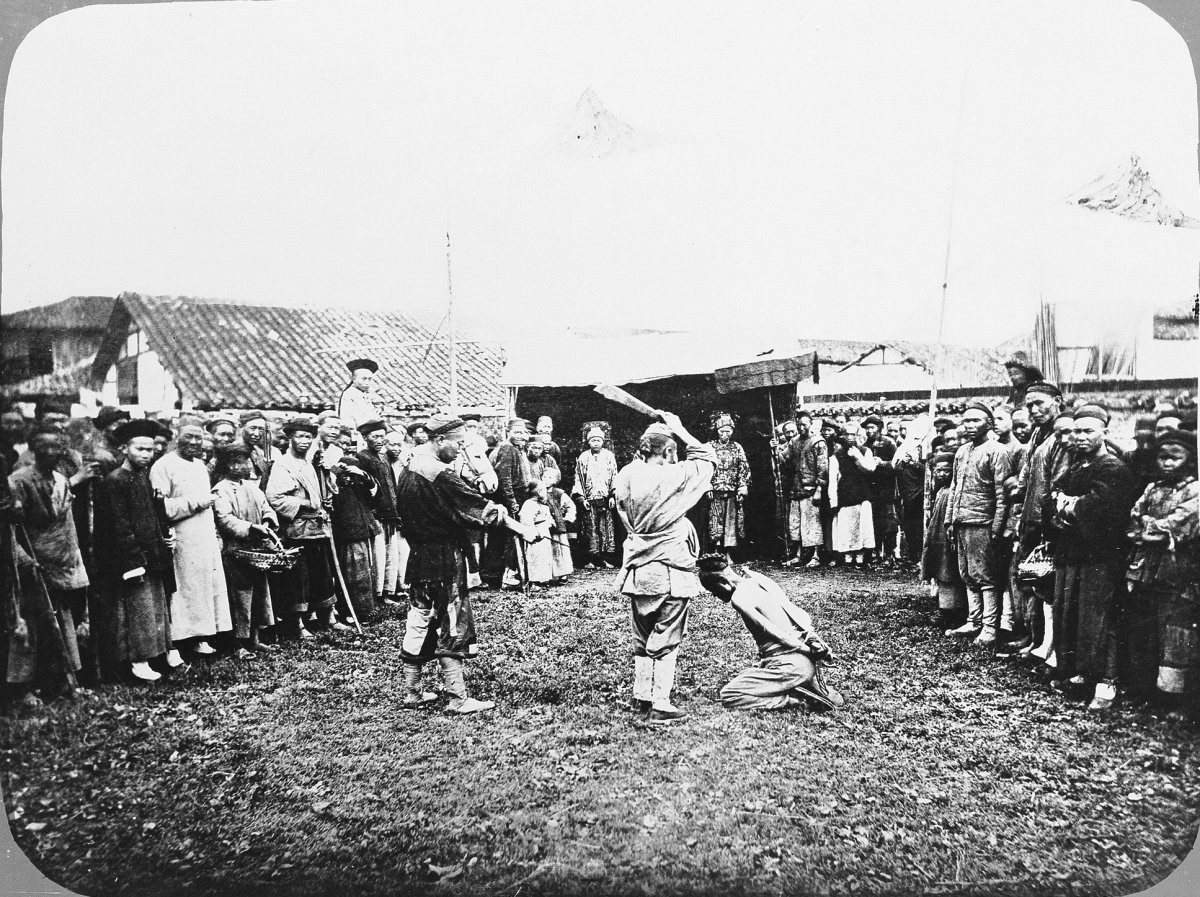
Photo of an unspecified 1867 Qing beheading in Canton.

* “The Chinese Legal Tradition and the European View of the Rule of Law” by Wu Shu-Chen in The Rule of Law History, Theory and Criticism, Part VI.

On this day..

1864: Six of Mosby’s Rangers

It was on this date in 1864* that an infamous Union war crime took place in Front Royal, Virginia.

Union forces in the Old Dominion were bedeviled by John Singleton Mosby, whose bold and legendary guerrilla tactics are commemorated in Herman Melville’s “The Scout Toward Aldie”:

All spake of him, but few had seen
Except the maimed ones or the low;
Yet rumor made him every thing–
A farmer–woodman–refugee–
The man who crossed the field but now;
A spell about his life did cling —
Who to the ground shall Mosby bring?

In 1864, the “Gray Ghost” haunted the Shenandoah Valley, and his spooky brand of warfare eventually goaded the Union into crossing the streams.

Allegedly raging from the murder by Mosby’s troops of a surrendering northern cavalryman, the blues rounded up six captured Mosby men — actually only five, plus one 17-year-old civilian who had opportunistically joined the fray — and summarily executed them.

David Jones, Lucien Love and Thomas Anderson were shot. So was the aforementioned civilian, Henry Rhodes, under the eyes of his shrieking mother.

Then, two last unfortunates were hanged. William Thomas Overton spurned an offer of clemency in exchange for information on Mosby’s hideouts with the memorable parting, “Mosby will hang 10 of you for every one of us.”

Not quite so … but not an empty threat, either. Weeks later, Mosby would order the retaliatory executions of a like number** of randomly-selected Union prisoners of war, and communicate this intelligence to his foes along with his (successful) suit to resume more gentlemanly methods of killing one another.

* Some sources (including some cited in this post) claim September 22nd. The consensus of authoritative sources appears to be clearly September 23rd. The Gray Ghost himself may be one source of the confusion; according to Custer and the Front Royal Executions, “In his memoirs, which were published over 50 years after the event, Mosby got the date wrong, apparently based upon one of the newspaper accounts … [which] stated that the Front Royal incident occurred on September 22, not September 23, the date upon which it actually did occur.”

** Seven were condemned in retaliation, for these six plus a separate execution that occurred Oct. 13.

On this day..

1918: The 26 Baku Commissars

On this date in 1918, 26 Bolsheviks and Left SRs were shot in what is now Turkmenistan, their bid to establish Soviet power in Baku defeated — temporarily.


The Execution of the Twenty-Six Baku Commissars, by Isaak Brodsky (1925)

The 26 Baku Commissars were the men of the Baku Commune, a short-lived Communist government in 1918 led by the “Caucasian Lenin,” Stepan Shahumyan. (He was a good buddy of the Russian Lenin, Vladimir Ilyich Ulyanov.)

In a cauldron of ethnic violence and against the military interventions of Turkey and Britain, these worthies were tasked with extending Soviet writ to the stupendous Azerbaijani oil fields* — the predominant source of tsarist Russia’s oil, and destined to be the engine of Soviet industry as well.

The Baku Soviet was expelled by the British, who inherited the bloody fight against an advancing Ottoman army.

Shahumyan and his fellow commissars, meanwhile, fled by ship across the Caspian Sea to Krasnovodsk (now Turkmenbashi, Turkmenistan), where they fell into the hands of a the anti-Soviet factions — backed, once again, by the British — of a brand new locale’s incarnation of civil war.

The commissars’ “presence in Krasnovodsk was a matter of great concern to the [anti-Bolshevik] Ashkhabad Committee, the members of which were seriously alarmed that opposition elements in Transcaspia might take advantage of the presence of the Commissars to stage a revolt against the government.” Said concern was relieved by the expedient of escorting the Baku Soviet to the desert and shooting them en masse.

The Red Army recaptured Baku in 1920, this time for good, and Shahumyan and friends were raised to the firmament of Communist martyrology, and not only in the Azerbaijan Soviet Socialist Republic. Streets and schools throughout the USSR bore their names.

As with many Soviet icons, the commissars had a rough come-down after the Iron Curtain fell. Their monument in Baku stood untended for many years, its eternal flame extinguished … until it was finally (and somewhat controversially) torn down earlier this year.


The Baku Commissars’ monument and its dead eternal flame, prior to its early 2009 demolition. Image (c) denn22 and used with permission.

* The Nobel family, which established the Nobel Prize, had a significant presence in the Baku petrol industry.

On this day..

1847: The San Patricios

At 9:30 a.m. this day, as the American army raised the Stars & Stripes over Chapultepec Castle during the Mexican-American War, it simultaneously carried out a mass hanging of 30 Irish deserters who had gone over to Santa Anna — the Saint Patrick’s Battalion, or the San Patricios.

Irish had been migrating to the United States en masse even well before the Great Famine got rolling in 1845.

And for those of that great migration wave who wound up in the service fighting the Mexican-American War, there was a hint of deja vu — an Anglo and Protestant imperial power seizing land from a “black”* and Catholic neighbor?

Some of the Irish decided they were fighting for the bad guys, and switched sides.**

These were the plurality (though not necessarily the majority) of the couple hundred soldiers who comprised the Saint Patrick’s Battalion. German immigrants and other nationalities, along with American-born deserters (desertion during the Mexican-American War seems to have been rife), made up the balance.

Knowing full well the fate that would await them upon capture, the San Patricios were renowned for their ferocity in battle; at the hopeless Battle of Churubusco, they reputedly forced down a white flag that Mexican comrades were trying to hoist on three separate occasions.

Eventually, the ammunition ran out, and with it, the San Patricios’ luck.

Within days, courts-martial began handing out death sentences to almost the whole of the surviving unit. U.S. General Winfield Scott subsequently reduced a number of sentences, and those who had deserted before the war couldn’t legally be executed … but even the “lucky” ones suffered faint-inducing scourgings and branding on the cheeks with the letter “D”.

And 50 men more were still bound for the gallows.

Twenty hung in the days prior to this at two separate sites, but the Yanks’ piece de resistance was an orchestrated scene on the second day of the Battle of Chapultepec.

On September 13, 1847, at dawn, Harney ordered the thirty remaining prisoners to be brought forward. They stood on wagons with nooses placed around their necks. This included one man who had lost both legs and was unable to walk to his own execution. The site of these executions was within viewing distance of the site where the final battle — the outcome of which could not have been in doubt — was to be fought. There the sentenced soldiers watched until finally, at 9:30, the US victors raised the American flag atop Chapultepec Castle.† At that point the order was given, the wagons were pulled away and the men were all hanged.

It must be remembered that the San Patricios had been standing, bound hand and foot, each with his head in a noose, for nearly four hours in the burning Mexican sun. When Harney finally gave the order for the hangings to proceed, such was the relief that their sufferings were finally at an end that “some of the men actually cheered as the nooses tightened and the wagons pulled away.”

The cruelty of the punishments led a Mexican paper to spit,

these are the men that call us barbarians and tell us that they have come to civilize us … May they be damned by all Christians, as they are by God.

The San Patricios are still honored as heroes in Mexico.

They brand with hot irons the faces of the Irish deserters and then hang them from the gallows. The Saint Patrick Irish Battalion arrived with the invaders, but fought alongside the invaded.

From the north to Molino del Rey, the Irish made theirs the fate, ill fate, of the Mexicans. Many died defending the Churubusco monastery without ammunition. The prisoners, their faces burned, rock to and fro on the gallows. -Eduardo Galeano, Masks and Faces

* The “blackness” of the Irish and the process of their “becoming white” later in the 19th and 20th centuries is one of the more illustrative and well-documented case studies of race and racism as social rather than biological constructs.

** They weren’t alone in this opinion. Many hundreds of miles from the fighting, Henry David Thoreau famously landed in jail for tax resistance in 1846 largely because of his disgust with the war. From Civil Disobedience:

The government itself, which is only the mode which the people have chosen to execute their will, is equally liable to be abused and perverted before the people can act through it. Witness the present Mexican war, the work of comparatively a few individuals using the standing government as their tool; for in the outset, the people would not have consented to this measure.

Abraham Lincoln, then a young Whig delegate to the U.S. House of Representatives, excoriated President James K. Polk for lying the nation into war.

† The capture of Chapultepec Castle, forgotten north of the Rio Grande, is still commemorated in Mexico for the heroism of six teenage cadets who died in its defense. The last of their number, Juan Escutia, leapt from the castle walls wrapped in the Mexican standard to prevent its capture.

On this day..

1941: Olga Kameneva, Christian Rakovsky, Maria Spiridonova and many others by the NKVD

On this date in 1941, as Nazi armies surged into the USSR, the Soviet NKVD summarily executed a reported 157 prisoners held in the soon-to-be-Nazi-occupied city of Oryol (Orel).


Kameneva (top), Rakovsky (middle) and Spiridonova.

Most prominent among them were:

  • Olga Kameneva, a pol in the 1920’s, she was the sister of recently-murdered Communist heretic/Stalin gadfly Leon Trotsky, and she was the widow of executed Old Bolshevik Lev Kamenev.
  • Christian Rakovsky, internationalist Bulgarian revolutionary turned Soviet diplomat. Rakovsky, Dmitry Pletnyov and Sergei Bessonov had been the only three to avoid execution at the Trial of the 21, one of Stalin’s red-letter purges. But all three were shot together this day.
  • Prominent Left SR Maria Spiridonova, a revolutionary who had taken four decades of beatings from tsarist and Bolshevik alike, and who Emma Goldman saluted as “one of the most sincere, well-poised, and convincing” opponents of the Soviet regime.

Many other political transgressors less memorable than these went along with them, leftover targets of opportunity from a generation’s internecine purges and counterpurges.

Why bother to spend the resources evacuating an enemy of the people? By this time, Operation Barbarossa was nearly three months old, and mass prisoner executions ahead of the advancing Germans were a practiced art. One difference this day: this hecatomb was not in the western Soviet Republics, but in Russia proper.

In the autumn of 1941, the Left SRs Spiridonov, Izmailovich, and Mayorov, the Maximalist Nestroyev, and the SR Timofeyev were among the 157 prisoners shot in the Medvedevsky woods. (A Century of Violence in Soviet Russia

As many of them might have been denounced as “fascist” in their time for not hewing the correct revolutionary line, one doubts they would have enjoyed any more comfortable treatment at the hands of the Wehrmacht, which overran Oryol on Oct. 3.

On this day..

1986: Andrew Sibusiso Zondo and two other ANC cadres

On this date in 1986, African National Congress cadre Andrew Sibusiso Zondo was hanged in Pretoria nine months after bombing a shopping center near Durban, with five white fatalities.

Zondo claimed he had intended to non-fatally target the South African Airways office at Amanzimtoti’s Sanlam Centre, but couldn’t find a functioning, available telephone in time to phone in his attempted bomb warning. Did we mention that he was 19?

Zondo, it turned out, had been radicalized by South African security forces’ indiscriminate violence against claimed ANC “strongholds” — and specifically by a still-infamous attack, the “Matola raids,” on neighboring Mozambique.

The apartheid regime wasn’t out to win hearts and minds. And it didn’t.

[T]here have never been any ANC bases or camps in Mozambique. There are residences … and if the qualification to make a home a base is only that the people in it can use a gun, then let us be told now: because every white man in South Africa can use a gun and there are weapons in every white household. Are these bases too? (ANC Acting President Oliver Tambo)

The bomb (actually a mine) was planted three days after a South African raid on Lesotho. One of Zondo’s accomplices later turned state’s evidence in exchange for immunity.

Both the ANC, which had an official policy of avoiding civilian casualties, and Zondo himself portrayed the affair as a regrettable rogue operation carried out unofficially by an understandably frustrated cadre.

It was not the last word in the bloody tit-for-tat

Two other persons suspected of being involved in the Amanzimtoti blast, Mr Phumezo Nxiweni and Mr Stanley Sipho Bhila, were [extrajudicially] executed by Security Branch members after they were acquitted in court … At Andrew Zondo’s memorial service, his brother was so severely assaulted that he developed epilepsy, which subsequently killed him. Two mourners were shot dead leaving his parents’ home after the memorial service. Lembede, one of the security policemen involved in the killing of Zondo’s alleged accomplice, was himself later killed, allegedly by members of MK.


Hanged along with Zondo were two unrelated ANC cadres, plus three unrelated common criminals.

I have no information about the criminals, but the other revolutionaries to swing were Clarence Lucky Payi and Sipho Brigitte Xulu (or Sipho Bridget Xulu — but a guy, by either name).

Payi and Xulu assassinated another ANC agent, Benjamin Langa, the brother of present-day South African Chief Jutsice Pius Langa.

South Africa’s post-apartheid Truth and Reconciliation Commission has officially attributed the murder to a false flag operation conducted by Pretoria — whereby a mole in the ANC ordered the killing and, with its perpetrators’ subsequent execution, achieved for the white government “a triple murder … without firing a single shot themselves.”

A murky affair by any standard, and one that may not be entirely buried. There’s been some attempt (hotly disputed) to establish a sinister (if vague) alternate hypothesis linking current South African President Jacob Zuma himself to the Langa murder.

On this day..

2006: 27 at Abu Ghraib Prison

On this date in 2006, 27 hanged in Baghdad’s notorious Abu Ghraib Prison.

It was just days after the American occupation forces handed back to the Iraqi government control of Abu Ghraib, scene of such iconic contributions to the annals of human rights abuse as this:

Iraqi prisoners would soon miss the old boss.

In the first (known) mass execution since the reign of Saddam Hussein — whose own turn at the gallows was just a few months away — 26 men and one woman were hanged on a variety of terrorism, murder and kidnapping charges.

“This is the message I have for the terrorists,” Prime Minister Nouri al-Maliki said in announcing the executions. “We will see that you get great punishment wherever you are. There is nothing for you but prison and punishment.”

On this day..