2002: Napoleon Beazley, who threw it all away

On this date in 2002, Napoleon Beazley was executed by lethal injection in Texas.

A high school class president and football hero, Beazley was 3 ½ months shy of his 18th birthday when he made the first entry on his criminal record.

It was a doozy:

Beazley (with two accomplices who later testified against him) shot a Tyler, Texas, couple in their garage to steal their Mercedes Benz.

The wife survived the attack by playing dead.

The husband was not so lucky. He was businessman John Luttig, the father of archconservative federal judge J. Michael Luttig. When Beazley’s appeal reached the U.S. Supreme Court, a third of its justices recused themselves for their own connections to Luttig.

(J. Michael Luttig testified at Beazley’s trial. “Individuals must be held accountable at some point for actions such as this,” he told the media afterward. “I thought this was an appropriate case for the death penalty.”)

Both in the legal arena and in public opinion, Beazley’s case turned in an unusually uncluttered fashion on the principle of executing juvenile offenders.

Beazley was not mentally impaired, nor warped by childhood trauma, nor even generally underprivileged. His had been the black family accepted by the white community in his native Grapeland.

There was no question of Beazley’s guilt in the crime. None of the typical extenuating circumstances applied, save Beazley’s own eventual remorse.

“I don’t blame anybody else for being here but me,” Beazley would say later.

And since he pulled the trigger just weeks shy of his legal adulthood, even his youth was barely in play.

So, the question of whether Napoleon Beazley deserved to die was a pretty close proxy for the question of how bright a line the age of 18 ought to be where the death penalty was concerned.

Beazley lost crucial votes by the closest of margins: one Supreme Court appeal denied him on a 3-3 tie, and the Texas Board of Pardons and Paroles turned him down 10-7.

If these votes reflected uncertainty over the juvenile death penalty as a policy, the matter would soon pass the tipping point to a resolution: Napoleon Beazley was the 19th person put to death in the modern American death penalty regime for a crime committed as a juvenile. Only three more followed before the Supreme Court (consisting of the same nine justices who had rejected Beazley’s appeal a few years before) ruled the death penalty for minors unconstitutional in the 2005 Roper v. Simmons decision.

There’s cinematic treatment of Beazley’s shocking crime in the recent documentary Two Hours to Tyler. There’s also a play about him.

On this day..

1906: Ivan Kalyayev, moralistic assassin

On this date* in 1906, Ivan Kalyayev (also transliterated Kaliayev, or Kaliaev) was hanged by his own assent for assassinating Grand Duke Sergei Alexandrovich in Moscow.

The Warsaw-born Kalyayev tread the usual path of student radicals — expulsion, arrest, internal exile — into the camp of the Socialist-Revolutionary Party and the trendy propaganda-of-the-deed philosophy.

He was the very epitome there of what Chaliand and Blin call “the moralistic approach to terrorism”; he would slay, of course, from a profound sense of moral outrage, but contextualized that terrible act with a no less dramatic sense of personal moral responsibility.

Revolutionary fellow-traveler Boris Savinkov remembered** of our day’s principal that he

loved the revolution with the tender, profound love felt for it only by those who have made it an offering of the whole of their lives.

Kalyayev voluntarily aborted his first attempt to murder the Grand Duke when he beheld his target’s wife and child riding along in the carriage where he meant to toss his bomb. Upon successfully carrying out the hit two days later, he made no attempt to flee, and at trial requested the death sentence for himself.†

In this behavior, Kalyayev presents the fascinating specter of a terrorist whose certainty of the justice of his crime does not excuse himself from moral responsibility for the crime.

For Kalyayev, the murder itself and its mortal expiation completed its own redemptive cycle. As the murderer wrote to his mother,

I am happy to know I acted in obedience to the call of my duty … It would be ridiculous to think of saving my life now, when my end makes me so happy. I refused to sign the petition for pardon, and you know why. It was not because I have spent all my physical and mental powers; on the contrary, I have preserved all that life gave me for my last triumph in death … I could not accept pardon because it is against my convictions.

This striking attitude recommended him to Camus, who featured it in Les Justes (The Just Assassins), a 1949 play exploring the morality of terrorism.

The second act of the play features Kalyayev’s revolutionary cell disputing his decision not to follow through on his first opportunity to kill the Grand Duke. Ignacio Gotz describes our killer’s posture as, “kill only when absolutely necessary and then accept your own death as proof that murder is not permitted.”

That’s what love is — giving everything, sacrificing everything, without any hope of it being returned.

-The character Ivan Kalyayev, in Les Justes

This was not the only ethos competing for purchase on the story and the soul of Ivan Kalyayev.

The widowed Grand Duchess Elizabeth Fyodorovna visited her husband’s assassin in prison and unavailingly attempted to convert him to Orthodox Christianity. (The Grand Duchess would take her own solace in a religious life, ultimately being martyred by the Bolsheviks during the Russian Civil War; she has since been canonized.)

The Russian paper Novaya Gazeta published a fairly lengthy Russian-language biography of Kalyayev on the centennial of his entry into the executioner’s annals.

* May 23 was the Gregorian date of the execution; it was May 10 by the Julian calendar still in use in Russia at the time.

** Cited in The History of Terrorism: From Antiquity to Al Qaeda.

† With the requisite grandstanding, of course — a moral indictment given added depth by Kalyayev’s personal conduct.

We are separated by mountains of corpses, by hundreds of thousands of broken lives, by an ocean of tears and blood that is flooding the entire country in a torrent of outrage and horror. You have declared war on the people. We have taken up the challenge … You are prepared to say that there are two moralities, one for mere mortals, stating, “Thou shalt not kill; thou shalt not steal,” and another, political, morality for the rulers, for whom it permits everything.

On this day..

1792: Jacob Johan Anckarström, assassin of Gustav III

On this date in 1792, Jacob Johan Anckarström lost his right hand and his center head for murdering Gustav III.

Like some other nobles, this officer considered the “theater king” and enlightened despot Gustav III a, well, despot.
Times being what they were, regicide was in order, to usher in an age of constitutional liberalism.

A conspiracy of Swedish nobles surrounded the royal victim at a masquerade ball on March 16, 1792, and shot him in the back. Alas for them, the scene was immediately sealed and the attendees unmasked before the gang could get away.

Although in the confusion nobody knew whodunit among those disguised revelers, it was only a matter of time before the discarded murder weapon was identified as Anckarström’s.

(Actually, it was a much longer matter of time before it became a “murder” weapon. The king only succumbed to the infection 13 days later.)

Five were condemned to death, but the four who hadn’t pulled the trigger were commuted to exile instead. Exile for regicide? Maybe that’s making you wonder why they all thought it was such an oppressive regime they all lived under.

Jacob Johan Anckarström could give them the answer. He was said to have met his beheading joyfully, which would only be natural after he’d been flogged in chains in three different parts of the city over the preceding three days.*

For readers of Swedish (or exploiters of online translation), there’s much more about Jacob and his dastardly plot here and here.

Appropriately, given the murder’s stagey venue, the Anckarstrom assassination was great performance art material in the 19th century. Verdi based Un Ballo in Maschera on it, although he’s given the principals a generic love-triangle relationship — and because of mid-19th century censorship, the iteration of it below is set in colonial Boston with “Anckarstrom” sporting the very New England name “Rennato”.

Although this particular plot didn’t achieve the revolutionary thing its authors intended, it didn’t have the opposite effect either. The king’s teenage son Gustav IV Adolf succeeded the throne, with an unsurprising hatred of Jacobinism. But in the tumult of the Napoleonic Wars (that also cost Sweden its dominion over Finland), Gustav IV was deposed and a liberal constitution adopted.

* He wasn’t handled with kid gloves in prison, either, but you can take in the scene over the libation of your choice at the present-day cafe that occupies Anckarstrom’s onetime dungeon. The joint is named for another Swedish political martyr, Sten Sture.

On this day..

1969: Sirhan Sirhan condemned

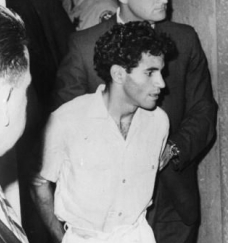
On this date in 1969, Sirhan Sirhan was condemned to the California gas chamber for assassinating Robert F. Kennedy.

The aggrieved Palestinian was not marked by fate to suffer that last extremity of the law, however; instead, his sentence was commuted to life imprisonment when all existing death penalty statutes were invalidated in 1972.*

As a result, Sirhan Sirhan remains alive as of this writing, serving that sentence in the Golden State’s Pleasant Valley State Prison. He’ll be next up for parole in 2011.

(In a parole appeal back in 1982 — he’s been on a bit of a losing streak — the convicted assassin had the chutzpah to complain that “if Robert Kennedy were alive today, I believe he would not countenance singling me out for this kind of treatment.”)

Although the guy was seen in a crowded room pulling the trigger (onlookers tackled him) and he subsequently confessed to the deed, there has long been a conspiratorial counternarrative suggesting that other shooters were there, too. It’s pretty hard to say that the guy who emptied his chamber in front of dozens of witnesses wasn’t involved, but there are versions of this where he’s a Manchurian Candidate-style hypnotized patsy.

Politics: much more interesting in the 1960s.

Precisely because that is so, this particular man’s crime attracts retrospective interest for what followed: the charismatic Democratic frontrunner from Camelot cut down; the sinister Richard Nixon arising in his place to bomb Cambodia, burgle Watergate, and create the Environmental Protection Agency. Sirhan Sirhan “assassinated modern U.S. history.”

That really seems a bit much.

Sirhan Sirhan himself has contributed to the trippy theorizing about his case by being all over the map on it. At one point, he attempted to plead guilty and draw the death penalty; the trial judge forced him to go through with a defense. Subsequently, as noted, he’s whinged for an early release. He’s claimed to have had no memory of the attack, which certainly isn’t what he said after he got arrested.

Ultimately, the most self-evident explanation has always been the first one that he offered: “I did it for my country.”

Sirhan was a Jerusalem-born Palestinian dismayed by Israel’s success in the Six-Day War, and by America’s concomitant foreign policy tilt towards Israel.

Kennedy was a strong advocate of that policy, and his death happened to coincide with the anniversary of war.

Maybe that’s just what they want you to think. But it has to be allowed that the cause in question has claimed more lives than just RFK’s.

* People v. Anderson, decided by the California Supreme Court. Later that same year, the U.S. Supreme Court would issue Furman v. Georgia, which would have had the same effect for Sirhan Sirhan.

On this day..

1919: Mehmed Kemal, for the Armenian genocide

Ninety-one years ago today,* the tottering Ottoman Empire hanged one of its officials in Istanbul for his role in the mass slaughter of its Armenian minority during the First World War.

Kemal Bey’s hanging in Bayezid Square occurred in the immediate aftermath of the Great War. Here, on its last legs, the remains of a sultanate splintered apart in the war instituted tribunals for wartime offenses by the Young Turks who had run the government during the war — a sop to the British occupying forces making worrying noises about international trials for much bigger fish.

Much testimony at the trial pointed to the governor’s fervor for massacres; an Armenian priest who survived the slaughter later wrote that a Turkish officer had told him that Kemal “made a vow on the honor of the Prophet: I shall not leave a single Armenian alive in the sanjak of Yozgat.”

A response to the New York Timesreport of the hanging noted that “his part was that of an executioner. The originators of the plan to exterminate the Armenians were primarily Enver, Tallat, and Djemal.”

These “Three Pashas” who had driven Ottoman policy during the war had fled abroad. They would be condemned to death in absentia, and though none would hang, neither would they outlive Mehmed Kemal by as much as four years.

They were among the many unpunished perpetrators of the slaughter hunted down by Armenian assassins. The latter two were avenged by Operation Nemesis; Enver Pasha died in battle in Tajikistan during the Russian Civil War.

Though overshadowed in historical import by those three, our day’s principal is distinguished as the first person executed for “crimes against humanity.”

This novelty, combined with the trial’s victor’s-justice character, were immediately controversial, and remain so in the fraught politicking around the genocide. (This genocide-denialist paper describes, on page 13, the rowdy funeral scene that erupted the next day, also attested** by annoyed British officials.)

Events would soon outstrip these tribunals and lay waste to all parties’ plans for the Ottoman carcass, incidentally leaving the Armenian issue permanently unresolved.

The month after Mehmed Kemal swung, western allies went one dismemberment too far by backing the irredentist Greek state’s landing at Smyrna — an intervention that was to backfire catastrophically for the Greeks, and help birth the Turkish Republic.

* A few secondary sources say April 12 rather than April 10, but the earlier date appears much better attested.

** e.g., a diplomatic note cited in The Burning Tigris, p. 337: “Not one Turk in a thousand will think that any other Turk deserves to be hanged for massacring Christians.”

On this day..

1199: Pierre Basile, marksman

(Thanks to Jonathan Shipley of A Writer’s Desk for the guest post. -ed.)

If you kill a king, expect swift retribution.

Expect avengers.

Expect to not live long after you deal the final fatal blow to a royal personage.

A boy, Pierre Basile, was executed on this date in 1199 for shooting King Richard the Lionhearted* with an arrow expelled from his crossbow.

The wound wasn’t fatal to Richard I; the gangrene was. (French page) Although the king pardoned the boy for the shot before dying, Richard’s right hand man, French Provencal warrior Mercadier, would hear none of it. After the king’s death, Mercadier stormed Chateau de Chalus-Chabrol, defended weakly by Basile, then flayed him alive before hanging him.

Little is known of the boy defender. Also known as Bertran de Gurdun and John Sabroz (the various names suggest we’ll never know his real name), Basile was one of only two knights defending the castle against the king’s siege.

This castle protected the southern approach to Limoges and was betwixt routes from Paris and Spain and the Mediterranean Sea and the Atlantic Ocean. The English army openly mocked its defenses as the siege continued. The ramparts were cobbled together with makeshift armor. A shield was constructed out of a frying pan.

Knowing the castle would fall sooner than later, the English were lax in their siege, though eager for the riches inside. (Supposedly within the castle walls was a treasure trove of Roman gold.)

Richard I, as feudal overlord, claimed it for himself and no boy knights were going to get in his way. The king had been in the area suppressing a revolt by Viscount Aimar V of Limoges. The viscount’s forces had been decimated by the king’s army. The riches for the win lay in the castle and Basile stood atop it.

It was early evening, March 25, 1199, when Richard walked around the castle perimeter without his chainmail on. Arrows had been shot from the ramparts by Basile but were paid little attention. The king applauded when one arrow was aimed at him. The next arrow fired struck the king in the left shoulder near the neck.


Richard the Lionhearted, mortally wounded.

The king returned to the privacy of his tent to pull it out. He couldn’t. The surgeon Hoveden, Mercadier’s personal physician, was summoned. He removed the arrow, but not swiftly, or cleanly. Gangrene quickly set in. The king asked for the crossbowman. The boy, Basile, appeared before the stricken king, expecting to be executed on the spot. The boy spoke first, saying he had tried to kill Richard because the king had killed the boy’s father and two brothers.

“Live on,” the king replied, “and by my bounty behold the light of day.”

He ordered the boy set free and, further, sent him away with 100 shillings. Deliriously jubilant at the king’s decision, the boy quickly returned to the castle.

On April 6, in the arms of his mother, Richard I died. His remains were buried at the foot of the tower from which Basile shot the arrow.

And with the king died his chivalry towards Basile.

Mercadier, who had entered the king’s service in 1184 and fought in battles in Berry and Brittany, Flanders and Normandy, brought the castle’s defenders to a swift and punishing death.

Hanging the defenders, he took the boy and flayed him first — that is, he removed the boy’s skin while he was still alive. Then Pierre Basile was hung, and his body consigned in an unmarked grave.

* Last seen in these parts slaughtering Muslims on Crusade.

On this day..

1910: Ahn Jung-geun, Korean nationalist

A century go today, Korean independence martyr Ahn Jung-geun (or An Jung-geun) hanged at Port Arthur for assassinating Japanese statesman Ito Hirobumi.

Ahn Jung-geun, who was also a skilled calligrapher (his epigram, “Unless reading everyday, thorns grow in the mouth” is well-known in Korea), actually had a more visionary pan-Asianist agenda than his nationalist byline might initially suggest.

But he militantly opposed Japan’s annexation of the peninsula, and won his hero stature for gunning down Ito in Manchuria.

Ito, for his part, is a national hero in Japan for establishing that country’s parliamentary government and serving as its first Prime Minister.

So, yeah. Still a spot of tension over this incident.

Because the Japanese worried that “if Ahn Jung-geun’s body is handed over to the surviving family or impudent Koreans … it will not be good in the future,” its ultimate deposition has become an enduring historical mystery, with China the current likely suspect. Koreans’ intensified hunt for records pointing to Ahn’s grave has been much in the news during the centennial run-up.

Wherever his bones rest, the Korean patriot (as the saying has it) lives on. He’s even been posthumously promoted by the South Korean army to the rank of “General”.

The recent Korean film 2009 Lost Memories is premised on an radically different alternate timeline starting when Ahn is prevented from killing Ito. Here’s its aesthetically appealing climax, when history is righted.

Scrabbel put the Ahn Jung-geun story to music.

On this day..

1945: Friedrich Fromm, Claus von Stauffenberg’s executioner

On this date* in 1945, Friedrich Fromm found out that you have to pick a side.

The cunning career army officer had been serving as the head of the Replacement Army.

This position provided access to the Fuhrer for Fromm — and for his chief of staff, Col. Claus von Stauffenberg. And it gave his office the authority to issue the “Valkyrie” orders for quelling civil unrest that Stauffenberg’s circle would use to attempt to seize Berlin.

Fromm realized that his underling was involved in a plot against the Nazi dictator, but neither joined it nor smashed it.

This play-it-safe approach turned out not to be safe at all. When Stauffenberg’s attempt to assassinate Hitler failed, Fromm hastily attempted to cover his tracks by summarily executing Stauffenberg and co-conspirators.

Not all that subtle, really. “You’ve been in a damned hurry to get your witnesses below ground,” Joseph Goebbels sneered.

Heinrich Himmler quickly had Fromm arrested. “Fate does not spare the man whose convictions are not matched by his readiness to give them effect,” wrote July 20th conspirator Hans Speidel. (As cited by Shirer.)

Although in Friedrich Fromm’s case, that wasn’t entirely true.

In recognition of the general’s calculated but not-unhelpful show of loyalty on the decisive date (enacted when Fromm realized the plotters had made a dog’s breakfast of everything) Hitler generously permitted the general to be “honorably” shot … rather than strangled from a meathook.

* Some sources give March 12, rather than March 19. I have been unable to establish primary documentation, but the sites for March 19 are far more numerous. (Years-later update: I probably got this wrong. I’d be better inclined to believe March 12.)

On this day..

1880: Ippolit Mlodetsky, Loris-Melikov’s would-be assassin

If you were a person of any privilege or official authority in late 19th century Russia, chances are that Narodnaya Volya was planning to take a shot at you.

If you were General Loris-Melikov, a Ukrainian Jew did that to you two days before this date in 1880.*

And if you were that errant assassin, Ippolit Mlodetsky, this was your execution date.

Even though Melikov rated as something of a liberal on the Russian autocracy spectrum, he had no qualms about ordering legal proceedings barely this side of summary.

Gen. Melikoff, on Wednesday evening, ordered a court-martial to assemble on Thursday morning. The trial of the prisoner was opened at 11 o’clock in the morning. The prisoner was insolent in his language and demeanor, and refused to stand up or take any part in the proceedings. He said he had nothing to add … that he did not want to be troubled any more, and wanted the matter finished. … at 1 o’clock … judgment was pronounced against him. The judgment on the prisoner sentenced him to be hanged, and his execution was appointed for 10 o’clock this (Friday) morning on the Simeonofsky Plain, near the Tsarskoe-selo Railway terminus.

And so he was.

Mlodetsky’s public hanging was witnessed by novelist Fyodor Dostoyevsky in the very square where Dostoyevsky himself had faced mock-execution for revolutionary activity 30 years before.

Dostoyevsky was, even then, pulling together his magnum opus, The Brothers Karamazov.

The very day Mlodetsky tried to kill Melikov found Fyodor Mikhailovich chatting with fellow reactionary journalist Aleksey Suvorin about the plague of terrorism and its accompanying social malaise.

On the day of the attempt by Mlodetsky on Loris Melikov I was with F. M. Dostoyevsky.

… Neither he nor I knew anything about the assassination. But our conversation presently turned to political crimes in general, and a [recent] explosion in the Winter Palace in particular. In the course of talking about this, Dostoyevsky commented on the odd attitude of the public to these crimes. Society seemed to sympathize with them, or, it might be truer to say, was not too clear about how to look upon them … (Quoted here.)

Dostoyevsky in this conversation revealed that for the planned sequel to The Brothers Karamazov — never to be realized in the event —

he was going to write a novel with Alyosha Karamazov as the hero. He planned to bring him out of the monastery and make a revolutionary of him. He would commit a political crime. He would be executed.

(Much more about this sequel in this paper.)

Melikov’s brush with death did not dissuade him from continuing to push for constitutional reforms as the antidote to terrorism, including introduction of a parliament. Tsar Alexander II was on the point of implementing that proposal … when he himself was assassinated by Narodnaya Volya, precipitating a political backlash.

That murder of Alexander II helped put the kibosh on the Karamazov sequel, which would thereafter have become politically problematic.

Nor was that the only artistic casualty of the Russian terrorists.

A discomfiting thematic similarity in Mlodetsky’s execution with that of the protagonist resulted in the cancellation of a just-opened opera: The Merchant Kalashnikov. (It would be a few more decades before that connection could appear ironic.)

* The assassination attempt occurred on February 20, with the execution on February 22, according to the Julian calendar still in use in Russia at that time. By the then-12-days-later Gregorian calendar, the dates were March 3 and March 5, respectively.

On this day..

1951: Charlie Gifford, politician-killer

On this date in 1951, Charlie Gifford was electrocuted in Florida’s Raiford Prison for murder.

The murder victim was popular young Florida legislator/war hero Charles Schuh, whose promising political career ended abruptly on April 24, 1950, when the 71-year-old Gifford strode into his St. Petersburg offices and shot him dead over some head-scratching private grievance relating to Schuh’s legal practice. (Schuh represented Gifford’s ex-wife in a divorce proceeding.)

An insanity defense didn’t fly, though Gifford’s purchase on reality seems to have been … hit and miss. The septuagenarian perp didn’t seem to mind the death sentence.

The murdered legislator’s son, Charles E. Schuh, grew up into a political career of his own, eventually becoming mayor of St. Petersburg. Charles E. Schuh’s recent passing brought out this fascinating story by a former reporter who witnessed Gifford’s execution.

The electric chair was in the center, but the controls were behind a glass-enclosed area. I was repelled by the sight of “Old Sparky,” the electric chair. I was even more horrified to see that the executioner, a local electrician, wore a black hood reminiscent of the Inquisition. …

Today I am a decade older than Gifford was then, but to a 22-year-old reporter he seemed to be just a frail old man with a shaved head.

On this day..