1603: The men of the Bye Plot, but not those of the Main Plot

On this date in 1603, priests William Watson and William Clark were executed for a dramatic (that is, harebrained) plot “to take away ‘the KINGE and all his cubbes.'”

The year was 1603, the first in the reign of James I. (However, he’d been James VI of Scotland since the tender age of 13 months, when his mother Mary, Queen of Scots had been forced to abdicate. He made himself quite a reputation for witch-hunting.)

With the death of the Protestant Queen Elizabeth and all her schismatic Anne Boleyn mojo, hard-pressed English Catholics greeted Jamie’s ascension hopeful of relief from official persecution. Although raised Protestant, both his parents had been Catholic.

Watson was one of these hopeful adherents, and hastened himself to Scotland as Queen Elizabeth lay ailing to extract from the future English monarch the soothing blandishments of good favor that future monarchs make.

When toleration was not extended to Catholics upon the new king’s elevation in late March 1603, the disenchanted Watson almost immediately embarked on a preposterous scheme to

assemble force and strengthe, and on Midsommer-day last, in the night, to come to the Parke pale at Grenewich, to enter in by the gardein with a key, that should be borowed; and when the numbers were come in, there should be a watche set at the dores of principall persons, and at the passages; and then to goe up to the KING’S loding. And when they cam to the KING, they should surprise his person, and carry him to the Tower, and they would move him for 3 things: — 1, for there pardon; 2, for tolleration of relligion; 3, for assuraunce thereof, to preferre Catholiques to places of credit, as WATZON the priest to be Lord Keper; GREY, Erle Marshall; GEORGE BROOKE, Lord Treasorer; and MARCAM, Secretary. They concluded to cutt of many of the Privy Councill, and to have made a Proclamation, purporting howe the KING had bene misled, and to have had many things reformed. They determined to have possessed the principall ports of the realme, and to have kept the KING in the Towre a quarter of a yeare.

The Bye Plot was ironically busted by other Catholics — Jesuits, as distinct from “secular clergy” (clergy not affiliated with an order) like Watson. Jesuits and secular clergy were at loggerheads in this period over tactics, church structure … more or less everything. The need to steal the thunder of whatever restore-the-Church scheme the Jesuits might be cooking up might have helped precipitate Watson into such immediate and desperate disaffection.

At any rate, these other more respectable fathers of the church blew the whistle on the Bye Plot lest it provoke anti-Catholic pogroms, and you’d have to concur with their estimate that taking the king hostage is the sort of thing that would have prompted some blowback.

In the course of rolling up the now-exposed Bye Plot, investigators also caught wind of the parallel Main Plot, courtesy of one conspirator who was involved in both and unable to hold his tongue under torture.

The Main Plot was a sketchier affair to a similar end, allegedly among Catholic-sympathizing nobles to depose James for his cousin. As befits its title, the Main Plot implicated much bluer blood than Watson’s: Lord Cobham,* Baron Grey, and the knighted soldier Griffin Markham.

Oh, and a guy you might have heard of by the name of Walter Raleigh.

All these Main Plot gentlemen were likewise condemned to death. December 9, 1603 was the date appointed for Watson and Clark to expiate the Bye Plot in the grisly manner that commoner priests were wont to suffer in that age — they as the undercard to the beheadings of Cobham, Grey, and Markham. (Raleigh was on deck for a later date.)

The drama that unfolded on the Winchester scaffold that day was wonderfully narrated in the correspondence of Sir Dudley Carleton and well worth extracting at length.

The two priests that led the way to the execution were very bloodily handled; for they were both cut down alive; and Clarke, to whom more favour was intended, had the worse luck; for he both strove to help himself, and spake after he was cut down. They died boldly both … Their quarters were set on Winchester gates, and their heads on the first Tower of the castle.

Warrants were signed, and sent to Sir Benjamin Tichborne, on Wednesday last at night, for Markham, Grey, and Cobham, woh in this order were to take their turns … A fouler day could hardly have been picked out, or fitter for such a tragedy. Markham being brought to the scaffold, was much dismayed, and complained much of his hard hap, to be deluded with hopes and brought to that place unprepared. One might see in his face the very picture of sorrow; but he seemed not to want resolution … [and] prepared himself to the block. The sheriff, in the mean time, was secretly withdrawn … whereupon the execution was stayed, and Markham left upon the scaffold to entertain his own thoughts, which, no doubt, were as melancholy as his countenance, sad and heavy. The sheriff, at his return, told him, that since he was so ill prepared, he should yet have two hours respite, so led him from the scaffold, without giving him any more comfort, and locked him into the great hall … The lord Grey, whose turn was next, was led to the scaffold by a troop of the young courtiers … and thereupon entered into a long prayer for the king’s good estate, which held us in the rain more than half an hour; but being come to a full point, the sheriff stayed him, and said, he had received orders from the king, to change the order of the execution, and that the lord Cobham was to go before him … he had no more hope given him, than of an hour’s respite; neither could any man yet dive into the mystery of this strange proceeding.

The lord Cobham, who was now to play his part, and by his former actions promised nothing but matiere pour rire, did much cozen the world; for he came to the scaffold with good assurance, and contempt of death. … [he] would have taken a short farewel of the world, with that constancy and boldness, that we might see by him, it is an easier matter to die well than live well.

He was stayed by the sheriff, and told, that there resteth yet somewhat else to be done; for that he was to be confronted with some other of the prisoners, but named none. So as Grey and Markham being brought back to the scaffold, as they then were, but nothing acquainted with what had passed, no more than the lookers-on with what should follow, looked strange one upon the other like men beheaded, and met again in the other world. Now all the actors being together on the stage (as use is at the end of a play,) the sheriff made a short speech unto them, by way of the interrogatory of the heinousness of their offences, the justness of their trials, their lawful condemnation, and due execution there to be performed; to all which they assented; then, saith the sheriff, see the mercy of your prince, who, of himself, hath sent hither to countermand, and given you your lives. There was then no need to beg a plaudite of the audience, for it was given with such hues and cries, that it went from the castle into the town, and there began afresh, as if there had been some such like accident. And this experience was made of the difference of examples of justice and mercy; that in this last, no man could cry loud enough, ‘God save the King;’ and at the holding up of [the previously executed] Brookes’s head, when the executioner began the same cry, he was not seconded by the voice of any one man, but the sheriff. You must think, if the spectators were so glad, the actors were not sorry; for even those that went best resolved to death, were glad of life … Raleigh, you must think (who had a window opened that way), had hammers working in his head, to beat out the meaning of this strategem. His turn was to come on Monday next; but the king has pardoned him with the rest, and confined him with the two lords to the Tower of London, there to remain during pleasure.

Turns out that James wanted to do only the minimum amount of butchery necessary to establish his bona fides, and it sure seems like the mercy play proved a public relations triumph.** Raleigh was left by this reprieve languishing in the Tower for years, before his own final adventure saw him to the block after all in 1618.

Would you like some bootless speculation that Raleigh’s being caught up in this mess led him to nurture during his imprisonment a decade-long grudge against William Shakespeare and eventually murder the playwright? Of course you would.

In the world of more demonstrable historical consequences, the failure of these plots and continuing frustration with Catholics’ lot under a new boss who seemed a lot like the old led two years later to the ne plus ultra of English sectarian terrorism, Guy Fawkes‘s Gunpowder Plot to blow King James and his court straight to kingdom come.

* Cobham was a descendant of John Oldcastle and is supposed to have forced Shakespeare to redact the family name in his Henry V plays — giving us, instead, the character of Falstaff.

** One is obliged to notice Carleton’s disquieting footnote indicating that the entire affair was staged so well that someone almost actually lost his head:

… there was another cross adventure; for John Gib could not get so near the scaffold, that he could speak to the sheriff, but was thrust out amongst the boys, and was fain to call out to sir James Hayes, or else Markham might have lost his neck.


Topical sourcing: Mark Nicholls, “Treason’s Reward: The Punishment of Conspirators in the Bye Plot of 1603” The Historical Journal, Vol. 38, No. 4 (Dec., 1995).

On this day..

1969: Nahashon Isaac Njenga Njoroge, assassin of Tom Mboya

At 3 a.m. this date in 1969 at a Nairobi prison that Nahashon Isaac Njenga Njoroge swung for assassinating Kenyan Luo politician Tom Mboya earlier that year … never clarifying the cryptic question he uttered to the authorities, “Why don’t you go after the big man?”

“No African leader has an abler brain or a stronger will,” wrote one Englishwoman who knew Mboya during his lifetime.*

A trade unionist during the waning days of British authority, the ethnically Luo Mboya had become a leading anti-colonial figure as the ethnically Kikuyu Mau Mau were suppressed.

During Kenya’s last years as a British possession, Mboya organized the African American Students Foundation, to provide scholarships for students from British East Africa to study in the United States.

(It was on Mboya’s AASF program — funded by John F. Kennedy — that a promising young Kenyan economics student named Barack Obama studied at the University of Hawaii in the 1960-61 academic year, and got an American girl pregnant. The reader will be familiar with those semesters’ legacy.)

Upon Kenyan independence, Mboya became a Member of Parliament and a cabinet officer, holding the Economic Planning and Development portfolio until he was gunned down on the streets outside a pharmacy on July 5, 1969.

Mboya’s murder by Njoroge,** a youth activist for the Kikuyu-dominated Kenya African National Union party (KANU) that Mboya himself had also joined, was widely read as President Jomo Kenyatta consolidating his own grip on the country and eliminating potential rivals.†

Mboya certainly had the talent and ambition to aspire to leadership in Kenya; little wonder that anger among his Luo people boiled over when Mboya was laid to rest.

Njoroge’s hanging during the pre-dawn hours this date — just days after Kenyatta banned the Luo-based opposition party, making Kenya into a one-party state — was conducted in secret; word only got out in late November, and even then it was not through an official announcement.

Njoroge remains the official lone gunman in this case, the only person ever held to judicial account for Tom Mboya’s convenient elimination. Decades later, however, many are still searching for the real story.

* From the London Times‘ unsigned July 7, 1969 obituary of Mboya.

** Allegedly by Njoroge; the assassin was not caught on the scene and Njoroge denied pulling the trigger, telling the court that Mboya was his longtime friend. (London Times, September 10, 1969) There are plenty who consider Njoroge a fall guy.

Pio Gama Pinto (1965) and Josiah Mwangi Kariuki (1975) were similar

On this day..

1978: Seventeen officers in Somalia

Seventeen army officers were shot this day on the outskirts of Mogadishu for attempting to overthrow Somali dictator Siad Barre.

“The executions were carried out by by a firing squad formed of soldiers of the armed forces and were witnessed by thousands of people from all areas of Mogadishu,” said Mogadishu radio.

The abortive April 9 coup attempt seems to have been precipitated by Somalia’s ill-fated intervention in neighboring Ethiopia’s Ogaden region, a bloody little Cold War sideshow that saw both the U.S. (from Ethiopia, to Somalia) and Soviet Union (from Somalia, to Ethiopia) switch sides. Some of the officers concerned feared that Siad would come a-purgin’ after the last Somali forces slunk home on March 15, 1978.

The condemned (per this source) were:

  • Col Mohamed Sheikh Osman “Cirro”
  • Maj Siad Mohamed Jama
  • Maj Ibrahim Mohamed Hersi
  • Maj Siad Jama Nur
  • Capt Mohamed Ahmed Yusuf Aganeh
  • Capt Abdisalan Elmi Warsame
  • Capt Bashir Abshir Isa
  • Capt Abdillahi Hasan Nur
  • Lt Abdi Osman Ugas
  • Lt Abdirahman Maalin Bashir
  • Lt Adan Warsame Abdillahi
  • Lt Abdillahi Mahamud Guled
  • Lt Mohamed Abdullahi Husein (Gorod)
  • Lt Abdulwahab Ahmed Hashim
  • Lt Abdulqadir Gelle Omar
  • Sgt Farah Mohamed Halwo
  • Director Abdulqafar Warsame Abdilleh

But they’re perhaps most memorable for a coup participant not among their number, Abdullahi Yusuf Ahmed, who fled to Kenya and founded from exile the Somali Salvation Democratic Front, eventually one of the principal entities resisting the Barre regime. Ahmed served as President of Somalia from 2004 to 2008, but his government was unable to gain control of the notoriously fractious state or to end Somalia’s ongoing civil war.

On this day..

1586: Anthony Babington and fellow plotters, Walsingham’d

The recently completed papal visit to England has summoned many a recollection of that country’s traumatic break from the Church. (As well as more recent embarrassments.)

While we know the schism from the comfort of retrospection, those present for its 16th century inception (and long afterward) had the task of sorting out winners and losers on blood-soaked scaffolds.

So we pause this date to note the extirpation September 20 and 21 of the Babington Plot, a half-baked scheme to re-establish the Old Faith that turned into one of history’s signature achievements of espionage.

Its namesake, young Sir Anthony Babington, was a secret Catholic with more money than sense; like many a Catholic of this time, he bristled under the rule of Elizabeth I, the daughter of the very woman who started all this English Reformation trouble.

Besotted with fellow-Catholic Mary Queen of Scots after having served as her page in his youth, Babington was easy prey for the fellow invariably described as Elizabeth’s “spymaster”Francis Walsingham.

Not one for scruples where his own security or his sovereign’s was concerned, Walsingham had long considered Mary Queen of Scots too dangerous to be left alive: every Catholic plot against Elizabeth intended to replace her on the throne with this Catholic cousin.

Trying to overcome Elizabeth’s reluctance to off fellow royalty — dangerous precedent, in these dangerous times — Walsingham entrapped Babington and a coterie of other Catholics into designing and documenting a scheme to assassinate Elizabeth and support a Spanish invasion.

And most importantly to Walsingham, they got Mary to sign off on it.

Though the design was grandiose, the real danger was pretty much nil — since Walsingham, a Renaissance reconnaissance man famous for his continent-spanning intelligence network, had penetrated the circle months before.* Walsingham let the conspiracy ripen long after he had the goods on the likes of Babington, intending to make it the instrument of Mary’s destruction. He succeeded.

Coded correspondence that Mary thought she was smuggling in and out of her cell was in fact being intercepted and decrypted.

When Babington wrote to her, alluding to his intent with “six noble gentlemen” to murder Queen Elizabeth, Mary doomed herself with a favorable reply:

The affair being thus prepared, and forces in readiness both within and without the realm, then shall it be time to set the six gentlemen to work; taking order upon the accomplishment of their design, I may be suddenly transported out of this place.

Within days, all — Mary, Babington, six gentlemen, and more — were in chains, and the commoners were being tortured into confessions and implications.**

The reckoning for Mary Queen of Scots would not arrive for some months yet.

But those of lesser breeding were dispatched with dispatch. Tried in two bunches, there were 14 in all condemned; on this date, Babington, was hanged, drawn and quartered for treason, along with accomplices John Ballard, Thomas Salisbury, Robert Barnewell, John Savage, Henry Donn and Chidiock Tichborne — the last of these leaving behind this doleful poetic adieu:

Elegy

My prime of youth is but a frost of cares,
My feast of joy is but a dish of pain,
My crop of corn is but a field of tares,
And all my good is but vain hope of gain;
The day is past, and yet I saw no sun,
And now I live, and now my life is done.
The spring is past, and yet it hath not sprung;
The fruit is dead, and yet the leaves be green,
My youth is gone and yet I am but young,
I saw the world and yet I was not seen;
My thread is cut and yet it is not spun,
And now I live, and now my life is done.
I sought my death and found it in my womb,
I looked for life and saw it was a shade,
I trod the earth and knew it was my tomb,
And now I die, and now I am but made;
My glass is full, and now my glass is run,
And now I live, and now my life is done.

-Chidiock Tichborne

(Hear this bummer of a verse read aloud here and here.)

The torture these first seven unfortunates endured as their entrails were ripped from their still-living bodies was so horrible that Elizabeth ordered the seven others awaiting execution the next day simply to be hanged to death before all the disemboweling business.†

A few books about spymaster Francis Walsingham

* Walsingham had plenty of plots to contend with, but did Elizabeth even greater service keeping tabs on the buildup of the Spanish Armada through a spy network in Italy — even using it to delay the invasion by a crucial extra year by drying up Spain’s credit line with Italian bankers. (Source, via (pdf))

Incidentally, and completely off topic: the subversive, forward-thinking philosopher Giordano Bruno — an Italian who was eventually executed by the Inquisition — has been alleged to be one in Walsingham’s employ.

** Luckily for Elizabeth, the treasonous Protestants who supported her back when she was at the mercy of her Catholic half-sister Mary Tudor were better able to hold their tongues under duress.

† One of those executed on September 21, Charles Tilney, has an oblique Shakespeare connection: he’s one possible author of the play Locrine, which Shakespeare might have revised and/or staged; Locrine is in the Shakespeare Apocrypha.

On this day..

1661: Kaj Lykke, in effigy

On an uncertain date in 1661, the Danish noble Kaj Lykke (sometimes Kai Lykke) — safely but penuriously absconded to exile — was “executed” in effigy.

This wealthy roue (Danish Wikipedia page) was famous for his affairs innumerable.

To one of these maids, Lykke addressed a love-note remarking that the unpopular queen consort Sophie Amalie enjoyed queen consorting with her servants.

The sort of salacious rumor-mongering that constitutes many a blogger’s daily bread (and no doubt many a debauched noble’s pillow-talk) was, in Denmark at the dawn of its absolute monarchy, lese-majesty, and a good excuse once it became known to seize the naughty noble’s riches for the crown.

Lykke got himself abroad and didn’t have to face the music in the flesh — though the forfeited estates were no mean loss — and a doll representing the dirty-minded fugitive had its hands and head lopped off in Lykke’s stead in Copenhagen.

Kaj Lykke returned from exile (Swedish link) and died in Denmark in 1699. Centuries later, his skull was unearthed pursuant to eugenics research: the theory was that this bad boy’s sloping forehead showed him to be a primitive Neanderthal-descended type.

Though that particular bit of pseudo-science has long since been buried, Lykke’s skull never has been — and given that it’s out and about anyway, it’s been used to reconstruct the noble’s appearance. (I’ve been unable to locate an image of this reconstruction online.)

Part of the Themed Set: Executions in Effigy.

On this day..

1951: Antonio Riva and Ruichi Yamaguchi

On this date in 1951, the first two foreigners — Italian merchant Antonio Riva and Japanese bookseller Ruichi Yamaguchi — were convicted and immediately executed in Beijing for a supposed plot to assassinate Mao Zedong.

According to Time magazine’s coverage of the affair, Radio Peking said that

“the streets they passed through [en route to execution] were thronged with people who expressed their feelings .. . with shouts of ‘Down with imperialism! Suppress counterrevolutionaries! Long live Chairman Mao!'”


No relation.

Riva (English Wikipedia entry | Italian) was a World War I fighter ace who had relocated to Beijing/Peking in the 1920s to peddle aircraft and training the Chinese Koumintang.

(In 1936, Riva married Catherine Lum, the daughter of American wood block artist Bertha Lum and sister of Eleanor Peter Lum, who took after mom.)

When the guys those planes were being used against won the Chinese Civil War, Riva mulled an expedient departure, but reportedly declared (Spanish link) that he could do business under any regime type.

The Communist government decided he had a different sort of business in mind. Citing Chinese state media, the London Times (Aug. 18, 1951) described the plot thus:

the conspirators planned to fire mortar shells at a reviewing stand outside the Tien An gate of the forbidden city in Peking during a procession to celebrate China’s national day on October 1 last year.

Several others, both Chinese and foreigners, drew long prison sentences as part of the “conspiracy” uncovered in a one-hour trial. The most illustrious of those was the Italian bishop Tarcisio Martina.*

Though Riva and Yamaguchi were the first foreigners officially executed by the new Chinese government, they were far from the last. All the more remarkable, then, that in a country that carries out thousands of executions per annum, Antonio Riva is thought to have been the last European citizen put to death there until Akmal Shaikh in 2009.

The Shaikh case helped rekindle interest in Riva’s execution — a timely confluence, since a recent book, L’ uomo che doveva uccidere Mao, critiqued the case against the Italian aviator.

* American diplomat Col. David Barrett, safely beyond the reach of the Maoists at Formosa, was a supposed ringleader.

On this day..

1878: Max Hödel

On this date in 1878, journeyman tinsmith Max Hödel was beheaded in Berlin’s New Prison for taking a potshot at Kaiser Wilhelm I.

Nothing daunted by the prospect of trading his life for an 81-year-old* man’s, this propagandist of the deed tried to kill the conservative German emperor in May of 1878. He missed his target, but killed a bystander.

(Hodel’s cover story that he was just trying to blow his own brains out, not shoot the emperor, was belied by a number of hints he had given to others prior to the attack — e.g., telling a photographer who took his picture that the photo would soon be worth thousands.)

Just weeks after Hodel’s miss, another unsuccessful attempt to kill the emperor was undertaken by Karl Nobiling. Though Nobiling died of self-inflicted injuries, Hodel had to make do with decapitation.

Reichstag fire-like, these two outrages provided the Reich sufficient pretext to outlaw the Social Democratic Party** — even though the gunmen were much more radical types than this. (Hodel himself had previously been booted from the SDP.)

Germans having taken a front-row seat to the Paris Commune just a few years before, Chancellor Otto von Bismarck had no intention of allowing radical organizing of any variety to pick up any steam.

Coincidentally, our day’s protagonist shares an execution date with the next generation’s (better) anarchist assassin, Sante Geronimo Caserio — guillotined 16 Aug. 1894 for killing the French president.

* And he was right: nature didn’t take its course with Kaiser Wilhelm for nine more years; he missed outliving his own son and heir by a mere three months.

** Engels — writing polemically, of course — reckons over 11,000 political prisoners arrested from 1879 to 1880 alone.

On this day..

1501: Antonio Rinaldeschi, bad gambler

This date in 1501,* the Italian city-state of Florence celebrated a “double feast”: that of St. Mary Magdalene, which marked a civic carnival every July 22; and, the hanging of sacrilegious gambler Antonio Rinaldeschi on the walls of the Bargello.

Eleven days prior, Rinaldeschi was having a bad run of wagering at The Fig Tree tavern.

Like Jesus is some people’s co-pilot, the Virgin Mary must have been Rinaldeschi’s card-counter — for, stalking out of the premises much the poorer, our doomed punter blasphemously uttered “words that are better kept silent” about her. Then, passing an image of Holy Mother at the piazza Santa Maria de Alberighi, he gathered up some nearby dung and flung it at the sacred pic.

This dry poo maybe should have just slid right off, but the Lord works in mysterious ways.

Write William Connell and Giles Constable in “Sacrilege and Redemption in Renaissance Florence: The Case of Antonio Rinaldeschi” (Journal of the Warburg and Courtauld Institutes, vol. 61 (1998), and the source of most of this entry’s narrative),

a portion of it, resembling a rosette (‘quasi pareva una rosetta secha’), stuck to the Virgin’s diadem, above the nape of her neck. The dirtied image drew much attention. The archbishop came to look. Candles and votive images were brought before the fresco, which quickly became an object of popular devotion.

Someone saw something and the trail led back to the ill-tempered cardsharp within days, who tried to stab himself to death when he realized what was about to go down. He copped to the crime pretty quickly (at least one source says it was so that he could be executed in preference to being lynched), and his corpse dangling out the Bargello window decorated the other Mary’s regularly-scheduled homage of parades and horse-races.

(And, now that it was no longer needed as evidence, the miraculous ordure was cleaned off the statue.)

Florence at the dawn of the 16th century was truly a place where religion could get you killed. This was the city that had elevated severe Dominican friar Savonarola to dictator and morals enforcer in the 1490s (Savonarola especially hated gambling), then overthrew and burned him in 1498.

Our authors think there’s some evidence that the first couple years of the 1500s were a period when the populist religious fanatics who once grooved on Savonarola’s violent party pooper act were back on the march as against, say, the more out-of-touch syphilitic reckless gambling blasphemer element that was now, post-Savonarola, enjoying free run of the town. Having one of the latter excrement-ize a Marian monument is the sort of thing that would have led the Florentine Fox News: naturally, he had to be made an example of.

To help you bear that example in mind, a nine-panel painting, “The History of Antonio Rinaldeschi”, attributed to the hanged man’s contemporary Filippo Dolciati, can be seen in Firenze’s Stibbert Museum.

Madonna + manure, meanwhile, has its own art legacy … and the combination is still good for raising a ruckus to this day.


The Holy Virgin Mary, by Chris Ofili: a black Mary smeared with elephant dung.

* The primary sourcing on the chronology of the execution is sketchy enough that it’s possible Rinaldeschi was hanged on July 21, before midnight — rather than in the dark early hours of July 22.

On this day..

1892: Ravachol, anarchist terrorist

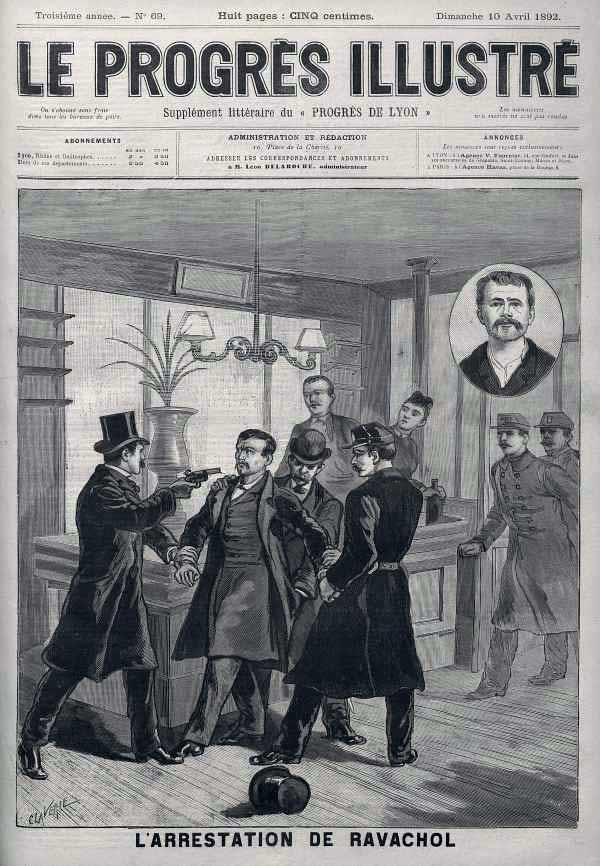
On this date in 1892, French anarchist François Claudius Koenigstein — better known as Ravachol — was guillotined at Montbrison for a series of bomb attacks on right-wing judges.

He took the name “Ravachol”, his mother’s, after his Dutch father ditched his mom, leaving the family in poverty.

Young Ravachol supported himself as best he could in proletarian labor and crime, as he attempted to observe* at his trial.

Ravachol, as painted by Charles Maurin.

There are many people who will feel sorry for the victims, but who’ll tell you they can’t do anything about it. Let everyone scrape by as he can! What can he who lacks the necessities when he’s working do when he loses his job? He has only to let himself die of hunger. Then they’ll throw a few pious words on his corpse. This is what I wanted to leave to others. I preferred to make of myself a trafficker in contraband, a counterfeiter, a murderer and assassin. I could have begged, but it’s degrading and cowardly and even punished by your laws, which make poverty a crime. If all those in need, instead of waiting took, wherever and by whatever means, the self-satisfied would understand perhaps a bit more quickly that it’s dangerous to want to consecrate the existing social state, where worry is permanent and life threatened at every moment.

Personal want segued into political conviction for Ravachol, whose crimes were justified by the principle of reprise individuelle.

And the political led him to reprisals of a less individual nature, when French state violence against radicals caused him to dynamite several magistrates’ homes.

He was caught in a restaurant,** brought to trial, and let off with penal servitude for life. Then another jury, intimidated by public outcry, reversed the decision and sent him to the guillotine.

The Banquet Years: The Origins of the Avant-Garde in France 1885 to World War I, which argues that anarchists “unsettle[d] the political smugness of the Third Republic … [and] challenge[d] any formulated aesthetic. The dynamism of prewar artistic activity ran a close parallel to anarchism; postwar Dada and surrealism look like its artistic parodies†.”

Anarchism, that revolutionary specter stalking fin-de-siecle Europe, burnt its fuse at both ends, but Ravachol’s falling head‡ left a legacy for his fellow-travelers. The next year, Auguste Vaillant tossed a bomb into the French Chamber of Deputies to avenge Ravachol. (Vaillant was himself guillotined, and himself avenged by Emile Henry and Sante Geronimo Caserio.)

Ravachol was also honored in a song, La Ravachole — set to the jauntily menacing tune of La Carmagnole, it cheers, “Long live the sound of the explosion!”

* This incendiary speech was cut off by the court.

** The table where the terrorist was nabbed got its own inscription: “Here ate Ravachol the day of his arrest.”

† e.g., Dadaist Marcel Janco‘s recollection:

We had lost confidence in our culture. Everything had to be demolished. We would begin again after the ‘tabula rasa’. At the Cabaret Voltaire we began by shocking common sense, public opinion, education, institutions, museums, good taste, in short, the whole prevailing order.

‡ Ravachol was guillotined midway through a parting exclamation, “Vive la Re-“. Initial newspaper reports implausibly rendered this as the patriotic classic “Vive la Republique!” rather than a much more in-character word like, oh, “Revolution”.

Weeks of controversy ensued over some witnesses’ claims that the head post-severing had actually completed the word “-publique”, a notion of a piece with the idea that the severed head survives decapitation by a few seconds. Scienticians countered that obviously excited witnesses were maybe hearing air escaping from the headless trunk and filling in the rest of the scene in their heads.

On this day..

1591: Euphane MacCalzean, witch

If there’s one thing King James VI of Scotland (eventually to also become James I of England) worried a lot about, it was witches.

The Al Qaeda of the 16th century imagination, those shadowy yet omnipresent necromancers were especially feared around this time for their powers of supernatural mayhem, and you can take your pick on the phenomenon’s psychosocial explanation. (It was hardly limited to Scotland.)

Whatever it was, King James had it in spades.

The son of one executed monarch and father of another, James kept head tightly fixed to shoulders all his own days, and he used it to write the (well, a) book on witch-hunting.

THE fearefull aboundinge at this time in this countrie, of these detestable slaues of the Deuill, the Witches or enchaunters, hath moved me (beloued reader) to dispatch in post, this following treatise of mine, not in any wise (as I protest) to serue for a shew of my learning & ingine, but onely (mooued of conscience) to preasse / thereby, so farre as I can, to resolue the doubting harts of many; both that such assaultes of Sathan are most certainly practized, & that the instrumentes thereof, merits most severly to be punished: against the damnable opinions … not ashamed in publike print to deny, that ther can be such a thing as Witch-craft.

Daemonologie

You couldn’t fault the guy for a lot of daylight between his principles and his practices.


With a deft political touch, Shakespeare wrote Macbeth after James ascended the English throne as James I.

In 1589, Jamie sailed to Denmark to wed a Danish princess. When ferocious storms nearly wrecked the royal convoy on its return trip, there was only one possible explanation: witchcraft. And security theater for 16th century Scotland wasn’t taking your shoes off when ferrying across the nearby loch — it was publicly burning human beings to death for consorting with the devil.

So once the king made it back home, he initiated the North Berwick Witch Trials, the first notable witch-hunt of his reign.

It was what you’d expect. Seventy people accused, the doomed tortured into confessions like Jack Bauer would do, and a respectable harvest of souls, most famously (because interrogated by the king himself) Agnes Sampson. “Most of the winter of 1591,” writes one chronicler, “was spent in the discovery and examination of witches and sorcerers.”

Our day’s principal, whose name has various different renderings (such as Eufame Mackalzeane), was the last to suffer for some months.

Euphan McCalzeane was a lady possessed of a considerable estate in her own right. She was the daughter of Thomas McCalzeane, lord Cliftenhall, one of the senators of the college of justice, whose death in the year 1581 spared him the disgrace and misery of seeing his daughter fall by the hands of the executioner. She was married to a gentleman of her own name, by whom she had three children. She was accused of treasonably conspiring of the king; of raising storms to hinder his return from Denmark; and of various other articles of witchcraft. She was heard by counsel in her defense; was found guilty by the jury, which consisted of landed gentlemen of note; and her punishment was still severer than that commonly inflicted on the weyward sisters; she was burned alive, and her estate confiscated. Her children, however, after being thus barbarously robbed of their mother, were restored by act of parliament against the forfeiture. The act does not say that the sentence was unjust, but that the king was touched in honour and conscience to restore the children. But to move the wheels of his majesty’s conscience, the children had to grease them, by a payment of five thousand merks to the donator of escheat, and by relinquishing the estate of Cliftonhall, which the king gave to sir James Sandilands, of Slamanno.

As a striking picture of the state of justice, humanity, and science, in those times, it may be remarked, that this sir James Sandilands, a favourite of the king’s, ex interiore principis familiaritate, who got this estate, which the daughter of one lord of session forfeited, on account of being a witch, did that very year murder another lord of session in the suburbs of Edinburgh, in the public street, without undergoing either trial or punishment. (Source

Like any number of other executed “witches,” this one professed innocence at the scaffold.

Before she was strangled and burnt, the poor woman “tooke it on her conscience that she was innocent of all the crymes layed to her charge.”

On this day..