On this date in 1918, a 28-year-old Jewish revolutionary was shot in Moscow for attempting to murder Vladimir Lenin.
Fanya (“Fanny”) Kaplan had actually drawn a life sentence for trying the same trick on a tsarist official 12 years before, so you couldn’t say she was a reactionary element.
No, she was a member of the peasant-based Socialist Revolutionary Party, the SRs — the Bolsheviks’ onetime coalition partners who had splintered into left and right factions, the latter being shut out of power when the Constituent Assembly was closed.
A peasant herself, Kaplan was incensed at the Bolshevik power grab and shot Lenin twice at close range as he left a factory on August 30.
Taken immediately, Kaplan clammed up in interrogation.
My name is Fanya Kaplan. Today I shot at Lenin. I did it on my own. I will not say whom I obtained my revolver. I will give no details. I had resolved to kill Lenin long ago. I consider him a traitor to the Revolution. I was exiled to Akatoi for participating in an assassination attempt against a Tsarist official in Kiev. I spent eleven years at hard labour. After the Revolution I was freed. I favoured the Constituent Assembly and am still for it.
Realizing there was no information to be had from her, the Cheka had her executed four days after her crime — an affair organized by Yakov Sverdlov, the same guy who had recently disposed of the tsar.
On the same day Kaplan took her shots at Lenin, Bolshevik Moisei Uritsky was (successfully) assassinated. The two murders helped justify the Red Terror officially initiated on September 2 — which saw thousands of politically-motivated arrests and executions as the Bolsheviks consolidated their hold on power.
YouTube hosts a great many dreadful student dramatizations of historical events, but this one of Fanya Kaplan by Georgia Tech students is remarkably watchable.
Supposed witches are a staple of history’s scaffold-rolls, and we may well take relief at the passing of this superstition.
England’s last witchcraft executions were in 1682; the law that hanged them was repealed in 1736. But the human story is not confined to parliamentary parchment, and popular belief in witches was not instantly dispelled at the stroke of a pen. Indeed, the belief never has been dispelled altogether.
In our mid-18th-century scene, figures who might have once been thought “witch”-like can now achieve mass-market fame. But old traditions died hard — and on this date* in 1751, Thomas Colley died for believing them to the extent of killing a “witch” himself.
Aging beggar Ruth Osborne got herself on the bad side not of Colley but a Tring farmer prosperously named John Butterfield when she pooh-poohed his refusal to spare her some scraps, and Butterfield’s livestock thereafter got sick.
Obviously, witchcraft!
Whether Butterfield was animated by genuine supernatural paranoia or merely by dick-swinging, he organized a witch-ducking of Ruth and her husband John: organized to the extent of having criers announce it days in advance.
Now, granted, witch-ducking was now illegal. But Mr. Butterfield draws a lot of water in this community, and he turned out a mob to wreck a couple of suspected hiding-places before the two were captured, trussed-up, and paraded to Marlston Meer.**
Butterfield got local yokel Thomas Colley drunk and agitated enough to do for him the dirty work of casting two impoverished souls into a pond so shallow they could scarcely sink, and therefore were obviously guilty for floating. This public torture continued until Ruth died† — Colley prodding the victims with a pole and passing the hat for community underwriting.
“The Ducking of John Osborn”, as reprinted (pdf) by the Hertfordshire Countryside.
Colley was prevailed upon after his conviction to sign a recantation of the belief that had brought him to his inglorious end, a neat inversion of the forced confessions of previous generations’ “witches”, and no less indicative of the operations of power upon the mind as well as the body of the condemned.
GOOD PEOPLE!
I beseech you all to take warning by an unhappy man’s suffering; that you be not deluded into so absurd and wicked a conceit, as to believe that there are any such beings upon earth as witches.
It was that foolish and vain imagination, heightened and inflamed by the strength of liquor, which prompted me to be instrumental (with others as mad-brained as myself) in the horrid and barbarous murder of Ruth Osborne, the supposed witch, for which I am now so deservedly to suffer death.
I am fully convinced of my former error, and with the sincerity of a dying man, declare that I do not believe there is such a thing in being as a witch; and pray God that none of you, through a contrary persuasion, may hereafter be induced to think that you have a right in any shape to persecute, much less endanger the life of a fellow creature.
I beg of you all to pray to God to forgive me, and to wash clean my polluted soul in the blood of Jesus Christ, my saviour and redeemer.
So exhorteth you all, the dying
Thomas Colley
Whatever the state of Thomas Colley’s mind by the time it was strangled by the halter at Gubblecote Cross, Colley’s come-to-the-Enlightenment moment didn’t exactly impress his former audience.
[T]he infatuation of the greatest part of the country people was so great that they would not be spectators of his death (perhaps from a consciousness of being present at the murder as well as he); yet many thousands stood at a distance to see him go, grumbling and muttering that it was a hard case to hang a man for destroying an old wicked woman that had done so much damage by her witchcraft.‡
As if to prove the point, it is said that Colley’s spirit has haunted the area ever since — in the form of a big black dog. (Colley – collie, is that it?)
* Some sources (incorrectly) give August 22nd as the date of the hanging, which might be a confusion with April 22nd, the date of the crime. Similarly, the Newgate calendar dates Thomas Colley’s hanging to April 24th, which is certainly wrong.
** “It only became possible to restrain collective violence towards witches in England … when from 1856 onwards a paid and uniformed police force came into existence. Up to that point the elected, non-professional constable or his deputy had kept well out of incidents of this sort or had even supported his fellow villagers in their infamous activities.” (Source)
† John Osborne is often reported to have died hours after he was pulled alive from the pond, but at least some (pdf) contemporaneous sources seem to indicate that he lived on and even stayed in the area — where nobody would hire him because of his wizardry stigma.
‡ Cited in W.B. Carnochan, “Witch-Hunting and Belief in 1751: The Case of Thomas Colley and Ruth Osborne” Journal of Social History, Vol. 4, No. 4 (Summer, 1971).
In 1626, Henri de Talleyrand-Périgord, Comte de Chalais, head of wardrobe to King Louis XIII, was one member of that house whose neck was shortened for an offense against the king’s court.
Henri — as he shall be herein known, so as not to confuse him with his many relatives — was the youngest of three children. Born in 1599, he served in the military at the unsuccessful Siege of Montauban in 1621 and 1622. (The defeat (temporarily) preserved Huguenot rights in France.)
In 1623, Henri returned from war and married Charlotte de Castille (not to be confused with the modern porn star!). It was not long after that rumors of Castille’s impropriety started making the rounds, as immortalized in Tallemant de Réaux‘s verse, whose rough translation is as follows:
Pontgibault boasts,
On seeing the slit
Of the Countess of Alais
Who likes the strong ballet,
And says hers is more charming
Than the Chalais’.
And that, not so roughly translated, is why Pontgibault received a visit from an irate Henri.
Henri is alleged to have challenged a duel, where he cock-blocked his cuckold — permanently. The European ideals of chivalry yet persisted, so there was some question whether this affair constituted murder, and the trial was the talk of France through the winter of 1623.
Madame de Chevreuse, former lover of Henry Rich (later Earl of Holland), had a string of lovers, and it’s questionable whether Henri was among them. Whether he was or not, she ignited in him a passion that would lead to his execution.
The impetus for this execution was ostensibly a plot to save Gaston d’Orléans, who, by decree of Louis XIII, was to marry Marie de Bourbon, duchesse de Montpensier. The union would bring significant wealth into the family of Louis XIII.
Backed by his First Minister Cardinal Richelieu, the king was insistent. For several years, Richelieu had also been reducing the power of the nobility and consolidating central authority around the king, which was not the way Madame de Chevreuse envisioned the world.
Instead, she sought to install Gaston d’Orléans on the throne, thus advancing her agenda to restore power to the nobility. The forced marriage became a convenient excuse to enact her plan against Richelieu. And her charming way with men made it easy to find participants.
Madame de Chevreuse and d’Ornano were at the heart of the conspiracy, but their reach extended as far as England and Spain. She was also supported by Anne of Austria, who is thought to have played a critical role in organizing the conspirators. At the very least, the collective hope was to make Monseiur abandon Louis XIII’s court and seek an alliance with the Hugenots, who would be sympathetic to a cause against the Catholic Church.
At some point, Richelieu caught wind of d’Ornano’s involvement in a conspiracy against the throne; not knowing the extent of the effort, he had d’Ornano detained. Lest their plot be found out, the conspirators encouraged Gaston to initiate a war; this was particularly true of Comte de Soissons, who posted a reward should Monseiur take up arms against his brother.
Gaston hesitated, and a new plan was enacted.
Instead, some of the conspirators would take audience with Richelieu and either detain or kill him, depending on the story. Needless to say, the plan failed, and the conspirators were found out. Chalais tried to lay low while the plot against the king and his minister unfolded, but he did not sufficiently distance himself from Madame de Chevreuse: Gaston was exposed and named names, and Chalais, not well-connected enough to fight the charges against him, was captured at Nantz on July 8.
Henri de Talleyrand-Périgord, Comte de Chalais, was sentenced to death by beheading for lèse-majesté, and on August 19, 1626, he mounted the scaffold at Place de Bouffay in Nantz. In a last, cruel twist, the conspiracy had bought off the town executioner in hopes that, lacking a practitioner of the macabre art, Chalais might be spared. But a replacement had been hastily found: a man himself condemned to death:
The [replacement] was so unskillful that, besides two blows from a Swiss sword, which had been purchased on the spot, he gave him thirty-four with an adze such as carpenters use; and was obliged to turn the body round to finish the severing of the neck, the patient exclaiming up to the twentieth blow: ‘Jesus, Maria et Regina Cali!’
No other conspirators were put to the sword, and Gaston and his brother eventually made up. Richelieu, meanwhile, gained more power and transitioned France from a feudal state to an absolute monarchy under Louis XIII and his successor, Louis XIV. His dealings form the backdrop of The Three Musketeers.
As for Madame de Chevreuse — who also figures in The Three Musketeers, scheming behind the scenes against Richelieu and crushed on by Aramis — she fled to Château d’Dampierre, then was exiled to England, where she fell in with the Duke of Lorraine (and became his mistress); she attempted to organize several more coups against the Red Eminence, but each fell short of the mark.
Madame de Chevreuse eventually ended up in Spain, then moved back to England, then shipped out to Flanders, where she connected once again with the Comte de Soissons and attempted to usurp the throne before it could be passed to Louis XIV. When Richelieu finally passed, she sought to oust his replacement, this time relying on César de Bourbon, duc de Vendôme, who was also involved in the Chalais conspiracy. After this failure, Madame de Chevreuse retired to Gagny.
Elizabeth Stone writes of Madame de Chevreuse in Political Women, “It was not she evidently who made of Buckingham a species of paladin without genius; a brilliant adventurer of Charles IV of Lorraine; of Chalais a hair-brained blunderer, rash enough to commit himself in a conspiracy against Richelieu, on the faith of the faithless Duke d’Orleans; of Châteauneaf, an ambitious statesman, impatient of holding second rank in the Government, without being capable of taking the first.”
Be that as it may, she is a compelling historical figure, and the Chalais conspiracy formed the basis for the operatic tragedy Maria di Rohan.
(A complete discussion of Talleyrand-Périgord’s life can be found here. (French link) Breathless French court gossip in a 19th century biography of Chevreuse here.)
Mohamed Oufkir’s wife and six children were “disappeared” to a desert prison, not to emerge for 18 years. Daughter Malika, a royal favorite in happier times, wrote Stolen Lives about that ordeal. (Interview | Another)
We find him today, 13 months later as the arrow of time flies, in the same story — on the other end of the gun-barrel.
At around 4 o’clock this afternoon, a stunning attempt on the monarch took place as he flew back to Morocco from France. The king’s 727 was attacked by F-5 fighters of the Moroccan Air Force, surviving, it is said, when the quick-thinking king himself took the radio, pretended to be a flight engineer, and informed the attacking fighters that the pilots were dead and the king mortally wounded.
The ruse tricked the attacking pilots into allowing the crippled plane to make its landing in Rabat; they returned too late to strafe the airfield when they realized their mistake.
This quashed coup was swiftly laid at the door of Oufkir, the powerful Defence Minister.
Oufkir was declared to have committed suicide late this night, or else in the small hours of August 17; this still-standing official explanation has always had its doubters, with more extravagant versions implicating the offended sovereign himself in dealing out the punishment. Probably not, but here’s foreign correspondent Stephen O. Douglas’s reconstruction in Morocco Under King Hassan:
[Interior Minister Mohamed] Benhima said that when Oufkir arrived at the Skhirat palace at 11 p.m. he was met in an anteroom by General Mawlay Hafid and Colonel Dlimi, and when he realised that the king knew he had masterminded the plot he pulled out a revolver saying, ‘I know what to expect.’ Benhima added, ‘The two witnesses tried to stop him. In the struggle he fired three shots, one wounding him in the chest, the second I don’t know where, but the third was the most fatal.’ He said this was ‘the truthful and authentic version’.
‘General Oufkir committed suicide. He was not killed. It has been asked if it was a suicide of loyalty or a suicide of treason. Well then, I am authorised to tell you, to certify that since 1 p.m. today, and considering the elements of inquiry we have in our possession, I can affirm that it was a suicide of treason and not a suicide of loyalty,’ Benhima said.
Later at the same news conference, Benhima indicated he was just as astonished as most of the journalists. He said he and Oufkir were ‘great friends. We appreciated each other very much and had confidence in each other. We had a common denominator: our loyalty, and I think we wore the same decoration, given to us on the same day for the same reasons. He was a great patriot, a great minister. As I just told one of your colleagues, I cannot figure how he could have done what he did. But he is one of the most attractive people I have known, and what I have said about him today is painful to me, but the truth had to be told.’
I learned later that during the fatal night a military ambulance took Oufkir’s blood-stained body back to his Souissi house where it was placed on the floor of a playroom. His wife Fatima was away on vacation on the Mediterranean coast and there were very few people in the house. They found Oufkir had four bullet wounds, three in the back and the fourth having gone through the nape of his neck and out through his left eye, shattering his glasses, the coup de grace. Suddenly someone decided it was a mistake to send the corpse back to his family and it was hastily retrieved the same night. Thus evidence that he may have been ‘suicided’ disappeared.
Hassan somehow escaped the day with his crown, but with two attempts to overthrow him over the previous 13 months and a need to purge the many unreliable Oufkir loyalists in the armed forces — well, as the London Times put it (Aug. 22, 1972), “short of his incredible good fortune there is little else that can be cited in real terms to guarantee the perpetuation of his rule.” You could have made good coin wagering informed observers of the time that Hassan would live and reign another 27 years and be internationally saluted at his peaceful death at age 70.
“I do not approve, but I must not pretend to misunderstand” – Eamon de Valera
The arrest of Reginald Dunne and “James Connolly” (Joseph O’Sullivan) in 1922
On December 1921 at 22 Hans Place in Knightsbridge, a treaty was signed between a provisional Irish Government and the British to create what was called the Irish Free State. However only six months later, a few hundred yards away in Eaton Place, an assassination occurred, the reverberations of which could be said to have helped start the Irish Civil War in 1922.
Sir Henry Hughes Wilson in 1918
Sir Henry Hughes Wilson in 1921
At around midday of 22 June 1922, Field-Marshall Sir Henry Wilson unveiled a war memorial at Liverpool Street Station. He made a speech, quoted some relevant Kipling poetry and soon after returned by taxi to his home at 15 Eaton Place in Knightsbridge. Two 24 year old men, Reginald Dunne and Joseph O’Sullivan, were surreptitiously waiting for his arrival. They watched while Wilson paid for his taxi before running up to him and killing him in cold blood on the footsteps leading up to his front door. In Dunne’s words:
I fired three shots rapidly, the last one from the hip, as I took a step forward. Wilson was now uttering short cries and in a doubled up position staggered towards the edge of the pavement. At this point Joe fired once again and the last I saw of him he (Wilson) had collapsed.
Joseph O’Sullivan
Reginald Dunne
The Field Marshall had half withdrawn his sword in a futile effort to protect himself but after being shot seven times he fell face first on to the pavement with blood running profusely from his body and mouth. Dunne and O’Sullivan started to run but O’Sullivan had been seriously wounded at Ypres during WW1 (both men had fought for the British) and his wooden leg severely hindered their escape. Dunne and O’Sullivan both attempted to shoot their way out of trouble and shot and injured two policemen and a civilian in the process but were soon surrounded by an angry and hostile crowd and the two men were quickly arrested. They actually had to be protected by the police from a mob who wanted instant revenge for Wilson’s death.
The steps of 36 Eaton Place where the Field Marshall fell fatally wounded.
The killing of Field-Marshall Wilson in Eaton Place turned out to be pivotal in an extraordinarily complex political period of Ireland’s history when a national liberation struggle turned into a civil war. However much of Britain was outraged with the murder and The Times wrote:
Field-Marshall Sir Henry Wilson, the famous and gallant soldier, was murdered yesterday upon the threshold of his London home. The murderers were Irishmen. Their deed must rank among the foulest in the foul category of Irish political crimes.
Six months earlier at 2.20 am 6th December 1921 the Anglo-Irish Treaty was signed between an Irish delegation, led by Michael Collins, and the British Government at 22 Hans Place. Incidentally, there is nothing on the outside of the building commemorating the historical event and today, in what is probably one of the most expensive property areas of London, seems to be unused and empty with security boards up in the windows.
22 Hans Place in Knightsbridge and where the Anglo-Irish Treaty was negotiated
Signing the Anglo-Irish treaty in 1922
Michael Collins in London October 1921
11th October 1921
Collins outside Downing Street 1921
The treaty envisaged an independent Ireland that would be known as the Irish Free State but the agreement was hugely controversial, especially back in Ireland. For a start, de Valera, the President of the Irish Republic and who had a difficult relationship with Collins at the best of times, was angry that the treaty was signed without his authorisation (although it was at his insistence that Collins went, with de Valera considering it wrong to be involved in the negotiations if Britain’s King George V wasn’t either). Also controversial was both the British insistence that they continued to control a number of ports, known as the Treaty Ports, for the Royal Navy and that Northern Ireland (which had been created in the Government of Ireland Act 1920) was able to leave the Irish Free State within one month, which of course it duly did.
In April 1922 a group of 200 anti-treaty IRA men had occupied the Four Courts in Dublin in defiance of their Government. Collins, wanting to avoid Civil War at all costs, decided to leave them alone. However after the Field Marshall’s assassination and the subsequent Fleet Street outrage this all changed. It was assumed by the British that Dunne and O’Sullivan were anti-treaty IRA men and after the shock of the Field Marshall’s murder Winston Churchill wrote to Collins threatening that unless he moved against the Four Courts anti-treaty garrison he (Churchill) would use British troops to do so for him. After a final attempt to persuade the men to leave the Courts, Collins borrowed two 18 pounder Artillery guns from the British and bombarded the Four Courts until it’s garrison surrendered. A surrender which almost immediately led to the Irish Civil War with fighting breaking out over Dublin and subsequently the rest of the country.
The Four Courts siege, Dublin 1922
Sackville Street, Dublin 1922
Meanwhile back in London at the Old Bailey, and before Mr Justice Shearman, Dunne and O’Sullivan were both tried together for the murder of Sir Henry Wilson on 2 July 1922. Dunne stood with his arms folded while the charge was being read while O’Sullivan stood stiffly at attention. When Dunne was asked, “Are you guilty or not guilty?” he replied “I admit shooting Sir Henry Wilson.” “Are you guilty or not guilty of the murder?” the Clerk of Arraigns repeated. “That is the only statement I can make,” was the response. O’Sullivan made a similar reply and after some discussion the plea was treated as one of “Not guilty.”
Towards the end of the trial, which lasted just three hours, the defence Counsel handed the judge a double sheet of blue official paper given to him by Dunne. After perusing the contents Mr Justice Shearman said – “I cannot allow this to be read. It is not a defence to the jury at all. It is a political manifesto…I say clearly, openly, and manifestly it is a justification of the right to kill.”*
Dunne’s hand written statement
Dunne and O’Sullivan were sentenced to death by hanging and sent to Wandsworth gaol where they were both hanged together by the executioner John Ellis on the 10th August 1922.
Less than two weeks later Michael Collins was ambushed and shot dead in his home county of Cork by anti-treaty IRA members.
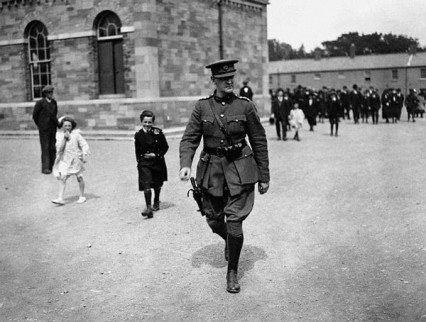
Commander in Chief Michael Collins in July 1922, two or three weeks before he was assassinated in Cork.
Michael Collins' funeral, O'Connell Street August 1922
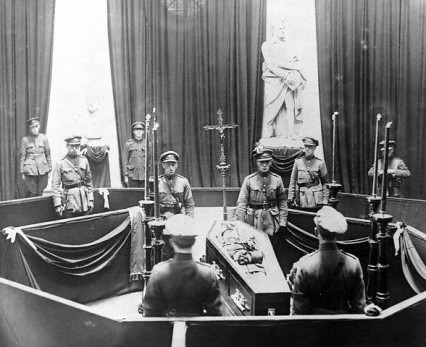
The coffin bearing the body of Michael Collins lying in state in the City Hall, Dublin. September 2, 1922 Dublin, Ireland
Michael’s brother Sean Collins
It was never really established whether Dunne and O’Sullivan acted on their own (the assassination seemed pretty badly organised for an official assassination so this was likely) or with the approval and help of Michael Collins. Collins had been a friend of Dunne’s while Sir Henry Wilson was responsible for establishing the Cairo Gang (a group of experienced British Intelligence agents who met frequently at Dublin’s Cairo Cafe) twelve of whom were murdered by the IRA acting under Collins command in 1920. The Cairo Gang killings provoked the British Auxiliaries in Dublin to shoot trapped innocent civilians at Croke Park in not the bloodiest but perhaps the nastiest of the various historical Bloody Sundays.
The infamous Cairo gang
Perhaps the ironic aspect to the story of the murder of Sir Henry Hughes Wilson was that Reginald Dunne and Joseph O’Sullivan were both born and bred in London, whereas Field-Marshall Wilson was born smack bang in the middle of Ireland at Ballinalee in County Longford.
A letter sent to O'Sullivan while waiting for his execution
* The text of Dunne’s intended last statement, as transcribed from the images in this post.
Lord and Members of the Jury. My friend and I stand here before you today charged with the offense of murder; and I have no doubt that, from the evidence placed before you by the prosecution, you will find us both guilty. With respect to the charges of attempted murder, we merely tried, as everyone must know, to try and escape arrest.
The offence of murder is a very serious matter; so much so, that any act which results in loss of human life requires very grave and substantial reason. We have never until now been charged with any crime. As you have heard from the Police Officer, who gave evidence as to our character and our previous records, we have both been in the British Army. We both joined voluntarily, for the purpose of [making Europe safe?] in order that the principles for which this country stood, should be upheld and preserved. These principles, we were told, were Self-Determination and Freedom for Small Nations. We both, as I have said, fought for these principles, and were commended for doing so; and I imagine that several of you gentlemen of this jury did likewise. We came back from France to find that Self-Determination had been given to some Nations we had never heard of, but that it had been denied to Ireland, We found, on the contrary that our Country was being divided into two Countries; that a Government had been set up for the Belfast district, and that under that Government outrages were being perpetrated, that are a disgrace to civilization — many of the outrages being committed by men in uniform and in the pay of the Belfast Government. We took our part in supporting the aspiration of our fellow Countrymen, in the same way as we took part in supporting the nations of the world who fought for the right of small nationalities.
Who was Sir Henry Wilson? What was his policy? And what did he stand for? You have all read in the newspapers lately, and been told, that he was a great British Field Marshal; but his activities in other fields are unknown to the men of the British public. The nation to which we have the honour to belong, the Irish nation, knows him, not so much as the British Field Marshal, but as the man behind what is known in Ireland as the Orange Terror. He was at the time of his death the Military Advisor to what is colloquially called the Ulster Government, and as Military Advisor he raised and organized a body of men known as the Ulster Special Constabulary, who are the principle agents in his campaign of terrorism.
My Lord and Members of the Jury, I do not propose to go into details of the horrible outrages committed on men, women and children of my race in Belfast and other places under the jurisdiction of the Ulster Government. Among Irishment it is well known that about 500 men, women and children have been killed within the past few months, nearly two thousand wounded, and not one offender brought to justice. More than 9000 persons have been expelled from their employment; and 23,000 men, women, and children driven from their homes. All the big cities of this country and even those of Northern France are now receiving these refugees. Sir Henry Wilson was the representative figure and the organiser of the system that made these things possible.
At his suggestion and advice the Ulster Parliament passed an Act authorising the [purging?] of political opponents and this power is now exercised and enforced by the Courts in Ulster.
There is and can be no political liberty in a country where one political party outrages, oppresses, and intimidates not only its political opponents, but persons whose religious opinion differ from those of the party in power. The same principle for which we shed our blood on the Battle Field of Europe led us to commit the act we are charged with.
My Lord and Members of the Jury, you can condemn us to death today, but you cannot deprive us of the belief that what we have done was necessary to preserve the lives, the homes, and the happiness of our countrymen in Ireland. You may by your verdict find us guilty, but we will go [to] the scaffold justified by the verdict of our own Conscience.
Dunne truncated his statement to “cut out the patriotic adjectives I feel inclined to use under the present circumstances” (as well as his specific delineation of the atrocities of Henry Wilson and the Ulster government). -ed.
On this date in 1812, Daniel Dawson “suffered the awful sentence of the law, at the top of Cambridge Castle, amidst a surrounding assemblage of at least twelve thousand spectators, it being market-day.”
The crowd was an appropriate ornament to the condign punishment of the most famous horse-poisoner in English history — and perhaps the most severely-punished sports cheat in all of modernity.
A tout scrabbling his living about the storied Newmarket tracks of Cambridge, Dawson killed the favorite for a high-profile race (and three other horses besides) by poisoning their trough, intending only to hamper the beasts enough to make good a variety of bookies’ bets against the fair Pirouette.
Although acquitted for that crime, Dawson was promptly returned to the dock for a previous, and previously unsolved, horse-poisoning, and convicted under a “black act” statute to punish livestock-killing.
According to the inevitable trial pamphlet, freely available from Google Books,
DAWSON behaved with a sullen and impudent levity during the trial, and he frequently abused the witnesses whilst giving their testimony, loud enough to be heard throughout the court … with horrid imprecations, ill becoming his unhappy situation, and at other times he was nodding at and saluting with his hand different persons in court. The verdict of GUILTY had not the slightest effect on him, and his general conduct was altogether depraved. On his return to the castle, his conduct, at times, bordered on insanity, and he appears too illiterate to feel a consciousness of wrong, although he has confessed his guilt to the full extent.
(Katherine Watson adds that although Pirouette’s owner sought a reprieve for the poisoner, Dawson “spoke bitterly of the hypocrisy of the Jockey Club, few of the members of which were above cheating.”)
She is of stately Norman figure; in her twenty-fifth year; of beautiful still countenance: her name is Charlotte Corday, heretofore styled d’Armans, while Nobility still was … A completeness, a decision is in this fair female Figure: ‘by energy she means the spirit that will prompt one to sacrifice himself for his country.’ What if she, this fair young Charlotte, had emerged from her secluded stillness, suddenly like a Star; cruel-lovely, with half-angelic, half-demonic splendour; to gleam for a moment, and in a moment be extinguished: to be held in memory, so bright complete was she, through long centuries!–Quitting Cimmerian Coalitions without, and the dim-simmering Twenty-five millions within, History will look fixedly at this one fair Apparition of a Charlotte Corday; will note whither Charlotte moves, how the little Life burns forth so radiant, then vanishes swallowed of the Night.
Hapless beautiful Charlotte; hapless squalid Marat! From Caen in the utmost West, from Neuchatel in the utmost East, they two are drawing nigh each other; they two have, very strangely, business together.
Or was it strange at all?
Implacable in her purpose, utopian in her design, unafraid to plant a butcher’s knife into the chest of an enemy of France, Corday has a little something in common with her mortal foe.
These make casting too easy: Marat, bad because he was ugly and ugly because he was bad; Charlotte, therefore, just the reverse. (She was also a virgin; they made sure to check at the autopsy.) Our Norman assassin’s looks have inordinately exercised her interlocutors from the moment of her arrest; her prosecutors, too, understood them as essential.
“Not at all pretty,” a contemporaneous government article (cited in Crisis in Representation) put about. “She was a virago, brawny rather than fresh, without grace, untidy as are almost all female philosophers and eggheads … an old maid … with a masculinized bearing … [who] had thrown herself absolutely outside of her sex.”
And there it is. Charlotte Corday’s power to excite both rapture and repulsion is plainly rooted in the unexpected contradiction between her sex and her crime. If she is a resolute political assassin, surely she is not feminine … or is it the other way around?
Take Andre Chenier‘s engorged ode: “Fair, young, resplendent, led to the executioners, you seemed to be riding in your bridal car … You alone were a man and vindicated the human race. And we, vile eunuchs, a cowardly and soulless herd, we know how to repeat some womanly whimper, but the steel would weigh heavy in our feeble hands. … One scoundrel less crawls in this slime. Virtue applauds you. Hear the majestic sound of its virile praise, heroic maid.” This is “throwing herself outside of her sex” in the affirmative sense of uplifting herself beyond mere womanhood, a girl so heroic she might almost qualify as a dude.
Place it at the historical pivot into a modernity unready to reckon with the place of the woman, and confusion reigns.
“The spectacle of such wickedness, beauty, and talent united in the same person,” a newspaper recorded, “the contrast between the magnitude of her crime and the weakness of her sex, her appearance of actual gaiety, and her smile before the judges, who could not fail to condemn her, all combined to create an impression on the spectators that is difficult to portray.”*
Still, this judgment offers more insight than some latterly “tributes,” like this Anglo magazine piece 30 years later: “an ornament and an honour to the sex of woman … Woman is the child of feeling. From this source spring up all her good and bad qualities. It is seldom ambition or policy which leads her on to any enterprise: it is the passions. … it was under the influence of such feelings that Charlotte Corday performed that act, which virtuous and generous minds, so far from considering a crime, will look upon as one of the most heroic deeds of recorded history.”
Which is a fascinating form of sexism, since it was precisely Corday’s unearthly calm — masculine virtue! — that awed the Revolutionary Tribunal. But everything about Charlotte Corday is up for interpretive grabs; Nina Rattner Gelbart even argues, in “The Blonding of Charlotte Corday” (Eighteenth-Century Studies 38.1 (2004)) that though a real-life brunette, her depictions trend increasingly flaxen-haired.**
As for Charlotte Corday her work is accomplished; the recompense of it is near and sure. The chere amie, and neighbours of the house, flying at her, she ‘overturns some movables,’ entrenches herself till the gendarmes arrive; then quietly surrenders; goes quietly to the Abbaye Prison: she alone quiet, all Paris sounding in wonder, in rage or admiration, round her. …
On Wednesday morning, the thronged Palais de Justice and Revolutionary Tribunal can see her face; beautiful and calm: she dates it ‘fourth day of the Preparation of Peace.’ A strange murmur ran through the Hall, at sight of her; you could not say of what character. Tinville has his indictments and tape-papers the cutler of the Palais Royal will testify that he sold her the sheath-knife; “all these details are needless,” interrupted Charlotte; “it is I that killed Marat.” By whose instigation? — “By no one’s.” What tempted you, then? His crimes. “I killed one man,” added she, raising her voice extremely (extremement), as they went on with their questions, “I killed one man to save a hundred thousand; a villain to save innocents; a savage wild-beast to give repose to my country. I was a Republican before the Revolution; I never wanted energy.” There is therefore nothing to be said. The public gazes astonished: the hasty limners sketch her features, Charlotte not disapproving; the men of law proceed with their formalities. The doom is Death as a murderess. To her Advocate she gives thanks; in gentle phrase, in high-flown classical spirit. To the Priest they send her she gives thanks; but needs not any shriving, or ghostly or other aid from him.
On this same evening, therefore, about half-past seven o’clock, from the gate of the Conciergerie, to a City all on tiptoe, the fatal Cart issues: seated on it a fair young creature, sheeted in red smock of Murderess; so beautiful, serene, so full of life; journeying towards death,–alone amid the world. Many take off their hats, saluting reverently; for what heart but must be touched? Others growl and howl. Adam Lux, of Mentz, declares that she is greater than Brutus; that it were beautiful to die with her: the head of this young man seems turned. At the Place de la Revolution, the countenance of Charlotte wears the same still smile. The executioners proceed to bind her feet; she resists, thinking it meant as an insult; on a word of explanation, she submits with cheerful apology. As the last act, all being now ready, they take the neckerchief from her neck: a blush of maidenly shame overspreads that fair face and neck; the cheeks were still tinged with it, when the executioner lifted the severed head, to shew it to the people. ‘It is most true,’ says Foster, ‘that he struck the cheek insultingly; for I saw it with my eyes: the Police imprisoned him for it.’†
In this manner have the Beautifullest and the Squalidest come in collision, and extinguished one another. Jean-Paul Marat and Marie-Anne Charlotte Corday both, suddenly, are no more. ‘Day of the Preparation of Peace?’ Alas, how were peace possible or preparable, while, for example, the hearts of lovely Maidens, in their convent-stillness, are dreaming not of Love- paradises, and the light of Life; but of Codrus’-sacrifices, and death well earned? That Twenty-five million hearts have got to such temper, this is the Anarchy; the soul of it lies in this: whereof not peace can be the embodyment! The death of Marat, whetting old animosities tenfold, will be worse than any life. O ye hapless Two, mutually extinctive, the Beautiful and the Squalid, sleep ye well,–in the Mother’s bosom that bore you both!
While the assassin went contentedly to her death, and left smitten admirers in her passing, more realistic politicians saw that all her magnificent stoicism, all her self-sacrifice, had doomed the liberals who were her political fellow-travelers and opened the door to the very Terror she meant to avert. (And also that the gesture might have been better directed elsewhere, since Marat was already dying.)
What meaning this leaves one with — any at all? — is the subject of the Peter Weiss play-within-a-play Marat/Sade, which sets a cast of lunatics in the Napoleonic era under the direction of the Marquisde Sade to portraying Marat’s rendezvous with Charlotte Corday.
* Cited by Elizabeth R. Kindleberger in “Charlotte Corday in Text and Image: A Case Study in the French Revolution and Women’s History,” French Historical Studies, Vol. 18, No. 4 (Autumn, 1994).
** Also of interest from Gelbart is the Vichy government’s affinity for our murderess: “Antisemitism made of Marat a Jew and a vile creature, dark, dirty, satanic, a bloodthirsty monster. In contrast, Corday was pure, saintly, beautiful, virginal, and of course fair.”
† The slap given Charlotte Corday’s severed head is historically attested by the French press (which was aghast); the famous story about it of a much more fantastic quality is that the severed head blushed — and, in the phrasing of Englishwoman Helen Maria Williams, “exhibited this last impression of offended modesty.” The legend of Charlotte’s crimsoned cheeks always comes up in the backstory of the guillotine’s experiments to determine if a head retained consciousness; Charlotte’s blush may in fact be credited as one of the reasons these experiments actually came to pass.
Early this Monday morning in 1836, Louis Alibaud — having been condemned to death by the Chamber of Peers at trial the preceding Friday and Saturday — lost his head for taking a shot at oft–shot–at French King Louis-Philippe.
As related by the London Times (July 6, 1836),
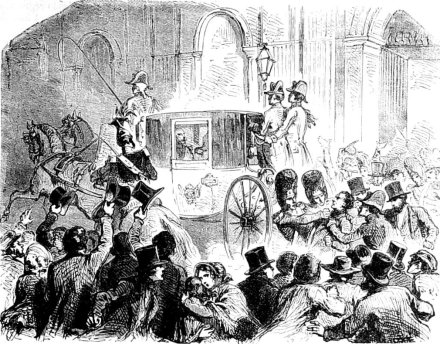
at half-past 6 in the afternoon of the 25th of June, 1836; the windows of the carriage were lowered, and it was passing through the gate [of the Tuileries palace] leading to the Pont Royale, when a man, who had been standing by a post in the court, raise [sic] a cane gun and discharged it against the King. By a miraculous chance the King was lowering his head to salute the National Guard under arms, and the ball passed just four lines above his head, and entered one of the angles of the carriage, settling about an inch deep in an oak beam.
The assassin was immediately arrested; he was a young man, of about 25 years of age, dressed in a dark coat, cloth pantaloons, and black hat, and wearing under his chin a thick brown beard.
Naturally, this line had neither the intent nor the effect of securing clemency, and he was repeatedly cautioned by the court against pursuing it; all concerned knew precisely where matters were headed, of course, and the state had no interest in providing a public forum for sedition.
On an unknown date in 1294, the former page of the late Danish King Eric V was put to death for regicide outside Roskilde.
Rane Jonsen or Jonsson (here’s his short Danish Wikipedia page) had been present at the hunt during which the former monarch, more popularly known as “Erik Glipping”, was murdered by unknown assailants in 1286.
The convention — and the official verdict of state — have it that Jonsen contrived to admit marsk Stig Andersen Hvide and fellow conspirators to the vulnerable king’s presence for the purpose of murdering him, possibly revenging the king’s rape of Andersen’s wife. “Marsk Stig” and Rane both fled, and were condemned along with seven other men by the Danish Assembly in the spring of 1287.
Although there is little remaining primary documentation, it does seem that the guilt of these people was decided above all by political expedience. It was Stig Anderson’s opponents who got control of the government (and the regency of 12-year-old Erik Menved), conveniently declaring the guilty parties to be their own rivals, who had formerly been close to Erik Glipping.*
Our page, himself a noble, got the short end of the stick in all this; he energetically denied the story that he had stood aside to permit the murder of his liege, claiming that he fought back albeit unarmed and outnumbered.
But as an emblem of the perfidy of the king’s inner circle, you couldn’t do much better than Rane theatrically planting his sword into a table and standing aside to signify the king’s vulnerability. You can just picture that story being retold with a meaningful ahem to the boy-king Eric VI.
In fact, it was retold: wrongful conviction or no, this episode (in its official version, with Rane and Stig as evildoers) was the basis for a number of entries in the rich Danish ballad genre.
Though popularly cited as medieval ballads, disputed dating places different verses anywhere from Rane Jonsen’s own time to three centuries later.** In any era, they offer some lovely exemplars of the art.
This book reproduces several; topical for this entry is an imagining of the fugitive regicide’s plight, both sad (for his hopelessness) and menacing (for his violent seizure of a bride) — disconcertingly delivered in a repetitious lullaby singsong.
Ranild bade saddle his charger gray,
‘Twas told me oft before,
“I’ll be the Algrave’s guest today,
“Tho’ friends I have no more.”
Ranild rode up to his castle gate
‘Twas told him oft before
Where ermine-clad the Algrave sate,
Tho’ friends he had no more.
“Hail noble Algrave, here I come,
‘Twas told thee oft before
“To fetch my trothplight Kirstin home,
“Tho’ friends I have no more.”
Then up and spake her mother dear,
“‘Twas told thee oft before,
“For thee is bride no longer here,
“For friends thou hast no more.”
“I’ll either with the maid return,
“‘Twas told you oft before
“Or else your house and chattels burn,
“Tho’ friends I have no more.”
“Nay set not thou the house on flame,
“‘Twas told thee oft before,
“E’en take the bride thou ‘rt come to claim,
“Tho’ friends thou hast no more.”
In mantle wrapt the gentle maid,
‘Twas told her oft before,
On Ranild’s good gray horse was laid,
Tho’ friends he had no more.
No other bridal bed had they,
‘Twas told her oft before,
Than bush, and field, and new made hay,
For friends he had no more.
“The wood has ears, the mead can see,
“‘Twas told thee oft before,
“A wretched outlaw’d pair are we,
“For friends I have no more.”
“And had you not King Erick slain,
“‘Twas told you oft before,
“We still might in the land remain,
“But friends we have no more.”
“Stay, Kirstin, stay, such words forbear,
“‘Twas told thee oft before,
“Where strangers are, take greater care,
“For friends we have no ore.”
With that he slapp’d her cheek so red,
“‘Twas told thee oft before,
“It was not I, smote Erick dead,
“Tho’ friends I have no more.”
From the same source, our day’s principal meets his end:
Report is rife in all the land
Ranild at last is caught;
He surely had never gone from Hielm,
His doom had he bethought;
A death of torture he must die,
As he has long been taught.
Ranild he stepp’d within the door,
‘Good evening’ bade the king,
And all the guard of gentlemen,
Who round him stood in ring;
“Christ! may no son of loyal Dane
“Such trouble on him bring!
“But, O King Erick, noble liege,
“Remember you no more;
“The best was I of all the swains
“Your father’s livery wore;
“And you through wood and flowery mead
“In arms so often bore?”
“Full well I know thou servedst here
“For clothes and food and pay;
“And, like a vile and treacherous knave,
“My father didst betray;
“For which the stake thy carcase bears,
“If I but reign a day.”
“My hands and feet hack from my limbs,
“Tear from my head these eyes;
“With racking tortures martyr me,
“The worst you can devise;
“So much the wrong I’ve done your house
“For vengeance on me cries.”
“Thine eyes put out, that will we not,
“Nor lop thy hands or feet;
“But with a traitor’s hardest death
“The worst of traitors treat;
“And on our father’s murderer take
“Such vengeance as is meet.”
As forth from Roskilde he was led,
He wrung his hands anew,
And tears to see him go to die
Wept ladies not a few;
He turn’d him round, and bade them all
A thousand times Adieu.
They led him forth to where the rack
Stood ghastly on the plain;
“O Christ, from such a martyring death
“Protect each honest Dane!
“Had I but stay’d at Hielm this year,
“And there in safety lain!
“Now were there here one faithful friend,
“Who home for me would go,
“And would my sorrowing wife Christine,
“Her path of duty show!
“O Christ, look on my children dear!
“O comfort thou their woe!
“And you, I pray, good Christian folk,
“Who here are standing round,
“A pater noster read for me,
“That grace for me be found;
“And that this night I reach the land,
“Where heavenly joys abound.”
Marsk Stig, however, is the primary focus of these dramas; he raided shipping from his island base on Hielm (Hjelm), dying of natural causes in 1293. Some additional translated ballads about this character are available here.
But since this is poetry, take a moment to dig the original Danish,† which should be at least partially comprehensible to any English- or German-speaker.
Marsti ind aff dorren tren
med suerd i hoyre hend:
kongen sidder hannem op igien,
saa giorlig han hannem kende
…
>>Hor du, Ranil Ienssen!
oc vilt du verie mit liff:
jeg giffuer dig min soster
oc halff min rige in min tid.<<
Det vor Ranil Iensson,
han hug i borde oc balck;
det vil ieg for sanden sige:
hand veriet sin herre som en skalck
De stack ham ind at skulder-bende,
oc det stod ud aff halss;
det vil ieg for sandingen sige:
det vaar alt giort med falsk.
De stack hannem ind at skulder
oc ud aff venster side:
>>Nu haffuer wi giort den gierning i dag,
all Danmarck baer for stor quide<<.
Stig burst through the door,
his sword in his right hand;
the king sat upright
and recognized him.
…
“Hear me, Rane Jonson!
If you defend my life
I will give you my sister
and half of my kingdom.”
Rane Jonson swung his sword
and stuck it in the table and in the wall;
in truth,
he betrayed his lord shamefully.
They stabbed him in the shoulderbone
and out through the neck;
in truth,
they did it all deceitfully.
They stabbed him in the shoulder
and out through the left side.
“Now we have done the deed today,
all Denmark bears too heavy a load”
* Discussed at length in “Killing Erik Glipping. On the Early Days of a Danish Historical Ballad” by William Layher in Song and Popular Culture, 45, 2000. Layher reports that the Norwegian government (which received the fugitives) and the Danish were still trading nastygrams over the propriety of the convictions in the early 1300s. On the instigation of the Archbishop of Lund, who supported the exiles, the Church interdicted sacraments to Denmark for several years around the turn of the century.
** See Layher again. At least one contemporaneous bard, minnesingerMeister Rumelant, is known to have composed on the famous murder.
† Extract and translation from Layher, once again.
On this date in 1840, a valet was hanged at Newgate Prison for the murder of his aristocratic employer, Lord William Russell.
This celebrity murder of a former Member of Parliament, septuagenarian patriarch of one of England’s august noble houses, by a member of his household activated all the crime-panic circuits still familiar a couple centuries later.
That of class, of course: the perpetual frisson of animosity between the respectable and those they held in economic servitude, bursting bloodily onto the front pages.
That of foreignness, since Courvoisier was Swiss.
And that ever-popular fear of youth amok, when the 23-year-old claimed inspiration from William Harrison Ainsworth‘s then-popular potboiler about the beloved underclass robber Jack Sheppard.*
Speedy Trial
The valet was quickly on trial for his life; the total time elapsed from Russell’s death to Courvoisier’s own was two months to the day.
But a less hasty schedule might have permitted better investigation, as Courvoisier was well on his way to acquittal with his lawyer’s deft rebuttal of the crown’s entirely circumstantial case.
When police discovered the decisively damning evidence of Russell’s stolen effects midway through the trial, the Swiss man made himself an milepost in the evolution of professional ethics at the bar. Summoning his lawyers, Courvoisier informed them that he was indeed guilty but that he had no intention of pleading guilty to a hanging crime and expected his defense to continue.
Attorney Charles Phillips reluctantly complied, implicating fellow-servant Sarah Mancer as the potentially guilty party. When it became publicly known after the trial that Phillips had become aware of his client’s guilt, he was publicly vilified for the vigor of his representation, e.g., contesting “with violent language the witnesses for the prosecution, whose evidence he [knew to be] true,” and a lively debate among legal types on professional propriety in such an instance ensued.**
Read All About It
None of this availed Benjamin Courvoisier aught. His celebrity was brief, but intense — he even signed an autograph for the sheriff, dating it “the day of my execution,” as he was being pinioned for hanging. Broadsides like these below (links to selections from Harvard Library’s extensive publication of execution broadsides) sold a reported 1.65 million copies. (Source)
Among the published broadsides are several popular ballads relating to the case — one written to lament the murder, before the apprehension of a suspect; others for the condemned’s execution. One certainly wouldn’t call these great literature, but they’re representative examples of broadside balladry, nearly de rigueuer for scandal-mongering Victorian crime coverage and therefore very relevant for these pages.
COURVOISIER’S LAMENT
(Written by Himself.)
You Christians all of every nation,
A warning take by my sad fate–
For the dreadful crimes that I’ve committed,
I, alas! repent too late.
Only think what I must suffer,
And the death which I must undergo–
I cannot rest by day or night,
My heart’s so full of grief and woe.
My parents they were poor — but honest —
And brought me up in virtuous ways;
And never, ’till this sad occurrence,
Did I embitter their fond days.
But now, alas! quite broken-hearted,
My friends and family must be,
To think that I soon must quit
This world for a long Eternity.
My Master was a Nobleman–
Lord William Russell was his name;
Beloved he was by all who knew him,
And well he did deserve the same.
Oh! how could I so basely murder
One that was so good and kind?
I hope the Lord above will pardon
Me, that I may mercy find.
Alas! my days they are all numbered.
When I must give up my last breath;
For the horrid crimes that I’ve committed,
Die an ignominious death.
Oh! while I’ve life, let me entreat you
All, take warning by my fate!
Shew the ways of evil-doers,
Or you’ll repent when ’tis too late.
Attend unto my true confession–
A lesson it may be to you;
Give not your mind too much to pleasure,
Act upright — be just and true.
Let not the sight of gold e’er tempt you
To act dishonest to your friend:
For that alone caused me to murder,
And brought me to this untimely end.
Let not the world blame those two Females
Who, fellow-servants were with me;
For of the murder and the robbery,
None whatever knew but me.
No other crimes have I committed,
Save one single robbery;
Tho’ it was said that Etiza Grimwood
Basely murdered was by me.
William Thackeray came too — he was becoming publicly engaged as a man troubled by capital punishment, and it was the first execution he had witnessed. (Actually, he turned away at the decisive moment.) Thackeray published an article about the experience in Fraser’s magazine, reflecting doubt at the salutary value of public executions and empathy with the young man’s scrambled mental state as he was raced from condemnation to the gallows in a mere fortnight.
At first, his statements are false, contradictory, lying. He has not repented then. His last declaration seems to be honest, as far as the relation of the crime goes. But, read the rest of his statement — the account of his personal history, and the crimes which he committed in his young days; them “how the evil thought came to him to put his hand to the work.” It is evidently the writing of a mad, distracted man. The horrid gallows is perpetually before him; he is wild with dread and remorse. Clergymen are with him ceaselessly; religious tracts are forced into his hands: night and day they ply him with the heinousness of his crime, and exhortations to repentance. Read through that last paper of his. By heaven, it is pitiful to read it. See the Scripture phrases brought in now and anon; the peculiar terms of tract-phraseology (I do not wish to speak of these often meritorious publications with disrespect). One knows too well how such language is learned-imitated from the priest at the bedside, eagerly seized and appropriated, and confounded by the poor prisoner.”
* Courvoisier’s Jack Sheppard reference triggered thunderous indictments of this text in the popular press — “a publication calculated to familiarise the mind with cruelties,” howled the London Examiner “and to serve as the cut-throat’s manual” and caused the stage adaptation to be censored (pdf).
Though Ainsworth had decades of writing ahead of him, it’s been argued that his reputation never fully recovered from this case, and that’s why he’s not in the canon. What he lacks in posthumous celebration he garnered in contemporary buzz; Ainsworth’s “Newgate novels” valorizing highwaymen helped to feed an enduring popular craze for hanging broadsides and “penny dreadfuls” and to mainstream a (commercialized) version of thieves’ cant. See The Hanging Tree: Execution and the English People 1770-1868.
** See The Bar & The Old Bailey, 1750-1850. In a more unctuous vein, the bishop of London submitted a petition to the House of Lords demanding repeal of the right of defendants’ lawyers to make closing statements.

 Fanya (“Fanny”) Kaplan had actually drawn a life sentence for trying the same trick on a tsarist official 12 years before, so you couldn’t say she was a reactionary element.





 This celebrity