On this date in 1962, Georges Kageorgis* was shot at Usumbura (now Bujumbura) for assassinating the charismatic national figure seemingly destined to lead the country into its postcolonial age.
“It was a bit like what could have happened in South Africa if Nelson Mandela was murdered before assuming the presidency in 1994,” said one pol later.
A prince, a pro-independence nationalist, a Tutsi who had married a Hutu and spurned a tribal leadership position lest he cast too sectarian a profile, Louis Rwagasore became prime minister in the fall of 1961 on the strength of his party‘s comprehensive electoral victory.
Rwagasore admired Patrice Lumumba. He was destined to share Lumumba’s fate.
Two weeks after his election, “the one truly popular national figure” was gunned down by Kageorgis, a Greek mercenary drawing pay from Belgian settlers who reckoned a better situation (French link) for themselves with Hutu governance. A revolution of (Belgian- and Catholic-backed) Hutu in Rwanda had had a “neo-colonial” character, according to Rene Lemarchand … and it had heightened ethnic tensions in Burundi.
With the murdered prince went ethnic cohesion; the bloody Kamenge riots of January 1962 presaged worse to come as leadership in the Rwagasore-less party collapsed. Ethnic conflict sharpened through the 1960’s, with a Tutsi-dominated dictatorship ultimately gaining control of the country and setting the stage for intermittent massacres (two classed as genocides) that haunt Burundi to this day and form part of the context for the Rwandan genocide.
Rwagasore Day — October 13, the anniversary of the prince’s assassination — is still observed in Burundi. Kageorgis’s execution date is notable for other reasons: it was the last day before Belgian authority in Ruanda-Urundi officially ended.
On this date in 1574, Gabriel de Lorges was beheaded in Paris for treason.
Known by the time of his death as the Comte de Montgomery (English Wikipedia entry | French) — though the title was punitively stripped from the man and his heirs, causing him to spit at the scaffold, “tell my children, if they are not able to reclaim their position, I curse them from the grave” — Lorges’ treason was going Protestant and fighting for the Huguenots in the wars of religion ravaging France.
But his claim to fame, and indeed (if quite unjustly) one of the explicit charges laid against him, was a regicide that fueled those wars and helped bring down the Valois dynasty.
The ol’ lance-in-the-eye
The vigorous 40-year-old French king Henri II seemingly had the Valois in good shape and anti-Huguenot policy firmly in the saddle.
In 1559, though, the sporting monarch put his own butt in the saddle at a joust with our day’s principal, then a captain of Henri’s Scots Guards (and a Catholic).
Gabriel’s shattered lance somehow found a chink in the king’s visor and managed to tolchock the royal gulliver just beside the eye.* After a week and a half in agony, Henri succumbed to the injury.**
Henri’s sudden death was bad news for France, because the oldest† of his seven children was only 15 years old, and feeble. He died the next year.
As the widowed Italian queen Catherine de’ Medici struggled over the ensuing decades to find a stable Valois heir among her brood, the aggressively Catholic House of Guise‡ flexed its political muscle to the resentment of the Bourbons and the Huguenot lords, and pitched France towards civil war.
Our errant knight, meanwhile, although forgiven by the dying Henri II, had despairingly retired and hurled himself into study that soon converted him to the Protestant party.
Quickly distinguishing himself as perhaps the ablest Huguenot commander, Montgomery was in Paris in 1572 during an ostensible truce for interparty dynastic nuptials when the Catholic faction sprang the St. Bartholomew’s Day massacre.
Though Montgomery was a specific target for assassination that day, he somehow managed to escape. He gave the Catholics fits for the two years left him, enough that the crown tried to buy him off. (Like most Protestants, he was distrustfully defiant after the horrors of St. Bartholomew’s Day.)
He was finally overcome in 1574; as Henri’s second son had just kicked the bucket without an heir, Catherine assumed the regency while a third boy was fetched from Poland, and got herself some gratifying but untoward revenge on the inadvertent author of her family’s unfolding ruin.
No time was lost in condemning [Montgomery] to the penalties of high treason; he was beheaded at the Greve, his body quartered, and his family degraded from their nobility. Previous to his execution, he was cruelly tortured to make him confess the existence of the late admiral‘s conspiracy, but the pain drew no such acknowledgment from him, and mangled and wounded as he was, he went to the scaffold with remarkable serenity. We have an account, given by a contemporary, of his steady attachment to his principles: “He would not confess to the Archbishop of Narbonne, who went to him in the chapel to admonish him; nor would he take or kiss the crucifix, which is usually presented to those who are being led to execution; nor in any way attend to the priest, who had been placed in the cart by his side. A cordelier thinking to draw him out of error, began to speak to him, and said that he had been abused. Looking at him steadily, he answered, ‘How! abused? and if I have been it is by those of your order: for the first person who ever handed me a Bible in French, and made me read it, was a cordelier like you; and therein I have learned the religion which I hold, which alone is the true religion, and in which, having since lived, I wish now by the grace of God to die.'”
(Some sources place Montgomery’s execution on May 27, which I believe confuses his date of death with his date of capture.)
Just like Montgomery himself, the Huguenot cause proved resistant to every policy of Catherine or the Guises; this day’s execution only screwed up the nerve of a party that had been given notice on St. Bartholomew’s Day that their lot must be to conquer or die. Since Henri II’s boys could neither, over 30 years’ time, produce an heir nor master their foes at arms, the Huguenots conquered when the throne finally passed to a Bourbon.
A public-domain biography of Gabriel de Lorges, comte de Montgomery, can be enjoyed by French-speakers here. For the English-speakers, Alexandre Dumas’ fictionalized treatment, The Two Dianas, is freely available in translation.
* French surgeon Ambroise Pare attended the dying monarch. Pare’s grim description of the king’s injuries appears in this biography of the physician, which also reports that Henri’s caregivers
secured the heads of four criminals that had been beheaded and experimented upon them with a lance in order to ascertain the probable course of the splinters.
** The fatal joust is alleged to be one of the vindicated prophecies of Nostradamus. Prophecy or no, the family had bad luck with sports; Henri came in line for the throne when his older brother dropped dead after playing tennis.
† Henri II’s immediate heir Francis II was married to Mary, Queen of Scots. After the death of her husband, she unhappily shipped back out to Scotland to contest the English throne, with unsatisfactory results.
On this date in 1980, the former intelligence chief of South Korea was hanged for assassinating President Park Chung-hee.*
In this surreal affair — known after its date as the “10.26 incident” in South Korea — the head of the Korean Central Intelligence Agency popped the autocratic head of state during a private dinner party at a secret KCIA compound.
He then returned to another dinner party at the compound and, without disclosing what he had done, reported an “accident” and started dropping suggestions to a general that this might be an opportune moment to arrange martial law. Instead, the two repaired to a bunker. There, several hours’ confused wind-gauging by a hastily assembled cross-section of the country’s power brokers (not knowing their own chief spook had pulled the trigger) gave illustration to the Ovid maxim that “treason doth never prosper: what’s the reason? If it prosper, none dare call it treason.”
Only two participants, Kim Chae Kyu and Kim Kye Won, had witnessed the assassination, and neither disclosed the killer … Without an explanation from these two, the others present were left to speculate whether the killings were truly accidental, organized by North Koreans, or perpetrated as part of a South Korean conspiracy, large or small. They could not rule out the possibility that some among them … were part of a plot. Without knowing the balance of power, both civilian ministers and military officers worried about making a wrong move … (Source)
The truth, eventually, would out. But the reason for this shocking internecine turn by a supposed confidante of the president? The murder was too well-planned to square with initial reports of an argument gone out of control. It seems a coup, but if so, our assassin disastrously — almost delusionally — miscalculated the post-Park lay of the land. Maybe we have to entertain the defendant’s own far-out claim to have struck against the authoritarian concentration of presidential power.
I shot the heart of Yusin Constitution like a beast. I did that for democracy of this country. Nothing more nothing less.
The controversial 2005 flick The President’s Last Bang offers a darkly comic look at the twisted mise en scene in the intelligence compound that fateful 10.26 … and doesn’t find a lot of participants worth admiring.
Whatever its cause, South Korea’s unanticipated transition was a wobbly one. Even as the spymaster who had set it in motion was hanged this date with some of his conspiring security men, successor dictator Chun Dwoo-hwan was crushing a student uprising in Gwangju.**
* Park had survived previous assassination attempts, often authored by North Korea — including one that slew his wife in 1974.
** This uprising resulted in a death sentence against future South Korean president Kim Dae-jung — obviously not carried out. Under Kim’s administration years later, Chun was himself condemned to die for the massacre; Kim returned the gesture of clemency.
On this date in 1972, Jaime Jose, Basilio Pineda and Edgardo Aquino were electrocuted* in Muntinlupa for the gang-rape of actress Maggie de la Riva (or dela Riva) five years before.
The rising young actress had scarcely wavered after the assault before courageously making the always-fraught rape charge against a quartet** of attackers themselves from elite families. (The particulars are recounted in the Supreme Court ruling.)
J’accuse! Maggie de la Riva identifies two of the culprits just five days after her gang rape. Talk about facing your accuser; according to the accompanying article, “the frail-looking mestiza was a picture of righteous indignation as she extended her arms, showed her bruises, and asked Pineda, pointedly: ‘Do you remember these?'”
The case was a media sensation from day one. The Philippine film blog Video 48 republished a three-part series on the rapists’ capture (parts 1 and 2) and execution (part 3), complete with the desperate efforts of the offenders’ families to save them.
The victim herself continued her acting career.
Decades later, she’s still a public personality, and seems to have made peace with and moved on from her famous ordeal with impressive equanimity.
When that misfortune happened to me, I realized that although my body was raped my true self was never defiled and that there’s another person in me that’s beautiful, strong and true. The old Maggie has faded away. I look at my experience as something that happened to someone else who is no longer the person I am today. (Source)
* The Philippines adopted use of the electric chair in the early 20th century from the U.S., its colonial ruler at the time. It’s the only country besides the United States to have used the chair.
** One of the four condemned to death for the rape, Rogelio Canial, died in prison of a drug overdose several months before the executions.
On this date in 1948, Burma hanged six for a shocking assassination that haunts the country to this day.
The previous summer — specifically, at 10:37 a.m. on July 19th — independence hero/proto-head of state Aung San and six members of his cabinet had been massacred by gunmen
The trail quickly led back to rival pol U Saw, himself a former Prime Minister of under British colonial rule.
U Saw had once defended in court the hero of a peasant revolt that the British had quelled with some difficulty. His own maneuverings were heretofore of a more slippery character, having negotiated with the British government early in World War II for independent dominion status — and then turned around and negotiated with the Japanese for consideration in their occupation government.
(The British caught him at his act, and locked him up for the rest of the war. Aung San — “hands … dyed in British and loyal Burmese blood,” Winston Churchill charged* — had also collaborated with the Japanese, who were viewed as liberators by many who had struggled against British domination.)
U Saw was executed with three collaborators in this plot this day at Insein prison, while two others were hanged at Rangoon prison.
The damage done by the assassination, in any event, could not be undone with the noose. Aung San appeared to be the only person with sufficient stature to govern Burma effectively. After his death, the newly independent country suffered impotent governments, ethnic conflict, and eventually coups that have today brought to power one of the more repugnant military dictatorships in the world.
The current Burmese junta has for a generation held under house arrest the most recent person to democratically win (but not assume) the office of Prime Minister: Aung San’s daughter, Nobel laureate Aung San Suu Kyi.
* Churchill said this after Aung San’s assassination. See London Times, Nov. 6, 1947, p. 4.
On this date in 1795, the attorney who had engineered the Terror was guillotined for engineering the Terror.
Antoine Quentin Fouquier de Tinville (English Wikipedia page | French), or just plain Fouquier-Tinville, had emerged during the Revolution from penurious obscurity to wrangle a jury foreman’s position courtesy of his connection to Camille Desmoulins. When Desmoulins ally Georges Danton spearheaded creation of a Revolutionary Tribunal (French link), Fouquier-Tinville drew the choice gig of Public Prosecutor.
From that perch, he would supply the arbitrary exercises of the Committee of Public Safety their (increasingly scanty) scaffolding of formal legality in Paris’s greatest show trials.
Fouquier-Tinville’s own onetime benefactors, Danton and Desmoulins. (He struggled to contain Danton’s rhetorical fireworks, as depicted in the 1983 film Danton — we see him plying his trade from about 3:29 of this clip.)
Heck … when the Terror ended, our good state’s attorney even signed off on the execution of Robespierre, with what must have been a lump in his throat. He was himself denounced within days, and narrowly preserved from the summary justice of his fellow-prisoners upon incarceration.
Naturally, like every criminal barrister since, Fouquier-Tinville’s defense was, hey, don’t blame me: the law made me do it. “I had only acted in the spirit of the laws passed by a Convention invested with all powers. Through the absence of its members [on trial], I find myself the head of a conspiracy I have never been aware of.”
I have been told by a gentleman who was at school with Fouquier, and has had frequent occasions of observing him at different periods since, that he always appeared to him to be a man of mild manners, and by no means likely to become the instrument of these atrocities; but a strong addiction to gaming having involved him in embarrassments, he was induced to accept the office of Public Accuser to the Tribunal, and was progressively led on from administering to the iniquity of his employers, to find a gratification in it himself.
And, indeed, he was condemned by his own hand. His lawyerly letter to the Convention during Danton’s trial — “the accused are behaving like madmen and demand the summoning of their witnesses … our judicial powers do not furnish us with any means of refusing” — duly elicited those heretofore absent powers, which the prosecutor immediately deployed to gag the defense.
Antoine Quentin Fouquier de Tinville, the sinister mediocrity who gave villainy the cover of law, was guillotined this morning in 1795 to the delight of the Paris mob: the last head to roll in a batch of 16.
On this date in 1820 — which was not yet a red-letter day on the leftist calendar — five radicals were hanged at Newgate Prison for a plot to overthrow the government.
This day’s conspirators plotted to overturn the authoritarian rule of Lord Liverpool by murdering his ministers at a dinner party. Next steps:
????
Revolution!
This excellent plot was hatched by none other than a government informant, who planted the idea among the circle and arranged their arrest when they took the bait. Already-notorious subversive Arthur Thistlewood was the jewel in the crown’s crown, particularly after having slain an arresting officer in the fray when the trap was sprung.
Ten were condemned to death, five of those sentences commuted to transportation — leaving Thistlewood to hang* along with John Brunt, James Ings, Richard Tidd and the Afro-Caribbean tradesman William Davidson. The crowd was reportedly vocally supportive of the condemned.
The Cato Street Conspirators hanged. As represented at the bottom of the scaffold: the dead men were cut down after their execution and posthumously beheaded.
It was in the aftermath of this shocking affair that Byron completed his work on a long-ago Venetian putsch, Marino Faliero, with such stirring reflections upon the blood sacrifice of liberty as
They never fail who die
In a great cause: the block may soak their gore:
Their heads may sodden in the sun; their limbs
Be strung to city gates and castle walls —
But still their Spirit walks abroad. Though years
Elapse, and others share as dark a doom,
They but augment the deep and sweeping thoughts
Which overpower all others, and conduct
The world at last to Freedom.
Still, even from the safety of Italy, the rakish rebel had a gentleman’s disdain for these lowborn butchers overpowering anything at all.
What a set of desperate fools these Utican conspirators seem to have been. As if in London, after the disarming acts, or indeed at any time, a secret could have been kept among thirty or forty. And if they had killed poor Harrowby — in whose house I have been five hundred times, at dinners and parties; his wife is one of ‘the Exquisites’ — and t’other fellows, what end would it have answered? ‘They understand these things better in France’, as Yorick says, but really, if these sort of awkward butchers are to get the upper hand, I for one will declare off. I have always been (before you were, as you well know) a well-wisher to, and voter for reform in parliament; but ‘such fellows as these, who will never go to the gallows with any credit’ … and make one doubt of the virtue of any principle or politics which can be embraced by similar ragamuffins. I know that revolutions are not to be made with rose water, but though some blood may, and must be shed on such occasions, there is no reason it should be clotted; in short, the Radicals seem to be no better than Jack Cade or Wat Tyler, and to be dealt with accordingly.
They were. Archive.org has the free text of An authentic history of the Cato-Street conspiracy; with the trials at large of the conspirators, for high treason and murder; a description of their weapons and combustible machines, and every particular connected with the rise, progress, discovery, and termination of the horrid plot. With portraits of the conspirators, taken during their trials, by permission, and other engravings.
* “The men died like heroes. Ings, perhaps, was too obstreperous in singing ‘Death or Liberty’, and Thistlewood said, ‘Be quiet, Ings; we can die without all this noise.'”
On this date in 1997, Peruvian paramilitaries stormed the Japanese ambassador’s residence held hostage for 126 days by leftist rebels.
Peace out.
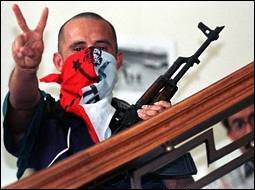
All 14 of the Tupac Amaru Revolutionary Movement (MRTA) were slain in the raid,* along with two of the commandos and one hostage. Officially, there were no “executions” at all.
Unofficially?
It’s pretty well-documented that some — perhaps most — of the terrorists were taken alive, and thereafter summarily executed. (pdf of Defense Intelligence Agency cable hosted by the National Security Archive)
However untoward the outcome and however unimpressive the foe, the operation was a master stroke for then-President Alberto Fujimori. Peru’s neoliberal taskmaster had introduced the world to the auto-golpe, the “self-coup”, a Cromwellian maneuver of shuttering parliament in order to rule as dictator, and he thereafter made ruthless suppression of Peru’s ruinous internal conflict the calling card of his presidency.
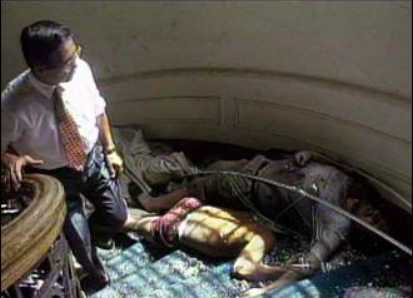
The DIA cable linked above claims Fujimori himself ordered the commandos to take no prisoners. He did not scruple to show himself in the middle of the bloodbath.
Alberto Fujimori made sure to get himself snapped standing over the bodies of the guerrillas, including MRTA leader Nestor Cerpa Cartolini.
El Presidente banked the political capital from having restored civic order, but it wasn’t the only capital he was banking. Three and a half years later, with a corruption scandal darkening his door, Fujimori absconded to Japan, faxed in his resignation, and became a fugitive.
Even there, he continued to justify his authoritarian governance.
Many Peruvians have always agreed with Fujimori’s self-assessment, even many who regret his well-publicized disregard for human rights.
But human rights researcher Michael Baney calls this day’s executions “pointless.”
“The MRTA was a spent force by the time of the embassy takeover,” said Baney. “The takeover was an act of total desperation, which is evidenced by the fact that the leader of the movement, Nestor Cerpa Cartolini, personally participated in it.”
After spending the best part of a decade in exile, Fujimori returned to the headlines by boldly returning to the hemisphere — to Chile, specifically, which arrested him and extradited him on a Peruvian warrant.
Just days ago as of this writing, Fujimori was convicted in his own former courts of authorizing death squads,** and sentenced to 25 years in prison. (Here’s some legal analysis.)
In the court of public opinion, it’s a different matter.
Fujimori’s daughter Keiko, a Peruvian congresswoman, figures to be a leading contender for the presidency in 2011, and has said she would pardon her father if given the opportunity.
“A majority of Peruvians think that Fujimori was guilty of serious human rights violations, but a majority also believe that he was a good president,” Baney observed. “And Fujimori really does believe that he single-handedly saved his country from economic and political collapse, and that Peru needs him around.”
* “Operation Chavin de Huantar”, profiled in several Spanish-language documentary videos available online. (Such as this one.)
** Not specifically related to this day’s MRTA killings, although these could be prosecuted in the future.
On this date in 1868, the first Australian known to have attempted a political assassination received the short drop and sudden stop that often constitutes the wages of that distinguished profession.
Someone was smiling down on Alfred that day, because the shot was deflected by a metal buckle and inflicted only a flesh wound. Onlookers tackled the assailant before he could finish the job.
O’Farrell claimed affiliation with the Irish nationalist Fenian brotherhood, which inflamed anti-Irish passions (some cynically whipped up by New South Wales Prime Minister Henry Parkes). Paranoia redoubled when a Fenian assassin killed a Canadian politician a few weeks later.*
Under the circumstances, it was a hopeless struggle for O’Farrell’s attorney, who strove to demonstrate (probably accurately) that his charge was not so much a terrorist as a madman. Even the Duke of Edinburgh’s own intercession for clemency did not secure it, eager as the populace was to make an offering of its loyalty.**
* Irish convicts transported to Australia, especially after the 1798 uprising, formed a significant demographic among early New South Wales settlers. (Source)
On this date* in 1881, five members of the Russian terrorist organization Narodnaya Volya were publicly hanged in St. Petersburg, where they had slain the tsar Alexander II a few weeks before.
“The People’s Will” etched in blood its place in the dangerous late 19th century ferment of Russian revolutionaries. In time they would read as the politically immature forerunners of the Bolsheviks, whose turn into terrorism was a political dead end.
But as of this date, they were at the top of their arc.
Every St. Petersburg tourist sees the place Alexander II died: the spot received a picturesque church that is now one of the city’s principal attractions.
On March 13, 1881, Narodnaya Volyaassassinated the former tsar with a suicide bombing on the streets of St. Petersburg. With the death of the monarch who had emancipated the serfs, and was on the very day of his murder tinkering with plans to introduce an Assembly, liberalism arguably lost its weak purchase on Russia’s future.
Their dramatic gesture failed to ignite a social revolution or topple the autocracy, and they would find in Alexander III an implacable foe.
But while this spelled the end for the old man’s five assassins,‡ and even the end of Narodnaya Volya as an effective organization as the 1880’s unfolded, Alexander III’s efficacious repression was a Pyrrhic victory for the Romanov dynasty.
Refusal of Confession (Before Execution), by Ilya Repin, 1879-1885. (Via)
Alexander II’s death in the context of the times and its effect for Russia’s fate receive diverting treatment in a BBC In Our Times broadcast
* April 15 was the date on the Gregorian calendar; per the Julian calendar still in use in Russia at the time, the date was April 3.
** A quick summary of the strains of Russian revolutionary thought of the time here.
† Despite their dramatic tyrannicide, the Nihilists’ letter was angled for the consumption of mainstream post-Enlightenment Europeans. Karl Marx noted its “cunning moderation,” and its call for freedom and civil rights commonplace in more developed countries drew considerable support in the west. The Nihilists even took care to underscore their reasonableness a couple months later by condemning the senseless assassination of American President James Garfield. (See Inside Terrorist Organizations.)

 Known by the time of his death as the Comte de Montgomery (
 In this
 The trail quickly led back to rival pol
  Antoine Quentin Fouquier de Tinville (
 It was March 12 — less than six weeks before — that

