On this date in 1913, Edward Hopwood was hanged for the murder of his girlfriend, Florence Silles.
Silles was an actress and music hall songstress who had broken off her relationship with the 45-year-old manager when she found out that, contrary to his representations, Hopwood was (a) still married; and (b) not wealthy.
Hopwood contrived to track his ex down in a hotel bar, and after an evening’s drinking and talking, the two got into a cab together. There, Hopwood shot her point-blank through the head.
It sounds — and was — pretty open-and-shut, but Hopwood’s bootless defense took the case through a brief detour of an odd cul-de-sac of English jurisprudence. Hopwood claimed that he’d been trying to commit suicide, and that Silles caught her bullet accidentally as she attempted to stop him killing himself.
While it’s clear that nobody else in the court believed this, it’s also the case that suicide is a felony by law. And up until 1957, it was legal doctrine that anyone who, in the course of commission of this felony, managed to kill another person, could be held liable for homicide. (Source)
Accordingly, as the London Times reported on Dec. 10, 1912, that with respect to the attempted-suicide claim, “even if the prisoner’s story were true, the prosecution submitted that in law his crime would be at least manslaughter, and in all probability murder.” Hopwood attempted to appeal his conviction on the basis of botched suicide, and an appellate ruling wrote this very doctrine into precedent.
There exists a receipt for January 9, 1386, in which the executioner of Falaise, France, acknowledges payment of ten sous and ten deniers
for his efforts and salary for having dragged and then hanged at the [place of] Justice in Falaise a sow of approximately three years of age who had eaten the face of the child of Jonnet le Macon, who was in his crib & who was approximately three months old, in such a way that the said infant died from [the injuries], and [an additional] ten s. tournoise for a new glove when the Hangman performed the said execution: this receipt is given to Regnaud Rigaut, Vicomte de Falaise; the Hangman declares that he is well satisfied with this sum and that he makes no further claims on the King our Sire and the said Vicomte.
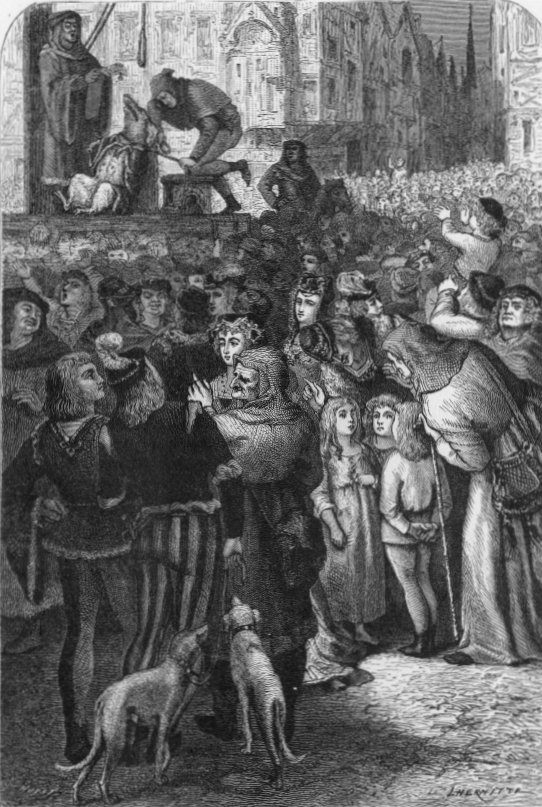
From this tiny kernel of primary documentation — the only primary source that exists — an impressive legend has grown up around the “Sow of Falaise”. It’s been alleged by subsequent interlocuters that the condemned sow was dressed up as a person for execution, that other pigs were made to attend in order to take warning by their swinish sister’s fate, and even that the incident became so famous as to merit depiction in a church fresco.
The supposed fresco has been whitewashed, but Arthur Mangin’s L’Homme et la Bete (1872) took a stab at reconstructing it.
This bizarre scenario can’t help but raise the question for we later observers — just what was the objective in trying and “executing” a farm animal? Did the human supporting cast to this scene not feel itself ridiculous?
According to Paul Friedland‘s research for his fascinating recent survey of public executions, Seeing Justice Done: The Age of Spectacular Capital Punishment in France, the subsequent embroideries around the Sow of Falaise have no basis in fact. They were simply made up … or rather, they were interpolations of authors who were baffled as we to see a sow hoisted on a gibbet.
“Punishment may be about many things, but in the last instance, we citizens of the modern world have an almost visceral need to believe that it is primarily about one thing: deterrence,” Friedland opines.
“The punishment of a pig for murder violates our modern understanding of the essential purpose of punishment because it punishes an animal, which we ordinarily do not believe to be capable of criminal intent, and because it does not lend itself very well to the principle of exemplary deterrence.” The tale’s evolution in later centuries “allowed an incomprehensible anecdote from the past to fit neatly into the modern paradigm of penal deterrence.”
Seeing Justice Donesituates that murderous pig within an unfolding saga of penal theory and practice stretching from the Roman Empire to the 20th century. And while Friedland’s study focuses on France in particular, the historical threads he teases out will look familiar much further afield.
We had the pleasure of interviewing Dr. Friedland about his book recently, and we’re pleased to present it here not in our customary Q&A form, but as Executed Today‘s debut podcast. The mediocre sound quality is on me, but Dr. Friedland’s insights are more than worth it. (Unlike your host, Friedland is a podcasting natural; catch him in a July 2012 episode of the New Books In Human Rights podcast.)
Trouble seeing the podcast player? Access the interview on podbean.
On this day in 1678, one Stephen or Steven Arrowsmith was executed at Tyburn for the rape of a little girl the previous summer.
He was one of six people sentenced to hang that day, but four of them got reprieved. Arrowsmith and Nathaniel Russel, a convicted murderer, were the ones who had to swing.
The victim in Arrowsmith’s case, eight-year-old Elizabeth Hopkins, testified against her rapist in court, as did the child who walked in and saw Arrowsmith abusing the victim on July 7 of that year. Neither witness was properly sworn in. From the Old Bailey records:
The Girl that was ravished, being between 8 and 9, testified that he had had to do with her for half a year together every sunday, that she was hindred from crying the first time, by his stopping her mouth, and that he gave her money afterwards; and she never discovered it, till some of her friends observing her to go as if she were very sore, examined her, and by telling her she would be in danger of hanging in Hell, got her to confess, that the Prisoner was her fathers Prentice.
One Mrs. Cowel did testifie that upon observing her going, and other Circumstances, she did resolve to examine her, and made her confess, which she did, and being searched, was found shamefully abused, and sent to the Doctors to cure.
The like was attested by one Mrs. Sherwin, and by a Midwife, who said, she had got a very foul disease by it.
Arrowsmith’s defense was two-pronged:
he hadn’t done it
but if he had done it, Elizabeth had consented
The maid of the doctor who examined Elizabeth testified for the defense, saying she’d asked the victim why she hadn’t told anyone about the abuse, and Elizabeth answered that she took pleasure in it.
The jury was very reluctant to convict and, in fact, initially brought back a verdict of not guilty. And here the judge, a fellow with the Dickensian name Lord Chief Justice Scroggs,* decided to become the prosecutor.
One of the jurors, an apothecary, ventured that he personally believed Elizabeth had consented to intercourse. Scroggs reminded this person that she was under age and so the issue of her consent was irrelevant.
Other jury members said they were bothered by the fact that almost all the evidence was hearsay and the only direct witnesses, Elizabeth and her friend, had not been sworn. Testily, the judge replied that a rapist was not going to commit his crime in crowd of eyewitnesses, and the only reason the two girls had not been sworn was because of their youth, but if the jury wanted them sworn in he was prepared to do that. Then he sent them back to re-think their verdict.
To further complicate matters, during the second round of deliberations a thoughtless officer of the court, charged with looking after the two child witnesses, brought both girls to the jury to talk to them in private. When Scroggs found out he quickly put a stop to this and had the bailiff thrown in jail, and the jury (who swore that this hadn’t been their idea) was allowed to continue its deliberations. Jurors later said the unauthorized meeting had convinced them of the girls’ honesty, and they returned with a verdict of guilty.
“The Criminal Trial Before the Lawyers,” (pdf) a paper published in the University of Chicago Law Review in 1978, referenced the Arrowsmith case and Scroggs’s behavior. The paper’s author, John H. Langbein, tried to explain and defend the “judicial dominance” which might lead a modern reader to look askance at the fairness of the proceeding:
Hale’s treatise confirms this practice. “If the jurors by mistake or partiality give their verdict in court, yet they may rectify their verdict before it is recorded, or by advice of the court go together again and consider better of it, and alter what they have been delivered.” The tradition that the jury would lightly disclose the reasoning for a verdict became especially important in this situation, because it enabled the court to probe the basis of the profferred verdict, hence to identify the jury’s “mistake” and correct it. Thus, in the Arrowsmith case, the court discovered that the chemist’s opinion that an eight-year-old “could not be Ravished” had been influential, and the court refuted it…
Indeed, to this day in many countries, including the UK and the USA, a judge still has the right to overturn a jury’s decision if he or she feels the evidence did not support the verdict. This privilege is but rarely exercised.
At the gallows, just before his death, Arrowsmith wept and finally owned up to what he had done, saying he’d been a good person all his life until “Satan seduced him to this abominable wickedness.”
* Seen here in a more everyday juridical situation, Scroggs was also a figure in the “Popish Plot” anti-Catholic trials breaking out at this period.
On this day in 1828, a black slave named James Guild, also known as Little Jim, was hanged in Farmington, New Jersey.
His crime, though brutal, was commonplace enough. But his case was extraordinary for another reason: at the time of his offense, Little Jim was twelve years, five months and thirteen days old.
On September 24, 1827, Little Jim took a break from his work in his master’s cornfield and went to the home of Catherine Beakes, a white woman in her sixties who lived with her son and grandson. She was home alone at the time, and Jim wanted to borrow her rifle to go fowling.
Some time prior to this, someone had tampered with Mrs. Beakes’s livestock, releasing the pigs from their pen during the night and letting the chickens out of their coop. She believed the culprit was Little Jim and, though he denied this, she had told him to stay off her property or she would tell his master, Mr. Bunn.
So when he knocked on the door and asked for the gun, she refused to give it to him.
Jim was angry, he said later, that the “damned old bitch” had been “saucy” to him for no reason.
So, after Mrs. Beakes had her back turned and thought he was gone, he took up a metal horse yoke and sneaked up on her from behind. He bludgeoned her to death in her own house as she was tending the fire, crushing her skull, shattering her jaw and gouging out one of her eyes.
He left the gore-caked weapon next to her corpse.
Little Jim came under suspicion and confessed to the murder after someone told him liars went to hell. At his trial, he said he’d killed Mrs. Beakes because he was afraid she would inform on him to Mr. Bunn and get him in trouble.
“The trial became more of a debate over whether a 12-year-old killer should be punished like an adult,” Daniel Hearn writes in Legal Executions in New Jersey: A Comprehensive Registry, 1691-1963. “The presiding judge placed great emphasis on that issue, especially during his instructions to the jury.”
It is an issue that remains highly controversial even now, nearly 200 years later.
The jury convicted James Guild of first-degree murder, which meant an automatic death sentence … but the judge was reluctant to execute a preteen. He referred the case to the New Jersey Supreme Court for sentencing, as Hearn records:
Special hearings were held to probe all aspects of Jim’s mentality. It was found that he knew right from wrong as well as the consequences of murder. He knew about the sanctity of an oath. It was also clear that Jim had had the wherewithal to confess what he had done based on his own rationale. Moreover, the appellate judges found what they considered to be ample precedent for condoning the execution of preteen felons — especially those of precocious acumen … The use of his tender age alone as a pretext for sparing his life under such circumstances would “be of dangerous consequence to the public … by propagating a notion that children might commit atrocious crimes with impunity. So the New Jersey Supreme Court ruled that Jim Guild was “a proper subject of capital punishment.”
Jim Guild’s manner was of “stoic indifference” when he was hanged before a large crowd fourteen months after his crime, the last execution in Hunterdon County history. He was thirteen years old when he died.
“No incident of the dreadful story” of Morant Bay, wrote Edward Underhill, “produced a more painful impression than the arrest, trial, and execution of Mr. G.W. Gordon” this date in 1865.
The son of a white planter and a mulatto slave, George William Gordon was an able businessman and became a Jamaican assemblyman.
In that capacity, he was a vocal critic of British colonial maladministration, an advocate for blacks, and a political foe of Jamaica’s governor, Edward John Eyre. He’d already had government commissions canceled because of his politics.
Gordon had nothing to do with the Morant Bay outbreak. He was away from the disturbance altogether, in Kingston, when it broke out.
But he was regarded by many white elites as a class enemy, and Eyre did not intend to miss this opportunity to eliminate him. A few years later, a French tribunal would express the rationale as it cracked down on the Paris Commune: guilty or no, “a prudent and wise Government must rid itself [of troublemakers] when it finds a legitimate occasion to do so.”
Accordingly, Gordon was arrested by civil authorities in Kingston — he actually turned himself in when he heard there was a warrant out on him — and then transferred into the hands of the drumhead military tribunals that were operating in the conflict zone, obviously with the intent of terminating a gadfly.
[Kingston authorities] were not the ministers or apparitors of the martial authority, and did not possess the power to take up Mr. Gordon for the purpose of handing him over to the martial law. Nevertheless, they did it. They did it by the exercise of the strong hand of power, because it was thought that a conviction could not be got at Kingston. It was altogether unlawful and unjustifiable. To Mr. Gordon it made the difference of life or death.
Gordon, in his last letter to his wife, took it all in an understandably contemptuous stride:
General Nelson has just been kind enough to inform me that the court-martial on Saturday last has ordered me to be hung, and that the sentence is to be expected in a hour hence, so that I shall be gone from this world of sin and sorrow.
I regret that my worldly affairs are so derranged: but it cannot be helped … I never advised or took part in any insurrection. All I ever did was to recommend the people who complained to seek redress in a legitimate way … It is however the will of my heavenly Father that I should thus suffer in obeying His command, to relieve the poor and needy, and to protect, as far as I was able, the oppressed …
do not be ashamed of the death your poor husband will have suffered. The judges seemed against me; and from the rigid manner of the Court, I could not get in all the explanations I intended. … It seemed that I was to be sacrificed.
Much of what Governor Eyre did in those desperate days skirted, at best, the edges of what might be legally colorable. But at least those instances, in the main, were directed at people alleged to have been actual rebels or rioters. Eyre could safely expect wide latitude where the security of the realm was at stake.
In Gordon, however, there was a man whose crime was nothing other than to have sympathized with the real and crushing plight of the lower orders and advanced their cause politically. Eyre’s magistrates made that fact alone into sedition, and twisted the rules of their own courts-martial to pin it on Gordon.
Given the exceptionally lawless nature of this scenario — and Gordon’s own visibility as a colonial elite — his became the lightning-rod case for English liberals incensed at Eyre’s behavior. John Stuart Mill, Charles Darwin, Herbert Spencer, and others demanded Eyre’s prosecution for the affair, Thomas Huxley writing for the faction,
the killing of Mr. Gordon can only be defended on the ground that he was a bad and troublesome man; in short, that although he might not be guilty, it served him right.
I entertain so deeply-rooted an objection to this method of killing people — the act itself appears to me to be so frightful a precedent, that I desire to see it stigmatised by the highest authority as a crime.
It can hardly surprise the reader, versed as we are by this late date in official impunity, that not Eyre nor any lieutenant was ever thus stigmatised.
While Eyre evaded due punishment, Gordon could not escape the plaudits of posterity. He’s been honored as a Jamaican National Hero, and the very building where the present-day parliament sits is called the Gordon House in his honor.
Hanging has been the legal method of execution in the state of Illinois for 106 years, the first execution in the state being held at Belleville on September 3, 1821, when Timothy Bennett paid the penalty for murder resulting in a duel in which Timothy [sic — the rest of the article refers to the victim as “Alphonso”] C. Stewart was killed.
According to the account appearing in an old history of St. Clair county, now in the state historical library, Timothy Bennett and Alphonso C. Stewart became involved in an argument while under the influence of liquor, on February 8, 1819, at Belleville. Friends interfered and sought to effect a reconciliation, but their efforts were unavail[ing]. Finally it was agreed to arrange a sham duel in the belief that the ridiculous issue would bring the two participants to their senses.
“The duel was arranged,” the account reads. “Jacob Short and Nathan Fike acted as seconds. When the word was given and the rifles discharged, it was proven the ‘sham’ duel was fought with powder and lead-at any rate Alphonso C. Stewart fell to the ground mortally wounded.
Special Session in Court
“Timothy Bennett was arrested and so were the seconds, Short and Fike. A special term of the circuit court was held March 8, 1919 [sic], under a special law of the legislature to hold said term. The officers of the court, John Reynolds, judge; John Hay, clerk, and W.A. Beard, sheriff, were all appointed by Governor Shadrack Bond.
“The grand jury found true bills of indictments for murder against Bennett and the two seconds after hearing the testimony of Reuben Anderson, James Parks, James Kincade, James Reed, Daniel Million, Ben Million, Peter Sprinkle and Michael Tannahill.
“When the case was called for trial the sheriff reported that Bennett had broken jail and was at large. Short and Fike had their trial in June 1819, and were acquited [sic].
“Bennett was captured and jailed about July 1, 1821. A special term of court was held July 26, 1821. The grand jury found a new indictment against him for the same offense
Trial Starts Immediately
“Bennett was put on trial July 27, 1821, before Judge Reynolds and a jury. The jury rendered a verdict July 28, and found the presoner [sic] guilty. He had entered a plea of not guilty.
“The court then proceeded to pass sentence upon him in the following words:
“And it being demanded of him if anything for himself he had or knew to say why the court should not proceed to pass sentence upon him, he said he had nothing more than he had before said. Therefore it was considered by the court that he be hanged by the neck until he is dead, and that the sheriff of the county do cause execution of this judgment to be done and performed on him, the said Timothy Bennett, on Monday, the third of September, next, between the hours of ten in the forenoon and four in the afternoon at or near the town of Belleville.”
“Neither Bennett nor his friends believed that this awful sentence would ever be executed. The latter made strenuous efforts to have him pardoned. Failing in this, they tried to have the sentence commuted. But the governor remained firm and against all entreaty.
“On the day appointed for his execution, Bennett was hanged near West Belleville, near the site of the Henry Raab school. The execution was witnessed by a multitude of men, women and children.
You have heard of mother Nottingham, who for her time was pretty well skilled in casting of waters: and after her, Mother Bombye; and there is one Hatfield in Pepper-Alley, hee doth prettie well for a thing that’s lost. There’s another in Coleharbour, that’s skilled in the Planets. Mother Sturton in Goulden-lane, is Fore-speaking: Mother Phillips of the Banke-side is for the weaknesse of the backe: and then there’s a very reverent Matron on Clarkenwell-Green, good at many things: Mistris Mary on the Banke-side is for recting a Figure: and one (what doe you call her) in Westminster, that practiseth the Booke and the Key, and the Sive and the Shears: and all doe well, according to their talent. For myselfe, let he world speake.
This date marks the 400th anniversary of the Pendle witches‘ hanging — perhaps the most notorious witchcraft execution in English history.
Eight women and two men — Alizon Device, her brother James Device, and their mother Elizabeth Device of the Demdike family; Anne Whittle and her daughter Anne Redferne of the Chattox family; Jane Bulcock and her son John Bulcock; Alice Nutter; Katherine Hewitt; and Isabel Robey* — hanged together this date at Lancaster’s Gallows Hill after being tried over the preceding 48 hours; they, along with a woman named Jennet Preston hanged at York on July 29, comprise the Pendle Witches.
It’s an extraordinarily sad case.
The prosecution of the Pendle witches bubbled out of a witches’ brew of circumstances particular to early-17th century England. There was, to begin with, a new(ish) English king, James I and the guy had a major jones for hunting those early modern supernatural terrorists, witches.** The guy even wrote his own book, Daemonologie, to establish “that such divelish artes have bene and are … [and] what exact trial and severe punishment they merite.” A 1604 law had accordingly broadened the reach of the death penalty for supposed instances of sorcery.
Coming as this did in the aftermath of the Tudor Reformation, the nebulous concept of “witchcraft” was handy as well for clamping down on any excessively Catholic practices that might strike the right authorities as subversive, intransigent, or impious. Lancashire where we lay our scene was just such a Catholic-leaning zone.
Lancashire also had, as almost everywhere in the Isles, its share of “cunning folk” — workers of everyday folk magic whose widely tolerated practices could also be taken by a hostile viewer as Catholic superstition and/or hard-core infernal trafficking.
So, these are the brew’s ingredients. Add wool of bat and tongue of dog, stir vigorously … and serve with a length of hemp.
Curses
The Pendle witches brew started bubbling with a freak incident: a cunning woman named Alizon Device (you’ll recognize her name from the list of the hanged, above) tried to beg some needles from a passing peddler. The latter refusing her, Alizon cursed him, just like you do when you’re cut off in traffic.
Except in this case, the peddler promptly suffered a stroke.
Everyone was spooked at this apparent effusion of transmundane malevolence, nobody more so than Alizon herself. She became the first arrestee, and in the end would go the gallows convinced of her own sorcery.
She also started accusing others of occult involvement, either from a sense of panicked guilt or a blithe ignorance that the new legal regime would be interpreting folk spells as capital crimes. This led her bizarre instance of passing-peddler-popping to become a full-on witch hunt.
Alizon Device came from a whole family, the Demdykes or Demdikes, of cunning-women, and she implicated her own grandmother for having taught her the witchy ways. (Grandma would be spared the ignominy of hanging because she suffered the ignominy of dying in the filthy dungeon.) Alizon also accused a rival family, the Chattoxes, themselves well-known as “witches”, and she also implicated the matriarch of that family, Anne Whittle. The dreadful progress of the ensuing investigation, in which the feuding locals hanged each other with the aid of an ambitious local magistrate, is widely available — thanks to the record one lawyer witness to the proceedings set down in his credulous 1613 chapbook The Wonderfull Discoverie of Witches in the Countie of Lancaster.
Foiled Again
Once these initial arrests were in the books, Alizon’s mother Elizabeth apparently convened a solidarity meeting at a hut with the diabolically menacing name of Malkin† Tower. Dining on stolen mutton, and on Good Friday no less, they may have worked out a plan to liberate the prisoners from Lancaster Castle (at least, the Demdike prisoners). But the magistrate got wind of this confabulation and burst in to arrest those participants, too. As these secondary circles were pulled into the investigation, so too were past years of community gossip about these “witches”, of various folk who had died unexplained and various mishaps that befell people whom the witches didn’t like.
These superstitions seem to have been shared by the witches themselves, at least many of them. The Demdikes and Chattoxes used clay figures, human remains, and little effigies of victims with the intent of hurling evil at their enemies. Causality aside, Alizon Demdike did curse the peddler. “Witches think sometimes that they kill, when they do not, and are therefore as culpable, as if they did,” said their contemporary, pastor John Donne.
To augment the assorted confessions and counter-accusations among the accused, Elizabeth Device’s nine-year-old daughter Jennet Device (little sister of the original peddler-curser Alizon) was summoned up to provide coached testimony against her siblings Alizon and James, against her mother, and against those at the Malkin Tower meeting. Several of these latter would be convicted of non-capital crimes or even acquitted outright, but little Jennet’s testimony doomed her own family.
Although not the first time a child had provided evidence, it was a landmark in normalizing minors’ accusations — jurisprudence advocated by James’s Daemonologie. “Children, women and liars,” the sovereign announced, “can be witnesses over high treason against God.”
In later life, Jennet appears to have been caught up in the same trap, when she was accused of witchcraft by a 10-year-old boy. A judiciary grown more cautious by then did not put her to death … but she (unless it was a different person also named Jennet Device) died in prison.
And the acceptability of this sort of children’s testimony, duly documented for country JP’s in Michael Dalton’s Country Justice, containing the Practice, Duty, and Power of Justices of the Peace, would be the lethal linchpin of the witch trials 80 years later across the Atlantic — in Salem, Massachusetts.
This miserable event has informed any number of artistic productions from the 17th century stage to the present-day Pendle Sculpture Trail. Pendle and Lancashire, as bywords for witch superstitions, now trade handsomely on the unfortunate fame.
Many there have also pushed (thus far unsuccessfully) for an official posthumous pardon of the hanged witches.
And the nearby village of Roughlee even erected a statue in 2012 to the hanged Alice Nutter … a gentlewoman (i.e., of considerably higher class standing than her fellow condemned) whose reason for attending the Malkin Tower meeting remains mysterious.
* Isabel Robey is an outlier case; as of this writing, she’s not even named as one of the Pendle witches on the Wikipedia page as it seems she was not associated directly with the Malkin Tower crowd — merely a bystander who got caught up in the storm of denunciations. She was, however, hanged on Gallows Hill for witchcraft on August 20. There’s a lengthy attempt at reconstructing her story in the face of scant documentation here (pdf).
** All well and good for us moderns to pooh-pooh James’s supernatural obsessions, but the man’s security concerns were very real.
† The BBC documentary has Malkin as slang for “shit”; this page proposes that the word can signify a cat, a bindle, a scarecrow, or “an awkward woman.”
On this date in 1916, Captain Charles Fryatt was shot at Bruges, Belgium as an illegal combatant.
Fryatt was a 42-year-old civilian mariner captaining the SS Brussels on the Harwick-Hook of Holland route when, in March 1915, a German U-Boat ordered him to heave to.
Fryatt wheeled the Brussels around on the submarine and attempted to ram it. The German ship escaped by a whisker only by scrambling an emergency dive. The Admiralty gave Fryatt a gold watch and a pat on the head for bravery.
It was not until the following year that the Germans captured that same vessel with that same captain on board. When they realized who they had, they subjected him to a snap tribunal for violating the laws of war: he’d participated in combat (by trying to ram the U-Boat) whilst being not a member of his country’s armed forces. That made him an illegal combatant, a franc-tireur in the still-current term for a civilian partisan left over from the Franco-Prussian War.
The Germans mightily loathed such terrorists, feared they would bedevil their steps in Belgium and France: people not sporting enough to stay beaten, people with the effrontery to fight back without being a duly enrolled member of a nation-state’s standing army. They did not scruple to push an expansive line on the definition of civilian non-participation.
“Every non-uniformed person,” read the a Moltke directive to the army, “if he is not designated as being justified in participating in fighting by clearly recognizable insignia, is to be treated as someone standing outside international law, if he takes part in the fighting … [or] participates in any way in the act of war without permission. He will be treated as a franc-tireur and immediately shot according to martial law.” (Source.)
So … that’s exactly what happened to Captain Fryatt.
This shooting set off a flurry of international recriminations and rebuttals.
People of normal moral sense can see readily enough that a merchant captain who scares off a submarine has not committed a grave crime any more than has a teen who chucks a grenade at commando firing at his home. The legal question for deliberation in Fryatt’s case was all about whether the merchant mariner had or had not committed an impermissible belligerent act by charging* … and as always, the definition of a war crime turned out to mirror precisely the political interest of the definer.
The British at this point had the Germans handily bottled up in a naval blockade that even seized food as “contraband”. (A tactic angrily denounced as a war crime in Berlin.) The Germans needed to get out of this stranglehold, and lacking anything approaching parity on the high seas, they staked their hopes on the U-boat. So the German interest was for maximum latitude for submarine activity; in fact, early in 1915, it was just in the process of rolling out its unrestricted submarine warfare policy of unannounced attacks on civilian freighters carrying war materiel. This does not seem to be what the U-boat stopping the Brussels did, but it gives you an idea of the scene. German military judges naturally said that German submarines who stopped a British merchant ship were not to be defied.
And the British interest, and by wonderous coincidence also its policy and legal position, naturally maintained maximum restrictions on a U-Boat’s potential targets, and maximum rights for the realm’s Captain Fryatts to resist.**
Fryatt, indeed, had followed the directives laid down by that Lord of the Admiralty, Winston Churchill. Churchill threatened to prosecute any ship captain who surrendered his vessel to a U-boat without opposing it “either with their armament if they possess it, or by ramming”: the theory was that routine resistance would maximize costs to the German navy, and maybe lead slow and vulnerable U-boats to skip the parley stage in favor of sneak attacks on unflagged steamers, which would sooner or later sink an American ship, which would help pull the U.S. into the war. (In May 1915, making no mistake at all about its target, a German U-boat intentionally torpedoed the Lusitania, generating a helpful stateside scandal also attended by dickering over the legality of the attack.)
So, the initial German announcement tersely reported that Fryatt
was condemned to death because, although he was not a member of a combatant force, he made an attempt on the afternoon of March 20, 1915, to ram the German submarine U-33 … One of the many nefarious franc-tireur proceedings of the British merchant marine against our war vessels has thus found a belated but merited expiation.
Britain replied that the captain had exercised only his “undoubted right of resistance,” and pointed out that a different merchant vessel that did obey such an order on the very same day had been sunk before it could evacuate — drowning 104 souls.
[T]he experience of German methods of warfare warned him that surrender would be no guarantee that the lives of his crew would be spared.
He determined therefore to take the best chance of saving his ship, and to steer for the submarine in order to force her to dive, and, if she were not quick enough in diving, to ram her.
This was his undoubted right under international law – to disregard her summons and resist her attack to the best of his power. It was a contest of skill and courage in which each side took their chance.
This led Germany to reiterate, on August 10, its view that Fryatt’s
act was not an act of self-defence, but a cunning attack by hired assassins …
The German War Tribunal sentenced him to death because he had performed an act of war against the German sea forces, although he did not belong to the armed forces of his country. He was not deliberately shot in cold blood without due consideration, as the British Government asserts, but he was shot as a franc-tireur, after calm consideration and thorough investigation …
Germany will continue to use this law of warfare in order to save her submarine crews from becoming the victims of francs-tireurs at sea.
There’s a 1917 monument to Captain Fryatt still displayed at London’s Liverpool Street Station, as well as a mountain in Alberta named in his honor.
Nobody was ever prosecuted for Fryatt’s execution.
* The distinction as parsed by Germany hung on whether the intended merchant prize was armed (allowed to resist) or unarmed (not).
** U-boats were new legal territory in 1915. The 1930 London Naval Treaty — although Germany was not party to it — attempted to clarify the status of these machines.
He had a couple of years to cool his heels and work his rosary while the new king, Henry VII, set about securing a reign of dubious legitimacy. One cunning strategem: Henry had his late rival’s supporters (like our friend Stafford) attainted of treason without actually taking action on those attainders, maintaining continuity with the ancien regime while dangling a Damoclean sword over the head of any lord who might step out of line again in the future.
Nevertheless, in the spring of 1486, the already-attainted Stafford emerged from his holy confines to throw the dice on a minor rebellion that never got off the ground. As the whole thing descended into fiasco, Stafford fled back to sanctuary at Culham.
A cozy but ill-fortified sanctuary: St. Paul’s at Culham. Image (c) Rex Harris and used with permission. (Mr. Harris says the church as pictured is a Victorian-era rebuild.)
Henry broke the asserted sanctuary to haul his man off consecrated grounds.
This was a bit of a sticky wicket, juridically, and Henry’s own judges proceeded very cautiously with it — ultimately holding that sanctuaries proceeded from the common-law grant of the king, and specifically that sanctuary may not be pleaded for instances of treason. There’s more about all this in this Google books freebie, which adds the interesting detail that the Pope himself did not fight this interpretation — assenting in a papal bull later that year to a much-circumscribed view of ecclesiastical refuge:
Where a sanctuary man got out of sanctuary and committed mischief and trespass, he lost the benefit of sanctuary although he returned to it.
The goods of no sanctuary men were to be protected from their Creditors.
If any man took sanctuary for case of treason, the King might appoint keepers to look after him in sanctuary.
“The Rebellion of Humphrey Stafford in 1486” by C. H. Williams in The English Historical Review, April 1928 — a JSTOR article that seems like it must be in the public domain even if it’s not yet covered by that institution’s free content bloc — is virtually the only semi-detailed source on this affair that’s readily available. Williams’s pithy conclusion: “Henry’s policy towards Stafford and his party was definite enough. Like all problems of statecraft of that period the rebellion ‘was so handled that neither prerogative nor profit went to diminution.'”
* The date is asserted here and here, among other places, although upon what primary authority I have not been able to determine.
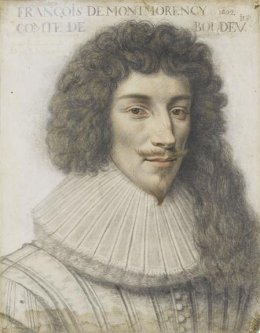
On this date in 1627, the Comte de Bouteville plus his cousin Des Chapelles lost their heads for fighting a duel — ultimately (because of the execution) one of the most notorious duels in French history.
Though this is the duel that everyone knows, Francois de Montmorency-Bouteville (English Wikipedia entry | French) had engaged in 22 such affairs of honor between the tender ages of 15 and 28. Like as not, he was the duellist par excellence in an age where demanding lethal satisfaction was all the rage among devil-may-care aristocratic straplings.
And this, of course, is why he was nominated for condign punishment in Louis XIII’s struggling anti-dueling campaign. One might say he nominated himself.
Dueling, a mano-a-mano vindication of feuds between fops, was an archaic holdover of Burgundian clan violence turned preposterous baroque ritual of conspicuous consociation.
It was also incredibly epidemic in France at this period.
During the reign of Louis’s predecessor Henri IV, 7,000 to 8,000 people are reported to have died in duels, which works out to the suspect rate of one per day for the entire period. Then again, France did have an excess supply of noble progeny whose violent impulses were no longer preoccupied by fratricidal religious warfare.*
Henri IV had tried to ban dueling, even in 1610 executing for lese majeste a couple members of his own guard who defied the ban. Just weeks later, and for no reason connected to dueling, Henri was assassinated. Then-nine-year-old heir Louis XIII was in no position at the time to follow up his father’s policy, and the naughty sport continued to flourish.
“Duels had become so common among the French nobility that the streets of Paris usually served as the field of combat,” according to the Mercure Francois. And as Richard Herr described in his “Honor versus Absolutism: Richelieu’s Fight against Dueling” (The Journal of Modern History, September 1955; this is also the source of all other quotes in this post), they often arose over utterly trivial “slights.”**
Typical was a duel in Lent of 1626 in which Bouteville [i.e., the subject of our post] with two seconds engaged the Comte de Thorigny and his two seconds. The fight was over a dispute between Thorigny and the Marquis de Chalais, who was in prison accused of treason. Bouteville was merely defending the honor of a friend. All six spent the night before the engagement in an inn outside Paris, and in the course of a fairly amicable conversation, they expressed regret that being good friends, they were going to kill each other over another gentleman’s quarrel. But they agreed that they had gone too far to be able to abandon the project without loss of honor. The next day Bouteville killed Thorigny after the latter’s sword broke.
By the 1620s, Louis was old enough to make another run at this intractable elite-on-elite crime wave, and did so with the full encouragement of his famous consigliere Cardinal Richelieu. Depriving the aristocracy of this weird extra-judicial prerogative fit right into the latter’s going campaign to centralize the French state and bring its quarrelsome lords to heel.
What with all those duels he liked to fight, Francois de Montmorency-Bouteville was a great test case. Fighting a public duel in January 1627 — at which his second was slain — made Bouteville a target, and he fled to the Netherlands for safety.
Our fugitive figured he’d send word that a pardon would be appreciated, and everything would blow over like it always did. But Louis was determined to disabuse this type of any privilege to commit public mayhem, and refused to grant Bouteville his absolution.
Honor offended — his default state, to judge by his career — Bouteville vowed angrily to “fight in Paris and in the Place Royale!” This he did on May 12, 1627, slipping back into France for the express purpose of dueling Guy Harcourt, the Marquis de Beuvron. And Bouteville disdained a private fight for the occasion, insisting, as he had declared, on a daytime melee where everyone could see it at the grand new Place Royale (today, Places des Vosges).
Bouteville and Beuvron fought to a bloodless stalemate and agreed to call it a draw. But Bouteville’s second Des Chapelles mortally wounded Beuvron’s second.
Everyone fled, and while Beuvron made it out of the country, Montmorency and Des Chapelles were nabbed, and condemned to death by the Parlement of Paris for violating Louis’s royal edict against duels.
From the king’s standpoint, this was just about the most egregious possible arrangement of factors.
The guy was a serial offender, and he was already a fugitive for his last duel.
The fight had produced a fatality.
Worst, the whole scene — sneaking back into Paris, fighting openly within the potential view of the sovereign — had been overtly staged to scorn the royal ban.
If Louis intended his decree to mean anything at all, he had to come down hard on this one. “It is a question of cutting the throat of duels or of your majesty’s edicts,” Richelieu summarized.
But as clear-cut as were the case indicia, this was still a hard one for Louis, and even for the usually-ruthless Richelieu. Bouteville was a well-born noble, with powerful friends and family who were also close to the king, and they besieged the royal person with petitions for mercy. A sorrowing but firm Louis had to personally refuse mercy to Bouteville’s tearful wife. “Their loss affects me as much as it does you,” he said. “But my conscience prevents my pardoning them.”
Although the poor wife couldn’t make any headway for clemency, she had the better of Bouteville’s swordsmanship off the field of honor. The doomed duke bequeathed one last rapier thrust to posterity by leaving his widow-to-be pregnant with a posthumous son who eventually generalled French armies to any number of routs of the Dutch in the late 17th century.
And while Richelieu’s memoirs would depict this instance of executive implacability as a decisive turn, Herr argues that it was nothing but a brief interruption. The pernicious hobby was back in all its glory within a couple of years, an evil that even Richelieu could never master. France’s aspired-to absolutism could not reach that ancient and intimate noble right save in the very most exemplary case.
In Dumas’s Three Musketeers, set in 1620s France, D’Artagnan is charged by his father in the opening pages to “[n]ever fear quarrels … Fight on all occasions. Fight the more for duels being forbidden, since consequently there is twice as much courage in fighting.” And indeed, it is by blundering into silly duels (e.g., the “offense” caused by bumping into Porthos while hurrying down the stairs, the latter of whom considers D’Artagnan’s apology discourteously perfunctory) that D’Artagnan becomes the fourth of their cadre … because Richelieu’s men arrive to break up the illegal D’Artagnan-vs.-Musketeer melees, and D’Artagnan joins with his “foes” to defend, all for one and one for all, their privilege as gentlemen to slaughter one another.
The dueling phenomenon faded significantly under Louis XIV, but still not completely: Voltaire almost fought a duel in 1726; the artist Manet dueled a critic in 1870; and YouTube will favor the viewer with a number of 20th century professors and litterateurs settling long-forgotten affairs of honor — like disputes over wartime collaboration after World War II — in ceremonial swordfights. Dueling pistol shooting (at human silhouettes) was even an event at the 1906 Olympics.†
* Also worth noting relative to the casualty numbers: at this time, each side’s seconds also fought in addition to the principals. A move for taking seconds out of the fight eventually prevailed, long before the end (if there has been a real end) of dueling, but in 1627 that time was not yet come.
† This event was an “Intercalated Games” falling between the natural 1904 and 1908 Olympiads. It’s an outlier historical experiment during the modern Olympics’ uncertain early years, and though it was officially sanctioned at the time and winners walked away with proper medals, the International Olympic Committee no longer recognizes the Intercalated Games as an official Olympics.


 The son of a white planter and a mulatto slave,
  This miserable event has informed any number of


 Though this is the duel that everyone knows, Francois de Montmorency-Bouteville (