2008: Curtis Osborne, poorly represented

Nach Golde drängt,
Am Golde hängt
Doch alles.

Goethe, Faust

On this date in 2008, Curtis Osborne suffered lethal injection in Georgia for a double murder.

In the words of the Atlanta Journal-Constitution report, “Osborne was executed for shooting Arthur Jones and Linda Lisa Seaborne on Aug. 7, 1990. Osborne allegedly killed Jones because Osborne didn’t want to give him the $400 he got for selling Jones’ motorcycle. Seaborne was killed because she was there.”

Pretty awful.

It’s very difficult to capture in individual cases the structural dimensions of the death penalty system, simply because individual cases are, well, individual. The many plausible actual innocence cases are one thing. Here what you’ve got is a guy who unquestionably shot dead two humans so that he could feed his cocaine habit: making some procedural argument for Curtis Osborne is going to sound like a lot of special pleading.

But those procedural arguments are the very guts of the animal. The U.S. death penalty proposes, as an institution, to attempt not the question, does Curtis Osborne deserve to die?, but the question, among hundreds of Curtis Osbornes, do we have the apparatus to justly distinguish the ones that deserve to die?

As an impoverished drug addict, Osborne was represented at trial by a since-deceased public defender named Johnny Mostiler.

If you search this case, the thing you’ll find immediately is that another defendant being represented at the same time by Mostiler would later swear that Mostiler told him, speaking of Osborne, “that little nigger deserves the chair.” And the context of the conversation was about how Mostiler had just received a plea offer that Mostiler didn’t plan even to relay to Osborne, for the aforementioned reason.

Pretty awful.

This sort of thing is hard to substantiate: the allegation comes from a man serving a murder sentence of his own, and Mostiler isn’t around to defend himself. But on its own, it’s a shocking claim and a reminder of how profoundly the trial attorney’s performance shapes the entire legal experience. As Time magazine put it, what if your lawyer wants you executed?

Whether Mostiler really dropped an N-bomb on Osborne’s case, we really don’t know. But it’s been said that capital punishment means those without capital get the punishment, and the fact of the matter is that not many of any race who have recourse to indigent defense are served at the bar by Atticus Finch.

Leave aside even that shocking racism allegation, one that no court saw fit to adjudicate. (Prosecutors called the racism claim “outlandish”; appellate court ruled it procedurally out of bounds.) Just reckon the structural situation.

The American Prospect profiled the blinged-out, fast-living Mostiler after his death — breathing not a word about Osborne’s case, which was nowhere on anybody’s radar — and described, essentially, the neoliberal project in action for public defenders.

Mostiler represented not only Osborne, but virtually every poor defendant in Spalding County, Georgia … because, in 1990, he’d pitched the county on a fixed annual contract. Mostiler argued that the county was

wasting money paying as many as 20 court-appointed attorneys $50 an hour to handle indigent cases without knowing exactly how many hours those attorneys would bill during any given year. Mostiler proposed instead that the commissioners pay him a flat fee to handle all of the county’s indigent cases, regardless of the number. That way the county would have to deal with only one lawyer, and it would know its final bill at the start of the fiscal year rather than at the end.

Let justice be done though the heavens fallwithin the confines of fiscal probity. This grift was going to be worth a good deal more than $400 … and come with its own body count, too.

Mostiler bragged about saving the county a good million bucks over the course of the nineties. That’s a new definition of the adversarial judicial process, fresh-minted for the race-to-the-bottom era: every exertion by a defense attorney on his client’s behalf costs him part of his own paycheck.

Small wonder that Mostiler hardly ever tried cases — no more than seven a year, he said, out of as many as 900 felonies. Most were dispatched within minutes in shotgun plea deals and no small number of those momentary clients remain on the inside of a Georgia penitentiary as we speak. Did we mention that Mostiler did all this “lawyering” in only 60% of his lawyer time? He kept up a lively private civil practice, too, one where he probably averaged more than 100 minutes per case.

Death sentences, of course, don’t result from plea bargains — but at Mostiler’s zero-sum rates he also wasn’t going to prep this like the Dream Team. Slate reported that

Mostiler never hired a psychiatrist to examine evidence that Osborne was a victim of childhood abuse, and was borderline retarded, despite a court-ordered sanity evaluation that had found “indications of depression, paranoia, and suicidal ideation.” He never examined the history of mental illness in Osborne’s family because, he said, he didn’t know how to conduct that kind of investigation. Mostiler called no expert witnesses to testify for his client and didn’t bother to interview the state’s experts before they appeared at trial. And he rejected appointment of a second attorney to help with Osborne’s defense, which the American Bar Association and all serious death penalty litigators say is essential if a capital murder defendant is to receive a fair trial.

Pretty damn awful.

Once Osborne’s conviction was in the books at the trial level, no appellate court could intervene without clearing a very high bar: would the evidence un-investigated and the argument un-made likely have made a difference? Could anyone prove that Mostiler described his client with a racial slur? Nobody could really say so. End of story.

It was 18 years between the time Osborne laid those two souls in the ground and the time he laid himself down on the gurney. The irony is that all that time, all those exhaustive appeals, left the most salient and troubling questions in his case un-examined. There were substantive questions here, but Georgia prevailed in a procedural argument that those questions remain closed.

All this unsalved death and sorrow, and all for what? So Curtis Osborne could have another hit. So Spalding County, Georgia wouldn’t have to trouble the property levies with billable hours. For nothing but a little bit of money.

On this day..

1856: Casey and Cora, by the San Francisco Vigilance Committee

Gold attracts all kinds of people but has a particular allure to crooks and corrupt politicians. When gold was found in California they flowed in from all over the world. Soon the gamblers and thugs had the run of San Francisco. Politicians and judges were bought and paid for. Crime went unpunished. (Usually.)

At the same time San Francisco was growing fast, and was filled with the flimsiest, most flammable wooden buildings imaginable. By 1850 huge fires began to rake the city and while they leveled block after block criminals would loot the homes and businesses of the good citizens who were out trying to fight the flames.

The first vigilance committee formed in 1851 after the fifth fire simply because the city government would do nothing to protect the people. The committee, made up of most of the leading citizens and with the backing of almost every honest person, hung a few men and chased a lot more out of town. Within months things improved dramatically and the committee disbanded.

But it’s hard to keep crooks that are in cahoots with corrupt politicians under control for long and by 1855 things were in terrible shape once more. Gold production was down, voting fraud was rampant, banks and business failed, a city supervisor slipped out of town just before his imminent arrest for a major real estate scam involving city money and a pier we now know as Fisherman’s Wharf.

James King of William, a once well-known banker who had lost everything in the collapse of 1855 was now running a small newspaper, The Evening Bulletin, devoted to exposing the corruption in the city. King was fearless in his reporting and ruthless but impartial in his editorials.

Yet things were still a mess in 1856 when the gambler, Charles Cora, took his doxy, a high powered and wealthy Madame called Belle, to the theater. By her presence she offended the young and ambitious US Marshal Richardson and a heated dispute arose between the two men. Then, days later, after that dispute was resumed in a local saloon, Cora shot Richardson in the chest in cold blood at point blank range.

King denounced the city officials who were holding Cora for trial, saying that the man could not be found guilty of even such a blatant crime in a city as corrupt as San Francisco. And as King predicted, amid charges of bribery, the jury in the trial of Charles Cora could not reach a verdict and Cora had escaped his punishment for murder. King then went after James P. Casey, a city supervisor, and exposed him as having once been a prisoner in New York’s infamous Sing Sing prison.

Casey was incensed and on May 14th stormed into the offices of the Bulletin and protested loudly. King ordered him out. Casey went but waited just up the street. An hour later, when King left for the day, Casey walked up to him in the middle of Montgomery Street and shot him down with a Navy Colt.

The news spread fast. Tens of thousands of people soon gathered.

Casey, joined by his powerful friends, went straight to the jail where Cora was still held for his own protection. Soon the crowd arrived. The local militia was called in to guard the place and there was no trouble that night. The next morning members of the old Committee of Vigilance met and by the time King died on May 20th a new committee had been formed and already had 3,500 members.

By now most of the militia sided with the vigilantes, so when the committee marched in mass to the jail and surrounded it, the jailers soon were soon persuaded to turn Casey over. A short time later the committee returned for Cora. The prisoners were taken to the committee’s headquarters, known as Fort Gunnybags, on Sacramento Street and held there under guard.

Both men were appointed lawyers and put on trial by the vigilantes. Each was convicted with a unanimous verdict.

On May 22nd they were hanged from short platforms extending from second floor windows of Fort Gunnybags before an enormous crowd of San Franciscans who filled the streets, buildings and roof tops all around. The Committee of Vigilance continued to operate until they were convinced that all corrupt politicians and crooks had been purged from city. This resulted in a wholesale change of the political power in San Francisco.

John Putnam is the author of Hangtown Creek, an exciting tale of the early California gold rush. His rich history of that incredible era at can be found at mygoldrushtales.com.

On this day..

1474: Peter von Hagenbach, war crimes milestone

On this date in 1474, Peter von Hagenbach was tried in a remarkable judicial proceeding in the Rhine city of Breisach, found guilty, and publicly beheaded by the end of the day.

This Alsatian knight in the train of Charles the Bold had been installed by that Burgundian duke as his satrap in in the Upper Rhine, in lands that Burgundy held on lease from the Habsburgs.

He made a legendary villain of himself in the early 1470s:

His regime of arbitrariness and terror extended to murder, rape, illegal taxation and wanton confiscation of pivate property, and the victim[s] of his depredations included inhabitants of neighbouring territories as well as Swiss merchants on their way to and from the Frankfurt fair … the outrages of Hagenbach, remarkable even by the standards of the late fifteenth century, greatly contributed to forging what, until then, had been considered impossible, that is, alliances against Burgundy by all her neighbours: Austria, Berne, France, and the towns and knights of the Upper Rhine, all formerly at loggerheads with one another.

After overturning Burgundian authority in the Upper Rhine, that unique alliance aired its many grievances with Hagenbach at a unique tribunal. There, the ex-knight was prosecuted before judges drawn from the several Germanic and Swiss principalities who had allied against him.


Breisach: seems like a nice place to oppress. (cc) image from Routard5.

This unusual procedure gained a special prominence in the 20th century postwar era as historical precedent for “war crimes” prosecutions. Since that time, there’s been a going debate over just what kind of precedent it really makes.

Executed Today is pleased to welcome Prof. Gregory Gordon of the University of North Dakota law school — a rising star in international human rights law.

Gordon wrote a 2012 paper re-examining the Hagenbach case attempting to reconcile both the legal and historiographical perspectives on Peter von Hagenbach.

ET: You characterize the present-day understanding of the Hagenbach case as proceeding from Georg Schwarzenberger‘s recovery of the incident further to providing legitimizing precedent for the Nuremberg tribunals. Between 1474 and World War II, did anyone think of this case as one with a wider import for jurisprudence? (And if not, do we know anything about how Schwarzenberger unearthed it?)

GG: To the extent anyone did, from my research, it would have been historians, not jurists per se. Hagenbach was the object of a fair amount of historical scholarship but that had evolved over the years. In the initial period after the trial, Hagenbach was portrayed as the quintessential bogeyman. But over the centuries, historians began to view him in a different light. By 1945, a more nuanced view of Hagenbach had been established. I have not researched Schwarzenberger’s biography in great detail. So I’m not sure how his eureka moment arose. What is clear is that the Nuremberg trial caused him to focus on Hagenbach (my sense is that Hagenbach was fairly well known in Europe — his supposed mummified head was on display in an Upper Alsace museum, for example — but given the absence of anything resembling Nuremberg before Nuremberg, people tended to ignore the details of the Hagenbach legal proceedings).

And my sense is that Schwarzenberger had an agenda — he realized the case could help legitimize what many would claim to be illegitimate ex post facto law at Nuremberg. So he relied on the earlier historical accounts of the Hagenbach case (it seems he based his seminal Manchester Guardian article primarily on the account of French historian Prosper de Barante). And thus he created a fissure between legal scholars and contemporary historians.

Who tried Hagenbach, under what authority, and how were the different interested parties formally represented? Whose idea was all this? What can we tell of the public atmosphere surrounding the trial — was there bottom-up pressure to do this?

After the League of Constance (consisting of various regional polities fed up with Hagenbach) paid off his debt for him, Archduke Sigismund of Austria resumed control over the Upper Alsace territory mortgaged to Charles the Bold. And thus Sigismund made the decision to have Hagenbach tried by the international ad hoc tribunal (another inexplicable link in the chain: Hagenbach escaped lynch-mob justice on Easter Sunday, April 10, 1474 — only thanks to Breisach resident Friedrich Kappelar’s decision to arrest him and await instructions from Sigismund).

Diebold Schilling the Elder made this illustration of the proceedings for a chronicle in 1485.

Sigismund’s decision to convene an ad hoc international tribunal was utterly remarkable for the time. And it is not clear how or why Sigismund came up with it (although historians suggest it had something to do with the prominent position Hagenbach held as representative of the Duke of Burgundy).

Numerous representatives of sovereigns from around the region, twenty-eight in all — including sixteen knights, sat as part of this international ad hoc tribunal.

Eight of the judges were nominated by Breisach, and two by each of the other allied Alsatian and Upper Rhenanian towns [Strasbourg, Sélestat, Colmar, Basel, Thann, Kenzingen, Neuburg am Rhein, and Freiburg im Breisgau] as well as by Berne, a member of the Swiss Confederation, and Solothurn, allied with Berne.

In fact, each sovereign represented a member of the League of Constance (Berne being the only representative of the Swiss cantons).

Thomas Schutz, the chief magistrate of Ensisheim, was designated as the tribunal’s presiding judge. The nominal trial prosecutuor was the new Alsatian bailiff chosen by Sigismund to replace Hagenbach — Hermann von Eptingen. Eptingen, for his part, chose Heinrich Iselin, one of the commissioners from Basel (one of the League of Constance’s members), to present the prosecution’s case to the court. The other representative from Basel, Hans Irmy, took on Hagenbach’s representation. At some point later in the trial, Iselin resigned because, as the evidence came in, he felt the case lacked merit (and even made a motion to withdraw the charges). He was then replaced by Hildebrand Rasp. Hagenbach also requested additional attorneys and the tribunal assigned him two attorneys — one from Colmar and one from Selestat.

The trial was held in open air before the Breisach mayor’s residence and was attended by “a multitude” of people from Breisach and surrounding towns. It appears as if it were somewhat of a circus atmosphere.

Is there a degree to which the pre-modern characteristics of the belligerents — Burgundian duchies, Swiss cantons, the Holy Roman Empire patchwork — set a contradictory precedent for the postwar world?

Let me quote my paper:

Nothing in history leading up to that moment in 1474 would have suggested the remarkable course of action taken by Sigismund. It is tempting to see that decision as an historic anomaly that would not be repeated for centuries to come. But on closer inspection, Sigismund’s choice to hold a trial before an international court fits well within the historical narrative of that era.

It was a time of religious and political disintegration. The Holy Roman Empire was fading into irrelevance and the Catholic Church was on the verge of losing its European hegemony. It was the eve of the nation-state — a unique moment when the old collective structures were dying and the new ones had yet to be born. Given the interstitial political turbulence, the time was ripe for a plural approach to law enforcement in the cosmopolitan geographic center of Europe. Hagenbach’s inter-regional depredations, which helped forge a rare pan-Germanic consensus, provided the perfect forum to experiment with international justice during that fragmented time. The Westphalian order, already on the horizon, would foreclose any such future experiments until Nazi brutality put a chink in the Westphalian armor and inspired an unprecedented transnational justice operation in the wake of a truly global war. In that sense, although on much different scales, Breisach and Nuremberg have much in common. And should the nation-state ever manage to reassert its absolute supremacy again, Breisach will undoubtedly be on the lips of future international jurists seeking, as before, to end impunity at the expense of sovereignty.

You discuss a revisionist thesis about Hagenbach that essentially says he wasn’t a monster, and even that he was a forward-thinking but star-crossed reformer. Why do you think that we can, in fact, conclude that there’s something to the claim that Hagenbach was tyrannous or criminal? What do you consider the most credible charges, and the ones that to his judges would have distinguished Hagenbach from a run-of-the-mill brutal lord or military commander?

What evidence supports the view that the good burghers of Alsace were the victims of Sir Peter’s violence? Their treatment of the wayward knight after his arrest is most revealing in this regard.

While torture may have been commonplace in ordinary criminal inquisitions of the time, the severity of torment inflicted leads one to believe it was inspired by and directed at the kind of mass, depraved criminality of which Hagenbach has traditionally been accused. Significantly, in this regard, in addition to enduring horrific torture, he was stripped of his knighthood. Degradation of knighthood was exceedingly rare in the Middle Ages and reserved only for the most extreme and infamous crimes.

And there is other evidence to suggest Hagenbach’s culpability for atrocities. Most telling perhaps is the trial record itself.

Hans Irmy, it must be remembered, mounted a valiant and spirited defense to the very end. And yet the record does not reveal his even attempting to refute the charge that Hagenbach planned to exterminate the citizens of Breisach or that he murdered the four petitioning residents of Thann. At most, he offered the rejected defense of superior orders. Nor did Irmy (or Hagenbach, for that matter), directly deny the rape charges (merely objecting that taking women in this fashion was common practice and/or he had paid for services rendered). Rape, as opposed to murder, appears to have been Hagenbach’s preferred weapon of terror and atrocity.

And there is a plausible explanation for why Hagenbach would have wanted to murder the citizens of Breisach.

Hagenbach was aware of other towns that had plotted to kill him during the previous year and, when requesting entry to create defensive fortifications in anticipation of an attack by the League of Constance, he had already been denied admittance with his troops into Thann and Ensisheim. He was only able to gain entry into Breisach because his mercenaries were already present there. Given the animosity shown him in these other towns and the previous conspiracy to kill him, Hagenbach did not want to take any chances. Killing Breisach’s citizens would have permitted him to use the town as a defensive fortification without the risk of an uprising from its citizens.

Did Hagenbach slaughter thousands of innocent civilians in concentrated liquidation campaigns? There is no evidence to suggest he did — he was not a fifteenth century proto-Nazi. But the record suggests that he terrorized the local population by murdering civilians, raping numerous women and conspiring to commit a large-scale massacre in Breisach. It should be noted that the rape charges are the most persuasive as there are numerous examples and they were never directly refuted.

And Hagenbach’s back story further validates this view of him. He was the product of a Burgundian ducal culture that was steeped in and glorified violence — the reflection of its bellicose chief, Charles the Bold (known to his enemies as Charles the Terrible). The duchy was in almost a permanent state of war with one enemy or another during Charles’s reign. Charles the Bold’s Burgundy was in the practice of laying siege to towns and routinely killing civilians who resisted — Liege, Dinant, Neuss — all were subjected to horrific violence by Burgundian troops, and Hagenbach played a leading role in the first two. And within that violent culture, Hagenbach was Charles’s fiercest, most loyal lieutenant. In that regard, Sir Peter’s steadfast reliance on superior orders at trial speaks volumes.

And it is not to be overlooked that a criminal disposition was apparent even before Hagenbach cast his lot with Charles the Bold. The reported kidnapping of Marquard Baldeck, the Swiss banker for whom Hagenbach demanded ransom, is telling in that regard. As noted previously, Hagenbach supposedly demanded ransom from Baldeck’s family and the scheme was scuttled only when Philip the Good ordered Baldeck released without any extortion payment. Hagenbach also seems to have fabricated a murder plot against Charles the Bold, which he falsely pinned on a court rival to have him eliminated.

Add to this Hagenbach’s contempt for the emerging bourgeoisie and townspeople, as well as a deep animosity toward the Swiss, and his stewardship of the Upper Rhine represented the perfect storm. By 1474, he had indeed become the scourge of the Sundgau. In this regard, it is interesting to note Burgundy expert Richard Vaughan’s insight that, in fact, it may have been Hagenbach driving policy and tactics in Charles’s Alsatian territory, not the other way around:

Many of Hagenbach’s activities were undertaken at [Charles’s] express command, though often as a result of representations made to him by Hagenbach in the first place. It is possible, for example, that Charles only agreed to sign the treaty of St. Omer on Hagenbach’s persuasion. In the duke’s letters to Hagenbach of 8 August 1470 he orders him to undertake the siege and conquest of Ortenberg castle, ‘in accordance with your memorandum (advertissement)’, which seems to imply that Charles was here acting on detailed advice to take Ortenberg sent him by Hagenbach. As to other mortgaged places, the bailiff wrote to Charles describing how he had seized possession of Landser and seeking the duke’s approval, which was given on 6 January 1474. . . . On 26 December 1470 he wrote congratulating Hagenbach on taking Ortenberg . . .”

Finally, it should be pointed out that Hagenbach may be responsible for atrocities in the region, even if he personally did not commit or order or was unaware of all of them. In particular, the Picard and Wallon mercenaries he hired toward the end of his reign had a well-known reputation for being unruly, violent and hostile toward the local Alsatian population. French historian Emile Paul Toutey, for example, describes Picard soldiers engaging in mass rape of Breisach’s women toward the very end of 1473. These troops may have acted on their own initiative but Hagenbach was their superior and, at the very least, he bore command responsibility. And this may also have contributed toward the writing of Hagenbach’s black legend.

Did the Hagenbach case, in your opinion, actually break new legal ground relative to what had occurred up through 1473? Does it have any analogues you’re aware of over the next century or two, prior to the advent of the Westphalian system?

In my opinion, nothing in the historical record up through 1473 suggests the possibility (certainly not the likelihood!) of what actually took place in 1474.

Eminent German historian Hermann Heimpel does note that the contemplated trial was consistent with other legal actions in late fifteenth century Swabia. What must have seemed entirely unprecedented, though, was the make-up of the court that would sit in judgment of Peter von Hagenbach. He was not to be tried by a local judge. Instead, numerous representatives of sovereigns from around the region, twenty-eight in all — including sixteen knights — would sit as part of an international ad hoc tribunal. Nothing after this, until the Versailles Treaty’s Article 227 contemplated international ad hoc tribunal trial of Kaiser Wilhelm II post-World War I (which never took place since the Dutch refused to extradite), even suggested such a procedure.

Hagenbach tried to raise a “superior orders” type of defense, claiming that Charles the Bold had ordered him to do the nasty things that were imputed to him. The dismissal of this defense does sound pretty modern, but was it mere expedience on the part of the court since it had no way to compel evidence from Charles the Bold?

That’s a great question! I don’t think so. Why? Because Hans Irmy asked for a trial continuance to contact Charles the Bold to appear before the tribunal and corroborate Hagenbach’s claims of superior orders. The tribunal flatly denied the motion for continuance. There was not even an attempt to contact the Duke of Burgundy. Like the decision to try Hagenbach before an ad hoc international tribunal, the decision to deny the motion (and flatly reject the defense) seems nothing other than ground-breaking. In short, it was an epochal precedent.

What interpretive conflicts does this case raise for you when considering it as a legal scholar, versus as a historian? How do you think people today should understand Peter von Hagenbach’s prosecution?

Again, I quote from my paper:

My piece attempts to identify and resolve certain vertical and horizontal dissonances in Hagenbach scholarship. With respect to the former, this has amounted to an exercise in historiographic and historical archeology. The recent attention lavished on the case by international criminal law (ICL) experts is informed by a cartoonish conception of the defendant — an ultra-violent, sexually depraved monster who ran amok for years along the Upper Rhine and terrorized its population. Consistent with that interpretation, the authorities who captured and tried him engaged in a righteous and visionary justice enterprise. They came out on the winning side of a Manichean struggle that gave birth to ICL and ennobled its pedigree.

Digging deeper, though, one finds a very different narrative developed initially by nineteenth century historians and embraced by most of their twentieth century confreres. They saw Hagenbach as a would-be administrative reformer whose efforts were thwarted by xenophobic subjects and a parsimonious superior. In trying to transform a fragmented archipelago of city-states into a cohesive governmental entity, Hagenbach was despised because he threatened an ingrained culture of seigneurial privilege and parochial complacency. In his efforts to redeem property put in hock by Sigismund, he likely reinforced views of Burgundy as excessively acquisitive and bent on conquest (this was exacerbated by Charles’s own efforts to accede to the imperial throne). And in levying taxes to pay for good government, Hagenbach stoked local fears of financial servitude and ruin. But in doing the Duke’s bidding, he did not have the Duke’s support. And so he was left to flounder, his undoing hastened by his admitted crass and prurient behavior. They point out that his trial, a marketplace spectacle based on torture-extracted confessions, was little more than drumhead justice. It was akin to executing Charles the Bold in effigy. Peter von Hagenbach may not have been the most adroit governor and perhaps he did manifest contempt for the rising merchant and urban classes. But, the revisionists would contend, his final deserts were not just at all.

Digging deeper still, the bottom layer of historiography consists of the journalistic rough draft and the first generations of historians that followed. It is largely consistent with the modern ICL expert view but without the larger historical perspective and legal focus. And it is more regionally tinged and archaic. This layer is at once more reliable, given its comtemporaneity or relative proximity, and less reliable, given the inherent biases of its initial chroniclers and the disproportionate influence they exerted on sixteenth through eighteenth century historians.

But my piece demonstrates that each layer is not necessarily inconsistent with the others. In fact, there are many points of convergence. And it is there that a unified, coherent narrative can be stitched together. Hagenbach was coarse and confrontational. But he was also hardworking and loyal and wanted to do right by his master. His entire career had been built on pleasing Charles the Bold. He undoubtedly meant to reform and upgrade the administration of his Alsatian fiefdom. And consequently resentment of the bailiff grew over the years as he pushed while the Alsatians pulled. Hostilities boiled over in 1473 and matters came to a head in 1474. Charles’s loyal lieutenant with a criminal past and odd sexual predilections felt increasingly boxed in and he eventually lashed out. The almost exclusive procedural focus of his defense at trial strongly supports accounts of the resulting crime spree.

It should also be noted that modern Hagenbach scholarship is characterized by a certain horizontal dissonance as well — between jurists and historians. Given the historical points of convergence just noted, however, these two schools ought to find common ground too. Certain views of the revisionist historians concerning the Hagenbach judicial proceedings are not without merit. The Breisach ad hoc tribunal may not have been a kangaroo court but it bears no resemblance to the well-oiled machine of modern international criminal justice administration. The defendant was hideously tortured for days before the trial. He was given no notice of the charges or allegations against him in advance of the hearing. He had no time to speak with a lawyer before standing in front of the judges. The proceeding itself was held on a market square in a circus atmosphere and concluded within a matter of hours. He was not able to call his most important (and only) witness to the stand – Charles the Bold. And there is no indication of a high burden of proof or that any such burden even rested with the prosecution. The Breisach Trial was certainly not the paragon of due process.

On the other hand, this was the late Middle Ages — centuries removed from our modern notions of due process. Torture was part of standard pre-trial procedure at that time. And the trial itself seems relatively fair for that era. Hagenbach was represented by a zealous advocate in Hans Irmy and he was given two additional lawyers of his choice. There is as well a flip side to the “public spectacle” aspect of his trial — transparency. Hagenbach could have been summarily condemned in front of a secretive Star Chamber but his trial was held in public (and that was consistent with local custom). He was able to confront witnesses called against him. He had twenty-eight finders of fact (compared to twelve in the modern jury system). And Charles the Bold, his sole designated witness, was not allowed to testify because the defense of superior orders was rejected ab initio. As well, the proceedings lasted from early in the morning until late at night — which could equate to two or three modern court days. There seems to have been significant deliberation among the twenty-eight judges suggesting that a consensus was cobbled together after carefully sifting through the evidence. In an age of witch-hunts, trials by ordeal, the Star Chamber, and the Inquisition, this was an exceedingly fair trial.

And in many ways it seems inappropriate to use twenty-first century ICL terminology to analyze a fifteenth century judicial proceeding. But if that terminology is used, this piece has demonstrated that the Breisach Trial has many of the hallmarks of a modern international atrocity adjudication. As a threshold matter, regardless of anything else, it is the first recorded case in history to reject the defense of superior orders. In itself, that distinction invests the trial with universal historic importance in the development of atrocity law.

On this day..

1612: Refried Edward Wightman

“Well, it is so often the way, sir, too late one thinks of what one should have said. Sir Thomas More, for instance — burned alive for refusing to recant his Catholicism — must have been kicking himself, as the flames licked higher, that it never occurred to him to say, ‘I recant my Catholicism.'”

-Edmund Blackadder, Ink and Incapability

On this date in 1612, Edward Wightman became the last person burnt for heresy in England.*

The clothier’s religious dissension had macerated in Puritanism — which was bad enough — and decanted into a heady potion of “the wicked heresies of Ebion, Cerinthus, Valentinian, Arius, Macedonius, Simon Magus, Manichees, Photinus, and of the Anabaptists and other arch heretics, and moreover, of other cursed opinions belched by the instinct of Satan.” Sort of a cafeteria heretic.

All this made a delectable smorgasbord when Wightman went on spectacular public trial late in 1611. Yet even this was not so much the direct outcome of a strict anti-heretic policy as of political rearrangements of the moment: essentially the Calvinist Archbishop of Canterbury George Abbott vs. anti-Calvinists like the future Archbishop of Canterbury William Laud. Laud was involved in Wightman’s prosecution.

As these worthies maneuvered for influence, our irrepressible preacher

was batted back and forth like a shuttlecock between the spring and autumn of 1611 … In the first ten weeks of his imprisonment, Wightman was brought before the High Commission four times before being discharged uncondemned in mid-June 1611; after an initial burst of energy and concern, the court appears to have decided to take no immediate action against the accused heretic who remained imprisoned at the king’s pleasure.**

There had not been a person put to death for heresy since 1589. Elizabeth I — she who eschewed “windows into men’s souls” — rarely hunted citizens for doctrinal difference alone. (Catholicism was constructed, rightly or wrongly, as treason: a crime of the state, rather than of the conscience.)

Wightman made himself a target by publicly flaunting his strange beliefs,† and by late in 16121 the anti-Calvinists had control of the process and a perceived opportunity to score political points by prosecuting him. The trial was a cinch, since Wightman made no bones about his dissension.

One is almost so inured to the hagiographic style of the day, martyr unflinchingly thrusting flesh into flame, that one might well forget how very unpleasant burning alive must be.

Wightman, as the heat of the pyre warmed under him on March 9, shrieked out an agonized recantation, or maybe just something of animal pain that the crowd misinterpreted. Infernus interruptus ensued and the stake was actually doused, with the singed near-executee removed to convalesce and formalize his timely abjuration.

But reprieve recovered the recusant’s recalcitrance, and he soon resumed his error, “every day more blasphemous.” So on this date, Wightman

was caried agayne to the stake where feeling the heat of the fier again would have recanted, but for all his crieinge the sheriff tould hyme he showld cosen him no more and comanded faggottes to be sett to him whear roringe he was burned to ashes.

It was not until 1677 that England abolished the death penalty for all religious offenses.

There’s an alleged family connection from Wightman’s descendants to most of the Wightmans and Whitmans in North America. That would include the 19th century U.S. missionary Marcus Whitman, who pioneered the Oregon trail, triggered a notorious Native American massacre against his homestead, and is the namesake of Walla Walla’s Whitman College.

* Not to be confused with the last-ever burnt, which wasn’t until 1789.

** Ian Atherton and David Como, “The Burning of Edward Wightman: Puritanism, Prelacy and the Politics of Heresy in Early Modern England,” English Historical Review, Dec. 2005. Recommended reading for anyone interested in really unpacking Wightman’s world and outlook.

† According to interrogators, Wightman “affirmed my selfe to be that prophet promised in the 18 of Deuteronomie. And that Elyas in the 4th of Malachie promised to be sent before the great and fearfull day of the Lord. And that comfortor in the 16th of John which should convince the world of sinne of righteousnes and of Judgment.”

On this day..

1312: Pierre Vigier de la Rouselle, Gascon

“It is unjust that that which is rightly judged should result in prejudice to us and bring damage to others …”

-Edward II, letter concerning the Pierre Vigier case

One is like to reckon the phenomenon of the interminable death penalty appeal a modern construct, product of the present day’s moral confusion or juridical inefficiency.

It’s been right about 700 years exactly since Pierre Vigier was hanged in the February-April neighborhood, in the year of our Lord 1312, for his impolitic sentiments on the governance of his native province. This medieval execution went with a very modern-sounding 12 years of indeteminate appeals.

Still, it is true what they say — “The past is a foreign country: they do things differently there.” In this foreign country, Gascony by name, they did the hanging first … and then did the appeals.

Our source here (virtually the only source short of plumbing the archives) is Joseph Kicklighter’s “English Bordeaux in conflict: the execution of Pierre Vigier de la Rousselle and its aftermath, 1312-24” from the Journal of Medieval History, no. 9 (1983).

And the source of all the judicial chaos was the bizarre situation of one king as a rival king’s vassal.

Gascony at this time was a sort of feudal leftover of the Angevin Empire whose Plantagenet descendants were still kings of England. This remaining Plantagenet patrimony* in southwestern France was a going source of conflict between the realms, the most recent of which had been expediently settled by making the English king also Duke of Gascony … and (with respect to Gascony) the French king his liege lord.


Seated French king Philip IV accepts the homage of his “vassal” Edward I.

The territory was worth the “submission”: ducal Gascony’s fertile land gave England a bounty in crops and wine. And the inevitable rivalry over sway in Gascony easily knocked on to the courts. As Barbara Tuchman put it in A Distant Mirror,

[t]he King of France still retained superior sovereignty under the formula of superioritas et resortum, which gave the inhabitants the right of appeal to the ultimate sovereign. Since his decisions were more than likely to go in their favor against their English overlord, and since the citizens, knowing this, exercised the right frequently, the situation was an endless source of conflict.

It was during such a conflict, when the rival factions of the Gascon capital of Bordeaux had the city in virtual anarchy as they jockeyed for power under the nominal lordship of English king Edward II, that the onetime royal castellan Pierre Vigier de la Rouselle apparently dumped on one of the new officials in conversation with a couple of informants.

The municipal government arrested Vigier and had him hanged — quickly, before Vigier’s inevitable attempted appeal to Parlement could save him.

(This all went down just a couple months before Edward II suffered a Gascon humiliation closer to home, when the Gascon nobleman Piers Gaveston, Edward’s dear friend and suspected lover, was executed by rival English lords.)**

Vigier’s aggrieved sons did pursue the appeal (it is they who provide posterity the circumstances of Pierre’s condemnation, so handle the story with care: one latter-day hypothesis is that Vigier was an outright rebel against the new appointees). Inevitably, the French backed their claim, allowing them undercut Edward’s ducal authority.


Productive relationship.

From there, the matter sank into an intractable mire of feudal Europe’s overlapping political authorities and factional rivalries. Parlement decreed some penalties. King Philip remitted some of them as a diplomatic gesture. The sons renewed their complaint. Bordeaux authorities tried to put the matter to bed by persecuting Vigier’s persecutors, only to be slapped down by an indignant King Edward. Persons were seized only to be ordered released, and estates likewise. Just as there was no single unambiguous authority to adjudicate it, there was no single wrongdoer to investigate, no single injury to repair (besides the matter of honor, there was the dead man’s property, and the fact that he was buried in unconsecrated ground), and no single arrangement of interested parties between the Vigier sons on the one side and the Plantagenet king on the other.

Edward seems to have taken particular affront at this imposition on his routine authority, and one must bear in mind that at this stage even the concept of sovereignty as we think of it today was simply not on the map. In some ways, the French appeals policy was pioneering it.

But as the suit bumped up and down or got kicked down the road by a Parlement that was probably enjoying its sport, Edward tried to dispose of it through such expedients as harassing its supporters and attempting to bankrupt the Vigiers. All this, naturally, just got rolled into the messy ol’ case.

Kicklighter:

Only time itself finally ended the appeal … in March 1324, King Charles IV announced the indefinite postponement of all ducal litigation at the Parlement of Paris becase of a mounting Anglo-French crisis which would soon lead to the brief War of Saint-Sardos. But even during the war, the court continued to deal with some aspects of the case; and the appeal was still under judgment when the Anglo-French feudal relationship was resumed with the accession of Edward III to the English throne.† It seems likely … Parlement had dropped the case by the 1330’s … in all probability, the Vigier case had lost the critical importance with which the king-duke and his officials had regarded it for so long. One might, with some justification, wonder why the appeal had ever enjoyed such attention.‡


In 1337, King Philip VI of France attempted to seize Gascony. In response, Edward III declared himself (not without at least some theoretical validity) the rightful King of France. The ensuing hostilities proved to be the opening act of the Hundred Years’ War.

“It was not the dynastic question that brought about the war,” wrote the historian T.F. Tout. “The fundamental difference between the two countries lay in the impossible position of Edward in Gascony.”

* Here’s a lovely free book about the preceding century’s backstory of English rule in Gascony.

** Potentially topical to this digressive connection: Edward’s loyal aide in Bordeaux, a gentleman by the name of Arnaud Caillau, may have been a cousin of Piers Gaveston. Edward certainly had a supportive Gascon faction that his own resentful alleged vassals were frequently keen to harass; maybe the whole Vigier intervention just struck a little too close to home.

† The reader will recall that Edward III’s route to power involved his French mother and her lover invading England and overthrowing Edward II. So there was a good deal of more interesting politics going on around this time than Pierre Vigier’s endless procedural appeal.

‡ Lest we misrepresent Kicklighter, he does go on to attempt to explain this hypothetical wonder as “a certain indication of the limited power of the English in Gascony.” I prefer my own stopping-point.

On this day..

1644: Mary Latham and James Britton, adulterous lovers

One James Britton, a man ill affected both to our church discipline and civil government, and one Mary Latham, a proper young woman about 18 years of age, whose father was a godly man and had brought her up well, were condemned to die for adultery, upon a law formerly made and published in print.

It was thus occasioned and discovered. This woman, being rejected by a young man whom she had an affection unto, vowed she would marry the next that came to her, and accordingly, against her friends’ minds, she matched with an ancient man who had neither honesty nor ability, and one whom she had no affection unto.

Whereupon, soon after she was married, divers young men solicited her chastity, and drawing her into bad company, and giving her wine and other gifts, easily prevailed with her, and among others this Britton. But God smiting him with a deadly palsy and fearful horror of conscience withal, he could not keep secret, but discovered this, and other the like with other women, and was forced to acknowledge the justice of God in that having often called others fools, etc., for confessing against themselves, he was now forced to do the like. The woman dwelt now in Plymouth patent, and one of the magistrates there, hearing she was detected, etc., sent her to us.

Upon her examination, she confessed he did attempt the fact but did not commit it, and witness was produced that testified (which they both confessed) that in the evening of a day of humiliation through the country for England, etc., a company met at Britton’s and there continued drinking sack, etc., till late in the night, and then Britton and the woman were seen upon the ground together, a little from the house. It was reported also that she did frequently abuse her husband, setting a knife to his breast and threatening to kill him, calling him old rogue and cuckold, and said she would make him wear horns as big as a bull. And yet some of the magistrates thought the evidence not sufficient against her, because there were not two direct witnesses; but the jury cast her, and then she confessed the fact, and accused twelve others, whereof two were married men. Five of these were apprehended and committed, (the rest were gone,) but denying it, and there being no other witness against them than the testimony of a condemned person, there could be no proceeding against them.

The woman proved very penitent, and had deep apprehension of the foulness of her sin, and at length attained to hope of pardon by the blood of Christ, and was willing to die in satisfaction to justice. The man also was very much cast down for his sins, but was loth to die, and petitioned the general court for his life, but they would not grant it, though some of the magistrates spake much for it; and questioned the letter whether adultery was death by God’s law now.* This Britton had been a professor in England, but coming hither he opposed our church government, etc., and grew dissolute, losing both power and profession of godliness.

March 21 [1643/44*]. They were both executed, they both died very penitently, especially the woman, who had some comfortable hope of pardon of her sin, and gave good exhortation to all young maids to be obedient to their parents, and to take heed of evil company, etc.

John Winthrop‘s journals, specifically this volume

While Puritan courts were certainly known to execute for sexual transgressions, Mary and James appear to be the only documented case in the history of [what is now] the United States of an outright execution for adultery.**

The crime and the setting inevitably call to mind Nathaniel Hawthorne’s The Scarlet Letter, and indeed he would likely have known about this case from Winthrop’s journals.

There are, however, even more compelling parallel cases — which, if they do not end on the scaffold, are at least as dramatic from the standpoint of posterity.

The case of the woman branded for adultery first appeared in the records of York, in what is now Maine. Dated 15 October 1651, the entry reads:

We do present George Rogers for, & Mary Batchellor the wife of Mr. Steven Batcheller minister for adultery. It is ordered by ye Court yt George Rogers for his adultery with mis Batcheller shall forthwith have fourty stripes save one upon the bare skine given him: It is ordered yt mis Batcheller for her adultery shall receive 40 stroakes save one at ye First Towne meeting held at Kittery, 6 weekes after her delivery & be branded with the letter A.”

Beside that entry, written in the same hand, is the notation, “Execution Done.” It appears that Charles Edward Banks, in his History of York, Maine (1935), recognized the connection between Hawthorne’s novel and this case, for he refers to Mary Batchellor’s branding in a section titled “The Scarlet Letter.”

… the similarities between Hester Prynne and Mary Batchellor are so outstanding that is is tempting to argue for a direct source. For example, Mary Batchellor’s adultery is the only known case involving a child that can be linked to Hester’s plight. By postponing execution of the sentence until six weeks after Mrs. Batchellor’s delivery, the officials of York obviously considered the health of the unborn child. Hawthorne suggests a similar delay in the novel, for when Hester and Pearl appear in the opening scaffold scene, Pearl is “some three months old”.

It’s rather interesting to notice that in Latham and Britton’s case, even the judges who ultimately sentenced the lovers to die were overtly reluctant about doing so: the subtext of Winthrop’s narrative suggests to this reader that, had the pair not confessed, everyone would have been more than happy to use the “two witnesses” loophole to avoid noosing a concupiscent teenager stuck in a barren marriage. Whatever our caricature of them, Puritan elites too had some sense of proportionality about these things.

Even in Hawthorne, where the protagonist is punished only with public shaming, one of the crowd complains,

“This woman has brought shame upon us all, and ought to die. Is there not law for it? Truly, there is, both in the Scripture and the statute-book. Then let the magistrates, who have made it of no effect, thank themselves if their won wives and daughters go astray.”

And they have, ever since.

Thanks to Laura James of the (alas) dormant true-crime blog CLEWS for bringing this case to our attention.

* 1643/44: England was observing the legal new year on March 25 at this point.

** See the Espy file.

On this day..

1719: Mary Hamilton, lady in waiting

On this date in 1719, Mary (Marie) Hamilton, lady-in-waiting upon the tsaritsa Catherine I, was beheaded in St. Petersburg for infanticide.

A frightened Mary Hamilton contemplates her imminent execution in this 1904 painting by Pavel Svedomsky.

Lady Hamilton — her Scottish family had emigrated generations earlier — did not like to wait on her libido.

She could tell you if Peter the Great deserved his nickname, and dish on any number of other courtiers, nobles, and hangers-on.

This pleasing sport, of course, assumes with it the risks imposed by an equally impatient biology. Hamilton’s gallantries two or three times quickened her womb.

Her decision to dispose of these unwanted descendants in the expedient way — once by abortion, and again by infanticide — was done on the sly (voluminous court gowns helped) but surely also with no expectation of such a severe sanction in the unlikely event of detection.

But according to Eve Levin,* Russia’s longtime slap-on-the-wrist policy for infanticide was changing, and beginning “to distinguish between a woman who killed her child to hide illicit sexual conduct, and a woman who killed her child because she was too poor to care for it. In the first instance, the killing of the child reflected selfish behavior and was considered to be murder.”

Mary Hamilton was obviously not too poor to raise children.

In 1717, an unrelated investigation of another of Hamilton’s lovers led him to accuse the libertine lady-in-waiting of practicing post-natal birth control, which Mary admitted to,** certainly expecting her mistress the queen and her paramour the king to look forward, not back.

Peter, the towering and intense “learned druzhina” with his eye fixed on the West and a modernity that Russia lagged behind, was a liberal man in many respects. But he remained eminently capable of ruthlessness in service of an idea. This affair played out, after all, in his brand-new capital St. Petersburg, built on the bones of thousands peasants who threw up the city over swampland at Peter’s command. In 1718, he’d had his own son knouted to death.

Apparently infanticide was one of those ideas.

After all, executing women for infanticide was happening where the Hamiltons had come from. And it would still be good enough for late 18th century Enlightenment philosophers.

On the day of the execution, the prisoner appeared on the scaffold in a white silk gown trimmed with black ribbons. Peter climbed the structure to stand beside her and spoke quietly into her ear. The condemned woman and most of the spectators assumed that this would be her last-minute reprieve. Instead, the Tsar gave her a kiss and said sadly, “I cannot violate the laws to save your life. Support your punishment with courage, and, in the hope that God may forgive you your sins, address your prayers to him with a heart full of faith and contrition.” Miss Hamilton knelt and prayed, the Tsar turned away and the headsman struck.

Then, the bystanding tsar picked up the severed head that had once shared his pillow and discoursed to the multitude on its anatomical features — another idea imported from the West. That strange tsar afterward had the disembodied dome preserved in a jar until Catherine the Great ran across it and (after remarking that the woman’s youthful beauty had been preserved this half-century) had it decently buried.

Something else of Mary Hamilton outlasted her pickled cranium, however.

In one of those unaccountable twists of history, Hamilton maybe became conflated with the “four Marys”, Ladies-in-Waiting of Mary, Queen of Scots — and the story seemingly became translated backwards into this altogether different time and place. This is a much-disputed hypothesis† but for purposes of a blog post is well worth the noticing, while resigning to wiser heads the literary forensics at stake.

There was no “Mary Hamilton” among the Queen of Scots’s attendants, but in at least some of the many different versions of this ballad that survive, a person of this name is held to have become the lover of the king (“the highest Stuart,” in this case) and been put to death for killing her illegitimate child.‡ It is, at the very least, rather difficult to miss the parallel.

O little did my mother ken,
The day she cradled me,
The lands I was to travel in,
Or the dog’s death I wad d’ee!

Variants of this ballad remain popular to this day.

* “Infanticide in Pre-Petrine Russia,” Jahrbücher für Geschichte Osteuropas, Neue Folge, Bd. 34, H. 2 (1986).

** She had also pilfered some effects from the Queen.

† Dissenting opinions on identifying the “Mary Hamilton” of the ballad with our Mary Hamilton can be read here and here.

Presumed basis for the conflation: an actual 1563 infanticide scandal featuring the illicit offspring of Mary’s apothecary and “a Frenchwoman that served in the Queen’s bedchamber.”

On this day..

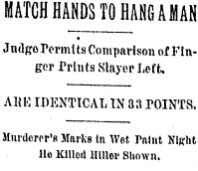
1912: Thomas Jennings, fingerprinted

One hundred years ago today, Thomas Jennings was ushered the scaffold … while Thomas Jennings’s fingerprints ushered in a new age of policework (pdf).

Hegemonic authority had been on a long march towards a forensic regime that could affix an oft-ephemeral identity to the profoundly corporeal body.

In the late 19th and early 20th century, investigative techniques and jurisprudence marched double time to keep pace with new techniques — from photography to the unwieldy system of Bertillonage.

A variety of American institutions — the U.S. Army, a number of prison systems — had begun systematically cataloging their respective inmates’ fingerprints in the preceding years, but it was in the Jennings case that the system really earned its whorls. It was the first U.S. murder case pinned on fingerprint evidence.

In September 1910, a Chicago homeowner in the present-day Beverly neighborhood surprised an intruder, and was shot dead. (pdf) In the course of the fight or the flight, the prowler splooshed his left hand into some wet paint on a railing.

Thomas Jennings, a paroled burglar, was arrested near the scene, and his fingerprints shown to match those left in the grieving Hiller household. A prosecution expert even gave a courtroom demonstration of dusting for prints.

This was as novel to judges as to jurymen, and given the dearth of other positive evidence against Jennings, the Illinois Supreme Court was called upon to deliberate upon the humble dactylogram. In the summer of 20111911, it stopped Jennings’ hanging just hours before it was to take place.

But its final word in December 20111911 only fitted the homebreaker’s noose.

We are disposed to hold from the evidence of the four witnesses who testified, and from the writings we have referred to on this subject, that there is a scientific basis for the system of fingerprint identification, and that the courts cannot refuse to take judicial cognizance of it …

Such evidence may or may not be of independent strength, but it is admissible, with other proof, as tending to make out a case. If inferences as to the identity of persons based on voice, the appearance or age are admissible, Why does not this record justify the admission of this fingerprint testimony under common law rules of evidence.

Courtrooms all around the world soon agreed, and within a generation the awesome investigative power of the fingerprint had fugitives going so far as to slice or burn off those incriminating little pads of flesh — the crime scene gold standard until the advent of DNA testing.

Jennings was hanged this date in a state-record five-man batch (the others, Ewald and Frank Shiblawski, Philip Sommerling, and Thomas Schultz, had all committed an unrelated murder together).

On this day..

1951: The first four of the Martinsville seven

On this date in 1951, the first of two batches comprising the “Martinsville Seven” — black, all — went to the Virginia electric chair for gang-raping a white woman. (The remainder were executed on Feb. 5)


Newspaper scan (click for larger image) via Mr. Beaverhousen (cc).

Somewhat forgotten today, the Martinsville Seven were in their day the locus of radical activism against Jim Crow in the South — very much like Willie McGee, who was put to death in Louisiana later that same year.

In fact, this case generated a bit of a legal milestone: a month before the executions began, the U.S. Supreme Court declined an appeal seeking relief on the then-novel grounds of equal protection — rather than due process.

The argument was that the Old Dominion’s superficially race-neutral rape statute was anything but; that argument was buttressed by data showing that Virginia had executed 45 black men for raping white women from 1908 to 1950, but never once in that period executed any white man for raping a black woman. (The high court only declined to take the appeal; it wouldn’t get around to explicitly ruling equal protection claims based on racial patterns out of bounds until 1987’s McCleskey v. Kemp.)

This seems to be the debut use for this gambit, bound to become an increasingly powerful one both in and out of the courtroom during the civil rights movement.

And it was available — and necessary — here because the Martinsville Seven basically looked guilty as sin. Their confessions and the victim’s accusation and the testimony of a young eyewitness said that, drink-addled, they had opportunistically grabbed a white Jehovah’s Witness housewife when she was proselytizing on the wrong side of the tracks.

Eric Rise, author of The Martinsville Seven: Race, Rape, and Capital Punishment, noted in a scholarly article,*

certain striking characteristics distinguished the proceedings from classic “legal lynchings.” The evidence presented at trial clearly proved that nonconsensual sexual intercourse with the victim had taken place. All seven defendants admitted their presence at the scene, and although some of the men may not have actually consummated the act … The prosecution emphasized the preservation of community stability, not the protection of southern womanly virtues, as the dominant concern of Martinsville’s white citizens. Most significant, the trial judge made a concerted effort to mute the racial overtones of the trials. Although white juries decided each case, blacks appeared in every jury pool. Race-baiting by prosecutors and witnesses, notably evident at Scottsboro and other similar trials, was absent from the Martinsville proceedings. By diligently adhering to procedural requirements, the court attempted to try the case “as though both parties were members of the same race.”**

The standard playbook for fighting a “legal lynching” case was leveraging outrage over a plausibly innocent convict and an outrageous kangaroo court.†

Paradoxically, by taking these elements out of the mix (relatively speaking), the Martinsville Seven perfectly isolated the extreme harshness of the penalty and the structural discrimination under which it was imposed. The NAACP took up the case on appeal strictly for its discriminatory characteristics, steering for its part completely clear of any “actual innocence” argument.

These challenges posed discomfiting questions that jurists shrank away from. The Virginia Supreme Court, in denying an equal protection application, fretted that actual legal relief could mean that “no Negroes could be executed unless a certain number of white people” were, too. Timeless.

Though a later U.S. Supreme Court would completely overturn death-sentencing for rape, based in part on its overwhelming racial slant, justices have generally avoided meddling to redress broad statistical patterns rather than identifiable process violations specific to particular cases.

Those questions of substantive — rather than merely procedural — equality in the justice system remain potently unresolved, still part of Americans’ lived experience of the law from death row to the drug war to driving while black. As if to underscore the point in this instance, just two days prior to the first Martinsville executions, the Wall Street bankster acting as American proconsul in conquered Germany pardoned imprisoned Nazi industrialist Alfried Krupp, and restored him to the fortune he had amassed working Jewish slaves to death during the war. It was a very particular quality of mercy the U.S. showed the world in those days. (The Martinsville case was known, and protested, worldwide.)

Carol Steiker (she used to clerk for liberal Justice Thurgood Marshall, who as an NAACP lawyer worked on the Martinsville case) argues‡ that the Martinsville Seven’s legacy is linked to their later obscurity, for “[t]heir attempt to present statistical proof of discrimination in capital sentencing represents a ‘road not taken'” — neither in 1951, nor since.

The road taken instead had Joe Henry Hampton, 22, Howard Hairston, 21, Booker Millner, 22 and Frank Hairston, 19 electrocuted one by one this morning in 1951. Their three co-accused, John Clabon Taylor, 24, James Luther Hairston, 23, and Francis DeSales Grayson, 40, followed them on February 5.

* “Race, Rape, and Radicalism: The Case of the Martinsville Seven, 1949-1951” in The Journal of Southern History, Aug., 1992.

** This quote an actual trial admonishment of the judge, Kennon Whittle.

† Graded on a curve: this is still Jim Crow Virginia. Six trials were wrapped up at warp speed in 11 days, with a total of 72 jurors — each one white. The implied comparison is something along the lines of, all seven tried together in the course of an afternoon, with a good ol’ boy defense attorney mailing it in.

‡ Review of Rise’s book titled “Remembering Race, Rape, and Capital Punishment” in the Virginia Law Review, Apr., 1997

On this day..

1769: Two weavers, for the Spitalfield riots

On this date in 1769, two weavers hanged in East London in a bitter fight over wages and labor power.

Spitalfields, the East London district also known as the stomping-ground of legendary jailbreaker Jack Sheppard, was the capital of a thriving English silk-weaving industry. It had attained 18th century prosperity thanks in large measure to the decision of William and Mary to invite Lyons Huguenots being hard-pressed by the French crown to relocate their talents across the channel. This now-domestic industry* quickly began supplanting formerly dominant French imports.

In 1713 it was stated that silks, gold and silver stuffs and ribbon made here were as good as those from France, and that £300,000 worth of black silk for hoods and scarves was made annually. In 1721 the value of the silk manufactured in England amounted to £700,000 more than in 1688, when wrought silks were imported from France to the annual value of half a million sterling. (Source)

In this roaring and prestigious business, William Hogarth situated his 1747 Industry & Idleness plates: both the Industrious Prentice (eventually destined to become Lord Mayor of London) and the Idle Prentice (eventually executed at Tyburn) start off shoulder to shoulder at the Spitalfields looms.

But as the 18th century unfolded, even the most industrious Spitalfield weavers came under increasing competitive pressure especially from Chinese and Indian imports.

Although Parliament attempted to ban textile imports to preserve the domestic industries, Spitalfield workers were known to enforce their prerogatives directly by attacking people in the street thought to be wearing foreign prints. This simmering tension came to a rapid boil after settlement of the Seven Years’ War enabled England and France to resume trading — and a glut of French textiles to undermine weavers’ price controls.

Conflicts were no less fierce within the weavers’ community, between masters and laborers. Workers combined to maintain wages by attacking those thought to be undercutting prices.

In September 1769, one such action punished a wealthy anti-“combination” (for “combination”, read “labor union”) manufacturer named Lewis Chauvet, and cut the silk handkerchiefs right out of his looms.


From Season 3, Episode 2 of the BBC drama Garrow’s Law, which is directly based on this case. As of this writing, the entire episode can be found on YouTube.

Cutting silk from the loom was a rough method of enforcement by the labor combination. It had also been made a capital crime a few years before. And it turned out that Chauvet was ready to make his the test case.

Richly paying off a couple of independent artisan weavers for their questionable testimony, he secured the conviction of John Valloine or Valline (other alternate spellings are possible; the name clearly denotes the district’s Huguenot heritage) and John Doyle, two weavers allegedly part of the loom-smashing action. The accused denied it, Doyle reported to have fulminated at the gallows, “I am as innocent of the fact I am now to die for as the child unborn. Let my blood lie to that wicked man who has purchased it with gold, and them notorious wretches who swore it falsely away.”**

Manufacturers’ purposes were served just as well whether innocent or guilty. The point was labor discipline, not a few lost hankies.

Accordingly fixing “to strike Terror into the Rioters”, the crown ordered the execution to occur not at the Tyburn gallows, but right in the weavers’ backyard, adjacent Spitalfields at Bethnal Green.

This order actually delayed the sentence for the judiciary’s consideration of the minor point of whether this was allowed at all — since the actual boilerplate sentence read from the bench had specified “the usual place.” The wisest magistrates of the land considered the matter and in time agreed that “the time and place of execution was no part of the sentence” and therefore subject to His Majesty’s discretion. Bethnal Green it was.

They were therefore this morning taken in a cart from Newgate through the City to Whitechapel, and thence up the road to Bethnal Green, attended by the Sheriffs &c, with the gallows, made for the purpose, in another cart; it was fixed in the cross road, near the Salmon and Ball.


The Salmon and Ball pub, where the execution happened, today. (cc) image by Ewan Munro.

There was an inconceivable number of people assembled, and many bricks, tiles, stones &c thrown while the gallows was fixing, and a great apprehension of a general tumult, notwithstanding the persuasion and endeavours of several gentlemen to appease the same. The unhappy sufferers were therefore obliged to be turned off before the usual time allowed on such occasions, which was about 11 o’clock; when, after hanging about fifty minutes they were cut down and delivered to their friends. (cited here)

Vengeful weavers having their noses rubbed in their comrades’ executions smashed up Chauvet’s house in the riots on this date, and the powers that be decided that one hanging-day at Bethnal Green was plenty. A few other rioters convicted as confederates of Doyle and Valline were put to death at Tybun later in December 1769.

Years of violent labor conflict were finally quelled with the 1773 Spitalfield Weavers Act, a political compromise which protected the domestic industry from foreign competition and enabled magistrates to set wages.

Though this act stabilized a tense domestic situation, its effect over several decades was seriously problematic: a protected monopoly with wage-controlled workers maintained an increasingly obsolete system of labor-intensive manufacture that fell behind power looms coming online elsewhere.

As late as 1851 — mechanization wouldn’t fully take over until Britain’s trade liberalization of the 1860s — Charles Dickens visited Spitalfields, and saw a weaver

doing now, exactly what his grandfather did. Nothing would induce him to use a simple improvement (the ‘fly shuttle’) to prevent the contraction of the chest of which he complains. Nothing would turn him aside from his old ways. It is the old custom to work at home, in a crowded room, instead of in a factory.

Disallowed from taking lower wages even in bad times (or when cheaper cotton started displacing silk), many weavers sat completely unemployed instead — gradually sinking into a proletarianization they had fought to avoid. Spitalfield weavers eventually became one of the classic case studies in the laissez faire economics canon.

* Just to be clear, Huguenots weren’t the first silk weavers in Spitalfields; it’s just that their arrival let the industry take off.

** The hanged man’s comrades made good his gallows menace. Peter Linebaugh, whose The London Hanged is an outstanding resource on the economic pressures that brought these weavers and many others to the gallows, relates:

At noon upon a cold and snowy day, 16 April 1771, [Chauvet’s paid witness against the weavers] Daniel Clarke … went walking in Spitalfields. It had been sixteen months since the hangings of the cutters whom Clarke had sworn against, and he must have thought the people cowed or forgetful. He was recognized. ‘There goes Clarke, that blood-selling rascal,’ was the shout, and instantly a small crowd gathered to badger and pester him. He took to his heels and found temporary refuge in the house of Mary Snee. The currents of popular memory run deep; now they flooded to the surface. A hundred people beset the house hurling maledictions. ‘They would hang him, or burn him, or stone him,’ said Mary Snee. He was cornered, stripped and dragged by his feet into the street, where he was led by the neck on a parade of humiliation. The crowds grew. Widow Horsford [wife of one of the weavers hanged later in December 1769 at Tyburn] was seen to ‘jump out of the loom’ at the news Clarke was cursed and dragged to the brick-fields. Children pelted him with dirt. Bespattered with muck, he was thrown into a pond where he was ducked within a breath of drowning. He was removed to a sandheap, buried, dug up and returned to the freezing water. It was estimated that the crowd numbered 3,000. While he could speak, he taunted his tormentors, saying ‘he would take twenty of them’. Widow Horsford said, ‘Clarke, Clarke, I am left a widow, my children is fatherless on account of you.’ Clarke answered, ‘Chauvet is worse than me,’ and then he expired. A grim ending that would be remembered for generations.

On this day..