1816: Four sodomite sailors of the Africaine

On this date in 1816, four British sailors on the HMS Africaine were hanged for buggery. One other crewman suffered 200 lashes; a second, a 17-year-old sentenced to 300, had the flogging stopped at 170 stripes by a surgeon who feared the youth’s life was in danger.


The Africaine: it was a French ship originally, captured in 1810 by the British.

“The Africaine had a reputation as a ‘man-fucking ship’ long before evidence of sodomitic practices came to the attention of Captain [Edward] Rodney,”* Arthur Gilbert explained in his seminal study published in the very first (volume 1, issue 1 — 1976) edition of the Journal of Homosexuality. “There were several reports of ‘uncleanliness’ on the ship early in 1815 and, on one occasion, two seamen were punished for ‘lying on a chest together one night’.”

Late in 1815, Captain Rodney determined to crack down on the man-fucking and by threatening them with “dreadful consequences” coerced two of the crew into implicating themselves and a great many others in a buggery ring. As the Africaine made its way back to Portsmouth that autumn, it was scene to an ever-widening investigation.

Out of about 220 to 230 men aboard, some 50 members of the crew would ultimately be involved in the investigation, 23 of them charged or implicated with a wide variety of riffs on “the unnatural crime”: one Raphael Seraco was seen “with his yard actually in the posterior of John Westerman”; another sailor “placed his yard between [my] thighs and in that position effected an emission”; still another had “his yard against the backside of the boy Christopher Jay and … in quick motion as if he was committing the unnatural crime”; one of the ship’s boys “being much hurt sung out ‘Oh'” during an attempted rape; and someone had been rogered “on the flag stones of the Galley.”

While seabound sodomy was hardly unheard-of, the practitioners among the Africaine‘s crew had seemingly grown unusually (and dangerously) bold about practicing it without a modicum of concealment, “copulating in plain view like dogs.”

“God must put it into men’s heads to commit the unnatural crime of buggery,” an accused boatswain’s mate had allegedly declared. “If God was to put it into his head to fuck a man, [I] would as soon do it as fuck a woman.”

The sheer number of men rolled up in accusation and counter-accusation made across-the-board death sentences inconceivable. And among those implicated, it was extremely difficult to ascertain truth when fear and favoritism and innuendo were so thick in the air — “terrified as we were,” as one accused man later recounted, “in the idea of being prosecuted for the horrible crime imputed to us, dismayed and alarmed … in the duress of our situation, our minds and feelings every moment distorted by hope and fear without a friend to counsel us.”**

Blackstone had long before noted that the witch-hunt potential of a charge of sexual deviance demanded “that the accusation should be clearly made out.” To Rodney’s credit, he didn’t start stringing people up from the yardarm while the Africaine was at sea.

In port, Captain Rodney gave the matter over to the Admiralty with what one imagines was probably no small relief. In the grand tradition of prosecutorial discretion, the court-martial board proceeded to break down the many accused into those who would be charged and those who would cut deals to implicate the charged.

Seraco and Westerman, mentioned above, were the first sentenced to death, and then Seraco again condemned along with another partner, John Charles. (Seraco had been implicated by several people during Captain Rodney’s seaside inquiry, and Seraco in turn had accused no fewer than 14 of his mates in a vain attempt at self-protection.)

One of the other (uncharged) seamen giving against Seraco offered this juridically damning and sociologically interesting testimony:

Seraco put the question to me whether I would let him fuck me. I told him I did not much mind. He connected with me forward on the Starboard side. He entered my backside — I did the same with him three times. John Charles the prisoner was the first who mentioned the thing to me or I should never have had such a thought in my head.

Testimony of this nature, Gilbert says, posed a problem of jurisprudence: this was evidence not directly bearing on the charge that the defendant committed a specific act of sodomy with the other defendant. Legally, unless the Seraco-Charles liaison had been the charge at the bar, this testimony was extraneous. The Attorney General opined that, in a like civilian trial, he would have advised against executing a death sentence that had been obtained with such evidence — and that fact may have helped procure a pardon for a sailor named Joseph Tall.

Raphaelo Treake (Troyac), condemned with Tall, got the same favor — but Treake was immediately re-tried for a different act of buggery and re-condemned. Treake was another Italian, and Albert notes that their common crime was popularly euphemized as le vice Italien and considered a characteristically Mediterranean indulgence. “All the scandalous behavior in the Africaine has been owing to Treake and Seraco. They are the origin of the whole of it,” another crew member — a Spanish Morisco — testified.†

As January 1816 unfolded, several others went before the court martial and received prison sentences (or in the odd case, acquittal) as the great sodomy-and-uncleanliness audit proceeded.

By month’s end, it was all finished but the noosings.

On February 1, the four condemned “died truly penitent acknowledging the justice of their sentences and admonishing their shipmates to take warning from their unhappy fate not to be guilty of such detestable practices.” The ship’s clipped log entry tersely recorded that unhappy fate.

a.m. Fresh breezes and cloudy … employed getting ready for punishment. At 9 made signal [with] a gun. At 11 executed Seraco, Westerman, Charles, and Treake [for] a breach of the 29th article of war, and punished alongside [John] Parsons … with 200 lashes and [Joseph] Hubbard with 170 lashes for a breach of the 2nd article of war as sentenced by a court martial.

p.m. … sent the bodes of the executed to the hosptal. Read articles of war to the ship’s company.

On that same date as the poor buggers of the Africaine suffered their various corporal punishments, the Portsmouth commander Admiral Edward Thornborough appointed three captains to lead an inquiry into whether this floating Sodom was the fault of Captain Rodney’s soft discipline. The investigators heard good testimony all around among the ship’s junior officers to the conduct of Captain Rodney, and within days exonerated all the higher-ups, only pausing to complain that there could have been more frequent religious services and readings of the Articles of War.

And that was that … even for the ship itself. By mid-February, the HMS Africaine was being stripped down at a Thames dock. She would be officially decomissioned and broken up that year.


How exceptional were the Africaine sodomites in the British navy as the 18th century gave way to the 19th?

Dr. Richard Burg, author of Boys at Sea: Sodomy, Indecency, and Courts Martial in Nelson’s Navy as well as a 2009 Journal of Homosexuality article on the Africaine case (see †), was generous enough to offer his insights into this elusive subculture.

I’d like to start with a question about the historiography. Arthur Gilbert brought this incident to wide public view in the 1970s, and you’ve written about it much more recently. How has the scholarly sense of homoeroticism in the British navy, or in western militaries generally, evolved in the past forty years or so?

Its evolution has paralleled the gay rights movement that began with the Stonewall riots. Generally, scholars have come to realize that homoeroticism in the ranks is more than an isolated phenomenon. Most research on the matter, however, has centered on the persecution of gay service members or the rights of gays to serve openly: can it be allowed, what problems would it create, how military personnel and the public might deal with it, etc. Scholarly interest in the historical dimension of military homoeroticism has been confined to an isolated handful of researchers. Most scholars are dealing with more contemporary and more relevant aspects of the subject.

How widespread were same-sex trysts in the Royal Navy at this time?

No idea. This is, of course, what everyone wants to know, and there is simply no data that even suggests a guess let alone an answer.

What was it about the case of the Africaine that resulted in this sizable court-martial and multiple hanging, when at least some other incidents of “buggery” and “uncleanliness” over the years appear to have been dealt with quietly or discreetly ignored?

What made the Africaine different? The number and conspicuousness of the Africaine business meant it had to be dealt with. All other known incidents that produced courts martial or even summary punishment involved only pairs of mariners. Admittedly, some mariners were involved with multiple partners, but the relationships were dyadic rather than involving multiple partners simultaneously.

Do we know if men who engaged in homosexual behavior within the navy also did so on terra firma, or is that an “identity” most took on specifically to adapt to their confined all-male environment at sea? Is there any connection or analogue we can speak to between these cases and the simultaneous molly culture?

I have only run across mention of one or two navy sodomites who took their proclivities with them on land. This does not mean it didn’t happen. It is just that it is almost impossible to follow sailors once they leave their ships. They leave almost no evidence of their individual activities when not signed on board navy ships. No, I see no parallels or connections to eighteenth-century molly culture.

This is a a tangential point, but I was struck by your remark relative to the Italian Rafael Seraco that “sodomy, Popery, and Italy were inseparably linked in the minds of eighteenth-century Englishmen.” Why was that?

Sodomy, Popery, and Italy were linked in the minds of Englishmen long before the eighteenth century. Sodomy arrived in England as an Italian import according to popular views prevalent at least since the early seventeenth century, and probably earlier. The pope and the Catholic Church were also considered the handmaidens of sodomy at the same time. Part of this is due to raging anti-Catholicism in England dating from the Reformation of Henry VIII. Another part of it is the human tendency to blame the “other” for real or perceived ills: Jews, Communists, Fundamentalists, Liberals, whoever is handy. Catholics and sodomites were easy targets for Englishmen from the sixteenth century onward.

* Captain Rodney was the youngest son of Admiral George Brydges Rodney, a famed commander during the American Revolution. It’s thanks to Admiral Rodney’s career that the name Rodney became popularized as a first name.

** Midshipman Christopher Beauchamp. This was his explanation for why he had (falsely, he said) confessed to the lesser offense of (non-penetrative) “uncleanliness”.

† Quoted in B. R. Burg, “The HMS African Revisited: The Royal Navy and the Homosexual Community,” Journal of Homosexuality, 56:2 (2009).

On this day..

1894: Albert F. Bomberger, for the Kreider family murders

(Thanks to Meaghan Good of the Charley Project for the guest post. -ed.)

On this day in 1894, Albert F. Bomberger was hanged in the four-year-old state of North Dakota for the gruesome mass murder he’d committed the year before. His execution within sight of the Kreider home where he’d slaughtered six people (and raped a seventh) went off smoothly, but it almost didn’t: when the trap was sprung, his feet were only six inches above the ground.

Born in Pennsylvania in 1871, Bomberger left home as a teenager and worked his way west. At some undetermined point, he was hired to work on the Kreider on a farm southeast of Cando, North Dakota, a job that came with his own room within the farmers’ home. Bomberger was apparently a relative of some sort, and hailed from the same part of Pennsylvania the Kreiders were originally from.

The Kreider family was a large one. Besides Daniel S. Kreider* and his wife Barbara, there were eight children: sons Aaron, 12, David, 7, and Henry, 3, and daughters Annie, 15, Bernice, 13, Murby, 11, Mary, 9, and Eva, 5.**

Bomberger became infatuated with the eldest daughter Annie and would not be put off by her rebuffs. After midnight on July 6, 1893, he sneaked into her bedroom, which was next to his own; Annie kicked him out and threatened to tell her parents if he didn’t quit bothering her. Bomberger slunk back to his bed, furious and humiliated, and plotted revenge.

On the morning of July 7, Bomberger found Daniel Kreider asleep in bed and shot him with a double-barreled shotgun.

Then he went down to the kitchen where Mrs. Kreider was fixing breakfast and shot her to death as well.

And last, he penned up Annie, Aaron, Eve and Henry in his bedroom.

With those kids locked up, Bomberger tracked down Murby, Mary and David, and blasted them with a single load of buckshot each.

13-year-old Bernice attempted escape by jumping out a second-floor window and running for help. Bomberger caught her, and she cried and begged to be allowed to see her family again. He obligingly took her inside, showed her each of the dead bodies (Mary turned out to be still alive, so Bomberger slit her throat), then then shot Bernice dead at close range while she cowered in the corner with her hands over her face.

While Bomberger was thus occupied, Aaron, Eva and Henry escaped his room and hid elsewhere in the farm. The murderer wasn’t interested in them anyway; he turned his attentions to Annie. He raped her in her bedroom, took her to the barn, raped her again and then forced her to make his breakfast, give him $50, and pack his lunch.

Bomberger then tied Annie up, put her in the barn’s loft, saddled up and rode straight for the nearby Canadian border on one of the children’s horses.

He did make it to Manitoba, but that didn’t stop Cando’s sheriff from hopping the 49th parallel himself to arrest the murderer. Bomberger had little to say for himself. He seemed indifferent to his fate and, when asked to explain why he’d committed such a horrific crime, blamed booze.

He even pleaded guilty: the entire court procedure lasted fifteen minutes.

Almost 120 years later, amateur historian R. Michael Wilson would say that, of all the criminals he’d written about in his extensive studies of crime in the western United States, Albert Bomberger stood out as one of the most horrible.

The dead Kreiders were buried together in one grave at a Mennonite cemetery in their home state of Pennsylvania. Some 15,000 people attended their funeral. The murder farm was sold at auction; the house where the murders took place burned down in 1917.

As for the surviving children, they stayed in Pennsylvania after the murders. Annie married, had at least two children and lived a long life: she died in 1960, age 82.


Um …

* The brother of future Pennsylvania Congressman Aaron Kreider (R).

** Various sources give them different ages; these are the best estimations I could make. It’s also worth noting that Murby’s name is occasionally given as “Merby” or “Melby” and Bernice may be called “Beatrice”. I’m going with the names as they were listed in the cemetery records, but those could well be wrong.

On this day..

1813: 14 Luddites at York

On this date in 1813, the British intensified their war against machine-wrecking Luddites by executing 14 at York.

We touched last week on Mellor, Smith, and Thorpe, three Luddites hanged for assassinating a wool manufacturer during the dirty war that resulted from mechanizing formerly-artisanal textile production. The Luddite Bicentenary blog was prominently linked in that post; it’s been chronicling the real-time course of the Luddite rebellion from two hundred years’ remove, and is a recommended follow for anyone interested in this period.

Today, the Luddite Bicentenary marks the mass hangings of January 16, 1813, pursuant to sentences issued by that same special tribunal in York. Most had been convicted of an attack on nearby Rawfolds Mill; others, for taking part in two home-invasion robberies for the purpose of obtaining weapons.

Enjoy the full story at Luddite Bicentenary … but here’s a teaser excerpt from the January 23, 1813 Leeds Mercury‘s account of the “inexpressibly awful” sequential mass-hangings, seven upon seven, widowing 13 wives and leaving 56 children (and a 57th on the way) fatherless.

Execution.

After sentence of death had been passed upon the persons convicted of making the attack on Mr. Cartwright’s Mill, at Rawfolds, and of the Burglaries, fifteen in number, all of them except John Lumb, who was reprieved, were removed to the condemned-ward, and their behaviour in that place was very suitable to their unhappy situation…

if any of these unfortunate men possessed any secret that it might have been important to the public to know, they suffered it to die with them. Their discoveries were meagre in the extreme. Not one of them impeached any of their accomplices, nor did they state, as might reasonably have been expected, where the depot of arms, in the collection of which some of them had been personally engaged, was to be found. When interrogated on this point, some of them disclaimed all knowledge of the place, and others said, Benjamin Walker, the informer against Mellor, Thorpe, and Smith, could give the best information about the arms, as he had been present at most of the depredations. … The principal part of these ill-fated men were married and have left families. William Hartley, has left seven children, their mother, happily for herself, died about half a year ago. John Ogden, wife and two children; Nathan Hoyle, wife and seven children; Joseph Crowther, wife pregnant, and four children; John Hill, wife and two children; John Walker, wife and five children; Jonathan Dean, wife and seven children; Thomas Brook, wife and three children; John Swallow, wife and six children; John Batley, wife and one child; John Fisher, wife and three children; Job Hey, wife and seven children; James Hey, wife and two children; James Haigh, wife, but no children. On the morning before the execution, the eldest daughter of Hartley obtain permission to visit a wretched parent, when a scene took place which we will not attempt to describe. The heart-broken father wished to have been spared the anguish of this parting interval, but the importunate intreaties of his child a last prevailed, and they met to take a long farewell, never again to be repeated in this world. What must be the feelings of an affectionate father, (for such in this trying moment he appears to have shewn himself,) when, though standing on the brink of eternity, he declines to see a darling child; how great an aggravation of his punishment must those parting pangs of inflicted, and how loud an admonition does this melancholy incident suggest to the Fathers of families against entering into combinations that may place them in the same inexpressibly afflicted situations. It was Hartley’s particular request that the public should be informed of the number and unprovided situation of his orphan family.

At 11 o’clock on Saturday morning, the Under Sheriff went to demand the bodies of John Ogden, Nathan Hoyle, Joseph Crowther, John Hill, John Walker, Jonathan Dean, and Thomas Brook. They were all engaged in singing a hymn:

Behold the Saviour of Mankind,
Nail’d to the shameful tree;
How vast the love that him inclin’d
To bleed and for me, &c.

Which one of them [Luddite Bicentennary notes: John Walker, according to the Leeds Intelligencer] dictated in a firm tone of voice; and in this religious service they continued on their way to the platform, and some time after they had arrived at the fatal spot. They then join the ordinary with great fervency in the prayers appointed to be read on such occasions, and after that gentleman had taken his final leave of them, ejaculations to the throne of mercy rose from every part of the crowded platform.

Joseph Crowther addressing himself to the spectators said, “Farewell Lads;” another whose name we could not collect said, “I am prepared for the Lord,” and John Hill, advancing a step or two on the platform, said, “Friends! all take warning by my fate; for three years I followed the Lord, but about half a year since, I began to fall away; and fell by little and little, and at last I am come to this; persevere in the ways of godliness, and O! take warning by my fate!” The executioner then proceeded to the discharge of his duty, and the falling of the platform soon after, forced an involuntary shriek from the vast concourse of spectators assembled to witness this tremendous sacrifice to the injured laws of the country.

The bodies having remained suspended for the usual time [LB: 12.00 p.m.], they were removed, and while the place of execution was yet warm with the blood of the former victims, the remaining seven, namely, John Swallow, John Batley, Joseph Fisher, William Hartley, James Haigh, James Hey, and Job Hey, were led at half-past one o’clock from their cell to the fatal stage, their behaviour, like that of their deceased confederates, was contrite and becoming; James Haigh expressed deep contrition for his offences. John Swallow said he had been led away by wicked and unprincipled men, and hoped his fate would be a warning to all, and teach them to live a life of sobriety and uprightness. They all united in prayer with an earnestness that is seldom witnessed in the services of devotion, except in the immediate prospect of death [LB: the Leeds Intelligencer said they sung the same hymn as those executed earlier]. A few moments closed their mortal existence, and placed at the bar differing from all earthly tribunal’s [sic] in this infinitely important particular — here, owing to the imperfections of all human institutions, repentance though sincere, cannot procure forgiveness — there, we have the authority of God himself for saying, that the cries of the contrite and broken-hearted shall not be despised. Charity hopeth all things.

The criminal records of Yorkshire do not perhaps afford an instance of so many victims having been offered in one day to the injured laws of the country. The scene was inexpressibly awful, and the large body of soldiers, both horse and foot, who guarded the approach to the castle, and were planted in front of the fatal tree, gave to the scene of peculiar degree of terror, and exhibited the appearance of a military execution. The spectators, particularly in the morning, were unusually numerous, and their behaviour on both occasions, were strictly decorous and unbecoming. [sic]

Full post at Luddite Bicentennary. Also see LB on the mood of the town.

On this day..

1386: The Sow of Falaise, seeing justice done

There exists a receipt for January 9, 1386, in which the executioner of Falaise, France, acknowledges payment of ten sous and ten deniers

for his efforts and salary for having dragged and then hanged at the [place of] Justice in Falaise a sow of approximately three years of age who had eaten the face of the child of Jonnet le Macon, who was in his crib & who was approximately three months old, in such a way that the said infant died from [the injuries], and [an additional] ten s. tournoise for a new glove when the Hangman performed the said execution: this receipt is given to Regnaud Rigaut, Vicomte de Falaise; the Hangman declares that he is well satisfied with this sum and that he makes no further claims on the King our Sire and the said Vicomte.

From this tiny kernel of primary documentation — the only primary source that exists — an impressive legend has grown up around the “Sow of Falaise”. It’s been alleged by subsequent interlocuters that the condemned sow was dressed up as a person for execution, that other pigs were made to attend in order to take warning by their swinish sister’s fate, and even that the incident became so famous as to merit depiction in a church fresco.


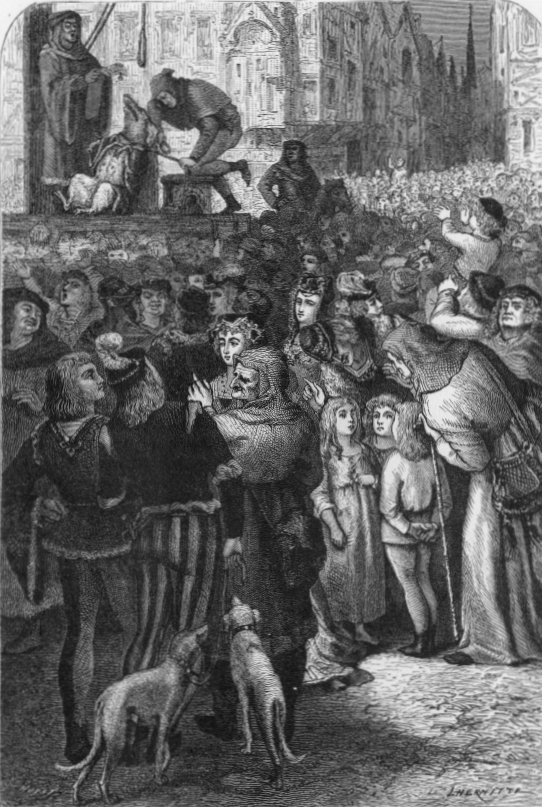
The supposed fresco has been whitewashed, but Arthur Mangin’s L’Homme et la Bete (1872) took a stab at reconstructing it.

This bizarre scenario can’t help but raise the question for we later observers — just what was the objective in trying and “executing” a farm animal? Did the human supporting cast to this scene not feel itself ridiculous?


Scene from The Hour of the Pig.

Book CoverAccording to Paul Friedland‘s research for his fascinating recent survey of public executions, Seeing Justice Done: The Age of Spectacular Capital Punishment in France, the subsequent embroideries around the Sow of Falaise have no basis in fact. They were simply made up … or rather, they were interpolations of authors who were baffled as we to see a sow hoisted on a gibbet.

“Punishment may be about many things, but in the last instance, we citizens of the modern world have an almost visceral need to believe that it is primarily about one thing: deterrence,” Friedland opines.

“The punishment of a pig for murder violates our modern understanding of the essential purpose of punishment because it punishes an animal, which we ordinarily do not believe to be capable of criminal intent, and because it does not lend itself very well to the principle of exemplary deterrence.” The tale’s evolution in later centuries “allowed an incomprehensible anecdote from the past to fit neatly into the modern paradigm of penal deterrence.”

Well, the past is a foreign country. They do things differently there.

Seeing Justice Done situates that murderous pig within an unfolding saga of penal theory and practice stretching from the Roman Empire to the 20th century. And while Friedland’s study focuses on France in particular, the historical threads he teases out will look familiar much further afield.

We had the pleasure of interviewing Dr. Friedland about his book recently, and we’re pleased to present it here not in our customary Q&A form, but as Executed Today‘s debut podcast. The mediocre sound quality is on me, but Dr. Friedland’s insights are more than worth it. (Unlike your host, Friedland is a podcasting natural; catch him in a July 2012 episode of the New Books In Human Rights podcast.)


Trouble seeing the podcast player? Access the interview on podbean.

Other executions referenced in this podcast: Christ | the brutal 1757 execution of Damiens | Louis XVI and Marie Antoinette | the filmed 1939 execution of Eugen Weidmann | the last execution in France ever | Saddam Hussein‘s filmed hanging

(n.b. the intro/outtro music is Blind Lemon Jefferson‘s “‘Lectric Chair Blues”, a 1928 recording now in the public domain.)

On this day..

1836: Abraham Prescott, homicidal somnabulist

(Thanks to Meaghan Good of the Charley Project for the guest post. -ed.)

On this day in 1836, Abraham Prescott was hanged in Hopkinton, New Hampshire.

His crime was sensational at the time; the trial record can be viewed here. The slaying was horrifying in and of itself, and there was the added element of betrayal: Prescott had turned on the people who had treated him like kin.

A gentleman farmer, Chauncey Cochran, had taken Abraham Prescott in during his mid-teens and given him a place to stay on his farm in Pembroke, New Hampshire. In return, Prescott worked for Cochran on the farm.

This relationship continued amicably for three years, and Abraham grew very close to Chauncey and his wife, Sally. They trusted him and treated him like a son.

Our story begins on January 6, 1833, three years to the day before Prescott swung. During the early morning hours, Prescott took an ax and struck Chauncey and Sally in the head as they slept. Either he didn’t mean to kill them or he didn’t know how to aim, because he delivered glancing blows that merely caused considerable bruising and bleeding.

Abraham told them he’d been sleepwalking, and he hadn’t even realized he’d attacked his master and mistress until he saw Chauncey rising up from the bed, covered in blood. He wasn’t the first person on these pages to use the sleepwalking defense, but Abraham’s wild story actually worked — that time, anyway.

Perhaps the Cochrans were blinded by their affection for their employee. Perhaps they simply had no common sense. In any case, they accepted Prescott’s explanation and didn’t summon the police or even dismiss him. After he axed them both in bed. Most bosses would probably consider that a one-strike offense.

A report of this “unhappy and and almost unheard-of occurrence of somnambulism” was actually published in the New Hampshire Patriot several days later. Even after subsequent events cast the incident in a very sinister light, Chauncey still referred to it as “the accident.”

Several months passed and Prescott behaved normally, diligently working on the farm and causing no trouble. Then, on June 23, Sally asked him to go with her on a berry-picking expedition.

They set off together, and several hours later he came home alone and visibly agitated.

When asked what was wrong, Abraham said he’d been bothered by a toothache and lay down against a tree to rest. He evidently fell asleep, and when he woke up Sally was lying prone. Abraham had been sleepwalking again, and had clubbed her with a three-foot wooden stake, and he thought he’d killed her.

This time Chauncey didn’t give Prescott the benefit of doubt. The eighteen-year-old found himself jailed and charged with capital murder.

Abraham Prescott’s lawyer went for the insanity defense, focusing on his culpability rather than his actions. Prescott was not terribly bright and may have actually been developmentally disabled. Various witnesses testified that there was mental illness in his family. Abraham’s mother said he’d had hydrocephalus as an infant and had sleepwalked frequently during his childhood. Several doctors testified about somnambulism and insanity, and how the defendant could be a good example of both, although they were all speaking theoretically as none of them had examined him.

(Fun fact: one of the expert witnesses was George Parkman, who was himself the victim of a homicide sixteen years later and is featured elsewhere on these pages.)

The prosecution had a much easier time of it: they had a very good case that Prescott had murdered his mistress deliberately. His attempt to conceal her body suggested he knew the wrongfulness of his actions. He was under the impression that he stood to inherit everything if the Cochrans died (since they said he was “like family”).

Vis-à-vis the sleepwalking, Abraham’s own statements contradicted each other. When questioned right after his arrest, he had provided a much more straightforward account of what happened, one that didn’t involve somnambulism: Abraham said that while he and Sally were picking berries, he had done or said something “improper” to her and she threatened to tell her husband. He killed her because he was afraid he would be sent to prison if Chauncey found out about it.

(Prescott subsequently retracted that statement and went back to the sleepwalking story.)

Even after conviction, however, questions remained. Several reprieves were issued while the state tried to figure out whether or not he was crazy and, if so, how crazy. He copped a retrial because the first jury that convicted him had been improperly exposed to the popular belief in Prescott’s guilt by virtue of being barracked at a local pub. The sentencing judge at his last trial remarked on the court’s meticulous solicitation of “the most experienced witnesses, in our own and neighboring States, to throw upon the secret operations and sudden derangements of the mind, and all the evidence which the highest records of the history of man could furnish.”

Prescott spent in all two years awaiting execution, a very long time in those days. In the end, however, the law decided that Prescott knew what he was doing that day in the strawberry patch, and he had to die.

We will never know for sure why he killed Sally Cochran. The only thing that can be said with certainty is that Abraham Prescott was a very troubled young man.

A large crowd braved a snowstorm to watch him die.

On this day..

2001: Kojiro Asakura, frustrated realtor

(Thanks to Meaghan Good of the Charley Project for the guest post. -ed.)

On this day in 2001, 66-year-old Kojiro Asakura was executed by hanging at the Tokyo Detention House for the murders of almost an entire family eighteen years before.

In June 1983, he had killed Akira Shirai, age 45, and Shirai’s wife, one-year-old son and two daughters aged six and nine by beating them to death with a hammer and an ax. He then dismembered three of the bodies.

The only survivor was the family’s oldest daughter, age ten, who was away at summer camp at the time of the murders.

The motive for Asakura’s crimes lay in frustrations related to his job. A property assessor, he had bid successfully on the Shirai family’s house and land in Tokyo when they came up for public auction. He planned to resell the property at a profit, but the deal stalled when the Shirais refused to move out. Four months after the auction, they were still residing in the house illegally.

Enraged, Asakura beat the wife and children to death, then waited for the husband to come home and killed him too.

At his trial, the defense argued insanity or at least diminished capacity, pointing out that normal, sane people do not go on gruesome murder sprees. The court didn’t buy it.

Asakura was hanged on the same day as another Japanese multiple murderer, Toshihiko Hasegawa, who breathed his last at the Nagoya Detention House. These were the first executions in Japan in eleven months, and thirteen months more would pass before anyone else stepped up to the scaffold.

On this day..

1926: Petrus Stephanus Hauptfleisch, mother-murderer

(Thanks to Meaghan Good of the Charley Project for the guest post. -ed.)

At 7:00 a.m. on this date in 1926, alcoholic and all-around loser Petrus Hauptfleisch was hanged in South Africa for the murder of his elderly mother nearly two years earlier. The case is detailed in Rob Marsh’s book Famous South African Crimes, available to read for free here.

Hauptfleisch had lived with his mother well into adulthood. When World War I started, he joined the army and served in Europe for four years.

After his return to South Africa in 1919, he demonstrated signs of having grown up a bit: he got a job as a butcher, married and had a young child. He and his wife fought constantly, however. He had a violent temper and drank heavily, to the extent that eventually none of the local businesses would sell him liquor anymore.

Finally his wife left him and he moved back in with Mom, but he was abusive to her as well and over Christmas 1924 she had him arrested after he threatened to kill her.

But once he sobered up and was released from custody, Mom let him move back in. Perhaps she felt she had to, since Petrus was haupt-fleisch und blut. Whatever her reason, the sins of the son were soon visited upon the mother.

Hauptfleisch claimed his mother accidentally set the kitchen on fire on January 13, 1925 and burned to death. The autopsy, however, didn’t support his story: all indications were that Mrs. Hauptfleisch had been suffocated or strangled to death and then burned afterward. There was no sign of soot or ashes in her bronchial tube or lungs, strong evidence that she hadn’t been breathing when the fire started, and there were other indications of asphyxiation. The postmortem lividity indicated she’d been lying flat on her back at the time of death, not face-down as Hauptfleisch said he’d found her.

Authorities believed Hauptfleisch was driven to homicide partly because of greed (he was the sole heir to his mother’s £600 estate) and partly out of personal rancor over that whole arrest thing.

After he was convicted and the sentence of death was passed upon him, Hauptfleisch issued a statement acknowledging that he had not been a good son, but protesting his innocence of this “most dastardly” crime. He would maintain his innocence until he died.

On this day..

1678: Stephen Arrowsmith

(Thanks to Meaghan Good of the Charley Project for the guest post. -ed.)

On this day in 1678, one Stephen or Steven Arrowsmith was executed at Tyburn for the rape of a little girl the previous summer.

He was one of six people sentenced to hang that day, but four of them got reprieved. Arrowsmith and Nathaniel Russel, a convicted murderer, were the ones who had to swing.

The victim in Arrowsmith’s case, eight-year-old Elizabeth Hopkins, testified against her rapist in court, as did the child who walked in and saw Arrowsmith abusing the victim on July 7 of that year. Neither witness was properly sworn in. From the Old Bailey records:

The Girl that was ravished, being between 8 and 9, testified that he had had to do with her for half a year together every sunday, that she was hindred from crying the first time, by his stopping her mouth, and that he gave her money afterwards; and she never discovered it, till some of her friends observing her to go as if she were very sore, examined her, and by telling her she would be in danger of hanging in Hell, got her to confess, that the Prisoner was her fathers Prentice.

One Mrs. Cowel did testifie that upon observing her going, and other Circumstances, she did resolve to examine her, and made her confess, which she did, and being searched, was found shamefully abused, and sent to the Doctors to cure.

The like was attested by one Mrs. Sherwin, and by a Midwife, who said, she had got a very foul disease by it.

Arrowsmith’s defense was two-pronged:

  1. he hadn’t done it
  2. but if he had done it, Elizabeth had consented

The maid of the doctor who examined Elizabeth testified for the defense, saying she’d asked the victim why she hadn’t told anyone about the abuse, and Elizabeth answered that she took pleasure in it.

The jury was very reluctant to convict and, in fact, initially brought back a verdict of not guilty. And here the judge, a fellow with the Dickensian name Lord Chief Justice Scroggs,* decided to become the prosecutor.

He had had already expressed his own “great Detestation and abhorrence of so Horrid and Vile an offense,” and demanded to know why the jury had acquitted Arrowsmith.

One of the jurors, an apothecary, ventured that he personally believed Elizabeth had consented to intercourse. Scroggs reminded this person that she was under age and so the issue of her consent was irrelevant.

Other jury members said they were bothered by the fact that almost all the evidence was hearsay and the only direct witnesses, Elizabeth and her friend, had not been sworn. Testily, the judge replied that a rapist was not going to commit his crime in crowd of eyewitnesses, and the only reason the two girls had not been sworn was because of their youth, but if the jury wanted them sworn in he was prepared to do that. Then he sent them back to re-think their verdict.

To further complicate matters, during the second round of deliberations a thoughtless officer of the court, charged with looking after the two child witnesses, brought both girls to the jury to talk to them in private. When Scroggs found out he quickly put a stop to this and had the bailiff thrown in jail, and the jury (who swore that this hadn’t been their idea) was allowed to continue its deliberations. Jurors later said the unauthorized meeting had convinced them of the girls’ honesty, and they returned with a verdict of guilty.

Kind of like Twelve Angry Men in reverse.

“The Criminal Trial Before the Lawyers,” (pdf) a paper published in the University of Chicago Law Review in 1978, referenced the Arrowsmith case and Scroggs’s behavior. The paper’s author, John H. Langbein, tried to explain and defend the “judicial dominance” which might lead a modern reader to look askance at the fairness of the proceeding:

Hale’s treatise confirms this practice. “If the jurors by mistake or partiality give their verdict in court, yet they may rectify their verdict before it is recorded, or by advice of the court go together again and consider better of it, and alter what they have been delivered.” The tradition that the jury would lightly disclose the reasoning for a verdict became especially important in this situation, because it enabled the court to probe the basis of the profferred verdict, hence to identify the jury’s “mistake” and correct it. Thus, in the Arrowsmith case, the court discovered that the chemist’s opinion that an eight-year-old “could not be Ravished” had been influential, and the court refuted it…

Indeed, to this day in many countries, including the UK and the USA, a judge still has the right to overturn a jury’s decision if he or she feels the evidence did not support the verdict. This privilege is but rarely exercised.

At the gallows, just before his death, Arrowsmith wept and finally owned up to what he had done, saying he’d been a good person all his life until “Satan seduced him to this abominable wickedness.”

* Seen here in a more everyday juridical situation, Scroggs was also a figure in the “Popish Plot” anti-Catholic trials breaking out at this period.

On this day..

1889: John Gilman, tetchy landlord

(Thanks to Meaghan Good of the Charley Project for the guest post. -ed.)

On this day in 1889, 60-year-old John F. Gilman was hanged in Oregon for the murders of William and Elizabeth Eationhover (Eatenhoover, Etenhover).

Elizabeth and her husband Christopher were German immigrants. They arrived with their five-year-old son William in Coquille, Oregon in July 1888 and signed a five-year lease on farmland belonging to Gilman and his wife.

The Eationhovers built a small house forty yards from John Gilman’s house. They hadn’t lived there long before they began having disputes with Gilman about just what they could do on his land. Gilman wanted them to move and offered to cancel the lease, but the Eationhovers refused to budge.

Less than a year had passed before Gilman had decided the only way out of the situation was to cancel his tenants’ lease … on life.

He tried subtlety first, poisoning their food. That didn’t work and he was forced to use a more direct form of homicide.

On Saturday, July 12, 1889, Christopher was returning home after working all week at another, distant farm. When he reached the river, he noticed Gilman on the other side and asked him to row over and give him a ride. Gilman obliged and Christopher continued his journey home — but when he reached the corral, Gilman came up behind him and hit him in the head with one of his boat’s oars. He then pulled out a knife and stabbed him multiple times.

Gilman had made a miscalculation, though — one that saved Christopher Eationhover’s life. He’d been carrying two knives in his pocket, and one had a broken blade. He’d mistakenly pulled out the broken one, and it could not inflict fatal wounds.

As the two men struggled, ElizabethGilman’s wife came out of the house to break up the fight. Christopher then took the opportunity to get away. He staggered down to the river, rowed the boat across and went to get help.

By the time he returned with a posse, however, his wife and child had disappeared. The kitchen table was set for breakfast, and little William’s plate still had food on it, long since grown cold.

When the authorities arrived at the Gilman house, they found John Gilman in bed asleep. He hadn’t even bothered to change his bloodstained clothes. Arrested, he insisted he had no idea where the Eationhovers were or what had happened to them. He suggested that perhaps they’d followed after Christopher and got lost.

A search party found them the next afternoon, poorly concealed in a shallow grave. Nearby was another, empty grave, presumably for Christopher.

The two had died horrible deaths.

Elizabeth had been beaten on the arms, hips and face, and had a bad cut on the back of her head, but the actual cause of death was strangulation. Medical evidence indicated she’d remained alive for a time after the beating.

Five-year-old William had tried to run away, but his killer was too fast for him. He’d been strangled with a rope and his neck was broken.

Gilman would later confess to the crimes. He said he had beaten Elizabeth and then ran off, leaving her semi-conscious and helpless, to kill the child. He then returned to finish off Elizabeth. He claimed he’d strangled the victims (actually hanging William from a tree) because he didn’t want to leave blood evidence in the house.

While clearing out his conscience in this rummage sale (which sorely tempted lynch law), Gilman also confessed to another murder, that of George Morras in 1888. He later recanted his statements, but law enforcement believed he had in fact committed the crime.

John Gilman was indicted for two counts of murder. His wife, Fidelia, was charged as an accessory, but later acquitted. John’s insanity defense failed, and there was no appeal or executive clemency.

One final tragic detail in this very tragic story: on October 21, 1892, nearly three years after the hanging of the man who killed his family, Christopher Eationhover hanged himself.

On this day..

1989: Carlos DeLuna, “I didn’t do it. But I know who did.”

On this date in 1989, with the last words “I want to say I hold no grudges,” Carlos DeLuna died by lethal injection in Texas

At the time, not many people took seriously DeLuna’s claim that a different Hispanic man named Carlos — one Carlos Hernandez — was the man who actually slashed Wanda Lopez to death in a Corpus Christi gas station on February 4, 1983.

“I didn’t do it. But I know who did.” That’s what he’d told a police officer soon after his arrest.

A generation later, it’s increasingly clear that Carlos DeLuna really didn’t do it … and that he knew who did it, knew he was going to the gurney for the crime of a man whom the state claimed was just a “phantom” invented by the defendant. Just a few months before DeLuna went to his death, that “phantom”, still on the streets, had knifed a four-inch gash in another woman’s abdomen. Carlos Hernandez had even bragged to others that his “stupid tocayo” — namesake — “took the blame for” a murder he’d committed. (Hernandez died in 1999.)

Carlos DeLuna might be the most convincing — Cameron Todd Willingham notwithstanding — instance of wrongful execution in America’s modern death penalty era.

DeLuna was arrested suspiciously hiding under a truck near the scene of a grisly knife slaying at a gas station. A Hispanic man had been reported as the suspect, and the eyewitness was able to identify DeLuna as that man, just moments after his arrest. Case closed.

Except everyone was wrong.

He was hiding because he’d been violating his parole by drinking at a strip club across the street. He chanced to look just like another Hispanic man from the area, a fellow who just happened to be a violent thug. And he didn’t have a spot of blood on him even though the murder scene looked like the set of a slasher film.

“It was an obscure case, the kind that could involve anybody,” Columbia Law Prof. James Liebman said. “Maybe those are the cases where miscarriages of justice happen, the routine everyday cases where nobody thinks enough about the victim, let alone the defendant.”

The facts of the case have been extensively documented elsewhere, including a 2006 Chicago Tribune series* and an entire 2012 issue of the Columbia University Human Rights Law Review, culmination of a years-long project organized by Liebman.

The latter investigation, complete with original source documents, video, and photographs, is preserved for public use at the magnificent Los Tocayos Carlos site. Its intensively-sourced book-length treatment comes highly recommended, but you might need to clear your schedule.

Executed Today is pleased to welcome one of the coauthors of Los Tocayos Carlos, Andrew Markquart — a 2012 graduate of Columbia Law who collaborated with Prof. Liebman on the DeLuna investigation and now practices in New York.

ET: How did you come to focus on this case, and what went into the investigation?

AM: I got involved after my first year at law school. I started out as a research assistant for Prof. Liebman, and he had been working on this project for years in one form or another when I got involved. I had already had quite a bit of interest in death penalty issues, so I jumped on it.

The initial investigation that Prof. Liebman did was back in 2004. He had done a previous study called “A Broken System” in which they found a shockingly high rate of reversals in capital cases. And basically the question that came out of that for him was, what does that mean?

Does that mean that the courts are doing their jobs and there are a lot of reversals because they’re being very diligent?

Or, is that high number indicative of some big systemic problems?

He started out looking at cases in Texas, for obvious reasons, and particularly focused on cases involving single eyewitnesses. This one came out fairly early on, but there wasn’t much about it initially to suggest this was a strong case. But Prof. Liebman was having someone going down to Corpus Christi anyway and had him check it out, and within one day this investigator was able to track down a lead and figure out exactly who this Carlos Hernandez person was who DeLuna claimed was the actual killer. From there the floodgates opened.

This case reads like something out of Dumas … your doppelganger, who looks just like you and also shares your name, commits a crime and you take the rap. Speaking as a layperson, it’s astonishing that Carlos DeLuna explicitly made the very argument you’re making, that this guy Carlos Hernandez was the real killer. But it wasn’t so much that DeLuna’s allegation was considered and rejected as that it was never taken seriously at all, even by his own defense. Why was that?

It’s a good question and it’s one of the major points we tried to make.

At first DeLuna was a little hesitant, with good reason: Hernandez was well-known in Corpus Christi; he was a terror in the town and had been known to use violence against people who threatened to expose him. Eventually the threat of execution overcame that.

His defense team did very little to research what could or would have been his saving argument, and on the flip side the prosecution said Carlos Hernandez didn’t even exist, which is just a mind-blowing claim. This guy had a rap sheet a mile long. He had been a major suspect in 1979 in another murder case involving one of the prosecutors in the DeLuna case.

The defense lawyer in that case did what DeLuna’s lawyer should have done: he called Carlos Hernandez to the stand and basically prosecuted Carlos Hernandez as his defense. He got his client off, and we’re pretty confident from our research that Hernandez was actually guilty of that murder, too.

Hernandez was definitely no “phantom”: he was known to law enforcement, known in the neighborhood. Can you explain why the prosecuting attorneys would make such a claim?

It’s hard to explain. I suspect they probably thought they had the right guy, they probably thought he was making up a bogus story … and they cut a few corners. But that’s speculation.

Your report writes, “Central to DeLuna’s obscurity was the failure of lawyers on the defense as well as the prosecution side to have the curiosity and gumption to look just an inch or two below the surface.” It seems like there just wasn’t much of any work done by any actor to pursue evidence that could defend DeLuna.

Carlos DeLuna’s defense lawyer had trouble getting any kind of funding to do investigation. And this was his first criminal case of any kind, let alone capital case.

The police only investigated for a couple of hours before turning it over to the store manager to clean up to open the next morning. It was a simple case of tunnel vision: they had arrested Carlos DeLuna, they got a quick eyewitness ID, and they thought they were done.

There’s all kinds of evidence at the scene. In the police photos, which are available at our website, there’s a footprint in blood that has to be the culprit’s shoeprint, and they never even saw it. It was that sloppy. You can also see the detective, Olivia Escobedo, literally standing on evidence — a nice metaphor for the investigation.

DeLuna’s lead prosecutor has recently reiterated his confidence in the verdict in the face of your investigation, and said that DeLuna lied about his activities that night. Did he?

Yes, he did. For reasons I can’t make sense of, he either was just severely misremembering, or just made up, some story about hanging out with these girls earlier in the evening that was completely untrue. But the thing about it is that the story as he gave it didn’t even help his case. It didn’t give him an alibi. But it hurt his case, because then they could bring in these girls to testify and destroy his credibility.

It’s hard to figure out what was in his head to say that. DeLuna wasn’t the most intelligent person; his IQ tested just barely above the threshold for cognitive impairment.

The original trial was in 1983, and Carlos was executed in 1989. How representative are the circumstances of this case still, relative to new death penalty trials today or to death row prisoners whose appeals are being handled now?

“[DeLuna]’s lying. He won’t admit it. I hope this is the day he gets it. He’ll lie like he’s been lying and now he’ll have to pay for what he did to my daughter.”
-Wanda Lopez’s mother Mary Vargas, quoted in Dec. 7, 1989 Dallas Morning News

“After carefully reviewing the information recently uncovered and printed by Steve Mills and Maurice Possley in the Chicago Tribune, I am convinced that Carlos DeLuna did not kill my sister and that Carlos Hernandez was the real murderer.”
-Wanda Lopez’s brother Richard Vargas, June 2006

You see these kind of cases and issues come up even today. That’s one point we try to make: yes, this case was from 29 years ago, but a lot of things remain the same.

There was no physical evidence, despite all the blood at the scene: it was just based on eyewitnesses.** And you kind of have a casebook bad eyewitness identification. They didn’t use a lineup; it was nighttime; it was a cross-racial identification, which we know are highly error-prone; he [DeLuna] was in the squad car, at the scene, handcuffed, under a highly stressful environment. You have these kinds of show-up identifications happen all the time, all over the country. They’re rife with error.

I know actually someone in the Texas legislature has introduced a bill to reform the eyewitness identification process.

And there’s a lot of good public defenders out there who really work hard and do good work, but also a lot of underexperienced and overburdened public defenders who are just being crushed. There’s always systemic pressure for cops and prosecutors to cut corners. I certainly don’t think the lessons of Carlos DeLuna’s case have been learned.

In your view, what are the most important of those lessons?

The fallibility of our criminal justice system. Carlos DeLuna wasn’t convicted and executed in some third world country — he was given a trial and a lawyer and appeals and all the other protections and yet he still slipped through the cracks.

And the other lesson is the widespread nature of the factors involved, like the unreliable eyewitness ID. People go to prison on that basis every day. It seems highly likely there are more Carlos DeLunas.

The way that we found this story and developed it was enormously labor-intensive. The number of man-hours that went into this, between authors, investigators, research assistants, and the whole staff of the Columbia Human Rights Law Review … you just can’t do this for every case where there’s some kind of colorable suggestion of the possibility of wrongful execution.

I’d be very surprised if there aren’t more like him.

* The Tribune series on DeLuna began on June 25, 2006 … the day before Supreme Court crank Antonin Scalia taunted in Kansas v. Marsh that there was “not one” case of a “clear” wrongful execution. “The innocent’s name would be shouted from the rooftops by the abolition lobby,” Scalia wrote.

** Eyewitness (mis)identification is also at the heart of the Ruben Cantu case, another suspected wrongful execution in Texas.

On this day..