1752: Mary Blandy, “forgiveness powder”

(Thanks to Meaghan Good of the Charley Project for the guest post. -ed.)

On this date in 1752, 32-year-old Mary Blandy was hanged for the murder of her father, Francis. He had died in agony on August 14 the previous year, having been sick for months.

That Mary had poisoned her father with arsenic was not in dispute; the evidence proved it and she admitted it herself, even before he died.

The question was as to her motive, and her intentions. Mary conceded she had caused Francis’s death, but denied having ever meant to harm him.

The events that lead to Francis Blandy’s demise at the age of 61 began in 1746. Mary was Francis’s beloved only child and an old maid by the standards of day. They lived in Henley-Upon-Thames, Oxfordshire, UK.

Although scarred from a bout with smallpox, she was well-educated, witty and intelligent, and advertised a dowry of £10,000. But she had never been able to find a suitor her father approved of, until Captain William Henry Cranstoun came along.

Cranstoun was several years older than Mary, short, ugly, a compulsive gambler and not terribly bright, but he was a member of the Scottish aristocracy, the younger son of an earl. When he proposed in 1747, both father and daughter happily said yes.

Unfortunately for the two lovers, Francis Blandy soon learned that Cranstoun was already encumbered with a wife and child back in Scotland. Cranstoun swore (falsely) that he was not legally married to the woman and she’d only ever been his mistress; smitten Mary believed him, but Francis didn’t take kindly to the deception and he showed his would-be son-in-law the door.

Cranstoun, however, was not going to let a £10,000 dowry slip through his fingers so easily.

While he tried (unsuccessfully) to annul his existing marriage, he remained in touch with Mary for years and told her about a special powder made by wise women in Scotland, which caused those who took it to forgive their enemies.

Mary was skeptical, but Cranstoun swore it really worked and said he’d taken it once himself and felt its effects. He obtained some of the powder and convinced Mary to start slipping it into her father’s food and tea, so his heart would soften and he would allow his daughter to marry the man she loved.

Such was Mary’s story, at any rate, and she stuck with it until her dying day.

She swore she did not realize the magic powder was toxic. Sure, Francis rapidly became sick with heartburn and stomach pains, but he had suffered these symptoms before. Then his condition worsened. He vomited constantly and all of his teeth fell out. Mary finally summoned a doctor.

By then it was too late, for both father and daughter. The family servants became suspicious after several of them got violently sick when they drank tea intended for Francis.

One of them noticed a white grainy substance in the bottom of a bowl of gruel Mary had fed her ailing father. The servants took the substance to Francis’s doctor, who determined it was arsenic. Around the same time, another servant saw Mary throw a bundle of Cranstoun’s letters into the fire. She also tried to burn a packet which the servant rescued from the flames; it contained white powder identical to the arsenic that was rapidly burning through the old man’s entrails from the inside out.

When he was informed his daughter had poisoned him and guessed why, Francis refused to be angry with her, saying, “Poor love-sick girl! What will a woman not do for the man she loves?”

As he lay in extremis, Mary rushed to his bedside and begged her father to forgive her. An indulgent parent to the very end (or perhaps the “forgiveness powder” really had worked), he blessed his wayward child and told her he would “pray to God to bless thee, and to amend thy life.” He blamed Cranstoun for everything.

A few days later he was dead.

Mary ran from the house after his death, pursued by an angry mob, and took refuge in the Little Angel Pub. Eventually she was persuaded to surrender herself to the authorities. On August 17, she was arrested.

When Francis’s estate was settled, its worth was determined to be only about £4,000. Cranstoun would have never gotten that £10,000 dowry: it didn’t exist.

James C. Whorton discusses her trial in his book The Arsenic Century: How Victorian Britain was Poisoned at Home, Work and Play:

‘A vast concourse of people’ gathered for the trial, including many students from the university (whom one prosecutor could not resist lecturing ‘See here the dreadful consequences of disobedience to a parent’). The proceedings lasted but a single day, albeit a long one, running from eight in the morning till nine at night. Conducting herself ‘with more than masculine firmness’, Mary continued to insist that she was the victim of a cruel deception (‘What women can withstand the arguments and persuasions men will make of us?’), but the jury would have none of it. Devoting only five minutes to deliberation, not even retiring from the courtroom, they pronounced the defendant guilty.

Just before her execution, Mary wrote out her side of the story, which can be read in full online. Whorton records her death:

The prisoner was hanged five weeks later, on 6 April 1752, still avowing her innocence: ‘May I not meet with eternal salvation,’ she declared from the scaffold, ‘nor be acquitted by the almighty God, in whose awful presence I am instantly to appear,’ if guilty. Then, ‘without shedding one tear,’ Mary Blandy pulled her handkerchief over her face and dropped into eternity.

Her last words were, “For the sake of decency, gentlemen, don’t hang me high.”

There was a lot of public sympathy for Mary, particularly after her execution, but none for Captain Cranstoun.

The Newgate Calendar called him a “profligate wretch” and “a disgrace to the noble blood from which he derived existence.” He escaped the grip of British justice by the skin of his teeth, going into hiding in the Continent when he found out about his fiancee’s arrest.

In the end, however, he got what was coming to him: nine months after Mary’s death, in Belgium, he was stricken by an unspecified intestinal ailment and met much the same end as Francis Blandy.

There was plenty of news coverage about Mary’s case, which had all the hallmarks of a morality play, and which was, in fact, made into one titled The Fair Parricide: A Tragedy in Three Acts. On top of this was the controversy over Mary’s intentions: was she was a conniving and ruthless little minx, a lovesick and pathetically naive girl, or something in between? The Newgate Calendar summed it up thusly:

With regard to Miss Blandy, the public have ever been divided in opinion on her case. Those who have presumed on her innocence have tacitly acknowledged that she was very weak, which contradicts the accounts we have of her genius and mental acquirements. On the contrary, those who have insisted on her guilt, have made no allowances for the weakness of the female mind; nor considered the influence of an artful man over the heart of a girl in love.

Her solemn declaration of her innocence would almost tempt one to think that she was innocent; for it is next to impossible to suppose that a woman of her sense and education would depart this life with a wilful lie in her mouth.

Be all this as it may, an obvious lesson is to be learnt from her fate. — Young ladies should be cautious of listening to the insidious address of artful love as they know not how soon, and how unsuspectedly, their hearts may be engaged to their own destruction, founded on the violation of all their nobler duties.

Mary Blandy was buried between her parents in the Henley Parish Church. There is no trace of her grave today, but her ghost is said to haunt the Little Angel Pub and also the site of her execution, which is the present-day Westford shopping center.

She would be remembered for hundreds of years after her death. Scottish lawyer and true crime writer William Roughead published an examination of her case, The Trial of Mary Blandy, in 1914; it is available free online here. Roughead concluded Mary had deliberately murdered her father. The case was made into a BBC miniseries, and in 1950, Joan Morgan published a novel based on the story, called The Hanging Wood, later retitled simply Mary Blandy.

Update: Because you can find anything on the Internet: the story of Mary Blandy in shadow puppetry.

On this day..

1883: Emeline Meaker, child abuser, first woman hanged in Vermont

(Thanks to Meaghan Good of the Charley Project for the guest post. -ed.)

On this day in 1883, Emeline Lucy Meaker was hanged for the murder of her nine-year-old sister-in-law and ward, Alice. She was the first woman executed in Vermont and almost the last; the only other one was in 1905, when Mary Mabel Rogers was hanged after killing her husband for his insurance.

Alice’s father died in 1873 and her impoverished mother sent her and her brother Henry to live in an overcrowded poorhouse. There, the little girl was reportedly sexually abused. Others noted that she was “a timid, shrinking child—of just that disposition that seems to invite, and is unable to resist—persecution.”

In 1879, Alice and Henry got a chance for a better life when their much older half-brother* Horace (described by crime historian Harold Schechter as a “perpetually down-at-heels farmer”) agreed to take them in for a lump sum of $400. However, Horace’s wife, Emeline, was unhappy at this extra burden. She referred to Alice as “little bitch” and “that thing.”

Schechter writes of the killer in his book Psycho USA: Famous American Killers You Never Heard Of:

Married to Horace when she was eighteen, forty-five-year-old Emeline was (according to newspapers at the time) a “coarse, brutal, domineering woman,” a “perfect virago,” a “sullen, morose, repulsive-looking creature.” To be sure, these characterizations were deeply colored by the horror provoked by her crime. Still, there is little doubt that … Emeline’s grim, hardscrabble life had left her deeply embittered and seething with suppressed rage — “malignant passions” (in the words of one contemporary) that would vent themselves against her helpless [sister-in-law].

Young Alice’s life, however difficult it may have been before, became hell after she went to live with her half-brother and his family.

She was forced to do more and heavier chores than she was capable of, and for the slightest reason, Emeline would beat her horribly with a broom, a stick or whatever else was at hand.

Soon Alice’s sister-in-law dropped the pretense of punishment and simply hit Alice whenever she felt like it. Emeline was quite literally deaf to the little girl’s screams, as she had a severe hearing impairment. So did Horace.

Some of the neighbors later said they could hear the child’s cries from half a mile away, and Emeline had no compunctions about abusing Alice in front of visitors. Everyone in in their small community of Duxbury was aware of what was going on, but no one bothered to do anything about it until it was too late.

Less than a year after Alice’s arrival, Emeline decided to do away with her. The crime is reported in detail in Volume 16 of the Duxbury Historical Society’s newsletter.

Emeline convinced her twenty-year-old “weak minded” and “not over bright” son, Lewis Almon Meaker, to help. He later said his mother had persuaded him that Alice would be “better off dead” and that “she wasn’t a very good girl; no one liked her.”

Emeline’s first suggestion was to take Alice out into the mountain wilderness and leave her there to die, but Almon thought this was too risky. Instead, on the night of April 23, 1880, Almon and Emeline woke up Alice, shoved a sack over her head and carried her to the carriage Almon had hired in advance. They drove to a remote hill and forced Alice to drink strychnine from her own favorite mug, which her mother had given her.

Twenty minutes later, the child’s death agonies ceased and Almon buried her in a thicket outside the town of Stowe.

Emeline and Almon, people who had been concerned about the riskiness of a previous murder plot, didn’t bother to get their stories straight about the unannounced disappearance of their charge, so when the neighbors asked where Alice had gone their contradictory explanations for her disappearance raised suspicions.

On April 26, a police officer subjected both mother and son to questioning. Almon didn’t last long before he broke down and confessed. He led the deputy sheriff to the burial site and they disinterred Alice’s remains, still visibly bruised from her last thrashing. Because the deputy’s buggy was small, Almon had to hold Alice’s corpse upright to keep it from falling out during the three-hour journey back to Roxbury.

That must have been some ride.

Emeline and Almon were both charged with murder. Each defendant tried to put as much blame as possible on the other, but both were ultimately convicted and sentenced to death. Almon’s sentence was commuted to life in prison, but Emeline’s was upheld in spite of years of appeals and a try at feigning madness.

Her violent tantrums, attempts at arson, and attacks on the prison staff didn’t convince anyone she was crazy — they merely alienated her family and others who might have otherwise supported her. Once she realized she wasn’t fooling anybody, she calmed down and passed her remaining days quietly knitting in her cell.

She was hanged at 1:30 p.m., 35 months after the murder.

On the day of her execution she asked to see the gallows. The sheriff explained to her how it worked and she declared, “Why, it’s not half as bad as I thought.” For the occasion — she had a crowd of 125 witnesses to impress — she wore a black cambric with white ruffles.

The not-half-bad gallows snapped Emeline Meaker’s neck, but it still took her twelve minutes to die. Emeline wanted her body returned to her husband, but Horace refused to accept it and it was buried in the prison cemetery.

Ten years after his mother’s execution, Almon died in prison of tuberculosis.

* Some reports say Alice was Horace’s niece rather than his half-sister.

On this day..

1586: Saint Margaret Clitherow, pressed Catholic

(Thanks to historian Courtney Thomas for the guest post. -ed.)

On March 25, 1586 Margaret Clitherow, the wife of a York-based butcher, was subjected to one of the more obscure forms of capital punishment in early modern England: she was pressed to death, the mandated form of punishment for those who refused to enter a plea to a legal charge.*

Margaret was a victim of increasingly stringent attitudes toward recusants in the second half of Elizabeth I’s reign (1558-1603): Margaret was pressed to death just a year before the execution of Mary Queen of Scots for her role in a Catholic plot to overthrow the Elizabethan regime and two years before the 1588 Spanish Armada.

The two officials who were tasked with carrying out the sentence allegedly employed several beggars to perform the job instead and Margaret was taken to the toll-both on the bridge that straddles the river Ouse where she was stripped and had a handkerchief tied over her eyes as a blindfold. She was then placed upon a rock roughly the size of a baseball or an adult’s fist and a large panel of wood (roughly the size of a door) was put on top of her and slowly loaded with 700-800 pounds of rocks and stones.

In theory the smaller rock beneath her would break her back when the heavy rocks were piled on.

Witnesses report that she expired within about fifteen minutes. Other victims of this punishment were not typically so lucky. For example, Giles Corey, executed in Salem in 1692, had weights slowly piled on him for a period of several days (being asked daily before more weight was added if he wished to enter a plea to the charge that he was a warlock) before he expired.

Margaret was born Margaret Middleton in 1552/3, the daughter of a wax-chandler named Thomas and his wife Jane, the daughter of Richard Turner, an innkeeper. One of four children, she was born during the reign of Mary I (who has gone down in history with the unfortunate (but not entirely undeserved) appellation “Bloody” attached to her).

A bit of background on the process of the various reformations in England is necessary to understand why Margaret’s Catholic beliefs were treated so harshly.

Having broken with the Roman Catholic Church and founded the Anglican Church in the 1530s through a legislative reformation designed to assist him in securing the dissolution of his marriage to Catherine of Aragon so that he could wed Anne Boleyn, Henry VIII saw many of his religious policies undone by his heirs.

He was succeeded on the throne in 1547 by his son (with his third wife, Jane Seymour), Edward VI, who made England into a more recognizably Protestant state than Henry appears to have intended (while Henry was interested in reforming stances, he appears to have identified most strongly with Catholic principles and geared his reformation toward abolishing the authority of the Pope in English ecclesiastical affairs, rather than changing beliefs and practices).

Edward was, however, a short-lived king, having died in 1553 after but six years on the throne. He was succeeded by his half-sister Mary (daughter of Henry’s first wife Catherine of Aragon) who was a devout Catholic and spent much of her reign steering England back into the port of Catholicism — a task which involved martyring approximately three hundred of her subjects for their Protestant sympathies.

Mary, in turn, was succeeded by Elizabeth, the daughter of Henry’s second wife, Anne Boleyn. Elizabeth was of a Protestant mindset and reinstituted the Anglican Church. Though initially reluctant to persecute people for their beliefs (she expressed herself as having no desire to “make windows into men’s souls”), political circumstances involving a plethora of plots on the part of Catholics (both real and perceived) against the Queen resulted in a hardening of attitudes.

While fines and penalties were in place for non-attendance at Church of England services, the regime also began to enforce strict penalties against those found guilty of sheltering priests and Jesuits. And it was to these laws that Margaret fell victim.


On July 1, 1571, when she was about eighteen years old, Margaret wed John Clitherow, a local York butcher and a widower with two sons. The number of children borne by Margaret to her husband is unknown; in addition to her stepsons William (1563-1636) and Thomas (d. 1604), she bore Henry (b. 1572) and Anne (1574-1622) and there is mention of other pregnancies but the details do not survive.

In 1574, when she was twenty one, Margaret experienced a spiritual awakening and converted to Catholicism.

While her husband did not join her in converting, members of his family also held Catholic sympathies and he was not unsupportive of her conversion, with the exception of one recorded incident when he railed against Catholics while drunk at a banquet.

Margaret soon became highly involved in northern England’s underground Catholic community. She regularly held masses in her home in the Shambles (where she assisted her husband with his business) and her son, Henry, traveled to Rheims (a Jesuit centre) to train for the priesthood. Inside her home, Margaret created a series of architectural features to facilitate the concealing of priests, including a priest hole and a hole which was cut between the attics of her house and the adjoining house which could be used by a priest to escape in the event that the house was searched.

Inevitably Margaret’s involvement with the local Catholic community drew official censure, and from 1576 onwards, John Clitherow incurred regular fines for her refusal to attend Church of England services with him. She was also imprisoned several times for her refusal to conform, serving three separate terms in York Castle as a recusant (August 1577 – February 1578; October 1580 – April 1581; March 1583 – winter 1584).

Once released, despite her efforts at concealment, on March 10, 1586 Margaret was arrested for harbouring priests (which, in 1585 had been made a capital offense). In a search of her house, a frightened child had revealed the location of a secret room containing Catholic paraphernalia and designed to shelter a priest.

After her arrest, Margaret was jailed and on March 14 she appeared at the assizes. Although she was repeatedly asked to plead, she refused a trial by jury and thereby incurred the penalty of peine forte et dure: being crushed or pressed to death. Margaret maintained that her refusal to plead was a measure to prevent her children and servants having to testify against her and also served to protect the souls of the jury which would find her guilty. It is very likely that she also wanted to protect other local recusants who had assisted her and desired to prevent the revealing of their identity, which a trial would have uncovered. However, many contemporaries simply thought her mad and wondered at her seeming indifference to her husband and children — and Margaret’s willingness to abandon them for martyrdom.

Yet, despite her imminent death, Margaret allegedly did not forget her family in her final days and reportedly sent her hat to her husband and her hose and shoes to her daughter, Anne. Some people, including her father-in-law, engaged in scurrilous mongering and postulated that Margaret’s willingness to die stemmed from guilt over an illicit encounter with her confessor, whose child she now carried. Such views, however, did not attain much popularity.

After her sentencing, she was visited by several local Protestant preachers and kin, who endeavoured in vain to persuade her to plead guilty and throw herself on the mercy of the assize justices. She also appears to have been pregnant at the time as many people urged her to publicly admit her condition and thereby obtain a stay of execution.

Margaret steadfastly refused to consider any of these things; she had embraced martyrdom. After her death, local family and friends (one of whom, John Mush, later authored a biography that remains the primary source for her life) found her corpse (buried anonymously as a criminal) and reinterred her in an unknown location in accordance with Catholic rites.

After his wife’s death, John Clitherow married for a third time and remained a convinced Protestant until his own death. The couple’s children, however, embraced their mother’s Catholic faith. Anne Clitherow was briefly imprisoned in 1593 for her refusal to attend Church of England services and eventually became a nun at the convent of St. Ursula’s in Louvain in 1598. Henry (the son who had traveled to Rheims) studied first to be a Capuchin (he joined that order in 1592) and then to become a Dominican. He died, possibly insane, without having firmly settled on an order. Margaret’s stepson, William, became a priest in 1608, and her other stepson, Thomas, a draper, was imprisoned for his recusancy. He died in Hull prison in 1604.

Margaret’s work for the English Catholic community and her martyrdom resulted in her canonization in the twentieth century. She was beatified in 1929 and canonized in October of 1970 — one of the Forty Martyrs of England and Wales. After her execution, somebody apparently chopped off her hand to preserve as a relic at the Bar Convent in York. Margaret’s feast day in the current Roman Catholic calendar, together with that of the other thirty-nine English martyrs, is May 4 — although in England it is celebrated on August 30.

A few books about Margaret Clitherow

* Editor’s note: the trial could not begin without a guilty/not-guilty plea, so pressing was a means of forcing a mum defendant to the bar. Brute force often succeeded in extracting the necessary plea; however, because death by pressing preceded trial or conviction, a defendant hardy enough to undergo that fate could use it as a means to skip to the “execution” without suffering the other pains of criminal conviction. In Margaret’s case, she avoided the potential implication of other furtive Catholics at trial; in Giles Corey’s case, he avoided forfeiting his property upon the inevitable witchcraft conviction, and passed his estate to his heirs instead.

On this day..

1936: George W. Barrett, the first to hang for killing an FBI man

(Thanks to Meaghan Good of the Charley Project for the guest post. -ed.)

On this date in 1936, Kentucky native George W. Barrett was hanged in Lockport, Indiana.

A rather nasty but ordinary enough career criminal specializing in car theft, Barrett also dabbled in murder. According to Keven McQueen’s book Offbeat Kentuckians: Legends to Lunatics, in 1930 he shot to death his elderly mother and his sister (who lingered for an extended time before dying of pneumonia, the consequence of her wounds), but pleaded “self-defense.”

Two juries were unable to reach a verdict.

Minor detail: Barrett’s cousin, Frank Baker, was the prosecutor in that case, and observers noted he appeared rather less than zealous about convicting his relative; the judge even remarked that Baker sounded more like Barrett’s defense attorney.

After his 1931 murder trial, a decidedly ungrateful Barrett allegedly murdered Frank Baker.

At his 1933 trial in that case he got a hung jury again, in spite of the fact that the only relative of his involved in the trial was the victim.

FBI agent Nelson Klein: shot dead in Ohio, but his killer hanged in Indiana.

Third time’s the charm: Barrett finally got his just deserts on December 7, 1935, when he was convicted of murdering FBI Agent Nelson B. Klein. The jurors stayed out for two days, but supposedly they decided on his guilt long before then and only wanted a few more free meals.

Barrett had killed Agent Klein in a shootout on August 14, 1935; before dying, Klein shot back, hitting Barrett in the legs and crippling him. The other agent involved in the gunfight, Donald McGovern, was unscathed and arrested Barrett.

There was an interesting dispute as to which state had jurisdiction over the crime; the agents had been standing in College Corner, Ohio, but the killer fired his shots from a position 22 feet over the Indiana state line. In the end, Indiana got the honors.

A recent federal law had mandated the death sentence for anyone convicted of killing an FBI agent. Barrett was the first to die under the new law; another man who’d murdered two agents in 1934 got a life sentence in Alcatraz.

The leg wounds Barrett suffered in his last shootout never healed. He attended his trial in a wheelchair and ultimately had to be carried to the gallows.

On this day..

1881: George Parrott, future footwear

(Thanks to Meaghan Good of the Charley Project for the guest post. -ed.)

On this date in 1881, George Parrott, a cattle rustler popularly known as Big Nose George, was lynched in Rawlins, Wyoming.

His story doesn’t end with his death, however: as his Wikipedia entry notes, Parrott was notable for “Banditry, Murder, being made into a pair of shoes.” Oh, and being pickled.

The series of events that lead to Parrott’s death began on August 19, 1878, when he and his gang tried to wreck a train near Medicine Bow, Wyoming so they could rob it. They loosened a rail and waited patiently, but an alert section foreman spotted the loose rail and notified railroad authorities, who came and fixed it before the train arrived.
Realizing the law would be after them, Parrott’s gang fled toward Elk Mountain and hid in Rattlesnake Canyon, waiting to ambush the posse they knew would be coming.

As soon as the lawmen were within their rifle sights, the bandits opened fire. Parrott killed Tip Vincent, a Union Pacific Railroad agent; one of the other fugitives, “Dutch” Charley Bates, killed Deputy Sheriff Robert Widdowfield. The gang then fled and hid out in Montana for a span, eventually reaching Canada — and all the while continuing their criminal ways.

Parrott couldn’t keep his mouth shut about his outlaw exploits and bragged everywhere he went. Inevitably, someone who’d heard one of his stories went to Rawlins and happened to mention the hook-nosed man who’d tried to derail a train, then killed two people when their plan failed.

“Dutch” Charley Bates was arrested in Green River, Wyoming in December 1878 and put on a train bound for Rawlins to face trial. Ironically, it was the same train he’d tried to derail earlier that year.

But Bates never made it to Rawlins: when the train made a stop at Carbon City, a group of masked vigilantes overpowered Bates’s guards, hauled him off the train, forced him to confess to his crimes and then hoisted him up on a rope to slowly strangle to death.

Parrott remained at large and the reward for his capture grew to $2,000 before his big mouth got him into trouble again. He and his gang had held up several stagecoaches and pulled off a particularly lucrative job in July 1880. He bragged about it to a lady friend, who told other people, and eventually word reached the ears of the Rawlins sheriff. Within hours he was under arrest.

In a repeat of the Bates lynching, a posse forced Parrott from his Rawlins-bound train in Carbon City. R. Michael Wilson, in his book Frontier Justice in the Wild West, writes what happened next:

They escorted him onto the station platform, put a noose around his neck, yanked him up, then lowered him and asked for a full confession. When he hesitated the men pulled him up several times and then promised that if he confessed, he would be given a fair trial — but if he did not confess, he would be hung. Parrott talked, and once he began, he gave every detail of his various criminal ventures, some of which were quite a surprise to the vigilantes. The mob, true to their word, then returned the prisoner to the custody of Sheriff Rankin.

That’s touching behavior for a vigilante mob, but it sure feels like Carbon City could stand to tighten up its railroad security.

At any rate, Parrott was tried for Tip Vincent’s murder in the fall of 1880, convicted, and sentenced to death.

However, on March 20, 1881, thirteen days before he was scheduled to hang, he made a desperate escape attempt. Though Parrott managed to knock Sheriff Rankin unconscious, Mrs. Rankin foiled the breakout by locking up the cells before Parrott could get out. Extra guards were assigned to watch him after that.

As Wilson records,

Sheriff Rankin asked the townsmen to wait the short time remaining before the prisoner was to be legally hanged, but the general opinion was that the sheriff had taken enough abuse from the prisoner and that Parrott might yet escape if left to await his fate on April 2. On March 22 at 10:55 p.m., a party of thirty masked men went to the jail and removed Parrott. They marched him to the telegraph pole … A rope was placed over the crossbeam of a telegraph pole, the noose was secured around the prisoner’s neck, and Parrott was forced to stand upon a barrel. Parrott begged piteously to be shot and cried out that it was cruel to hang him, but his pleas were ignored.

They kicked the barrel out from under him, but it was too short: the rope and Parrott’s neck stretched enough so that his toes touched the ground.

The mob cut him down and went and got a ladder. Parrott climbed it and said he would jump off and break his neck, but as far as the vigilantes were concerned, that was too good for him: they pulled the ladder away instead, and he slowly strangled to death, tearing off one of his ears in the process.

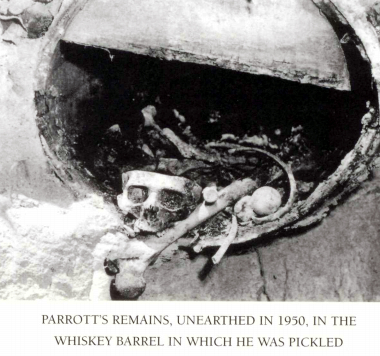
Drs. Thomas Maghee and John Eugene Osborne conducted the autopsy, examined Parrott’s brain, and could find no apparent abnormalities. Osborne then removed a large piece of skin from the dead man’s chest, kept the skullcap, and put the rest of the body in a whiskey barrel full of saline solution, effectively pickling it. The barrel was buried without ceremony, and Dr. Osborne had the skin tanned. He sent the leather to a shoemaker, who made him a pair of shoes with it.

Dr. Osborne was disappointed that Parrott’s nipples weren’t on the tips of the toes like he’d requested (!!!), but you can’t have everything you want in life.

He wore the human leather shoes on special occasions, including at his inaugural ball when he was elected governor of Wyoming in 1890. The skullcap he gave to his fifteen-year-old female assistant, Lillian Heath, who used it variously as a doorstop and an ashtray. (She would grow up to become the first female doctor in Wyoming.)

Parrott’s pickled remains were dug up at a construction site in 1950, and identified after some confusion. His skull, as well as the shoes, are now on display at the Carbon County Museum.

On this day..

1777: James Aitken, aka John the Painter, terrorist of the American Revolution

This date in 1777 saw the public execution of “John the Painter” — a Scotsman who had been christened “James Aitken” at his birth less than 25 years before, but who had run through countless aliases in his adult life as a (mostly) petty thief.

But this man was not a hapless victim of England’s Bloody Code, although he often enough offended the capital statutes against petty property crime.

Rather, the scraggly redhead with the thick Scottish brogue was the author of a stunning act of domestic terrorism, in England, in freelance support of the rebellious American colonies an ocean away.

“So dangerous an individual to the kingdom as this man perhaps never existed,” in the judgment of the Newgate Calendar, who knew him as “John Hill” — just one of Aitken’s many aliases. “and whose confession and repentence can hardly soften the abhorrence felt on the contemplation of the extent of his crimes.”

James Aitken, aka John Hill, aka John the Painter — for this last was, unfortunately, the unprofitable occupation of his apprenticeship training — fired the Portsmouth dockyards on December 7, 1776, then followed that up with an attack on the Bristol dock and city shortly after the New Year, as well as an unsuccessful attempt to ignite the Plymouth quay.

There are ready reasons we imagine men to undertake terrorist activities. James Aitken did not have them, according to Jessica Warner’s John the Painter: Terrorist of the American Revolution (review).

Although he was well-read for his class, he was not ideological, not a zealot of any creed religious or secular.

He was not American himself even in the loose sense that term could hold for the immigrant proto-nation. His only brush with that land was brief and unedifying: fearing his many thefts had made London a bit too hot for him, he signed on as an indentured servant and shipped out to the colonies in 1773 and slave-like labor in the fields. He escaped his master in 1775 and immediately shipped back to Europe, leaving no evidence of any revolutionary contacts.

And he wasn’t a madman. Just lonely, as evidenced, Warner says, by the “sad and always desperate invitations” to drink with which he plied the newest of acquaintances, to their discomfort. “He asked complete strangers to drink with him because he was lonely, and loneliness overrode his reason. His invitations always came too quickly, and his conversation and his manner always just a little off.” He even invited this indiscreet attention when on the incendiary job.

James Aitken reads like an Enlightenment version of the disaffected loser “going postal” on a world that could barely see him to tread upon him. His fondest desire from childhood was that classic Scots aspiration, the army commission. The closest he came was a series of short-term army enlistments to pocket the enrollment bonus, each of which he deserted as soon as practicable. (He did dream that his terrorism spree would earn him an appointment in the Americans’ Continental Army.)


Back in Britain after his unsuccessful foray in the colonies, Aitken conceived a disordered affinity for the burgeoning patriotic cause of the colonies he had recently fled. (Warner thinks he read Thomas Paine‘s Common Sense.) Only accidentally, when he overheard boozers at an Oxford pub chatting about the importance of the dockyards to the British Navy, did the heretofore aimless Aitken animate his wanderings with a new revolutionary purpose: he, scorned nobody, could win the War of Independence by crippling these facilities.

I spent two days in the contemplation of this malicious design, and promised myself immortal honour in the accomplishment of it. I beheld it in the light of a truly heroic enterprise, such as never would have been equalled to the end of time. I was persuaded it would entitle me to the first rank in America, and flattered myself with the ambition of becoming the admiration of the world! (Source)

Aitken was not a criminal mastermind, but there was a plausibility to the plot that fluttered the Admiralty’s heart once the details emerged. The dockyards were critical. They were also — Aitken readily perceived this as he began to case them — scarcely guarded; at Portsmouth, Aitken came and went as he pleased, freely schlepping his materiel in and out. (His attempt at Portsmouth set the subsequent facilities more on guard; the man’s initial plan to hit five different dockyards in sequence would ultimately have been as self-defeating as the 9/11 hijackers planning to commandeer a different plane on five consecutive days … but this was the way Aitken had to conceive it since he lacked the charisma or leadership aptitude to form a cell of fellow-travelers for a coordinated attack.)

Before launching himself into history, Aitken made an autumn 1776 visit to Paris to call upon the American representative there, Silas Deane.

Deane’s own recounting says he was struck by the wildness of Aitken’s scheme. But he was sufficiently taken with the prospective payoff to lend it his blessing, and “sponsor” it to the extent of giving the Scotsman a little pocket money to make his way back to England. He would later defend himself against “respectable persons,” presumably British ones, who “[regard] me equally criminal with the actor.”

[S]upposing me to be the liege subject, not of Great Brittain, but of a foreign independant Nation, at the Time at War with Great Brittain, and that imagining that I had found a favorable opportunity, & met with a proper Agent to destroy, at one blow, the Fleet & armaments preparing to carry, and to spread devastation, and bloodshed in my Country, and that I improved the favorable moment, and attempted through this agency, to effect this great object; on this view of the case I am confident that every one of common sense & impartiality must acquit me, nay more though they rejoice at the defeat of the enterprize they must approve of the motives, which influenced me to engage in it, motives no less than a desire to weaken a declared Enemy, and to preserve my Country, by every means in my power, from the horrors, and distress of Fire and desolation.

… if it was a noble, and most honorable Action in Lord Rodney to defeat the Count de Grasse, would not the Man who at equal hazard of his Life, had set fire to the Count’s Squadron in Brest, & thereby have equally defeated his expedition, been entitled (at least in the Court of Common sense) to the same Honors?

This was certainly good enough to convince Aitken that he torched in the name of Liberty, and he made his way back to set his plan in motion.


After botching his first attempt at Portsmouth and getting locked in the rope house — he pounded on the door until he got someone to open up, then bluffed his way out of the situation — Aitken got the least mileage possible from a superficially successful attack.

At about 3:30 p.m. on Saturday, December 7, Aitken fired three homemade incendiaries in the rope house and slipped away in what witnesses would later reconstruct as an evident state of agitation. The flames soon gutted the brick building (the damage would eventually reckon to £20,000) but he was this close to an exponentially more impressive bit of sabotage.

To begin with, many of his matches failed to start up Aitken’s jerry-built fuses. (This is also what caused his initial arson attempt to abort.) Having been once bitten by finding himself locked into the rope house at night, Aitken made his next trip earlier in the afternoon: that ensured that plenty of dockhands would still be in the vicinity to contain the fire to the one building. It also meant that the tide was in, and the nearby brig swollen with two thousand pounds of gunpowder could be easily put out to sea and away from danger as soon as the alarm went up.*

Admiralty investigators weren’t even sure at first that it was arson. Yards in the era of wood ships and wood buildings had a lot of flammable materials lying around. Fires happened.

Aitken soon dispelled any possible confusion.

Finding the Royal Navy dockyards at Plymouth too vigilant for his machinations, Aitken settled on an ambitious, and again somewhat plausible, scheme to engulf the densely-populated port of Bristol — dockyard and city alike. Repeatedly his blazes petered out or were suppressed. They did little consequential damage, but raised a rapidly-escalating panic at revolutionary incendiaries abroad, and it did not take long to link them to Portsmouth. (Copycat attempts and crackpot anonymous letters threatening same also started popping up elsewhere in the realm.)

“I have not the least doubt that the late fires have been the effects of premeditated malice,” wrote Bristol’s M.P. — the political philosopher Edmund Burke. Naturally this only had the effect of silencing potentially considerable pro-American sentiment in Bristol and throughout the realm. Lord Germain exploited the terrorist panic to push through a February 1777 Treason Act aimed at the American colonies. It authorized detention of suspected rebels without habeas corpus protection at His Majesty’s pleasure.

Aitken himself, though, was at the end of his own fuse. At Sir John Fielding‘s urging, the Admiralty posted an eye-popping £1,000 reward for the terrorists’ (multiple attackers were presumed, owing to the quantity of fires) capture. The arsonist was in irons with a week; a gaoler had noticed him and recognized Aitken’s fit to the description of the unknown Scotsman who had been seen in the vicinity of some of these blazes which Fielding had published in his crime clearinghouse periodical, Hue and Cry.** That man rode off after the suspect and overtook him in the village of Odiham,† where an exhausted and by now fatalistic Aitken surrendered without a fight.


The mizzenmast of the docked HMS Arethusa was removed and set up on land to hang this enemy of the navy outside the walls of the damaged Portsmouth dockyard.

Upon it, they would hang their man as high as Haman: after being turned off, a team of workmen hoisted Aitken’s still-strangling body 60 feet into the air. It’s reportedly the highest gallows ever known to be erected in England, and for the benefit of anyone who didn’t get a good enough look at the spectacle, his body remained conspicuously suspended in chains for years thereafter at Fort Blockhouse, overlooking the Portsmouth harbor as it rotted away.

One might expect that a man who had turned his face against king and country to such an extent would make his end defiantly. James Aitken, once again, defies expectations here, sounding submissive and contrite in the officially reported last words.

I asked John the Painter author Jessica Warner what it was that the state hoped a prisoner like Aitken would say from the scaffold. How did condemned prisoners typically come to shape their last words in (usual) conformity to the expected models? Was it usually necessary for somebody to convince them to do so?

JW: I can only speak for eighteenth-century England. The so-called “dying speeches” of the condemned follow a pretty predictable pattern: the condemned man expresses contrition for his crime, warns others against following his example, and says, in so many words, that he is reconciled with his Creator. That’s the official version, and really two things are going on here: the prisoner is in effect upholding the state’s right to take his life while also upholding the moral order of the Ancien Regime, its laws as much as its religious teachings. I say “official” because just about all dying speeches were penned by other people, the most notorious being the succession of chaplains (ordinaries) who presided over the condemned prisoners at Newgate. It was a bit of a standing joke that dying speeches were printed before they were delivered. The irony is that shorthand was used in the eighteenth century, and so theoretically it was possible to take down exactly what prisoners said.

Popular expectations, to the extent that they can be penetrated, also expected the condemned to make a good end, a good end being measured in terms of bravery bordering on contemptuous indifference to one’s fate. It’s hard to reconcile this indifference with the regret the prisoner was supposed to express.

ET: Did the fact that Aitken was a hated state criminal, rather than an everyday felon, alter anything about the role he was expected to play in the execution ritual?

JW: I don’t think so. The various accounts of his last moments read suspiciously like those you find in other dying speeches. Given the fact that he was a Scot who had poor social skills and who was also more than a little off his head, it beggars belief that he would have performed his part so well and in so conventional a fashion. I don’t doubt, though, that he made a brave end of it.

* The original Portsmouth plan was to start with a diversionary fire in the city itself, and then burn the dockyard while fire engines were occupied with the previous blaze. Again, his imagination outstripped his reach as a lone wolf: the attempt to kindle this preliminary fire just got him run out of his boarding-house and made the landlady a later witness against him.

** For more on Fielding’s criminal investigation reforms, see this post.

On this day..

1909: C.Y. Timmons

(Thanks to Meaghan Good of the Charley Project for the guest post. -ed.)

Minutes after midnight on this date in 1909, an Oregon plasterer named C.Y. Timmons was hanged at the state prison in Salem, Oregon for the murder of Estella, his wife of two years.

On October 21 the previous year, he had put an ax in the back of her head, slit her throat from ear to ear with a straight razor and then attempted to take his own life with the same razor. The two were discovered by the neighbors at 7:30 the next morning when a partially unclothed C.Y. came knocking on their door, “covered in blood from head to foot.”

C.Y.’s wound, as R. Michael Wilson explains in his accounting of the case in Legal Executions After Statehood in North Dakota, South Dakota, Wyoming, Montana, Idaho, Washington and Oregon, was serious but not fatal, and it responded to medical treatment: “The gash had missed the veins and arteries but had severed the trachea, but it had sealed and prevented him from drowning in his own blood.”

Timmons quickly regained his ability to speak and told authorities Estella had cut his throat while he was sleeping. He grabbed the razor from her hand, slit her throat in self-defense, and then finished her off with an ax. Then he lay down and waited until dawn before he went and asked for help.

The truth came out, however, and at his trial in mid-January 1909, C.Y. admitted that he’d gone round the bend with jealousy over his younger wife’s* affair with one Robert Hornbuckle. C.Y. and Estella had been quarreling for a long time about her relationship with Hornbuckle. Only the day before the murder, the couple had met with an attorney to procure a divorce — a drastic measure in that day and age.

During the meeting, Estella told the lawyer that her husband had a violent temper, especially when he had been drinking, and that he had threatened her life on numerous occasions.

C.Y. apparently believed his victim’s alleged infidelity would outrage the jury into acquitting him. Not so; they deliberated a whopping 35 minutes before finding him guilty. C.Y. broke down in tears when the verdict was read. And, for what it’s worth, all evidence indicates that Estella’s “affair” with Hornbuckle existed only in her husband’s imagination.

C.Y.’s hanging was as gruesome as his crime, as Wilson records:

[A]t 12:31 p.m., the trap was sprung and Timmons dropped six feet, one inch. The force of the drop caused the neck wound to open and for some time the hanging figure breathed through the gaping wound beneath the rope, and the body was drenched with blood. The attending physicians differed on whether Timmons’ neck was broken in the fall, but later examination proved that the vertebrae had been dislocated. This complication, breathing through the open wound, prevented pronouncement of death until 12:54 p.m., and the body was allowed to hang another seven minutes to ensure he was dead.

The murderer was buried separately from his victim, at the Lee Mission Cemetery in an unmarked grave.

* Her age was given in different accounts as either 19 or 21; C.Y. Was 37. Another pathetic detail to her tragic life: Estella was an orphan, raised in an orphanage after her parents both died of tuberculosis.

On this day..

1862: Margaret Coghlan, the last woman hanged in Tasmania

(Thanks to Meaghan Good of the Charley Project for the guest post. -ed.)

On this date in 1862, Margaret Coghlan (sometimes spelled “Coughlin” or “Coghlin”) was hanged in Tasmania, Australia for the murder of her husband.

Described as a “gray-headed old woman,” Margaret was, like many residents of the colony, a transported convict.

The murder happened on January 5, less than six weeks before Margaret’s date with death. It was a fairly typical domestic homicide: the Coghlans had a drunken quarrel and Margaret’s husband threw an iron bar at her. He missed and she picked it up and beat him until he was unconscious and perhaps dead.

This much might be colored self-defense, but then Margaret administered coup de grâce by slitting her husband’s throat.

In an act worthy of one of those “dumb criminals” books, she then placed the razor in her husband’s own hand to try to make it look like he committed suicide. But the authorities did not believe the man could have beaten himself to death with the iron bar, cut his throat afterwards and left someone else’s fingerprints in blood on the razor.

According to newspaper coverage of the event, Margaret made the usual scaffold speech acknowledging the justice of her sentence and the foulness of her crime:

I acknowledge fully the justice of my sentence, I deserve this, and a thousand deaths, if that were possible, for the horrible crime I have committed. Drink, the curse that has been on me, strong drink, has caused all my misery—everything has been sacrificed for strong drink … May all forgive me whom I have injured, offended, or scandalised, by my evil living.

She was hanged by Solomon Blay, “the colony’s most unpopular public servant.” He was a convict like Margaret, transported from England after he pleaded guilty to counterfeiting. Margaret would turn out to be the last woman hanged in Tasmania, although the state didn’t abolish the death penalty for more than a hundred years after her execution.

On this day..

Podcast: One For Ten

We’ve just posted a new podcast conversation with Will Francome of One For Ten, a documentary project that’s aiming to produce a series of short films about ten people exonerated from death row in the U.S. Here’s One For Ten’s pilot on Ray Krone.

One For Ten is crowdsourcing £30,000 needed to fund the project. You can donate here. (Full disclosure: I did so myself.)

New Yorkers can check out a launch party this coming Wednesday, February 13th. For the rest of us, there’s much more at OneForTen.com or @one_for_ten.

Check it out here, or on our podbean satellite site.

On this day..

1997: Michael Carl George

(Thanks to Meaghan Good of the Charley Project for the guest post. -ed.)

On this date in 1997, 39-year-old Michael Carl George was executed by lethal injection at Greensville Correctional Center in Virginia. He’d been condemned for the murder of fifteen-year-old Alexander Eugene Sztanko in 1990.


Michael Carl George (top) and his victim, Alexander Sztanko.

The teenager’s death had been horrific by any standard: he was abducted while out riding his dirt bike, handcuffed to a tree and sexually abused. Before shooting him in the head, the killer applied a stun gun to his genitals. His body, fully clothed but shoeless, was found the following afternoon.

The boy had been killed so close to home that his unsuspecting father actually heard the gunshots. A few hours after Alex Sztanko’s body was found, George was seen loitering near the murder site by a police officer and stopped for questioning. He matched the description of a camouflage-clad man seen near the Sztanko residence the day before, and the suspicious officer asked him directly if he’d been there the previous day.

George admitted that he had, claiming he’d been turkey hunting in the woods. As he was being questioned he was standing directly in front of a “No Trespassing” sign, which gave the policeman an excuse to pick him up.

At the time of his arrest he was carrying, among other things, a knife, a handcuff key and a map, which had an “X” marking the site where Alex’s body turned up in the woods and an “O” where the boy’s dirt bike and helmet were ultimately located.

Inside George’s truck was a machete, a hacksaw, bolt cutters, a tear gas canister, leather gloves and a stun gun. A search of his parents’ home, where he lived, turned up more incriminating items: a pair of handcuffs that matched the key he carried, and a loaded 9mm pistol which turned out to be the murder weapon.

Blood, DNA and fiber evidence also pointed to George as the culprit. The case was pretty open-and-shut.

George had a reputation as a pedophile and Alexander Sztanko wasn’t the only person he killed. The first, as far as anyone knows, was Larry Wayne Perry, a mentally disabled nine-year-old who lived with his grandparents in Dumfries, Virginia.

Larry vanished without a trace on May 22, 1979 and was never found. George admitted to burying the child’s body but said his death was an accident. As the authorities lacked the evidence to prove intentional homicide, he was allowed to plead guilty to involuntary manslaughter and abduction.

A model prisoner, he served just two and a half years of a five-year sentence.

Four years later, he killed Alex Sztanko.

George would later claim he had murdered a third person, but he never named the alleged victim and his statements could not be verified. His appeals raced through the court system at top speed; his time on death row was less than five years, one of the shortest in the state since Virginia resumed executions in the early eighties.

Given the circumstances of the murder and his prior record, he had very few sympathizers and not much he could say for himself on appeal. His case went all the way up to the U.S. Supreme Court, but they voted 7 to 2 to deny a stay of execution, with Justices Ruth Bader Ginsburg and Paul Stevens dissenting.

Alex Sztanko’s parents were quoted as saying they were opposed to the death penalty generally, but as far as they saw it, George’s death was society’s gain.

George’s lethal injection took place without incident and he was pronounced dead at 9:18 p.m. He had no last statements for the press, but he did leave a letter for Mr. and Mrs. Sztanko, both of whom declined to witness his execution.

On this day..