1824: Henry Fauntleroy, choked on debt

On this date in 1824, the last Englishman to hang for forgery, met his fate at Newgate prison.

Henry Fauntleroy making his defense. From this Harvard gallery (part of the university’s Crimes Virtual Collection) of the period’s hanging press, including a Fauntleroy broadsheet (huge image, with a generic-looking merchant type as the criminal).

In a celebrated affair of the time, Fauntleroy was found to have inherited from his father a partnership in the foundering London bank Marsh, Sibbald & Co.

Desperate to keep the concern alive by maintaining a front of normalcy, Fauntleroy serviced its obligations by forging powers of attorney authorizing him to sell stock that he was supposed to merely be holding for investors.

Ever the diligent clerk, Fauntleroy made a ledger of the fraudulent transactions, plainly footnoted:

In order to keep up the credit of our house, I have forged powers of attorney for the above sums and parties, and sold out to the amount here stated, and without the knowledge of my partners. I kept up the payments of the dividends, but made no entries of such payments in our books.

The more things change…

Fauntleroy, of course, didn’t have the reach of the Smartest Guys in the Room; what he did by foul means the collapse of his firm might have (more or less) accomplished by what economists regard as fair.

The firm, said the defendant, was in quite a fix.

I was only twenty-two years of age, and the whole weight of an extensive but needy Banking establishment at once devolved upon me, and I found the concern deeply involved in advances to builders and others … and the necessity of making further advances to those persons to secure the sums in which they stood indebted.

Translation: If you owe the bank £100, you’ve got a problem; if you owe the bank £100,000,000, the bank has a problem.

It took a lot less than that to run Marsh, Sibbald & Co. into the ground.

In this perplexed state the house continued until 1810, when its embarrassments were greatly increased, owing to the bankruptcies of Brickwood and others, which brought upon it a sudden demand for no less a sum than 170,000 £ … About 1814, 1815, and 1816, from the speculations with builders and brickmakers, & others, in which the house was engaged, it was called upon to provide funds to near 100,000 £, to avert the losses which would otherwise have visited it from these speculations. In 1819, the most responsible of our partners died, and we were called upon to pay over the amount of his capital, although the resources of the house were wholly inadequate to meet so large a payment. During these numerous and trying difficulties the house was nearly without resources, and the whole burthen of management falling upon me, I was driven to a state of distraction, in which I could meet with no relief from my partners, and, almost broken-hearted, I sought resources where I could, and so long as they were provided, and the credit of the house supported, no inquiries were made, either as to the manner in which they were procured, or as to the sources from whence they were derived.

In almost Dickensian fashion, our malefactor reacted more violently to allegations that the embezzlement had been effected in pursuit of a debaucherous lifestyle than he did to the criminal charge itself; if his version of bourgeois rectitude and endemic financial criminality further to the crumbling facade of his enterprise rings true, the ascetic clerk’s mortal penalty on behalf of his crummy bank will be a timely reminder of the pleasures one ought to seek before life withdraws them (or at least — just ask Robert Rubin! — of the invaluable utility of the limited liability company).

Having thus exposed all the necessities of the house, I declare that all the monies temporarily raised by me, were applied, not in one instance for my own separate purposes or expenses, but in every case they were immediately placed to the credit of the house in Berners-street, and applied to the payment of the pressing demands upon it. This fact does not rest on my assertion, as the transactions referred to are entered in the books now in the possession of the assignees, and to which I have had no access since my apprehension. These books, I understand, are now in Court, and will confirm the truth of my statement; and to whatever account all the sums may be entered, whether to that of Stock, of Exchequer Bills, or to my private account, the whole went to the general funds of the Banking-house.

Parliament abolished the death penalty for forgery in 1832. According to Hanging in the Balance: A History of the Abolition of Capital Punishment in Britain, a factor in the legislation was jurors’ increasing unwillingness to convict those accused of the crime knowing that it could lead to hanging. (See much testimony to that effect from the period’s lawyers and bankers here.)

A rumor circulated after Fauntleroy’s death — having something to do with the fame of the criminal, and something to do with what was reportedly his corpse’s unnaturally undamaged condition after the execution — that he had contrived to survive the hanging by slipping a silver tube down his throat, then absconded to live abroad.

Though evidently baseless as a factual matter, the legend is paid tribute by Nathaniel Hawthorne’s The Blithedale Romance, with a mysterious banker named “Fauntleroy” whose backstory would have elicited a knowing wink from many a reader in his time … and ours.

After Fauntleroy had thus spent a few empty years, coruscating continually an unnatural light, the source of it — which was merely his gold — began to grow more shallow, and finally became exhausted. He saw himself in imminent peril of losing all that had heretofore distinguished him; and, conscious of no innate worth to fall back upon, he recoiled from this calamity with the instinct of a soul shrinking from annihilation. To avoid it, — wretched man! — or rather to defer it, if but for a month, a day, or only to procure himself the life of a few breaths more amid the false glitter which was now less his own than ever, — he made himself guilty of a crime. It was just the sort of crime, growing out of its artificial state, which society (unless it should change its entire constitution for this man’s unworthy sake) neither could nor ought to pardon. More safely might it pardon murder. Fauntleroy’s guilt was discovered. He fled …

The wreck of his estate was divided among his creditors: His name, in a very brief space, was forgotten by the multitude who had passed it so diligently from mouth to mouth. Seldom, indeed, was it recalled, even by his closest former intimates. Nor could it have been otherwise. The man had laid no real touch on any mortal’s heart. Being a mere image, an optical delusion, created by the sunshine of prosperity, it was his law to vanish into the shadow of the first intervening cloud. He seemed to leave no vacancy; a phenomenon which, like many others that attended his brief career, went far to prove the illusiveness of his existence.

On this day..

1517: Torben Oxe

It was November 29, 1517, when the last Roman Catholic king of Denmark, the ambitious and possibly manic-depressive monarch Christian II, enforced the execution of a man whom he trusted for years. Torben Oxe was beheaded at St. Gertrude’s Hospital Cemetery for crimes against the throne.

Oxe was a subsidiary character during the tenure of one of the more intriguing Western European monarchs, and his hasty — and largely unsubstantiated — condemnation was a critical indicator in the governance of King Christian II.

Christian II of Denmark

Christian took the throne during a time of great disquiet in Scandanavia. His father, Hans of Denmark, fought for more than 30 years to restore the union across Norway, Sweden, and Denmark while harshly opposing the Hanseatic League. His efforts bore fruit in 1483 when Norway and Denmark came together to appoint him ruler of those two lands; 14 years later, he conquered Sweden and claimed kingship.

But his dominion over Sweden was short-lived: struggles to regain independent territory in Northern Germany resulted in a resounding defeat, and Sweden gave its new king the pink slip in 1501. Hans was eventually reinstated as an absentee ruler, awarded the title of king in 1509 but not allowed into Stockholm, nor re-crowned. His takeover was exclusively economic.

It was during this time that Christian stepped into his political future.

He took control of Norway as viceroy in 1506, and his rule was less than appreciated by the wealthy. The nobles in Norway maintained a sort of Privy Council called the Rigsraadet, which Christian was unwilling to cede any more power to than he felt was necessary.* Christian was known as a brutal man among the nobles even as he tried to cultivate a connection to the common people.

It was this connection that led to the downfall of Oxe. During his time in Norway, Viceroy Christian took a mistress named Dyveke Sigbritsdatter, a Norweigan peasant of Dutch descent.

At the death of Christian’s father early in 1513, the viceroy became King of Denmark and Norway and immediately set to bringing Sweden under heel. His father had made similar efforts which were supported by Eric Trolle, who was initially appointed regent to Sweden after Sten Sture (the elder) passed away; unfortunately for Christian II, in 1511, Sten Sture (the younger) convinced the high council to rescind its earlier appointment in his favor.

Sture was no friend to Christian II.

It is widely thought that the desires of Christian were eventually played out through Gustav Trolle, Eric’s son, who rose to the post of archbishop early in Christian II’s reign. Trolle threw his lot in with the Danish ruler and gained his ear, earning the promise that Trolle might rule over Sweden in Christian’s name. Trolle did everything he could to secure his place in history, demanding more autonomy for the church and, Sture claimed, attempting a backdoor coup. In 1515, Sture had Trolle imprisoned, the Catholic church condemned the Swedish government, and the Swedes and Danes squared off in a series of battles to decide its fate.

But Christian was obsessed with the expansion of his realm. He worked persistently to expand his power and reach, forming alliances that would help him gain control of what he considered the whole of Denmark. It was around this time that Christian II hitched the horse of the Holy Roman Empire to his team by marrying Isabella (Elizabeth I), granddaughter of Maximilian I.**

Which brings the story back to Torben Oxe.

Oxe was appointed Governor of Copenhagen Castle, a modest nobleman’s post that put him in close contact with the king’s court. Despite Christian’s marriage, he kept his mistress, openly housing her and her mother immediately adjacent to his residence. In summer 1517, Dyveke Sigbritsdatter fell ill and died; her mother pointed the finger at Oxe, who sent the girl a box of cherries two days earlier: apparently, Oxe was also enamored of Dyveke. Sigbrit alleged that Dyveke rebuked Oxe’s advances, and out of spite, he had murdered her.

History is awash with uncertainties, and there are plenty of those in the death of Dyveke. To begin, it’s not even clear that Dyveke was poisoned; she died suddenly and with severe stomach pain, so poisoning was assumed, but never really proven. In addition, it’s not clear whether Oxe was, indeed, courting Dyveke, as Sigbrit insisted. Last but not least, if Dyveke was murdered, there was nothing to suggest that the killer was not a member of the Rigsraad — the Privy Council in Denmark — or just someone seeking revenge on the king for one of his many cruel acts; instead of tracing these possibilities, Christian II condemned his friend Oxe on Sigbrit’s word alone.

But the farce was not complete without an equally farcical trial or two. Oxe’s post gave him a trial by the Council of the State: a dozen noblemen met, conferred, and delivered a rebuke to the king, declaring Oxe innocent of the crime. Christian was incensed at the verdict, allegedly asserting, “If I had as many kinsmen in the Rigsraad as he has, he would never have been acquitted.”

Not content with this form of justice, the king turned to the people, assembling a jury of peasants who were more than obliging in delivering the famed line, “We do not convict him, but his deeds convict him.” So, despite the pleadings of the king’s wife, Torben Oxe lost his head — and his corpse was burned for good measure.


Christian II underskriver Torben Oxes dødsdom, or Christian II Signs Torben Oxe’s Death Warrant (1874-76), by Eilif Peterssen. The queen sits at his side, imploring him not to do it.

In the great tradition of nepotism, Sigbrit was subsequently appointed chief adviser to the king and took over the role of management of the mercantile taxation system, the Sound Tolls; she was remarkably successful in these posts and formed a middle-class council which held far more sway over Christian than its “noble” counterpart, the Rigsraadet.

As he moved away from them, Christian’s rule became more and more unstable, and his desire to have Sweden almost insatiable. After a series of battles, he managed to claim the title of King of Sweden for a brief period around 1520, crowned by his friend Gustav Trolle shortly before putting on the Stockholm Bloodbath. It was this event which earned him the title in Sweden of Christian the Tyrant.

Peder Oxe

As if these connections weren’t enough, Oxe’s nephew, Peder Oxe (born in 1520), who was Steward of the Realm under Frederick II, became one of the players in an attempt to restore Christian II’s daughter, Christina, to the Danish throne — long after Christian himself was out of the picture. The attempt was unsuccessful.†

Dyveke’s story, and her impact on King Christian II, has been cast in a variety of literary formats.

* The Rigsraadet was the Norweigan instantiation of the Scandanavian sort of House of Lords, with members the noblemen of the time. New members could be appointed by kings and queens, or by other members of the council, and, until the Reformation, Roman Catholic bishops also maintained posts.

** This marriage also extended the reach of the Habsburgs into Denmark, a move that would have further consequences several hundred years hence.

† Christina also has the distinction of turning down a marriage proposal by Henry VIII. According to legend, her witty response to the ambassador sent to arrange the marriage was, “If I had two heads, one should be at the King of England’s disposal.”

On this day..

1780: David Dawson and Ralph Morden, Quaker “traitors”

On this date in 1780, two unconnected Quakers were hanged for two unconnected treason convictions in two different cities in Pennsylvania.

The public executions of Ralph Morden in Easton, Pa., and David Dawson in Philadelphia (in a double hanging along with counterfeiter Richard Chamberlain) had the unusual distinction of being treason convictions against the state of Pennsylvania during the Revolutionary War, rather than against any sort of federal entity.

According to the Espy File of American executions, there were only 15 people put to death for treason* during the Revolutionary War. It’s a remarkably low figure under the circumstances — separatist colonial conflict that often pitted revolutionary neighbor against loyalist neighbor.

Morden, a Quaker who kept his head down during the war, agreed to guide one Robert Land, a Tory who needed to slip past Continental sentries, and of course didn’t make it. His case is summarized here, here and here.**

Less is readily available about Dawson, but a fellow-prisoner (and fellow-Quaker) left an account remembering that he and the counterfeiter Chamberlain

were taken out amidst a crowd of spectators — they walked after a cart in which were two coffins and a ladder, etc., each had a rope about his neck and their arms tied behin [sic] them … they were both hanged in the commons of this city abt. 1 o’clock.

This prisoner, Samuel Rowland Fisher, kept a two-year journal (pdf) of his imprisonment in Philadelphia for Tory sympathies, and as one might imagine paints an unflattering picture of the revolutionary “State as they call it.” In his view, Dawson’s hanging was a

greater act of Cruelty in the present Rulers than anything they have heretofore done, for they never gave him even a shadow of a tryal in their own fashion & they have executed him merely as what they call a proscribed person because he came into the City while the Brittish Army lay here, the circumstances of which was, that he was coming from his abode with his Waggon, that being in danger of his life from some of Washington’s Men he fled into the City & left & lost his Wagon, Horses, provisions &c — He never acted in any manner under Brittish, nor had he taken the Test to the present Usurpers, he did not go with the Brittish Army to New York, but had secreted himself in various places till he was betrayed by Jamed Reed last Spring & taken prisoner

Quaker Notes

Quakers who stuck by the sect’s pacifist teachings had a tough go of the American Revolution, often lumped in as Tories by patriots and subject to spasms of popular abuse, official writs confiscating their property, and other indignities from those who considered them “the unfriendly Quakers … notoriously disaffected to the cause of American Liberty.”† That same prejudice occasionally exposed Quakers to the severest punishments for perceived crimes.

Thus Morden, who presumably helped the British agent as a personal gesture of assistance, an everyday “crime” for which hanging was an extreme stricture: one hundred Continental dollars from Chamberlain’s press to the reader who can demonstrate that this was one of the 15 most treasonable acts committed behind American lines. But confronted with the request in a time of war, what was the neutral, pacifist choice?

“A man was hanged this morning,” one British officer’s diary recorded, “for piloting some people through the back woods, to the Indians. He was very old and left a wife and 9 children. His death was chiefly owing to his being a noted friend of Government.” (Cited by John Coleman in “The Treason of Ralph Morden and Robert Land,” The Pennsylvania Magazine of History and Biography, Oct. 1955)

Dawson, meanwhile, had worked for the British during the city’s recent occupation by General William Howe and was one of many so-called Loyalists “attainted of High Treason” and stripped of property by the state. Still, the British had been gone more than two years by the time he hanged.

Egged by Benedict

What might have upgraded Dawson’s sentence to a capital one was having the bad sense to be apprehended around the same time news arrived that Benedict Arnold had betrayed the Revolutionary cause two months before this date.

Arnold had recently been stationed in Philadelphia, and there controversially married into a Tory family. The betrayal he wrought thereafter was keenly felt in the cradle of liberty, and Arnold’s

effigy was paraded through the streets and hanged, his wife was ordered to leave the city within fourteen days, and his estate was confiscated. Still more rigorous proceedings were instituted against the tories and Quakers, one of whom [Dawson -ed.] was convicted of high treason and hanged. (Source.)

Discipline and Punish

Since we are students of the morbid here, let us also pause to notice the strikingly throwback nature of the punishment — not merely the fact that the Dawson-Chamberlain hanging was public, but that they were so theatrically marched to it, with ropes drawn about necks like the false Martin Guerre.

Not only did the treason conviction belong to a pre-American jurisprudence — against the state, yes, but also of a broader British conception of treason that the still-to-come U.S. Constitution would sharply curtail — but the resulting sentence is sharply at odds with Pennsylvania’s historical image as a a haven of penal reform.

Before the decade was out, the Keystone State would establish itself as an international epicenter of the movement away from harsh and (to us) primitive-sounding judicial sanctions, reconceptualizing punishment into the ordered prison system still familiar today. Pennsylvania abolished the death penalty for all crimes but murder by the turn of the century (it had made liberal use of the rope to punish crimes like burglary before that), and even murder hangings were not frequent.

Quakers, and Quaker philosophy, were instrumental in the shift.

If the thought that led to that sea change came from a deeper place, it may yet have been informed by the episodic recent history of the revolution: according to Gail Stuart Rowe’s Embattled Bench, there were around 700 indictments and attainders for treason or misprision of treason in Pennsylvania throughout the American Revolution, and these resulted in only four hangings.

All four of the hanged were Quakers.

* The Espy file is an outstanding resource, with the intent to document every execution that took place in what is now the United States since its colonial antecedents. However, it is not necessarily reliable that it actually does this, so the precise figure of 15 should not be depended upon too greatly.

** Land himself managed to escape from the ambush, leaving only Morden to face the music. The interest in his fate seems to come from genealogists; according to this site, Charles Lindbergh numbered among his descendants — bringing us to another century’s death penalty.

† That was George Washington, cited in George Washington and Slavery. However, according to this listing of famous Quakers, other notable patriots like revolutionary Gen. Nathanael Greene, flag-stitcher Betsy Ross and polemicist Thomas Paine were Quakers, too.

On this day..

1927: Father Miguel Pro, “Viva Cristo Rey!”

On this date in 1927, the anti-clerical Mexican government made the emblematic martyr of the Cristero War.

This video is in Spanish, but the storyline is pretty easy to follow — young man finds faith, lives faith, dies faith.

Miguel Pro‘s dying cry, “Viva Cristo Rey!” — “Long live Christ the King!” — was a refrain of Cristeros, anti-government guerrillas who in the late 1920’s fought the revolutionary Mexican government’s attempts to forcibly restrict the power of the Catholic Church.

That conflict had been brewing for years, an outgrowth of Mexico’s own complex history of colonization and development — measures to restrict the church’s size, wealth, and social reach had been mooted and sometimes implemented well back to the middle of the 19th century.

Early in the 20th, the confrontation was merely a twist on its classic form: liberal state-builders and the Catholic hierarchy were (or increasingly saw themselves as) diametrically opposed in their vision for Mexico.

That conflict came to a head under president Plutarco Elias Calles, an irreligious northerner with a project of national capital development for whom the church’s intransigence from its agrarian strongholds was most unwelcome … and who seemed to delight in provoking Rome with sport like mandatory physicals for priests, not neglecting to publicize the incidence of venereal disease thereby revealed.

Liberals had already brought about drastically reduced clerical privileges in the Mexican Constitution of 1917; its somewhat draconian measures were neither fully enforced nor fully resisted, but initiated a period where the two hostile institutions rudely grappled for their respective spheres of influence on the ground.

Calles was the rudest grappler of all, and his 1926 Calles Law pushed for anti-clericalism stricter than the letter of the constitution … and sparked armed resistance.

It was an exceptionally dirty war with routine summary executions on both sides and thousands of Catholic refugees — a dangerous environment for any priest with legal sanctions against basically every practice of the vocation. (Photos of Cristeros, some in heroic resistance and others in grisly martyrdom, can be eyeballed here.)

Pro, a Jesuit who like many was forced underground, was under state surveillance and got picked up in the aftermath of an assassination attempt against a prominent politician. He was chosen to make an example of — without an actual trial, possibly because there’s no actual reason to think he was involved in the bombing.

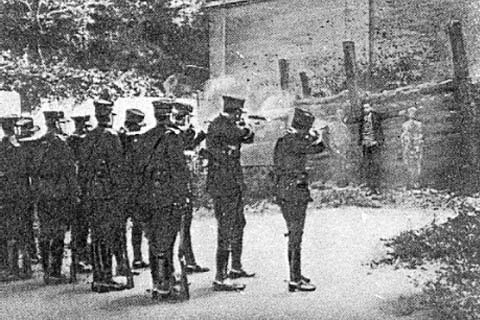
Looking at these pictures of Pro’s last moments, it’s hard to believe that they were taken and circulated at government direction to cow the Cristero movement. Fail.


Led out to execution in a police courtyard. The place of his death today is (bizarrely) Calle Loteria Nacional.


Calmly at prayer before his death, under the eye of the firing squad commander.


Pro himself refused a blindfold. But why state authorities carrying out the execution with an eye towards public relations would allow him to die in this pose is anyone’s guess.


He blessed and forgave the firing squad, of course.


Just beginning to topple at the moment the bullets struck him.


Like many firing squad executions, this one failed to kill its victim with the ceremonial volley. Pro was finished off with a coup de grace.

Calles was simultaneously — the key measures were also enacted in 1926 — involved in a confrontation with the United States over oil rights, a situation that came to the brink of war, with Washington saber-rattling about “Soviet Mexico”. It’s tempting to wonder whether the two situations weren’t related, especially since the new American ambassador* who had arrived only the month before Pro’s execution would ultimately negotiate both situations’ resolutions.

While the natural resource politics went their separate way, the Mexican Revolution’s anti-clerical strain didn’t so much disappear by negotiation as fade away over decades, with regular new outbreaks.

One thinks of Mexico today as such so staunch a Catholic country that it’s hard to imagine that some of these provisions were only officially repealed in 1998.

As for Pro, he’s welcome in Mexico by now — celebrated by Pope John Paul II who ultimately beatified him, and the inspirational source of this hymn whose refrain is his famous last cry.

There’s a faithful site in his honor here, and apparently a shrine to him in Houston, Texas run by a group pushing for his canonization.

* The American ambassador in question, Dwight Morrow, invited Charles Lindbergh on a goodwill tour to Mexico, where the aviator would meet the diplomat’s daughter not long after Miguel Pro’s martyrdom. Little could Lindbergh and Anne Morrow suspect that their love match would set them on the path to their own famous encounter with capital punishment.

On this day..

1538: John Lambert, “none but Christ”

On this date 470 years ago, John Lambert was burned to death at London’s Smithfield market for heresy.

One possible way to read the early progress of the English Reformation is as an initial flowering of Protestantism followed — after the execution of Anne Boleyn — by a reactionary crackdown by the monarch.

In this telling, John Lambert (born John Nicolson or Nicholson) marks the turning point, the man in whose blood Henry VIII etched his warning against doctrinal liberality.

John Lambert cooked his goose by picking a theological dispute with a pastor in London. He didn’t buy into transubstantiation, the Catholic doctrine (still extant today) that the bread blessed on the altar became the literal body of Christ.

Though the Anglican church would ditch this belief soon thereafter, it came down hard on Lambert in a show trial attended by Thomas Cromwell, Thomas Cranmer, and all the Tudor big wheels whose heads were at that point attached to their shoulders.

The king himself — who here reminds one of the the stout defense of the sacraments that in his early Catholic period had earned him the papal honorific “defender of the faith” — debated theology with the accused, though mostly he left it to his august councilors.


John Lambert disputing before Henry VIII. Early 19th c. illustration.

But the crowned head made his doctrine as plain to the audience as the consequences of crossing it.

The pro-Lambert account from which this extract is drawn is available free on Google books:

At length [Lambert] was worn out with fatigue, having been kept five hours standing …

Night coming on, the King being desirous to break up this pretended disputation, said to Lambert, “What sayest thou now, after all this pains taken with thee, and all the reasons and instructions of these learned men? Art thou not yet satisfied? Wilt thou live or die? What sayest thou? Thou has yet free choice.” Lambert answered, “I yield and submit myself wholly unto the will of your Majesty.” Then said the King, “Commit thyself into the hands of God, and not unto mine.” Lambert replied, “I commend my soul unto the hands of God, but my body I wholly yield and submit unto your clemency.” Then said the King, “If you do commit yourself unto my judgment, you must die, for I will not be a Patron unto heretics.” And then turning to Lord Cromwell he said, “Cromwell, read the sentence of condemnation against him:” which was accordingly done.

A few months later, Henry induced Parliament to pass the Act of the Six Articles, essentially establishing Catholic doctrine — sans Pope, obviously — as the basis for the Church of England and criminalizing dissent.

What to make of this trial and the policy it represented is open to dispute. In a simple telling, Henry realizes his Reformation is running away from him, or becomes wise to discomfiting reforms that Cranmer or Cromwell are pushing. Too, the ebb and flow of Henry’s “Reformation” has sometimes been seen as a product of the shifting balance between reformers and conservatives advising the crown; Protestant martyrologist John Foxe favored this approach since it enabled him to celebrate a John Lambert without indicting the monarch by blaming advisors.

Lambert’s death is also sometimes interpreted in light of the international situation, as the Catholic powers of France and the Holy Roman Empire had made peace, potentially (along with Scotland) encircling England with Popish foes who might conceivably be less belligerent with a move towards traditional doctrine.*

But maybe that’s all a good deal more explanation than is needed for the old defender of the faith. G.W. Bernard’s consideration of The King’s Reformation argues that Lambert isn’t so pivotal after all:

[H]istorians who see … the trial of Lambert as some sort of turning point are greatly mistaken. There was absolutely nothing new in Henry’s policy in November 1538. Ever since radical — Zwinglian — notions on the mass had come to influence some within England, Henry had reacted firmly and boldly. This was not something that only came late in the 1530s, when he supposedly woke up to what Cromwell and Cranmer had been doing in his name but without his knowledge. It was there from the start. As early as March 1535 a proclamation fiercely denounced strangers who had presumptuously rebaptised themselves and who denied that the blessed and most holy sacrament of the altar was really the body of Christ. If there was a novelty in autumn 1538, it was the perception that such heresies were spreading through the realm and that heretics with a high profile, such as Lambert, needed to be dealt with publicly so that others might learn from their unhappy example. … Henry surely blasted against sacramentarians for the straightforward reason that he sincerely believed them to be wicked.

As for Lambert himself, he met an especially cruel version of the none-too-pleasant sentence of burning alive, allegedly being lifted by pikestaffs from the flame when his legs were burned off to prolong his suffering. He is said to have continued to call out the inspirational last words, “None but Christ! None but Christ!”

* It was against this alliance that Cromwell would arrange the king’s ill-fated marriage to German princess Anne of Cleves, a debacle that helped Cromwell lose his own head.

On this day..

1942: Partisans by the Sonderbataillon Dirlewanger

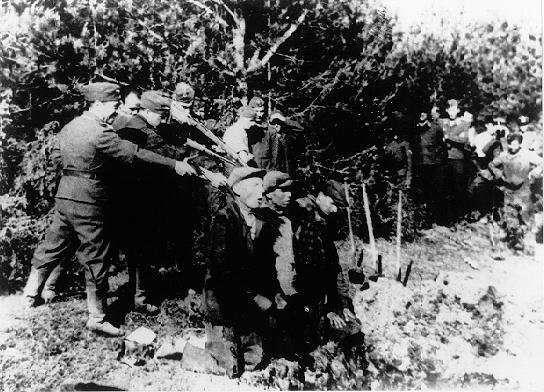
On an uncertain date in November 1942, this photograph of an SS unit executing anti-Nazi partisans in Belarus was taken.

Behind this striking but all too typical image of brutal field executions on the eastern front lies the sordid story of one of the strangest military formations in the Nazi service.

The Dirlewanger brigade was formed under a man whose fortuitous early enrollment in the NSDAP had enabled him to pull strings to get himself out of Dachau, where he had been sent after his second molestation conviction, and where unfolding events could have easily seen him on the other end of the firing squad.

Instead, Oskar Dirlewanger formed a unit of criminals and reprobates: poachers at first, and eventually, as it grew into the SS-Sonderbatallion Dirlewanger, men culled from the camps or soldiers condemned by the army, some literally trading the likelihood of execution themselves for service under one of the most disreputable commanders in the field.

Oh, and, just incidentally — it stuck them into a lawless environment where they could probably practice and refine their pathologies unchecked. Some “rehabilitation.”

As of this relatively early date, the convict floodgates weren’t yet entirely open, and the existing German volunteers were supplemented by a goodly portion of Soviet citizens recruited in the occupied territories. From 1942 to 1944, they hung around Belarus hunting guerrillas and doing to them — well, you know. (The original notion of using poachers was to exploit their ranger-like woodsman talents for anti-partisan warfare.)

Oh, and civilians. Tens of thousands of civilians. That almost goes without saying.

Sadly for Dr. Dirlewanger, events further south were undoing all his bloody work, for it was also in the November 1942 that the Red Army decisively turned the tide of the war with its counterattack at Stalingrad — in fact, it was this very date in 1942 that it completed its encirclement, stranding a quarter-million freezing Wehrmacht regulars on the banks of the Volga, only a handful ever to see Germany again.

The Dirlewanger brigade would have its own turn being minced by the Soviet war machine, though not before it had a notorious hand in drowning the Warsaw Uprising in blood.

Dirlewanger himself was tortured to death by Polish guards a few weeks after the war ended.

Part of the Themed Set: The “Ex” Stands For “Extrajudicial”.

On this day..

284: Aper, by Diocletian

On this date* in 284, one of Rome’s greatest emperors claimed the purple by summarily executing his rival before the approving army in Anatolia.

The Emperor Diocletian christened his reign with a bit of scaffold theatricality, but he might have been the real perp.

For half a century, the Roman Empire had waded through crisis. In its political manifestation, a parade of forgettable emperors had marched through the throne room, each to be assassinated, overthrown, or otherwise disposed of by some equally forgettable aspirant en route to a similarly unenviable end.

At length, out of this unpropitious bunch, rose one Diocles, a low-born Dalmatian of classical education whose martial gifts saw him rise through the legions. His opportunity came when the emperor Carus, barely a year on from succeeding his assassinated predecessor, died on campaign against Persia allegedly struck by lightning (quite possibly a euphemism for something more dagger-like), leaving his son Numerian in charge.

As the army meandered back to the friendly confines, Numerian secluded himself in his litter. And after a while, the litter started to stink.

Sometime on the journey, he’d been secretly killed — but by whom?

The principals this day are our leading suspects. (And it’s a little mystifying in either case just what was gained by leaving the body hidden so long.) We turn to Gibbon to narrate what must have been a riveting — not to mention definitive — proceeding adjudicating between them a few kilometers past Nicomedia (moder Izmit, Turkey) towards Chalcedon (now the Kadikoy district of Istanbul).

A general assembly of the army was appointed to be held at Chalcedon, whither Aper was transported in chains, as a prisoner and a criminal. A vacant tribunal was erected in the midst of the camp, and the generals and tribunes formed a great military council. They soon announced to the multitude that their choice had fallen on Diocletian, commander of the domestics or body-guards, as the person the most capable of revenging and succeeding their beloved emperor. The future fortunes of the candidate depended on the chance or conduct of the present hour. Conscious that the station which he had filled exposed him to some suspicions, Diocletian ascended the tribunal, and raising his eyes towards the Sun, made a solemn profession of his own innocence, in the presence of that all-seeing Deity. Then, assuming the tone of a sovereign and a judge, he commanded that Aper should be brought in chains to the foot of the tribunal. “This man,” said he, “is the murderer of Numerian;” and without giving him time to enter on a dangerous justification, drew his sword, and buried it in the breast of the unfortunate praefect.** A charge supported by such decisive proof was admitted without contradiction, and the legions, with repeated acclamations, acknowledged the justice and authority of the emperor Diocletian.

Though there isn’t any direct evidence of it, posterity is entitled to suspect on grounds of means, motive and opportunity, that the eventual beneficiary of Numerian’s demise — the emperor henceforth known as Diocletian — was its true author.

Whether obtained by fair means or foul, Diocletian put the laurels of state to good use, stabilizing government by introducing the “Tetrarchy” — the rule of the empire’s eastern and western halves by two emperors (“Augusti”) each aided by a “Caesar” who was also the heir apparent.

Diocletian’s two decades in power before his anomalous voluntary retirement constitute a watershed in the late history of Rome, and not only because the cycle of imperial assassinations and civil war took a welcome generation-long hiatus.

Although he’s also remembered for initiating the last major persecution of Christians, his administration set the stage for the rise of Constantine the Great, the Galilean’s first imperial champion. Constantine’s father was one of the original tetrarchs, the Caesar of the west.

And in the longer term, Diocletian’s division of the empire between east and west would sow the seed of the later separation of Byzantium and Rome, and the corresponding division in the Christian world. No surprise, then, that the first ruler profiled in Lars Brownworth’s 12 Byzantine Rulers podcast is this date’s executioner:

[audio:http://www.12byzantinerulers.com/audio/02-Diocletian.mp3]

More audiophilia about Diocletian and the tetrarchs in this lecture from Isabelle Pafford’s UC-Berkeley course on Roman history. (The first 6:45 or so consists of class business and carryover from previous lectures.)

[audio:http://webcast.berkeley.edu/media/s2008/hist106b/hist106b_20080425.mp3]

* As with much in the ancient world, sourcing is tenuous, and there is some scholarly debate over whether the events in this post should be ascribed to November 20, or to November 17, or to September 17, or to some other date. Since this blog, notwithstanding its title, embraces the occasional execution whose date is uncertain, I am prepared to wave aside textual uncertainty in the interest of a ripping good story.

** According to the Historia Augusta, Diocletian had a superstitious reason to carry out this bloodthirsty act personally.

This story my grandfather related to me, having heard it from Diocletian himself. “When Diocletian,” he said, “while still serving in a minor post, was stopping at a certain tavern in the land of the Tungri in Gaul, and was making up his daily reckoning with a woman, who was a Druidess, she said to him, ‘Diocletian, you are far too greedy and far too stingy,’ to which Diocletian replied, it is said, not in earnest, but only in jest, ‘I shall be generous enough when I become emperor.’ At this the Druidess said, so he related, ‘Do not jest, Diocletian, for you will become emperor when you have slain a Boar (Latin: Aper).’ ” … It is now well known and a common story that when he had killed Aper, the prefect of the guard, he declared, it is said, “At last I have killed my fated Boar.” My grandfather also used to say that Diocletian himself declared that he had no other reason for killing him with his own hand than to fulfill the Druidess’ prophecy and to ensure his own rule. For he would not have wished to become known for such cruelty, especially in the first few days of his power, if Fate had not impelled him to this brutal act of murder.

Part of the Themed Set: The “Ex” Stands For “Extrajudicial”.

On this day..

1817: Policarpa Salavarrieta, Colombian independence heroine

This morning in 1817, a Colombian seamstress was shot in Bogota for spying on the Spanish forces fighting to quell South America’s Bolivarian independence movements.

Policarpa Salavarrieta — it was the name her brother used for her; her legal given name and origin are romantically lost — was infiltrated into Bogota during the reconquista, when a Spain recovering from Napoleon’s intrusion deployed in force to quash the separatist aspirations of its New World colonies.

It was the day of Simon Bolivar, but Spain had completed its apparent pacification of New Granada* in 1816, and established a stronghold in Bogota. Subversives had to mind their P’s and Q’s.

Although she was a known agitator in the city of Guadas, “La Pola” could slip into Bogota without drawing attention.

There, she used her skills as a domestic to hang around royalist households, sewing up clothes while snooping around, and helping revolutionaries recruit soldiers.

She was arrested when the Spanish busted the network, (the link is in Spanish) and shot publicly with her lover, Alejo Sabarain, and a number** of others — all men, none of them half so well-remembered or beloved as Salavarrieta. She was supposed to have ignored the priests murmuring te deums in her ear on the scaffold in order to exhort the onlookers to resistance.

Over the years to come, she would become an emblematic martyr of independence; just see how many times her theme is visited in this history of Colombian painting (Spanish again). She’s also the only historical (not mythological/allegorical) woman ever used on Colombian currency.

As will be readily surmised, of course, she merits her tribute because the movement in whose service she died soon rallied and carried the day.

* The Spanish territory of New Granada encompassed most of the ice cream of the South American cone.

** Various numbers are given for the day’s total execution count. This site (Spanish) says a total of nine — Policarpa Salavarrieta and eight men, including Alejo Sabarain — and persuasively names all of them.

On this day..

1849: Frederick and Marie Manning, a Dickensian scene

On this date in 1849, husband-and-wife murderers Frederick and Marie Manning (or Maria Manning) were publicly hanged together outside Horsemonger Lane Gaol in London.

An image of Marie Manning (nee Marie de Roux) from the Victorian popular press — from this romantic biography of Tolstoyan length available free from Google books.

The felonious pair — she a Swiss-born domestic; he a shifty laborer with a penchant for the inside job — lured to dinner in their Bermondsey home a wealthy friend who had designs on the redheaded knockout, then murdered him for his loot and stuffed the limed body under the floorboards. They were apprehended separately on the lam.

As is typical when a heartthrob femme fatale stands in the dock, a sensational trial of the “here today, gone tomorrow” variety ensued. The crime, nicknamed “the Bermondsey Horror” (here (pdf) is a book chapter-scale recounting), had each accusing the other, with the outcome usual for this site.

A massive, jeering throng turned out to see the two off (Mrs. Manning’s choice of black satin for the occasion is said to have caused the look to go out of fashion).

Among that crowd was Charles Dickens,* who took a break from working on David Copperfield to write The Times a letter published Nov. 14 demanding that executions be removed within prison walls on account of the unedifying conduct of the spectators.

Sir — I was a witness of the execution at Horsemonger-lane this morning. I went there with the intention of observing the crowd gathered to behold it, and I had excellent opportunities of doing so, at intervals all through the night, and continuously from daybreak until after the spectacle was over.

…

I believe that a sight so inconceivably awful as the wickedness and levity of the immense crowd collected at that execution this morning could be imagined by no man, and could be presented in no heathen land under the sun. The horrors of the gibbet and of the crime which brought the wretched murderers to it, faded in my mind before the atrocious bearing, looks and language, of the assembled spectators. When I came upon the scene at midnight, the shrillness of the cries and howls that were raised from time to time, denoting that they came from a concourse of boys and girls already assembled in the best places, made my blood run cold. As the night went on, screeching, and laughing, and yelling in strong chorus of parodies on Negro melodies, with substitutions of “Mrs. Manning” for “Susannah,” and the like, were added to these. When the day dawned, thieves, low prostitutes, ruffians and vagabonds of every kind, flocked on to the ground, with every variety of offensive and foul behaviour. Fightings, faintings, whistlings, imitations of Punch, brutal jokes, tumultuous demonstrations of indecent delight when swooning women were dragged out of the crowd by the police with their dresses disordered, gave a new zest to the general entertainment. When the sun rose brightly — as it did — it gilded thousands upon thousands of upturned faces, so inexpressibly odious in their brutal mirth or callousness, that a man had cause to feel ashamed of the shape he wore, and to shrink from himself, as fashioned in the image of the Devil. When the two miserable creatures who attracted all this ghastly sight about them were turned quivering into the air, there was no more emotion, no more pity, no more thought that two immortal souls had gone to judgment, no more restraint in any of the previous obscenities, than if the name of Christ had never been heard in this world, and there were no belief among men but that they perished like the beasts.

… I am solemnly convinced that nothing that ingenuity could devise to be done in this city, in the same compass of time, could work such ruin as one public execution, and I stand astounded and appalled by the wickedness it exhibits. I do not believe that any community can prosper where such a scene of horror and demoralization as was enacted this morning outside Horsemonger-lane Gaol is presented at the very doors of good citizens, and is passed by, unknown or forgotten.

Dickens would base a French maid named Mademoiselle Hortense in his next novel, Bleak House on Marie Manning.

This question of public as opposed to private hangings was a lively debate at the time, and Dickens’s view was hardly uncontested. A letter in response from one F.B. Head of Oxenton countered thus:

The merciful object of every punishment which the law inflicts is not so much to revenge the past crime as to prevent its recurrence. Now, Mrs. Manning’s last moments clearly explain, or rather indisputably prove, the benefit which society practically derives from a public execution. … as for a few fleeting moments she stood, with bandaged eyes, beneath the gibbet, how unanswerably did the picture mutely expound the terror which the wicked very naturally have of being publicly hanged before the scum and refuse of society! “The whistlings — the imitations of Punch — the brutal jokes and indecent delight of the thieves, low prostitutes, ruffians and vagabonds,” so graphically described by Mr. Charles Dickens were — by her own showing — not only the most fearful portion of her sentence but, under Providence, these coarse ingredients may possibly have effected that momentary repentance which the mild but fervent exhortations of the chaplain had failed to produce.

But, besides the impolicy of divesting the death by law of a murderer of the most effective portion of its terrors, there are, Sir, I submit, higher and infinitely more important reasons, which make it our bounden duty to require that every criminal who suffers death should be executed in public.

So long as it shall be deemed advisable by us, by laws divine as well as human, to deprive the murderer of his life, the whole process of his trial, ending in an act of such awful responsiblity, ought to be performed in open day, in order that the community may at all events clearly see what it is they are doing — what it is they have done. The purple hands of the wretched sufferer sufficiently explain what the white nightcap hypocritically conceals, namely, the dreadful act that has been performed; and, although thieves and prostitutes may ridicule the convulsions they witness, there will, it is to be hoped, in a free country and with a free press, always be found among an English crowd some one fellow-creature possessing the kindly feelings of Mr. Charles Dickens, who, should he see sufficient reasons for doing so, will not only call upon the country most seriously to consider whether the punishment he delineates has not exceeded the offence, but, as an honest witness, will condemn and expose any unnecessary harshness or cruelty that may have accompanied it.”

Even the legendary British humor magazine Punch weighed in, with a famous cartoon skewering the mob who turned up for public hangings.**


“The Great Moral Lesson at Horsemonger Lane Gaol”, Punch magazine’s rendition of the Mannings’ execution — turning its gaze not on the scaffold but on the unruly crowd beneath it. It comes with a poem.

Public executions would continue in England until 1868.

* Not the only literary big wheel in the crowd: Herman Melville also checked it out. No indication they bumped into each other, and no surprise: the crowd was so huge that at least one spectator was crushed to death against a police barricade. (As reported by Hanging in the Balance: A History of the Abolition of Capital Punishment in Britain, which numbers the onlookers at 30,000 and claims 2.5 million execution broadsheets were sold.)

** According to Dickens and Crime, Dickens actually observed the hanging with the Punch cartoonist who sketched “The Great Moral Lesson” (the two went in together to rent out a well-placed roof “for the extremely moderate sum of Ten Guineas”). That artist, John Leech, had illustrated Dickens’ A Christmas Carol a few years before.

On this day..

1793: Olympe de Gouges, a head of her time

On this date in 1793, Olympe de Gouges’ forward thoughts were removed from her shoulders in the Place de la Revolution.

Most recognizable today for her Declaration of the Rights of Woman and the Citizen* — a proto-feminist call for equality of the sexes issued in response to the day’s revolutionary but guy-centric Declaration of the Rights of Man and of the Citizen — de Gouges was much more than a one-issue woman.

Fully engaged with the liberal intellectual currents of the Enlightenment, de Gouges spent the 1770’s and 1780’s in Parisian salon circles cranking out plays (over 40) and petitions, pamphlets and manifestos on animal welfare, poverty, the treatment of orphans, and ending slavery.

The latter issue, and not women’s rights, was the cause her contemporaries would have most associated with her.

But the natural-born gadfly didn’t pick her battles with injustice, and the Terror was a bad period to be indiscriminate. Like some of her Girondist associates, she risked the Paris mob’s wrath by openly opposing Louis XVI‘s execution — right in character, Olympe was down on the whole idea of the death penalty — and she carried principle into foolhardiness by printing broadsides savaging Robespierre.

Show trial time.

There can be no mistaking the perfidious intentions of this criminal woman, and her hidden motives … calumniating and spewing out bile in large doses against the warmest friends of the people, their most intrepid defender.

Misogynist condescension veined the prevailing interpretation of this misbehavior.

Olympe de Gouges, born with an exalted imagination, mistook her delirium for an inspiration of nature. She wanted to be a man of state. She took up the projects of the perfidious people who want to divide France. It seems the law has punished this conspirator for having forgotten the virtues that belong to her sex.

And strange to say, that condescension outlived Robespierre by centuries.

Only recently, as mainstream thought has (sort of) caught up with de Gouges, has the scope of her work (French link) attracted renewed appreciation, and Olympe been acknowledged an Olympian herself.

* Article 10: “Woman has the right to mount the scaffold; she must equally have the right to mount the rostrum.” The work was dedicated to Marie Antoinette.

On this day..