2011: Li Lindong, truck driver

(Thanks to Meaghan Good of the Charley Project for the guest post. -ed.)

A year ago today, coal truck driver Li Lindong was executed for the murder of a 35-year-old man named Mergen.*

The victim was dragged down the street for 160 yards, or 145 meters, before he finally died. His death is symptomatic of the serious ethnic/class tensions in Inner Mongolia, where the crime took place.

Li Lindong was Han Chinese; Mergen was an ethnic Mongol herder. Inner Mongolia covers over 10% of China’s landmass and has 24 million people. Han Chinese make up almost 80% of the population, but the ethnic Mongol minority were there first.


A yurt on the Mongolian steppe.

While the Mongols continue to live a traditional, pastoral existence, the region’s coal industry has been booming of late and many Hans, like Li, have flocked in vast numbers to work in the mines.

Problem: mining and sheep-herding don’t exactly go together.

The Mongols claimed a number of grievances:

  1. The noise from the mines is difficult to live with.
  2. The coal pollution is turning the steppe into desert, making it impossible for them to find pasture for their animals.
  3. The miners are intruding on their land, tearing up the grass and even running over and killing their livestock.
  4. The Chinese government is trying to force them to to give up their nomadic existence and live in permanent houses.

According to The Guardian, these complaints had merit and the damage was obvious, even from a distance:

Many students are from herding families who have been moved into cities as the wide-open pastures are fenced off. The government says such measures are necessary to promote development, prevent overgrazing and protect the fragile grasslands, much of which have turned to desert in recent years. Locals say herders’ rights have been violated and the fencing and mining have created bigger environmental problems, including pollution, noise, traffic and dust storms that blow across much of north-east Asia.

The transformation is evident on the flight to Xilinhot. From the air, the grasslands are blotched with sandy areas near farms and the dark smudges of open-cast pits. From the road, the clouds of dust from mines and trucks is visible miles away.

So outraged were the Mongol herders that they actually began organized protests, which aren’t terribly common in China, particularly among Mongols. (The precedents aren’t good.)

This was what lead to Mergen’s murder.

He and about 20 to 40 other herders had formed a human chain to try to block a convoy of coal trucks. There was a standoff as the truckers tried to persuade the herders to move aside. Finally Li, infuriated, simply hit the gas and ran over some of the herders, killing Mergen.**

Mergen’s murder lead to still more protests. One, attended by some two thousand Mongolian high school students, was the largest protest in Inner Mongolia in twenty years. The protesters claimed the Chinese government hadn’t acted to address the underlying problems that lead to the herder’s death.


A protest over Mergen’s death.

The government claimed otherwise, saying they were going to overhaul the coal mining industry and shut down the worst polluters, as well as try to cut down on other environmental problems like water shortages and soil erosion. (They have, at least, shut down over 200 mines.)

As for Mergen’s murder, their response was swift, as Chinese justice tends to be.

Mergen was killed on May 10. Li Lindong was arrested shortly thereafter and tried on June 8, in a six-hour procedure that resulted in the death sentence. That sentence was carried out two months later.

Nor was he was the only person to face charges. Lu Xiangdong, the passenger in Li’s truck, was also convicted of murder and sentenced to life in prison. Wu Xiaowei and Li Manggang got three years apiece for obstructing justice by blocking the police cars that arrived on the scene and allowing the truckers to escape.

The government also gave a monetary settlement to Mergen’s grieving family, but they would probably rather have him back instead.

As for Inner Mongolia … it’s hanging in there, but it remains to be seen whether the environmental problems will or even can be relieved.

* In his culture, there are no last names.

** According to one widely reported but unconfirmed account, he joked about it, saying he had enough insurance to cover the death of a “smelly Mongolian herder.”

On this day..

1932: Richard Johnson, great-grandfather of Craig Watkins

On this date in 1932, two African-American men were electrocuted in Huntsville, Texas.

Richard Johnson was a career criminal already serving a 35-year sentence for various burglaries when he busted out of prison in 1931. He teamed up with 20-year-old Richard Brown to rob a white couple in a parked car.

When the man, Ted Nodruft, tried to drive away, they shot him (he died the next day), and then proceeded to rape his fiancee and steal her jewelry. When caught, each man tried to throw the lion’s share of blame on the other.

These two on their own hardly stand out to posterity, and certainly not in the context of notoriously execution-friendly Texas, whose “List of individuals executed in Texas” Wikipedia entry (most states have such a page) is actually paginated by decade. Here’s the doings for the rest of the 1930s in the still-newish Texas electric chair.

We pause to note them here on this site because they made unexpected headlines earlier this year when Dallas County District Attorney Craig Watkins — the first elected black D.A. in Texas history — publicly revealed that Richard Johnson was his great-grandfather.

Long before that revelation, Watkins had already earned nationwide plaudits for doing what every district attorney should be doing as a matter of course: publicly emphasizing justice rather than conviction counts as his office’s guiding principle, greeting the rising tide of exonerations with a proactive program to search out potential miscarriages of justice rather than doubling down on them … hell, even apologizing to people whose lives have been ripped apart by wrongful convictions.

Watkins knew about the “dark secret of our family” for many years before he mentioned it in the run-up to witnessing his first execution (it was topical because Watkins used the trip to also visit his great-grandfather’s grave in the prison cemetery). How exactly that blood tie has helped to shape Craig Watkins’s outlook is hard to say, but not for any reticence on the DA’s part: he’s been disarmingly public about speaking to the real ambiguities and human costs of the criminal justice system that prosecutors are usually not supposed to acknowledge.

The broader issue is, look, I have walked 25 men out of prison for crimes they didn’t commit. We have gotten this case in Williamson County, where the DA withheld evidence, or it’s alleged that he withheld evidence. Because of that, a guy spent 25 years on death row. The Supreme Court of Texas has instituted a court of inquiry to look into the actions of this individual. At the time he was DA; now he is a judge. You have got the Todd Willingham case. We have had all of these folks who have been exonerated that were on death row throughout our nation.

And so my concern, basically, is, look, we are seeking the ultimate punishment against someone, and we need to have all the safeguards in place to make sure that we don’t wrongly execute someone. And I think with all the evidence that we have seen, I think anyone that does not come to the conclusion that a person has been executed in this country for a crime they didn’t commit is being irresponsible. So that’s my position. Like I said, I can argue from my moralistic standpoint all day, but that’s not where the argument should be had. It should be one of logistics. Are we making mistakes? Do we need to reevaluate the process to make sure we are not making mistakes?

Watkins personally opposes the death penalty on moral grounds, but seeks it routinely in his capacity as district attorney. Here’s the man expanding on some of those themes in a 30-minute interview with the Dallas-Fort Worth NBC affiliate:

Watkins (or someone in his office) blogs infrequently here, and tweets @craigmwatkins.

On this day..

2011: A day in the death penalty around the world

China

On the morning of July 19, 2011, two Chinese politicians were executed for corruption.

Xu Maiyong (right), former vice mayor of Hangzhou in Zhejiang and bearer of the Santa Claus-esque nickname “Plenty Xu”, was on the hook for $30 million of embezzlement as part of a wide-ranging campaign of public graft in service of a suitably luxuriant lifestyle filled with homes and mistresses.

Jiang Renjie, deputy mayor in charge of urban planning, construction, transportation, communications and housing in Suzhou, had made about half that much in bribes from developers around 2001-2004.


United States

On July 19, 2011, Arizona executed 52-year-old Thomas Paul West, a mere 24 years after he beat a man to death while robbing his Tucson trailer in June 1987.

West had the depressing background so common to condemned prisoners, a litany of childhood sexual abuse that drove him to drug abuse and a PTSD diagnosis: he would claim that he “freaked out” when the homeowner Donald Bortle surprised him and started yelling at him, and that he didn’t think he’d killed Bortle at all.

He lost a closely divided clemency vote shortly before his death on a 3-2 margin. He also lost judicial appeals over Arizona’s having illegally obtained the execution drug sodium thiopental, and then switched the injection protocol at the last minute to the instead use the hip new killing-drug pentobarbital. He even lost after he was already dead.

The Grand Canyon State, more famous perhaps for its outre immigration policies, is an emerging death penalty hot spot.

Per the Death Penalty Information Center’s database, Arizona didn’t conduct its first 21st-century execution until 2007, nor its second until 2010. But West was the fourth man (no women since 1930) put to death there in 2011, and the state could carry out up to seven in 2012.


Iran

The public triple-hanging in Azadi Square in the ethnically Kurdish west Iranian city of Kermanshah on this date was just a drop in the bucket relative to Iran’s hundreds-strong annual execution toll. But this one made the headlines.

Fazel Hawramy of Kurdishblogger.com provided the following video of the public hanging to Amnesty International, which helped focus worldwide attention on the event … although to what real consequence for “the continuing horror of the death penalty in Iran” (Amnesty’s words) is harder to say.

Equally hard to say from here is what relationship the hanged men’s rape conviction had to reality.

Warning: This is a snuff film.

On this day..

1952: Chester Gregg

On this date in 1952, 58-year-old Chester Gregg nonchalantly died in Ohio’s electric chair for killing his wife the previous year.

Gregg shotgunned Alma Colliday Gregg, his estranged spouse and the head of the “lonely hearts” club through which the pair oiginally met, in her Kenton apartment after she filed for divorce.

As that killing made him a two-timer — he’d been paroled from a 1927 murder rap in Kentucky; the daughter of that victim petitioned unsuccessfully to attend Gregg’s execution — his clemency prospects were remote.

Although he’s of no known relationship to the namesake of the landmark Gregg decision returning death penalty to the U.S. in 1976, Chester has managed to find his way into the news of late.

Apparently, he was acquainted with an Ohio child named Jay Chapman (newspaper reports have termed Gregg Chapman’s “childhood friend”, but Chapman would only have been about 13 at this time: we intend no derogation to intergenerational friendship in saying that this is not the connotation of “childhood friend”). And Chapman would go on, as Oklahoma’s medical examiner in the 1970s, to play a subtle but important role in the modern death penalty: he invented the “traditional” lethal injection three-drug cocktail.

Dr. Chapman, who at least has the comfort of not having the lethal needle named after him a la Joseph Guillotin, knocked out the standard sodium thiopental-pancuronium bromide-potassium chloride sequence at the request of legislators looking for a less unpleasant alternative to that ubiquitous 20th century contraption, the electric chair. (That’s also how Gregg was put to death.)

But apparently, Chapman assumed that trained medical personnel who knew how to administer IVs and measure drugs would be conducting the procedure.

In fact, as executions “medicalized”, professional medical associations like the AMA barred members from participating as a breach of professional ethics. More recently, supply interruptions for lethal drugs have made a mess of the entire process. The upshot has been some high-profile botches — including Ohio itself outright failing in a recent lethal injection attempt — necessitating a 20072008 U.S. execution moratorium to sort out legal challenges to the needle.

It’s a far cry from Chapman’s vision of a litigation-proof method: “We felt that by going with this type of regimen, no one could suggest that it was cruel and unusual because people undergo this very protocol every day for anesthetic for surgery world-round,” he said in 2009.

The doctor’s own interest in the subject was merely instrumental: fewer appeals avenues mean more executions. “I’m an eye for an eye person,” Chapman told the London Guardian.* “The lethal injection is too easy for some of them.”

For that reason, Chapman is quite alright with the switch his home state an others have recently made to conducting lethal injections with only a single massive overdose of a single drug, either sodium thiopental or pentobarbital. Whatever gets the case out of courts, and onto the gurney.

As for the ghost of Chester Gregg, he really doesn’t enter the picture either way.

“It’s a totally separate thing,” Chapman said of his executed former neighbor. “It’s just an experience I had along the way.”

* There are some May 2010 photos of Chapman in the Guardian magazine archive.

On this day..

2011: Scott McLaren, Highlander

A year ago today, 20-year-old Scott McLaren of the 4th Battalion (The Highlanders) the Royal Regiment of Scotland was captured by Afghan insurgents and summarily shot.

The baby-faced McLaren, not yet three months in Afghanistan at that point, had left his base in in the Nahr-e-Saraj district of Helmand province during the middle of the night; reports suggest that he’d done so in order to retrieve mislaid night-vision goggles whose loss he would have been punished for. (This detail, while poignant, is not completely certain.)

Whatever the reason for his sortie, it ended with him being captured by Afghan insurgents.

As British, U.S., and Afghanistan forces mounted a 17-hour manhunt for the missing soldier, McLaren was reportedly stripped of his body armor and equipment and, at some point, shot in the head and dumped in a canal. The exact circumstances of his capture and death may never be known.

On this day..

1945: Dr. Achmad Mochtar, quiet hero

On this date in 1945, Japanese forces occupying Indonesia cut off Dr. Achmad Mochtar’s head for a medical experiment gone horribly awry.

Officially, Dr. Mochtar had been responsible for a supposed vaccine whose administration killed hundreds of Indonesian forced laborers.

Latter-day research, however, indicates that it was the Japanese military who administered the vaccine (Indonesian link), an experimental tetanus-cholera-typhoid-dysentery combination shot, getting a trial run before it was administered to Japan’s own soldiers. When this drug proved lethal to most of its recipients, Mochtar and his staff at the Eijkman Institute were arrested in 1944 and subjected to harrowing torture.

According to Jakarta-based British researcher Kevin Baird, Mochtar agreed to take the fall for the experiment in exchange for the release of his colleagues.

“We think of this sort of heroism as the reserve of military men and not learned intellectuals,” Baird told the Guardian. “Achmad Mochtar was not only a hero of Indonesia, but a hero of science and humanity.”


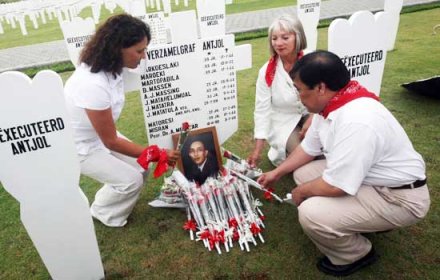
Present-day Eijkman Institute director Sangkot Marzuki (right), and two descendants of the executed man, Monique Mochtar (left) and Jolanda Mochtar (center) lay flowers at a 2010 memorial event after the doctor’s location in a mass grave was discovered. Achmad Mochtar’s name also graces a Sumatran hospital.

On this day..

2010: Michael Perry, Herzog subject

It was on this date in 2010 that Texas executed Michael Perry by lethal injection for his part in a triple homicide that netted a cherry-red Camaro.

Perry is the subject of the 2011 Werner Herzog documentary Into the Abyss; being a Herzog film, it comes recommended.

Abyss is “not an issue film; it’s not an activist film against capital punishment,” Herzog has said. “In this particular case, with this very senseless crime, so senseless it’s staggering, what fascinated me was that it points to a decay in family values and the cohesion of society, all these things that looked so big and beyond this case.”

Trailer:

Interview with Herzog:

Full movie, if it remains available:

On this day..

2011: Yao Jiaxin, road rager

On this date last year, a young pianist turned public enemy number one was executed in China for a notorious roadside murder.

Yao Jiaxin, a 21-year-old student at Xi’an Conservatory, hit a waitress on her bike while driving in October 2010.

Seeing her taking down his car’s license plate and fearful that she would revenge herself with financial demands for her minor injuries, an infuriated Yao stabbed her to death there at the scene.

“Yao stabbed the victim’s chest, stomach and back several times until she died,” in the words of one court. “The motive was extremely despicable, the measures extremely cruel and the consequences extremely serious.”

Appropriately, the execution took place on the very day that Chinese students were facing grueling university entrance exams, like the ones Yao himself had passed a few years before.

This event sparked massive national outrage, and Yao — the ivory-tickling son of a well-off couple who worked for the defense industry but didn’t have the pull of true elites — proved to be perfectly cast for the role of public pariah in a country undergoing the cataclysmic social displacements of internal migration, urban proletarianization, social stratification, and uneven capitalistic growth. He reportedly told police in his confession that he feared that his victim, a “peasant woman[,] would be hard to deal with.”

So-called “netizens” thrilled to the scandalous murder and bombarded online communications spaces with demands for Yao’s condign execution — an offering to the hollow bromides of legal egalitarianism that people in China as everywhere else see flouted every day. Yao’s family even fed that in a backhanded way by offering the victim’s family a larger compensation than that demanded by law if they would back off their demand for execution. Those “peasants” spurned the bribe.

Despite the familiar spectacle of public bloodlust over an infamous crime, Yao’s case also had an unsettling effect for at least some. He was, after all, a promising young man undone by a moment of madness and moral frailty: his downfall was distinctly tragic, in the classical sense, and not such a stretch to read as symbolic of China’s challenges and transformations.

Palpably grief-stricken and contrite about it — his parents took him to the police station to turn himself in, and cameras tracked the frail-looking youth through his few months of legal calvary all the way to a pitiably sobbing spectacle in his final court appearance as he pleaded in vain for his life — Yao could inspire pity as well as loathing.

The nature of Yao’s crime makes him an unlikely poster-boy for ending capital punishment per se. Yet there was also something discomfiting about authorities’ theatrical and foreordained compliance with a bloodlust that they had arguably stoked.

And in a China which has moved towards dialing down executions in recent years, even Yao’s individual culpability met some overt challenge: academics and legal professionals prepared to frame it as a crime of passion or something akin to “temporary insanity,” meriting a lesser punishment.

“A lot of people felt shocked,” a Chinese death penalty opponent told a western reporter. “They felt shocked by the process. Some people thought the netizens pushed the court into giving Yao the death penalty.”

On this day..

2008: Curtis Osborne, poorly represented

Nach Golde drängt,
Am Golde hängt
Doch alles.

Goethe, Faust

On this date in 2008, Curtis Osborne suffered lethal injection in Georgia for a double murder.

In the words of the Atlanta Journal-Constitution report, “Osborne was executed for shooting Arthur Jones and Linda Lisa Seaborne on Aug. 7, 1990. Osborne allegedly killed Jones because Osborne didn’t want to give him the $400 he got for selling Jones’ motorcycle. Seaborne was killed because she was there.”

Pretty awful.

It’s very difficult to capture in individual cases the structural dimensions of the death penalty system, simply because individual cases are, well, individual. The many plausible actual innocence cases are one thing. Here what you’ve got is a guy who unquestionably shot dead two humans so that he could feed his cocaine habit: making some procedural argument for Curtis Osborne is going to sound like a lot of special pleading.

But those procedural arguments are the very guts of the animal. The U.S. death penalty proposes, as an institution, to attempt not the question, does Curtis Osborne deserve to die?, but the question, among hundreds of Curtis Osbornes, do we have the apparatus to justly distinguish the ones that deserve to die?

As an impoverished drug addict, Osborne was represented at trial by a since-deceased public defender named Johnny Mostiler.

If you search this case, the thing you’ll find immediately is that another defendant being represented at the same time by Mostiler would later swear that Mostiler told him, speaking of Osborne, “that little nigger deserves the chair.” And the context of the conversation was about how Mostiler had just received a plea offer that Mostiler didn’t plan even to relay to Osborne, for the aforementioned reason.

Pretty awful.

This sort of thing is hard to substantiate: the allegation comes from a man serving a murder sentence of his own, and Mostiler isn’t around to defend himself. But on its own, it’s a shocking claim and a reminder of how profoundly the trial attorney’s performance shapes the entire legal experience. As Time magazine put it, what if your lawyer wants you executed?

Whether Mostiler really dropped an N-bomb on Osborne’s case, we really don’t know. But it’s been said that capital punishment means those without capital get the punishment, and the fact of the matter is that not many of any race who have recourse to indigent defense are served at the bar by Atticus Finch.

Leave aside even that shocking racism allegation, one that no court saw fit to adjudicate. (Prosecutors called the racism claim “outlandish”; appellate court ruled it procedurally out of bounds.) Just reckon the structural situation.

The American Prospect profiled the blinged-out, fast-living Mostiler after his death — breathing not a word about Osborne’s case, which was nowhere on anybody’s radar — and described, essentially, the neoliberal project in action for public defenders.

Mostiler represented not only Osborne, but virtually every poor defendant in Spalding County, Georgia … because, in 1990, he’d pitched the county on a fixed annual contract. Mostiler argued that the county was

wasting money paying as many as 20 court-appointed attorneys $50 an hour to handle indigent cases without knowing exactly how many hours those attorneys would bill during any given year. Mostiler proposed instead that the commissioners pay him a flat fee to handle all of the county’s indigent cases, regardless of the number. That way the county would have to deal with only one lawyer, and it would know its final bill at the start of the fiscal year rather than at the end.

Let justice be done though the heavens fallwithin the confines of fiscal probity. This grift was going to be worth a good deal more than $400 … and come with its own body count, too.

Mostiler bragged about saving the county a good million bucks over the course of the nineties. That’s a new definition of the adversarial judicial process, fresh-minted for the race-to-the-bottom era: every exertion by a defense attorney on his client’s behalf costs him part of his own paycheck.

Small wonder that Mostiler hardly ever tried cases — no more than seven a year, he said, out of as many as 900 felonies. Most were dispatched within minutes in shotgun plea deals and no small number of those momentary clients remain on the inside of a Georgia penitentiary as we speak. Did we mention that Mostiler did all this “lawyering” in only 60% of his lawyer time? He kept up a lively private civil practice, too, one where he probably averaged more than 100 minutes per case.

Death sentences, of course, don’t result from plea bargains — but at Mostiler’s zero-sum rates he also wasn’t going to prep this like the Dream Team. Slate reported that

Mostiler never hired a psychiatrist to examine evidence that Osborne was a victim of childhood abuse, and was borderline retarded, despite a court-ordered sanity evaluation that had found “indications of depression, paranoia, and suicidal ideation.” He never examined the history of mental illness in Osborne’s family because, he said, he didn’t know how to conduct that kind of investigation. Mostiler called no expert witnesses to testify for his client and didn’t bother to interview the state’s experts before they appeared at trial. And he rejected appointment of a second attorney to help with Osborne’s defense, which the American Bar Association and all serious death penalty litigators say is essential if a capital murder defendant is to receive a fair trial.

Pretty damn awful.

Once Osborne’s conviction was in the books at the trial level, no appellate court could intervene without clearing a very high bar: would the evidence un-investigated and the argument un-made likely have made a difference? Could anyone prove that Mostiler described his client with a racial slur? Nobody could really say so. End of story.

It was 18 years between the time Osborne laid those two souls in the ground and the time he laid himself down on the gurney. The irony is that all that time, all those exhaustive appeals, left the most salient and troubling questions in his case un-examined. There were substantive questions here, but Georgia prevailed in a procedural argument that those questions remain closed.

All this unsalved death and sorrow, and all for what? So Curtis Osborne could have another hit. So Spalding County, Georgia wouldn’t have to trouble the property levies with billable hours. For nothing but a little bit of money.

On this day..

1776: Benjamin Harley and Thomas Henman, Smugglerius?

On this date in 1776, smugglers Benjamin Harley and Thomas Henman were hanged at Tyburn for murdering a customs-house officer who had intercepted them trafficking tea on the Deptford turnpike.

One of these two gentleman might well be the flesh-and-bones person behind the ghoulish ecorche sculpture known as “Smugglerius”.

This beautifully ghastly item was commissioned of sculptor Agostino Carlini by the anatomist William Hunter: it is the cast of a hanged man, meticulously flayed of his skin to reveal the musculature for the convenience of future students’ sketches. Those students gave their subject the jocular nickname, since in life it was thought to be a smuggler.

For good measure, Carlini posed the corpse in the manner of the Hellenistic marble Dying Gaul.


Dying Gaul (known in the 18th century as Dying Gladiator), one of the world’s best-known classical sculptures. (cc) image from Tom Magliery.

Of the “Dying Gladiator”, Byron wrote:

He recked not of the life he lost, nor prize,
But where his rude hut by the Danube lay,
There were his young barbarians all at play,
There was their Dacian mother, — he their sire,
Butchered to make a Roman holiday; —
All this rushed with his blood; — Shall he expire,
And unavenged? — Arise! ye Goths, and glut your ire!


A copy of Agostino Carlini‘s bronze cast of “Smugglerius”, displayed in Edinburgh. (cc) image from Chris Hill.

So that is Smugglerius, an astonishing artifact. For decades, it (actually a copy of Carlini’s original, which is long lost) has been parked at the Edinburgh College of Art, translating thence into countless students’ anatomical sketch pads.


William Linnell‘s 1840 drawing of Smugglerius.

To trace the ecorche‘s origin, we have, to start with, this letter from John Deare … not the tractor guy, but a noteworthy Liverpool sculptor. At time of writing in 1776, he was a 15-year-old matriculating art student:

One of the men bid me tell you, that Mr. Carter would give me half-a-guinea, at least, a week, for the first part of my time, and fifteen shillings for the latter part; but you will write to him, and ask him what he proposes: he is, just as they say, a blustering fellow, but a good man. I have seen two men hanged, and one with his breast cut open at Surgeons’ Hall. The other being a fine subject, they took him to the Royal Academy, and covered him with plaster of Paris, after they had put him in the position of the Dying Gladiator. In this Hall there are some casts from Nature that are cut from the middle of the forehead down to the lower part of the body, one part excoriated, and the other whole.

With the direct reference to the Dying Gladiator/Dying Gaul pose, we seem very clearly to have a bead on the creation of Smugglerius, and the letter suggests that it was one man taken from a pair of hanging subjects. Conveniently (or inconveniently) there were just two such pairs of executions at Tyburn in the spring of 1776: those of Benjamin Harley and Thomas Henman on May 27; and, those of Samuel Whitlow and James Langar on April 12.

Now, artist Joan Smith and anthropologist Jeanne Cannizzo have recently, and very publicly, argued that Smugglerius is not Harley or Henman, but James Langar — a man from the earlier hanging pair. This claim even teased an exhibition carrying the perhaps unfortunate title Smugglerius Unveiled.

The case for Langar basically has two components:

  1. Deare dated his letter about the “Dying Gladiator” on May 1, so the executions must precede that date — which means that it’s one of Langar or Whitlow.
  2. It’s more likely that Langar, a soldier, would have had the outstanding physique to attract Hunter’s interest. (Whitlow was a domestic servant who robbed his master in an unrelated crime.)

Headlines aside, this sleuthing obviously falls well shot of airtightness.

Historian Tim Hitchcock, incidentally a moving spirit behind the creation of the invaluable Old Bailey Online database, doesn’t find James Langar a persuasive candidate. In private communication with this site (4 April 2012), he remained “still very much of the opinion that [Smugglerius] is either Thomas Henman or Benjamin Harley … I am even more convinced now than before.” Here’s the case for one of the Harley/Henman pair:

  1. Harley and Henman were smugglers. You know … like Smugglerius?
  2. Trial records indicate death-sentenced prisoners also condemned to anatomization, and they do not say that about Whitlow and Langar, who were merely thieves
  3. Harley and Henman, by contrast, had killed; they were therefore subject to the Murder Act, and accordingly sentenced “to be afterwards dissected and anatomized; which sentence was executed upon them”*

All things equal outside of the date on Deare’s letter, Harley and Henman look much the likelier source of Smugglerius. (If so, we seem to lack any good reason to prefer Harley as the Smugglerius model as against Henman, or vice versa. Flip a coin.)

The historiography for Langar depends inordinately upon the present-day interlocutor’s confidence in the “1 May” date a Georgian-era teenager slapped onto a bit of personal correspondence with, one can be sure, nothing resembling academic gravity. May 1 could be mistaken outright (maybe it was June 1, and he wrote “May” out of the previous 31 days’ habit); or, it could be only a reference to when Deare began a letter that he might have composed over several weeks; or, it could be that the author had some trivial reason of personal expediency to backdate.

Maybe so, maybe not. But who would have thought anyone would be interested in Harley or Henman (or Langar) going on two and a half centuries after their deaths.

Executed Today had occasion to discuss this fascinating object d’art and its discomfiting origin with one of Hitchcock’s collaborators, IUPUI Professor of British History Jason M. Kelly.

ET: What’s the background? Why is Smugglerius being produced at all in 1770s Britain?

JK: Well, 1768 marked the establishment of the Royal Academy of Arts. It took over 20 years to create.

The idea was to give Britain a school of art — of painting, sculpture, and architecture — to rival its continental peers. The French had established art academies in the previous century; they were among the premier art schools in Europe, if not the premier schools.

The British didn’t have anything comparable. And, in an age of rivalries, both political and cultural, artists and patrons alike saw the Royal Academy as central to British national identity.

The Academy hired William Hunter to be the professor of anatomy. He was an anatomist — a doctor — by training, not an artist, so he was very interested in teaching things like musculature, skeletal structure, and the circulatory system.

Smugglerius was not William Hunter’s only ecorche. He had made at least one other as a teaching aid, and he was proud to associate himself with it. He even poses for a portrait with a miniature version of it.


Miniature portrait of William Hunter holding a miniature bronze from Michael Henry Spang‘s reduction of an earlier ecorched figure. (The full-sized figure can be seen in the background of this sketch.)

What actually goes into producing an ecorche?

They had to get the body from the gallows to the art academy. Then they flayed it. In this case, somebody decided to pose the corpse as the Dying Gladiator.

They had some time prior to rigor mortis to get everything situated. in this case, they flayed him, posed him, then let him dry out, possibly overnight, so that they could make a mold of his body.

Beyond its immediate use as a teaching device, it’s also an art object for appreciation in its own right. How do you read that phenomenon?

This is very much a representation of the power of the state, the unrestrained power.

The execution itself is a display of power, but the government went further when in 1752 it passed the Murder Act allowing the College of Surgeons to get six bodies a year to dissect.

Ordinary people had no desire to have their remains used in this way. In the example of Smugglerius, the criminal was executed. Then, the body was desecrated — transformed into an art object for elite connoisseurs.

The sculpture was meant to represent ideal beauty as well as the terrifying strength of the state. The very people who were meant to appreciate the model of the Dying Gaul were the same people holding the reigns of power. In a sense, this image reinforced the elites’ view of the world, both aesthetically and politically.

Why pose the figure in this way, as the Dying Gaul or Dying Gladiator?

There’s one reading of Smugglerius to the effect that it was very subversive because the Dying Gladiator was seen as emblematic of the decline of Rome: the sculpture represented Rome’s decadence and corruption.

an inveterate abuse, which degraded a civilised nation below the condition of savage cannibals. Several hundred, perhaps several thousand, victims were annually slaughtered in the great cities of the empire; and the month of December, more peculiarly devoted to the combats of gladiators, still [in the early 5th century] exhibited to the eyes of the Roman people a grateful spectacle of blood and cruelty … which had so long resisted the voice of humanity and religion.

-Edward Gibbon in The Decline and Fall of the Roman Empire

So, you could speculate that this pose slyly represented contemporary executions under the Bloody Code in the same critical way.

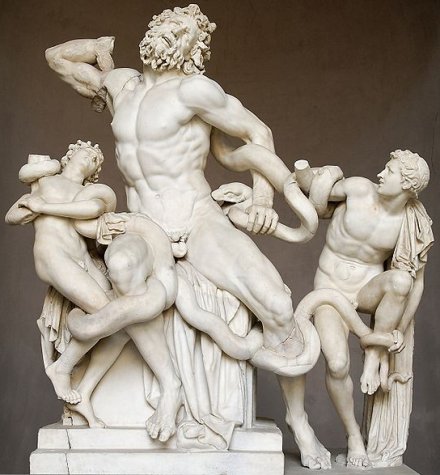
The Gladiator was also one of the best-known and -admired classical sculptures in all of Europe, along with the Laocoön.

In the 18th century they were compared as two examples of dignified dying. Contemporaries saw a certain stoicism in the sculptures — even though Virgil wrote that Laocoön cried out.

Ultimately, Smugglerius reminds us what happens when power is unrestrained. In a world where most people don’t have a voice, the state can ignore the rights and dignity of individuals. The real story here is the story of arbitrary authority and the importance of an enfranchised citizenry with the ability to put limits on those wielding power.

* Hanged felons not sentenced to anatomization could still wind up being taken apart in an operating theater, either as a result of their striking a direct bargain with the surgeons, or involuntarily via London’s growing trade in illicit corpses.

On this day..