1870: Thomas Scott, “take me out of here or kill me”

On this date in 1870, a troublesome Anglophone was shot in Fort Garry by the rebellious Metis provisional government.

The Red River “Rebellion” pitted the Métis people — Francophone mixed-race descendants of Europeans and natives, constantly referred to as “half-breeds” in the period’s literature — of the inland plains against the Canadian government that had just bought the rights to their land from the Hudson’s Bay Company.

Needless to say, this sale was not effected with reference to the consent of said land’s inhabitants, which makes the term “rebellion” something of a misnomer — rightful authority was not clearly constituted, and in this period it would be negotiated on the fly.

Distrustful of the Ontario government and the Red River Settlement’s own minority of Anglo settlers, Louis Riel led a headquarters in Upper Fort Garry.* Riel’s negotiations with Canadian authorities set the parameters for the future province of Manitoba.

Parallel to the diplomatic overtures, however, were skirmish-level military hostilities.

Scott, an Irish-born Orangeman of fiercely anti-Catholic disposition, was captured with a few dozen Anglos attempting to mount an assault on Metis holdings and imprisoned in Fort Garry. He escaped with some of the other prisoners, but was re-arrested making a return trip to attack the fort again and liberate the remaining captives.

Scott’s execution this day helped inflame anti-Metis sentiment and contributed to the Riel government’s collapse a few months later.** But the guy makes a bit of a problematic martyr because — and we want to be fair here — he seems to have been an unmitigated prick.

The leader of Scott’s fatal expedition, Charles Boulton, was likewise condemned by the Metis, but Riel pardoned Boulton and even offered to bring him into Riel’s own government. Scott, by contrast, let no one be mistaken about his contempt for the half-breeds and abused his captors; his particular sentence was procured on the grounds of having defied the provisional government’s authority and threatened Riel.

Since Riel was looking for someone to make an example of, he was the guy.

As so often with firing squads, the execution was a botch … and upon that botch was laid, according to the testimony of a Metis opponent of Riel quoted by Boulton, a downright sadistic final chapter. (It must be noted that both the original source and the man citing it have an interest in maximizing the alleged brutality of Riel.)

Six soldiers had been chosen to shoot Scott. I have here again to write the name of a man whose behaviour in that circumstance reflects on him the greatest honour. Augustin Parisien, one of the six soldiers, declared openly that he would not shoot at Scott; in fact, he took off the cap from his gun before the word of command ‘present’ was given. Of the five balls remaining, only two hit the poor victim, one on the left shoulder, and the other in the upper part of the chest above the heart. Had the other soldiers missed the mark undesignedly, or had they intentionally aimed away from Riel’s victim, it is not known. However that may be, as the two wounds were not sufficient to cause death, at least sudden death, a man, named Guillemette stepped forward and discharged the contents of a pistol close to Scott’s head while he was lying on the ground. This ball, however, took a wrong direction. It penetrated the upper part of the left cheek and came out somewhere about the cartilage of the nose. Scott was still not dead, but that did not prevent his butchers from placing him alive and still speaking, in a kind of coffin made of four rough boards. It was nailed and plated in the south-eastern bastion, and an armed soldier was placed at the door. This would seem like a story made at one’s ease, if there were not several credible witnesses who, between the hours of five and six in the evening, heard the unfortunate Scott speaking from under the lid of his coffin, and it was known that he had been shot at half-past twelve. What a long and horrible agony, and what ferocious cruelty was this on the part of his butchers. The words heard and understood by the French Metis were only these ‘My God, My God!’ Some English Metis, and those understanding English, heard distinctly these words: ‘For God’s sake take me out of here or kill me.’ Towards 11 o’clock — that is, after ten and a half hours of frightful agony — a person, whose name I shalt withhold for the present, went into the bastion, and, according to some, gave him the finishing stroke with a butcher’s knife, with a pistol, according to others. After having inflicted the last blow on poor Scott, that person said, as he was coming back from the bastion: ‘He is dead this time!’ The corpse was left for a few days in the south-eastern bastion, being guarded by the soldiers, relieving each other in turn.

* The site — most of the fort is demolished — is now in downtown Winnipeg.

** Riel himself had a colorful career ahead of him, which ultimately delivered him too to the annals of the executioner.

On this day..

1968: Nguyen Van Lem

Around noon of February 1, 1968, in the opening days of the communist Tet Offensive, South Vietnamese General Nguyen Ngoc Loan summarily executed a Viet Cong prisoner on the streets of Saigon — and photographer Eddie Adams captured perhaps the war’s most unforgettable image.

An American cameraman also captured it in on celluloid. Caution: This clip shows … well, a man being shot in the head at point-blank range.

Though the image brought Adams the Pulitzer Prize, he would express discomfort with it later in life, and eulogized General Loan in Time magazine when he died in the U.S. in 1998.

The general killed the Viet Cong; I killed the general with my camera … photographs do lie, even without manipulation.

For Adams, the lie was the omission of context — that the plainclothes Lem had allegedly just been caught having murdered not only South Vietnamese police but their civilian family members; that Loan was a good officer and not a cold-blooded killer.

Adams’ editor has said that many such summary executions were taking place during the Battle of Saigon — a broader context to the image no matter its specific fairness to the executioner.

But of course, the shot gained its deeper resonance from the growing disgust with the Vietnam War … and from its concise tableau of a century’s brutality. Here is a frozen image of Orwell’s boot stamping on a human face, forever.

Like any great work of art, Adams’ serendipitous photograph took on a life of its own … and a tapestry of meanings richer than its creator could ever have intended.

On this day..

1759: The Tavora family

Two and a half centuries ago today, Portugal’s noble Tavora family was extirpated in Belem.

[A] scaffold eighteen feet in height was erected in the market-place of Lisbon, during the night of the 13th, round which was drawn up a cordon of military. Precisely at 7 o’clock in the morning, the old Marchioness of Tavora, as the most guilty, was brought upon the scene, her hands bound, and a rope round her neck. She was placed on a chair, and her eyes being bound, the executioner struck her head off without the previous utterance by her of any complaint. After her came the twenty-one-year-old son, Joseph Maria de Tavora. They bound him on a cross raised aloft, broke his arms and legs with iron clubs, and then strangled him with a rope. The same fate befell [Tavora son-in-law] Jeronimo de Ataide, Count of Atouguia, the young Marquis Luiz Bernard de Tavora, colonel of cavalry, his servant Blasius Joseph Romeiro, Corporal Emanuel Alvarez Fereira, valet of the Duke of Aveira, and the body-page, John Michael. Their corpses were all flattened upon wheels, which were placed on poles, and this proceeding took up so much time that fully half an hour elapsed before another execution could be proceeded with.


Other outstandingly gory images of this day’s business are here.

After the page Miguel or Michael, the executioner took the old Francis d’Assis de Tavora, bound him on a St. Andrew’s cross, gave him three blows on the chest with an iron rod that resounded to a distance, shattered his arms and legs, and then gave him his coup de grace through the heart. The executioner’s men then, amidst wild shrieks, shattered the arms, legs, and thighs of the ninth victim, the old Duke of Aveiro, while still alive, then killed him by a blow on the chest, and threw him into the blazing fire. Finally, the tenth delinquent, the valet Anton Alvarez Fereira, brother of the above-mentioned Emanuel, was conducted before the corpses of the nine who had been previously executed, each one being shown to him; he was then bound to a stake, round which was placed a heap of wood, and this being set fire to, was raked together until he was completely consumed* … When the execution was over, the scaffold, together with all the dead bodies, was set on fire and burnt to ashes, which were thrown into the Tagus.

Oh, and one last thing:

[T]he palaces of the high nobility who had been executed were pulled to pieces and levelled to the ground, and salt strewed on the places where they had stood, as a sign that they should never be built up again.

Yikes.


This stone marker was placed on the site of the razed palace of Jose Mascarenhas, the Duke of Aveiro. “On this infamous land,” it announces, “nothing may be built for all time.” Copyrighted image courtesy of Ludgero Paninho.

Seems someone got the idea that the Tavoras tried to kill (and more problematically, failed to kill) Portuguese king Joseph I.

Circumstantial, torture-adduced evidence put the scheming Marchioness Eleonora de Tavora and clan behind an apparent assassination attempt, wherein a couple of assailants had shot at the king’s unmarked carriage as it returned on a little-used road from a rendezvous with his mistress. (One of the circumstances was that the mistress was a Tavora, which put the accused in a position to know the king’s secret travel plans. Others argue the gunmen might have just been common highwaymen who had no idea they were setting upon the royal person.)

Whatever the facts of the matter, obscure behind a quarter-millennium, its attribution to the Tavoras and the spectacular revenge thereupon visited was effected by the king’s competent and ruthless minister, Sebastião José de Carvalho e Melo, the future Marquis de Pombal.


A monumental plinth surmounted by Pombal dominates the present-day Lisbon plaza named for him.

His able handling of the recent Lisbon earthquake had cemented his position as the throne’s right-hand man in a trend of centralizing absolutism not much appreciated by the old aristocracy (nor by the hidebound clerical orders, which explains why the aforesaid gory account of the execution ground comes from a German anti-Jesuit polemic).

And he would not miss the opportunity an attack on the king’s person gave him to sweep away his opponents.

The peers of the realm were summoned to witness their fellow blue-bloods so nauseatingly dispatched, and the Jesuits — “reported to have inflamed the Tavora family to their [the Jesuits’] desired pitch … in revenge for what had justly been done to them in South America”** — were forthwith suppressed.

(Functionally a progressive secular dictator — or an enlightened despot, to use a more 18th-century description — Pombal would eventually push political conflict with Rome so near the brink of outright schism that the Catholic Encyclopedia’s entry on Melo characterizes it as “a sort of disguised Anglicanism,” adding that “many of the evils from which the Church now suffers are a legacy from him.” His ascendancy is the “Pombaline Terror” in Catholic annals.)

Melo/Pombal exercised the power of the state for the rest of Joseph’s life, but the king’s daughter and successor Maria I dismissed him — though she did not take punitive action against Pombal for his persecutions, as his enemies demanded.

* Also doomed to burning alive was one Joseph Policarpo, who was able to escape the mass arrest a few weeks before and fled the kingdom. He was executed by effigy.

** This comment is from the letters of Christopher Hervey, an Englishman abroad in Portugal at the time of the execution whose 100+ pages’ worth of correspondence include live-at-the-scene reporting and English translations of the public pronouncements against the supposed culprits. As to the South American roots of Pombal’s conflict with the Jesuits, the order had resisted Pombal’s early schemes to reorganize and rationalize Portugal’s New World holdings in order to make the country a more competitive colonial power. Jesuit resistance to giving up the order’s control of education, and its humanitarian efforts to protect Indians, had been seen as contributing to an Indian rebellion that broke out in Jesuit-controlled territory — even to the point that Jesuits themselves were suspected of arming Indians in an effort to carve out church-controlled states. Hervey’s version has the Jesuits behind the plot in order to eliminate Pombal’s threat to their power. Others share this opinion … and Pombal, obviously, was keen to have his rivals inculpated for lese majeste in the public mind.

On this day..

2003: Liu Yong, for corruption

On this date in 2003, Liu Yong’s situation took a very abrupt turn for the worse.

The wealthy Communist Party member and Shenyang city legislator had been sentenced to death 20 months before in a corruption case for ordering the murder of a tobacco vendor as part of a mafioso racket of graft, extortion, black marketeering, and kindred mayhem.

When that sentence was reduced on retrial on a showing that Liu’s confession was extracted by torture, public outcry at the appearance of a well-connected insider getting off scot-free led the Supreme Court to take the unprecedented step of yet again re-trying a criminal case itself.

“According to China’s legal system, a criminal case can usually be tried only twice,” as China Daily lightly put it.

Amnesty International is less measured, and alleges that the irregular Supreme Court hearing was ordered by political insiders to buttress the credibility of the country’s anti-corruption drive — and to avoid setting any precedent that evidence of torture should mitigate criminal sentencing. (China certainly found defenders for the trial (the link is to an ugly layout of raw HTML).)

The high court handed down its sentence this very day, after which Liu was immediately hailed to one of China’s mobile execution vans, given a lethal injection, and cremated.

On this day..

1730: Hans Hermann von Katte, Frederick the Great’s lover

On this date in 1730, Prussia’s greatest king watched his boyhood lover put to death at his father’s order.

Happy families are all alike; every unhappy family is unhappy in its own way. Most of those ways were explored at some point by a Hohenzollern.

The 18-year-old prince Frederick had a thoroughly frosty relationship with the old man. Surly Frederick William I — “the soldier king” — didn’t have much use for his sensitive, music-loving son. An “effeminate fool,” dad thought the boy, and did not scruple to beat him publicly as he forcibly molded the unwilling heir into a military man.

Now, blue bloods have often had rocky relationships with their sires, but running away is not the usual option for a prince of the realm.

But Frederick contrived to hit the bricks, and 26-year-old officer Hans Hermann von Katte had the bad luck to be his best friend (and presumed homosexual lover). When Frederick turned to him for help, they started plotting flight.

Both were apprehended and imprisoned, and Frederick was himself in some danger of being executed by command of his own father. Dad softened up enough to keep his son’s head attached to his shoulders.

Von Katte wasn’t so lucky: sentenced only to imprisonment, the verdict was upgraded by the vindictive monarch — and as part of Frederick William’s ongoing project to break his son, he made the kid watch his friend’s beheading from close enough proximity to beg (and receive) von Katte’s forgiveness.

Here’s a melodramatic interpretation from a short film called Der Tod des Hans Hermann von Katte:

Frederick spent the next decade under the father’s thumb, chafing but bending himself to the austere demands of Prussian statecraft.

Well did he absorb them, for upon succeeding in 1740, he far surpassed his father in the martial pursuits, and for the half-century span of his reign was Europe’s acknowledged battlefield master. Known to posterity as Frederich the Great — and more familiarly as der alte Fritz, “old Fritz” — his augmentation of the empire vaulted Prussia into Europe’s great powers club and set the stage for German unification.

[flv:http://play-mcvideos.howstuffworks.com/2008-07/31/12211.flv 425 344]

Frederick scarcely ever spoke again of von Katte, but neither did he lose his native intelligence, and he kept up a long-running correspondence with Voltaire.

It gives an achingly tragic cast to the boy who suffered the horrible loss of his intimate this day — who dutifully delivered to his country genius as a commander and statesman, at the uncomplaining sacrifice of the life he yearned to lead.

UC-Berkeley professor Margaret Anderson’s wonderful “Rise and Fall of the Second Reich” course podcast situates Frederick in the arc of Prussia’s development out of the Middle Ages —

[audio:http://webcast.berkeley.edu/media/f2007/hist167b/hist167b_20070904.mp3]

— and treats his adroit foreign policy and active mind in the age of the Enlightenment.

[audio:http://webcast.berkeley.edu/media/f2007/hist167b/hist167b_20070906.mp3]

On this day..

1793: Marie Antoinette

This afternoon in Paris, 1793, the French Revolution devoured the Queen.

Thirteen-year-old Madame Antoine — a year before marriage, and rebranding as Marie Antoinette. A vast gallery of her portraiture awaits here.

Among the most emblematic death penalty victims in history, Marie Antoinette — the “widow Capet,” as she was styled in egalite, after the guillotine shortened her husband — had the bad luck to personify the decadence of the ancien regime under the hegemony of the sans-culotte.

(And, of course, the good luck to be born heir to all the perks of absolutism she enjoyed for the first thirty-plus years of life. So, you know: a mixed bag.)

Those infamous excesses — and her infamous alleged bon mot, “let them eat cake” — are said to have been greatly exaggerated, nothing that everyone wasn’t doing, nothing that wasn’t understandable under the circumstances.

She had a gift, it seems, for accumulating to her personal reputation the outrage incurred by every gross and petty indulgence of the old order. And she had a popular press, the libelles, ready to embroider them salaciously.

Poor Marie.

Jacques-Louis David sketched this portrait of a haggard Marie Antoinette en route to the guillotine.

Cruel, wanton, senseless … her death was all of these, but then many others in the Terror suffered the same, as many others had under the Bourbons.

As royal dynastic pairings go, she’d been dealt a bad hand.

Her mere presence in France was fruit of the controversial policy of alliance with the Austrian Habsburgs from the Seven Years’ War, and she was trundled off with her dowry and her teenage wiles to the foreign snakepit of Versailles just as the minister advancing that policy fell. Distrusted by the French as an Austrian catspaw, castigated by her family for her inadequacies thereto, socially expected to display conspicuous regal largesse during a budget crisis not of her making, and unable for the longest time to get a successful coition from her indifferent and/or impotent husband, it must have seemed to her some days like every play was a losing one.

She struggled to gain traction at court. But she would lose much more than influence.

I was a queen, and you took away my crown; a wife, and you killed my husband; a mother, and you deprived me of my children. My blood alone remains: take it, but do not make me suffer long. (WikiQuote)

Her bearing she kept forever: in a kangaroo court with a foreordained outcome where her imperious dignity still managed to turn aside an accusation of sexual abuse her son had been cajoled into supplying; on the scaffold, when she did not neglect courtesy to the executioner whose foot she trod:

“Monsieur, je vous demande pardon. Je ne l’ai pas fait exprès.”

For much more queenliness, Marie-Antoinette.org delivers what the url promises, in quantity. If this figure or this period appeals, be sure to browse its forums.

Naturally, the doomed queen has had plenty of attention from printed word as well:

A few books about Marie Antoinette

As well as less, er, traditional media.

Part of the Themed Set: Belles Epoque.

On this day..

1560: Arnaud du Tilh, alias Martin Guerre

On this date in 1560, a French peasant was hanged outside the home he had made with another man’s wife in the southwestern French village of Artigat (or Artigues).

A poignant, perplexing tale of identity and social place — and possibly even of love — the story of Martin Guerre is at once exactingly local to its time and place, and timeless in its principals’ humanity.

As told in Natalie Zemon Davis’ captivating social history The Return of Martin Guerre, the restless (or ill-tempered) young titular peasant — impotent with his wife Bertrande, tense living with his father-in-law, chafing in rural Artigat — got out of town in 1548, joined one of the soldiering companies crisscrossing Europe, and was heard of no more.

In the centuries before fingerprints, credit cards, cell phones and Facebook, Guerre just disappeared. Constrained by Catholic law not to remarry without proof of his death, Bertrande just had to wait.

Until “Martin” returned in 1556 simply by reappearing at Artigat — moved in with Bertrande — resumed the vanished man’s name and with it his place in the village. There were suspicions from the first that he wasn’t quite right … but this man had Martin’s stories, and the villagers didn’t have so much as a photograph to test him against.

Martin was accepted in Artigat for three-plus years, fathered two children with Bertrande, and managed the estate as head of household. In Davis’s telling, he appears much the better husband and father than the pre-1548 version, and this bolsters her case that Bertrande must have been complicit in the fraud that unraveled in 1560.

Property and inheritance conflicts with Martin Guerre’s uncle (now married to Bertrande’s widowed mother) brought to the courts the novel case: was this man really Martin Guerre?

The inconclusive tools for establishing identity and a deft defense by “Martin” must have made for a riveting legal drama (French link) — with villagers taking up competing sides and the man put to the test of his memory of Martin’s life, which he impressively aced. So thoroughly did the man command the role that

the gesture, deportment, air, and mode of speaking of the prisoner were cool, consistent, and steady; while those who appeared in the cause of truth were embarrassed, hesitating, confused, and on certain points contradictory in their evidence. (Source)

On the point, perhaps, of acquittal, the case was resolved like any legal potboiler should be: with the dramatic reappearance of the real Martin — for so all the conflicting witnesses quickly agreed him to be, and so confessed the imposter husband, Arnaud du Tilh (or Arnaud du Tilb), a peasant from a nearby village also nicknamed “Pansette”. A onetime army buddy of Guerre’s, the enterprising du Tilh had been mistaken for Guerre, and had pieced together enough of the absconded husband’s life that by dint of total recall and superhuman audacity, he made for his own the place in the world that Martin Guerre disdained.

The sentence of the court was that Martin Arnaud

make amende honorable in the marketplace of Artigat, in his shirt, his head and feet being bare, a halter about his neck, and holding in his hands a lighted torch; to beg pardon of God, the king, and the justice of the nation; of the said Martin Guerre, and de Rols his wife; and this being done, the said du Tilh shall be delivered into the hands of the executioner, who after making him pass through the streets, and other public places in the said town of Artigat, with a rope about his neck, at last shall bring him before the house of the said Martin Guerre, where, on a gallows set up for that purpose, he shall be hanged and strangled, and afterwards his body shall be burnt. (Source of the translation, slightly tidied up based on the French version here)

Arnaud du Tilh, and Martin Guerre with him, passed thereupon into the historical memory, for in assigning names to bodies, had the court really sorted out who was who? What does it mean to drop out of one’s society … and what rights can one expect to command upon returning? What did it mean to be Martin Guerre but to live in the house of Martin Guerre and manage the affairs of Martin Guerre? And the characters: Arnaud with his mysterious spark of bravado; Martin and his sudden and unexplained reappearance; the two of them as if cast for one another’s roles in life and crossed up by the gods.

And the mysterious Bertrande — what did she do, and what did she want?

A bit of Rorschach history, then, which accounts for the still-robust liveliness the tale enjoys four and a half centuries later. And let’s admit: a bit of wistfulness for the time you could start on a clean sheet just by changing your name. (Although illiterate 16th century peasants had achieved TSA-quality security protocols in this respect.)

Natalie Zemon Davis, whose own account has been criticized for overclaiming Bertrande’s role and motivations, also consulted as she was writing it for a Gerard Depardieu film of the same title.

The same story transplanted to the Civil War United States yielded the 1993 film Sommersby:

And if you must, you can see Martin Guerre in show tunes.

(This medley sequence has second and third parts as well.)

On this day..

1599: Beatrice Cenci and her family, for parricide

On the morning this day in 1599, the Cenci family — mother Lucrezia, son Giacomo, and immortal tragic heartthrob Beatrice — were put to death at Sant’Angelo Bridge for murdering the clan’s tyrannous father.

Francesco Cenci, the victim, was more accustomed to making victims of his own: detested around the Eternal City, he indulged his violent temper and fleshy lusts with the impunity of a wealthy cardinal’s son. By all accounts, he enjoyed pushing around his family, too.

This much is stipulated. What lies beyond is legend.

But the legend is why we’re dallying with Beatrice today, so we might as well begin there: in fear that her father would rape her, it goes, Beatrice tried to turn to the authorities, who let mean old dad walk on account of his connections. Desperate to protect herself from incest, Beatrice and family arrange to batter his gulliver and toss him over a balcony to make it look like suicide.

Slight problem: it didn’t look very much like suicide.

So the family was hauled in and tortured, and eventually Lucrezia and Beatrice (both beheaded) and Giacomo (quartered after suffering the mazzolatura of an incapacitating hammer blow to the head followed by gory lethal knifework by the executioner) all paid the price while the youngest child watched, spared death but condemned to life in the galleys.

(The papacy gobbled up the patricides’ estate, which puts a fine point on the ironically-named Pope Clement VIII‘s law-and-order stance on the appeal for mercy, and his subsequent edicts to quash public comment on the affair.)

Then Beatrice’s body — the part below the neck — contrived to disrobe when fumbled by the brethren taking it away for burial.

You’ve got to admit it’s pretty romantic. Some versions even hold that the responsible executioners died violently themselves within a month, or that a ghostly Beatrice returns to the scene of her demise on this anniversary.

And not a word of Italian fluency will be necessary to catch the gist of this excerpt from this 1969 Lucio Fulci film:

It’s a little too Romantic, as in capital-R.

While the case was a true sensation Rome at the turn of the 17th century, the legend as we know it was heavily constructed in the 19th century … and specifically Percy Bysshe Shelley, who heard the story in Italy* where it had persevered as local folklore. A girl who killed her despot-father, executed by the despotic agents of the Divine Father? You don’t get into the canon without knowing what to do with that kind of material.

And he had this charming painting of her to boot:

Shelley amped up the menaced-virginal-purity theme, made the bloodshed a lot more demure, and turned it into a long poem, “The Cenci” (available on Google Books, and on Bartleby.com) which in Melville’s description proceeds from putting its protagonist between the “two most horrible crimes possible to civilized humanity — incest and parricide.”

This doesn’t all actually turn out to be well supported: at a minimum, Shelley inflated an incest allegation of doubtful lineage into accomplished fact. Beatrice’s camp did not raise this claim until just before her execution, when it needed a high card for clemency. The loutish victim eventually got his own biographer, who strongly disputed the incest charges. (Francesco also sports his own Italian Wikipedia page.)

From Shelley’s influential quill** into the DNA of western literature: Stendahl tapped the vein, as did Artaud, and risorgimento figure Francesco Domenico Guerrazzi; both Melville and Hawthorne used that painting so captivating to Shelley as plot devices (Dickens loved the painting, too). American sculptor Harriet Hosmer worked Cenci’s complex sensuality in marble.

Remarkable how the tradition in its modern incarnation proceeds root and branch from Shelley’s apprehension of a single painting, and how his reading stamped itself upon the canvas for later observers — like Hawthorne, writing in his journal:

It is the very saddest picture that ever was painted, or conceived; there is an unfathomable depth and sorrow in the eyes; the sense of it comes to you by a sort of intuition. … It is the most profoundly wrought picture in the world; no artist did it, or could do it again. Guido may have held the brush, but he painted better than he knew. I wish, however, it were possible for some spectator, of deep sensibility, to see the picture without knowing anything of the subject or history; for no doubt we bring all our knowledge of the Cenci tragedy to the interpretation of the picture.

He wrote better than he knew: the painting is no longer attributed to Guido Reni, and it’s doubtful whether it’s a portrait of Beatrice at all. One wonders if it would retain its place in Hawthorne’s estimation as a local washer-woman modeling for an allegory.

* Apparently you can still crash at the same place Shelley first got hep to Cenci.

** Kick back with some polysyllabic literary analysis of Shelley’s Cenci stuff.

On this day..

1850: Prof. John Webster, for the timeless conflict between donors and academics

On this date in 1850, a 57-year-old Harvard professor expiated upon a gallows at Boston’s Leverett Square the murder of one of the university’s donors.

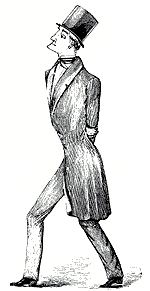
The buzz of Boston in 1849-50, the Parkman-Webster murder case began with the disappearance of one of the crimson’s great benefactors, George Parkman, a Boston Brahmin known for his Ministry of Silly Walks gait about town (see right). According to Oliver Wendell Holmes, Sr. (who appeared as a witness at the trial of Parkman’s accused murderer), “he abstained while others indulged, he walked while others rode, he worked while others slept.”

Also, he inherited a ridiculous sum of money, and was tight with the debtors to whom he lent it.

Back before collection agencies, Parkman disappeared in November 1849 while making the rounds to shake down his borrowers. Within days, suspicion settled on Harvard anatomy and geology professor John Webster, who had squandered his own pile of money buying rock collections and maintaining appearances and such, and sank into desperate hock to the jutting-chinned ambulator who had helped him land the Ivy League appointment in the first place.

A weighty circumstantial case soon formed against Webster, with the invaluable aid of a snoopy janitor who turned up human remains in the office and testified to incriminating-sounding conversations.

Elites-on-elite crime epidemics always churn the scandal mills. Henry Wadsworth Longfellow’s wife Fanny wrote a friend,

You will see by the papers what dark horror overshadows us like an eclipse. Of course we cannot believe Dr. Webster guilty, bad as the evidence looks. … Many suspect the janitor, who is known to be a bad man and to have wished for the reward offered for Dr. Parkman’s body. … I trust our minds will be soon relieved, but, meanwhile, they are soiled by new details continually.

“Harvard professors do not often commit murder,” or so they say. (This was still a century before Robert McNamara.)

Boston high society was about to see a whole different side of Harvard.

Although perhaps individually explicable — anatomists had plausible reasons to have human remains at work, and other anatomists than Webster could have had access to his office — the cumulative weight of Webster’s ham-handed attempts to declare that he had paid up his debts to Parkman just before the latter’s mysterious disappearance, of the discovery of what (disputed) dental forensics declared to be Parkman’s dentures, of the ghastly appearance of a torso (disputedly) declared to be Parkman’s stuffed in a tea chest at Webster’s offices started to really make the man look guilty.

In view of a mediocre defense, the jury convicted Webster of whacking his own professional benefactor, in the university building erected on said benefactor’s donated plot of land.

Talk about donor recognition.

While the prof’s seeming post-conviction acceptance of guilt — in a plain strategem to secure clemency — and generally shifty demeanor have cemented him as the definitive perpetrator in the standard historical reading,* Fanny’s snobbish take on the “bad man,” janitor (and moonlight body-snatcher) Ephraim Littlefield, has not been entirely lost to the tradition.

At the end of the day, everything about the case is circumstantial — indeed, besides being historically noteworthy for the first use of dental forensic evidence in a murder trial (forensics we might find rather speculative and unconvincing today), Webster’s case generated a landmark ruling from the judge’s jury instruction establishing “reasonable doubt” as the threshold for criminal conviction rather than the “absolute certainty” Webster’s prosecutors had no hope of attaining; that ruling influences American jurisprudence down to the present day.

And one cannot but notice how many of the circumstances — creepily playing Sherlock Holmes with a freelance dig into the professor’s furnace to discover charred bones, for instance — were provided by the fellow-suspect-turned-star-witness Littlefield, who niftily reaped the $3,000 reward for his offices in substituting Webster for himself under the pall of suspicion.

According to peripatetic crime blogger Laura James, a forthcoming (2009) book promises to revisit the sensational trial, “to examine all the intricacies for ourselves — not aided by the eager voice of the janitor.”

* Bemis, one of the prosecutors, wrote the go-to source on the Webster trial, available from Google Books; another contemporaneous account is here.

On this day..

408: Stilicho, whose execution let in the barbarians

Sixteen hundred years ago today, the general whose talents were the last bulwark against barbarian conquest of the Western Roman Empire submitted for the sake of civil peace to execution at the hands of a callow boy-emperor.

The half-Vandal patrician Stilicho comes to the notice of posterity late in the reign of Theodosius the Great, the last Roman to rule both Eastern and Western Empires. At Theodosius’s death in 395, his two sons ascended the separate thrones.

Honorius, a 10-year-old child, took the purple in the west and somehow held it for 28 lackluster years that saw Rome’s long erosion finally set the realm on the slide into collapse.*

An apt commander, Stilicho had held Visigoth king Alaric at bay in two invasions of Italy (the crucial Battle of Pollentia stanched the first).


Stilicho and his wife Serena, with their child: two were executed, one was murdered.

Distrusted because of his part-barbarian parentage — and hated by the still-significant pagan community for burning the Sibylline Books — Stilicho’s service never made him popular. Because Alaric had escaped his battlefield defeats, it was whispered that Stilicho had connived with him … and Stilicho’s alliance of his legions with Alaric against other barbarians in Illyrium and Burgundy only heightened the suspicions.

We have little reliable basis to judge the possible truth of these accusations; the fundamental fact was that Rome no longer exercised its accustomed hegemony, and its principals needed to balance interests, cut deals and allocate scarce resources in ways that would have been unthinkable a century or two before.** The army itself was mostly barbarian; Alaric himself had once been a Roman officer.

In the story as related by Zosimus — a later Byzantine historian, a pagan famously abusive towards Christians and elsewhere critical of Stilicho, here softening his stance as he turns to savage his executioners — a wormtongued advisor got the ear of the still-youthful emperor and turned him against the general who was holding back the cataclysm.

Stilicho … was not conscious of any ill intention either against the emperor or the soldiers, [but] Olympius, a native of the vicinity of the Euxine sea, and an officer of rank in the court-guards, concealed under the disguise of the Christian religion the most atrocious designs in his heart. Being accustomed, because of his affected modesty and gentle demeanor, to converse frequently with the emperor, he used many bitter expressions against Stilicho, and stated that he was desirous to proceed into the east, from no other motive than to acquire an opportunity of … placing the empire in the hands of his own son, Eucherius. … Olympius, accustoming himself to visit the sick soldiers, which was the master-piece of his hypocrisy, dispersed among them, likewise, similar insinuations. … they were excited almost to madness … then dispersing themselves about the city, killed as many of the magistrates as they could lay hands on, tearing them out of the houses into which they had fled, and plundered all the town. … The tumult continued till late in the night, and the emperor fearing lest any violence should be committed against his own person also, for which reason he withdrew. … There likewise perished so great a number of promiscuous persons as is beyond all computation.

When intelligence of this reached Stilicho, who was then at Bononia, he was extremely disturbed by it. Summoning, therefore, all the commanders of his confederate Barbarians, who were with him, he proposed a consultation relative to what measures it would be most prudent to adopt. It was agreed with common consent, that if the emperor were killed, which was yet doubtful, all the confederated Barbarians should join together, and fall at once on the Roman soldiers, and by that means afford a warning to all others to use greater moderation and submissiveness. But if the emperor were safe, although the magistrates were cut off, the authors of the tumult were to be brought to condign punishment. Such was the result of the consultation held by Stilicho with his Barbarians. When they knew that no indignity had been offered to the person of the emperor, Stilicho resolved to proceed no further in punishing or correcting the soldiers, but to return to Ravenna. For he reflected both on the number of the soldiers, and that the emperor was not steadfastly his friend. Nor did he think it either honourable or safe to incite Barbarians against the Roman army.

It came to a bad end, Stilicho nobly refusing the prospect of his allies upholding his cause by arms:

Stilicho being therefore filled with anxiety concerning these circumstances, the Barbarians who were with him were very desirous of putting in force their former resolutions, and therefore endeavoured to dissuade him from the measures which he afterwards thought proper to be adopted. But being unable to prevail with him, they all determined to remain in some place until they should be better apprized of the emperor’s sentiments towards Stilicho, … In the meantime Olympius, who was now become master of the emperor’s inclination, sent the imperial mandate to the soldiers at Ravenna, ordering them immediately to apprehend Stilicho, and to detain him in prison without fetters. When Stilicho heard this, he took refuge in a Christian church that was near, while it was night. His Barbarians and his other familiars, who, with his servants, were all armed, upon seeing this expected what would ensue. When day appeared, the soldiers, entering the church, swore before the bishop that they were commanded by the emperor not to kill Stilicho, but to keep him in custody. Being brought out of the church, and in the custody of the soldiers, other letters were delivered by the person who brought the first, in which the punishment of death was denounced against Stilicho, for his crimes against the commonwealth. Thus, while Eucherius, his son, fled towards Rome, Stilicho was led to execution. The Barbarians who attended him, with his servants and other friends and relations, of whom there was a vast number, preparing and resolving to rescue him from the stroke, Stilicho deterred them from the attempt by all imaginable menaces, and calmly submitted his neck to the sword. He was the most moderate and just of all the men who possessed great authority in his time. … he never conferred military rank for money, or coverted the stipend of the soldiers to his own use. … In order that no studious person, or astrologers, may be ignorant of the time of his death, I shall relate that it happened in the consulship of Bassus and Philippus, during which the emperor Arcadius submitted to fate, on the twenty-second day of August.

This date is the end of the line for Stilicho, but hardly the end of the troubles that laid him low. A spasm of mob violence against barbarians on the peninsula ensued; the executed general’s son was among those murdered. Teutons, many of them Roman soldiers, in turn flocked to the banner of Alaric, who promptly swarmed into the enfeebled Italian lands and for the first time in 800 years sacked Rome.

Romans knew just who to blame: Stilicho’s widow, who was herself executed at the order of the Senate. In Gibbon’s relating:

The first emotions of the nobles, and of the people, were those of surprise and indignation, that a vile Barbarian should dare to insult the capital of the world: but their arrogance was soon humbled by misfortune; and their unmanly rage, instead of being directed against an enemy in arms, was meanly exercised on a defenceless and innocent victim. Perhaps in the person of Serena, the Romans might have respected the niece of Theodosius, the aunt, nay, even the adoptive mother, of the reigning emperor: but they abhorred the widow of Stilicho; and they listened with credulous passion to the tale of calumny, which accused her of maintaining a secret and criminal correspondence with the Gothic invader. Actuated, or overawed, by the same popular frenzy, the senate, without requiring any evidence of his guilt, pronounced the sentence of her death. Serena was ignominiously strangled; and the infatuated multitude were astonished to find, that this cruel act of injustice did not immediately produce the retreat of the Barbarians, and the deliverance of the city. That unfortunate city gradually experienced the distress of scarcity, and at length the horrid calamities of famine.

Alaric made out quite a lot better.

* Such, at least, is the conventional assessment of Honorius. For a take friendlier to the emperor (and less so to Stilicho), see here.

** Stilicho, incidentally, called home the second-last legion of Roman troops from Britain for use closer to home, and the island’s remaining Roman presence was cut off by barbarian incursions into Gaul during his lifetime … setting that island on its independent way (into, if you like, the Arthurian age); Honorius would later answer a plea for help from those lands with a note to the effect of, “good luck on your own.”

On this day..