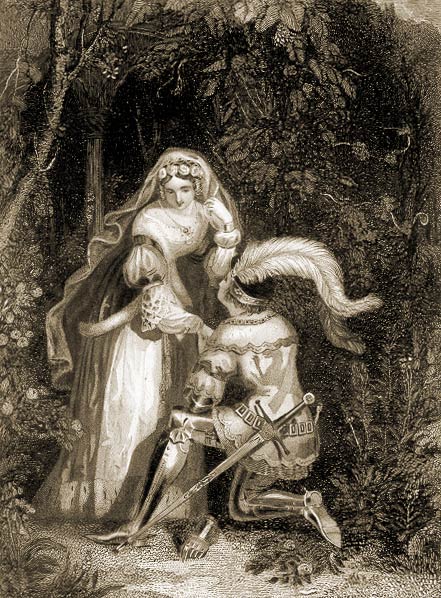
1848: Camila O’Gorman and Father Ladislao Gutierrez, for traditional family values

On this date in 1848, a pregnant 20-year-old socialite and her forbidden lover were shot at the order of an Argentine dictator.

Virtually a lens for the contradictory currents of gender, class and power in her time, Camila O’Gorman was the daughter of an elite family of (as her name suggests) Irish extraction, and a bosom friend of the daughter of her future executioner, dictator Juan Manuel de Rosas.
She fell into a torrid affair with Gutierrez, the family priest, and in 1847 eloped with him, a grand gesture of romanticism that brought a government warrant for their capture to “satisfy religion and the law and to prevent further cases of immorality and disorder.”

A scandal, as one might suppose — there was much chatter over who seduced whom, and whether it was a kidnapping — but a manhunt (and womanhunt)? Rosas appears psychotically enraged by two young people crazy in love, and still more so for summarily decreeing their death when he had them in his clutches. Another priest, it turned out, handed them over — more in sadness than in anger, in the manner of such folk, but understanding deep down that the arbitrary law is the law and immorality and disorder don’t go about preventing themselves.

O’Gorman was the first woman executed in independent Argentina, and she was eight months pregnant: the better to “satisfy religion” (though not the law, which forbade the execution of a pregnant woman), O’Gorman’s unborn child was baptized … by making her mother drink holy water.

The lovers were then shot together at the town of General San Martín, then known as Santos Lugares de Rosas.

The pregnant O’Gorman, borne to her firing squad. The image comes from this Argentinian page (in Spanish) about the heroine.

According to this effusively pro-elopers essay,

Camila and Uladislao’s brave sense of freedom upset the structured norms of a society used to obeying through fear. Their only way of facing the tyrannical power was escaping from a society which would never understand. They did not give up on their love to please the Restorer [Rosas], as was expected in those days. They never showed signs of repentment, [sic] on the contrary their peaceful minds reflected their clean consciences.

And among the many questions this tragic true story might raise, there’s one that particularly appals [sic] us: why did Rosas shoot Camila knowing the law stated a pregnant woman could not be murdered? Was that baby guilty of his parents’ “crime”?

He evidently was, since by being born he would symbolise the testimony not only of the criminal act, but also the evidence of “disobedience” of a moral code imposed by a fearful dictator.

Such Shakespearean drama ripped from recent history has not failed to inspire literary treatment — such as Enrique Molina’s Una Sombra Donde Suena Camila O’Gorman, (“A Shadow Where Camila O’Gorman Dreams”) and this 19th century Spanish text.

On the screen, O’Gorman and Gutierrez’s doomed love was the topic of one of the first Argentine feature films (a century-old silent film now thought lost), and an Academy Award-nominated 1984 film with plenty of talking:

On this day..

1993: Mohamed Mustafa Tabet, serial rapist with a badge

On this date in 1993, the police chief of Casablanca was shot in Kenitra Central Prison for abuse of power.

Mohamed Mustafa Tabet (or Tabit) wasn’t exactly Captain Renault.

While Morocco still has prisoners on death row, Tabet’s was the first execution actually carried out in 11 years, and it’s the last execution in Morocco to date. He went on the rocket docket, just five months from his arrest to standing up against a wall.

To earn that rare distinction, Tabet exploited his official power to rape or sexually exploit hundreds of women. Tabet confessed to some 1,500 victims over 13 years; the minimum figure matches the 518 personal identity cards found in his apartment. (Also found: 118 video cassettes — many of them violent — and a computer list of his crimes.)

The “Tabet Affair” — actually called “Tabetgate,” proving that the United States retains the power of exporting ideas — opened a discomfiting window on gender and power in Morocco.

Webster University Prof. Don Conway-Long was in Morocco at the time researching gender and masculinity for his dissertation. His paper “Sexism and Rape Culture in Moroccan Social Discourse” (pdf) is probably the most illuminating readily-available English* document on the affair — and the many contradictory reactions it drew from contemporaries, and the pressure it put on the government to contain the fallout as “a morals case, instead of looking further into overall police corruption.”

Prof. Conway-Long was good enough to spare Executed Today a few minutes to explore power and gender in Morocco, then and now.

ET: The scale of the crime spree seems just unimaginable, that he could get away with victimizing hundreds upon hundreds of women.

DCL: And not that many came forward! It was just a couple of women. If it’s difficult to talk to rape and sexual assault survivors here [in the U.S.], it’s exponentially harder in Morocco.

You were in Morocco in the years leading up to this trial. What was the country like in terms of its gender outlook?

It’s more like our 1950’s in terms of the attitudes towards women. Some educated professors at one point were laughing at the idea that a man could be charged with raping his wife in the West. In some ways, attitudes in Morocco are maybe 20 years behind what we see in the West. We had that same conception in the 1950’s — Missouri actually finally changed that law in 1993. [See here and here -ed.]

Morocco was also probably one of the most liberal countries of the Muslim world in the sense of being more closely connected to the West. Morocco has had more openness, more tourism.

How did the Tabet case impact women’s position?

[In 1995,] about a year after I left, a battered women’s shelter was set up in Casablanca, the first one in Morocco. By comparison, our first shelters in the U.S. and U.K. were set up in 1971, 1972.

In 2004, they passed a new family law that changed a lot of the freedoms that women have — e.g., women can ask for divorce, and don’t have to obey their husbands.

But I have no idea if you can claim there’s any causal relationship between the discovery of Tabet’s crimes and these later events. At the time, some men thought he was this great sexual hero, very virile.

So what lies ahead?

The old king died in 1999; his son Mohammed VI is in there now and he’s young and more aware and one of the rising stars of the monarchs of the middle east, like the king of Jordan. His [Mohammed’s] head is on the right way, but running a country like this with so much variation — there’s 50% illiteracy, the Western Sahara conflict, a certain level of Islamist opposition, and around twenty political parties all the way out to the Communists.

So there’s no certain future, absolutely not.

As far as cases like Tabet’s — let’s hope it’s not happening still, but Morocco when I was there was a place where you pass six different kinds of uniforms walking down the street with Uzis that would be pointed at your body as you passed.

* There’s more in French and Arabic.

On this day..

2007: Zheng Xiaoyu, former Director of the State Food and Drug Administration

One year ago today, China made to clean up its image — with public health advocates, if not with human rights advocates — by executing* its former Food and Drugs minister for economic crimes.

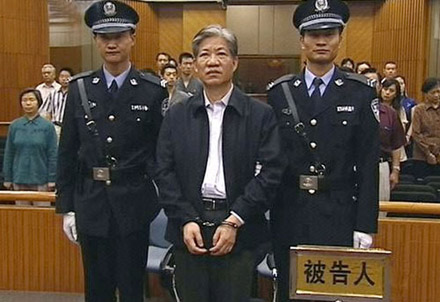
Zheng Xiaoyu, China’s drug regulation capo from 1994 to 2005 and only (“only”?) the fourth minister-level official to be put to death in China since the immediate aftermath of Mao Zedong’s reign, was sentenced for extracting bribes from pharmaceutical companies he nominally regulated in exchange for approving their worthless and/or unsafe products.

One bogus antibiotic he rubber-stamped killed ten in China before it was pulled from the market, but it was dangerous Chinese products exported abroad — including lethal pet food ingredients to the United States and a cough syrup that killed dozens in Panama — that lit a fire under the export-driven colossus. The court that rejected his appeal explicitly referenced Zheng’s danger to China’s international reputation — simultaneously shifting focus from structural weaknesses by individualizing them to Zheng’s personal failings.

Zheng Xiaoyu hears his death sentence.

On this same day it announced Zheng’s death, China anxiously unveiled plans to safeguard the food supply for its upcoming turn under the Olympic klieg lights. That acid test is now upon it: opening ceremonies are mere weeks away as of this writing.

It may have been a politically-driven execution and an unusually heavy sentence, but Zheng’s passing was exulted in China. Someone even tried to put his name on a rat poison — rejected for that most distinguished reason of modern capitalism, Zheng’s own intellectual property in his name.

For an interesting dive into the social and legal currents surrounding this case, check out this .pdf edition of Criminal Bar Quarterly.

* The method of execution was not announced, and to my knowledge has not been conclusively documented. Gunshot was the longtime standby for Chinese executions, but China has shifted heavily towards lethal injection in recent years; it’s generally assumed that Zheng suffered the latter fate.

On this day..

1865: Four for Abraham Lincoln’s assassination

On a sweltering July 7, 1865, a mere 12 weeks after Abraham Lincoln was shot at Ford’s Theater, four of his assassin’s accomplices were hanged in the courtyard of the District of Columbia’s Washington Arsenal — present-day Fort McNair, and specifically its tennis courts.

Booth, on the far left, playing Marc Antony in Julius Caesar opposite his brothers. He had Brutus’ example in mind, as he wrote in his diary while on the run: “with every man’s hand against me, I am here in despair. And why? For doing what Brutus was honored for.”

The exact nature of the conspiracy against the man who had seen the North to victory in the Civil War has been debated ever since actor John Wilkes Booth lodged a ball from his one-shot Derringer behind Honest Abe’s ear. But it was a conspiracy — an astoundingly bold one.

Simultaneous with Booth’s successful attack upon Lincoln, there was an unsuccessful attempt to kill Secretary of State William Seward; it would emerge in the investigation that another man had been detailed to murder Vice President Andrew Johnson, but got drunk and chickened out. The apparent upshot: with the President and Vice President dead, new national elections would be required to replace the Senator who would become acting president — and with the Secretary of State dead too, there’d be nobody to implement them. Booth was trying to paralyze the North with its own constitutional machinery in some desperate hope of reviving the defeated South.

Ten Against D.C.

Hundreds were detained in the stunning assassination’s immediate aftermath, but ten would ultimately be the federals’ targets. A massive manhunt pursued Booth through southern Maryland and into Virginia, where he was killed in a shootout. John Surratt, who had conspired with Booth in an earlier plot to kidnap the president — that failed plot had been reconfigured into the assassination — escaped from the country.

The other eight were rounded up and stashed at the Arsenal to face a military tribunal. It was a highly controversial arrangement: the war had entered a gray area — Robert E. Lee’s surrender just days before the murder had effectively ended the war, but when the trial opened in May Confederate President Jefferson Davis was still at large, and the last Southern general wouldn’t lay down his arms until late June. The District of Columbia was still technically under martial law … so would it do to use a military court?

Military Tribunal

So the government asked itself: government, would you rather have looser evidentiary rules and a lower bar of conviction than you would have in civil court? The government duly produced for the government an opinion that the military characteristic of the assassination — that is, to help whatever southern war effort still obtained — licensed the government to use the military courts.

That didn’t sit well with everyone. One former Attorney General griped:

If the offenders are done to death by that tribunal, however truly guilty, they will pass for martyrs with half the world.

Indeed, a year later, the Supreme Court’s landmark ex parte Milligan ruling would forbid the use of military courts where civilian courts are open — which they were in Washington, D.C.

That, of course, was too late to help Booth’s comrades. It would be a military trial, with a majority vote needed for conviction and no right of appeal but to the president for the most infamous crime of the Republic. Everyone had a pretty good idea what the results would be.

A cartoon depicting the defendants as Gallow's (sic) Birds.

Rogues’ Gallery

Two of the four today were doomed from the outset under any juridical arrangement imaginable: Lewis Powell (also known as Lewis Paine or Lewis Payne) had made the attempt on Secretary of State Seward; David Herold had guided him there with the getaway horse, and later escaped along with Booth. They were in way past their eyeballs. George Atzerodt, the schmo who couldn’t rise to the occasion of popping Andrew Johnson, looks a bit more peripheral from the distance of a century and a half, but in the weeks following the assassination he was much too close to the action to have any hope. All received death sentences.

Two others — Michael O’Laughlen and Samuel Arnold — had been involved in Booth’s earlier scheme to kidnap the president, but didn’t seem to have much to do with the murder. Still another two — Ned Spangler and Dr. Samuel Mudd* — were lesser participants. They all received long prison sentences for their pains, and the three of them still surviving were pardoned by Andrew Johnson as he left the presidency in 1869.

That left Mary Surratt, mother of the fugitive John and the only woman in the dock, the focus of attention and controversy. The 42-year-old widow owned a downtown boardinghouse, plus a tavern of sufficient importance at a Prince George’s County, Maryland, crossroads, that its community was called Surrattsville.**

The conspirators met frequently in her lodgings; Surratt maintained her innocence beyond that, but evidence and witness testimony began to pile up heavily against her … especially when Seward assailant Lewis Powell wandered into her place looking for refuge right while the police were questioning her. Booth and Herold turned out to have made a pit stop at her Surrattsville tavern to pick up a package of guns that Mary had prepared for them.

Though Surratt’s avowal of ignorance was not widely believed, a gesture of presidential mercy was anticipated — many thought (and think) she went on trial as a virtual hostage for her absconded son, who declined to take the bait. Strangely, five members of the nine-judge panel who condemned Mary Surratt turned around and asked President Johnson for clemency. Johnson claimed never to have seen the memo, but his mind seemed pretty made up — when Surratt won a habeas corpus stay on the morning of her scheduled hanging, he promptly “specially-suspended” the writ specifically to hang her:

I, Andrew Johnson, President of the United States do hereby declare that the writ of habeas corpus had been heretofore suspended in such cases as this; and I do hereby specially-suspend this writ, and direct that you proceed to execute the order heretofore given upon the judgment of the Military Commission.

Harsh treatment, and possibly well-deserved, for the first woman executed by the U.S. government. Even so, it does seem a curious thing when all is said and done that the mother of “the nest that hatched the egg” was worth a special suspension of the Great Writ, and even the stagehand who just held Booth’s horse for him caught six years, but old Jeff Davis — who apart from having figureheaded a treasonous four-year insurrection was implicated for giving Booth’s kidnapping plot official Confederate sanction — got to retire to write his memoirs.

Fine pages on the Lincoln assassination are here, here and here. There are also contemporary newspaper accounts posted online as filed for The Boston Post and The New York Herald.

The Surratt houses, by the way, are still standing. The Maryland tavern is kept as the Surratt House Museum by the Surratt Society. The downtown boarding house is a Chinese restaurant … marked with a plaque remembering more momentous doings than bubble tea.

The Chinatown restaurant where Mary Surratt had her boarding house ...

... as marked by plaque ...

... and how it looked back then.

* The panel voted 5-4 to hang Mudd, a Maryland doctor who not only set the leg Booth broke when he leaped onto the stage after shooting Lincoln, but then misdirected Booth’s pursuers. However, the rules for the trial said a two-thirds majority was required for execution.

** They changed the name after the unpleasantness. Today, it’s Clinton, Maryland.

On this day..

1822: The audacious Denmark Vesey

On this date in 1822, white South Carolinians hanged the most terrifying slave insurrectionary who never rose — and breathed a sigh of relief as they clamped the shackles ever tighter upon their groaning servile class.

Inspired by slave revolts shaking the Caribbean, the Denmark Vesey plot was the South’s worst nightmare: Nat Turner, multiplied by about nine thousand.

That’s the size of the slave and free black network Vesey is said to have recruited — ready to undertake a coordinated uprising to seize Charleston, slaughter the white populace, and possibly then to sail for a Haiti whose own slave revolt had recently established it a black-governed republic. The mind boggles at such a scheme’s bravado … but in an age when horseshoes and mizzenmasts could outrun information, Vesey’s plot could have been past any prospect of obstruction before anyone in a position to obstruct it even knew what happened. Had they not flown but defended Charleston, the event would have ignited a conflagration to outshine every other slave uprising.

The weak point, of course, were those 9,000 — or however many — slaves who had to act ruthlessly and in unison, and keep their peace until they struck. It is incredible enough that such a secret kept among so many for up to four years.

The plot finally leaked mere days before it was to have been attempted when a middling player attempted the unnecessary freelance recruitment of a house slave — a class Vesey had intentionally (and rightly, events would prove) excluded for dangerously excessive personal loyalty to their masters’ families.*

Melancholy Dane

A well-educated and well-traveled man on account of his years as the personal property of a slaver — Joseph Vesey, who bequeathed his purchase both a surname and the given name Telemaque, subsequently corrupted into “Denmark” by Charlestonians — the plot’s signature hero/villain had managed to purchase his freedom and establish himself in the anomalous position of free black artisan/entrepreneur in the slaveholding South.

His successful carpentry business (apt choice, for a martyr) had given him the prestige and the werewithal to start an independent African Methodist Episcopal church where he poured out a hatred of chattel slavery undiminished by his own liberty.

For several years before he disclosed his intentions to any one, he appears to have been constantly and assiduously engaged in endeavoring to imbitter [sic] the minds of the colored population against the whites. He rendered himself perfectly familiar with those parts of the Scriptures which he could use to show that slavery was contrary to the laws of God; that slaves were bound to attempt their emancipation, however shocking and bloody might be the consequences … (Source)

His judges were later incredulous that he’d be so hung up about it:

It is difficult to imagine, what infatuation could have prompted you to attempt an enterprise so wild and visionary. You were a free man, comely, wealthy, and enjoyed every comfort compatible with your situation. You had, therefore, much to risk and little to gain.

An American Spartacus?

Denmark Vesey blurs into myth as he approaches his end, together with lieutenants: among them, Peter Poyas, the organizational maven of the operation who was hanged along with Vesey and four others; and Gullah Jack, an African priest among the 29 more who would die in the weeks ahead.

Most of the principals held their tongues before interrogators; the tribunals were held secretly; their records were censored against the apprehension by other slaves of the potential for such designs as “a bottle with poison to put into my master’s pump & into as many pumps he could about town.”

But there was enough known to shatter forever any illusion of paternal congeniality more liberal masters might have fancied. One planter was incredulous that his agreeable charge might be involved in such nefarious doings until he asked the man directly and was astonished to hear from his trusted coachman’s lips the frank intention “to kill you, rip open your belly and throw your guts in your face.” (Both quotes are from this book review.)

Whites were scared. “I have never heard in my life, of more deep laid plots or plots more likely to succeed,” wrote Anna Haynes Johnson, niece to Gov. Thomas Bennett. (Source) Another concluded that “our NEGROES are truly the Jacobins of the country.” (Source)

But as initial panic (and federal troop deployments) gave way to a more pervasive undertow of security paranoia, the affair was self-consciously downplayed and records intentionally destroyed for fear that too-careful documentation of its particulars could map the way for a revival. An 1861 piece in The Atlantic — an excellent read on the progress of the conspiracy — grapples with what was even then a gaping evidentiary vacuum.

The intense avidity which at first grasped at every incident of the great insurrectionary plot was succeeded by a distaste for the memory of the tale; and the official reports which told what slaves had once planned and dared have now come to be among the rarest of American historical documents. In 1841, a friend of the writer, then visiting South Carolina, heard from her hostess for the first time the events which are recounted here. On asking to see the reports of the trials, she was cautiously told that the only copy in the house, after being carefully kept for years under lock and key, had been burnt at last, lest it should reach the dangerous eyes of the slaves. The same thing had happened, it was added, in many other families. This partially accounts for the great difficulty now to be found in obtaining a single copy of either publication; and this is why, to the readers of American history, Denmark Vesey and Peter Poyas have been heretofore but the shadows of names.

Antebellum September 11

Even as a nonstarter, the insurrection was an antebellum 9/11 that spurred a reactionary crackdown on perceived liberalities in the system — most vividly symbolized by the construction of the fortress that became the still-extant military academy The Citadel, but more systematically impinging blacks’ everyday freedom to assemble and worship, and even requiring (until the Supreme Court overruled the law) free black sailors be detained whenever a northern ship called at port. Pro-slavery southerners blamed open disapprobation for slavery voiced in Congress during the recent Missouri Compromise wrangling, and even similar sentiments expressed in the British parliament, for emboldening the terrorists.

All this yielded a rich political harvest from the fruit of the gallows — like Charleston mayor James “there is nothing they are bad enough to do, that we are not powerful enough to punish” Hamilton, who rode his timely suppression of the plot to Congress later that year.

Such political profiteering, combined with the sketchiness of primary sources, has licensed a revisionist take on the orthodox history — that there was never any conspiracy, but that reactionary white elites concocted the plot from a tissue of loose liberation talk, false confessions, and latent white fear in order to win political power. This contested minority interpretation has been a recent topic of academic dispute, since Michael P. Johnson floated it in 2001 (an account is required to read Johnson’s original essay; here’s a synoptic article that appeared subsequently in The Nation).

Markers of historiography around these competing versions of Vesey, bearing directly on the question current in today’s Charleston of whether and how to memorialize this episode, are ripe with controversial modern-day implications.

Consider: if Vesey is a rebel indeed, the silence of (most of) the plotters is a noble acceptance of torture to protect their confederates; if they’re framed, they’re silent because there’s nothing to confess. Either way, the modern reader’s sympathies are likely to lie with the blacks, but Johnson’s interpretation removes the locus of action from them to white elites. If he’s right, would that derogate an entire narrative of black resistance to slavery, drain the martyrdom from their deaths? Or would it correct an overstated romantic mythology of armed resistance, and color this day’s hanging with a different heroism: refusing to purchase their lives with a false accusation?

* For his timely betrayal, Peter Desverneys received his liberty and a state pension; he later became a slaveholder himself. See Black Slaveowners.

On this day..

1594: Rodrigo Lopez, Shylock inspiration?

On this date in 1594, a 70-year-old Portuguese physician was torn apart at Tyburn before a jeering London mob for attempting to poison Queen Elizabeth I.

Born around 1525 to a family of conversos — Jewish converts forcibly converted to Christianity — Rodrigo Lopez (alternatively, Lopes) went abroad because the Spanish Inquisition menacingly suspected him of secretly maintaining the faith of Abraham.*

For us, the man’s true doctrines might be a matter for his god. In the 16th century, Lopez never could outrun his Jewishness.

Establishing himself in London in 1559, nearly the precise midpoint of his life, Lopez built a thriving medical practice, eventually rising in 1586 to the attendance of Her Majesty herself. England in those days was scrapping with the mighty Spanish empire, one front of which was endlessly byzantine diplomatic intrigue. It happened that Elizabeth gave harbor to a Portuguese pretender (Lopez had attended him, too), whose circles the Spanish were naturally endeavoring to infiltrate.

Some nefarious machinations in this ambit that came to light in 1593 opened an investigation characteristically heavy on the torture, and Lopez’s name came up. Allegedly, the doctor was negotiating to take Spanish gold for slipping the Queen a mickey.

Lopez doesn’t seem to be any less capable of greed or intrigue than anyone else at court, but poison? It was doubted at the time, the prosecution itself a product of the courtly rivalry between Essex and Cecil.** Despite a confession (extracted by torture, like the accusations), even Elizabeth never seems to have really bought the charge: she held Lopez more than three months after his sentence before finally permitting the punishment to go forward, and pensioned his family when the treason conviction entitled her to confiscate their property.

The London mob entertained no such nuance. When Lopez was hauled to the scaffold this day for his public butchery — still protesting that he “loved the Queen as he loved Jesus Christ,” derisively taken as a backhanded confession by spectators who didn’t doubt the practicing Protestant was really a Jew — it elevated popular anti-Semitism to fever pitch.

Hath not a Jew eyes?

Lopez, or at least the popular mood of Jew-baiting current after his trial, is thought to have helped inspire William Shakespeare’s use of the Shylock character in The Merchant of Venice — one of the most controversial and captivating of all the Bard’s creations, a villain far more compelling (and sympathetic) than the play’s lightweight good guys and one whose place in the Shakespeare canon and the fabric of Elizabethan England is still vigorously debated.

Is Shylock a vicious caricature? A sublimely three-dimensional human? Both? Wherever the “real” William Shakespeare stood on the matter of religious equality, he put one of literature’s great apologias for it in Shylock’s mouth:

* Insincerely converted Muslims and Jews were a choice target of the Inquisition in the 16th century; many thousands were driven to emigrate. For the fate of some other crypto-Jews who fled to Spain’s possessions in the New World, see here.

** Lopez’s Javert, the Earl of Essex, lost the power struggle a few years later … and with it, his own head.

On this day..

2004: Nam Cam, Vietnamese crime lord

On this date in 2004, at Ho Chi Minh City’s Long Binh execution ground, Vietnamese mafioso Truong Van Cam was shot with four of his lieutenants for ordering the murder of a rival crime lord.

An anti-communist soldier during the Vietnam War, “Nam Cam” (“Cam the fifth sibling”) survived a communist re-education camp and ingratiated himself sufficiently with the powers that be through the late 1970’s and 1980’s to ensconce himself as a wealthy and influential power broker within the country.

Nam Cam emerges from court after hearing his death sentence on June 5, 2003.

His arrest in 2001 for ordering a hit in a characteristic underworld turf war mushroomed into a vast corruption scandal, implicating a network of official protectors who ran interference for his criminal syndicate.

More than 150 people stood trial with Nam Cam — including “two expelled members of the 150-member Communist Party central committee, the former head of the state radio system, and the former director of police in Troung Nam Cam’s base of operation, Ho Chi Minh City.” (Source)

The doomed capo reportedly indulged the comfort of gloating that “the Communists may have thought they defeated South Vietnam, but I have shown that they are rotten to the core with corruption.”

The more things change …

On this day..

1425: Parisina Malatesta and Ugo d’Este, for incest

On this date in 1425, the Marquess of Ferrara had his wife and son beheaded for an incestuous affair, along with a courtier who had kept their secret.

The “incest” was social rather than sanguinary: the lovers were not related. Like many a Renaissance despot, Niccolò III d’Este produced a multitudinous assortment of illegitimate children and underaged dynastic wives. Small wonder, one might think, that the 14-year-old (at her marriage) Parisina Malatesta (the link is to her Italian Wikipedia page) should come to prefer the attentions of the Duke’s eldest bastard Ugo (one year her junior) to those of a spouse more than twenty years older.

Awww.

Still, the affair has its curious aspect, apart from the obvious. The Duke was on that timeless monarchical quest for legitimate male issue; Parisina Malatesta would bear him two surviving daughters and a son who died in infancy during her teenage years.

One can hardly fail to think of that more renowned decapitated queen of the next century Anne Boleyn. Like Anne, Parisina lost her head to an incest allegation after a few years’ failure to give her husband an heir.

The need for specifically legitimate succession, however, was somewhat less pressing in tightly run Ferrara than early Tudor England. As the oldest illegitimate son, Ugo himself had a chance to succeed by his father’s appointment — in fact, the second illegitimate son Leonello ultimately did just that. For this reason, Ugo and Parisina — the latter threatening to supplant the former with a legitimate child of her own — might have been natural rivals, and there is some hint of initial enmity between the two. One wonders if there might not have been a twist of obscured courtly skullduggery about this day’s bloody climax.

In any event, interlocutors have preferred the personal aspect, and little wonder. The Marquess played his part by being stricken with anguish and remorse for his ruthless treatment of a favored son, possibly aided by a general reaction of horror among most contemporaries.*

Retold in later years as scandal (though never with much sympathy for the marquess**) its Byronic potential as tragic love story was eventually seized by, well, Lord Byron. His “Parisina” gives us two true hearts in the flower of youth crushed by the cruel weight of their unjust world … although he found it more apt to conclude with only the boy losing his head while the wail of his lover signals a more ambiguous fate.

With all the consciousness that he
Had only passed a just decree;
That they had wrought their doom of ill;
Yet Azo’s† age was wretched still.
The tainted branches of the tree,
If lopped with care, a strength may give,
By which the rest shall bloom and live
All greenly fresh and wildly free:
But if the lightning, in its wrath,
The waving boughs with fury scathe,
The massy trunk the ruin feels,
And never more a leaf reveals.

Mascagni also adapted it for the opera in 1913 — a legendarily tiresome four-hour affair. One review’s famous recommendation (apt enough for the subject as well as the performance) was “Cut, cut, cut!”

* The Marquess was less troubled about his wife, and promulgated a decree imposing like punishment for any other wife guilty of such a crime. The sentence was actually carried out upon a magistrate’s wife.

** Gibbon tut-tutted the affair, simultaneously helping circulate it anew:

Under the reign of Nicholas III, Ferrara was polluted with a domestic tragedy. By the testimony of a maid, and his own observation, the Marquis of Este discovered the incestuous loves of his wife Parisina, and Hugo his bastard son, a beautiful and valiant youth. They were beheaded in the castle by the sentence of a father and husband, who published his shame, and survived their execution. He was unfortunate, if they were guilty: if they were innocent, he was still more unfortunate; nor is there any possible situation in which I can sincerely approve the last act of the justice of a parent.

† Niccolo is “Azo” in the poem, for metric convenience. The House of Este had produced a number of lords named Azzo over the preceding centuries.

On this day..

1820: Karl Ludwig Sand, a curious strand of German history

Alexandre Dumas recognized the name of Karl Ludwig Sand, who lost his head on this date in 1820 in Mannheim, Germany, for the murder of the dramatist and humorist August von Kotzebue.

The assassination of von Kotzebue* worried the Prussian monarchy — then headed by Friederich Wilhelm III — and precipitated a series of proclamations, reforms, and internal struggles that finally led to a full-scale rebellion 30 years later.

A print showing Sand stabbing August von Koetzebue. Sand is reported to have shouted, “Here, you traitor to the fatherland!”

Sand was a member of a Burschenschaft,** a liberal student fraternity organization which appealed to nationalist Germans seeking a unified German nation-state, and he and others in his group regarded von Kotzebue as a plague on their cause. Von Kotzebue was then Councillor of the Russian Legation, the culmination of over a decade in the Russian civil service, and a spinmeister for the Russian regime. In 1816, while Sand was in college, von Kotzebue was tasked with managing the flow of information into the Prussian state in an effort to increase the monarch’s popularity in Germany.

At the very least, then, von Kotzebue had no love for the Burschenshaft movement from the start, which originated in the university town of Jena, and he did not hold back his criticisms in his weekly literature newpaper Literatische Wochenblatt. He casually disparaged the Burschenschaften, as this stab in the review of a novel in one of the earlier editions evidences:

Longing and love in the work is described in a way which, in the judgment of the Jenaer Recensenten, resembles a light Spring rain that is at least refreshing. That is more than one can say of the Jenaer Literature-Zeitung, which roughly resembles an autumnal rain that simply makes one wet without refreshing at all.

But the student organizations were on the rise during Sand’s time at university as a theology student, and the turbulent events in France during his final days in school were having ripple effects across the German populace. It was in this climate that a young man who was “distinguished at once by the gifts of the mind and the faculties of the soul” (as his Gymnasium rector put it) and who sought to become a pastor was drawn to the nationalistic movement. Sand’s opposition to the imperial rule of Prussia became increasingly more urgent after his studies, and he was determined to make a statement through action, eschewing what he called “simply writing and talking.” On March 23, 1819, the 22-year old found von Kotzebue in his house and stabbed him in front of several witnesses. Sand was quickly arrested and sentenced to death.†

A print depicting the Wartburg Festival of 1817, Burschenschaft colors prominently displayed. (Click for larger image.)

As a result of von Kotzebue’s murder, Prince Klemens Wenzel von Metternich set down a series of decrees, known as the Karlsbad Decrees, which sought to quell any thoughts of rebellion before they could fully ferment. The decrees limited both university activity and press activity, constraining the actions of university employees and setting down harsh restrictions on anyone who might dare question the monarch’s authority.

Sand’s contemporaries outside of Germany were hardly pleased with the death of von Kotzebue, which they saw as the precursor to a greater turmoil, and two decades of removal from the event proved a powerful force. By the time Dumas visited the site of Sand’s beheading and penned his own biography of the man, a thorough rendering of Sand’s brief life — much of it reconstructed from Sand’s writings and the memories of those who knew him — the rebellion of the Burschenschaften was once again afoot, this time with permanent consequences for the German people.

In the end, nationalism and constitutionalism were not the panaceas Sand and other Burschenschaefter may have liked. While Sand would hardly have counted as a Nazi (his Puritanical theology would have fallen on deaf ears in that regime), he would have recognized that group’s near-religious fervor of the public book burnings anti pro-German sentiments as a distant echo of the Burschenschaft’s Wartburg Festival.†† Indeed, the so-called Third Reich could never have existed without the Second Reich, whose seeds Sand and his fellow nationalists were sowing a half century early when his fateful date with the axe arrived.

* The name is also spelled “Kozebue” by some sources.

** The Burschenschaften were roughly based on the Lützow Free Corps, an academic paramilitary group which fought during the Napoleonic Wars. During their height of popularity, the Burschenschaften adopted the black-red-gold flag that was reclaimed by the Frankfurt Parliament in 1949 to be the official German flag.

† In the end, Sand and von Kotzebue were buried at the same cemetery.

†† The Wartburg Festival, held in 1817, was a celebration of Martin Luther’s proclamation against the church. An interesting discussion of the appeal of such festivals to the students of the day is given in The Course of German Nationalism: From Frederick the Great to Bismarck.

On this day..

1536: Anne Boleyn

On this date in 1536, Anne Boleyn lost her head.

Any queen decapitated by her king would of course rate an entry in these grim pages. But this does not quite explain Anne Boleyn‘s enduring appeal, relevance and recognizability for the most casual of modern observers, and her concomitant footprint in popular culture, even with the “Greek tragedy” quality of her life.

Anne stands at the fulcrum of England’s epochal leap into modernity. Whether she was that fulcrum might depend on the reader’s sympathy for the Great Man theory of history, but little more do we injure our headless queen to regard her as the woman for her time and place — the accidental hero (or villain) raised up and thrown down by the tectonic forces of her milieu.

Through Anne was born — for reasons of momentary political arrangements of long-forgotten dynasts, which seems a shockingly parochial proximate cause — the English Reformation, and through the Reformation was born the crown’s decisive triumph over the nobility, the broad middle class nurtured on the spoils of Catholic monasteries, the rising Britannia fit to rule. Most would take as an epitaph historical accidents of such magnitude.

Of course, by those same accidents, Anne was the instrument of thousands of deaths herself, and little did she appear troubled in life by the corpses upon which she ascended the throne.

Her own family maps the change wrought on England. An ancestor was beheaded in the Wars of the Roses, medieval England’s last great breakdown; her uncle Thomas Howard was one of the throwback scheming Dukes, mastered by his sovereign to the extent of issuing Anne’s capital sentence from his own lips;* the beheaded woman’s daughter, Queen Elizabeth I, set a recognizably centralized English state on the path of empire.

Fitting tribute that, from the Tower where she met her end** to lands undreamt-of in her time, people still, like Henry, find her captivating.

[audio:http://www.bl.uk/whatson/podcasts/podcast95533.mp3]

* Anne’s father also declared for her guilt. Unprincipled as these men undoubtedly were, it cannot have been a pleasant responsibility; the question of whether she was actually guilty of adultery-cum-treason, the fatal charge extracted from a supposed lover by torture, has been hotly and inconclusively disputed by posterity.

** With a solemn speech submissive to Henry but not admitting any guilt — in an earlier moment of levity, she had famously remarked of the French swordsman hired to do the job, “I heard say the executioner was very good, and I have a little neck.”

On this day..