1440: Gilles de Rais, unholy

On this date in 1440, the wealthiest man in France, a noble who had once fought under Joan of Arc‘s banner, was hanged for an outlandishly demonic crime spree.


This dashing Gilles opposite Milla Jovovich in The Messenger; you’d never think he would sodomize hundreds of children.

Rivaling Hungarian blood-bather Erzsebet Bathory for the reputation of most bewitchingly depraved aristocratic sex-killer of early modern Europe, Gilles de Rais (or de Retz) hanged for abducting numberless legions of anonymous young commoners (boys, mostly) for rape and murder.

It’s a rap sheet trebly astounding given that a decade before, de Rais’s reputation for posterity would have figured to be his role as Saint Joan’s chief lieutenant when she raised the siege of Orleans, culminating with elevation to the rank of Marshall of France on the very day Charles VII was crowned in Reims. Talk about a fall from grace.

A 1440 investigation triggered by de Rais’s attack on a priest during an intra-aristocracy dispute turned up a Gacy‘s floorboards’ worth of Nantes-area kids allegedly disappeared into the Marechal’s creepy castle. Remarkably detailed trial records preserve a heartbreaking cavalcade of parents who entrusted their children to de Rais’s service or just sent them out one morning never to be heard from again. “It is notorious,” one added, “that infants are murdered in the said chateau.” (Many of these depositions and other original trial records can be read here.)

His servants and co-deviants Henriet and Pouitou admitted the most shocking stuff —

that de Rais then raped [the typical captive] as he was hanged from a hook by the neck. Before the child died, Gilles took him down, comforted him, repeated the act and either killed him himself or had him slain.

Poitou testified that the child victims were murdered sometimes by decapitating them, sometimes by cutting their throats, sometimes by dismembering them, sometimes by breaking their necks with a stick …

Gilles de Rais rarely left a child alive for more than one evening’s pleasure, Poitou claimed.

Now, it needs to be said that the servants were induced to these confessions by the threat of physical harm — and that when de Rais reversed his own denials he had likewise been menaced with torture. Nobody had been tortured, mind. But they had been given to understand that they would be corroborating the witnesses with self-incriminating statments, and we can do this the easy way or the hard way. In a world without dispositive forensics, confessions were the evidentiary gold standard … and torturing to obtain them was standard operating procedure.

It’s for that reason that there has also long persisted a revisionist thesis that de Rais was actually innocent, framed up by elite rivals who cannibalized the man’s estates. A 1992 “rehabilitation tribunal” re-tried the affair, and returned an acquittal.

Arguably, the populace — font of all those damning accusations — did likewise on the day de Rais hanged with his two servants. A crowd one might expect to be frenzied with rage actually sympathized with the doomed noble, even rescuing his hanged body from the fire. A monument his daughter put up became an unsanctioned popular pilgrimage site until it was destroyed during the French Revolution.

Whether as fact or fable, there’s something gorgeously baroque about de Rais’s dungeon mastering — especially when considered vis-a-vis his historical casting call opposite the abstemious Maid.

As a text for our latter-day edification, de Rais appears a carnivore devoured by his own appetites (and not only sexual: he also blew through the gargantuan family fortune). Reduced from hero to beast, he’s almost a literal werewolf or vampire; he’s often cast as such in video games and the like.

And he transfixes us because he personifies this uncanny bridge from the atomized digital age with its iconic serial killers, alone and psychologically deconstructed, back into the medieval — feudal, irrational, communal, violent and physical but also suffused with an omnipresent alien-to-us paranormal spirit world. It is enough to glance to experience the pull of the abyss gazing back.

Sabine Baring-Gould anticipated the modern afterlife of Gilles de Rais in the mid-19th century Book of Were-Wolves — which incorporated an extended account of de Rais’s trial into a wider narrative of folklore shapeshifting.

De Rais himself shapeshifts even within the brief arc of his dramatic trial: from indignant defendant into contrite supplicant, every drop sincere so far as one can perceive. His very prosecutors, indeed his very victims, wept for the fallen Marechal, and the “monster” reversed with this display his excommunication. (This may have been the part of the punishment de Rais feared most: again, we encounter the alien cosmology.)

“Nothing seems to me to be more beautiful –- and farthest away from our mentality of today — than the crowd of parents of the victims praying for this soul’s salvation,” one modern observed. “That is spiritual nobility.”

Agonizing ecstacist Georges Bataille wrote a whole book about de Rais, characteristically taken by the intersection of repugnance and transcendence. For Bataille, Christianity even reconciles our prisoner’s stupendous villainy with his unfeigned anticipation of spiritual salvation that “ultimately summarize the Christian situation.”

“Perhaps,” Bataille mused, “Christianity is even fundamentally the pressing demand for crime, the demand for the horror that in a sense it needs in order to forgive.”

A Few Books About Gilles de Rais

There are also several free public-domain books, such as Bluebeard: an account of Comorre the cursed and Gilles de Rais, with summaries of various tales and traditions and (already alluded to, the one with the original trial documents) Blue-beard, a contribution to history and folk-lore. Gilles de Rais is popularly, though I think not very persuasively, believed to have helped inspire the “Bluebeard” legend of the murderous aristocrat.

On this day..

1876: Marie Louise Houghton escapes capital murder prosecution

Thanks to Undine of the blog The World of Edgar Allan Poe for breaking her posting hiatus with this guest entry. -ed.

When reflecting upon the life and times of Edgar Allan Poe, Edward Wagenknecht once wrote that “One might also say of Poe that he lived in a Gothic novel. Hardly anybody behaves normally in this history.” Of all the names one finds in Poe’s biographies, no one better illustrates these words than Marie Louise Barney Shew Houghton. While there were many players in Poe’s life story who undoubtedly deserved to be put in the dock, (the Reverend Rufus Wilmot Griswold being merely the most famous example,) Mrs. Houghton was the only one of the lot who faced the prospect of being tried, and very possibly convicted and executed, of first-degree murder.

This was the date in the year of the nation’s centennial that Houghton slipped the noose.

Mrs. Houghton is known to history as having been the nurse of Poe’s wife Virginia during her final illness, as well as an all-around Poe family benefactor. This saintly reputation, unfortunately, comes largely from her own boasts on the matter, made many years after the poet’s death. In 1875, she began a correspondence with Poe’s early biographer John H. Ingram. Her avowed intent was to insure that she—as opposed to other ladies who were vying for the title—would be remembered as Poe’s dear friend and guardian angel. Unfortunately, at the time she contacted Ingram, she was clearly in appalling shape, mentally and emotionally. The numerous extant letters she wrote him—which date from January to June of 1875–are always rambling, usually incoherent, and occasionally quite insane. She related to Ingram many colorful stories about Poe that are completely uncorroborated, patently absurd, and often at complete variance with the known facts. Ingram privately acknowledged that Mrs. Houghton was mentally unstable, and he suspected as well that she was enhancing, or even completely inventing, many Poe anecdotes, in order to keep their correspondence alive. He wound up dismissing her with the euphemism, “imaginative.” In spite of all this, Ingram—who was desperately in need of original source material about the ever-elusive Poe—wound up relaying far too much of her dubious information in his 1880 biography, and, even more unforgivably, Poe’s modern-day historians repeat unquestioningly this same apocrypha to this day.

One wonders what Ingram’s reaction would have been if he had known anything about his pen-pal’s personal life. Marie Houghton was a predecessor to today’s “New Age” devotees. Her first marriage, to the “water-cure” practitioner Joel Shew, gave her an avenue into what were the more extreme circles of Transcendentalist faddism, which embraced alternative medicine, “free love,” “freethinking,” communal living, and disdain for established institutions. Ironically, she represented everything Poe most despised in contemporary society.

In the mid-1840s, Marie Louise separated from her husband and entered into an affair with another member of their circle, Dr. Ronald Houghton, although she continued to live with Dr. Shew. In 1849, she gave birth to a son, Henry, who was probably acknowledged as Houghton’s, although at least one historian has theorized that the father was a third man who was living with (and financially aiding) the Shews. The next year, the Shews divorced and she married Houghton. Although they had several more children, the marriage proved unhappy, and they too separated. She continued to work as a nurse, while indulging in a number of extremely complicated and very dodgy financial and property transactions on the side.

However, it was this son Henry who proved to be the catalyst that brought Mrs. Houghton serious trouble. After a varied and exciting career out west where he was charged with adultery, mule thievery, swindling, and “open and notorious lewdness,” Henry Houghton returned to the family home in New York, bringing with him his mistress, a Mary E. Stanley, who had evidently been Henry’s partner in crime as well. With them was a toddler who was understood to have been their child, even though Mary was at the time married to another man.

In 1876, the now-pregnant Mrs. Stanley was living with the Houghton family, although by this point Henry appears to have tired of her. Her common-law mother-in-law, Mrs. Houghton, acted as her sole medical attendant. Unfortunately, Mrs. Stanley died soon after giving birth. The Houghtons failed to summon a doctor until she was obviously at death’s door. Very curiously, she was quickly buried without a death certificate having been issued, apparently at the instigation of Marie Houghton. After her burial, the undertaker prevailed upon the physician who had been at her deathbed, a Dr. Bleecker, to provide him with some sort of certificate. Bleecker was reluctant to do so, as he had never actually treated the deceased, but finally issued one with the noncommittal statement that the cause of death appeared to be “congestive chills.”

“To Mary Louise”
by Edgar Allan Poe

Of all who hail thy presence as the morning–
Of all to whom thine absence is the night–
The blotting utterly from out high heaven
The sacred sun–of all who, weeping, bless thee
Hourly for hope–for life–ah, above all,
For the resurrection of deep buried faith
In truth, in virtue, in humanity–
Of all who, on despair’s unhallowed bed
Lying down to die, have suddenly arisen
At thy soft-murmured words, “Let there be light!”
At thy soft-murmured words that were fulfilled
In thy seraphic glancing of thine eyes–
Of all who owe thee most, whose gratitude
Nearest resembles worship,–oh, remember
The truest, the most fervently devoted,
And think that these weak lines are written by him–
By him who, as he pens them, thrills to think
His spirit is communing with an angel’s.

Mary Stanley’s death would have passed unremarked had it not been for a collection of letters she had written to a friend, which was soon brought to the attention of the authorities. In brief, these letters stated that Mrs. Houghton wished to perform an abortion on her. (It was alleged that Houghton supplemented her income as a professional—and, on occasion, fatally incompetent—abortionist.) When Mrs. Stanley refused, she attempted to give her patient certain “medicines” which Mrs. Stanley believed were intended to permanently rid the Houghtons of her as well. Faced with this uncooperative attitude, Mrs. Houghton “became cruel to her, and starved both herself and her child.” The question of why she remained in the household appeared to be answered by murky and never-clarified issues regarding the estate of Mrs. Houghton’s late estranged husband. It was said that she stubbornly stayed put in an effort to defend the interests of Mrs. Houghton’s other son, Frank, who was involved with a legal dispute with his mother over a certain piece of property. There was a good deal of nightmarishly complex litigation surrounding Dr. Houghton’s estate, and evidently Mrs. Stanley played some crucial role regarding the dispute over the distribution of Roland Houghton’s properties. According to these letters, Mrs. Stanley was attempting to act as some sort of a roadblock in schemes Henry and his mother were attempting in relation to the matter.

After the local coroner and District Attorney had read their fill of these missives, their first act was to have Mrs. Houghton arrested.

An inquest was soon held, and these letters, as well as testimonies of friends of the dead woman, were presented to the jury. A lurid picture was painted of Mrs. Houghton’s long career of poisoning (including two alleged attempts against her husband,) abortions both successful and fatal (Mrs. Stanley wrote of seeing “terrible things” in the Houghton’s cellar that related to this practice—other testimony agreed that she literally knew where the bodies were buried,) financial fraud, and all-purpose cruelty. Mrs. Stanley wrote that “I do not think there is another woman as bad as her living,” and if half of what was related about her at the inquest was true, this was a genteel understatement. Mrs. Stanley also declared that the Houghtons wanted her dead, not only for the fact that she “knew too much” about their depraved dealings, but because she was threatening to “swear her child” on Henry Houghton—i.e., hit him with a paternity suit. (The inquest also included testimony that Mrs. Houghton expressed great joy that Mary Stanley’s death freed her son from taking responsibility for his mistress and their child.)

When Mrs. Houghton took the stand in her defense, it was said that she gave her testimony “fairly and with much plausibility.” She simply denied everything the dead woman had written. Mrs. Stanley, she said, was a designing criminal who had robbed her son “not only of his money, but of his good name.” She had allowed the pregnant woman to live in her house out of pure Christian charity. Mrs. Stanley’s death, on September 12th 1876, was of a “congestive chill” that came on so suddenly there was no time to send for a doctor. She admitted that she had practiced medicine from 1851 until the previous year, when she was threatened with imprisonment if she did not cease her unaccredited ministrations. She also conceded that Mrs. Stanley had threatened to “crush” the Houghton family, and that “something disagreeable” had occurred several months before that had inspired Mrs. Stanley to write these accusatory letters. However, it was also revealed that at the time of Mrs. Houghton’s arrest, certain family papers were seized by the authorities which corroborated much of what the deceased had alleged.

When Dr. Bleecker testified, he could say only that an autopsy on the dead woman “could not determine the cause of death satisfactorily.”

After all this, it is quite startling to read that the jury ruled that Mary Stanley died of natural causes, “from hemorrhage and exhaustion while in labor.” The only way of explaining this conclusion (which seemed to have no evidence to back it up) is to note that from the newspaper reports, the jury was clearly on Mrs. Houghton’s side from the beginning. In fact, the jury attempted to halt the inquest very early on, claiming they had heard enough evidence to reach a verdict. The coroner and DA overruled them, insisting that they hear additional witnesses. Also, one of the jurors questioned a doctor who testified, asking if it wasn’t true that pregnant women were often prone to paranoid fancies, where they imagined dangers that did not exist. When the doctor admitted that such things were possible, this obviously sealed the deal for this panel. The reason for this obvious bias in favor of the defendant is, most unfortunately, unknown.

The case was left open for further investigation, but as far as can be ascertained by a search of contemporary newspapers, the matter was closed as far as the authorities were concerned. Marie Houghton left the court a free woman, if not exactly one without a stain on her character. She died less than a year later, at the age of fifty-five, on September 3, 1877.

One of the strangest things about this case is the fact that it has attracted so little attention, from that time to this. The only detailed contemporary accounts I have been able to uncover are a handful of articles from one newspaper, the Brooklyn Eagle, and two columns in the New York Herald which simply repeated some of the information published in the Eagle. Even though the story contained enough scandal to keep a platoon of yellow journalists in clover for years, it was otherwise ignored. Despite the fact that the central character was a figure well-known to anyone who has the slightest interest in Poe’s life, this odd little episode appears to be unknown to his biographers. It is a great pity deeper investigation in the matter appears impossible at this late date, as from what was reported, Marie Houghton was either the most viciously slandered woman of her era, or a monster Poe himself could not have created in his darkest fits of imagination.

Sources:
Brooklyn Eagle, Sept. 21, Sept. 23, Sept. 25, Sept. 30, Oct. 3 1876
New York Herald, Sept. 22 and 23, 1876
Building Poe Biography, ed. John Carl Miller

On this day..

2010: Two Afghan adulterers stoned

On this date last year, the Taliban carried out the public stoning of an adulterous couple who had attempted to elope in northern Afghanistan.

“Even family members were involved,” the New York Times reported, “both in the stoning and in tricking the couple into returning after they had fled.”

as a Taliban mullah prepared to read the judgment of a religious court, the lovers, a 25-year-old man named Khayyam and a 19-year-old woman named Siddiqa, defiantly confessed in public to their relationship. “They said, ‘We love each other no matter what happens,'” [local farmer Nadir] Khan said.

The executions were the latest in a series of cases where the Taliban have imposed their harsh version of Shariah law for social crimes, reminiscent of their behavior during their decade of ruling the country. In recent years, Taliban officials have sought to play down their bloody punishments of the past, as they concentrated on building up popular support.

“We see it as a sign of a new confidence on the part of the Taliban in the application of their rules, like they did in the ’90s,” said Nader Nadery, a senior commissioner on the Afghanistan Independent Human Rights Commission. “We do see it as a trend. They’re showing more strength in recent months, not just in attacks, but including their own way of implementing laws, arbitrary and extrajudicial killings.”

Apparent cell phone video of the execution later surfaced.

Warning: Mature Content. It’s two filmed stonings, after all.

On this day..

1828: William Corder, for the Red Barn Murder


This nostalgic emblem of bygone pastoral idylls doubles as a great place to dump a body. (cc) image from boodie131.

This date in 1828, throngs of thousands at Bury St. Edmunds saw the climax of the Red Barn Murder case in the form of the public hanging of William Corder.

This broadside blockbuster got its start in a Suffolk village, where a local ladies’ man and his paramour plotted a rendezvous at the titular shed for the purpose of elopement — she having become pregnant by the young man’s offices.

When the meeting was over, Corder had vanished from town … and Maria Marten had just plain vanished.

Almost a year later, Maria Marten’s stepmother began reporting dreams that the poor girl had been murdered and stashed in the barn. And sure enough, when they searched it, there lay Maria — with William Corder’s handkerchief around her neck. Corder was found in London living with his new wife.

(About the stepmom: she was just a year older than her “daughter”, and considering her essential role in divining the body’s location, has to be considered suspect herself. It’s not too hard to picture her as Maria’s rival for the tomcatting Corder. She never faced any charges, though.)

In a standing-room-only trial that commenced a mere four days before the hanging — papers reported shortages of post-horses owing to the influx of rubberneckers — Corder failed to persuade anyone that he merited the least bit of mercy with his cockamamie story that Marten done shot herself through the eye.* He was doomed by the jury with 35 minutes’ deliberation.

The Red Barn murder is one of dozens in Judith Flanders’ The Invention of Murder (Review)

The London Times (Aug. 11, 1828) waxed unctuously pleased with this circumstance.

We congratulate the country on a manifest improvement in the condition of its moral feeling, since the sickly sensibility of the press, and of the multitude to whose foul taste it ministered, was wont to declare itself on the side of ruthless and treacherous murder, and to stifle at once every movement of honest compassion for the victim, and all reverence for the principles by which justice is vindicated and human society held together.

Another base ruffian has now equalled or exceeded Thurtell in guilt, and is about to follow him in the experience of lawful retribution. To the honour of the people, we have not yet heard one ejaculation of unnatural pity for the miscreant who deliberately butchered the mother of his infant on pretence of accompanying her to the altar. Corder has united in this one deed of horror — if it be his only one — whatever the heart revolts at most in the conduct of man to woman. He seduced — then betrayed — then massacred the wretched creature, in cold blood; and providential were the means of his detection, as his crime was hateful to God and man.

Why will not unhappy females bethink themselves before it be too late, that he who is depraved enough to corrupt their innocence, has already made no small advance in that course which ends too often in his exacting from them the only remaining sacrifice?

Corder left the scaffold just as he had reached it, corrupting females all the way down.

Seated on a wall, which gave a commanding view of the whole scene, were several ladies, dressed in the first style of fashion. I mention this fact because it shows the intense curiosity prevalent in this county respecting every action of Corder: for nothing else could have brought respectables females to behold a catastrophe so uncongenial with the usual kindness and benevolence of the female character.

London Times, Aug. 12, 1828

An account of the trial is long since in the public domain and available free from Google books; especially recommended is the collection of dozens of Victorian-Craigslist notes Corder received when he advertised for a wife upon reaching London.

Also of interest: this journal article comparing popular ballads around the case, and even linking to a recorded performance.

As befits such a magnetic public spectacle, Corder’s body was slated for a long afterlife as a macabre totem of the principles by which justice is vindicated.

His corpse was publicly displayed — some 5,000 people are reported to have filed past it — and the hanging rope sold off in increments. Gruesome relics from the case — Corder’s scalp, his death mask, a book bound in his skin — were harvested for exhibition. (Tourists also poured into Corder’s village of Polstead, stripping souvenirs from the red barn and chipping Maria Marten’s gravestone down to the nub.)

The murderer’s skull was one of these trophies, but its owner became convinced it was cursed and had it buried. The rest of Corder was anatomized, as was the style at the time, and its skeleton remained on public display until just a few years ago with that of 18th century crime lord Jonathan Wild.

While the traditional ballads are to be expected …

this venial crime among commoners has sustained popular memory of sufficient longevity to put the Red Barn Murder onto such unanticipated media as the silver screen

… and Tom Waits’ somber blues/rock.

* Corder confessed before his execution.

Part of the Themed Set: Branded.

On this day..

1606: Caravaggio murders Ranuccio Tomassoni

This site is occasionally prepared to stray outside its execution-anniversary beat to cover especially fascinating manifestations of the death penalty in history.

So for this date, we observe the anniversary not of a punishment, but of the crime itself: a capital homicide in the capital of the world that changed art forever.

NNDB summarizes Caravaggio as a “temperamental painter,” but a less generous interlocutor might prefer a descriptor like “lowlife.”

Painter, he certainly was.

Caravaggio’s pioneering realism and flair for the dramatic …


Caravaggio’s Judith Beheading Holofernes, 1598-1599. Though the young painter on the make would hardly want for models of public decapitation in 16th century Rome, the gendered intimacy with the act invites consideration of Caravaggio’s likely attendance at the execution of Beatrice Cenci.

… made him a rock star on the canvas.

Though the papacy in its dogmatic counter-reformation aspect may have viewed Caravaggio’s eye-catching chiaroscuro with suspicion, there were scudi enough to burst the coinpurse of a talent who could grace a chapel with awe-inspiring stuff like this:


Caravaggio’s Crucifixion of St. Peter, painted in 1601 for Rome’s Santa Maria del Popolo.

However many souls his stark brushwork won for the Church, Caravaggio’s reverential fare belied the creator’s own distinctly profane pastimes: gambling, boozing, brawling, and whoring around. He needed the intervention of well-placed patrons to duck prosecution on several occasions.

May 29, 1606 finds our “temperamental” antihero encountering a wealthy scoundrel by the handle of Ranuccio Tomassoni and a problem that would outstrip any political pull the artist could muster.

Allegedly, the two met to settle a paltry tennis wager, although this may have been a cover story for a rivalry over a courtesan.*

On whatever pretext, the young hotheads fell into a melee. Caravaggio won … and Tomassoni bled to death from the gash his foe dealt to his femoral artery.**

Caravaggio now had mortal blood on his hands. Homicides were treated very harshly by the authorities. Caravaggio was about to have a price put on his head, and if he were caught, that head would be summarily removed from his body and hung on a public street. Allies of Ranuccio bent on revenge were likely to be after him as well. … Caravaggio, the celebrated Italian painter, was now a notorious wanted killer. (Source)

Condemned an outlaw by Pope Paul V — himself fruit of Rome’s Borghese family, great patrons of art in their own right — Caravaggio fled the Eternal City. His brilliance went with him, perhaps even amplified by the exile.

“The fall from grace was huge,” a curator of late Caravaggio works argued. “It had a profound impact. He started expressing the psychological essence of the stories he is telling.”

The painter and killer had four years left to him — an exile spent sleeping clothed and armed, forever looking over his shoulder. But what his jangled nerves could still spare for the canvas would help launch the baroque artistic epoch and still influences us today.

Flight, fancy, and fortune took Caravaggio to Malta and to Sicily, but the year or so he spent as Naples’ visiting genius would make his artistic legacy: that city’s succeeding generations of painters took enthusiastic inspiration from Caravaggio’s Neapolitan offerings — like a Seven Works of Mercy that must have carried a very personal meaning for the hunted man.

He was reportedly as arrogant and hot-tempered on the run as he had been in Rome, but Caravaggio’s art in exile also traces his desperate attempts to undo the consequences of his bad behavior.

Exploiting his apparent affinity for the sawing off of heads, Caravaggio rendered his own head in a severed state in at least two apparently penitential paintings during this vulnerable period.

This Salome with the Head of John the Baptist was made for the Grand Master of the Knights of Malta after the latter had in 1608 booted Caravaggio from that island refuge:

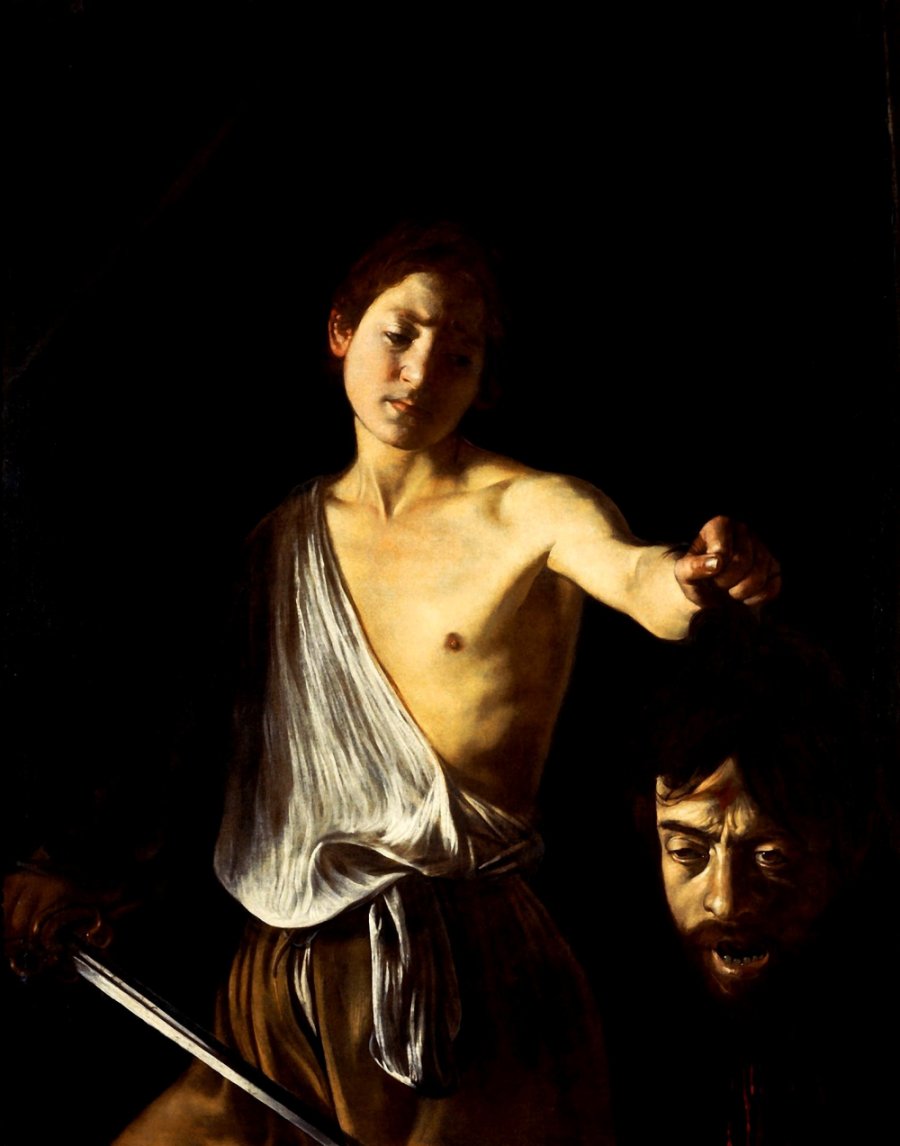
While David with the Head of Goliath seems to have been created shortly before Caravaggio’s own death for the pope’s art-hounding “Cardinal Nephew” Scipione Borghese, in a bid to earn a pardon. Caravaggio’s self-portrait as the dead man, and Latin inscription “humility kills pride” on the Israelite hero’s sword, suggest an attempt to effect through his creative virtuosity his own execution in effigy.

That would be, at any rate, the only execution Caravaggio ultimately had to endure. He died in the summer of 1610 under unclear — and inevitably suspicious — circumstances while attempting to return to Rome.

A few biographical books about Caravaggio …

… and some Caravaggio art books

* Ranuccio Tomassoni was the pimp and lover of a prostitute named Fillide whom Caravaggio had painted years before, and become enamored of. This Fillide was also Caravaggio’s model for Judith in the arresting painting of the Biblical heroine in mid-decapitation above.

** Possibly, if you like the love triangle angle, in a botched attempt to castrate his rival.

On this day..

1872: Yoarashi Okinu, geisha

On this date in 1872, geisha Yoarashi (“Night Storm”) Okinu was beheaded at Tokyo’s Kozukappara execution grounds after killing her lover to run away with a kabuki actor.

A notorious dokufu, so-called “poison-women” that captivated that country in the late 19th century, Night Storm (English Wikipedia entry | Japanese) was of humble origins but became a sought-after geisha in Edo.

Her celebrity affairs are treated here (reliability: unknown), but the reason she’s in this here blog is poisoning off the second-last of them with arsenic in order to get free to run off with kabuki actor Arashi Rikaku.

Rikaku himself was up to his eyeballs in this same plot, and was arrested — our source says, during a kabuki performance! — and initially condemned to death. Since Okinu was pregnant, however, her execution was put off pending childbirth; eventually, Rikaku’s sentence was moderated from capital punishment altogether.

Okinu’s head was cut off, and displayed in public for several days. Her lover served three years in prison, then rebuilt his kabuki career as Ichikawa Gonjuro.

* The date was the “20th day of the 2nd month of the fifth year of Meiji”, using Japan’s system of dating years from the start of the current emperor’s reign. Helpful in nailing down the date: Tokyo’s first daily newspaper published its first issue on the very next day.

On this day..

1811: Thomas White and John Newbolt Hepburn of the Vere Street Coterie

Two centuries ago today, two men were hanged at Newgate Prison for buggery as a result of one of 19th century England’s most notorious anti-gay police raids.

Brits whose sexual palate ran beyond the stiff upper lip braved the force of the law to frequent molly houses, private clubs catering to homosexuality, cross-dressing, and the like.

In 1810, bobbies* busted mollies at one such establishment at the White Swan in London’s Vere Street. A press which evidently preferred its nicknames as vanilla as its coition dubbed these apprehended sodomites the Vere Street Coterie.

According to Phoenix of Sodom, a lasciviously queer-loathing account of the Coterie’s misadventures and of “the vast geography of this moral blasting evil” infesting London,

The fatal house in question was furnished in a style most appropriate for the purposes it was intended. Four beds were provided in one room – another was fitted up for the ladies’ dressing-room, with a toilette, and every appendage of rouge, &c. &c. A third room was called the Chapel, where marriages took place, sometimes between a “female grenadier”, six feet high and a “petit maitre” not more than half the altitude of his beloved wife! There marriages were solemnized with all the mockery of “bridesmaids” and “bridesmen”; the nuptials were frequently consummated by two, three or four couples, in the same room, and in the sight of each other. The upper part of the house was appropriated to youths who were constantly in waiting for casual customers; who practised all the allurements that are found in a brothel, by the more natural description of prostitutes. Men of rank, and respectable situations in life, might be seen wallowing either in or on beds with wretches of the lowest description.

It seems the greater part of these quickly assumed feigned names, though not very appropriate to their calling in life: for instance, Kitty Cambric is a Coal Merchant; Miss Selina a Runner at a Police Office; Blackeyed Leonora, a Drummer; Pretty Harriet, a Butcher; Lady Godiva, a Waiter; the Duchess of Gloucester, a gentleman’s servant; Duchess of Devonshire, a Blacksmith; and Miss Sweet Lips, a Country Grocer. It is a generally received opinion, and a very natural one, that the prevalency of this passion has for its object effeminate delicate beings only: but this seems to be, by Cook’s account, a mistaken notion; and the reverse is so palpable in many instances, that Fanny Murry, Lucy Cooper, and Kitty Fisher, are now personified by an athletic bargeman, an Herculean Coal-heaver, and a deaf Tyre-Smith: the latter of these monsters has two sons, both very handsome young men, whom he boasts are full as depraved as himself. These are merely part of the common stock belonging to the house; but the visitors were more numerous and, if possible, more infamous, because more exalted in life.

This intriguing little window into proto- or pre-gay culture opens to us at some cost to its participants, six of whom were confined to the pillory where the dangerous mob (“chiefly consisting of women”) bombarded them

with tubs of blood, garbage, and ordure from their slaughter-houses, and with this ammunition, plentifully diversified with dead cats, turnips, potatoes, addled eggs, and other missiles … They walked perpetually round during their hour [the pillory swivelled on a fixed axis]; and although from the four wings of the machine they had some shelter, they were completely encrusted with filth … On their being taken down and replaced in the caravan, they lay flat in the vehicle; but the vengeance of the crowd still pursued them back to Newgate, and the caravan was so filled with mud and ordure as completely to cover them.

Worse was to come.

Not arrested on the initial bust or included on the pillory, a 16-year-old regimental drummer named Thomas White was snitched out by a fellow-drummer for having also been a White Swan regular … and in fact, “an universal favourite … very deep in the secrets of the fashionable part of the coterie.”

The stool pigeon’s motivation was the usual in such cases: said pigeon was also making a bit on the side from the Coterie, and he had a mind to avoid his own self being completely covered with mud and ordure and dead cats and turnips.

This James Mann’s report to his superior officer, and subsequent testimony to the magistrates, got White and his partner in vice Ensign John Hewbolt Hepburn hanged for sodomy.

Our correspondent in Phoenix of Sodom notes the presence among that “vast concourse of people” who witnessed their deaths several nobles whom he clearly takes to be a vanguard of that homosexual agenda, “the Duke of Cumberland, Lord Sefton, Lord Yarmouth, and several other noblemen.” No word on Miss Sweet Lips or Blackeyed Leonora.

Merrie Olde England would go on issuing hempen discharges to gay soldiers for years to come.

As a footnote, the Rev. John Church, who might be the earliest openly homosexual Christian minister in England, was rumored to have performed gay marriages at the club.

* Okay, technically, “bobbies” didn’t yet exist.

On this day..

1829: William Burke, eponymous body-snatcher

Wanted: corpses. Apply to Doctor Robert Knox, MD, FRSCEd, Professor of Medical Studies, Barclay’s Medical College, Surgeon’s Square, Edinburgh. Reference William Burke, hanged Jan. 28, 1829.

Robert Knox was a noted physician in his prime, in the early 1800s.

A surgeon, anatomist, and zoologist, Knox studied anatomy in London, then headed off to Africa in the army. Field surgery was a brutal business, and the poor anatomical knowledge at the time made it even more terrifying for those involved.

In 1821, Knox moved to France to work in the shadow of his heroes, Georges Cuvier and Étienne Geoffroy Saint-Hilaire; a year later, he was back in Edinburgh, making himself a career academic.

When his old professor came calling in 1826 with an opportunity to teach at Surgeon’s Square in Edinburgh, Knox jumped at the chance. As a partner to Barclay and curator of the school’s museum, Knox was well aware of the significant problem that faced the school: corpses were hard to come by.

And since the Royal College of Surgeons at Edinburgh certified the school as a prep course for entrance to University, coming up with bodies became a very important task.

If there’s one way to ruin your career, it’s to be caught paying a few pounds for fresh murder victims.

So it was for Knox, who gave out 7 pounds, 10 shillings for the body of an itinerant lodger who died in William Burke’s building in 1827.

This transaction led Burke to realize that such lodgers weren’t paying as much alive as dead. As a collector of bodies, Knox also had a strict no-questions-asked policy, and Burke and his partner William Hare exploited that to its fullest extent.

Almost a score of suspicious bodies later (and after the price had inflated to 10 pounds per), the pair was found out, given away as suspects by the lame and mentally disabled “Daft Jamie” Wilson, then caught when the late Marjory Campbell Docherty was found by a fellow tenant under one of Burke’s lodge’s beds.
Hare copped to a string of murders* and played stool pigeon in exchange for a lighter sentence.

Burke went to the gallows to “vehement cheering from every quarter, mingled with groans and hisses.” (London Times, Feb. 2, 1829)

“When the cheers had subsided, the wretched man was assailed with every epithet of contempt and abhorrence,” the Times continued. “Not a single indication of pity was observable among the vast crowd: on the contrary, every countenance wore the lviely aspect of a gala-day.”


William Burke’s hanging.

As a corpse himself, Burke made one final contribution to science’s insatiable desire for bodies: his cadaver went straight from the gallows to the practiced hands of one Dr Alexander Monro, who performed a complete lecture while dissecting the murderer’s corpse.

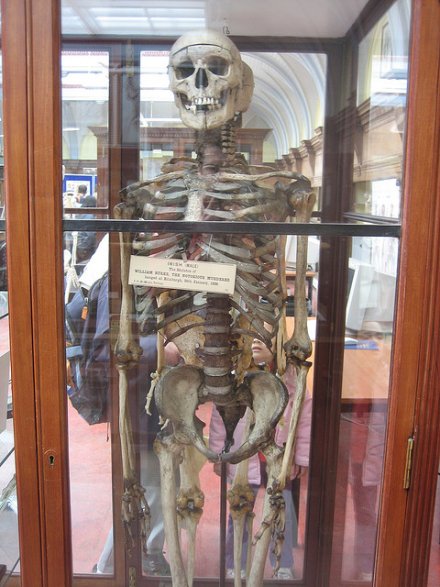
Lecture complete, the good doctor opened the doors to all comers to gaze upon the body, and tens of thousands of Scots obliged. Burke’s skeleton remains on exhibit at University of Edinburgh medical college, and, as was the style at the time, his skin was used to make a pocket book now on display at the Surgeons’ School there.


Hello there. William Burke’s skeleton, on display in Edinburgh. (cc) image from ejbaurdo

Knox, for his part, paid not with his neck but with his reputation.

Though never charged with a crime, the doctor was run out of the the lecturing business, first by subtle and not-so-subtle actions by the University, and eventually by the passage of the Anatomy Act of 1832.

He was also unable to obtain any surgical post after the incident and spent his later years writing academic books and papers, none of which have lasted like the doggerel that shadowed his steps.

Burke’s the butcher, Hare’s the thief,
Knox, the boy who buys the beef.

A few books about Burke and Hare

Anatomy of Anatomy

Robert Knox was operating under the Murder Act of 1751, which expressly forbade the burial of an executed murderer while permitting the malefactor’s dissection.

The Act had the dual effect of allowing the state to gibbet executed criminals (both hanging in chains and dissection were considered an added ignominy, beyond the punishment of the gallows), and of supplying the budding medical community with an immediate source of fresh bodies.

As courses in anatomy became more commonplace, though, the need for cadavers increased dramatically, and the business of selling bodies for science was born.

Typically, these sales manifested themselves in body-snatching — wherein “resurrectionists” illicitly exhumed a freshly buried corpse and conveyed it to some physician’s ready scalpel.

This grim trade in turn spawned a variety of security measures. The favored dead were defended by fences, watchtowers, and human lookouts. But nothing could eliminate the industry.

In particular, those with little money or no immediate relatives were unlikely to be buried in these gated graves; that left their remains ripe for the remaindering. As well, the increase in demand made so-called anatomy murder a possibility. Burke and Hare may have been notorious for the offense,** but they did not invent it.

As detailed by George Mac Gregor in The history of Burke and Hare and of the resurrectionist times: a fragment from the criminal annals of Scotland, the first known case of anatomy murder occurred in 1752, also in Edinburgh.

In that case, two nurses (Jean Waldie and Helen Torrence) on death watch bartered a decent price of two shillings to sell the body of an ill child to a local surgical college. His death was delayed, and the nurses smothered him, possibly through simple carelessness.

Shortly after the Murder Act, simple economics made pikers of Torrence and Waldie. In the 17th century, England executed hundreds of prisoners a year, each a potential dissection. As Dr D.R. Johnson writes in his Introductory Anatomy:

The dissections performed on hanged felons were public: indeed part of the punishment was the delivery from hangman to surgeons at the gallows following public execution, and later public exhibition of the open body itself. …

Agents representing surgeons would bargain with condemned prisoners not under sentence of dissection (remember this only happened for murder: hanging was in vogue for stealing a sheep or even a loaf): occasionally prisoners struck a bargain to pay expenses, to provide for a family or to buy the customary decent apparel for the hanging.

Supply was unreliable, however: riots at public hangings became common, partly because of the paltry nature of hanging events, partly from superstition. The body was often reclaimed by relatives and the unpopular anatomists stoned, defeated and out of pocket. Competition was often so fierce that a rival anatomy school carried off the body.

Dissection was unpopular and other medical uses were to be found for a recently hung body – the cure of scofula, goitre, wens, ulcers, bleeding tumours, cancers and withered limbs for example. To prevent riots and disorder the Sheriff of London took all bodies of hanged men, except those sentenced to dissection, into his own custody and handed them to the relatives for burial.

Human Trafficking

Hanoverian Britain sure did keep the gallows busy. But the pace of hangings had abated by the 19th century just as demand boomed. The math didn’t add up.

Anatomy schools (officially) dissected some 592 corpses in 1825; at the time of the Burke and Hare murders, only about 50 executions were carried out annually, and each college was guaranteed just one a year.

That meant a shortfall of close to 550 bodies. With limited supply and significant demand, surgical colleges and anatomical lecturers were willing to pay top dollar for new cadavers … and the anatomical murder business really got legs.

This was particularly true in Edinburgh, which boasted an internationally known medical college.

Burke and Hare? Just call them entrepreneurs.

And while the execution of Burke was met with applause from the community, in London, another group was already hard at work both body snatching and murdering its way into the classroom.

The London Burkers were caught in 1831 and convicted of murdering a 14-year-old whose cadaver they sold to St Bartholemew’s Hospital for 9 guineas.† The killers, Thomas Williams and John Bishop, had offed several others prior to the lad in question, making about the same price on each body.‡ In the grand, Burkean tradition of anatomical murderers, these miscreants were also dissected after their execution.§

Williams and Bishop were just two of a group of resurrectionists known collectively as the London Burkers, who claimed to have stolen upwards of 1,000 bodies from nearby cemeteries. That made the Burkers the largest known exploiters of the anatomical trade.

Over the decades after the Murder Act, though, resurrectionists were walking a dangerous line in their communities.

Reverence for the dead sparked community outrage when graves were found empty or disturbed, and it was often the anatomists themselves who felt the wrath of crowds.§§ In Glasgow in 1803, surgeons were threatened by an unruly mob and were forced to seek police protection; in 1813, an empty grave caused a similar furor. Punishments moved from fines to jail time as the surging demand made body-snatching an ever more lucrative trade.

A few books about body-snatching

By the time of the Burkers, anatomists were generally presumed to be body thieves in some capacity, a hostile sentiment graphically underscored during the Aberdeen riots of 1831. When a dog unearthed what looked like a human bone behind the Aberdeen surgical college, a mob coalesced and stormed the lecture hall.

The lecturer (“Dr Moir” — little else is known about the man) fled in terror as the hall was burned to the ground. Soldiers and police clashed with the crowd, which was thought to be over 10,000 strong. Hours later, the riot subsided, but Aberdeen was no longer a friendly place for a prospective medical talent.

And where Burke and Hare were still not quite sufficient to convince the House of Lords to take up a measure providing anatomists with alternatives for corpse acquisition, the Burkers and the Aberdeen riots apparently were.

The underground economy of resurrectionists was supplanted by the Anatomy Act of 1832, which allowed individuals to donate themselves or their unwilled kin to science for a pittance of compensation.

Anatomy murder is, of course, still the subject of horror movies. Like this one, or for the more classically inclined, this 1945 Boris Karloff/Bela Lugosi vehicle adapted from a Robert Louis Stevenson story inspired by Burke and Hare:

* The murders included at least one husband/wife pair, a mother and, later, her (adult) daughter, and a grandmother and her young grandson. They are also known as the West Port Murders.

** Burke entered the English language as a verb meaning … well, pretty much exactly what Burke got up to.

We like the poetic explanation of this 19th century popular crime reader:

Dr. Murray, in the new English Dictionary, gives the following definition of the verb to ‘burke.’ ‘To murder in the same manner or for the same purpose as Burke did: to kill secretly by suffocation or strangulation, or for the purpose of selling the victim’s body for dissection,’ and the familiar lines are quoted from the Ingoldsby Legends: —

But when beat on his knees, that confounded De Guise
Just whipped out the “fogle” that caused all the breeze,
Pulled it tight round his neck until backwards it jerked him,
And the rest of the rascals jumped on him and burked him.

† 9 pounds, 9 shillings; by the time of the transactions, the guinea was no longer technically in use, but the term had stuck at the 21-shilling mark.

‡ Over the course of their 6 active months, the pair went from asking 8 guineas to asking 12 guineas; apparently 9 was the negotiated price with St Bartholemew’s.

§ The Burkers are the subject of the song “The Resurrectionist” by the Pet Shop Boys. (Lyrics)

§§ Edinburgh also had trouble as far back as 1742, when several surgeons’ homes were attacked by locals; a local beadle suspected of the crimes also had his home, dubbed resurrectionist hall, burned during the mob incident.

On this day..

1256: Marie of Brabant, on suspicion of infidelity

On this date in 1256, Louis II, Duke of Bavaria, had his wife Marie of Brabant beheaded at Donauworth for adultery.

Louis II depicted with the first two of his three wives: Marie, and the more fortunate Anna of Glogau.

This 26-year-old uncle of the doomed Conradin was kept away from his spouse for many months on state affairs.

At some point, he returned furiously convinced of his wife’s infidelity.

One representative version of the legend has it that

[Lewis] held his Court in Heidelberg, and by him stood ever his dearest friend, Henry, Count of Leiningen, and to him one day the anxious wife sent a letter, beseeching he would use his influence to quicken her husband’s return. Another missive was dispatched at the same time to Duke Lewis … The old mistake was made, Duke Lewis received the letter destined for his friend, wherein the artless Duchess had assured Henry of Leiningen that, if he accompanied her lord in his return, her pleasure in welcoming him would be great.

Etcetera.

That Marie really did exist and really was beheaded on her husband’s authority for adultery appears to be about the extent of the certain information available to us.

This poignant scenario became embroidered into popular legend (and is supposed to have inspired the tale of one of the classic medieval faithful-accused-wife tales: that of Genevieve of Brabant).

The accusation evidently appeared quite doubtful in real life, since her husband and executioner Louis subsequently founded the Cistercian Furstenfeld Abbey in penitence.

She is not to be confused with Marie de Brabant, Queen of France later in the 13th century and a suspect in the poisoning death of the French heir … an affair that cost chamberlain Pierre de la Brosse his life. The words Dante wrote of that later Marie of Brabant would have suited our day’s heroine, too.

may the Lady of Brabant
while she’s still in this world, watch
her ways—or end among a sadder flock

On this day..

1611: Three accomplices of Elizabeth Báthory, the Countess of Blood

Four hundred years ago today, on Jan. 7 1611, three servants of the legendary “Countess of Blood” Elizabeth Bathory (Báthory Erzsébet, in the Hungarian) were tried, convicted, and immediately put to death for the noblewoman’s stupendous career of homicide.

This date’s entry is occasioned by the deaths of three subalterns — manservant Janos Ujvary, beheaded; and female attendants Ilona Jo and Dorottya Szentes, fingers ripped off and burned — but the headline attraction is their employer, who was never tried or condemned.

Not, at least, juridically. Posterity’s condemnation of this classic vampire inspiration has been little short of … voluptuous.


A 1971 film based on Elizabeth Bathory’s exploits. Horror star Ingrid Pitt later reprised her “role” with guest vocals on a Cradle of Filth concept album devoted to the Countess, Cruelty and the Beast.

Bathory was rarefied Hungarian nobility, the niece of the King of Poland, which is also the biography of countless aristocrats you’ve never heard of.

The world remembers Elizabeth Bathory because she exploited her rank to butcher hundreds of peasant girls, allegedly to bathe in their rejuvenating blood.

On one occasion, a lady’s-maid saw something wrong in [Elizabeth Bathory’s] head-dress, and as a recompence for observing it, received such a severe box on the ears that the blood gushed from her nose, and spirted on to her mistress’s face. When the blood drops were washed off her face, her skin appeared much more beautiful — whiter and more transparent on the spots where the blood had been.

Elizabeth formed the resolution to bathe her face and her whole body in human blood so as to enhance her beauty.


McFarlane Toys figurine of Erzsebet (Elizabeth) Bathory from its grotesque “Faces of Madness” series.

These scrub-ups are what the Countess of Blood is best remembered for, but however striking the visual, it’s an atrocity that actually doesn’t turn up in the trial records.

But she could hardly complain of the embroidery, having given her interlocutors so much material.

Elizabeth Bathory is supposed to be responsible for over six hundred deaths, starting while her husband was away on campaign, and then carrying on into a wholesale operation after he died. When she and her servants were finally busted at Csejte Castle the end of 1610, their captors found a dead girl, a dying girl, and several others imprisoned and awaiting that fate.


Elizabeth Bathory, a sexually charged 1893 painting by Hungarian impressionist Istvan Csok depicting one of the countess’s victims being drenched in icy water for death by exposure.

So although the confessions the servants made this date to seal their own fates were undoubtedly torture-adduced, the documentary record turns out to be amazingly strong for such a fantastical spree. Hungarian King Matthias II convened a tribunal that examined 200 to 300 witnesses.

One can postulate that the woman ran afoul of a patriarchal culture affronted by her exercise of power or that she became a parable for the “unnatural” lust of a middle-aged woman … but so far as we are left to understand, Erzsebet Bathory really did lure young girls to her castle, and then inflict (pdf) a Nazi doctors’ litany of sadism on them … like jabbing them with needles to drain out their blood. She even kept a log of the victims in her own hand.

So, locals disappearing into the creepy castle, never to be seen again, or possibly to turn up pallid and dead. (Disposing of all those corpses became a logistical problem for the creepy castle.) No surprise to find it associated with the vampire legend.*

And no surprise that the tale became magnified, twisted, and reconfigured by popular culture.

In 1817, as accounts of the testimonies about the alleged murders and sadistic tortures were published for the first time, national and international headlines sensationalized the already misconceived story. From that on [sic], the literary countess took on a life of her own: the Grimm brothers wrote a short story about her, the romantic German writer, Johann Ludwig Tieck (1774 – 1853), cast her as a Gothic femme fatale, Swanhilda, in his short story Wake Not the Dead. It is alleged that Sheridan le Fanu shaped his female vampire Carmilla on Elizabeth Bathory. If we can believe some etymological explanation the compound English word blood-bath is of mid-nineteenth century origin possibly connected to the bloody countess’ rising popularity in England.

-László Kürti, “The Symbolic Construction of the Monstrous — The Elizabeth Bathory Story,” Croatian Journal Of Ethnology and Folklore Research, Jan. 2009

A few books about Erzsebet Bathory

To say nothing of the death porn (link not safe for work).

The noblewoman never faced an executioner herself, owing to her rank; she was shut up in the castle.

* As it turns out, a Bathory ancestor actually fought with the “original Dracula” Vlad the Impaler in the 15th century.

On this day..