1942: Nikola Vaptsarov, Bulgarian poet

Poet Nikola Vaptsarov was shot on this date in 1942 for organizing anti-fascist resistance in Axis Bulgaria.

A communist machinist — the Varna naval academy where he learned engineering is now named for him* — Vaptsarov — Vaptsarov was a proper proletarian poet who only ever versified on the side.

Nevertheless, he was well-known in his time and remains so to this day in Bulgaria, particularly given his political bona fides and martyrdom thereto, which bear ready comparison to Spanish Civil War martyr Frederico Garcia Lorca.

Spain

What were you to me?
Nothing.
A land forgotten and remote,
a land of knights and high plateaux.
What were you to me?
The hearth
where blazed a strange and cruel love,
a wild intoxicant
of blood,
of glinting blades
and serenades,
of passion,
jealousy
and psalms.

Now you are my destiny,
now I live and share your fate.
In your struggle to be free
wholly I participate.

Now I’m stirred, now I rejoice
at all your victories in the fight.
In your youth and strength I trust
and my own strength with yours unite.

Crouching in machine-gun nests,
I fight on to victory,
down among Toledo’s streets,
on the outskirts of Madrid.

A worker in a cotton shirt
torn by bullets near me lies,
Ceaselessly the warm blood streams
from the cap pulled o’er his eyes.

It is my blood that I feel humming
through my veins, as suddenly
in him I recognize the friend
I once knew in a factory

where we shoveled coal together,
stoking the same furnace fire,
and found there was no barrier
to check our young and bold desire.

Sleep, my comrade, sleep in peace!
Though now the blood the blood-red flag be furled,
your blood into mine will pass
and stir the peoples of the world.

The blood you gave, already flows
through village, factory, town and state,
arouses, urges and inspires
all working men to demonstrate.

That workers never will lose heart,
but will advance relentlessly,
determined both to work and fight
and shed their blood that men be free.

Today your blood builds barricades,
infuses courage in our hearts,
and with a reckless joy proclaims:
‘Madrid is ours!
Madrid is ours!’

The world is ours! Friend, have no fear!
The whole expanding universe
its ours!
Beneath the southern sky
sleep
and have faith,
have faith in us!

-Vaptsarov

Vaptsarov published his lone book, Motor Songs, in 1940, which was the same year he was interned demonstrating against Bulgaria’s tenuous neutrality and in favor of alliance with the USSR. A few months after his release, the Third Reich forced Bulgaria into the Axis. A member of the Central Military Committee of the Bulgarian Communist Party, Vaptsarov was arrested for doing just the sort of things that such a committee would be doing in 1942.

A Selected Poems volume of his was published posthumously; it can be enjoyed free here.** Perhaps the most moving entry is the very last one, a short composition dedicated to his wife just hours before his execution.

On Parting

To my wife

Sometimes I’ll come when you’re asleep,
An unexpected visitor.
Don’t leave me outside in the street,
Don’t bar the door!

I’ll enter quietly, softly sit
And gaze upon you in the dark.
Then, when my eyes have gazed their fill,
I’ll kiss you and depart.

The fight is hard and pitiless.
The fight is epic, as they say.
I fell. Another takes my place —
Why single out a name?

After the firing squad — the worms.
Thus does the simple logic go.
But in the storm we’ll be with you,
My people, for we loved you so.

2 p.m. — 23.VII.1942

* You’ll also find the man’s tribute on the frigid slopes of Vaptsarov Peak on the Antarctic Livingston Island. More accessibly, there are museums to him in the Bulgarian capital of Sofia as well as Vaptsarov’s hometown of Bansko.

** Some other sites with Vaptsarov poems: here and here.

On this day..

1661: Antonius Hambroek, defying Koxinga

Missionary Antonius Hambroek was put to death on this date in 1661 as the warlord Koxinga wrested control of Formosa (Taiwan) from the Dutch.

In the 1620s, the running Dutch-Spanish war as projected into both countries’ colonial extrusions had resulted in the two dividing that South China island: the Dutch in the south, based at Fort Zeelandia, and Spain in the north. In 1641 the Dutch conquered Spanish Formosa to establish themselves as the apex predators on a rough and lawless island.


Fort Zeelandia.

But that’s before they ran into Koxinga.

Simultaneous with the Dutch advance on Formosa, China’s Ming dynasty was in the process of collapsing. From the 1640s, civil wars between the advancing Manchus (eventually victorious as the incoming Qing dynasty) and the remnants of the Ming would tear at the mainland.

Koxinga was the last great Ming commander. He’d been born on a Nagasaki beach to a Japanese mother. His family ran a commercial concern stretching across the South China Sea as far as Vietnam and the Philippines; its dubious legality confers the romantic sobriquet “pirate” upon Koxinga but think corporate raider here. “Some people call him a pirate, but he was a businessman,” said present-day Taiwan historian Chu Cheng-yi.

And in both commerce and war, Koxinga could flex.

The author of this book about Koxinga’s victory over Dutch Formosa describes his book in this video.

Paradoxically the Ming’s collapse launched Koxinga; his very name as history knows it derives from a title (“Lord of the Imperial Surname”) conferred by the executed Longwu Emperor in gratitude for staying loyal when even Koxinga’s own dad had gone over to the Qing. In one cinematic moment, with the Ming looking toast, Koxinga torched the scholarly robes he had earned studying for a respectable court career and swore he would don nothing but armor until he’d expelled the Manchus from China.

This “Badass of the Week” post chronicles his scintillating military career; in the twilight of the Ming, Koxinga’s victories gave the foundering dynasty its last legitimate cause for hope and in the course of the 1650s his sword-arm established a Qing-defying state in the southerly province of Fujian. From this base in 1659 he launched a proposed history-altering attack on Nanjing that only narrowly failed.

Win or lose on terra firma, the pirate was nails on the waves. “Never before nor since was a more powerful and mighty fleet seen in the waters than that of Koxinga, numbering more than 3,000 junks,” Jesuit missionary Vittorio Ricci wrote of the armada he had once assembled to attack Xiamen. (Source) “The sight of them inspired one with awe. This squadron did not include the various fleets he had, scattered along neighboring coasts.”

In his reduced circumstances post-Nanjing, Koxinga managed “only” 400 ships to launch from Fujian with 25,000 souls … to arrive at Formosa and set up shop there. “Hitherto this island had always belonged to China, and the Dutch had doubtless been permitted to live there, seeing that the Chinese did not require it for themselves,” he remarked. “But requiring it now, it was only fair that Dutch strangers, who came from far regions, should give way to the masters of the island.”

To make the argument persuasive, Koxinga delivered his ultimatum via this post’s principle, Antonius Hambroek (English Wikipedia entry | Dutch), a missionary whom Koxinga cautioned not to return with a displeasing answer at the risk of his life.

On May 25, 1661, Koxinga sent Hambroek to Fort Zeelandia with one of the Chinese leader’s letters demanding surrender. Hambroek had to leave his wife and children behind as hostages to assure his return. When Coyett refused to surrender, Hambroek was urged to stay at the fort as he and his family were bound to be killed because of the failure of his mission. The emotional pull to remain was intensified by the discovery that two of his daughters from whom the family had been separated during the chaos of the invasion were among the refugees in the fort. But Hambroek decided his duty was with his wife and other children. The two daughters, says, the fort daybook, “hung about his neck, overwhelmed with grief and tears to see their father ready to go where he knew he must be sacrificed by the merciless enemy.” The fate of Hambroek is recorded by Caeuw, the commander of the relief fleet. Two native boys got into the fort in October and said they had seen Koxinga fly into a rage the previous month and order the decapitation of all the Dutch male prisoners, Hambroek among them. The wives were given to Koxinga’s captains as concubines and the small children were sent to China. Koxinga himself took one of Hambroek’s teenage daughters — “a very sweet and pleasing maiden” according to Caeuw — as one of his concubines. In August there was also a killing of captive Dutch from the hinterland and Fort Provintia [a lesser outpost opposite Fort Zeelandia -ed.]; Koxinga believed they had been inciting the aborigines against the Chinese. The Dutch reports say five hundred men were either beheaded or “killed in a more barbarous manner.” Many women and children were killed too, but others were “preserved for the use of the commanders, and then sold to the common soldiers. Happy was she that fell to the lot of an unmarried man, being thereby freed from vexations by the Chinese women, who are very jealous of their husbands,” says the fort’s daily journal.

The results of these incidents are still evident in some parts of southern Taiwan. There are areas where the people have decidedly European features and even occasionally the red or auburn hair common among seventeenth century Dutch.

-Jonathan Manthorpe, Forbidden Nation: A History of Taiwan

Koxinga’s siege delivered him Fort Zeelandia by February of the following year.


Antonius Hambroek taking leave of his daughters, by Jan Willem Pieneman (1810)

The fate of Hambroek, Zeelandia, the women, and all the rest make for literary pathos in Joannes Nomsz’s Anthonius Hambroek (1775). Koxinga lives on as an iconic hero celebrated in China and Taiwan and Japan, which is a complicated trick indeed. (A refugee prince from the ancien regime setting up a holdout state on Taiwan made him an obvious propaganda reference for Chiang Kai-shek.) For all his legend, his life remains a bit of a what-might-have-been: a few months after taking Fort Zeelandia, Koxinga died suddenly, perhaps of malaria, still well shy of his fortieth year. His son Zheng Jing, whom the violent-tempered Koxinga had nearly executed in his last hours, maintained an independent Formosa-Fujian kingdom that held out against the Qing until 1683.


Statue of Koxinga at the present-day remains of Fort Zeelandia.

On this day..

1683: Two lynched during the Ottoman siege of Vienna

Our “execution” this date is of the mob justice variety — said mob being panicked Viennese bracing for Ottoman investiture.

As is generally the case one has many ways to read this particular lynching; at least one victim has even been situated as a trans martyr. John Stoye in his The Siege of Vienna: The Last Great Trial between Cross & Crescent gives us the thread of causation, and it turns out that these two unfortunates owed their death to Vienna’s urban planning.

The military architecture of this period was designed to keep the besieger at a distance as long as possible. The ground in front of the main defences would be cleared of buildings, and even levelled — this was the ‘glacis’; along the outer rim or ‘counterscarp’ of the moat a well-protected walk, the covered way, was constructed — usually of timber spars and palisades — from which detachments of the garrison could command with their fire the open ground in front of them; and the covered way had to be laid out so that they could command it from a number of angles … Attackers on the glacis, those who reached the counterscarp, those even who got as far as the main wall, were all exposed to fire from artillery and marksmen on the bastions …

Clamped within the walls but expanding in numbers, the citizens of Vienna had tried to build upwards. They added an extra storey to some 400 out of 1,100 houses in little more than a century. But inevitably the suburbs also grew, spreading out into the countryside — and in towards the city. By 1680 there were large settlements in Leopoldstadt on the Prater island, by the right bank of the Wien on the east, round the hamlets of Wieden and St Ulrich south and south-west, and on the western side. Particularly here the new building approached very close to the fortifications. The government had over and over again ordered the demolition of dwellings within a given distance of the walls, but to little effect. If a maximum estimate of Vienna’s total population brings it to nearly 100,000 people, a sizeable proportion must have lived in these suburbs, which would in due course give accommodation and protection to a besieging army.

The foremost Ottoman raiders now appeared, and in the distance the smoke of burning villages in the neighbourhood rose skywards. [Vienna military governor Count Ernst Rudiger von] Starhemberg did not dare delay in performing one of his most disagreeable duties: the speedy and forcible clearing of the glacis. Since earlier demolition orders had not been obeyed, he began — on 13 July — to burn down everything in the area outside the counterscarp which would obviously hamper the garrison. Most of all he wanted to clear the ground west of the city, where suburbs came closest to the moat. More smoke rose skywards. The sparks flew. They flew over the walls as far as the roof of the Schotten monastery by the Schottengate, where a fire broke out in the afternoon of Wednesday, the 14th; and it almost altered the course of history. The wind blew sparks against the neighbouring buildings, an inn, and from the inn to a wall of the Arsenal, where supplies of every kind were stored, including 1,800 barrels of powder. Nearby, other powder magazines adjoined the New-gate. If the defence-works here were seriously damaged by explosion, or the stores lost, resistance to the Turks was hardly thinkable. The flames moved along a wooden gallery into the Arsenal. Townsmen and soldiers gathered, there was a muddle about keys which could not be found, but soldiers broke through a door and cleared the points of greatest danger. A hysterical mob, looking on, smelt treason at once and lynched two suspects, a poor lunatic and a boy wearing woman’s clothes. It also destroyed the baggage which an inoffensive mining official from Hungary, then in Vienna, was trying to get out of a second inn near the Arsenal; and it panicked at the sight of a flag flying unaccountably from a roof close to the fire, fearing some kind of a signal to the enemy. More effectively, the wind then veered. Flames swept towards and into aristocratic properties on the other side, away from the Arsenal, and proceeded to burn out the Auersperg palace where the ruins went on smouldering for days. The crisis had passed before the arrival of the Turks; but the danger of yet more fires, set off by Turkish bombs or by traitors and spies inside the walls, was to be a constant nightmare in Vienna later on.

Despite the nightmare, Vienna — scorched glacis, crazed mobs, and all — withstood the siege. It was indeed the siege’s Turkish military commander who was executed for his command failure before the year was out, after failing to complete the conquest.

On this day..

1758: Not Florence Hensey, Seven Years’ War spy

The French spy Florence Hensey was due to die at Tyburn on this date in 1758. As it happened, the only violence done there was to the spectators.

A well-traveled Irish Catholic, Hensey had a prosperous London medical practice when he made an offer to a former colleague in France to share intelligence on war preparations at the outset of the England-vs.-France Seven Years’ War (1756-1763).

Upon being accepted into the ranks of salaried moles, Hensey set his industry to forming acquaintances at establishments where parliamentarians and their clerks met and gossiped, transmitting the resulting nuggets to France by way of Germany in lemon juice ink concealed within letters bearing nothing but everyday pleasantries. Eventually clerks suspicious at the volume of such superficially trivial exchanges being imposed upon the international post got nosy and found out the real story.

Hensey’s treachery was obvious, ongoing, and in the midst of wartime. He should have died for it, but on that very morning he was spared that miserable fate. The Newgate calendar professes “much surprise at the extension of royal mercy” considering numerous other precedents to the contrary.

De la Motte, the particulars of whose case we shall hereafter give, was “hanged, drawn, and quartered,” for the same kind of offence which Hensey committed; and in still more recent times, numbers have suffered death for similar treason; and yet we have to observe, without finding any especial reason for it, that Doctor Hensey was pardoned. If granted from political motives, it must have been in fear of Spain; an unworthy impulse of the ministers of a far greater and more powerful nation.

Indeed, the Spanish connection appears to be the best explanation for Hensey’s unexpected reprieve: he had a brother in the retinue of a Spanish ambassador who was able to exercise his empire’s diplomatic channels in the doctor’s service. (Spain was on the sidelines at this moment, and Britain keen to keep her there; the Spanish finally joined the war on France’s side very late in the game, in 1762.)

This gambit, however, came as quite a nasty surprise to the ample and bloodthirsty crowd that had turned up at Tyburn.

The awful procession to Tyburn, intended to impress the multitude with sentiments of reverence for the laws of their country, produced a very contrary effect; and the eager and detestable curiosity of the populace, to witness executions, became a source of considerable emolument to certain miscreants, who were in the habit of erecting scaffolds for spectators; many of these scaffolds were substantial wooden buildings, and erected at every point from whence a glimpse of the execution could be obtained; the prices for seats varied according to the turpitude or quality of the criminal: — Dr. Hensey was to have been executed for High Treason in 1758, the prices of seats for that exhibition amounted to 2s. and 2s. 6d.; but, in the midst of general expectation, the Doctor was most provokingly reprieved.

As the mob descended from their stations with unwilling steps, it occurred to them, that, as they had been deprived of the intended entertainment, the proprietors of the seats ought to return the admission-money; which they demanded in terms vociferous, and with blows offensive, and in short, exercised their happy talent for rioting with unbounded success. On this occasion a vast number of these erections were destroyed.

Hensey spent a couple more years in Newgate, then was released into obscurity; presumably he left the realm to his brother’s custody.

On this day..

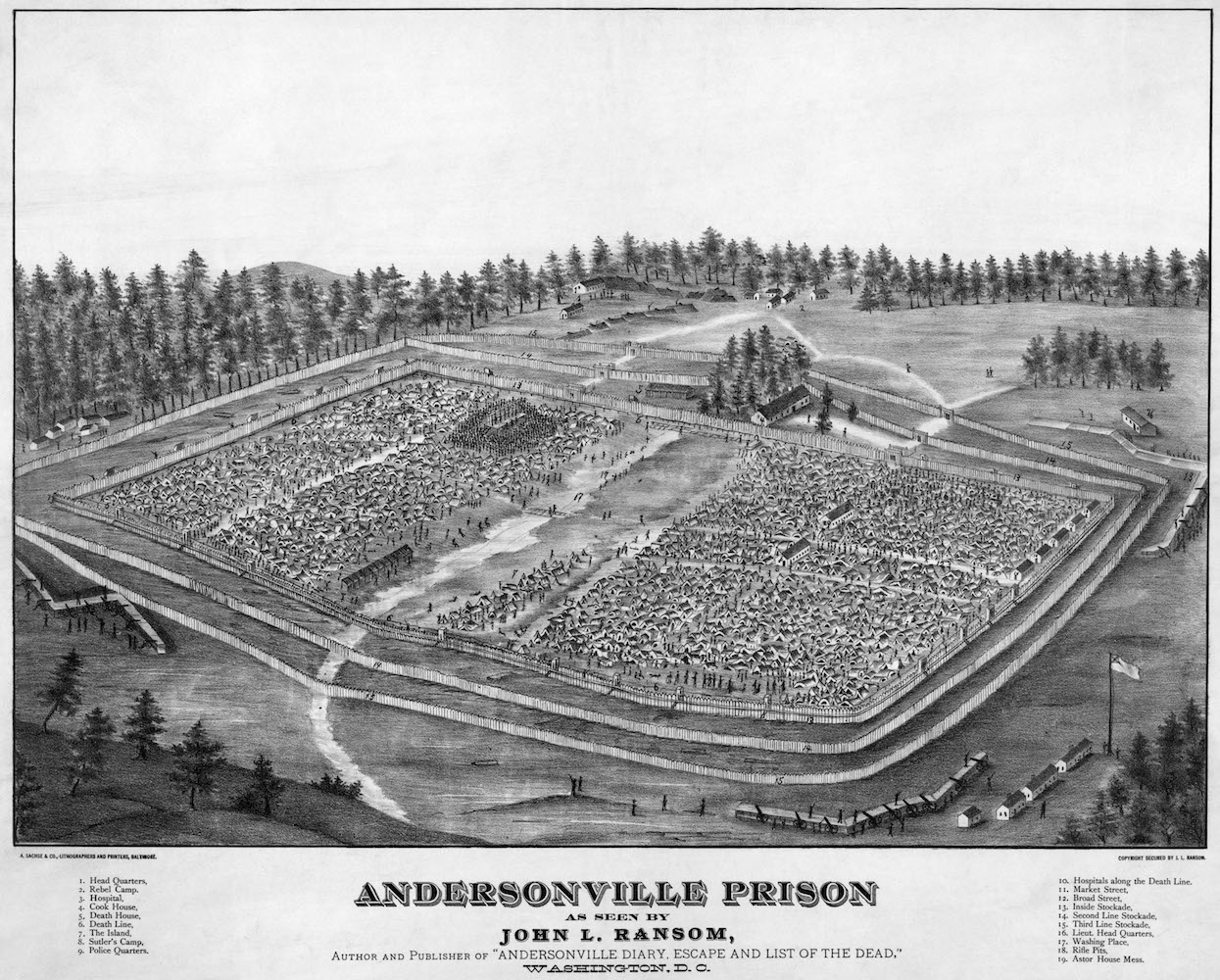
1864: The Andersonville Raiders

It’s not hard to understand why the Andersonville Raiders turned criminal. But on this day in 1864, the group was decapitated when six of its leaders were hanged in a quasi-legal action at the most inhospitable prisoner of war camp in the Confederacy.*

Andersonville Prison was opened in February 1864, 26.5 Georgian acres (about 0.1 square kilometers, or about the size of a square 4 city blocks on a side) of tightly-packed tents with a ditch of water flowing through its center. Its design population was 10-15,000 prisoners; its true population at one point was almost 30,000.** Some 45,000 Union soldiers went in, passing first the outer stockade, then the so-called “dead line” that demarcated the line outside of which they could be shot summarily, and finally into a mass of malnourished, often sickly humanity. Of these, 13,000 never emerged.

The Confederacy, you may recall, was not the war’s winner. As an aspiring nation, the CSA borrowed heavily to fund its arms, then found itself strapped for basic supplies as the war dragged on. By 1863 the nation was already economically depressed, and when a CSA-USA prisoner exchange agreement broke down, the Confederacy found itself with a lot of Union soldiers to house and nowhere to put them. Enter Andersonville: far enough from the North to be “safe”, easily defensible, and in the heart of slave labor to build it. All the Confederacy needed to build some basic housing was wood, which should be … oh wait … war update!…the Union controlled lumber supplies. Guess there won’t be housing.

Prisoners instead got lumped in with their brigade, and (at least initially) basic materials to make some sort of shelter.† New arrivals often showed up without being thoroughly checked over, so they might come in with food and supplies that weren’t already available to other internees.‡ Very quickly, the grounds were littered with Union POWs from around the country, people with vastly different backgrounds and goods. As the camp’s population breached 10,000 and then 20,000,§ there were, of course, inmates with designs on better living.

It’s not hard to see where this is going.

Sometime around May 1864, dozens of them assembled into a loose affiliation. The Raiders were headed by about a half dozen men: Charles Curtis, Patrick Delaney, John Sarsfield, William Collins (“Moseby”), a guy known only as “A. Munn”, and W.R. Rickson (or possibly Terry Sullivan; there’s an unusual disparity in diary accounts on the person’s name, but first-hand diary entries from the moment prefer Rickson) were considered the principal offenders. Each headed a small band of thieves who would trick new entrants, burgle tents, or use violence or threats of violence to amass “wealth” and keep themselves well-fed, well-clothed, and, most importantly to them in this hostile place, alive.

The Raiders had some huge advantages when they committed these crimes. Thanks to their amalgamated resources, they had good odds of being better armed and more fit than their victims — unless those victims were green, in which case they just knew the place better. The thieves started out as midnight raiders who turned tail at the first sign of genuine resistance unless they thought they could readily overpower the victim. By mid-June they were brazen, according to John Ransom: “Raiders … do as they please, kill, plunder and steal in broad day light, with no one to molest them.”

The victims were soldiers who, even if they weren’t killed, were left without resources in a deadly environment. Even the robberies and beatings were, in many cases, a prolonged form of murder, and Union inmates knew it. Indeed, Collins was thought by most to have never directly assaulted anyone, but he was known to steal blankets from the ill.

It’s unclear what the full Raider population was (estimates range from 100 to 500, but most people settle on the 100-200 range). What we can say definitively is that it was large enough to be a problem. Late in June of that year, a group called “the regulators” began taking police-like action against the perpetrators. Inmates brought their complaints to the group, which sought out and punished — usually through head shaving or other non-destructive means — those they found responsible.

On June 29, that problem started getting a real solution when the Raiders assaulted and robbed a prisoner now known only as Dowd. Dowd complained to the guards, and Andersonville’s overseer, Captain Henry Wirz, officially endorsed the Regulators as a police force/tribunal to maintain order. But first he announced an end to inmate rations until the Raiders were given up. (What a guy!)

The Regulators, headed by a man called “Lumber” (or maybe “Limber”) Jim, quickly had 80-100 inmates to deal with. Jury trials were implemented in the spirit of (but without most of the protections of) common law, and most punishments ranged from setting in the stocks to running the gauntlet.


Detail of a panorama sketch of Andersonville (click to see it) makes space for a certain well-attended sextuple hanging.

The ringleaders were also among this bunch. They were assembled on July 11 and executed at a hastily-erected gallows on the north end of camp. As far as the POWs were concerned, the ultimate crime of the Raiders was a violation of the soldier code of death before dishonor. Their bodies were buried separately from other inmates, and the US makes a point of placing no memorial flags at their graves.

To be clear, the Andersonville Raiders were, for most inmates, not the primary problem but an obviously controllable one. Remember that 30% of the interned died, and for the most part those deaths were borne of bad sanitation, hunger, and disease. The removal of the Raiders was a morale boost at best, as Andersonville was still a pee-pee soaked heckhole in which another 10,000 soldiers would die before liberation in May 1865, most of them before the summer’s end.

* It was also known as Camp Sumter, named after the county it resided in.

** The population density at peak was 330,000 people per square kilometer. For comparison, the world’s densest city is Manila, at about 71,000 people per square kilometer.

† It turns out the term “shebang” wasn’t widely-used camp lingo. Drawings and photos of the camp illustrate the variety of dwellings: open sleeping, simple V-tents, structured tents, lean-tos, huts, and shacks were all scattered about the grounds.

‡ They also came with new diseases.

§ The original camp was actually only 16.5 acres, and the population ballooned to 20,000 in early June and 33,000 in August of that year. Ransom notes that the stockade was “enlarged” on July 6. Fall transfers dropped the number to 1,500 and it bumped back up to 5,000 until war’s end. Sanitation issues persisted throughout.

On this day..

1941: George Johnson Armstrong, under the Treachery Act

Marine engineer George Johnson Armstrong on this date in 1941 was hanged at Wandsworth Prison … attaining an unenviable distinction as the first of five Britons executed under the Treachery Act of 1940.

One of the very first laws enacted by the incoming wartime government of Winston Churchill as the Wehrmacht overran France, the Treachery Act anticipated two potential difficulties in punishing various forms of aid that folk might thereafter attempt to extend to the Third Reich.

We’ll let all about those difficulties:

if we rely upon the Treason Act — the main Act, as I have said, is an Act of great antiquity — and other Acts which establish special procedure and special formalities, we shall have a much more complicated and cumbrous procedure than may, in existing circumstances, be justified.

There is also this further point. The law of treason in this country applies, of course, to every British subject wherever that British subject is living, because every British subject owes allegiance to the King. The law of treason also applies to aliens in so far as they owe to the King local allegiance — that is to say, as long as they are resident in this country and enjoying the protection of its laws. It is a very doubtful question indeed whether under the existing law of treason you could proceed against an alien who has come here suddenly, surreptitiously by air or otherwise, for the purposes of wreaking clandestine destruction or doing other acts against the safety of the real. In as much as treason is a crime committed by someone who owes allegiance, it might be well argued that such a person does not owe allegiance to the British Crown.

This act was handy indeed against enemy spies like Josef Jakobs, but it was also employed against five British citizens during and immediately following the war. (We’ve previously met a couple of them in these very pages: Theodore Schurch and Duncan Scott-Ford.) Johnson’s particular offense was to communicate an offer to a German consulate in the United States to help keep the then-still-neutral U.S. out of the war.

A full list of those executed for wartime treachery can be found at CapitalPunishmehtUK.org.

On this day..

1941: 3,500 Jews at the Khotyn Fortress … but not Adolph Sternschuss

(Thanks to Meaghan Good of the Charley Project for the guest post. -ed.)

On July 4, 1941, a thirteen-year-old Jewish boy named Ephraim Sternschuss began his diary in the Nazi-occupied Zloczow, Poland, with these lines:

Mother knows nothing about Father’s murder. I won’t be the one to tell. But I have to express what I’m feeling … I’ll write down all the details so when I’m old I’ll remember my youth and this World War, even though I’m not sure I’ll live through it.

I’m writing while lying on my back. I can’t move my legs. Mother says I’m in shock. Maybe I am. Maybe I’m so anxious because I can’t tell her about Father, who was drafted yesterday into forced labor and Mother still believes he’s alive.

The eastern Polish town of Zloczow had been annexed by the Soviet Union after the partition of Poland with the Molotov-Ribbentrop Pact in 1939. Zloczow‘s Jews, who at 14,000 people constituted about half of the population, lived in relative safety until the summer of 1941, when the Nazis invaded the Soviet Union.

They arrived in Zloczow on July 2. With the help of enthusiastic local Polish and Ukrainian collaborators, the SS rounded up 3,500 Jews, among them Adolph Sternschuss, Ephraim’s father. The victims were told they would be sent to forced labor — excavating mass graves of Soviet victims, digging anti-tank ditches, and such.

They were, in fact, digging their own graves.

Ephraim described his father’s departure thusly:

Father was taken at 10:00 a.m. An evening earlier Mrs. Reichard came by and told us that at a local Ukrainian meeting, it was decided to carry out an anti-Jewish pogrom the very next day. Unfortunately, Father didn’t believe her because she was such a gossip. Father was sitting in the kitchen when two Ukrainians came in, Warwara from our street and Bojko a tailor …

They told Father to get ready for work. Father changed into an old suit, emptied his pockets of everything except a penknife, a handkerchief and a Soviet ID. They said to give Father bread because “he would return only at two in the afternoon and he’d get hungry until then.” (My god, what hypocrisy!) Mother made two sandwiches with sausage. They also told him to bring a shovel and he kissed Mother and me and went away.

Adolph did not return at two o’clock, and at four that afternoon, Ephraim and his mother, Anna, heard the sound of distant gunfire coming from the Khotyn Fortress. A neighbor came by and told Ephraim there had been a mass shooting (the perpetrators were members of Einsatzgruppe C) and “all the men were killed.”


Khotyn Fortress. (cc) image from Andriy Baranskyy.

Ephraim assumed his father must be dead. He started his diary because he couldn’t bear to speak the dreadful fact aloud, but had to confide in somebody, if only an old school notebook.

What he didn’t know was that Adolph Sternschuss had, in fact, miraculously survived the shooting. The happy news was delivered to Ephraim’s family on July 5: Adolph was alive and hiding with friends of the family.

Around four o’clock the mother of Mrs. Kitai, Mother’s friend, came in and said that Father was alive and staying with them. Hurray! I went wild, jumping, laughing, everything. Mother gave her clean underwear for Father and asked her to tell him to stay there, not to come home, until the situation improved. Mother went out to tell Mrs. Reichard the news, and about an hour later the door opened and Father came in.

I’ll never forget the sight. His black suit was gray with dirt and dust, on his head he wore some wrinkled hat … He held the package of underwear Mother sent him and a small army shovel. When he entered I jumped out of bed and screamed “Mummy!” and ran to him. I kissed him although he was terribly stinking, like a corpse — and he started crying. It was the first time I saw Father cry.

Together with Mrs. Beer we pulled a sofa into the other room and hid the door behind a mirrored chest. We helped Father remove his clothes and then we saw what the Ukrainians were capable of. His whole back was beaten to a black pulp and swollen and he had a hideous bruise on his head.

We washed him and then he ate something and then we put him to bed and he fell asleep. He didn’t say a word.

Over the next few days, Adolph described his ordeal and his incredible survival to his only child, who wrote it all down in detail in his diary. Adolph’s story, as told to Ephraim, is worth quoting almost in full:

At noon I brought him a meal and he told me what he had gone through. I didn’t recognize his monotonous tone, but there, in the darkness of the basement, I sensed that he was reliving his ordeal. Well, in the beginning he worked near the Fortress, burying cadavers of horses.

Then he was transferred to the Fortress itself. At the entrance he was ordered to show his papers, but he lied, claiming he had none. “A man is only an addition to his identity card,” he said as if he were the father I knew.

They worked in two places: the inner court of the prison and the garden. They had to dig up mass graves of corpses killed by the NKVD — Ukrainians and Poles (and some Jews like Dr. Grosskopf and his son-in-law). The bodies were laid out in rows to be identified.

On that occasion, the Ukrainians beat the Jews, accusing them of committing these murders. Naturally, the Germans and the S.S. troops joined in, beating the Jews mercilessly. Father was followed by a short, white-haired butcher who hit him with a stout stick he had pulled out of the fence, and by a tall, blond S.S. soldier who used a coiled rope.

At noon two officers came up to Father and asked his profession. He answered, “Lawyer.” Probably they could tell from his accent that he had studied in Vienna,* but they asked him anyway. When he confirmed it, one of the Germans asked, “You aren’t Jewish, are you?” and Father said he was, and the German, furious, said, “Then I can’t do anything for you,” and the two of them stormed off.

Shortly after, the shooting began …

Around three o’clock they shot Father, but as he happened to already be in the ditch, all four bullets hit the pile of dirt, and Father fell down and pretended to be dead. An hour later it started raining and that’s what saved him: the Ukrainians and Germans were forced to stop shooting and shelter themselves under the roof.

At 9 p.m. sharp Kuba Schnapp and Freimann pulled Father out of the ditch and all three made their escape. Father practically had to be dragged away because both of them, and two corpses, were lying on his left leg. “After playing Indians,” said Father and it seemed to be that he smiled, they slipped through a hole in the fence and parted ways.

Father wanted to enter Winczura’s house but was refused. He then moved on to Barabasz and there, in the attic, were about thirty people. The next day he was forced to leave because of the terrible conditions. He moved over to a client of his, Mrs. Lewant, and stayed in the attic with the Kitai family. From there he returned home.

“One thing is etched in my memory forever,” he said. “I never imagined that Jews could die like that. They were like Romans. Proud, erect, silent. Thus they were killed.”

Seventy years later, one “old, toothless” witness, one of the fifteen remaining Jews still living in the area, recalled the massacre: “The earth shifted for days. They couldn’t bury them fast enough.”

Unfortunately, Adolph didn’t live long after he crawled out from under those corpses in the mass grave. He was not young, and his health was ruined by his horrific experience. Just a few days before Christmas, he died in his bed after a series of heart attacks.

On December 29 that year, Ephraim wrote mournfully,

Only those who have lost their fathers will understand me — and regrettably there are so many now. Dr. Hreczanik was right when he said to Mother, “your husband was killed at the Fortress.”

This first mass killing in Zloczow was followed by others. In late August 1942, the Germans rounded up 2,700 Jews and deported them to the Belzec Extermination Camp. In early November, a further 2,500 people were taken away.

A month later, a ghetto was established for between 7,500 and 9,000 people from Zloczow as well as the remnants of several nearby Jewish communities. Rather than go into the ghetto, Ephraim and his mother went into hiding, concealed outside the village of Jelechowice by sympathetic Ukrainian Catholic farmers: Grzegorz “Hryc” Tyz, his wife Maria “Misia” Koreniuk, and Helena Skrzeszewska.

The Sternschusses made the right choice: in April 1943 the Zloczow Ghetto was liquidated and all the survivors were shot and buried in mass graves.

Ephraim and Anna Sternschuss remained hidden on the rural farm for the rest of the war. When it was safe they just stayed inside the house; when there was danger they hid “downstairs” under the floor, “in a grave-like pit, narrow and long.” He kept writing in his diary:

We walk about the house without any inhibition, trusting Rex to faithfully do his duty. He barks differently at anyone so we can know in advance whether he’s a friend or a foe. In any case, whenever we hear him, Mother and I enter our room, shut the door and Misia, if the visitor is a stranger, sings “Chiming of Bells in the Dusk.” Then we sit quietly, almost without breathing, waiting for the visit to end. Nobody must know about our existence here.

The Sternschuss family’s hosts refused to accept any payment for their stay, but Ephraim and his mother did have to chip in to cover the cost of their food. Over time, others joined them: Ephraim’s aunt and uncle, Lipa and Linka Tennenbaum; the Tennenbaums’ daughters, Eda and Selma; the five members of the Parille family; and Edzia Weinstock and her daughter Eva.

Thus, the farm became a sanctuary for eleven Jews, plus the three hosts — all living on a small farm with a three-room farmhouse, a shed, an outhouse, and an uncertain grant of borrowed time. Ephraim occupied himself writing in his diary, drawing, and reading. Misia Koreniuk, one of his hosts, was a teacher, and she freely shared her “huge chest of books and magazines” with him. Ephraim even began teaching himself algebra and geometry.

It wasn’t all a nightmare. There was, for example, an amusing incident in February 1943 where they got the farm animals drunk on moonshine vodka:

It was a pity to have to throw it away, so Hryc scattered a bit in the yard for the chickens and the rest he put in the trough for the cow Krasula. The chickens pecked — and immediately lay down on the earth, absolutely foggy minded. But Krasula started going berserk, running around and climbing trees. It was terribly funny but also a bit dangerous. Hryc managed to overcome her with much difficulty and tied her up in the stable.

Through his hosts Ephraim kept up with the progress of the war and tracked the Allied advance in his diary, eagerly awaiting liberation. Yet it was hard to stay optimistic and he occasionally had thoughts of suicide. As he wrote in October 1943, he struggled to keep from succumbing to apathy and despair:

It’s all nonsense. […] Nobody knows us. We don’t have anybody in the whole wide world. Nobody. Only Mother and I. Therefore there’s no other option: one mustn’t give in to crises. We have to stay united. Today my heart is heavy. I’m writing almost in darkness but I must write. Too much crap weighs on my heart and I must pour all of it, at least in this diary.

Why is it called life? The best years of my youth have gone by and will not return. Never. Even if it all ends today, it won’t do any good … This is my life. And if I add the well known fact that everybody is born with a death verdict — what’s there to live for?

On November 6, 1943, a baby girl was born on the farm — the offspring of one of the members of the Parille family. Before the war, the mother had tried for years to get pregnant, going through “all possible treatments and nothing helped. And here, of all places, did she give birth.”

Ephraim wrote that their host, Hryc, started sobbing in despair when he found out:

So we aren’t only fourteen but fifteen with the baby! Not too bad … That’s to say very bad. Lipa is right saying that the baby can betray us all. We learned not to speak but to whisper, but a baby?! What’s to be done?

Within a few days the baby died. Perhaps it was just as well.

The situation became even more precarious in late January 1944, after a unit of retreating Germans showed up at the farm and the commander requisitioned a room in the farmhouse for himself and his Russian girlfriend.

Thus the farmhouse was divided: the German in one room, the three Ukrainian farmers in the next room, eight Jews in the 3×4 meter room down the hall, and three more hidden in the shed!

The German officer never found out about the hidden Jews, and as Ephraim noted, the man’s presence turned out to have a silver lining, because it protected everyone from the threat of looting, arson and murder at the hands of anti-Semitic Ukrainian partisans, who had become very active in the area.

Also, Helena Skrzeszewska was able to cajole the military kitchen into giving her their leftover soup, which she fed to the Jews. Ephraim noted wryly, “We live at the expense of Hitler.”

He was actually upset when the German officer left the farm two weeks later, writing,

Our citadel is no more. Again fearful nights will begin without the landlords who’ll go to the village for their sleep. We’ll remain on our own against the gangs, full of fear of the Ukrainian killers, of being set on fire … Again night watches every two hours, with a pistol and six bullets.

Sure enough, in early March, while Ephraim’s hosts were away from the farm, the Ukrainian partisans tried to set the place on fire. Ephraim was on watch that night:

I don’t know if I panicked. But now, while writing that, I think I wasn’t absolutely clear about what I was doing. Anyhow, after raising [the others in hiding], I opened the door and like an idiot went out into the lighted yard. Two sprints brought me to the well. I crouched behind its side and emptied my pistol of all its bullets, shooting into the darkness of the forest like a movie cowboy. The first time in my life.

In the meantime Lipa, Mother, Linka and Edzia came out with buckets. […] I don’t think it took us a long time to control the situation. The fools didn’t shoot at us from the forest despite the fact that we were in the light. I assume — and I’m not the only one thinking like that — that they were frightened of us being armed.

In the morning, when our landlords came back from the neighbors, they were surprised to learn that the house was still standing. […] Hryc went to the forest and found blood stains in the snow.

Later the month the Germans returned and searched the farm for signs of partisan activity, and actually encountered Ephraim’s aunt and mother inside the house:

Mother and Auntie locked us in and ran to the entrance door. They hardly made it when the door was busted open in spite of the big lock hanging outside. The Germans were astonished running into them. Despite Lipa’s warnings to Mother not to reveal her knowledge of German, she explained to them that they were locking themselves in the house in fear of the partisans.

“The partisans are all Juden,” said one of the Germans, and then asked where did Mother acquire such a German [language]. She told him she lived in Salzburg and came here to get married. “It’s all Love’s fault,” said the German, asked her to forgive him, went out and in a moment returned with a bomboniere.

In the meanwhile dawn was breaking and they discovered the Germans were S.S. troops. Mother says that if she wasn’t hit by a heart attack she would never have one. Immediately she told them they were being “evacuated” to the West. The Germans, perfect gentlemen that they were, proposed to help them, give them a truck. Auntie thanked them, said there was no need, everything was under control. Indeed.

Half an hour later our landlords returned back from the village. They looked really terrified when they saw Mother and Linka standing at the entrance to the house with two S.S. men. Mother introduced them, bid the Germans farewell and entered the hideout with Auntie.

The hideout happens to be east of the house, not west.

All the Jews spent three days in the underground hideout until the SS officers left. By then the front was very close, as Ephraim wrote on March 13:

In the nights, during shifts, we hear the “music” of artillery. The front keeps coming closer. Two days ago they were at Podhorce, 15 kms away! The windows were shaking to the blasts of cannon. But the Germans, damn it, pushed them back to a point 35 kms from us. There they stand and shoot. What bad fortune! Tarnopol has been liberated and we are not.

On March 26, Ephraim noted that it was the 1,000th day he had spent living under German occupation: “The 1,000 days we’ve spent in the Reich are like 1,000 years. With my whole heart I wish the Fuhrer and his admirers to have 1,000 such days …”

And he had months left to endure before he would see freedom.

On July 3, the second anniversary of the massacre at the Khotyn Fortress, Ephraim was using the outhouse when he saw a car stop and two Germans emerge with two men and a child. The Germans shot all three of them and left their bodies by the road. The victims, he found out later, were Jews who had been caught hiding nearby.

Liberation finally came to Jelechowice on July 16, 1944, as noted by a single sentence in red pencil in Ephraim’s diary: “THE BOLSHEVIKS HAVE ARRIVED!!!” He was sixteen years old, and had survived 1,111 days under the Germans.

On the third day after liberation, he recorded,

Mother, Auntie and I went to town. Zloczow made a terrible impression on us. Only bombed, burnt houses, torn wires on the road. A mass of troops on the way to Lvov. Our house is burnt. The neighbors — who couldn’t really understand how we managed to survive — said that the Germans had set the house on fire because it contained the archives of the Gestapo.

In the house, which was inhabited by the Gestapo unit, we found our dining room furniture in one of the rooms. It looked strange to me. That’s precisely what we need: a big table, or a buffet …

We haven’t met Jews.

Ephraim’s last diary entry was on July 29. He wrote of finally encountering some other survivors:

Maybe twenty people, perhaps thirty … All stood and cried. For sure I don’t have to write that picture down in the diary. I’ll remember it to the end of my life. All the Jews, the ten thousand Jews of Zloczow, were praying together in one small room. I heard the heart-rending sobbing, the wailing, the “Magnified and sanctified be His great name” prayer for the dead, and the “God, full of compassion” one, and I understood once and for all that they, we, address somebody who was absent when needed, and perhaps now wasn’t needed any longer, or maybe simply never existed. It was noontime and

The diary ends in mid-sentence.

Ephraim remained in Poland for over a decade after the war. He attended engineering school for two years, then switched his studies to theater. He moved to Israel in 1957. There he changed his family name from Sternschuss to Sten.

In Israel, Ephraim married, had children, and had a successful career as an author, actor, director and playwright for both stage and radio. But for decades he kept his diary hidden and did not speak of his Holocaust experiences to anyone.

Although he had a normal existence in his adopted country, he never recovered emotionally from the trauma of the war, describing it as “the load crushing my soul.”

He had thought, he said, once he left Poland, that he might finally “become a regular human being. But the world wouldn’t let me.”

In the 1990s, Ephraim returned to Zloczow, which is now part of Ukraine and called Zolochiv. Two of his Ukrainian rescuers had died, but Ephraim had a tearful reunion with Hryc Tyz, who told him, “You are my relatives. I didn’t believe I’d be lucky to yet see somebody from my family.”

His four-day trip inspired him to dig out his diary and translate it into Hebrew so that his children could read it. The diary was published in English in 2006, with annotations by an older Ephraim fifty years after the fact, under the title 1111 Days in My Life Plus Four.

Ephraim Sten died in 2004.

The Khotyn Fortress is a major tourist attraction in Ukraine and is considered one of the nation’s most stunning castles. In a nearby field, a “foul-smelling marsh” where “the grass is high and thick,” is a memorial for the 3,500 Jews (but not Ephraim’s dad) who were murdered there in July 1941.

* Zloczow answered to the sovereignty of the Austro-Hungarian Empire until 1918.

On this day..

1798: Father John Murphy, Wexford Rebellion leader

Catholic priest John Murphy was executed on this date in 1798 for his part in the Irish Rebellion of 1798.


The Black 47 jam “Vinegar Hill” celebrates Father Murphy, imagining him confronting and embracing the choice to rebel …

I return to my prayers
And reflect upon Your tortured lips
But not a word do I hear
Just a veil of silence around the crucifix
And I remember the Bishop’s words
“When faith is gone, all hope is lost”
Well, so be it
I will rise up with my people
And to hell with the eternal cost!

An exemplar of that rare type persuadable to follow his moral commitments all the way out of the safety of a status quo sinecure, Father Murphy initially eschewed the trend towards armed rebellion in 1798.

This outbreak was itself a response to a violent martial law-backed campaign of repression to crush Ireland’s growing United Irishmen movement for self-rule, republicanism, and Catholic emancipation — each of them scarlet fighting words to the Crown. The risings that finally broke out had only scanty success, weakened as they were by months of arrests.

By far the strongest rising occurred in Wexford, so much so that the Wexford Rebellion is nearly metonymous for the Irish Rebellion as a whole. And our man, John Murphy, was a priest in Wexford Town.

Giving due heed to Ecclesiastes, Murphy pivoted quickly from his previous counsel that prospective rebels surrender their arms once he saw an enemy patrol gratuitously torch some homes, a decision that would immortalize his name at the cost of greatly shortening his life.

During the brief existence of the Wexford Republic, the padre surprisingly became one of its prominent combat commanders, and also one of the signal martyrs after the rebels were shattered at the Battle of Vinegar Hill on June 21, 1798.*

Murphy escaped that tragic battlefield only to have his remnant definitively routed a few days later.

He had only a few days remaining him at that point, days of hiding out with his bodyguard, James Gallagher. At last they were captured at a farm on July 2, and subjected that same day to a snap military tribunal and execution delayed only by the hours required to torture him.

After hanging to death, Murphy was decapitated so that the British could mount his head on a pike as a warning.

This 1798 rebellion they were able to crush, but Murphy has survived into legend. He flashes for only an instant in the sweep of history, springing almost out of the very soil into the firmament as an allegory of revolutionary redemption, brandishing together (as Black 47 puts it above) both his missal and his gun.


The ballad “Boolavogue” by Patrick Joseph McCall for the 1898 centennial of the rebellion pays tribute to Father Murphy:

At Vinegar Hill o’er the River Slaney
our heroes vainly stood back to back
And the yeos of Tullow took Father Murphy
and burned his body upon the rack
God grant you glory brave Father Murphy
and open heaven to all your men
The cause that called you may call tomorrow
in another fight for the Green again.

* There was a “Second Battle of Vinegar Hill” … comprising Irishmen but not in Ireland, for it was a convict rebellion in Australia in 1804. One of its leaders, Phillip Cunningham, was a survivor of the 1798 Irish Rebellion.

On this day..

1797: Richard Parker, for the Nore mutiny

On this date in 1797, a president of the floating republic was put to death by an empire of the lash.

The occasion brings us to the era of Great Britain’s protracted war with Revolutionary France. That war’s essential factor from the British point of view was the navy — crewed in its turn by an immiserated working class, sometimes forcibly impressed, and drawing pay on a schedule that had been set in 1658.

In April 1797, after a wage grievance was dismissed out of hand by the Admiralty, the crew of the Channel Fleet mutinied at Spithead, near Portsmouth. For “mutiny” here, think less H.M.S. Bounty* and more labor strike: keeping discipline within their ranks, they used the leverage of refusing to put out to sea to successfully negotiate that pay rise, as well as the transfer of some distasteful officers who went otherwise unharmed. The Spithead mutiny contributes no execution to our pages.


This hostile caricature of the Spithead mutineers nevertheless depicts — however incredulously — the common sailors’ degree of organization.

However, in its waning days in May, a sympathy mutiny ensued at the fleet lying at an anchorage at the mouth of the Thames, called the Nore. These Spithead and Nore mutinies are generally taken together since they had the same grievances … but their resolutions were very different.

The Nore mutiny, less united and disciplined than that at Spithead, saw several ships at Nore mutiny and elect as their leader this post’s principle character, Richard Parker. Parker was an intelligent, veteran sailor with some history of sticking his neck out for better working conditions. He would always insist that he had no part of the mutiny’s planning and was appointed its leader by surprise; whether or not this was so, he exercised his newfound office, President of the Delegates of the Fleet, as best he could. It was a fraught situation; each ship had its own delegates (hence Parker’s title) who did not always agree, and there were radical and moderate factions, and a proclivity among ships inclining to the latter to slip away from the mutinied fleet even as their erstwhile comrades fired upon them.

But the most perilous function demanded of Parker was to present mutineers’ demands to the Admiralty, whose perspective was that the fleet’s complaints had already been disposed of via Spithead — especially when the Nore demands expanded to include peace with France. The mutiny collapsed, and Parker was marched to Maidstone Prison to the jeers of Londoners.

Even the Newgate Calendar, scold for the status quo, could not resist admiring Parker’s bearing, “throughout the whole of his trial … firm and manly; while he was before the Court, decent and respectful, and from the time he received his sentence, till his execution, resigned and penitent” even while abhorring his “wretched existence.”

After a solemn pause of nearly ten minutes the Lord Advocate rose and, with his head uncovered, read the awful sentence — viz. “The Court judges Richard Parker to suffer death, and to be hanged by the neck, on board any one of his Majesty’s ships, and at such time as the Lords of the Admiralty may think proper to appoint.”

The prisoner listened to the sentence without emotion, and addressed the Court as follows: — “I have heard your sentence; I shall submit to it without a struggle. I feel thus, because I am sensible of the rectitude of my intentions. Whatever offences may have been committed, I hope my life will be the only sacrifice. I trust it will be thought a sufficient atonement. Pardon, I beseech you, the other men; I know they will return with alacrity to their duty.”

The president then briefly addressed himself to the prisoner. He said that, notwithstanding the enormity of the crimes of which he had been found guilty, on the fullest and clearest evidence, yet the Court, in order to afford him the necessary time to expiate his offences, and to make his peace with God, would then not name any day for his execution, but leave that point to the determination of the lords of the admiralty. The prisoner then withdrew, and was soon put in irons.

The time of his execution was fixed for Friday, the 30th of June. 1797. At eight o’clock in the morning a gun was fired on board his Majesty’s ship L’Espion, lying off Sheerness garrison, Vice-Admiral Lutwidge‘s flagship, and the yellow flag, the signal of capital punishment, was hoisted, which was immediately repeated by the Sandwich hoisting the same colour on her foretop.

The prisoner was awakened a little after six o’clock, from a sound sleep, by the provost-marshal, who, with a file of marines, composed his guard; he arose with cheerfulness, and requested permission might be asked for a barber to attend him, which was granted. He soon dressed himself in a neat suit of mourning (waistcoat excepted), wearing his half-boots over a pair of black silk stockings. He then took his breakfast, talked of a will he had written, in which he had bequeathed to his wife a little estate he said he was heir to, and after that lamented the misfortune that had been brought on the country by the mutiny, but solemnly denied having the least connection or correspondence with any disaffected persons ashore; and declared that it was chiefly owing to him that the ships had not been carried into the enemy’s ports. [a threat to sail to France was part of Nore mutiny negotiations]

At half past eight he was told the chaplain of the ship was ready to attend him to prayers upon the quarter-deck, which he immediately ascended, uncovered: at his first entrance on the deck he looked a little paler than corn mon, but soon recovered his usual complexion; he bowed to t lie officers, and, a chair being allowed him, he sat down for a few moments: he then arose, and told the clergyman he wished to attend him: the chaplain informed him he had selected two psalms appropriate to his situation; to which the pris oner, assenting, said, “And with your permission, sir, I will add a third,” and named the 51st. He then recited each alternate verse in a manner peculiarly impressive.

At nine o’clock the preparatory gun was fired from L’Espion, which he heard without the smallest emotion. Prayers being soon after closed, he rose, and asked Captain Moss “if he might be indulged with a glass of white wine”: which being granted, he took it, and, lifting up his eyes, exclaimed, “I drink first to the salvation of my soul! and next to the forgiveness of my enemies!” Addressing him self to Captain Moss, he said, “he hoped he would shake hands with him”; which the captain did: he then desired “that he might be remembered to his companions on board the Neptune; with his last breath sent an entreaty to them to prepare for their destiny, and refrain from unbecoming levity.” His arms were now bound, and the procession moved from the quarterdeck to the forecastle, passing through a double file of marines on the starboard side, to a platform erected on the cat-head, with an elevated projection. Arriving there, he knelt with the chaplain, and joined in some devout ejaculations, to all of which he repeated loudly, “Amen.” Rising again, the Admiral’s warrant of execution, addressed to Captain Moss, was now read by the clerk, in which the sentence of the court martial, the order of the Board of Admiralty and his Majesty’s approbation of the whole proceedings were fully recited, which the prisoner heard with great attention, and bowed his head, as if in assent, at the close of it. He now asked the captain whether he might be allowed to speak, and immediately apprehending his intention might be misconceived he added: “I am not going, sir, to address the ship’s company. I wish only to declare that I acknowledge the justice of the sentence under which I suffer; and I hope my death may be deemed a sufficient atonement, and save the lives of others.”

He then requested a minute to collect himself, and knelt down alone, about that space of time; then rose up and said: “I am ready.” Holding his head up, he said to the boatswain’s mate: “Take off my handkerchief (of black silk); which was done, and the provost-marshal placed the halter over his head (which had been prepared with grease,) but, doing it awkwardly, the prisoner said rather pettishly to the boatswain’s mate, “Do you do it, for he seems to know nothing about it.” The halter was then spliced to the reeve-rope: all this being adjusted, the marshal attempted to put a cap on, which he refused; but, on being told that it was indispensable, he submitted, requesting it might not be pulled over his eyes till he desired it. He then turned round, for the first time, and gave a steady look at his shipmates on the forecastle, and, with an affectionate kind of smile, nodded his head, and said “Good-by to you!” He now said, “Captain Moss, is the gun primed?” — “It is.” — “Is the match alight?” — “All is ready.”– On this he advanced a little, and said, “Will any gentleman be so good as to lend me a white handkerchief for the signal?” After some little pause, a gentleman stepped forward and gave him one; to whom bowing, he returned thanks. He now ascended the platform, and repeated the same questions about the gun. He now ascended the platform. The cap was then drawn over his face, and he walked by firm degrees up to the extremity of the scaffold, and dropped a white handkerchief, which he had borrowed from one of the gentlemen present, and put his hands in his coat-pockets with great rapidity. At the moment he sprang off, the fatal bow-gun fired, and the reeve-rope, catching him, ran him up, though not with great velocity, to the yardarm. When suspended about midway his body appeared extremely convulsed for a few seconds, immediately after which no appearance of life remained.

It being ebb of tide, the starboard yard-arm pointed to the Isle of Grain, where scaffolding was erected for the spectators on shore; a considerable number of yachts, cutters, and other craft, surrounded the Sandwich. The last time the prisoner knelt with the chaplain at the cat-head, though he made his responses regularly, his attention was particularly directed the whole time to the armed boats of the fleet, which were plying round on duty. The whole conduct of this awful ceremony was extremely decorous and impressive; it was evident, from the countenances of the crew of the Sandwich, that the general feeling for the fate of their mutinous conductor was such as might be wished: not a word, and scarce a whisper, was heard among them.


The Newgate Calendar’s illustration of Parker’s execution.

Parker was not mistaken to warn his compatriots to brace for punishment, and his hope that his would be the only life paid in forfeit was sorely disappointed. Twenty-nine more men were hanged as Nore mutineers, in addition to a number of others imprisoned, flogged, or transported. (The Sydney, Australia suburb of Redfern is named for the transported Nore mutineer who once owned the land.)

* Speaking of the Bounty, its old notorious captain William Bligh in 1797 captained one of the mutinied ships at the Nore, on which occasion Bligh discovered “that his common nickname among men in the fleet was ‘that Bounty Bastard’.”

On this day..

1942: Gordon Cummins, the Blackout Ripper

It was a black hood for the Blackout Ripper on this date in 1942.

Charming Royal Air Force serviceman Gordon Frederick Cummins gave rein that February to a theretofore unarticulated inclination to femicide, attacking six women in the course of a single week, four of whom were killed by strangulation. The pattern of perverse post-mortem mutilations led one examiner to characterize the wanted man as “a savage sexual maniac”. This predator’s opportunistic use of the city’s protective cloak of air raid darkness reminds a similar spree perpetrated on the Berlin S-Bahn: truly, all men are brothers.

For a few days, this special horror gripped the wartime capital, so recently under enemy blitz. As fingerprint expert Frederick Cherrill, whose evidence would help to tie up Gordon Cummins’ noose, wrote in his now-out-of-print autobiography,

Women police in ordinary clothes strolled about the streets in the hope of being accosted by the unknown killer. So great was the terror which swept like a wave over the square mile in which these crimes had been committed that the regular street-walkers who haunted the area were too scared to venture out. [several of the victims were prostitutes -ed.] Small wonder, for nobody knew when or where the killer would strike again. That he would strike again seemed certain, for the lust of killing appeared to have siezed him in a merciless grip

Unlike his permanently elusive Whitechapel namesake, the Blackout Ripper was not long at his liberty once he loosed the beast within: crime scene forensics were still coming of age in this period, but the ample evolution of the bureaucratic state did for Cummins. On lucky Friday, February 13, Greta Hayward had fought off her attacker with the help of a passerby’s interruption. Cummins, when he fled, abandoned his RAF gas mask case … which was helpfully stamped with a serial number identifying its owner. He was arrested on February 16, just eight days after the start of his spree. (Scotland Yard, however, would later claim that his fingerprints connected him to two previous London murders, from October 1941.) It took a jury 35 minutes to convict him.

On this day..