1941: Henri Honoré d’Estienne d’Orves, the first martyr of Free France

Henri Honoré d’Estienne d’Orves, the “first martyr of Free France”, fell to German guns at the Fort du Mont Valerien on this date in 1941, along with two companions.

A Catholic nationalist naval officer, d’Estienne d’Orves found himself in Egypt in June 1940, when his government capitulated to the devastating German blitz.

Eschewing the accommodationist crowd, d’Estienne d’Orves made his way first to a fleet in Somaliland, and then around the Cape of Good Hope and up to London, to link arms with de Gaulle’s Free French government-in-exile. By December of 1940, he’d infiltrated himself into German-occupied France to set up a spy network. By January of 1941, most of the network had been arrested by the Gestapo.

He and eight others were death-sentenced on May 13 and although the German brass entertained the possibility of clemency as their tribute to an honorable fellow-troop, the growth of partisan attacks against the Reich throughout that summer* eventually dictated a more punitive course. D’Estienne d’Orves, Maurice Barlier, and Jan Doornik were fusilladed together, disdaining blindfolds.


Proclamation in German and French announcing the August 29, 1941 executions of Henri Louis Honore d’Estiennes d’Orves, Maurice Charles Emile Barlier, and Jan Louis-Guilleaume Doornik.

* Germany’s invasion of the USSR in June 1941 forced European Communist parties — and very notably the formerly reticent French Communists — into violent anti-Nazi resistance.

On this day..

476: Orestes, father of the last Roman Emperor

On this date in 476, the father of the very last Roman emperor was put to death by a Germanic chief … a week before that last emperor was forced to abdicate his throne and the whole Roman experiment with it.

The final generation of Roman Emperors comprise a parade of nondescript interregnums, but the very last regnum fell to 16-year-old Romulus Augustulus whose destiny it was to seal the long fall of the (western) Roman Empire.

This youth with the apt nomen had been plopped in the purple by his dad, a Pannonian-born general named Orestes. Orestes had made his bones in the court of Attila the Hun before signing on as a free agent with Rome when the Hunnic polity collapsed after Attila’s death; he accordingly enjoyed the regard of the heavily-Germanic enlistees of Rome’s armies — a simpatico that constituted a great asset for Rome and a great danger for her sovereign. Our opportunistic general was able to turn this force against the previous emperor,* but as Gibbon notes, “having now attained the summit of his ambitious hopes,” Orestes encountered the danger of his disloyal soldiery from the opposite end of the spear.

[H]e soon discovered, before the end of the first year, that the lessons of perjury and ingratitude, which a rebel must inculcate, will be resorted to against himself; and that the precarious sovereign of Italy was only permitted to choose, whether he would be the slave, or the victim, of his Barbarian mercenaries. The dangerous alliance of these strangers had oppressed and insulted the last remains of Roman freedom and dignity. At each revolution, their pay and privileges were augmented; but their insolence increased in a still more extravagant degree; they envied the fortune of their brethren in Gaul, Spain, and Africa, whose victorious arms had acquired an independent and perpetual inheritance; and they insisted on their peremptory demand, that a third part of the lands of Italy should be immediately divided among them. Orestes, with a spirit, which, in another situation, might be entitled to our esteem, chose rather to encounter the rage of an armed multitude, than to subscribe the ruin of an innocent people. He rejected the audacious demand; and his refusal was favorable to the ambition of Odoacer; a bold Barbarian, who assured his fellow-soldiers, that, if they dared to associate under his command, they might soon extort the justice which had been denied to their dutiful petitions. From all the camps and garrisons of Italy, the confederates, actuated by the same resentment and the same hopes, impatiently flocked to the standard of this popular leader; and the unfortunate patrician, overwhelmed by the torrent, hastily retreated to the strong city of Pavia, the episcopal seat of the holy Epiphanites. Pavia was immediately besieged, the fortifications were stormed, the town was pillaged; and although the bishop might labor, with much zeal and some success, to save the property of the church, and the chastity of female captives, the tumult could only be appeased by the execution of Orestes.

As for the young puppet-emperor Romulus Augustulus himself, the conqueror who now proclaimed himself King of Italy wasn’t a vindictive man. “The life of this inoffensive youth was spared by the generous clemency of Odoacer; who dismissed him, with his whole family, from the Imperial palace, fixed his annual allowance at six thousand pieces of gold, and assigned the castle of Lucullus, in Campania, for the place of his exile or retirement.” This gesture of charity did not save Odoacer from suffering a violent death in his own turn.

* Julius Nepos has a claim on being the last Western Roman Emperor, insofar as Orestes’s revolt did not kill him but chased him to an exile where he pathetically maintained an ineffectual claim to the purple until his assassination in 480. It was only with Nepos’s death that the Western Roman Empire was formally abolished.

On this day..

1936: Melquiades Alvarez, a liberal in a revolutionary time

On this date in 1936, the Spanish politician Melquíades Álvarez was shot by the Republicans.

A centrist who disdained “two equally despicable fanaticisms … red fanaticism and black bigotry,” Alvarez (English Wikipedia entry | the more comprehensive Spanish) fell into the chasm torn by the Spanish Civil War.

The Gijon-born former barrister noted for his oratory had been in public life as a liberal back to the last years of the 19th century and in 1912 co-founded the Reform or Reformist Party. Although sympathetic to the democratic aspirations of the Republican movement, the Reform Party was cool to forcing a confrontation with Spain’s monarchy. He was briefly president of the Congress of Deputies before the military coup of Primo de Rivera. Alvarez opposed Primo, judiciously.

I recalled many years ago going to see another vacillating Liberal, the unfortunate Melquiades Alvarez, after he had ventured to criticise Primo at a public dinner. He was shivering in a travelling rug waiting to be arrested while he told with pride that he had made his speech in such guarded, euphemistic and even allegorical terms that no one would have been quite sure what he meant. He vacillated to the end and now the militia have shot him in the Carcel Modelo.

V.S. Pritchett

By the onset of the Republic in the 1930s, Alvarez’s institutionalism and anti-Marxism had his political tendency drifting rightwards in a revolutionary era, to the extent of actually joining the conservative coalition known as CEDA. Alvarez would surely have said that the Republic left him; a liberal to a fault, he even in these years defended the son of Primo de Rivera when this founder of the fascist Falange was arrested for conspiring to overthrow the Republic.

So the start of General Francisco Franco’s rebellion in 1936 found Alvarez in Madrid as a center-right parliamentarian — right in the path of a sharp political repression immediately leveled by the Republicans against perceived internal enemies. Alvarez and other right-leaning politicians were arrested in early August. Many, like Alvarez, were eventually shot by Republican militias after the barest of legal proceedings.

“You kill a man who only did you good,” Alvarez spat at his executioners before they opened up on him. “You slaughter in the worst way any idea of freedom and democracy, you pack of cowards and scoundrels!” (Quote translated from this Spanish-language pdf account of Alvarez’s last days.)


In this 1917 cartoon, Alvarez, a key political player during Spain’s crisis and near-revolution that year, swaps the caps of monarchism and republicanism in an “illusion” … for “everything remains the same”

On this day..

1648: Sultan Ibrahim the Mad

On this date in 1648, the once-debauched and now-deposed Ottoman sultan Ibrahim I “the Mad” was strangled to make way for his seven-year-old son.

He’s fondly remembered as a debauched madman at the helm of state but you’d go crazy too with his upbringing. He was locked up by his famously brutal brother Sultan Murad in the palace Kafes — literally, “cages”, where potentially dangerous rival claimants lived under constant surveillance — and could not but dwell on the Damoclean sword constantly dangling at his throat. Justifiably nervous about the ever-present danger of a coup — Murad owed his own throne to the Janissaries deposing and murdering a prior sultan in 1622 — Murad had three of his caged brothers put to death. Ibrahim woke each day from the ages of 8 to 25 in his gilded cage knowing that Murad was one foul mood away from ordering his own death, too.

So paranoid was he that when informed that he was to come to the throne as sultan, he suspected a trick meant to implicate himself in treason. Only the combined assurance of his and Murad’s mother and the Grand Vizier* plus a personal inspection of the late Murad’s corpse convinced him to accept rulership of the Ottoman Empire.

And once he did so, he was able to unite in his person the pathologies of imprisonment with those of absolutism.

Freed from the terror of his cell, he gave himself to sensuality that was noted for both volume and transgressiveness: forcing himself on the Grand Mufti’s daughter, scouring his empire for the fattest woman he could find and elevating her to the pinnacle of his harem, and pony playing a virile stallion in his gardens to virginal women who were made to disrobe and act his mares. But don’t forget the wild mood swings! Becoming convinced that his harem was indulging in sub-imperial frolics, he once had 278 of them drowned in the Bosporous.

We will leave to wiser observers of the Porte than we just where among these legends we enter into the calumnies of the enemies who eventually toppled him. That happened in 1648 and had more to do with his profligacy in matters financial, for he gobbled jewelry and expensive furs as voraciously as maidenheads, and then put the Ottoman economy under a fearful strain by launching a ruinous war of choice against Venice that would drag on for 24 years and result in the Venetian navy blockading his capital.

Pitiably, his last days were spent back in the Kafe after he was displaced by rebelling Janissaries driven to fury by the growing tax burden required to support a war that brought only immiseration. Maybe it was a mercy that he had not years thereafter to pace the gardens under the eyes of burly minders with unknown orders, but for 10 days** that quarter of the palace redounded with his wails until

on August 18, the executioners entered the “Cage”. With the Koran in his hand, Ibrahim cried out: “Behold! God’s book! By what writ shall you murder me?” and “Is there no one among those who have eaten my bread who will take pity on me and protect me? These cruel men have come to kill me. Mercy! Mercy!”

* In 1644, Ibrahim would have this same Grand Vizier executed.

** We would be remiss on this grim site not to mention the fate that befell his Grand Vizier on August 8, when Ibrahim fell: torn apart by an angry mob for attempting to impose a heavy tax, he gained the posthumous nickname “Hezarpare” (“thousand pieces”).

On this day..

1950: The Hill 303 massacre

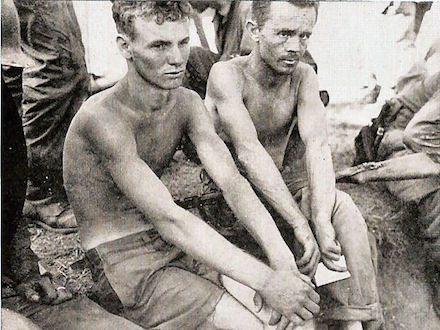
North Korean regulars on this date in 1950 committed a notorious mass execution upon 41 U.S. prisoners during the Korean War.

The Hill 303 massacre took place upon a 303-meter hill guarding the northern approach to Waegwan. In mid-August of 1950, said hill was defended by the U.S. Army’s 2nd Battalion, 5th Cavalry Regiment, 1st Cavalry Division, which narrowly escaped encirclement there by the advancing North Koreans.

Most of them escaped encirclement.

It’s a barely remembered atrocity in a war that America has consigned to forgetfulness; the massacre has seemingly never had anything like a thorough investigation. An indelible horror to the five men* who lived to tell the tale, its narrative outline is crude timelessness itself: holding these 42 U.S. POWs for two days, the North Koreans were themselves pummeled by a counterattack on the fiercely-fought hill;** unable to continue guarding the Americans, their captors fusilladed them.

This indiscriminate mass firing mere minutes ahead of the American approach was far from a thorough affair — hence the survivors, who were subsequently able to point out some of the captured Koreans who took part.


Massacre survivors James Rudd and Roy Day.

As a result of this and other summary battlefield executions, U.S. Gen. Douglas MacArthur addressed a threatening leaflet that was heavily dropped behind North Korean lines, threatening to “hold you and your commanders criminally accountable” according to the recent Nuremberg precedent.

There’s a monument to this gratuitous bloodbath that’s been recently installed, at the site of the shooting which is also nearby to a still-extant U.S. Army base called Camp Carroll. (The stone displays the date “June 25, 1950” — which denotes the start of the war, and not the day of the massacre.)

* Even the exact figures involved are a bit slippery. I believe we have 37 humans killed out of 42 captured, leaving five survivors. Some sources give it as 41 (attempted) executions with four survivors. A private named Frederick Ryan apparently was given last rites and declared dead on the scene but miraculously survived, possibly accounting for the variance.

** Hill 303 changed hands at least seven times.

On this day..

1704: Roland Laporte, posthumously, and five aides, humously

On this date in 1704, the great Camisard commander Pierre Laporte was publicly burned. He was already two days dead, but the same could not be said by five comrades-in-rebellion who were quite alive as they were broken on the wheel.

Familiarly known by the nom de guerre “Roland”, Laporte (English Wikipedia entry | the far more detailed French) was a whelp of 22 when entrusted with command of about 400 Protestant guerrillas operating around Lassalle, and his native Mialet.

These were rebels in a very dirty regional civil war in France’s heavily Protestant southeast, following the crown’s revocation of tolerance for the heretics. Roland proved himself one of its ablest prosecutors, putting Catholics to fire and sword be they enemy troops or wrongthinking neighbors.

By 1704 the insurgency was circling the drain as Camisard officers were either killed off or bought off. Our self-proclaimed “general of the children of god” was not the type to be had for 30 pieces of silver plus an army commission,* and so only violence would do for him. On August 14, betrayed by an informer who was amenable to purchase, Roland was slain in a Catholic ambush at Castelnau-les-Valence. Five officers escorting him opted not to go down fighting and surrendered instead, which proved a regrettable decision.

But even death could not slake the vengeance of his foes. “On the 16th August, 1704, the body of Roland Laporte, general of the Camisards … was dragged into Nimes at the tail of a cart and burnt, while 5 of his companions were broken on the wheel around his funeral pyre.”

For the unusually interested reader, there’s a 1954 French biography by Henri Bosc — who also authored a multi-volume history of the Camisard war — titled Un Grand Chef Camisard Pierre Laporte dit Roland, 1680-1704. It’s long out of print and appears to be difficult to come by.

* Not long before Roland’s defeat, just such a deal had shockingly induced fellow Camisard commander Jean Cavalier to turn coat.

On this day..

1918: Boris Donskoy, Left SR assassin

One hundred years ago today, the Germans hanged Russian revolutionary Boris Donskoy.

Donskoy was not a Bolshevik but a Left Social Revolutionary — the party faction most closely aligned with Team Lenin. And his offense was a revolutionary crime, but one that events soon swept into irrelevancy.

In March of that same year, Russia’s revolutionary government had fulfilled its promise to exit the charnel house of World War I, ceding in exchange for peace the huge territorial gains that Germany had exacted in the bloodlands in-between empires.

These prospectively gigantic territorial gains were not long held by Berlin, whose wartime government would collapse suddenly before the year was out … but in the short interim where we lay our post, the Baltic States, Belarus, and Ukraine are under firm German control.

The last of these stood under the authority of Field Marshal Hermann von Eichhorn. Donskoy, a radical sailor who had served on the Executive Committee of Kronstadt when it demonstrated against the Revolution’s initial, too-moderate Provisional Government, on July 29 assassinated the field marshal — declaring to his captors that the old Prussian warhorse had been condemned by the Left SRs for suppressing the Ukrainian revolution.

On this day..

1862: Frisby McCullough, Missouri bushwhacker

On this date in 1862, Confederate soldier Frisby McCullough was shot as a terrorist during the U.S. Civil War’s guerrilla Missouri campaign.

McCullough had a youthful stint in the California gold rush to his back when he returned to Missouri in the mid-1850s to practice law. (He also served in the Missouri State Guard, a pro-slavery militia that had been established in 1861 by the since-exiled secessionist governor.)

With the onset of the Civil War in 1861, McCullough signed up for the pro-slavery Southern army and after a few different assignments became detailed to aid Confederate Col. James Porter in the hasty bush war raging in that frontier state.

We’ve previously detailed that conflict here. For purposes of this post it will suffice to say that the border state of Missouri was fiercely contested during this war, and claimed by North and South alike.

The Union commander John McNeil was not very inclined to charitably reading the treasonable secessionist irregulars who opposed him in the state, whom the Union considered to be operating illicitly behind its lines — in the character of spies and saboteurs, like the British agent John Andre during the Revolutionary War. This very much applied to our man, since McCullough’s particular gift was recruitment — you know, luring loyal citizens into sedition and rebellion.

On August 6, 1862, McNeil’s forces routed Porter’s at the Battle of Kirksville, and they pressed their victory. The very next day after, McNeil had 15 Confederate prisoners taken at Kirksville executed as former POWs who had violated their paroles by returning to the field: “I enforce the penalty of the bond,” McNeil icily reported to Washington.

Not long after, northern sentries also captured the ailing McCullough riding alone near Edina. He wasn’t a parolee — but “he had no commission except a printed paper authorizing the bearer to recruit for the Confederate army,” McNeil would write of him later in a missive to a comrade. At a snap trial on the 8th, “he was found guilty of bushwhacking and of being a guerilla. He was a brave fellow and a splendid specimen of manhood. I would gladly have spared him had duty permitted. As it was he suffered the same fate that would have fallen to you or me if we had been found recruiting within the Confederate lines. He met a soldier’s death as became a soldier.”

A memoir of the southern travails during this conflict titled With Porter in North Missouri; a chapter in the history of the war between the states is in the public domain; chapter XXII relates with umbrage the fate of McCullough whom the author Dr. Joseph Mudd* greatly admired:

Leaning against a fence he wrote a few lines to his wife, and these, with his watch and one or two other articles, he delivered to an officer to be given her, with assurance of his devoted affection in the hour of death. Upon the way to the place of his execution he requested the privilege of giving the order to fire, which was granted to him. All being ready, he stood bravely up, and without a tremor in his manly frame or a quiver in his clarion voice, he called out, ‘What I have done, I have done as a principle of right. Aim at the heart. Fire!’

… He was a good citizen, a high-minded gentleman, of fine presence, brave as a lion, gentle as a woman. Even in his death the strongest Unionists who knew him respected and admired his virtues and entertained the most bitter regrets that what they considered his misconceptions of duty had led him to his fearful fate. At the time of his death he was thirty-three years of age.

* Dr. Joseph Anthony Mudd hailed from Maryland: he was the brother of the Maryland Dr. Samuel Mudd who narrowly avoided execution as a conspirator in the assassination of President Abraham Lincoln.

On this day..

1939: Las Trece Rosas

The Spanish Civil War’s victorious fascists shot Las Trece Rosas — “the thirteen roses” — on this date in 1939.


Plaque at the Cementerio de la Almudena in Madrid in honor of 13 young women shot there by Francoist troops on August 5, 1939. (cc) image by Alvaro Ibanez.

Earlier that 1939, Franco had clinched victory by finally capturing the capital city after a siege of 29 months. A punishing suppression of the Spain’s leftist elements ensued, running to hundreds of thousands imprisoned, executed, or chased into exile.

Our 13 Roses were members of a communist/socialist youth group, JSU, and they had been arrested in rolling-up of that organization. They were crowded into the overflowing dungeons of the notorious women’s prison Las Ventas.

A few Spanish-language books about Las Trece Rosas

And there they resided on July 29, 1939, when their JSU comrades struck back against the dictatorship by assassinating Isaac Gabaldón, the commander of Madrid’s fascist police.* The 13 Roses were immediately court-martialed and executed in revenge. Their names follow; there’s a bit more detail about them in Spanish here:

  • Carmen Barrero Aguado (age 24)
  • Martina Barroso García (age 22)
  • Blanca Brissac Vázquez (age 29)
  • Pilar Bueno Ibáñez (age 27)
  • Julia Conesa Conesa (age 19)
  • Adelina García Casillas (age 19)
  • Elena Gil Olaya (age 20)
  • Virtudes González García (age 18)
  • Ana López Gallego (age 21)
  • Joaquina López Laffite (age 23)
  • Dionisia Manzanero Salas (age 20)
  • Victoria Muñoz García (age 19)
  • Luisa Rodríguez de la Fuente (age 18)

The affair is the subject of a 2007 Spanish film.

* Gabaldon’s predecessor, the police commander under the Spanish Republic, Jose Aranguren, had been removed from his post and executed in April.

On this day..

1940: Udham Singh, Jallianwala Bagh massacre avenger

A national revenge drama 21 years in the making culminated on the gallows of Pentonville Prison on this date in 1940.

The story of Udham Singh‘s hanging begins long before and far away in the British Raj.

There, a crowd of 20,000-25,000 protesting for independence in the restive Punjab city of Amritsar were wantonly fired upon by Raj authorities — an atrocity remembered as the Jallianwala Bagh massacre. British authorities acknowledged a staggering 379 dead; Indian accounts run much higher than that.

The massacre’s principal immediate author was the army commander Reginald Dyer, who fired on the crowd without warning and with so much premeditation as to bar exits from the Jallianwala Bagh garden for maximum bloodshed — his acknowledged intent “not to disperse the meeting but to punish the Indians for disobedience.” but Punjab Lieutenant Governor Michael O’Dwyer, for many years a noted rough hand in the suppression of national militancy on the subcontinent, had his back. “Your action correct,” read an O’Dwyer-to-Dyer telegram on the morrow of the bloodbath. “Lieutenant Governor approves.”

British opinion was not quite so approving; indeed, many Britons were outraged and both Dyer and O’Dwyer ended up sacked. But as is usual for a horror perpetrated under the flag they also never faced any sort of punishment.

Until Udham Singh, avenger, entered the scene.

A survivor of that horrific day — when he’d been dispatched from the orphanage that raised him to serve drinks to the protesters — Singh had unsurprisingly thrilled to the revolutionary cause. A Sikh by birth, the name he adopted, Ram Mohammed Singh Azad, gestures to his movement’s now-remote spirit of unity across sect and nation.

Come 1934 Singh had made his way to London, where he worked as an engineer and quietly plotted revenge against O’Dwyer, pursuant to a vow he had taken many years before. (Dyer escaped justice in this world by dying in 1927.) And on March 13, 1940, he had it when the retired colonial hand addressed a joint meeting of the East India Association and the Royal Central Asian Society at Caxton Hall. As proceedings concluded, Singh produced a concealed pistol and fired six shots at the hated O’Dwyer, killing him on the spot.

Like many (not all) of his countrymen, Singh gloried in his long-awaited triumph in the few weeks remaining him.

I did it because I had a grudge against him. He deserved it. He was the real culprit. He wanted to crush the spirit of my people, so I have crushed him. For full 21 years, I have been trying to seek vengeance. I am happy that I have done the job. I am not scared of death. I am dying for my country. I have seen my people starving in India under the British rule. I have protested against this, it was my duty. What greater honour could be bestowed on me than death for the sake of my motherland?

Many countrymen shared his exultation, even if those in respectable leadership positions had to disapprove of assassination. Nevertheless, a few years after the subcontinent’s Union Jacks came down for the last time, PakistanIndia independence leader-turned-president Jawaharlal Nehru publicly “salute[d] Shaheed-i-Azam Udham Singh with reverence who had kissed the noose so that we may be free.”

On this day..