
On May 20, 1691, Captain Mark Baggot was hanged as a spy in Dublin.
Baggot had maintained loyalty to King James II when that sovereign was deposed in the 1688 Glorious Revolution that elevated William of Orange to the English throne.
Though deeply unpopular in England, the Catholic James — still to this day England’s last Catholic monarch — had sympathetic subjects to flee to in Ireland. Apart from the religious sympatico, the Irish were still smarting from ravages dating back to Cromwell and before, authored in the main by factions who were direct ancestors of the Whigs, King James’s staunchest domestic foes.
In 1689, James landed in Ireland backed by the French and kicked off the Williamite-Jacobite War between the rival kings. This war was so nasty it even survived the flight of King James himself in 1690:* William refused to guarantee amnesty for a wide swath of the Jacobite leadership, who consequently saw no odds in laying down their weapons.
The latter months of 1690 and the early months of 1691 had the now-outnumbered Jacobites girding the defenses of the cities they held against the coming Williamite attacks that were sure to come. Intelligence was critical under such conditions, and here our man Mark Baggot enters the stage.
Baggot was dispatched from the Jacobite stronghold of Limerick to Williamite-held Dublin to scout the enemy, but there had the embarrassment of being captured trying to escape notice in women’s clothes.** (You may be certain that the Williamite press included this emasculating detail on every available occasion.)
A court-martial condemned Baggot to hang the very next day, March 25.†
But the secret agent bought himself two months’ respite by cooperating with his captors — making the whole mission a clear intelligence win for the Williamites, especially since they still got to hang their spy in the end.
The resulting document has copy nearly as long as its unwieldy title …
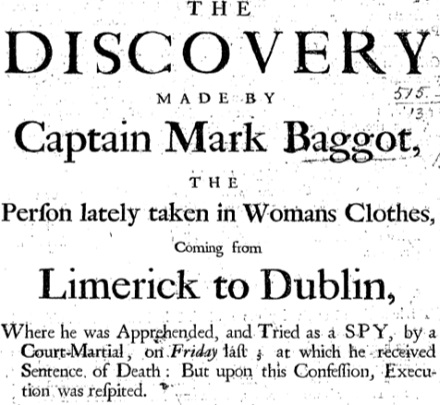
That the Irish army consists of forty thousand men of all sorts; that Tyrconnel was reducing them to thirty thousand; but SarsfieldSir Richard Nagle are pensioners of France.
That there is no good understanding between Tyrconnel and Sarsfield, having great jealousies of one another.
That King James has correspondence with, and intelligence from some persons in considerable places of trust here in England every ten days.
That the French fleet is hourly expected with thirty pieces of cannon, ammunition, provisions and arms; a French general, some marine men, but none of the army; they resolve to maintain their greatest force against the confederates in Flanders next campaign.
That the Irish army intends to move towards the frontiers, their greatest design being against Cork more than ny other place; what is left of the suburbs they intend to burn; they expect a great many deserters at their approach to the town. The commanders of the parties for this service are Colonel Dorrington and Colonel Clifford.
A spy, taken at Limerick, was hang’d here [Dublin], and confess’d that Major Corket was in particular favour, and held correspondence with the English, who was carried prisoner to Limerick, and suppos’d to have suffer’d death.
That the contributions paid to the new Irish are one peck of wheat or meal, 12 pound of butter every fortnight out of each plow lands.
That there is express order that no guns be removed from Limerick; that the English deserters are only paid and encouraged, but no pay given to the Irish.
That they are still fortifying Limerick.
That Ballyclough and Castletown, with some other places, were to be made garrisons by the Irish; that Sir Michael Creagh’s regiment of foot, under command of Colonel Lacy, are at Ballyclough, which places they are fortifying; that Strabane’s regiment of horse are at Charleveel and Buttifant, &c.
Baggot’s less than flattering report of the Jacobite forces’ condition proved bang-on: that July, the Williamites dealt a fatal blow to the Jacobite cause at the Battle of Aughrim — thanks to forcing a defile that the dug-in Jacobites ought to have held but for want of ammunition.‡ Shortly thereafter, Limerick capitulated to Williamite siege — its last Jacobite garrison escaping into exile, never to stir in Ireland again.
* He’s remembered in Ireland as “James the Shit” (Seamus a Chaca) because he ditched his supporters mid-war.
** Not the only Jacobite with a cross-dressing escapade to his name.
† London Gazette, March 26-30, 1691, which calls the spy Baggot “a Person very well known.”
The Baggot(t)s (Bagods, Baggetts) were an English family that could trace lineage back to the age of William the Conqueror, with a very longstanding branch in Ireland. (Dublin still has streets that bear that name.) The 17th century Irish Baggots took it on the chin for their loyalty to the Stuarts, several dying in that service or being dispossessed. The family’s Baggotstown Castle in County Limerick was seized and razed by the Williamites months after the events in this post.
The date of Baggot’s execution is reported in the Gazette for May 25-28, 1691.
‡ “All the day, though he was sincking in his center and on his left, [the Williamites] yett durst not once, for his relief, attempt to traverse the cawsway, till despayr at the end compelled him to trye that experiment at all hazards … they confidently ventured to goe through, notwithstanding the fire from the castle on their right, which fire was insignificant; for it slew but a few in the passage. The reason of it was given, because the men had French pieces, the bore of which was small, and had English ball, which was too large. Here is a new miscarriage thro’ heedlessness. Why was not this foreseen and the dammage prevented?” (Source)
On this day..
- 1527: Hans Hergot, immovable type
- 1952: Jan Bula, Czechoslovakian priest
- Feast Day of St. Baudilus
- 1622: Sultan Osman II
- 1799: Simon Taylor, for indulging in drunkenness
- 1795: Ignac Martinovics and the Magyar Jacobins
- 2001: An adult actress stoned to death in Evin prison
- 1881: Po'olua, "darkened in my mind"
- 1943: Wilhelm H., pensioner and vandal
- 1987: Edward Earl Johnson, "I guess nobody is going to call"
- 2001: Zhang Jun and his gang
- 1820: Karl Ludwig Sand, a curious strand of German history
 Cybo (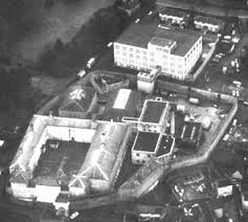


 This ferocious group was a severe mismatch for
 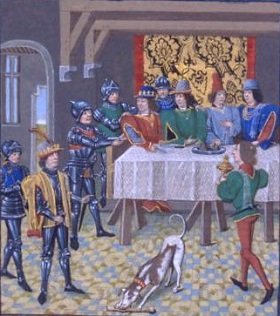 The king of France, on Tuesday the 5th of April, which was the Tuesday after midlent Sunday, set out early, completely armed, from Mainville, attended by about one hundred lances. There were with him his son the earl of Anjou, his brother the duke of Orleans, the lord John d’Artois, earl of Eu, the lord Charles his brother, cousins-german to the king, the earl of Tancarville, sir Arnold d’Andreghen, marshal of France, and many other barons and knights. They rode straight for the castle of Rouen, by a back way, without passing through the town, and on entering found, in the hall of the castle, Charles, duke of Normandy, Charles king of Navarre, John earl of Harcourt, the lords de Preaux, de Clerc, de Graville, and some others seated at dinner. The king immediately ordered them all, except the dauphin, to be arrested, as also sir William and sir Louis de Harcourt, brothers to the earl, the lord Fricquet de Friquart, the lord de Tournebeu, the lord Maubué de Mamesnars, two squires called Oliver Doublet and John de Vaubatu, and many others. He had them shut up in different rooms in the castle; and his reason for so doing was, that, since the reconciliation made on occasion of the death of the constable of France, the king of Navarre had conspired and done many things contrary to the honour of the king, and the good of his realm: the earl of Harcourt had also used many injurious expressions in the castle of Vaudreuil, when an assembly was holden there to grant a subsidy to the king of France against the said king, in order to prevent, as much as lay in his power, the subsidy from being agreed to. The king, after this, sat down to dinner, and afterwards, mounting his horse, rode, attended by all his company, to a field behind the castle, called the Field of Pardon.