1746: Charles Radclyffe, twice Jacobite rebel

On this date in 1746, Jacobite lord Charles Radclyffe was beheaded at Tower Hill as a rebel.

He was the 5th Earl of Derwentwater — or would have been, had not his older brother James forfeited the title along with his own head for joining the Jacobite rising in 1715.

This antecedent rebellion was no stranger to our man Charles, either. He’d been in the dock with James; in fact, it was under this 30-year-old death sentence that he was beheaded in 1746. We’ve even met him on these very pages, for the 1716 beheading of James — and the clever cross-dressing escape of his fellow-condemned, Lord Nithsdale — have featured in our pages before.

Using the less picturesque ruse of bribery, Charles Radclyffe himself escaped from Newgate in December of 1716, and immediately absconded to the continent to join the Lord Nithsdale at the exile Jacobite court in Rome — where the young pretender Bonnie Prince Charlie was born on the last day of 1720 and grew into manhood, champing for his opportunity to reclaim the family’s lost patrimony.

That opportunity seemed to present itself in the 1740s when Britain went to war against a coalition that included most of Europe’s Catholic powers. France, with her long history of opportunistic Scotch alliance against England, backed a fresh Jacobite rising in 1745 to stir the north and divert the British from the continent. Prince Charlie landed in Scotland and marched into a cheering Edinburgh on September 17, leading Charles Radclyffe, too, to sail for Scotland in November of that year. Now 52 years old, he would be one of the few lords to participate in both the great Jacobite rebellions … but he would not even set eyes on the new military debacles, for Radclyffe was simply intercepted at sea.

A noted lothario, Charles Radclyffe left illegitimate children whose exact numbers can only be guessed; they might possibly include the eventual husband of British feminist Mary Ann Radcliffe, and a girl named Jenny, the protagonist of Anya Seton’s historical novel Devil Water.

On this day..

1557: Galvarino, Mapuche warrior

On this date in 1557, the handless Mapuche cacique Galvarino was executed by the Spanish during the Arauco War.

The Mapuche people, still extant today, inhabited present-day Chile and Argentina; Spanish explorers pushing south from the wreck of the Inca Empire encountered them, and naturally antagonized them.

Rebellion broke out among the Mapuche in 1553, led by Caupolican and his able commander Lautaro; they won some signal victories but the conflict was never decisively finished by either side. The Arauco War — encompassing many distinct rebellions and campaigns punctuated by relative calm — ran until the early 19th century.

Our fellow Galvarino was elevated to folk hero status by the Spanish in the very first period of rebellion when he was captured in battle at Lagunillas. Instead of cutting off his head, the Europeans chopped off his hands — then sent him (with a number of like mutilated prisoners) back to his people. The intent was to make a terrifying example, but Galvarino made the example his own: brandishing the bloodied stumps and oratorical fury to match, he incited his comrades to further resistance.

At the Battle of Millarapue on this date in 1557, hours before his execution, the Spanish beheld him urging on the Mapuche:

My Brothers, why have you stopped attacking these Christians, seeing the manifest damage that from the day which they entered our kingdom until today they have done and are doing? And they still will do to you what you see that they have done and they are doing? And still they will do to you what you see that they have done to me, cut your hands off, if you are not diligent in making the most of wreaking destruction on these so injurious people for us and or or our children and women!

But by evening, the Spanish carried the day — and once again had Galvarino in their custody.

“The poet Ercilla, impressed by the Indian’s valor, made every effort to keep him from being executed, arguing that he had seen Galvarino changing sides and joining the Spanish troops,” writes Guillermo I. Castillo-Feliu in Culture and Customs of Chile. “Galvarino, displaying his mutilated arms, until then covered by a shawl, refused Ercilla’s offer to commute his death sentence and said that he only wished that he could tear his enemies apart with his teeth.”

They put him to death straightaway. Accounts of the execution method range from hanging to impalement to being thrown to dogs.

On this day..

1986: The Moiwana Massacre

On this date in 1986, during the opening months of a guerrilla war that would last until 1992, a 70-man detachment of Suriname soldiers raided the village of Moiwana, home of the rebel leader Ronnie Brunswijk, and massacred dozens of people.


Drawing made c. 1990 by an eight-year-old refugee of Moiwana. Image from Richard Price’s “The Killings in Suriname”, Cultural Anthropology, November 1995.

Sealing the roads, the team went house to house for four hours, torching houses and slaughtering any of the Ndyuka civilians who couldn’t escape into the surrounding jungle.

“Everyone was shot — the unarmed women, pregnant women, a baby barely seven months old,” goes the account in Memre Moiwana, a publication of the NGO Moiwana ’86. “No distinctions were made.” Some were mowed down with automatic weapons; others slashed to death with machetes. At least 38 people died, though various sources posit estimates running to upwards of 50.

In the weeks following, nearby Ndjuka villages in eastern Suriname shared a like fate, often bombarded by helicopters and finished off with bulldozers while death squads hunted suspected guerrillas. The U.S. State Department reported 244 Ndyuka people killed that December. A United Nations investigator entering the area months later reported that “no human being or living creature was seen apart from starving dogs in [one such town] Albina. The jungle vegetation had taken over the destroyed buildings.”

A police inspector named Herman Eddy Gooding who had the temerity to investigate these massacres while the guerrilla war was still ongoing was found mysteriously shot dead in 1990. (See Rainforest Warriors: Human Rights on Trial) In 2005, however, survivors of Moiwana won a suit against the army of Suriname before the Inter American Court of Human Rights.

On this day..

1836: Six Creek rebels, amid removal

We ask you how the Muscogee Nation came by this country? You came from the west and took the country from another people who were in possession. After living here a great many years, the people from over the big waters came in large vessels and took some of the country from you and set up their own government, and made laws, & made you obey them …

you must be sensible that it will be impossible for you to remain, for any length of time, in your present situation, as a distinct society or nation, within the limits of Georgia, or any other State. Such a community is incompatible with our system, and must yield to it. This truth is too striking and obvious not to be seen by all of you, surrounded as you are by the people of the several States. You must either cease to be a distinct community, and become, at no distant period, a part of the State within whose limits you are, or remove beyond the limits of any State …

Brothers, we now tell you, what we, in the name of your Father the President, want you to do. We want the country you now occupy. It is within the limits of Georgia and Alabama. These States insist upon having their lines cleared. The President will do this by giving you a better country, and will aid you in removing; protect you where you may go, against whites and all others, and give you a solemn guaranty in the title and occupancy of the new country which you may select … By deciding for yourselves, it may prevent others from deciding for you.

-U.S. federal communication to the Muscogee Creek chiefs, Dec. 9, 1824


Brothers, you have been deceived. A snake has been coiled in the shade, and you are running into his mouth … drunk with the fire of the pale-face. Brothers, the hunting grounds of our fathers have been stolen by our chief and sold to the pale-face, whose gold is in his pouch. Brothers, our grounds are gone, and the plow of the pale-face will soon upturn the bones of our fathers. Brothers, are you tame? Will you submit?

Opothle Yoholo

On this date in 1836, six Muscogee Creek rebels were hanged in Alabama as murderers.

This age of the bellicose Andrew Jackson comprised the peak years of America’s Indian Removal — a frightful term denoting the forcible expulsion of indigenous nations from America’s east to her frontier wastelands. This was the fate ordained for the Creek people of Alabama, just as it was with their “civilized tribes” brethren, the Choctaw of Mississippi and the Cherokee of Georgia and the Carolinas.

Jackson himself had tangled with the Creek during his career-making appearance as America’s up-and-coming caudillo in the War of 1812: the eponymous Fort Jackson in Alabama was the base from which the Tennessee militia captain had defeated rebellious natives in the 1813-1814 Creek War and forced upon them the Treaty of Fort Jackson.* “Numberless aggressions,” read that document, “had been committed [by the Creeks] against the peace, the property, and the lives of citizens of the United States.”

So small wonder that as President, Old Hickory — for whom Indian Removal was a signature policy — had no time for Creek appeals to Washington to uphold their treaty rights in Alabama and Georgia. Their defeat in 1814 had left the Creek polity a powerless dependency, whose rights and even survival extended precisely so far as the American government wished. With the shrunken remnant** of their ancestral lands increasingly sought by white settlers, all the pressure within Anglo America ran towards the ethnic cleansing option.

“Voluntary” emigration under steady white pressure gnawed away at Creek numbers in the Southeast for a decade or more preceding the events of this post, but there was always going to be a militant slice of the population for whom no inducement short of violence would suffice. In 1836, land incursions finally triggered a Creek revolt, and became the Second Creek War — Jackson’s justification at last for completing the long-sought elimination of the Creek in the East.†

“The Creek Indians, below the Federal Road, are all in arms and killing every white person they have fallen in with,” ran the May 12, 1836 Macon Messenger. Everything was in “confusion and disarray” — the fleeting advantage of initiative while Anglos mustered an overwhelming response.

Attacks on stagecoaches this same month “created a greater sensation throughout the country than any previous act of Indian hostility,” per this public domain history of Columbus, Ga. (The town abuts the Alabama border.)

Two stages carrying the United States mail, going from Columbus to Tuskegee, Ala., were attacked about eighteen miles from Columbus. The Indians killed Mr. Green, one of the drivers, and two horses, and robbed the mail. The next day a party of fifteen men started to come through to Columbus with two stages. Some of these men were passengers and others volunteers who accompanied the stages to assist in their protection.

It was for this raid that claimed Green’s life that Tuscoona Fixico and four others — never named in any source I have been able to find — were condemned to hang on Nov. 25, alongside a man named Chilancha for the unrelated killing of a man named Fannin during the uprising.

The Second Creek War went much the same way as the first, and proved those American diplomats prescient as to the inevitability of the conquered peoples’ fate. Today, the Poarch Creek — numbering barely 2,000 — are the only remaining band of Muscogee Creek in Alabama.

* It was from this engagement that Jackson proceeded to the famous Battle of New Orleans.

** In one vain bid to stanch the loss of Creek territory, the tribe — incensed by the Treaty of Indian Springs — had in 1821 enacted capital punishment for anyone who sold land to whites. It was on the strength of this statute that Creek assassins murdered/executed the collaborationist chief William McIntosh in 1825.

On this day..

1915: The Ghadar Mutineers

Prior to the war certain European nations, and especially those now ranged against us, regarded our Easern Dependency as a country where the great Mutiny would be surpassed in horror by the upheaval that would inevitably follow the entanglement of Britain in a great war, and at the outset of the conflict the German Press confidently relied upon trouble in India as a large factor on their side. Even among a not inconsiderable section of our own countrymen, too, there seemed to be a feeling of doubt. The moment Germany threw down the gauntlet, however, his Majesty’s dusky subjects forgot their little quarrels, closed their ranks, and offered all they possessed in defence of the Empire to which they are all so proud to belong, and with which their future prosperity and advancement are bound up.

Devon and Exeter Daily Gazette, Dec. 31, 1915

One century ago today, seven of his Majesty’s “dusky subjects” submitted to the noose at Lahore Central Gaol in preference to submitting to his Majesty.

These partisans of the two-year-old expatriate Ghadar party — the word means “revolt” — had been cogitating the subcontinent’s independence since its founding two years prior in the United States.

With the onset of World War I, the Ghadarites began returning to India by the thousands with a view towards ejecting the British Raj. For an ambitious objective, an ambitious plot spanning multiple interlocking conspiracies and reaching to the sepoy bunkers of Singapore.

The project was a logistical nightmare: no surprise considering the distances and communications lags involved. German-supplied munitions arrived late or (when intercepted in North America) not at all. The movement was penetrated by counterintelligence, and many of its adherents arrested.

Full of the desperate recklessness of patriotism, the remains of the conspiracy tried to go ahead with a rising in February 1915: this too was compromised, and easily squelched.

The resulting Lahore Conspiracy Case saw nearly 300 who were not quite so proud to belong to the Empire as the crown had hoped — seven of whom hanged on November 16:

The last in particular, only 19 years old when he hanged, has attained wide recognition as a Punjabi martyr.

On this day..

1944: Joseph Watson and Willie Wimberly Jr.

(Thanks to Meaghan Good of the Charley Project for the guest post. -ed.)

On this date in 1944, Private Joseph Watson and Technician Fifth Grade Willie Wimberly Jr. of the U.S. Army were executed for a brutal attack on two French civilians.

They broke into a farmhouse only a few hundred yards from their company bivouac area, shot the elderly farmer and his unmarried daughter, and raped the woman. Their crimes and deaths are described in French L. MacLean’s book The Fifth Field: The Story of the 96 American Soldiers Sentenced to Death and Executed in Europe and North Africa in World War II.

At 8:00 p.m. on the evening of August 8, 1944, Watson and Wimberly, both of them already drunk, arrived at the farmhouse and bartered for a liter of apple cider. They spoke no French but were able to get their point across. The farmer and his daughter were wary of the inebriated pair and, after they left, barricaded the door.

Five minutes later, the two soldiers returned and battered it down.

Wimberly hit the man on the head with his Tommy gun and Watson forced the woman into a chair. Then, just like that, they left again. The two victims went upstairs, barricaded themselves into another room and double-locked it.

A few hours later the two soldiers returned and fired at least twenty .45 submachine gun rounds through the upstairs door, wounding both of the French civilians.

The farmer staggered downstairs and went to get help, but his daughter’s tibia was fractured and she was unable to flee. She was raped in turn by each of the men while the other held her at gunpoint.

At trial she couldn’t identify either of her attackers. The farmer identified Wimberly out of a lineup of six black soldiers, but wasn’t sure about Watson.

Their identification wasn’t really needed, however. Watson was found passed out at the crime scene in the morning, still wearing his bloodstained pants, with the fly unzipped. Wimberly had left, but he left his helmet liner (marked with a unique serial number) on the steps of the farmhouse.

When questioned, Wimberly blamed the entire thing on Watson. Watson made several contradictory statements about the night of the crime before pulling the old amnesia gag. He admitted he’d gone to the farmhouse with Wimberly and added, “I must have gotten drunk because the next thing I knew I was in the yard with a Colonel, two Lieutenants and two MPs.”

Given the circumstances, there wasn’t much either man could say to show why he should not be convicted and executed.

Justice was quick: they were hanged less than three months after their crime. Wimberly went first and was pronounced dead at 10:29 p.m. Watson followed and was dead by 10:48. Eight days later, General George S. Patton had a letter sent to the rape victim, apologizing for what she’d been through and for the soldiers’ part in it.

On this day..

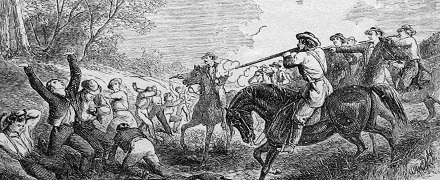
1863: William Griffith, for the Marais des Cygnes massacre

One of the signal outrages of Bleeding Kansas was avenged with a hanging on this date in 1863.

“Bleeding Kansas” was the guerrilla war over slavery in the late 1850s that presaged the conflagration about to consume the Republic; here on the frontier, pro- and anti-slavery partisans traded atrocities in their respective campaigns to secure Kansas’s imminent entry to the Union as either a slave or a free state. The stakes, had America continued her antebellum course, were vital Congressional votes on which the continuance of the peculiar institution might one day hang.

The naked brutality of the conflict shocked its contemporaries; as one particularly notorious example, the sons of abolitionist crusader John Brown executed pro-slavery captives with broadswords.

The Marais des Cygnes massacre was one of the last major horrors of that conflict: a party of 30 or so pro-slavery men led by Charles Hamilton seized 11 Free-Staters. They were mostly people who knew Hamilton personally, and seem to have gone along without resistance not anticipating what he had in store for them.

But Hamilton had told his men that on this campaign, “we are coming up there to kill snakes, and will treat all we find there as snakes.” (Source)

Much to their chagrin, these “snakes” were driven into a narrow ravine and lined up before Hamilton’s men’s guns. The volleys they delivered before fleeing back over the porous border into equally restive Missouri “only” killed five of their hostages: the other six survived by playing dead.


(Via)

Five years later, one of those survivors, William Hairgrove, supplied the identification that damned William Griffith — whose claim that he only helped capture the Marais des Cygnes victims, and didn’t help shoot them was an especially lame offering at the height of the Civil War.

According to Legal Executions in Nebraska, Kansas and Oklahoma Including the Indian Territory: A Comprehensive History, Griffith paid the forfeit for his role in the massacre “in a wood west of [Mound City, Mo.] on the opposite bank of Little Sugar Creek” before a crowd of thousands. There,

[a] little after noon Griffith was conveyed to the wood where he stepped onto the wooden platform a few inches above the ground. His wrists, knees and ankles were bound and the noose was adjusted. The black cap was pulled over his face at 1:07 p.m., and in but a moment William Hairgrove, one of the survivors of the massacre, cut the restraining rope with a hatchet; the four hundred pound weight dropped, jerking Griffith upward. The body rebounded and hung motionless while the attending physicians monitored his vital signs, and in twenty-five minutes they pronounced him dead.

Today, the site of the massacre is a U.S. National Historic Landmark. Quaker abolitionist poet John Greenleaf Whittier also memorialized the blood that was shed there in a poem titled “Le Marais du Cygne”:

A blush as of roses
Where rose never grew!
Great drops on the bunch-grass,
But not of the dew!
A taint in the sweet air
For wild bees to shun!
A stain that shall never
Bleach out in the sun!

Back, steed of the prairies!
Sweet song-bird, fly back!
Wheel hither, bald vulture!
Gray wolf, call thy pack!
The foul human vultures
Have feasted and fled;
The wolves of the Border
Have crept from the dead.

From the hearths of their cabins,
The fields of their corn,
Unwarned and unweaponed,
The victims were torn,—
By the whirlwind of murder
Swooped up and swept on
To the low, reedy fen-lands,
The Marsh of the Swan.

With a vain plea for mercy
No stout knee was crooked;
In the mouths of the rifles
Right manly they looked.
How paled the May sunshine,
O Marais du Cygne!
On death for the strong life,
On red grass for green!

In the homes of their rearing,
Yet warm with their lives,
Ye wait the dead only,
Poor children and wives!
Put out the red forge-fire,
The smith shall not come;
Unyoke the brown oxen,
The ploughman lies dumb.

Wind slow from the Swan’s Marsh,
O dreary death-train,
With pressed lips as bloodless
As lips of the slain!
Kiss down the young eyelids,
Smooth down the gray hairs;
Let tears quench the curses
That burn through your prayers.

Strong man of the prairies,
Mourn bitter and wild!
Wail, desolate woman!
Weep, fatherless child!
But the grain of God springs up
From ashes beneath,
And the crown of his harvest
Is life out of death.

Not in vain on the dial
The shade moves along,
To point the great contrasts
Of right and of wrong:
Free homes and free altars,
Free prairie and flood,—
The reeds of the Swan’s Marsh,
Whose bloom is of blood!

On the lintels of Kansas
That blood shall not dry;
Henceforth the Bad Angel
Shall harmless go by;
Henceforth to the sunset,
Unchecked on her way,
Shall Liberty follow
The march of the day.

On this day..

1936: Ramiro Ledesma Ramos, Falangist

Falangist politician Ramiro Ledesma Ramos was executed on this date in 1936, during the Spanish Civil War.

Ledesma (English Wikipedia entry | Spanish) launched the first fascist publication in Spain as a perspicacious 25-year-old admirer of Mussolini and Hitler.*

La Conquista del Estado — the expressive title was cloned from Curzio Malaparte‘s Italian fascist magazine — positioned Ramos as one of the leading apostles of the right in early 1930s Spain. Despite his youth, he’s been credited by later observers as one of the clearest, earliest intellectual exponents of fascism in Spain. Ledesma affiliated from the start with the Falangist movement Jose Primo de Rivera, and personally signed off on the party’s yoke-and-arrows logo and its motto “¡Arriba España!”

Spain’s Republican government had him detained in Madrid with the outbreak of the Spanish Civil War in July 1936. With the fascist armies closing in on Madrid in late October, Ledesma was among dozens of political prisoners taken out and shot without trial at the cemetery of Aravaca.

* His philo-Hitlerism allegedly led Ledesma to imitate the Fuhrer’s flopover coiffure.

On this day..

1849: Zsigmond Perenyi, by the Hangman of Arad

In the weeks following his defeat of Hungary’s 1848-49 revolution, the Austrian general Julius Jacob von Haynau consolidated his victory with enough cruelty to merit the title “Hangman of Arad.” On this date in 1849, he advanced Zsigmond Perényi, of late the speaker of revolutionary Hungary’s House of Magnates, to the ranks of Magyar martyrs.

A career politician and judge, Perenyi (English Wikipedia entry | the more detailed Hungarian) was a stately 74 years of age when the barricades went up. He was a baron, but a member of the reform-minded faction of that class who in the 19th century came more and more to see themselves in a national, Hungarian context. This historical thrust would lead, 18 years after the events of this post, to the official arrangement of an Austro-Hungarian Empire, the promotion of Hungary to titular imperial partnership but never to a fully satisfactory settlement of the tensions between Hungarian patriotic aspiration and Habsburg imperial prerogatives.

Perenyi signed the April 14, 1849 Hungarian Declaration of Independence; he and others who had set their hand to this treasonable document and played a role in the national government — they were just the sort of people to invite the attention of the hangman of Arad.

“Many government commissioners who had supported Kossuth were summarily court-martialled and led to the gallows,” Alan Walker notes in Franz Liszt: The Weimar Years, 1848-1861, Volume 2.

Baron Jeszenak, lord-lieutenant of the county of Nyitra; Szacsvay, the young secretary of the Diet; and Csernus of the treasury board all swung from the end of a rope. Baron Zsigmond Perenyi, of the court of justice, listened carefully to the charges against him and replied: “I have to complain that the accusation is incomplete. I request to add that I was the first to press the resolution that the House of Habsburg-Lorraine should be declared to have forfeited the throne of Hungary.”


By Hungary’s own Franz Liszt.

On this day..

1939: Operation Tannenberg public mass executions begin

This photo (from the German Bundesarchiv) captures an SS execution of Poles in Kornik just weeks into the German occupation of Poland in 1939, fruit of a pre-planned Nazi project to secure the new territory as lebensraum.

Operation Tannenberg (English Wikipedia entry | German | Polish) could be seen as a vanguard for the mind-boggling exterminations to come in subsequent years, cementing the army’s commitment to a campaign that extended well beyond territorial conquest. Alexander Rossino examines this understudied segment of World War II in Hitler Strikes Poland: Blitzkrieg, Ideology, and Atrocity and contends that “the unlimited, almost nihilistic violence of the Wehrmacht” emerges first in these initial weeks of the Polish campaign, which proved a “transitional conflict” pivoting towards the more notorious atrocities to come. “The invasion of Poland thus occupies a crucial place in the history of Nazi Germany’s descent into mass murder and genocide.”

Drawn up by Hitler, Himmler, and Heydrich and officially authorized on August 25, a week before Germany invaded Poland, Tannenberg intended to destroy Poland’s elites — from intelligentsia and nobility down to community priests and teachers, and the politically active across the spectrum from Communist to monarchist. The hope was to leave the subject nation supine, incapable of challenging Berlin’s designs on her future. Estimates I have seen vary widely but tens of thousands of Poles (with a liberal portion of Polish Jews) were shot by SS Einsatzgruppen units under Tannenberg even by the end of 1939, and kilings continued apace thereafter. Though not the literal first Operation Tannenberg Killings, the October 20-23 period marked the first public mass executions; a Polish-language list of the incidents and victims involved is available here.

The very name Tannenberg is a nationalist allusion to Germany’s time-immemorial rivalry with Poland; the original Battle of Tannenberg saw the rising Polish-Lithuanian empire defeat the Teutonic Knights, essentially breaking the latter as a European power. This defeat resonated in 20th century German national mythology not unlike the Battle of Kosovo for Serbia; in 1914, Field Marshal Paul von Hindenburg made himself a household name by smashing the Russians in a battle vaguely in the vicinity, and cannily christened it, too, the Battle of Tannenberg. (The Germans put up a monument to it which they felt obliged to tear down later in the war as they were being driven out of Poland.)

On this day..