On this date in 1855, Giovanni Pianori submitted to the guillotine for an unsuccessful assassination attempt — pictured above — on the French Emperor Napoleon III.
Himself an Italian nationalist in his youth, Napoleon as prince had gutted his former cause by intervening to crush the revolutionaryRoman Republic and restore the exiled pope to power. No small number of fellow-travelers in the patriotic cause thought Napoleon’s betrayal deserved a bullet.
Pianori’s were launched, without effect, on the Champs-Elysees on April 28, 1855, just sixteen days before his execution.
Claude Henry Branton was noosed in Eugene, Oregon on this date in 1899, with the last words, “I haven’t much to say. I hope for God’s sake no one will try to run my folks down on account of this. They are innocent. I hope people will learn a lesson from this and tread on the right path. I hope to meet you all in the other world. I ask this for Jesus’s sake. Amen.”
Branton with another young farmhand named Courtland Green murdered rancher John Linn when the three were in the wilderness driving horses to Oregon’s McKenzie River Valley for sale. The motive was the thousand dollars or so that they thought that Linn was carrying; instead, the two killers found only $65 to split: he’d wisely given his ready cash to a friend for safekeeping before setting out.
And now they had to explain why they were arriving as a duo when they had set out as a trio.
A retrospective (May 20, 2018) from the Redmond (Ore.) Spokesman compares their subsequent situation to Melmoth the Wanderer, vainly sounding the valley for someone to give them an alibi.
The two of them decided what they needed was to find some rustic sucker willing to perjure himself by swearing that he had seen the three of them together, bringing the horses down.
And so commenced Branton and Green’s Melmoth-like wanderings through the McKenzie valley, horses in tow, looking for friends old and new who would be willing to perjure themselves in exchange for the pick of the herd.
Branton even made a fake beard so that he could pretend to be Linn at one spot. This didn’t work, though, because the rancher he was trying to fool recognized his voice.
The two of them tried several times to sell the horses, too, but no one would take them because Linn wasn’t there to sign the bill of sale.
Eventually the two murderers split up, Branton fleeing out of the state and Green into the bottle. But neither man found his refuge secure. Conscience and drink overcame Green’s composure and he revealed the crime (he ended up with a life sentence). Branton unwisely returned to Eugene without realizing that the murder had been exposed, and was instantly arrested.
There were about 50 official witnesses to the hanging, which took place within a stockade outside the Lane County courthouse while a large crowd milled outside or sought elevated vantage points in order to steal a glimpse. A few years later, a similarly raucous scene outside a similar “private” hanging in Portland, the Beaver State moved all executions indoors to the state penitentiary at Salem.
Myers was accused by his lover, a Stamford tailor’s apprentice named Thomas Crow who “had the general character of a common liar” according to several character testimonials in court. Due to this, Myers was acquitted in the Lincolnshire assizes on three indictments stemming from Crow’s charges of same-sex congress; however, a fourth indictment arose from an assignation in Burghley Park, outside of Stamford and in the jurisdiction of the Peterborough (Cambridgeshire) sessions — where it was also witnessed by several more credible accusers besides Crow.
Here’s the report of his hanging in the Stamford Mercury of May 8, 1812, again via Norton’s site.
The miserable man who was under condemnation at Peterborough for an unnatural offence, paid the debt of hs life to the world and to his Maker on Monday. — He saw his afflicted wife for the last time on Thursday! — On Friday morning, the Rev. Mr. Pratt (the Vicar of Peterborough), and the Rev. Mr. Courtney, of Orton, both of whom had been unceasing in their endeavours to prepare the convict for eternity, administered to him the Sacrament; and next day a most affecting parting took place between him and the former reverend gentleman, who, being under the necessity of going a journey, bid him a last farewell. The prisoner expressed his gratitude in the most lively terms to Mr. Pratt, for having, as he declared, been instrument, through Divine Providence, “in forcing him to repent, and preparing his soul for another and a better world.” — He was attended until late on Sunday night by the Rev. Joseph Pratt, Rector of Paston, and the Rev. Mr. Hinde; and on Monday morning partook of the Sacrament again, with them and the Rev. Mr. Courtney. He continued in a most happy state of mind for his melancholy situation; and on being brought out of the prison, at a quarter past elevent o’clock, to be put into a post-chaise and conveyed to the place of execution, he declared that that was the happiest moment he had experienced for 14 years! The Rev. Mr. Hinde accompanied the prisoner in the chaise, which was preceded in the procession by a hearse and coffin, and moved slowly amidst a concourse of 5 or 6000 spectators to the usual place of execution on Peterborough common, where a new drop had been erected under the gallows for the occasion. — On this platform the convict joined the accompanying clergyman in a most admirable prayer, composed by that reverend gentleman, with whom the wretched man parted in a way that drew tears from the eyes of every beholder. He shook hands with a person of St. Martin’s whom he recognised near him, and briefly exhorting the surrounding multitude to “take warning by his example,” he intimated to the executioner that he was ready; and whilst the officer drew the cap over his eyes, he was heard fervently to repeat the last line of a hymn which had been composed for him, and which he had taken great delight in singing — “Lord, remember me!” The fall of the drop in a few moments after, placed him beyond the bounds of mortality: he seemed to be dead in almost the instant after the descent of the scaffold.
Although Myers did not attend public worship on Sunday, as it had been intimated he would not, most excellent and appropriate sermons were preached to very crowded congregations: at the cathedral, in the morning, by the Rev. Wm. Head, one of the Minor Canons, and Rector of Northborough, from the 3d chapter of the Epistle to the Hebrews, 13 v. — “Exhort one another daily, whilst it is called today; lest any of you be hardened though the deceitfulness of sin;” — and at the parish church, in the afternoon, by the Rev. John Hinde, Curate of Peterborough, from Acts, c. 24, v. 25 — “Go thy way for this time; when I have a convenient season I will call for thee.” The public mind seemed brought into an excellent state for the instruction which was to be given; and the most judicious and happy advantage was taken of it by the preachers.
We need not dwell upon the state of wretchedness to which the excellent wife and innocent children of Myers have been reduced by the ignominious death of their husband and father: they, it is to be hoped, will find many friends. The public indignation is appeased with the public justice which has been rendered, and that man will ill deserve the name of one, who shall ever unfeelingly refer to the events which have passed, with a view to wound the innocent connexions of a guilty man. In the last sad interview of Myers and his wife, she is said with almost frantic vehemence to have entreated on her knees, that he would bring no wife, no mother, into the depth of misery which she endured, by disclosing the names of those who had been associates in his horrid crime. Whether Myers attended to this injunction is not publicly known.
Copy of a PAPER written by D. T. MYERS, two days previously to his Execution, and left by him with a request that the same might be made public after death.
As I believe that persons in my unhappy situation are expected to say something at the place of execution, and feeling that I shall not be able to do it, I wish these my dying words to be inserted in the Stamford Papers, and to be made as public as possible. I confess that I am guilty of the crime for which I am about to suffer; and for these and all my sins, I desire to repent before God with a broken and contrite heart. I forgive, from the bottom of my soul, every one who has wronged me; and I earnestly pray to Almighty God that my untimely end may be a warning to others, who are walking in the same path. Oh! may my shameful death put a stop to that dreadful crime! may those who have been partakers with me in my crimes be brought to true repentance!! I am a miserable sinner in the sight of God, and I am deservedly degraded in the sight of man. But I commit my guilty polluted soul into the hands of my blessed Saviour, to be pardoned and cleansed by him. And though I deserve nothing but punishment for my sins, I trust, thro’ the merits of my Redeemer, when I leave this wicked and miserable world, to be received into a World of Purity and Peace.
As my example has led many into sin, I hope these, my Dying Words, may lead many to repentance.
D. T. MYERS.
Signed in Peterborough Gaol, 2d of May, 1812, in the presence of J. S. Pratt, Vicar of Peterborough; John Atkinson, Clerk of the Peace; Thomas Atkinson, Attorney, Peterborough.
The young maid Adriana Bouwman was guillotined on this date in 1813 for theft and arson; it was the second and last use of that notorious machine in The Hague, during the three years that the Netherlands was directly incorporated into Napoleon’s First Empire.
Arijaantje Apersdr Bouman was condemned for robbing and torching a farmhouse where she worked as a domestic. She was four months shy of her 20th birthday when beheaded.
James Edward Singleton caught a death sentence in Texas after setting out from Beeville with a business partner carrying a wad of cash with which they intended to set up a saloon in Rockport.
The business partner never made it there, and Singleton swung in Beeville on April 27, 1877, after having been arrested boarding a boat with all their saloon boodle in his pocket. He left this colorful last will and testament; the reader will not be surprised to learn that it was not honored. (The document survives in damaged condition; ellipses indicate lost text.)
In the Name of the Omnipotent, Omnipresent, Omnificient of science and common sense Amen. I, J.E. Singleton (cosmopolite) Now sojourning in Galveston Jail, State of Texas, And, being of sound mind. Do by these presents, Will, divise, and bequeath, (for the diffusion of anatomical knowledge among mankind) — my mortal remains to J.J. Swann, on the following conditions.
First, that my body — after the execution — be prepared in the most scientific & skillful manner known in anatomical art, and placed in his Office, in the Courthouse in Beeville … O … ter temple of Justice … may …
Second. It is my express desire — If [his prosecutor -ed.] Dave Walton has no objections — That two drumheads, be made of skin. On one of which shall be written in Indellible characters Popes universal prayer, & on the other the following Verdict, –
We, the Jury, find the defendant, Jas. E. Singleton, guilty of murder in the first degree, as charged in the Indictment, and assess the penalty of death.
The said drum heads to be presented to my distinguished friend and fellow citizen, Frank Boggus — drummer for Tom Holly’s division — On the following conditions that he, the aforesaid Frank Boggus, shall beat, or cause to be beaten on said drum heads the popular tune [Old Mollie Hare] … front on the 8th day of June Annually.
The viscera, and other parts of my body, useless for anatomical purposes, I wish composted for a fertilizer, and presented to Mr. Barclay, proprietor of the Grand Palace Hotel in Beeville, to be used by him for the purpose of nourishing the growth of cabbage, turnips, pertaters, and other garden sass, that the worthy people of Bee County — or at least the masculine portion thereof — may have something to relieve the monotony of hash & dried apples, during their brief sojourn at the aforesaid Hotel, while assembled at Beeville, for the purpose of dishing out Justice to Violators of the Law.
J.E. Singleton.
The foregoing is my last will and testement, and I wish J.J. Swann to act as Executor. I feel very grateful to the Citizens of Bee County in general, and to J.J. Swann in particular for the many favors conferred upon me by them. I also feel that I am indebted to them, to some extent pecuniarily, and being at present in Indigent circumstances, I write and leave this will, alike to liquidate my debts, and prove my gratitude.
Singleton really was quite a character. Newspapers around the Republic reported his pig-out last meal request of “one dish ham and eggs, one apple pie, one peach pie, one egg custard, one fruit pudding, one large pound cake, and two bottles of wine.” He also attempted to cheat the hangman by taking his own life, leaving a note for his mother that also hit the papers in which he confesses himself in very human terms not excluding his amusing disdain for the community that was preparing to take his life. (This from the Galveston Weekly News of May 7, 1877:)
Dear Mother — When you read this, I, your sinful, rebellious, neglectful son, will be no more on this earth. But, mother dear, I am not going to give these worthy people of Bee county the pleasure of publicly executing me. You will understand by this that I contemplate destroying my own life. And such is the case. I am aware that you look upon it as an unpardonable sin, or almost as such, but I can not bear the idea of being hanged in public, before a gaping multitude of fools, and especially Bee county fools. I am compelled to lose my life, mother dear; there is no other alternative, and you will pardon me, I’m sure, for this act, for it is only shortening my existence a few hours at most.
As for the justice of my conviction, I will not speak or write falsely to you at this time, and I reckon the verdict of the jury was a just one. I did the murder, but not with malice aforethought, as every one thinks, nor was I actuated by any hope of gain. It was for a quarrel about a trifle, and the provocation was not sufficient to warrant the killing; therefore, I don’t feel justified.
It’s hard, mother dear, for me to calmly contemplate death, and a great deal harder, when I think of your long suffering toll and privations for me. I know you are suffering and will suffer after my death. I would to God I could avert it from you, but I can not; but I think it’s better to take my life, than to be executed by the minions of the law in this place. I will not ask you not to grieve for me, mother, for I know that would be useless; but try and bear up the best you can. I trust that we may meet again in that better world beyond the grave. I do not feel capable of saying anything that will strengthen or comfort you at this time, when I know how much you need comfort and strength. But one thing, mother, please for my sake, and for the sake of Lee and Mamie, do not despair nor give up, if you can help it. Think how you, and none but you, can instruct them how to be great and good men. Some would think that my career was a contradiction of what I say, but God knows that the fact of my now being under sentence of death, and my name forever disgraced, is not the consequence of my home training. I was taught things that were right, but I was too weak and sinful to profit by your good teachings, but I do hope to God it will be different with the two younger ones. Teach them always to do right at all times, and for my sake teach them to think with pity and never with scorn of the disgraced and outcast murderer. For with all my faults, I always loved them; but I am not much afraid on that score, if they continue as they are now, as I do not in the least doubt their love for me. I saw Mamie this evening. I am thankful that I was permitted to see him once more. I regret not having seen Lee very much, but as I did not, you must convey my loving farewell to him. I must close this, mother, for writing here, solitary and alone as I am, of our loved ones causes such a rush of old half-forgotten memories that I am almost overpowered. I am not as near cast-iron as I thought. Well, dear, dear mother, farewell, and may God, in His infinite mercy, bless, comfort and console you is the prayer of your loving but unhappy son.
This episode from Mexican Alta California comes from the short-lived administration of Manuel Victoria, who proved himself such a martinet in his few months as governor of that territory that a rebellion that December forced Victoria’s resignation.
The administration of justice was a subject which early claimed the new ruler’s attention. It had been much neglected by the easy-going Echeandia, and crime had gone unpunished. Criminal proceedings had been often instituted, as we have seen in the local presidial annals of the last six years, but penalties had been rarely inflicted with fitting severity. Victoria had strict ideas of discipline, and no doubt of his ability to enforce the laws. He is said to have boasted soon after his arrival at Monterey that before long he would make it safe for any man to leave his handkerchief or his watch lying in the plaza until he might choose to come for it. How he carried out his ideas in this direction will be apparent from a few causas celebres of the year.
The case of Atanasio was pending when Victoria came. Atanasio was an Indian boy less than eighteen years of age, a servant in sub-comisario Jimeno’s office, who had in 1830 stolen from the warehouse property to the extent of something over $200. The prosecution was conducted by Fernandez del Campo, Padres, and Ibarra as fiscales; and the last-named demanded, in consideration of the youth and ignorance of the culprit, as well as on account of the carelessness with which the goods had been exposed, a sentence of only two years in the public works. The asesor, Rafael Gomez, after having sent the case back to the fiscal for the correction of certain irregularities, rendered an opinion April 18th, in favor of the death penalty; and by order of the comandante general Atanasio was shot at 11 a.m. on the 26th. Gomez was an able lawyer, and I suppose was technically correct in his advice, though the penalty seems a severe one. Naturally the Californians were shocked; and though an example of severity was doubtless needed, Victoria was not fortunate in his selection. The circumstance that led to the culprit’s detection seems to have been his using some military buttons for gambling with his comrades; and the popular version of the whole affair has been that an Indian boy was shot by Victoria for stealing a few buttons.
“We are free Swiss, completely equal citizens. That government that will not hear the voice of the people is a tyranny.”
–Hans Jakob Willi, leader of the Bockenkrieg, who was executed on 25 April 1804.
The defeat of the Old Swiss Confederacy by Napoleon had shaken up political arrangements in Switzerland, creating the successor Helvetic Republic. As Napoleonic revolutions were wont to do, this new state aimed to centralize, universalize, and rationalize, having done with archaic redoubts of canton authority and ancient feudal privileges.
This new Republic was a short-lived affair, held up only by French bayonets; upon their withdrawal in 1802, it succumbed quickly to civilstrife which necessitated the Corsican’s mediation — and a new political order which restored some powers of the prostrated cantons.
It was the consequent flex of Zurich upon its former provincial domains that brought about the Bockenkrieg insurgency — a rural rebellion near Horgen requiring Zurich to impose its will by means of a very picturesque suppression.
The Bocken estate after the battle for the manor during the Bockenkrieg, 28 March 1804 by Johann Jakob Aschmann (c. 1804)
Hans Jakob Willi, a cobbler turned soldier who gave the insurgency a veteran military man at its fore, was injured in battle, resulting in the speedy collapse of the rising. A court martial declared his death, despite Napoleon’s attempted intercession on Willi’s behalf.
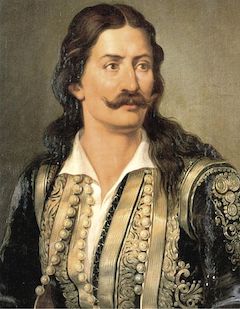
Greek independence hero Athanasios Diakos died by Ottoman impalement on this date in 1821.*
Though he acquired his nickname Diakos (“deacon”) from a youthful spell in a monastery, this fellow Athanasios (English Wikipedia entry | Greek) while the Turks still governed Greece made his way as a klepht — Greece’s version of the Balkan hybrid outlaw/guerrilla archetype, similar to the hajduk figures among the South Slavs. All of these outlaw types took to the mountains where they could subsist as brigands and mercenaries beyond the reach of the Porte, and seek opportunities where they might to strike at Ottomans. Many of the Greek persuasion, Diakos included, adhered to the Filiki Eteria secret society that aspired to liberate Greece.
With the onset of the Greek War of Independence in early 1821, Diakos jumped right into the fight. Picturesquely, he met a much larger Turkish detachment in battle at Thermopylae where he made like Leonidas and with a handful of companions heroically held out against impossible odds at the Alamana Bridge.
Captured wounded, Diakos spurned the temptation of an officer’s commission in the Turkish army should he but switch sides with words that remain legendary in his homeland to this day: “I was born a Greek, I shall die a Greek.” He was impaled at the city of Lamia, fearlessly musing, “Look at the time Charon chose to take me, now that the branches are flowering, and the earth sends forth grass.”
He’s a very famous and beloved figure in Greece, albeit much less so in parts beyond. The village where Diakos was allegedly born has been renamed for him full stop.
* The narratives I’ve seen run a bit hinkie between the Battle of Alamana on April 22 and the great klepht’s death on April 24 since there’s a two-day gap and everyone seems to agree that he was ordered for execution “the next day”. I’m sticking to the agreed death date here, which is universal, but as best I can discern the timeline alternatives for accounting the missing day appear to break down between the notion that Diakos was impaled on the 23rd and lingered on his spike overnight before death, and that it was not until the 23rd that the Ottoman commander had the opportunity to interrogate him and decide his fate and thus “the next day” was the 24th. I haven’t located a source that appears dispositive on this issue.
Hanged April 23, 1845 for poisoning her brother Charles Dimond — and commonly suspected to have offed several other family members by means of arsenic — the “Shapwick Murderess” Sarah Freeman insisted her innocence to her very last breath. “I am as innocent as a lamb,” she said to the hangman William Calcraft as he noosed her.
Gottfried wielded the 19th century’s weapon of choice for subtle domestic homicide, arsenic, mixed into spreadable fat, a concoction known as Mäusebutter after its intended legitimate use. This delectable served for 15 murders over as many years in the 1810s and 1820s.
The “Angel of Bremen” — so earned for her kindly habit of nursing her victims through the death throes she prepared them — began as is customary with her spendthrift first husband, followed soon by the three children she had by him, her own mother, father, and brother, and her second husband.
After a six-year break apparently because her access to Mäusebutter had run out, Gottfried was able to resume her career in 1823 by offing her second husband followed by a series of less intimate acquaintances: a neighbor, a landlady, a maid, a creditor. All of her murders seemingly had some pecuniary motive, including those early ones of her own kin (think inheritance). But in many instances the apparent profit was very minor, and her motivations remain uncertain to this day. The phrenologists who examined her head after execution certainly had some ideas: “the brain exhibits an enormously large organ of Destructiveness, with a very deficient Benevolence. This combination appears to have rendered its possessor almost a hyena or tiger in her dispositions.” (Source)
At last one of her proposed victims, one Johann Rumpff who was the husband of the “landlady” Wilhelmine Rumpff already poisoned by Gottfried, became suspicious enough of her to have meals she served to him examined by a doctor, which led speedily to her arrest and to all the rest.
Gottfried was the last person (male or female) publicly executed in Bremen. She survives well enough in the cultural memory to earn periodic tribute on stage, screen, and literature …
… and for the discerning Bremener desiring to see upon whom their sputum falls at Domshof, the Angel’s death mask can still be gawked at the Focke Museum.
German speakers might enjoy the Life of Poison-Murderer Gesche Margarethe Gottfried composed by her attorney Friedrich Voget: part 1, part 2. or see archive.org.


 Though he acquired his nickname Diakos (“deacon”) from a youthful spell in a monastery, this fellow Athanasios (


