1886: Tabby Banks and Tom Honesty, for election rejection

This date in 1886 gives us the double execution of two men named Banks and Honesty — words we don’t hear in the same sentence every day, amirite?


Baltimore Sun, June 5, 1886: the source of all newspaper quotes in this post.

That’s Tabby Banks and Tom Honesty, to be exact, “two full-grown and powerful negroes” who to nobody’s satisfaction denied all the way to the gallows that they had murdered a white 18-year-old, Joseph McFaul, outside the (still-extant) Taylor Hotel on November 14, 1884. The sources I have located do not explicate any beef specifically known to have existed between these individuals; they do, however, situate the conflict squarely within America’s political environment in that electoral year. It is not only in passing that we have noted the parties’ racial identities.

Days before McFaul died, former hangman Grover Cleveland was elected President — the first Democrat to win the office since before the Civil War.

It might be better to say that Cleveland was the first Democrat to hold the office. The tossup 1876 presidential election was more-or-less won by New York Democrat Samuel Tilden, but he was bilked of the prize in an electoral college bargain that exchanged another Republican presidency for the end of Reconstruction.

In the 1870s and 1880s, northern whites were steadily coming around towards Southern whites’ distaste for the ongoing rigor necessary to enforce the putative equality of ex-slaves with their former masters.

Recognizing that such lethargy among white elites in effect amounted to abandoning the field to the violent reassertion of white supremacy, blacks were deeply apprehensive about 1884. Some even feared that chattel slavery might be restored outright. For all the growing indifference of the Republicans, the potential election of the Democrat Cleveland, T. Thomas Fortune wrote during the campaign, “would be a cold afternoon for this country and especially for the Negro and the laboring classes.” (Via)

This is presumably why McFaul, a Democrat taking part in a celebratory parade for Cleveland’s election, would have been hateful to Banks and Honesty. According to the Baltimore Sun, those latter two had previously “traversed the [march] route, threatening to kill some democrat.” Later, McFaul chanced to nominate himself their target by stepping into an alley, where the two churls “immediately attacked him.” Some passing Samaritan saw what was happening and managed to pull McFaul out of the alley and onto the street; still, his assailants did not disdain to press the assault in public view and clobbered the young man with a rock.

Everyone parted and went their separate ways, but young McFaul was a dead man walking. His skull fractured by the stone, he died that night in his sleep.

President Cleveland, of course, did not restore slavery. He took little interest in the situation of black Americans and did nothing to check the onset of Jim Crow, but in this he was not so different from his Republican contemporaries. Nobody among the nation’s white elite had a belly for the fight any longer.

Frederick Douglass had to concede in a Washington, D.C. speech of 1886 that “as far as the colored people of the country are concerned, their condition seems no better and not much worse than under previous administrations.”

Lynch law, violence, and murder have gone on about the same as formerly, and without the least show of Federal interference or popular rebuke. The Constitution has been openly violated with the usual impunity, and the colored vote has been as completely nullified, suppressed, and scouted as if the fifteenth amendment formed no part of the Constitution, and as if every colored citizen of the South had been struck dead by lightning or blown to atoms by dynamite. There have also been the usual number of outrages committed against the civil rights of colored citizens on highways and by-ways, by land and by water, and the courts of the country, under the decision of the Supreme Court of the United States, have shown the same disposition to punish the innocent and shield the guilty, as during the presidency of Mr. Arthur.

On this day..

1691: William Fielding, scammer

Four men and four women stretched their necks at Tyburn on this date in 1691.

Among them we find one William Fielding, condemned for robbing three houses by using a 17th century variant of the Nigerian prince email scam:

The Prisoners came to all the Prosecutors and pretended that there was a Lady Dead who had left them Legacys, and Wheedled them to go to look after it, and the whilest Robbed their Houses; which was lookt upon as a very wicked Invention.

Proving that even confidence men are vulnerable to their own trick, however, the Ordinary of Newgate‘s dispatch from the foot of the gallows reports that Fielding

said, That he was afraid that if he might be spared that he should be tempted to Rob again, because of his extream poverty: Therefore he now submitted to dye willingly, that he might not add sin to sin, and so encrease his future punishment.

Well might he fear hellfire if he took the judiciary for his example. In a time when property was far dearer than life, Fielding himself and all but one of the other seven to hang with him (the one was an infanticidal mother) died for felony thefts of various types — ranging from the pathetic (“stealing from Charles Thurston, on the 4th of this Instant May, one Linnen Bag, value 1 d. and 20 l. in Mony”) to the ludicrous (“Robbing Daniel Leery, on the 12th Instant, in the Street, as he was going along, in St. James’s Parish, snatching his Hat and Perrywig off his Head, in the Night”).

On this day..

1581: James Douglas, Earl of Morton

On this date in 1581, James Douglas, the Earl of Morton was beheaded on the Maiden.

The fourth and last of little King James‘s regents, Morton was arguably the most able of the bunch and distinguished his span of authority by winning the raging civil war against James’s mother Mary.

Regent Morton had a reputation for avarice during his run in the 1570s. However, deriving as it does from his executive impingement on the treasures of courtiers and clans no less grasping than himself, that reputation probably ought to be taken with a grain of salt.


Rimshot

If nothing else, Regent Morton had the excuse of king and country. Sir Walter Scott, for one, favored this Red Douglas with a much more charitably statesmanlike gloss in The Monastery and The Abbott.

As one example, Morton irked divines by enforcing with a minimum of pious exceptions a pre-existing statute requiring a one-third cut of ecclesiastical revenues.

Likewise, he made an enemy of Lady Agnes Keith — the widow of the assassinated first regent — and her (subsequent) husband, the Earl of Argyll by forcing them to turn over crown jewels that were being held in their quote-unquote safekeeping.

In 1578, this Argyll kidnapped King James VI and induced the 12-year-old to declare his majority and dismiss the Earl of Morton. Argyll landed a Chancellorship out of the deal: Morton — well, you know. He would eventually be accused, 14 years’ belatedly but not inaccurately, of complicity in the 1567 murder of Lord Darnley.

Argyll in the end lost his head to that distinctive Scottish proto-guillotine known as the Maiden. Though the apparatus actually dates back to 1564,* a legend as moralistic as it is specious holds that the Regent Morton was himself the man who ordered construction of the device that would eventually end his own life. Sir Walter could hardly be asked to resist that kind of material:

“Look you, Adam, I were loth to terrify you, and you just come from a journey; but I promise you, Earl Morton hath brought you down a Maiden from Halifax, you never saw the like of her — and she’ll clasp you round the neck, and your head will remain in her arms.”

“Pshaw!” answered Adam, “I am too old to have my head turned by any maiden of them all. I know my Lord of Morton will go as far for a buxom lass as anyone; but what the devil took him to Halifax all the way? and if he has got a gamester there, what hath she to do with my head?”

“Much, much!” answered Michael. “Herod’s daughter, who did such execution with her foot and ankle, danced not men’s heads off more cleanly than this maiden of Morton. ‘Tis an axe, man, — an axe which falls of itself like a sash window, and never gives the headsmen the trouble to wield it.”

“By my faith, a shrewd device,” said Woodcock; “heaven keep us free on’t!”

-Sir Walter Scott, The Abbott

When next in Edinburgh, quaff Scots engineering acumen with the friendly backpackers crashing at the High Street Hostel — the glorious stone town house that was once Regent Morton’s very own crib.


By Kim Traynor (Own work) [CC BY-SA 3.0], via Wikimedia Commons.

On this day..

1946: Ion Antonescu

Romania’s wartime fascist dictator Ion Antonescu was shot on this date in 1946.

Antonescu (hand raised) and Adolf at Nazi headquarters in June 1941. Behind them are Ribbentrop and Keitel.

An army officer who worked his way up to the brass via his exploits in the Second Balkan War and then in World War I, Antonescu emerged as a major nationalist politician in the interwar period. He was the elite political figure who allied with Corneliu Codreanu‘s Iron Guard movement.

Antonescu became the Defence Minister in a a far-right government, was temporarily shouldered out of the state by King Carol II‘s coup, and then re-emerged as the leading alternative when Carol’s government was undone by the tectonic political crises in the run-up to World War II. After territorial concessions wrung by Romania’s neighbors triggered protests against the king in Bucharest, Antonescu on September 5, 1940, forced Carol to transfer dictatorial power to him — and shortly thereafter, he forced Carol to abdicate altogether.*

That left Carol’s son Michael the figurehead of state, and Ion Antonescu the actual strongman — at least, once he tamed the Iron Guard.

Antonescu oriented Romania towards Hitler’s Germany, including a fairly enthusiastic involvement in the Holocaust.**

For Germany, it was an important alliance: Romania’s oil fields were essential to powering the Reich’s mechanized army. And Romania ultimately fielded the largest Axis army other than Germany and Italy themselves with well over one million men under arms by the summer of 1944. For Romania, well, opportunism is as opportunism does: as Antonescu put it, echoing an ancient argument, “in today’s circumstances a small country which is under threat, such as ours, does not do what it wishes, but what it can.”

The Romanian “General Antonescu Army Group” joined the fateful invasion of the Soviet Union. Romanian divisions were prominent at Stalingrad where some 150,000 were lost as casualties or prisoners.

The turn of the war’s tide put Romania in a grievous dilemma whose parameters ran something like this:

  • Maintain Antonescu’s personal grip on power
  • Maintain the territorial expansion Romania had achieved early in the war
  • Exit the war without going down in Germany’s Gotterdammerung

… pick one of three. Provided it’s the last one.

As the Red Army approached from the northeast and American bombers struck from Italy and North Africa, Antonescu scrambled to sound out what kind of a deal he could cut with the Allies.

Antonescu might perhaps have negotiated without the desperation due his position,† and dilated with his decreasingly patient enemies while the Germans flattered him with the dream that he could still retain conquered Bessarabia (present-day Moldova). Only with the Soviet army on his doorstep was Antonescu finally disabused of the statesman’s dream and office both — when King Michael ousted Antonescu and immediately switched Romania to the Allied side.‡ This move accepted the Soviet occupation that was about to become a fait accompli, and put Romanian soldiers into the field for the last months of the war fighting against their former German allies.

It also put Antonescu into Soviet custody. He rode out the war under guard in Moscow, then was shipped back to postwar Romania where he would serve as the feature attraction of the People’s Tribunals.

One hundred eighty-seven people answered war crimes charges to these bodies; there were 13 death sentences, but only four were actually executed.§ All four — Transnistria governor Gheorghe Alexianu, Interior Minister Constantin Vasiliu, and Foreign Minister Mihai Antonescu (no relation — were shot on this date at Jilava. The executions were filmed.

* Carol went into exile, never to see his native soil again. He died in Portugal in 1953.

** “Of all the allies of Nazi Germany, Romania bears responsibility for the deaths of more Jews than any country other than Germany itself,” according to a 2003-2004 commission. “Efforts to rehabilitate the perpetrators of these crimes are particularly abhorrent and worrisome. Nowhere else in Europe has a mass murderer like Ion Antonescu, Hitler’s faithful ally until the very end, been publicly honored as a national hero.” (The full report is available here; the quoted lines come from its executive summary.)

† Berlin was keeping an eye on Romania’s separate-peace feelers, too, and had prepared a plan to occupy Romania should it attempt to desert the Axis. This is precisely the fate that befell Nazi-allied Hungary … but in Romania’s case, Germany never had the moment to implement the plan.

‡ Michael was, like his father, forced into exile in 1947; he did not return to Romania until after the collapse of Communism. Now in his nineties, King Michael is still alive as of this posting and remains the claimant should Romania ever re-establish its monarchy.

§ Six of the 13 death sentences were delivered in absentia. Notable among those fled souls was the Hungarian writer Albert Wass: Wass had escaped to the United States, which refused repeated appeals by Communist Romania to deport him. There is a running struggle in both Hungary and Romania over whether to rehabilitate Wass or posthumously rescind his death sentences. (Postwar Hungary condemned him, too.)

On this day..

1915: Kassim Ismail Mansoor, purveyor of coffee and treason

A century ago today, an Indian Muslim named Kassim Ismail Mansoor was hanged by the British in Singapore as a traitor.

The treason in question concerned the dramatic mutiny some months previous of Singapore’s 5th Light Infantry — Muslims who had feared that they would be dispatched to World War I’s European charnel house. (Ironically, the British brass had no such intent: they already considered these troops too unreliable, for some reason.)

Many of the mutineers were shot en masse by summary court-martial.

Our man Mansoor was not a fighter but a civilian coffee-shop proprietor. Having come into the confidence of some of his countrymen enough to know the mutinous thrust of their grievances, he made bold put in writing an appeal to the Rangoon consul of the Ottoman Empire — Britain’s wartime enemy — for the intervention of Turkish warships that could pick up their disaffected Muslim brethren and turn together against the British. Unfortunately for Mansor, that missive fell into British hands.

A 1937 retrospective series in the Straits Times on the distinguished career of Mansoor’s defense counsel, Sir Vincent Devereux Knowles, dives into the case here: 1, 2. Knowles, it says, knew his task was quite hopeless.

On this day..

1806: Polly Barclay, accessory in the murder of her husband

On May 30, 1806, Polly Barclay of Wilkes County, Georgia was “taken by a proper officer to a gallows previously to be erected in or near the town of Washington, and then and there on the day aforesaid, between the hours of ten o’clock in the forenoon and two o’clock in the afternoon … hung by the neck until you are dead.”

And may God have mercy on her soul.

The purported triggerman, Polly’s brother, had been acquitted of murdering Polly’s husband; then, said assassin turned right around and testified against his sister — who was duly condemned for hiring him. (They do say that Justice is blind.)

But don’t take Executed Today‘s word for it. For this sordid all-in-the-family homicide, we’re pleased to recommend a visit to the annals of Washington, Ga., we gladly defer to genealogist and historian Stephanie Lincecum‘s Peachy Past post.

On this day..

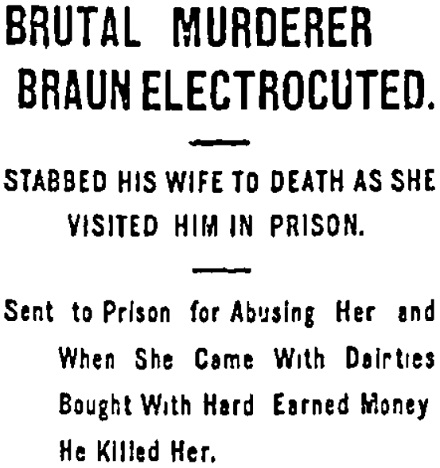
1899: Adrian Braun, who murdered his wife in Sing Sing


Wilkes-Barre Times, May 29, 1899.

On this date in 1899, Adrian Braun was electrcuted at Sing Sing.

Braun was a hulking German cigar-maker with a reputation for habitually thrashing his wife. Authorities got involved when he bashed a neighbor who intervened in a beating so hard that it fractured the man’s skull.

In August 1897, Braun caught a two-year sentence for assault. With her batterer put away, Kate Braun now had to shift for herself; struggling to make ends meet as a washer-woman, she had to give up two of her five children to the St. Joseph’s Roman Catholic Orphan Asylum. Still, she scraped together enough money to buy her incarcerated husband some sweets on a prison visit.

Mr. Braun was at work peeling potatoes in the prison kitchen when he was summoned for the arrival of his spouse in March 1898. After using up their visiting time on a conversation that appeared entirely mutually affectionate, the two were about to part when Adrian Braun suddenly whipped out the potato-knife he had recently been employing and daggered the poor woman’s throat — with lethal effect.

Braun never explained his shocking crime and pursued only a half-hearted insanity defense at his ensuing trial.

“No man was ever executed at the prison who had less sympathy than was felt for Braun,” the Wilkes-Barre Times reported on the day of the man’s execution.

On this day..

1879: Alexander Soloviev, bad shot

On this date* in 1879, would-be regicide Alexander Soloviev was hanged

Soloviev (English Wikipedia entry | Russian), a Narodnik revolutionary, was one of the less competent assassins to have a go at Tsar Alexander II.

Surprising the undefended sovereign on the latter’s morning constitutional near Winter Palace, Soloviev couldn’t connect with his revolver from four meters’ distance. As Alexander fled, Soloviev gave chase, firing four more times in the process to no effect before the gathering crowd wrestled him to the cobblestones.

Soloviev admitted the crime — the admission was hardly necessary — and hanged before a crowd of 70,000 souls. Despite the ensuing police crackdown on subversives (resulting in still more executions), many of those 70,000 surely numbered among the gawkers two years later for the hanging of the Narodnaya Volya terrorists who at last successfully assassinated Alexander.

* May 28 was the local (Julian calendar) date for the execution; by the Gregorian calendar prevailing outside Russia, it was June 9.

Part of the Themed Set: Terrorism.

On this day..

1925: The Sveta Nedelya bombers

Three perpetrators of Europe’s most spectacular terrorist attack were hanged on this date in 1925 in Bulgaria’s capital Sofia — after each stood on the gallows for forty minutes while the names of their victims were read to them.

Those 40 minutes of victims had unknowingly begun their path to Calvary two years before, when the Bulgarian military overthrew the post-World War I civilian government.

Though the Communist party stayed out of this putsch — it was a peasants‘ party that was toppled from power — the reds responded a few months later with their own countercoup: the September Uprising.


Septemvri 1923, by Ivan Milev. Perhaps topical to the horrible events yet to come in this post, also check out his 1926 Our Mothers Are Always Dressed In Black.

The eventual Cold War Communist government of Bulgaria would officially regard September 1923 as “the first anti-fascist uprising” — an ex post facto interpretation that would be aided by the Bulgarian dicator‘s eventual affinity for the World War II axis, and by the “White Terror” unleashed by the military after it routed the Communist revolt.

Harried and hunted, and their underground leadership succumbing to assassinations, the Communists conceived a punchback as devastating as it was contrary to the standard Leninist line on terrorism.

On April 14, 1925, a Communist agent assassinated Gen. Konstantin Georgiev.


Memorial marker for Konstantin Georgiev. Photograph by Miko (Own work) [CC BY-SA 3.0].

Shocking as this murder was, it was only the overture — and Gen. Georgiev was only the bait.

Two days later — Holy Thursday — a huge crowd turned out for the general’s funeral in Sveta Nedelya Church, perhaps Bulgaria’s most important cathedral. Unbeknownst to them, they shared the sacred vault with 25 kilograms of explosives packed into a column under the church’s dome.

When detonated during the service, it brought the dome down on the congregation.

“A tremendous explosion occurred and all became dark,” a former War Minister told the London Times correspondent. “Fortunately, I was standing almost below a pair of arches and I escaped without injury, not even losing my balance. A minute later the fumes began to disperse and, with six or seven others, I found myself standing while every one else was lying on the ground. Fragments of masonry were falling from the walls and the roof.”

One hundred fifty people died and another 500 were injured when Sveta Nedelya’s roof fell in — though amazingly, none of the many top state officials attending were killed. (And Tsar Boris III was not even in attendance.)


Sveta Nedelya after the explosion.

Like Samson, the bombers brought the walls down on their own heads, too.

Already none too lenient with the subversive element, the dictatorship directly implemented martial law and began rounding up suspected fellow-travelers, “disappearing” hundreds in the process. (One notable victim was poet Geo Milev, who never returned from a May 15 police interview; his remains were discovered 30 years later in a mass grave.)

The lucky ones managed to escape to Yugoslavia and thence to the Soviet Union. But three men* implicated in the plot remained to face the more decorous vengeance of the judiciary: Lieutenant-Colonel Georgi Koev, Marko Fridman, and Petar Zadgorski. The last of these was a sexton at Sveta Nedelya whose role as the inside man was essential to infiltrating the deadly package into the sanctuary.

* There were actually eight death sentences at this proceeding, but five of them were delivered in absentia … an absentia caused, for three of the five, because they had already been murdered during the post-bombing crackdown.

Part of the Themed Set: Terrorism.

On this day..

1868: Michael Barrett, the last public hanging in England

England held its last-ever public execution on this date in 1868, and made it big game indeed: Fenian Michael Barrett, whose Clerkenwell Prison bombing long remained one of the most infamous atrocities of the Irish nationalist cause.

The bill certifying the end of that distinctive institution, the public hanging, would be finalized three days hence, so the occasion’s milestone was anticipated in advance. Elites increasingly disdained the boorish carnivals that unfolded under the gallows, like Dickens who complained that “no sorrow, no salutary terror, no abhorrence, no seriousness; nothing but ribaldry, debauchery, levity, drunkenness, and flaunting vice in fifty other shapes” redeemed the 1840 hanging of Courvoisier.


“The Great Moral Lesson at Horsemonger Lane Gaol”, Punch magazine’s view of the notoriously rowdy mob at Frederick and Marie Manning execution.

“The crowd was most unusually orderly,” ran the Times‘ report of Barrett’s death — a sort of dual eulogy — “but it was not a crowd in which one would like to trust.”

It is said that one sees on the road to the Derby such animals as are never seen elsewhere; so on an execution morning one see faces that are never seen save round the gallows or near a great fire. Some laughed, some fought, some preached, some gave tracts, and some sang hymns; but what may be called the general good-humoured disorder of the crowd remained the same, and there was laughter at the preacher or silence when an open robbery was going on. None could look on the scene, with all its exceptional quietness, without a thankful feeling that this was to be the last public execution in England. Towards 7 o’clock the mass of people was immense. A very wide open space was kept round the gallows by the police, but beyond this the concourse was dense, stretching up beyond St. Sepulchre’s Church, and far back almost, into Smithfield — a great surging mass of people which, in spite of the barriers, kept swaying to and from like waving corn. Now and then there was a great laughter as a girl fainted, and was passed out hand over hand above the heads of the mob, and then there came a scuffle and a fight, and then a hymn, and then a sermon, and then a comic song, and so on from hour to hour, the crowd thickening as the day brightened, and the sun shone out with such a glare as to extinguish the very feeble light which showed itself faintly through the glass roof above where the culprit lay. It was a wild, rough crowd, not so numerous nor nearly so violent as that which thronged to see Muller or the pirates die. In one way they showed their feeling by loudly hooting a magnificently-attired woman, who, accompanied by two gentlemen, swept down the avenue kept open by the police, and occupied a window afterwards right in front of the gallows. This temporary exhibition of feeling was, however, soon allayed by coppers being thrown from the window for the roughs to scramble for. It is not right, perhaps, that a murderer’s death should be surrounded by all the pious and tender accessories which accompany the departure of a good man to a better world, but most assuredly the sight of public executions to those who have to witness them is as disgusting as it must be demoralizing even to all the hordes of thieves and prostitutes it draws together. Yesterday the assembly was of its kind an orderly one, yet it was such as we feel grateful to think will under the new law never be drawn together again in England.

Michael Barrett’s ticket to this last assembly was punched by a different execution six months previous — the hanging of the Manchester Martyrs. This trio of Irish patriots were part of a mob who liberated some comrades from a police van, shooting a policeman in the process — though it was far from certain that any of these three actually fired shots.

Of importance for our purposes today was the crackdown on other Fenians occasioned by the Manchester affair. In November of 1867, a Fenian agent named Richard O’Sullivan Burke was arrested with his companion Joseph Casey in London purchasing weapons for the movement. They were clapped in Clerkenwell Prison pending trial.

The bombing that brought Michael Barrett to the gallows was a bid to liberate these men … and it did not pause for subtlety. The conspirators simply wheeled a barrel of gunpowder up to the wall of the facility when they expected the inmates to be at exercise in the adjacent yard. The explosion blasted a 60-foot gap in the wall; the inward-collapsing rubble might easily have been the death rather than the salvation of the prospective beneficiaries, except that they weren’t actually in the yard at all — nobody was there, and nobody escaped Clerkenwell.

But numerous working-class families lived in little tenements opposite the prison and were there, and in fact Clerkenwell had a reputation for political radicalism and Fenian sympathy. This monstrous new “infernal machine” tore through Clerkenwell homes, leaving 12 people dead and numerous buildings near to collapse, while windows and chimneys shivered to pieces all up and down the block.


Improvised struts shore up damaged buildings opposite the wall of Clerkenwell Prison reduced to rubble by the December 13, 1867 Fenian bombing.

Karl Marx, a strong supporter of the Irish cause, despaired this counterproductive turn towards terrorism: “The London masses, who have shown great sympathy towards Ireland, will be made wild and driven into the arms of a reactionary government. One cannot expect the London proletarians to allow themselves to be blown up in honour of Fenian emissaries.”

English reformer Charles Bradlaugh agreed. “The worst enemy of the Irish people could not have devised a scheme better calculated to destroy all sympathy,” he wrote.


Punch magazine depicts the Clerkenwell bomber(s) as the “Fenian Guy Fawkes“.

Considering the magnitude of the crime, someone would have to pay for it. That Barrett was that someone did not sit well for many.

Five men and a woman stood trial at the Old Bailey in April for the Clerkenwell outrage, but Barrett was the only one of them convicted, a terribly inadequate investigation/prosecution outcome given the infamy of the crime.

That conviction stood on the basis of disputed eyewitness identifications: Barrett produced witnesses who said he was in Glasgow when the bomb went off, while the crown found others who would swear he was actually in London. (The length of Barrett’s whiskers on specific dates in late November and early December forms a running subplot of the dueling testimonies.)

The reliability and even the good faith of all such winesses might well be impugned. A highly questionable stool pigeon named Patrick Mullany who ducked prosecution by turning crown’s evidence, charged that Barrett personally set off the ordnance.

Despite his certain doom, Barrett eloquently vindicated himself at his sentencing

To give me credit for such an undertaking is utterly absurd; being, as I am, a total stranger to acts of daring, and without any experience which would in any way fit me for engaging in such an enterprise. Is it not ridiculous to suppose that in the City of London, where … there are ten thousand armed Fenians, they would have sent to Glasgow for a party to do this work, and then select a person of no higher standing and no greater abilities than the humble individual who now stands convicted before you? To suppose such a thing is a stretch of imagination that the disordered minds of the frightened officials of this country could alone be capable of entertaining.

If it is murder to love Ireland more dearly than life, then indeed I am a murderer. If I could in any way remove the miseries or redress the grievances of that land by the sacrifice of my own life I would willingly, nay, gladly, do so. if it should please the God of Justice to turn to some account, for the benefit of my suffering country, the sacrifice of my poor, worthless life, I could, by the grace of God, ascend the scaffold with firmness, strengthened by the consoling reflection that the stain of murder did not rest upon me, and mingling my prayers for the salvation of my immortal soul with those for the regeneration of my native land.

Benjamin Disraeli’s government could not in the end realistically entertain the agitation from liberal and radical circles for sparing Barrett, because that would mean that nobody would hang for Clerkenwell. But as the next day’s edition of Reynold’s News noted, “Millions will continue to doubt that a guilty man has been hanged at all; and the future historian of the Fenian panic may declare that Michael Barrett was sacrificed to the exigencies of the police, and the vindication of the good Tory principle, that there is nothing like blood.”

Three months after Barrett made that expiation, England officially began its era of fully private hangings behind prison walls.

* James Joyce hung out with a (much-older) Joseph Casey in Paris in the early 20th century. Yes, that’s in Ulysses too: “He prowled with Colonel Richard Burk, tanist of his sept, under the walls of Clerkenwell and crouching saw a flame of vengeance hurl them upward in the fog. Shattered glass and toppling masonry. In gay Paree he hides, Egan of Paris, unsought by any save by me.”

Part of the Themed Set: Terrorism.

On this day..