Jesus of Nazareth, King of the Jews

Images of the Crucifixion


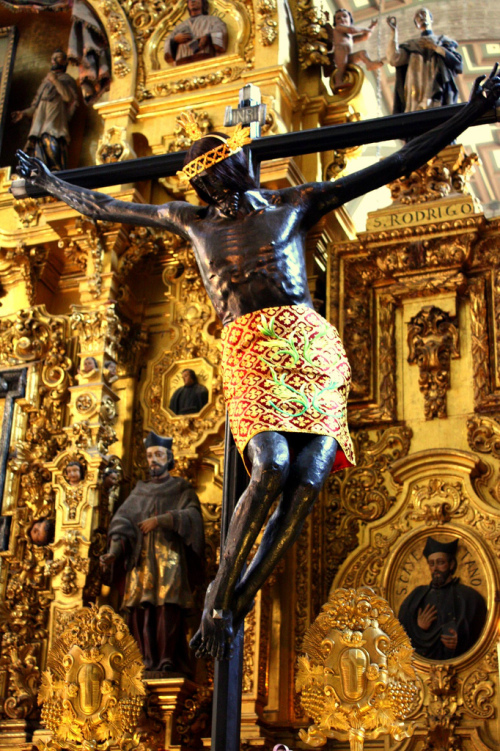
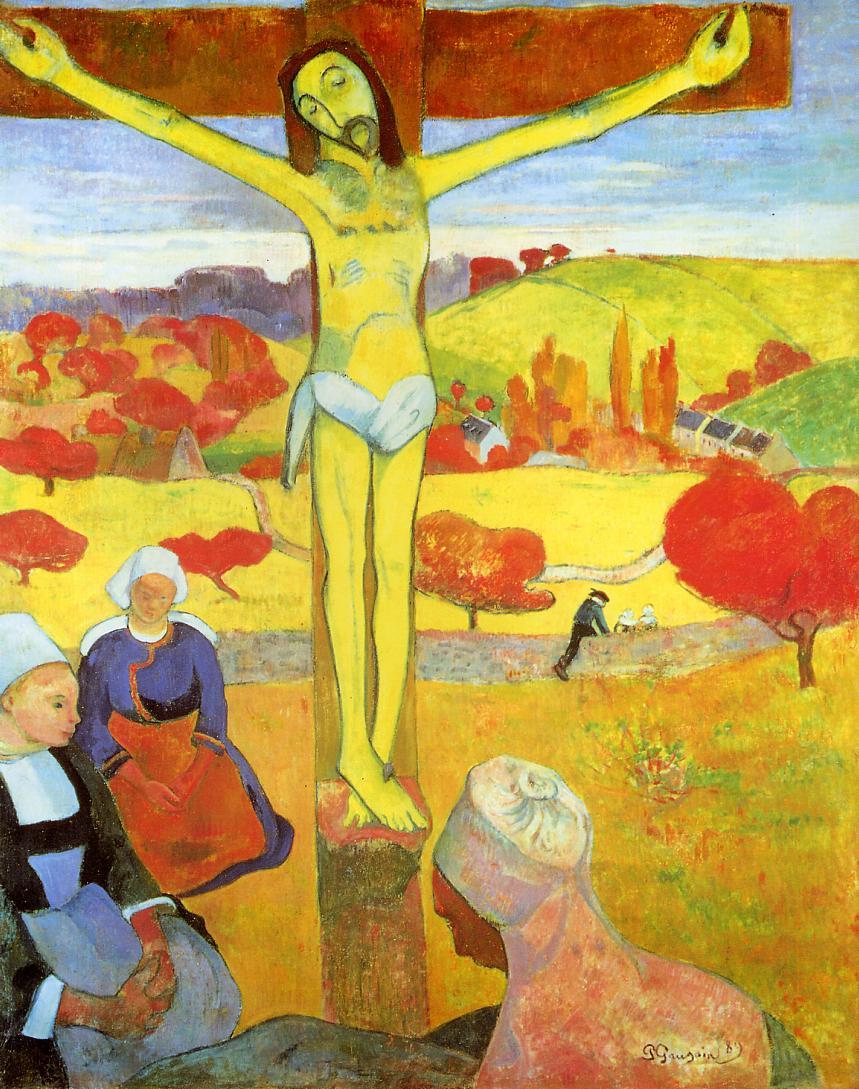

(Thanks to Jeffrey Fisher [jeffreyfisher at me.com] for the guest post.)

On Good Friday every year,* Christians around the world commemorate the death by crucifixion of Jesus of Nazareth, rabbi, prophet, Son of God, Son of Man, messiah, and all-around trouble-maker.

The truth is that very little is known of Jesus’ life and teachings from verifiable accounts, but this has not stopped generation after generation of Christians from telling his story, beginning with Jesus’ semi-official biographers, the evangelists of the New Testament. Almost everything we know about the life and teachings of the physical human being Jesus are in those writings, which do not portray him always in compatible ways, and which are almost entirely unconfirmed by any external source. The Roman historian Tacitus mentions (with disdain if not disgust) Jesus’ cult following, as does the Jewish historian and philosopher Josephus, but neither gives us anything to work with as historians (or, for that matter, as theologians). For the record, Suetonius and Pliny also talk about Christians, but these piecemeal sources tell us much more about Roman perceptions of Christians than about Christ and his teachings, or even necessarily Christian beliefs and practices.

What, then, can we reasonably say about Jesus?

It is almost impossible to find universal agreement around anything more than a few basics, including most importantly Jesus’ crucifixion. The Gospels narrate it; Paul the Apostle (who never met Jesus in the flesh, as it were) hangs his theology on it, together with the equally important resurrection; and no contemporary sources (Christian or otherwise) dispute it.

But it’s when we ask why Jesus was crucified that things start to get interesting.

What did he do? The two men he is traditionally said to have been crucified with are commonly understood to be “robbers,” but that they were common criminals is highly unlikely. Crucifixion is a horrible death designed to make a very public statement about the crucified, the sort of thing you use on gladiator-slave rebels like Spartacus, not on pickpockets and roustabouts. The Greek term used for these two men (lestai) is consistent with the description of the released Barabbas as one who had participated in rebellious activities, whose “criminality” was related to his revolutionary business. Moreover, the name “Barabbas” means literally “son of the father,” a purely symbolic and surely entirely fictional name, and that the people choose to have him released indicates their affinity for him as a thorn in the side of the Romans. He is thus contrasted with Jesus, the other son of the father, the peaceful (apocalyptic) revolutionary.

So Jesus would have been crucified as a political criminal, a rebel. This would make sense of accounts of his having been identified by the Romans as “Iesus Nazarenus Rex Iudaeorum”: “Jesus of Nazareth, King of the Jews.” Anyone claiming to be king (and “son of God” was a Jewish way of talking about the king of Israel recorded clearly in Psalm 2), would, if taken seriously, be understood as challenging Roman authority.

Insofar as Jesus seems to have been deliberately poking the Romans’ local running dogs, the Sadducees and the Temple priests, his seizure and termination were surely inevitable. If his teaching is as opposed to violence and unconcerned with “politics” as it seems to have been, it’s hard to believe the Romans would have noticed him without some prodding, this coming not from the “crowd,” but from the leadership (who in Mark and Matthew incite the crowd). Indeed, the priests and scribes look for ways to arrest him when the crowds are not around, because they fear a riot.

If we take the Gospel of Mark at all seriously, Jesus was preaching a new kingdom of God, an apocalyptic redemption of the people of the earth by God’s direct intervention (and with Jesus as the sacrificial pesach lamb). If we take the Gospel of Luke seriously, Jesus spoke in a classic prophetic mode, calling people — Jew and Gentile both — to care for the oppressed of the earth, the poor and the hungry and the helpless. Both Jesuses called for people to be better to each other, to love each other, and indeed to love each other when love was, according to common sense, the foolish thing.

Why would this get you executed?

Well, in itself, it wouldn’t. But the Gospel of Mark tells us of Jesus speaking with a man who realizes that all the animal sacrifices in the world don’t amount to a hill of beans (in that crazy world). When love counts more than sacrifice, we are undermining the Temple. When we go into the Temple, start knocking things over, and say it’s become about robbing the poor and not about loving God and one’s neighbor, we are undermining the Temple. And to undermine the Temple’s authority is also to undermine Rome’s authority, and Rome’s cash flow.

Jesus, like the Essenes he may or may not have associated with, was a purist.

The Temple was full of collaborators and exploiters, the kind seen before in the history of Israel (and berated by prophets like Isaiah and Amos), the kind hated also by the Dead Sea community of apocalyptic purists awaiting a final showdown between God and evil (i.e., the Roman Empire and their local potentates, the Temple authorities).

Jesus, like other Jewish prophets before him, thought that Judaism was about something. That it was somehow about justice and not just about following rules or waiting around for things to get better: that it was about our making the world a better place, and not just making our own lives better.

Start talking that way and get people on your side, and you’re fairly likely to get killed, even twenty centuries later.

* Though the actual date (even the year) of the execution marked by the movable feast of Good Friday is fundamentally unknowable, there are some present-day astronomer types who’d like to sell you April 3, 33 A.D.

On this day..

37: Some poor wretches, despite the death of Tiberius

The Roman Emperor Tiberius expired at Misenum on this date in 37 A.D.


The Death of Tiberius, by Jean-Paul Laurens. Tacitus records that the aged princeps was thought to have expired, to the great relief of all, when word came that he was reviving. “[Praetorian prefect] Macro, nothing daunted, ordered the old emperor to be smothered under a huge heap of clothes.”

As Tiberius had been spending his last years terrifyingly purging Rome of alleged “traitors,” his death was met with some considerable relief. Great news: charismatic young prince Caligula is in charge now!

Anyway, despite the old man’s unpopularity and the manifest injustice of his treason trials, Tiberius’s death did not quite halt momentum of political butchery. Ever thus with bureaucracies.

According to Suetonius,

The people were so glad of his death, that at the first news of it some ran about shouting, “Tiberius to the Tiber,” while others prayed to Mother Earth and the Manes to allow the dead man no abode except among the damned. Still others threatened his body with the hook and the Stairs of Mourning, especially embittered by a recent outrage, added to the memory of his former cruelty. It had been provided by decree of the senate that the execution of the condemned should in all cases be put off for ten days, and it chanced that the punishment of some fell due on the day when the news came about Tiberius. The poor wretches begged the public for protection; but since in the continued absence of Gaius [Caligula] there was no one who could be approached and appealed to, the jailers, fearing to act contrary to the law, strangled them and cast out their bodies on the Stairs of Mourning. Therefore hatred of the tyrant waxed greater, since his cruelty endured even after his death.

But Tiberius’s cruelty didn’t endure too long after his death. Pretty soon, Caligula’s cruelty would have the stage all to itself and Tiberius survivors would be yearning for the good old days.

The History of Rome podcast covers Tiberius’s crazy years and the transition to Caligula here.

* It’s not completely explicit that it was on this same March 16 that news of the emperor’s death hit Rome; therefore, it’s conceivable that the drama described here played out on a subsequent date.

On this day..

1945: Denise Bloch, Lilian Rolfe and Violette Szabo

On or about this date in 1945, three women who had been caught behind German lines working for the British Special Operations Executive were shot at Ravensbruck.

Left to right: Denise Bloch, Lilian Rolfe, Violette Szabo.

Denise Bloch, Lilian Rolfe, and Violette Szabo were all fluent young Francophones who volunteered their services for Britain’s dangerous spying-and-sabotage operations in support of the French Resistance.

Bloch and Rolfe were wireless operators; Szabo, the most famous of the three, got her hands dirtier with explosives and sabotage.

One evening towards 1900 hours they were called out [of the punishment block] and taken to the courtyard by the crematorium. Camp Commandant Suhren [German Wikipedia link] made these arrangements. He read out the order for their shooting in the presence of the chief camp doctor, Dr. Trommer, SS Sergeant Zappe, SS Lance Corporal Schult, SS Corporal Schenk, and the dentist Dr. Hellinger

All three were very brave, and I was deeply moved. Suhren was also impressed by the bearing of these women. He was annoyed that the Gestapo did not themselves carry out these shootings.

Extensive and illustrated biographies on all three, as well as other SOE agents, can be found at 64 Baker Street: Bloch; Rolfe; Szabo.

Violette Szabo in particular was much written-of after the war (long out of print, the classic Carve Her Name With Pride was recently republished), and was posthumously awarded a variety of decorations by both England and France.

Szabo has what looks to be a charming museum in Herefordshire (phone ahead to Miss Rigby before visiting!); for a younger generation, she’s the inspiration behind “Violette Summers”, the protagonist of the video game Velvet Assassin.

On this day..

1682: Alexander Cockburn, hangman, condemned

Domestic annals of Scotland: from the reformation to the revolution (reporting an item initially recorded by Lord Fountainhall):

1682. Jan. 16. Alexander Cockburn,* the hangman of Edinburgh, was tried before the magistrates as sheriffs, for the murder, in his own house, of one Adamson or Mackenzie, a blue-gown beggar. The proof was slender, and chiefly of the nature of presumption — as, that he had denied Adamson’s being in his house on the alleged day, the contrary being proved, groans having been heard, and bloody clothes found in the house; and this evidence, too, was chiefly from women. Yet he was condemned to be hanged within three suns. One Mackenzie, whom Cockburn had caused to lose his place of hangman at Stirling, performed the office.

Condemned by the evidence of women. How much worse can it get?

There is no report I have been able to locate of Cockburn’s actual hanging date; the “within three suns” sentence was standard for the time.

In days of yore, (says Aubrey) lords and gentlemen lived in the country like petty kings, had jura regalia belonging to the seignories, had castles and boroughs, had gallows within their liberties, where they would try, condemn, and execute; never went to London but in parliament time, or once a year to do homage to the king. Justice was administered with great expedition, and too often with vindictive severity. Pennant informs us that “originally the time of trial and execution was to be within three suns!” About the latter end of the seventeenth century** the period was extended to nine days after sentence; but since a rapid and unjust execution in a petty Scottish town, 1720,† the execution has been ordered to be deferred for forty days on the south, and sixty on the north side of the Tay, that time may be allowed for an application to the king for mercy.

* Not to be confused with barrister Alexander Cockburn (we’ve already met him) … nor, of course, with the late acerbic journalist.

** Specifically, 1695 — well after our day’s hangman had turned hanged man.

† This picturesque over-hasty execution detail appears to me to be folklorish and of questionable reliability. The bottom footnote here attributes the legal change to a cracking yarn about a dancing-master and an officer (here’s the broadside). This source puts it down to a man who committed murder while drunk and was caught, tried, and hanged before he so much as sobered up.

On this day..

Feast Day of St. Stephen

The day after Christmas — or the second day of the twelve days of Christmas, in a more traditional coinage — is the feast of St. Stephen.*

St. Stephen is well-known as the “protomartyr”, the first Christian to die for his faith. (Jesus doesn’t count.) There’s a St. Stephen’s Gate in Jerusalem so named for its supposed proximity to the site of the protomartyrdom.

We get the Stephen story from the New Testament Acts of the Apostles, as given in this from the Tyndale-derived King James Version (Acts 6:8 – 8:3)

And Stephen, full of faith and power, did great wonders and miracles among the people. Then there arose certain of the synagogue, which is called the synagogue of the Libertines, and Cyrenians, and Alexandrians, and of them of Cilicia and of Asia, disputing with Stephen. And they were not able to resist the wisdom and the spirit by which he spake.

Then they suborned men, which said, We have heard him speak blasphemous words against Moses, and against God. And they stirred up the people, and the elders, and the scribes, and came upon him, and caught him, and brought him to the council, and set up false witnesses, which said, This man ceaseth not to speak blasphemous words against this holy place, and the law: For we have heard him say, that this Jesus of Nazareth shall destroy this place, and shall change the customs which Moses delivered us. And all that sat in the council, looking stedfastly on him, saw his face as it had been the face of an angel.

Then said the high priest, Are these things so? … [elided; Stephen preaches on at great length before he comes to the point]

Howbeit the most High dwelleth not in temples made with hands; as saith the prophet, Heaven is my throne, and earth is my footstool: what house will ye build me? saith the Lord: or what is the place of my rest? Hath not my hand made all these things?

Ye stiffnecked and uncircumcised in heart and ears, ye do always resist the Holy Ghost: as your fathers did, so do ye. Which of the prophets have not your fathers persecuted? and they have slain them which shewed before of the coming of the Just One; of whom ye have been now the betrayers and murderers: Who have received the law by the disposition of angels, and have not kept it.

When they heard these things, they were cut to the heart, and they gnashed on him with their teeth.

But he, being full of the Holy Ghost, looked up stedfastly into heaven, and saw the glory of God, and Jesus standing on the right hand of God, and said, Behold, I see the heavens opened, and the Son of man standing on the right hand of God.

Then they cried out with a loud voice, and stopped their ears, and ran upon him with one accord, and cast him out of the city, and stoned him: and the witnesses laid down their clothes at a young man’s feet, whose name was Saul.

And they stoned Stephen, calling upon God, and saying, Lord Jesus, receive my spirit. And he kneeled down, and cried with a loud voice, Lord, lay not this sin to their charge. And when he had said this, he fell asleep.

And Saul was consenting unto his death. And at that time there was a great persecution against the church which was at Jerusalem; and they were all scattered abroad throughout the regions of Judaea and Samaria, except the apostles. And devout men carried Stephen to his burial, and made great lamentation over him.

As for Saul, he made havock of the church, entering into every house, and haling men and women committed them to prison.

The persecuting “Saul” at the end of this text is, of course, Saul of Tarsus, the future St. Paul.

Here’s a set of Catholic devotionals for the day, and here’s a more secular vibe on the day’s various quirky Anglo traditions.

As for that song …

Good King Wencesla(u)s, a tenth-century Bohemian ruler, is himself a saint — the patron saint of the Czechs, as a matter of fact.

Wenceslas was murdered in a palace coup, supposedly leading his servant Podevin to avenge that death, for which said Podevin was in turn executed. The lyrics of the song “Good King Wenceslas” celebrate the king and his loyal page undertaking together the charitable works they were famous for.

“Mark my footsteps, my good page
Tread thou in them boldly
Thou shalt find the winter’s rage
Freeze thy blood less coldly.”

In his master’s steps he trod
Where the snow lay dinted
Heat was in the very sod
Which the Saint had printed
Therefore, Christian men, be sure
Wealth or rank possessing
Ye who now will bless the poor
Shall yourselves find blessing.

* At least, it’s the Feast of St. Stephen in the Latin rite. The occasion is observed on Dec. 27 in the Orthodox tradition.

On this day..

1676: Johan Johansson Griis, the Gävle Boy

On an uncertain date in November 1676, the Gävle Boy paid the penalty for his elders’ credulity.

Only 13 years old at his death, he’d spent the foregoing months as the star witness in Stockholm’s witch trials. Like the hysteria itself, he’d migrated to the capital from the provinces; it’s said that in his native town of Gävle, he’d orphaned himself with a witchcraft accusation against his own mother.

Sent off by relatives to live in Stockholm, young Johann Johansson Griis (or Grijs) found his previous evidence made him an expert courtroom authority on the infernal arts; driven by some blend of blandishments and cajolery sufficient to stimulate the youthful imagination’s potent capacity for blending fancy insensibly with fact, Griis was in no time at all sending fresh victims to the scaffold with his freaky stories about Blåkulla.

Dracula‘s soul brother, deadlier even than he …”

No, Blåkulla, a sort brunch buffet for Swedish sorcerors.

Hard to imagine this kid and a few others like him were given carte blanche to destroy people’s lives with increasingly ludicrous Satanic abuse stories.

When authorities reined in the witch hysteria, it wasn’t the authorities who were going to end up with a hemp necktie for structuring and managing a legal system that allowed a gaggle of impressionable adolescents to railroad innocent people. No, it was the adolescents themselves who would pay the penalty for the perjury that they had so recently been solicited to provide. And of course, when pressured by the Man to cop to lying about everything, Gävle Boy did exactly that.

“A vicious and mendacious rascal,” is how our short-lived character was being described by the time he got his comeuppance. (Quote from this detailed Swedish paper about the witch hunts.)

Well, maybe. He wouldn’t exactly be the first callow, naughty adolescent. But give the Swedes this much: after they hanged the Gävle Boy (and some fellow youths with tall tales to tell), they stopped executing witches. Only one more person would ever again die for the “crime” in the country’s history.

Johan’s namesake town would prefer you remember a different Yuletime tradition, the Gävle Goat.

On this day..

30 B.C.E: Caesarion, “Little Caesar”

(Thanks to Jonathan Shipley of A Writer’s Desk for the guest post. -ed.)

Like father like son … unfortunately, in this case.

It was around this date that Ptolemy XV Philopator Philometor Caesar, “Caesarion” to his pals, the son of Julius Caesar and Cleopatra, was put to death by orders of the autocratic Octavian.

Cleopatra and Caesarion walk like Egyptians at the temple of Dendera, Egypt.

Caesarion (“Little Caesar”) was the only known son of Julius Caesar. Octavian, whose claim to power proceeded from his status as Caesar’s adoptive son, became the Emperor Augustus after eliminating the dangerous rivalry of his “brother”.

While most of us at the age of three were putting Matchbox cars in our mouths and eating macaroni and cheese, little Ptolemy XV was co-ruler of Egypt with his famous mom. King in name only, he must have seen his mother still grieving because of Caesar’s assassination March 15, 44 B.C.

The little tyke, though born in Egypt, spent the first couple of years in Rome with Caesar and his mother. Then his dad was stabbed, repeatedly, and Cleopatra took the boy home to Egypt. Proclaimed “King of Kings,” little Caesarion couldn’t realize at his young age the power struggles roiling around him and his mother.

Indeed, things were a little tense outside the family home. (And inside.)

There was some wrestling going on, and not Greco-Roman. No, there were men who wanted power. Lots of power.

There was Mark Antony, Cleopatra’s lover and a Roman General. He was Julius Caesar’s second cousin.

There was the patrician Marcus Lepidus, Caesar’s, for lack of a better word, deputy dictator.

Then, the aforementioned Octavian (Julius Caesar was his great uncle).

Together, the three were the Second Triumvirate, a dream team of Roman political heavyweights. Supreme rule they had. Ambition, sometimes, makes a mess of things. Only one of the three would stand victorious at the end, and there’d be casualties, like Caesarion.

Lepidus was driven into exile to Circeii. At least he died peacefully years later, securely ensconced as the Triumvir You’re Most Likely To Forget.

Conflict between Octavian and Antony climaxed at the Battle of Actium, one of history’s signal events.* (Its anniversary is next week, September 2.)

Octavian won the battle.

Antony escaped to Egypt, but as Octavian’s legions closed in the following year, Antony committed suicide by stabbing himself with a sword. He died in Cleopatra’s arms. Cleopatra’s arms would be cold with death soon after when she committed her famous (supposed) suicide-by-asp on August 12, 30 B.C.


“Death of Cleopatra”, by Edmonia Lewis. (Commentary.)

Before the Queen died, she sent her son Caesarion away from the political tumult.

Now 17, Caesarion bolted to the Red Sea port city of Berenice. Things were looking bleak for the young man. Octavian controlled Alexandria in early August, annexing Egypt to the Roman Empire. Antony died. His mother died. His father had been dead most of his young life. And now Octavian — making an offer he couldn’t refuse — was asking for the lad, the closest living blood relation to Caesar, to come to Alexandria. He was to be spared. There was nothing to fear. Mercy would be heaped upon Caesarion.

It was not to be. “Two Caesars are too many,” Octavian declared … so Caesarion was subtracted. No documentation has been discovered about his death; because of his young age, it is thought he died of strangulation.

Octavian assumed absolute power, became known as Augustus, and died of illness August 19, AD 14. While Augustus, during his reign, was proclaimed a god by the Senate, Caesar’s only known son became a footnote in history, long dead and buried.

* More on the Battle of Actium here and here, and at this episode from the highly recommended The History of Rome podcast. -ed.

On this day..

Feast Day of Saint Peter and Saint Paul

June 29 is the shared feast day (in both the Latin and Greek rites) of the two biggest wheels in first century Christianity, Saint Peter and Saint Paul.

Tradition holds that both men were martyred in Rome during the persecutions of Emperor Nero after Rome burned: Paul beheaded, Peter crucified upside-down at his own request not to die in the manner of his lord.* Some traditions have both being put to death on the same day; others do not.

Concrete dates** are going to be hard to come by, of course, and the purported historical doings of New Testament Christians are inextricably conjoined to theological ox-goring.

But it is their lives and not their deaths that make them memorable, and to judge by the conquest of the faith they propounded, their feast day honors are richly deserved. Some scholars with no fear for their soul will tell you that Paul in particular can be rated a more consequential historical person than the Nazarene himself, having formulated the doctrine and conducted the ministry needed to turn a dead-end Jewish sect or inchoate reform movement into a surging universal religion that would play to Praetorians.

[flv:http://www-tc.pbs.org/wgbh/pages/frontline/video/flv/1610/jc7.flv 440 330]

More from this program — and other resources on early Christianity — at this Frontline page.

While linked on this day, Peter and Paul appear in the Bible as sometime rivals. One might well speculate at the dynamics between them: Peter, after all, got his commission straight from the Savior himself; the upstart Saul of Tarsus, late of the Jewish establishment, arrived fired with the zeal of the converted and went from persecuting Christians to appropriating their doctrine, even calling Peter out publicly.

However they sublimated that awkwardness, their respective offices as Apostle to the Jews (Peter) and Apostle to the Gentiles (Paul) allude to an oft-explored problem whose resolution would prove decisive for the nascent faith: did Christianity require adherence to the strict Mosaic law?

The stakes: would anyone outside of already-existing Jews actually want to convert?

Paul looks like the firebrand, boldly and tirelessly enacting his revolutionary faith-alone revelation (so central to the Protestant Reformation 15 centuries later) on the pacified highways and sea lanes of the Pax Romana; Peter seems the compromiser (or a vacillator), instinctively granting precedence to the Jewish tradition but being carried along by events towards Paul.

Peter is seen in the Bible acceding to Paul’s opposition to making Greeks eat kosher and circumcise, and even persuading the most august Judaizer and leader of the Jewish Christians at Jerusalem, Saint James.

Amongst these illustrious names, we may perceive or imagine — “through a glass darkly”, as it were — what must have been a blossoming multitude of contending beliefs and practices.

Paul made Christian doctrine amenable† to the practices that would make it a phenomenal evangelical success (and separate it from the faith of Abraham), but on that same winners-write-history basis one is entitled to wonder whether the authority of Peter and James have been appropriated ex post facto by the Biblical writers of the Pauline party. If so, you wouldn’t say his reputation has suffered for it: the pope still claims to speak as “the unworthy heir of St. Peter” … and in St. Peter’s Basilica.

Whatever the faithful and the merely interested may speculate about their historicity, their names are on the founding charter of Christianity.

I have fought the good fight, I have finished the race, I have kept the faith. Now there is in store for me the crown of righteousness, which the Lord, the righteous Judge, will award to me on that day … (St. Paul, 2 Timothy 4:7-8)

A very few of the very many books about Peter and Paul and their times

* See the apocryphal Acts of Peter.

** Italian archaeologist Margherita Guarducci, however, argued that Peter’s death could be assigned to a precise date: October 13, 64. We can pose against this skepticism that Peter ever went to Rome at all, a sometime Protestant hobby-horse supposed to undermine the primacy of the Holy See.

† But not so decisively that he wasn’t soon at loggerheads with the Jerusalem Jewish Christians again.


Update: Just as this post was getting set to publish, the Vatican announced the discovery of what it claims may be the oldest image of St. Paul, a 4th century fresco uncovered in a Roman catacomb.

On this day..

Unspecified Year: Clever Tom Clinch, hung like a hero

This 1726 poem by Jonathan Swift toasts a charismatic client of the Tyburn tree — who is, alas, completely fictional.

Clever Tom Clinch going to be hanged

As clever Tom Clinch, while the Rabble was bawling,
Rode stately through Holbourn, to die in his Calling;
He stopt at the George for a Bottle of Sack,
And promis’d to pay for it when he’d come back.
His Waistcoat and Stockings, and Breeches were white,
His Cap had a new Cherry Ribbon to ty’t.
The Maids to the Doors and the Balconies ran,
And said, lack-a-day! he’s a proper young Man.
But, as from the Windows the Ladies he spy’d,
Like a Beau in the Box, he bow’d low on each Side;
And when his last Speech the loud Hawkers did cry,
He swore from his Cart, it was all a damn’d Lye.
The Hangman for Pardon fell down on his Knee;
Tom gave him a Kick in the Guts for his Fee.
Then said, I must speak to the People a little,
But I’ll see you all damn’d before I will whittle.
My honest Friend Wild, may he long hold his Place,
He lengthen’d my Life with a whole Year of Grace.
Take Courage, dear Comrades, and be not afraid,
Nor slip this Occasion to follow your Trade.
My Conscience is clear, and my Spirits are calm,
And thus I go off without Pray’r-Book or Psalm.
Then follow the Practice of clever Tom Clinch,
Who hung like a Hero, and never would flinch.

Any relationship between this literary gallows scene and any particular calendar date is purely coincidental, although the condemned man’s past-tense reference to executed thief-taker Jonathan Wild would theoretically place it subsequent to that man’s hanging on May 24, 1725.

On this day..

1178 B.C.E.: Penelope’s suitors, by Odysseus

On this date in 1178 B.C.E., according to some enterprising astronomers, the Greek hero Odysseus returned home to Ithaca from a 20-year absence and slaughtered the suitors who had taken up lodgings in his palace.

The date was asserted in 2008 based on astronomical clues in the text of Homer’s Odyssey.

This sort of putative historical specificity extracted from what could as well be read as literary devices — e.g., an eclipse — for a literary episode might gratify an advocate of “the higher naivete”, but the reader is well entitled to doubt.

Similarly, and more specifically for this venue, is the problem of whether the summary justice exacted by a Bronze Age chieftain meets the definition of an “execution”. This dubious case is resolved here by the unique subject matter.

Crafty quasi- (or altogether) mythical hero Odysseus (aka Ulysses), having left a generation before for the decade-long Trojan War which he finally resolved with the famous Trojan Horse strategem, then spent the next decade wandering about the sea en route to his home island.

When he gets there, he finds that 108 ill-mannered suitors have moved in, dissipated his fortune in merrymaking, and have ceaselessly dogged his faithful wife (and presumed widow) Penelope to remarry one of them.*

Together with his now-grown son Telemachus, Odysseus punishes them terribly .

“Dogs, did you think that I should not come back from Troy? You have wasted my substance, have forced my women servants to lie with you, and have wooed my wife while I was still living. You have feared neither God nor man, and now you shall die.”

They turned pale with fear as he spoke, and every man looked round about to see whither he might fly for safety, but Eurymachus alone spoke.

“If you are Ulysses,” said he, “then what you have said is just. We have done much wrong on your lands and in your house. But Antinous who was the head and front of the offending lies low already. It was all his doing. It was not that he wanted to marry Penelope; he did not so much care about that; what he wanted was something quite different, and Jove has not vouchsafed it to him; he wanted to kill your son and to be chief man in Ithaca. Now, therefore, that he has met the death which was his due, spare the lives of your people. We will make everything good among ourselves, and pay you in full for all that we have eaten and drunk. Each one of us shall pay you a fine worth twenty oxen, and we will keep on giving you gold and bronze till your heart is softened. Until we have done this no one can complain of your being enraged against us.”

Ulysses again glared at him and said, “Though you should give me all that you have in the world both now and all that you ever shall have, I will not stay my hand till I have paid all of you in full. You must fight, or fly for your lives; and fly, not a man of you shall.”

The suitors fight back, and most of the resulting deaths occur in the fray. But it’s about as one-sided as the contest on any proper scaffold.

As eagle-beaked, crook-taloned vultures from the mountains swoop down on the smaller birds that cower in flocks upon the ground, and kill them, for they cannot either fight or fly, and lookers on enjoy the sport — even so did Ulysses and his men fall upon the suitors and smite them on every side. They made a horrible groaning as their brains were being battered in, and the ground seethed with their blood.

And if many of the doomed die with their boots on, there are at least a couple of specific instances that clearly have a summary-execution character.

Leiodes then caught the knees of Ulysses and said, “Ulysses I beseech you have mercy upon me and spare me. I never wronged any of the women in your house either in word or deed, and I tried to stop the others. I saw them, but they would not listen, and now they are paying for their folly. I was their sacrificing priest; if you kill me, I shall die without having done anything to deserve it, and shall have got no thanks for all the good that I did.”

Ulysses looked sternly at him and answered, “If you were their sacrificing priest, you must have prayed many a time that it might be long before I got home again, and that you might marry my wife and have children by her. Therefore you shall die.”

With these words he picked up the sword that Agelaus had dropped when he was being killed, and which was lying upon the ground. Then he struck Leiodes on the back of his neck, so that his head fell rolling in the dust while he was yet speaking.

The minstrel Phemius, whose services had been procured by force, has better luck pleading for clemency when Telemachus intervenes before Odysseus can give him the chop. But the explorer’s son has no use at all for twelve corrupt handmaids who have abetted the suitors’ predations. I like this version in the chilling verse form quoted by Dr. Samuel Haughton in an 1866 paper on hanging that weirdly goes on to produce the physics necessary to demonstrate the intuitively obvious point that this must have required the main rope to anchor to pillars between each suspended noose, rather than all twelve on a single line.

…leading forth
The women next, they shut them close between
The lofty wall and scullery, narrow, straight,
And dreadful, whence no prisoner might escape.
Then, prudent, thus Telemachus advised:
 The death of honour would I never grant
To criminals like these, who poured contempt
On mine and on my mother’s head, and lay
By night enfolded in the suitors’ arms.
 He said, and noosing a strong galley rope
To a huge column, led the cord around
The spacious dome, suspended so aloft,
That none with quivering feet might reach the floor.
As when a flight of doves entering the copse,
Or broad-winged thrushes, strike against the net
Within; ill rest, entangled, there they find;
So they, suspended by the neck, expired
All in one line together. Death abhorred!
With restless feet awhile they beat the air,
Then ceased.

On whatever date imagined, or strictly as fiction, this whole bloodbath fixes the climax of one of seminal works of the western literary canon.

The excerpts quoted here are from the Internet Classics Archive; multiple versions of both The Odyssey and The Iliad are available on Gutenberg.org … they’ve even done The Odyssey as a TV miniseries.

* This site claims that there’s at least one alternate tradition in which the famously virtuous Penelope — wasn’t.

On this day..