On this date in 1915, three of the Black Hand conspirators who had assassinated Archduke Franz Ferdinand in Sarajevo the previous June were hanged for treason and murder as the World War that assassination ignited engulfed Europe.
You could say it was too little, too late.
Ironically, the gunman who actually got the Archduke, Gavrilo Princip, was too young to receive the death penalty under Austro-Hungarian law — barely short of his 20th birthday,* a more liberal standard for capital responsibility than even present-day human rights standards require.
In fact, that was true of five of the eight student nationalists convicted; the Slavs’ barbarous oppressor accordingly punished them for murdering the heir to its throne and involving it in a ruinous war with prison sentences of no more than 20 years. Three of the underaged five (Princip included) contracted fatal tuberculosis cases in custody during World War I; the other two, Cvijetko Popovic and Vaso Cubrilovic, outlived the Habsburg Empire by decades.
Three remained, old enough to swing for turning Europe into a charnel house: Vaso’s older brother Veljko (a schoolteacher), Danilo Ilic (a newspaper editor) and Misko Jovanovic (a businessman).
But if their names aren’t familiar, and their comedy assassination plot succeeded almost in spite of themselves, these forgotten radicals still rank among the midwives of modernity for the global cataclysm unleashed by their deed, for its calamitous aftershocks of nationalism and ideology, and for the second war that succeeded the horrors of the first.
According to John S. Craig’s Peculiar Liaisons, Gavrilo Princip left his poetry scrawled on the wall of his cell.
Our ghosts will walk through Vienna
And roam through the palace
Frightening the lords
All things considered, he sold himself short.
* There seems to be some uncertainty as to Princip’s actual date of birth, so he might in fact have been 20 years old. The court, at any rate, took him for 19.
Pioneering non-representational theater — and a training method, “biomechanics”, to facilitate them — his star shone bright in the avant garde firmament of the early Bolshevik Republic.
But Meyerhold’s schtick was most definitely not Uncle Joe’s fave, socialist realism.
And that meant, come the 1930’s, Meyerhold had a problem.
His career (Russian link) died out over that chill decade and the director himself was arrested in 1939 and tortured into confessing to spying.
(Shortly after his arrest, his wife was “mysteriously” killed.*)
I was made to lie face down and beaten on the soles of my feet and my spine with a rubber strap … For the next few days, when those parts of my legs were covered with extensive internal haemorrhaging, they again beat the red-blue-and-yellow bruises with the strap and the pain was so intense that it felt as if boiling water was being poured on these sensitive areas. I howled and wept from the pain … When I lay down on the cot and fell asleep, after 18 hours of interrogation, in order to go back in an hour’s time for more, I was woken up by my own groaning and because I was jerking about like a patient in the last stages of typhoid fever
The director was officially rehabilitated in the post-Stalin thaw, but some of his work — like a collaboration with another artistic heretic, Prokofiev, on Boris Godunov — is only now being found and staged.
Her body had 17 knife wounds, and her eyes had been cut out, apparently from the superstitious fear that they retained the image of her murderers. The only things taken from the apartment were documents.
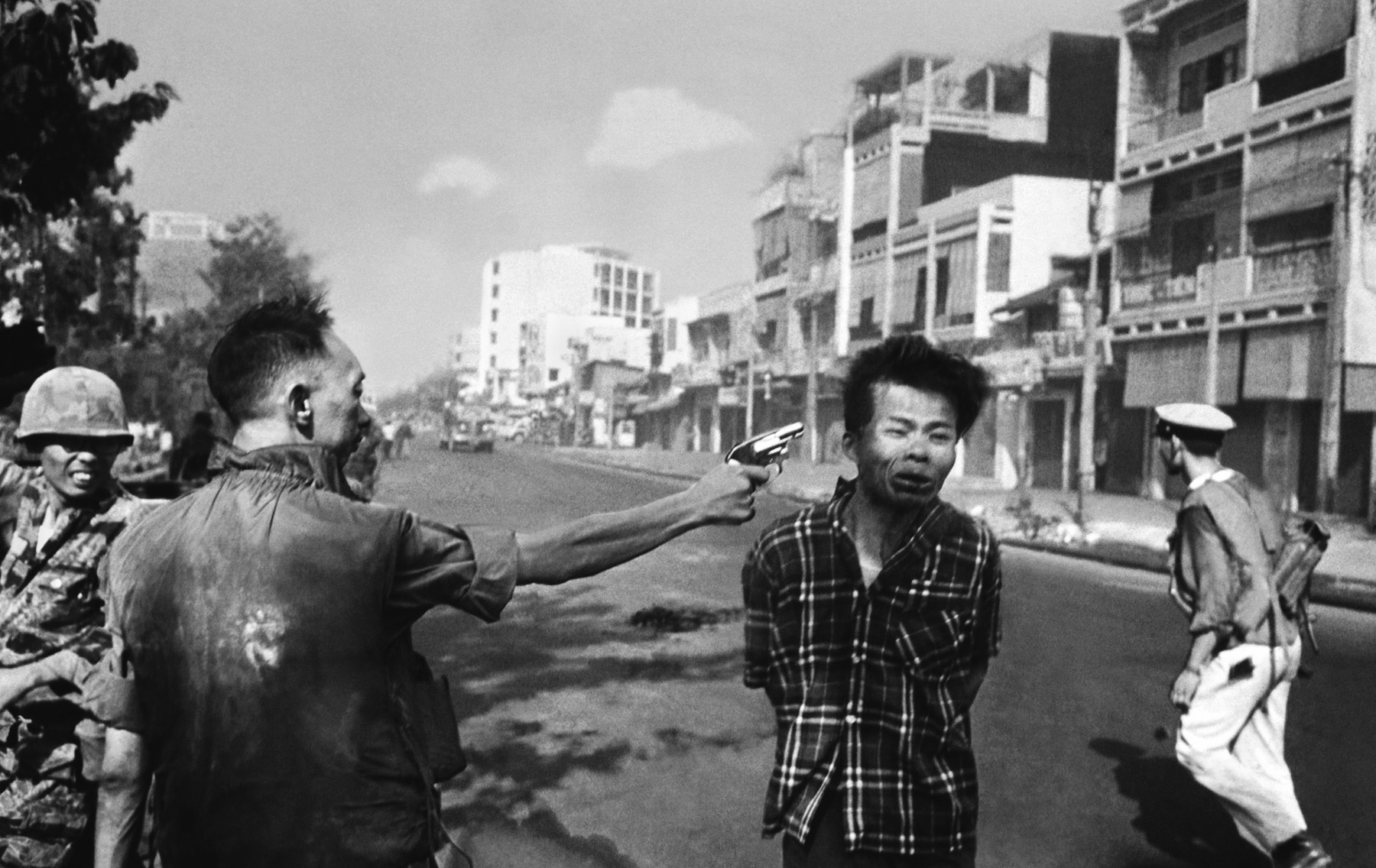
Around noon of February 1, 1968, in the opening days of the communist Tet Offensive, South Vietnamese General Nguyen Ngoc Loan summarily executed a Viet Cong prisoner on the streets of Saigon — and photographer Eddie Adams captured perhaps the war’s most unforgettable image.
An American cameraman also captured it in on celluloid. Caution: This clip shows … well, a man being shot in the head at point-blank range.
The general killed the Viet Cong; I killed the general with my camera … photographs do lie, even without manipulation.
For Adams, the lie was the omission of context — that the plainclothes Lem had allegedly just been caught having murdered not only South Vietnamese police but their civilian family members; that Loan was a good officer and not a cold-blooded killer.
Adams’ editor has said that many such summary executions were taking place during the Battle of Saigon — a broader context to the image no matter its specific fairness to the executioner.
But of course, the shot gained its deeper resonance from the growing disgust with the Vietnam War … and from its concise tableau of a century’s brutality. Here is a frozen image of Orwell’s boot stamping on a human face, forever.
Like any great work of art, Adams’ serendipitous photograph took on a life of its own … and a tapestry of meanings richer than its creator could ever have intended.
On January 31, 1945, Private Edward Donald “Eddie” Slovik became a curious outlier of World War II: he was executed by firing squad by the U.S. Army for desertion. He is the only person to have been so punished for that crime since the Civil War.
Pvt Slovik was, by all accounts, quiet and helpful, by no means a coward, and more than willing to aid in the effort of World War II, traits which would have put him among a large class of that war’s veterans. Unfortunately, he was also immobilized by shelling. Equally unfortunately, he knew it, and he decided to do something about it.
Slovik and a friend, Pvt John F. Tankey, first separated from their detachment under artillery fire in late August 1944, shortly after being shipped to France. The pair hooked up with a Canadian unit and spent six weeks pitching in. Having recused themselves from the hard shelling others were experiencing on the front line, they opted to rejoin their regular U.S. unit: Slovik and Tankey sent a letter to their commanding officer explaining their absence and returned on Oct. 7.
But the front lines were not a place for Pvt Slovik.
After his assignment to the rifle unit, which would face imminent danger during shelling, Slovik asked to be placed in the rear guard, indicating he was too scared to remain in front. His request was refused. He then reportedly asked whether leaving the unit again would be considered desertion, was told it would be, and opted for the seemingly safer route of, well, deserting. One day later, Slovik was back at a U.S. camp, this time turning himself in to the camp cook. He had drafted a letter explaining his actions and indicating that he knowingly deserted, permanently recording his guilt on paper.
It’s not clear whether Pvt Slovik was acting on principles or out of an understanding of the U.S. military judicial system. He was by no means the only soldier without affinity for the conditions of war, particularly on the allied side. During the war, thousands of soldiers were tried and convicted in military courts for desertion, but up to then, all had received only time in the brig. What is clear is that Slovik was repeatedly offered opportunities to return to the line, and he equally repeatedly refused.
The case was adjudicated on Nov 11 by nine staff officers of the 28th Division, none of whom had yet been in battle. One of those judges, Benedict B. Kimmelman, wrote a stark and intriguing account of his role in the story of Pvt Slovik, capturing the scene thusly:
Five witnesses were heard. The cross-examinations were perfunctory. The defense made no closing argument. The court recessed for ten minutes, resumed, and retired almost immediately afterward. Three ballots were taken in closed court, the verdicts unanimously guilty on all counts. In open court once more, the president announced the verdict and the sentence: to be dishonorably discharged, to forfeit all pay and allowances due, and to be shot to death with musketry. The trial had begun at 10:00 A.M.; it was over at 11:40 A.M.
As with all court martial cases, Slovik’s was sent to a judge advocate for review. His criminal record, including everything from destruction of property to public intoxication to embezzlement, did not endear him to the reviewer. More importantly, though, the advocate felt Slovik could be made an example:
He has directly challenged the authority of the government, and future discipline depends upon a resolute reply to this challenge. If the death penalty is ever to be imposed for desertion, it should be imposed in this case, not as a punitive measure nor as retribution, but to maintain that discipline upon which alone an army can succeed against the enemy.
Strangely, Pvt Slovik was the only person who would be exemplified this way.
Though the military tried 21,000 desertion cases and passed down 49 death sentences for desertion during the war, it carried out only Slovik’s. And in the war’s final battles, with Germany collapsing, his execution seemed like a surreal throwback. As Kimmelman notes, hundreds if not thousands of soldiers were strictly guilty of dereliction of duty and desertion in the waning days of 1944.
They’re not shooting me for deserting the United Stated Army — thousands of guys have done that. They’re shooting me for bread I stole when I was 12 years old. (Source)
Three weeks after his conviction and three weeks before the Battle of the Bulge, Slovik’s execution order was confirmed by the 28th Division’s commander, Major General Norman “Dutch” Cota. Cota was disturbed by Slovik’s forthrightness in confessing to the desertion, and, as a front line commander who had sustained severe casualty rates in the Battle of Hurtgen Forest, had no sympathy for the crime.
After an appeal to the deaf ears of Dwight Eisenhower shortly before the sentence was to be carried out, Slovik was out of options. He was taken to the courtyard of an estate near the village of Sainte-Marie-aux-Mines and shot by 11 Army marksmen* at 10 a.m. By 10:04, as they were reloading, he was declared dead. His body was interred at a French cemetery, and after decades of lobbying the U.S. government, his remains were returned to Michigan in 1987.
Because he was dishonorably discharged, Slovik was not entitled to a pension, and his wife, Antoinette, stopped receiving payments. Curiously, though the Army managed to communicate this to her, they omitted the bit about the execution. She found out in 1953 from William Bradford Huie.
Huie was a journalist who took immediate interest in Slovik’s story, popularizing it with his book The Execution of Private Slovik, which was released in 1954. Twenty years later, the book and title were requisitioned for a well-received TV movie starring Martin Sheen.
Perhaps more interesting than this film was its never-produced predecessor, which is entitled to a place in the history of the Hollywood Blacklist. Frank Sinatra acquired rights to The Execution of Private Slovik and in 1960 announced that he would produce it as his directorial debut — with the script of this inherently political story to be written by “Hollywood Ten” blacklistee Albert Maltz. Maltz and other blackballed writers had continued working pseudonymously during the anti-Communist blacklist, but Sinatra’s openly announcing an intent to hire and credit Maltz constituted a significant crack in the wall — even though commercial and political heat eventually forced Sinatra to abandon the project. This event has treatment in a recommended episode of the magnificent cinema-history podcast You Must Remember This.
* The firing squad included 12 marksmen, but one was given a blank. Despite their skill, the 11 remaining shooters did not manage to kill him instantaneously.
On this anniversary date of King Charles I’s beheading, the two-years-dead corpse of the late Lord Protector Oliver Cromwell was hung in chains at Tyburn and then beheaded, along with the bodies of John Bradshaw and Henry Ireton.
The great-great-grandnephew of ruthless Tudor pol Thomas Cromwell rose higher than any English commoner, high enough to be offered the very crown he had struck off at Whitehall. Oliver Cromwell declined it in sweeping Puritan rhetoric just as if he hadn’t spent weeks agonizing over whether to take it.
“I would not seek to set up that which Providence hath destroyed and laid in the dust, and I would not build Jericho again.”
The House of Stuart never could rebuild its Jericho while the Lord Protector ran the realm* — thirteen years, writes Macaulay, “during which England was, under various names and forms, really governed by the sword. Never, before that time, or since that time, was the civil power in our country subjected to military dictation.”
“Cromwell lifting the Coffin-lid and looking at the body of Charles I”, by Hippolyte (Paul) Delaroche — a French painter with an affinity for English executionscenes. The painting is based on an apocryphal but irresistible legend, also used by Nathaniel Hawthorne in a tedious short story.
The English Commonwealth foundered after Cromwell’s death, however, and restoration of the monarchy — a rock, as it turned out, on which the Puritans’ bourgeois revolution could erect its colossus — came with the price of a few examples being made.
Of course, “executing” dead guys displays about as much strength as it does sanitation, and for all Charles II‘s demonstrative vengeance, the politically circumscribed throne he resumed was very far from his father’s dream of absolutism. Between the late dictator and the new king, the future belonged to the corpse clanking around on the gibbet.
When the able Charles II followed Cromwell into the great hereafter, his brother James II promptly fumbled away the crown with his anachronistic insistence on royal authority and his impolitic adherence to Catholicism.**
In the emerging England of the century to come, the divine right would depart the Stuarts for another dynasty more amenable to the rising authority of the parliament whose sword Oliver Cromwell once wielded.
* Resources on the particulars of Cromwell’s career, the English Civil War, et al, are in plentiful supply online. This BBC documentary is a very watchable overview: part I; part II; part III; part IV.
** James II remains England’s last Catholic monarch.
On this date three years ago — or at least, so says the date in the camera’s viewfinder — a female spy was “tried” and “executed” in Iraq by al Qaeda affiliated terrorists for spying.
Warning: This is (by design) a graphic and chilling video. I have little information beyond the assertion of the video posters as to its veracity. Whether or not it may be relied upon factually or dated reliably, it’s a gut-twisting video of a woman being shot in the head.
On this date in 1953, Derek William Bentley was hanged by Albert Pierrepoint in London’s Wandsworth Prison for a murder committed by a friend.
The execution of the mentally impaired 19-year-old was a lightning rod when it was pronounced the previous December and remained so over a half-century struggle for his posthumous pardon.
He had been caught robbing a warehouse with an underage friend in November 1952, and in the gunfight that ensued, a police officer was shot — 15 minutes after Bentley was arrested.
In a welter of confusing evidence, the essential fact was that the two youths had engaged a criminal enterprise and thus became jointly liable for every consequence of the crime, regardless of who pulled the trigger. Nevertheless, it rankled as a manifest injustice that the young man should hang for a murder that happened after he was in custody, while the triggerman should not. There was a sense that Bentley faced a maximal punishment in the state’s frustration that the shooter was too young to hang; and, that since the two boys’ ages were barely on either side of 18 and the 17-year-old Christopher Craig arguably the dominant member of the duo, the effect was a great injustice.
This morning’s hanging was hotly protested. Several hundred rallied outside the prison; 200 MPs presented a petition for Bentley’s clemency, and afterwards several were rebuffed attempting to debate the hanging in Parliament. The medical journal Lancet assayed the general disquietude at the situation and opined that
[W]e are obliged to ask ourselves whether in holding to the letter of justice we are letting the spirit escape … To the English, at any rate, revenge is seldom a fully satisfying experience; it carries too much guilt with it. In the case of Bentley the public sense of guilt seems to have been strong — far stronger than the desire for vengeance.*
Bentley’s 21-year-old sister Iris vowed to her brother the night before his death that she would clear his name, and she fought for the rest of her life to do so. She would win that fight in 1998 (one year after her own death) when the conviction was overturned.
In the meantime, Bentley’s fate entered the public conscience, generally but not universally in the capacity of miscarriage of justice.
Bentley is the subject of an Elvis Costello song, “Let Him Dangle”:
* Lancet also said that “in our view the perpetual public preoccupation with the condemned cell and the gallows is harmful to the mental health of society.” Executed Today does not endorse this position.
On this date in 1781, George Washington quelled a dangerous mutiny in his starving Continental Army with a couple of salutary summary executions.
Weeks before, the Pennsylvania Line had mutinied for better pay — successfully. (When approached by British agents offering hard currency should they turn coat, the mutinous troops patriotically arrested the agents.)
General Washington had cause to fear widespread discontent in his chronically undersupplied army, however. He circulated to Congress and to several state governors an urgent appeal (.pdf) for more aid to hold up morale.
The aggravated calamities and distresses that have resulted from the total want of pay for nearly twelve months, the want of clothing at a severe season, and not unfrequently the want of provisions, are beyond description … it is vain to think an army can be kept together much longer under such a variety of sufferings as ours has experienced … unless some immediate and spirited measures are adopted to furnish at least three months’ pay to the troops in money, which will be of some value to them, and at the same time ways and means are devised to clothe and feed them better … the worst that can befall us may be expected.
Washington vowed in the meantime to “continue to exert every means I am possessed of to prevent an extension of the mischief.”
The mischief, however, extended.
The New Jersey line at Pompton imitated — and the imitation was reportedly explicit — the Pennsylvania line. They had legitimate grievances, like nearly everyone in the Continental Army, and that was precisely the problem: if mutiny became the means to resolve grievances, Washington wouldn’t have a Continental Army much longer.
Sir: You are to take the command of the detachment, which has been ordered to march from this post against the mutineers of the Jersey line. You will rendezvous the whole of your command at Ringwood or Pompton as you find best from circumstances. The object of your detachment is to compel the mutineers to unconditional submission, and I am to desire you will grant no terms while they are with arms in their hands in a state of resistance. The manner of executing this I leave to your discretion according to circumstances. If you succeed in compelling the revolted troops to a surrender you will instantly execute a few of the most active and most incendiary leaders.
Dr. Sir: I have the pleasure to inform your Excellency, that the measures concerted for quelling the mutiny in the Jersey line were this morning carried into full execution. The mutineers were unexpectedly surrounded and awed into an unconditional surrender with little hesitation and no resistance. Two of the principal actors were executed on the spot, the rest pardonned. The spirit of mutiny seems now to have completely subsided and to have given place to a genuine repentance. This was very far from being the case previous to this step, notwithstanding the apparent submission which the assurances of redress had produced; they still continued insolent and refractory and disobedient to the commands of their officers.
A general pardon was promised by Colonel Dayton, on condition of an immediate and full return to duty. This condition was not performed on the part of the mutineers and of course they were not entitled to the benefit of the promise; besides which the existence of the Army called for an example. I have the honor etc.
That second paragraph of the letter hints at a bit of ass-covering from Washington. The officer on the scene, Elias Dayton, had, according to Charles Patrick Neimeyer, already smoothed the disturbance by promising that a state commission would adjudicate discharge claims.
The placated “mutineers” were therefore surprised to be roused from their beds at Ringwood, N.J., by Howe’s forces and forced to form a firing squad to execute their own sergeants. (Neimeyer also claims that the first six-man squad intentionally missed.)
On this date in 1937, Isidore “Beansy” Zimmerman spent the day preparing for death in New York’s electric chair … but was spared by an 11th-hour clemency from New York Governor Herbert Lehman.
Here’s the scene, as laid in the anti-death penalty tome of wrongful convictions In Spite of Innocence:
As dawn broke over Sing Sing Prison, Beansy Zimmerman had every reason to think it would be his last day.
Zimmerman numbly went through the pre-execution rituals. The last meal (choose whatever you want), and music (you get to choose that, too) played on the wind-up phonograph. The barber shaves your scalp so the electrodes can fit snugly against your bare skin. The tailor slits one of your trouser legs for another electrode. Officials treat you with unaccustomed politeness. A final family visit — how do you say good-bye when you know it is forever? What should your last words be? Beansy’s mother stayed away, unable to face such finality.
Two hours before execution, Gov. Lehman commuted his sentence.
In this blog, we lay aside each story day by day, but for those affected, it’s rarely so easy — which is why the mothers of the five men condemned today put in their personal clemency appeals to the governor.
For Zimmerman and a fellow “accomplice” named Philip Chaleff whose respective roles in a robbery/murder were doubted, it had the desired effect. (Dominick Guariglia, Arthur Friedman and Joseph O’Loughlin weren’t so lucky.)
Chaleff, a diabetic being kept alive just for execution, soon succumbed. For Zimmerman, the execution that did not happen was to define the rest of his 66 years. He was alive, but to what end?
“I wasn’t dead, no,” he remembered. “But every day from now on they’d bury me a little more.”
Zimmerman fought, by becoming a skilled jailhouse lawyer and in 1962 finally winning exoneration from the New York Supreme Court, which held that the testimony against him had been perjured with the connivance of the prosecutor.
He’d spent nearly a quarter-century in prison. Now, he was just another ex-con scrabbling after dead-end employment.
For years thereafter, Zimmerman fought for a special bill that would allow him to sue the Empire State for wrongful imprisonment, finally winning approval in 1981.
His suit asked for $10 million. The judge reckoned Zimmerman’s time and trouble were worth a tenth of that.
Expenses deducted, Zimmerman walked away with $660,000 — that, and sweet vindication.
On this date in 1795, a Balzac story La Comedie humaine reaches its climax as the tumbrils of the Thermidorian Reaction wind their way to the scaffold.
It transpires in an exchange between the two that the stranger’s own conscience is somehow troubled.
“Remember, my son, [said the abbe] that it is not enough to have taken no active part in the great crime; that fact does not absolve you. The men who might have defended the King and left their swords in their scabbards, will have a very heavy account to render to the King of Heaven — Ah! yes,” he added, with an eloquent shake of the head, “heavy indeed! — for by doing nothing they became accomplices in the awful wickedness—-”
“But do you think that an indirect participation will be punished?” the stranger asked with a bewildered look. “There is the private soldier commanded to fall into line — is he actually responsible?”
We have no more answer in the text than we have in life.
Spoiler (That You Saw Coming) Alert
The stranger returns on the anniversary of the king’s martyrdom, but he remains enigmatic, until the abbe is caught up in a crowd watching the procession to the guillotine.
“What is the matter?” [the abbe] asked Madame Ragon.
“Nothing,” she said; “it is only the tumbril cart and the executioner going to the Place Louis XV. Ah! we used to see it often enough last year; but to-day, four days after the anniversary of the twenty-first of January, one does not feel sorry to see the ghastly procession.”
“Why not?” asked the abbe. “That is not said like a Christian.”
“Eh! but it is the execution of Robespierre‘s accomplices. They defended themselves as long as they could, but now it is their turn to go where they sent so many innocent people.”
The crowd poured by like a flood. The abbe, yielding to an impulse of curiosity, looked up above the heads, and there in the tumbril stood the man who had heard mass in the garret three days ago.


 Pvt Slovik was, by all accounts, quiet and helpful, by no means a coward, and more than willing to aid in the effort of World War II, traits which would have put him among a large class of that war’s veterans. Unfortunately, he was also immobilized by shelling. Equally unfortunately, he knew it, and he decided to do something about it.

 The execution of
  In this blog, we lay aside each story day by day, but for those affected, it’s rarely so easy — which is why the