On this date in 1934, Dutch bricklayer Marinus van der Lubbe was beheaded by guillotine in Leipzig for setting the Reichstag Fire.
A watershed event* in the formation of the Nazi dictatorship, the Reichstag fire days before a parliamentary election enabled Hitler to stampede voters, suspend civil liberties, suppress left-wing parties on grounds of a suspected Communist plot, and seize “emergency” powers he would never relinquish.
Heil Hitler.
This clip from an American miniseries on Hitler with the characters chattering in unaccented English portrays the fascists’ opportunistic use of the attack on a national symbol … something not exactly unknown to later generations.
Van der Lubbe, who was arrested on the scene, suffered the predictable fate. Four other Communists charged as accomplices were acquitted, in a trial with the gratifying spectacle of Hermann Goering personally testifying, and being undressed on cross-examination by one of the reds. One is reminded here that Hitler did not yet have everything in the state apparatus at his beck and call … although he did have a great deal already, inasmuch as the arson law under which van der Lubbe died was passed after the Reichstag fire and made retroactive.
If the big-picture outcome of the Reichstag fire is pretty clear-cut, its real origin and the corresponding rightness of the judicial verdicts have remained murky ever since. The fact that the scene of the crime became Nazi ground zero for the next decade sort of obscures the evidence.
Van der Lubbe confessed, so his participation is generally taken as a given.
Whether he was really able to start the blaze acting alone, as he insisted, and the Nazis “only” exploited this fortuitous calamity; whether he was part of a larger leftist plot, as his prosecutors claimed; or whether, as Shirer and many others since have viewed him, he was a patsy in a false flag operation set up by the Nazis with an eye towards creating a politically advantageous national emergency — these possibilities remain very much up for debate.
For what it’s worth, postwar West German courts reversed and un-reversed the sentence before officially rehabilitating van der Lubbe last year on the non-specifically indisputable grounds that the legal machinery brought to bear on the Reichstag fire “enabled breaches of basic conceptions of justice.”
I do not see that one can blame the majority of Germans who, in 1933, believed that the Reichstag fire was the work of the Communists. What one can blame them for, and what shows their terrible collective weakness of character … is that this settled the matter. With sheepish submissiveness, the German people accepted that, as a result of the fire, each one of them lost what little personal freedom and dignity was guaranteed by the constitution, as though it followed as a necessary consequence. If the Communists had burned down the Reichstag, it was perfectly in order that the government took “decisive measures”!
Next morning I discussed these matters with a few other Referendars. All of them were very interested in the question of who had committed the crime, and more than one of them hinted that they had doubts about the official version; but none of them saw anything out of the ordinary in the fact that, from now on, one’s telephone would be tapped, one’s letters opened, and one’s desk might be broken into. “I consider it a personal insult,” I said, “that I should be prevented from reading whichever newspaper I wish, because allegedly a Communist set light to the Reichstag. Don’t you?” One of them cheerfully and harmlessly said, “No. Why should I? Did you read Forwards and The Red Flag up to now?”
Fifteen years ago, a Libyan-born dissident of American nationality was abducted from a human rights conference in Cairo.
The fate or current whereabouts of Mansour Kikhia remain unknown to this day — although one widely-suspected scenario (and the conclusion of a CIA report on the incident) is that he was spirited to Libya and secretly executed early in 1994.
While other speculation has had Kikhia being held alive, the insulin-dependent diabetic would have been in a bad way absent the sort of painstaking medical attention he would not likely have been receiving from his captors.
The former Libyan foreign minister and United Nations ambassador, who had broken with dictator Muammar al-Gaddafi in 1980, was in Egypt to participate in an Arab Organization of Human Rights conference. The date he vanished from his hotel, last seen in the company of unknown Egyptian men driving vehicles with Mukhabarat markings, was December 10, 1993 — the 45th anniversary of the seminal modern human rights document, the Universal Declaration of Human Rights.
Several distinguished Middle Eastern scholars wrote an open letter shortly after Kikhia’s disappearance imploring
Arabs, Americans with an interest in the Arab world and human rights organizations not to rest until he regains his freedom. Nothing could be worse than to let the governments concerned think he will be forgotten.
If not “forgotten” in the strictest sense — see some links of the bulletins issued over the years to keep alive his memory — the governments concerned sure seem to have paid no price for having disappeared Mansour Kikhia.
December 30 is Rizal Day (Araw ng Kabayanihan ni Dr. Jose Rizal in Tagalog) in the Philippines, for the execution that date in 1896 of the great martyr of Philippine independence.
Also available free at gutenberg.org (the HTML version is very well-illustrated).
At Jose Rizal’s birth in 1861, it had been 340 years since Magellan had reached (and died at) the Philippines under the Spanish flag.
In Rizal’s century of romantic nationalism, independence movements stirred abroad in the Spanish Empire … too weak yet in the Philippines and elsewhere during the mid-1800s, but unmistakably prefiguring those national destinies that this day’s victim would come to embody.
Oddly, Jose Rizal was not even the most “revolutionary” of his farming family’s 11 children. That distinction went to older brother Paciano, who was under an official cloud before Jose hit adolescence for his relationship with the Gomburza priests, and would later serve as a brigadier general in the revolutionary army of Emilio Aguinaldo.
Jose was less strident — and more brilliant.
Though reputedly an adept fencer and crack shot with a pistol, the renaissance man’s gifts ran more to the life of the mind.
At the Universidad Central de Madrid, the University of Paris, and the University of Heidelberg, Jose Rizal studied ophthalmology and anthropology, and pursued the variegated artistic interests of his youth.
His two novels published from Europe, Noli Me Tangere and El Filibusterismo*, both criticized colonial authorities and their Vatican adjutants and struck nationalist chords that put him on the Spanish government’s watch list.
“I die without seeing the dawn brighten over my native land! You, who have it to see, welcome it — and forget not those who have fallen during the night!” -From Noli Me Tangere
Rizal also penned essays and editorials in a less symbolic vein, like this one skewering the stereotype of the lazy native by turning the mirror upon colonial agents who were waiting to prey on the fruit of native labor:
How is it strange, then, that discouragement may have been infused into the spirit of the inhabitants of the Philippines, when … they did not know whether they would see sprout the seed they were planting, whether their field was going to be their grave or their crop would go to feed their executioner? What is there strange in it, when we see the pious but impotent friars of that time trying to free their poor parishioners from the tyranny of the encomenderos by advising them to stop work in the mines, to abandon their commerce, to break up their looms, pointing out to them heaven for their whole hope, preparing them for death as their only consolation?
Man works for an object. Remove the object and you reduce him to inaction The most active man in the world will fold his arms from the instant he understands that it is madness to bestir himself, that this work will be the cause of his trouble, that for him it will be the cause of vexations at home and of the pirate’s greed abroad. It seems that these thoughts have never entered the minds of those who cry out against the indolence of the Filipinos.
(This essay and both novels are available in the original Spanish and in English at gutenberg.org, along with various translations of Rizal’s various fiction and non-fiction work.)
Fire-eating stuff in the eyes of the Spanish crown, but Rizal wasn’t the bomb-throwing type himself.
As the Philippine Revolution that would break the Spanish yoke on the islands took shape in the summer of 1896, Rizal applied to go to Spanish Cuba to treat victims of the yellow fever, and even explicitly disavowed the revolution.
Countrymen: I have given proofs, as well as the best of you, of desiring liberty for our country, and I continue to desire it. But I place as a premise the education of the people, so that by means of instruction and work they may have a personality of their own and that they may make themselves worthy of that same liberty. In my writings I have recommended the study of the civic virtues, without which there can be no redemption. I have also written (and my words have been repeated) that reforms, to be fruitful, must come from _above_, that those which spring from _below_ are uncertain and insecure movements. Imbued with these ideas, I cannot do less than condemn, and I do condemn, this absurd, savage rebellion, planned behind my back, which dishonors the Filipinos and discredits those who can speak for us. I abominate all criminal actions and refuse any kind of participation in them, pitying with all my heart the dupes who have allowed themselves to be deceived. Go back, then, to your homes, and may God forgive those who have acted in bad faith.
This stance on the revolution — the fact that he thought and wrote but never struck a blow — has engendered some controversy over the rightfulness of Rizal’s place in the national pantheon, as has his anti-clericalism and a disputed Vatican claim that Rizal retracted his criticisms of the Church before his death. One Spanish contemporary called Rizal “the Tagalog Hamlet.”
But mostly he is seen as the Spanish government at the time saw him, and as many revolutionaries did as well: as the lodestar of the Philippines’ national aspirations.
Rizal was arrested en route to his humanitarian assignment in Cuba and returned to Manila to face trial for sedition, rebellion and conspiracy, by which point, of course, the verdict was quite preordained. He was shot in the back by a firing squad, uttering the Christ-like last words “consummatum est” — “it is finished.”
Rizal’s execution, and the events preceding it, are depicted in this long excerpt of a 1998 film:
Jose Rizal’s execution.
Near the spot Rizal was actually executed, his martyrdom depicted in statuary.
* A filibuster is a private military expedition, and more typically associated with Anglo American campaigns against the Spanish-speaking lands to the south, like those of William Walker.
On this date in 1878, John “Black Jack” Kehoe was hanged in Pottsville — as Pennsylvania’s anthracite trusts took a victory lap around the corpses of the Molly Maguires.
Even to say what the Mollies were is to take a side in their life-and-death struggle. Irish immigrants fleeing the potato famine had poured into Pennsylvania’s coal mining country in the mid-19th century, where life in the mines was nasty, brutish and short, and the pay wasn’t anything to write home about either.
In a time when capital ruthlessly hunted any intimation of labor organizing and the Irish were a distinctly second-class people, the (apparent, or at least alleged) response of the Mollies was natural: form a secret society, and wring by threat of bodily harm the concessions it could not pursue by collective bargaining. For the recent Irish transplants, the tableau of a Catholic underclass working for a Protestant landlord who owned (and gouged on) everything in sight had a certain familiar feel.
Terrorists? They certainly used violence to achieve political objectives, at least if the testimony of their foes is credited. But they weren’t the only ones.
Mine owners turned public and private violence on Irish radicals pushing for things like the eight-hour day. The notorious strike-breaking Pinkerton Detective Agency was detailed to infiltrate the Mollies.
The main blow against the Mollies was struck over a period of (extrajudicial) vigilante justice in the mid-1870’s, culminating in “Pennsylvania’s Day of the Rope” in 1877, when ten supposed members were (judicially) hanged around the Keystone State.
Kehoe, a power broker in mining country with some sway at the capital who was reputed to call the shots among the Maguires, faced the hangman singly a year later for an 1862 cold-case murder so doubtfully ascribed to Kehoe that the governor hesitated to sign the death warrant.
He signed it just the same, marking a sort of ceremonial “end to Molly-ism.” The New York Timesexulted two days hence “that the widely-extended and long-continued tyranny and terror of this association is at an end,” and all because the resolute executive had gone and sent a hempen message to “the savage and benighted population of the coal region.”
The lesson taught by the punishment of the Molly Maguires would have been shorn of much of its terror and impressiveness if the energetic and persistent efforts made in behalf of KEHOE, the reputed king of that organization, had resulted in rescuing him from the gallows. If they had even so far succeeded as to have caused his punishment to be commuted to imprisonment for life, the admonitory influence of his fate upon the murderous clain of whom he was the last surviving chief would have been greatly lessened, and the snake of Molly Maguire-ism, of which he was the forked tongue and fangs, might haply have been only scotched, not killed. … The law has shown that it has subtlety enough to hunt [the Molly Maguires] through every possible labyrinth of refuge and strip from them every artifice of disguise, and power enough to wring them out of the desperate grasp of sympathizing constituencies and crush them.
Florid.
Like we said, violence wasn’t the exclusive resort of one side. But the monopoly of violence … that was held, as always, by the same hands that held the monopolies. Sean Connery as Kehoe reflects on the uneven contest while awaiting his fate in a (fictional) exchange with the Pinkerton mole who condemned him from the 1970 film The Molly Maguires.*
Pennsylvania Gov. John Hartranft left office a few weeks later, and reflected in his outgoing address on the lessons “the manufacturers and operators” ought to draw from the late unpleasantness.
The Mollie Maguire murders, like the agrarian murders in Ireland, and the trades-union outrages, arsons, and machine-breakings in England, were not the work of the so-called criminal classes. They were essentially class murders … If some of the leading spirits of the class had been members of a board of arbitration as representatives of labor, with some of the employers or their agents as representatives of capital, it is not unreasonable to suppose that most of the disagreements that have kept the coal regions in a state of turmoil might have been amicably adjusted, and many of those who were assassinated and of those who have been hanged living to-day.
101 years later, Kehoe received what was thought to be the first and only posthumous pardon in the state’s history. The Mollies’ true extent, purpose and actual actions — even their very existence as anything but a stalking-horse for the more thorough conquest of surplus labor — remain hotly debated to this day, since the public record of this tight-lipped society consists of little beyond the courtroom testimony of a handful of parties thoroughly prejudiced to hostility by class interest or payoffs.
* Written by Walter Bernstein, who had only recently emerged from the Hollywood blacklist for his Communist proclivities.
On this date in 1937, Japanese emigre Masao Sudo was shot in Moscow as a spy.
The executed man’s son, Dr. Mikhail Masaovich Sudo.
A true-red Communist who had fled increasingly right-wing Japan in the 1920’s and become a labor organizer in the far east, Sudo shared the tragic fate of the Japanese community in Stalin’s USSR, decimated by denunciations of one another.
John Brown, abolitionist, father of 20 children, advocate of armed insurrection as a direct means of ending slavery, is just such a figure. Before looking at how his actions influenced history, however, it is instructive to consider how history influenced him.
Born into a devout family opposed to slavery on religious and moral grounds, Brown grew up in a vehemently anti-slavery district of Ohio and, as a young man, began training in New England to become a Congregationalist minister.
When money ran out, he returned to Ohio and began a series of variously successful business ventures and married his first wife, with whom he would have seven children. When his businesses failed, he moved to Pennsylvania, buried his wife, married his second, and started a tannery, which began to founder as one of his sons died and Brown fell ill. He moved his family –- now with more than a dozen children –- back to Ohio, where he was hit hard by the economic crisis of 1839 (PDF link). In 1842, he was declared bankrupt; the following year, four more of his children died of dysentery.
In spite of these setbacks, Brown remained dogged in his pursuit of ventures to get himself out of debt, becoming a seasoned expert among small sheep farmers and acting as a self-appointed crusader for their empowerment against the encroaching interests of manufacturers. While this backfired and Brown remained impoverished into the 1850s (thought not as much as when he was declared bankrupt), it solidified his interest in helping the underdog.
Bleeding Kansas
Moral and religious interest in the abolition of slavery had been part of Brown’s upbringing, but it wasn’t until 1855, when five of Brown’s adult sons began sending word of often violent pro-slavery machinations in the Kansas territory, that Brown first became committed to drastic action on behalf of the cause. His strategy wasn’t at first overtly violent, but was rather convinced that the anti-slavery cause could win by the ballot box; over the course of the next year, however, he became convinced that the only sure way of preserve Kansas as a free territory was by “fighting fire with fire” (historical opinion as to the precise extent of the pro-slavery violence in relation to Brown’s later actions is divided).
In 1856, with tensions reaching a boiling point, Brown, four of his sons, and a band of other abolitionists killed five pro-slavery settlers in Franklin County, Kansas in what became known as the Pottawatomie Massacre. No legal retribution was possible or likely; Brown and his party escaped handily (although one of his sons was killed the following August), and Brown spent the next three years using various aliases to travel among abolitionists raising funds to launch an all-out assault on slaveowners back East.
“The crimes of this guilty land will never be purged away but with blood.”
That he chose the federal arsenal in Harpers Ferry, Virginia (now West Virginia) for his historic attack was no accident; it “evinced federal power stained by slavery.”
Brown believed his actions would be the start of a lasting insurrection in which slaves would rise up against their owners in an insurrection that would quickly spread to neighboring counties and throughout the South. While violence was expected, it was to be minimized, and, after the initial raid, used only in self-defense.
Twenty-one men, in total, took part in the raid; Brown’s expected hundreds of recruits never materialized. The slave population never got a chance to rise up against their masters, as townspeople promptly began firing on the raiders; by the morning after the start of the raid, the invaders were surrounded by a company of US Marines.* Brown was captured, along with seven of his men; ten were killed, and four escaped.
Tried in Virginia for murder, treason and conspiracy, Brown was convicted on November 2, just weeks after his failed insurrection, and sentenced to be hanged within a month. His often-cited speech in Court in response to this sentence would become a rallying cry for the abolitionist movement:
This court acknowledges, as I suppose, the validity of the law of God. I see a book kissed here which I suppose to be the Bible, or at least the New Testament. That teaches me that all things whatsoever I would that men should do to me, I should do even so to them. It teaches me, further, to “remember them that are in bonds, as bound with them.” I endeavored to act up to that instruction… Now, if it is deemed necessary that I should forfeit my life for the furtherance of the ends of justice, and mingle my blood further with the blood of my children and with the blood of millions in this slave country whose rights are disregarded by wicked, cruel, and unjust enactments, I submit; so let it be done!
“Make the gallows glorious like the Cross.”
During his last month on Earth, Brown seemed well-aware that he was on his way to be a martyr. Refusing rescue by a supporter who had managed to infiltrate the prison, he wrote letters of valor and conviction which were increasingly picked up by the Northern abolitionst press, and attracted pleas of clemency from sources as removed as Victor Hugo.
Christ-like: The Last Moments of John Brown, by Thomas Hovdenden.
John Brown hanged at Charles Town, Virginia (present-day West Virginia — another thing Virginia lost during the Civil War). This 19th-century drawing is from the Virginia Military Institute archive of the event, which includes eyewitness accounts of soldiers who attended the hanging, including Thomas “Stonewall” Jackson.
Hanged in the mid-morning of December 2, 1859, Brown stated ominously: “I, John Brown, am now quite certain that the crimes of this guilty land will never be purged away but with blood. I had, as I now think, vainly flattered myself that without very much bloodshed it might be done.”
Brown’s dramatic enactment of an attempted armed insurrection –- even an abortive one –- stoked longstanding Southern fears of slaverebellions, leading the South to reorganize and equip its outdated militias, and the Union to increasingly valorize a man who held, with sheer and utter clarity, the very convictions in which they must needs believe to fight and win the coming War Between the States.
Called a “misguided fanatic” by the man who would lead that war, Brown’s actions nonetheless both hastened the inevitable schism already drawn so dramatically across a nation in which one out of every ten human beings was held in legal bondage, as well as gave moral and spiritual courage to those who would ultimately rise to eradicate it.
Did John Brown draw his sword against slavery and thereby lose his life in vain? And to this I answer ten thousand times, No! No man fails, or can fail, who so grandly gives himself and all he has to a righteous cause. No man, who in his hour of extremest need, when on his way to meet an ignominious death, could so forget himself as to stop and kiss a little child, one of the hated race for whom he was about to die, could by any possibility fail.
Did John Brown fail? Ask Henry A. Wise in whose house less than two years after, a school for the emancipated slaves was taught.
Did John Brown fail? Ask James M. Mason, the author of the inhuman fugitive slave bill, who was cooped up in Fort Warren, as a traitor less than two years from the time that he stood over the prostrate body of John Brown.
Did John Brown fail? Ask Clement C. Vallandingham, one other of the inquisitorial party; for he too went down in the tremendous whirlpool created by the powerful hand of this bold invader. If John Brown did not end the war that ended slavery, he did at least begin the war that ended slavery. If we look over the dates, places and men for which this honor is claimed, we shall find that not Carolina, but Virginia, not Fort Sumter, but Harpers Ferry, and the arsenal, not Col. Anderson, but John Brown, began the war that ended American slavery and made this a free Republic. Until this blow was struck, the prospect for freedom was dim, shadowy and uncertain. The irrepressible conflict was one of words, votes and compromises.
When John Brown stretched forth his arm the sky was cleared. The time for compromises was gone – the armed hosts of freedom stood face to face over the chasm of a broken Union – and the clash of arms was at hand. The South staked all upon getting possession of the Federal Government, and failing to do that, drew the sword of rebellion and thus made her own, and not Brown’s, the lost cause of the century.
On this date in 1871, eight first-year medical students, aged 16 to 19, were shot in Havana Place de la Punta by Spanish colonial authorities in one of the most notorious episodes of that island’s independence struggle.
Cuba was three years into the Ten Years’ War, the first of three major 19th century insurrections that would eventually throw off Spanish rule, but popular support for independence was far from universal.
This book is the English translation of the classic Cuban text written by their schoolmate.
A vocal pro-Spanish element opposed the rebels to the extent of mobilizing right-wing volunteer goon squads to rough up demonstrators and menace the government into dealing with them only at bayonet-point … proto-brownshirts, albeit from a more well-heeled class position.
Mostly middle- or upper-class peninsulares, they were able by sheer force of numbers to cow [liberally inclined Captain-General Domingo] Dulce into acceptance of their views … Their journal, La Voz de Cuba, accused Dulce of working for the rebels …
The volunteers were a foretaste of those twentieth century lower middle-class mobs of young men who often protest violently against the end of empire. Shouting Viva Espana! in the Villanueva Theatre, foreshadowing the pieds noirs of Algeria, they bridge the gap between Carlism and Fascism. (Cuba, Or, The Pursuit of Freedom by Hugh Thomas)
The Volunteers would make themselves felt this day.
The editor of that Volunteer paper La Voz de Cuba was assassinated in 1870. The fatal accusation against the students was that they had desecrated the grave of that editor.
In Cuba in 1871, vandalism with the wrong politics was good enough to get you shot … four days after the supposed crime. In that environment, it’s practically beside the point that one of the eight wasn’t even in town at the time and the “desecration” was so exaggerated (the link is a Spanish backgrounder) as to be essentially fabricated.
The procedural rigging dignified with the word “trial” wasn’t going to get hung up on that detail, but it was also on the verge of an acquittal or a light sentence when a Caribbean Brooks Brothers riotsteamrolled it (Spanish again) into sentencing eight to death and most of the others to significant prison terms.
Defense attorney Frederico Capdevila alone distinguished himself (more Spanish) at this circus with an indignant and energetic defense, despite being attacked at one point by the Volunteer mob. At its appalling conclusion, he drew his sword and theatrically broke it over his knee — a gesture of contempt for the military tribunal that cost him his military career and made his reputation to posterity.
Radical writer Jose Marti, 18 years old at the time of this execution, summoned the image frequently and helped raise 27 Noviembre de 1871 into an enduring emblem of the worst of colonialism.
On this date in 1927, the anti-clerical Mexican government made the emblematic martyr of the Cristero War.
This video is in Spanish, but the storyline is pretty easy to follow — young man finds faith, lives faith, dies faith.
Miguel Pro‘s dying cry, “Viva Cristo Rey!” — “Long live Christ the King!” — was a refrain of Cristeros, anti-government guerrillas who in the late 1920’s fought the revolutionary Mexican government’s attempts to forcibly restrict the power of the Catholic Church.
That conflict had been brewing for years, an outgrowth of Mexico’s own complex history of colonization and development — measures to restrict the church’s size, wealth, and social reach had been mooted and sometimes implemented well back to the middle of the 19th century.
Early in the 20th, the confrontation was merely a twist on its classic form: liberal state-builders and the Catholic hierarchy were (or increasingly saw themselves as) diametrically opposed in their vision for Mexico.
That conflict came to a head under president Plutarco Elias Calles, an irreligious northerner with a project of national capital development for whom the church’s intransigence from its agrarian strongholds was most unwelcome … and who seemed to delight in provoking Rome with sport like mandatory physicals for priests, not neglecting to publicize the incidence of venereal disease thereby revealed.
Liberals had already brought about drastically reduced clerical privileges in the Mexican Constitution of 1917; its somewhat draconian measures were neither fully enforced nor fully resisted, but initiated a period where the two hostile institutions rudely grappled for their respective spheres of influence on the ground.
Calles was the rudest grappler of all, and his 1926 Calles Law pushed for anti-clericalism stricter than the letter of the constitution … and sparked armed resistance.
It was an exceptionally dirty war with routine summary executions on both sides and thousands of Catholic refugees — a dangerous environment for any priest with legal sanctions against basically every practice of the vocation. (Photos of Cristeros, some in heroic resistance and others in grisly martyrdom, can be eyeballed here.)
Pro, a Jesuit who like many was forced underground, was under state surveillance and got picked up in the aftermath of an assassination attempt against a prominent politician. He was chosen to make an example of — without an actual trial, possibly because there’s no actual reason to think he was involved in the bombing.
Looking at these pictures of Pro’s last moments, it’s hard to believe that they were taken and circulated at government direction to cow the Cristero movement. Fail.
Led out to execution in a police courtyard. The place of his death today is (bizarrely) Calle Loteria Nacional.
Pro himself refused a blindfold. But why state authorities carrying out the execution with an eye towards public relations would allow him to die in this pose is anyone’s guess.
He blessed and forgave the firing squad, of course.
Just beginning to topple at the moment the bullets struck him.
Like many firing squad executions, this one failed to kill its victim with the ceremonial volley. Pro was finished off with a coup de grace.
Calles was simultaneously — the key measures were also enacted in 1926 — involved in a confrontation with the United States over oil rights, a situation that came to the brink of war, with Washington saber-rattling about “Soviet Mexico”. It’s tempting to wonder whether the two situations weren’t related, especially since the new American ambassador* who had arrived only the month before Pro’s execution would ultimately negotiate both situations’ resolutions.
While the natural resource politics went their separate way, the Mexican Revolution’s anti-clerical strain didn’t so much disappear by negotiation as fade away over decades, with regular new outbreaks.
One thinks of Mexico today as such so staunch a Catholic country that it’s hard to imagine that some of these provisions were only officially repealed in 1998.
As for Pro, he’s welcome in Mexico by now — celebrated by Pope John Paul II who ultimately beatified him, and the inspirational source of this hymn whose refrain is his famous last cry.
* The American ambassador in question, Dwight Morrow, invited Charles Lindbergh on a goodwill tour to Mexico, where the aviator would meet the diplomat’s daughter not long after Miguel Pro’s martyrdom. Little could Lindbergh and Anne Morrow suspect that their love match would set them on the path to their own famous encounter with capital punishment.
Today is International Students’ Day and a public holiday in the Czech Republic and in Slovakia thanks to the martyrdom of nine at the hands of the Nazi occupation forces this day in 1939.
The previous fall, Hitler had cowed the allied powers into ceding the mountainous Czechoslovakian Sudetenland to the Third Reich in order to avert war — leading to Neville Chamberlain‘s famously mistaken “peace in our time” speech.
In March 1939, Germany reneged its part of the bargain and gobbled up Bohemia and Moravia, essentially the modern Czech Republic.
That this would collapse Chamberlain’s vision of peace and set Europe’s powers on the road to war with Berlin was cold comfort to the occupied Czechs. They had their own problems.
On October 28, youth demonstrations in Prague against the occupation resulted in the shooting of Charles University medical student Jan Opletal
Two weeks later he succumbed to the injury, and his funeral turned into an anti-occupation riot forcibly quashed by German arms. According to the London Times account:
On November 17 at 3 a.m., the Gestapo entered all students’ colleges, men’s and women’s, without allowing them to dress, tied the students in groups of three, and dragged them away … Between 3 o’clock and 8 o’clock in the morning the Gestapo visited students’ homes and lodgings. Those opposing arrests and parents who withheld information were immediately shot at, and the wounded were refused attention. The Gestapo broke into high schools as well as into the university …
The prisoners were taken to the Ruzyn barracks and to the Sparta football stadium, where cold water was flung over them and were made to wait until the evening. Then, in the barrack yard, 124 students and teachers* were shot before their fellow-students, the first nine being presidents of students’ associations, including the brilliant young sociologist Dr. Matoushek [English Wikipedia entry | Czech], son of a former Minister of Commerce.
Universities in the cities were declared closed for three years; they would not in fact re-open until after the war.
The day, subsequently memorialized as den boje studentu za svobodu a demokracii (Day of the Students’ Fight for Freedom and Democracy), entered Czech history a second time a half-century later. A student protest at Opletal’s grave on this date in 1989 helped catalyze the Velvet Revolution that toppled Czechoslovakia’s Communist government.
* The larger figure was circulated in the days following by Czech sources. It is not clear to me whether that number proved unfounded, or whether subsequent memorials simply came to focus on the leading nine — whose executions are certain, and were even announced by German communique.
On this date in 1887, the Chicago political machine hanged four at Cook County Jail to defend civilization from the eight-hour day.
The Haymarket martyrs, as they would be remembered ere the hysterical atmosphere of their sentencing had passed, were four from a group of eight anarchist agitators rounded up when a never-identified person threw a bomb at Chicago police breaking up a peaceful rally. The bomb killed one cop; the indiscriminate police shooting that followed killed several more in friendly fire, plus an uncertain number of civilians.
The incident occurred just days after nationwide strikes began on May 1, 1886, in support of the eight-hour day. Nowhere were the tensions greater than Chicago, an epicenter of militant organizing. When tens of thousands poured into the streets on May 1, the Chicago Maildarkly said of high-profile radicals Albert Parsons and August Spies,
Mark them for today. Hold them responsible for any trouble that occurs. Make an example of them if trouble does occur.
Sure enough …
Most of the eight hadn’t even been present at the time the bomb was thrown, but the state put anarchism itself on trial under the capacious umbrella of “conspiracy,” in a proceeding so absurdly rigged that a relative of a slain cop was on the jury. Quoth the prosecutor,
Law is upon trial. Anarchy is on trial. These men have been selected, picked out by the grand jury and indicted because they were leaders. They are no more guilty than the thousand who follow them. Gentlemen of the jury; convict these men, make examples of them, hang them and save our institutions, our society.
That was the argument for hanging them. And right-thinking burghers applauded it.
Seven of the eight were condemned to die; two had their sentences commuted, but the other five refused to ask for clemency on the grounds that, innocent, they would “demand either liberty or death.” One of those five, Louis Lingg, painfully cheated the hangman by setting off a blasting cap in his mouth the night before his execution. (Lingg might have made, though seemingly not thrown, the mysterious bomb.)
“The time will come when our silence will be more powerful than the voices you are throttling today.”
“Throttle” was right, as the Chicago Tribune reported the next day, taking up when the trap was sprung:
Then begins a scene of horror that freezes the blood. The loosely-adjusted nooses remain behind the left ear and do not slip to the back of the neck. Not a single neck is broken, and the horrors of a death by strangulation begin.
Six years later, Illinois Gov. John Altgeld granted the free pardon the hanged men had demanded to the three surviving Haymarket anarchists. There is no institutional mechanism to determine erroneous executions in American jurisprudence — a fact that occasionally leads to smugly circular avowals that nobody recently executed has ever been “proven” innocent — and death penalty researchers Michael Radelet and Hugo Bedau believed as of this 1998 paper (pdf) that Altgeld’s executive statement flatly asserting the injustice of the Haymarket convictions was the most recent official acknowledgment of a wrongful execution in U.S. history. If true, its uniqueness would be understandable: the gesture cost Altgeld his political career.
Long gone as all these principals are, the legacy of Haymarket remains very much with us, and not just as a magnet for digital archives like this, this and this (don’t miss the brass gallows pin).
May 1, now rich with the symbolism of the Haymarket Passion, was soon selected by the international labor movement as the date to resume the eight-hour-day push — thus becoming the global workers’ holiday it remains to this day.
* Opposing interpretations of the Haymarket affair — which can be the “Haymarket riot” or the “Haymarket massacre,” depending on where you line up — were marked by opposing memorials. The police memorial was itself eventually bombed by the Weather Underground, and subsequently squirreled away from easy public view. Paradoxically, the Haymarket Martyrs Monument has been federally dignified as a National Historic Landmark.

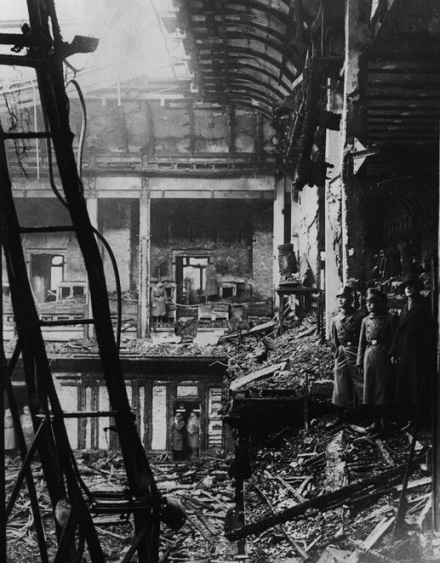
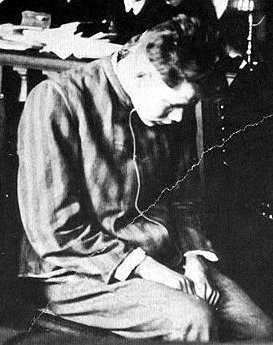 Van der Lubbe, who was arrested on the scene, suffered the predictable fate. Four other Communists charged as accomplices were acquitted, in a trial with the gratifying spectacle of Hermann Goering personally testifying, and being undressed on cross-examination by one of the reds. One is reminded here that Hitler did not yet have everything in the state apparatus at his beck and call … although he did have a great deal already, inasmuch as the arson law under which van der Lubbe died was passed after the Reichstag fire and made retroactive.
 The fate or current whereabouts of Mansour Kikhia
  His two novels published from Europe,

 The main blow against the Mollies was struck over a period of (extrajudicial) vigilante justice in the mid-1870’s, culminating in “Pennsylvania’s Day of the Rope” in 1877, when ten supposed members were (judicially) hanged around the Keystone State.


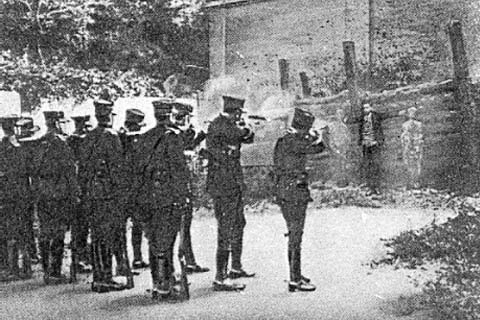


 In March 1939, Germany reneged its part of the bargain and


