On this date in 1934, in the coda to Hitler’s Night of the Long Knives purge of the Nazi party, the emerging dictator had his longtime ally shot.
Bavarian World War I veteran Ernst Röhm (Roehm) had been a National Socialist brawler of the earliest vintage: after the armistice, he was among the Freikorps paramilitaries to topple the short-lived Munich Soviet. He joined the NSDAP’s predecessor, the German Workers’ Party, before Hitler himself, and he stood trial with the future Fuhrer after helping Hitler attempt the Beer Hall Putsch. They were so tight, Hitler politely ignored Röhm’s open homosexuality.
But most importantly, Röhm was the energetic organizer of the Sturmabteilung, or SA — the party’s private army ready at arms for street battles with Communists, roughing up Jews, Praetorian Guard duty for party brass, and various and sundry other unpleasantries.
An SA brownshirt tosses a book on the pyre at a May 10, 1933 book burning.
Röhm grew the SA like a weed. At well over 4 million men by the time of Hitler’s Chancellorship, it greatly outnumbered the army itself.
This gave Röhm personal designs on absorbing the army into his paramilitary instead of the other way around, and it gave Röhm the literal boots on the ground to manifest his own commitment to the “Socialist” bits of the “National Socialist” project. His noises about the “second revolution” to come after the Nazis had already obtained state power were most unwelcome.
“One often hears voices in the bourgeois camp to the effect that the SA have lost any reason for existence, but I will tell these gentlemen that the old bureaucratic spirit must yet be changed in a gentle or, if need be, an ungentle manner.”
Well, those gentlemen weren’t about to wait around to be changed in an ungentle manner. Hitler was induced to sacrifice the man who raised him to power in favor of those who could keep him there, personally arrested his old friend and aide-de-camp as the June 30 purge got underway.
A sucker for nostalgia, Hitler didn’t have Röhm killed outright — the fate of many others in those terrible hours — but instead shipped him to Stadelheim Prison in Munich.* After due consideration, though, the treacherous chancellor did what he was always going to do.
Hitler ordered a revolver to be left in his cell, but Röhm refused to use it: “If I am to be killed, let Adolf do it himself.” According to an eyewitness at the 1957 Munich trial of those involved, he was shot by two S.S. officers who emptied their revolvers into him at point blank range. “Röhm wanted to say something but the S.S. officer told him to shut up. Then Röhm stood at attention — he was stripped to the waist — with his face full of contempt.”
A nice twist of the Long Knife by its wielders: they justified the purge on the grounds of an imminent coup attempt by the dead SA boss,** branding the murders of Röhm and his comrades … the Röhm-putsch.
In the dark hours this date in 1934, a bargain with the devil was sealed in blood.
Months before, even mere hours before, it was still possible for longstanding adherents of the National Socialist Workers’ Party to demand the “Socialist” part of the program.
The SA and the SS will not tolerate the German revolution going to sleep and being betrayed at the half-way stage by non-combatants. … It is in fact high time the national revolution stopped and became the National Socialist one. Whether [the bourgeoisie] like it or not, we will continue our struggle — if they understand at last what it is about — with them; if they are unwilling — without them; and if necessary — against them.
Populist, not Bolshevik. (In fact, stridently anti-communist.) Nevertheless, a distinct menace by the have-nots against the haves.*
Especially so because they were the words not of some impotent scribbler but of Ernst Roehm, commander of the the Nazis’ paramilitary brownshirts. And threatening, too, for Adolf Hitler for this same reason: his ascension the previous year to the Chancellorship had entailed terms with a German elite who needed but mistrusted the man’s mass party. Something was going to have to give.
The Communist exile Leon Trotsky’s 1933 analysis of the infant Nazi Germany’s dynamics proved prescient.
The banner of National Socialism was raised by upstarts from the lower and middle commanding ranks of the old army. Decorated with medals for distinguished service, commissioned and noncommissioned officers could not believe that their heroism and sufferings for the Fatherland had not only come to naught, but also gave them no special claims to gratitude. Hence their hatred of the revolution and the proletariat. At the same time, they did not want to reconcile themselves to being sent by the bankers, industrialists, and ministers back to the modest posts of bookkeepers, engineers, postal clerks, and schoolteachers. Hence their “socialism.”
…
German fascism, like Italian fascism, raised itself to power on the backs of the petty bourgeoisie, which it turned into a battering ram against the organizations of the working class and the institutions of democracy. But fascism in power is least of all the rule of the petty bourgeoisie. On the contrary, it is the most ruthless dictatorship of monopoly capital. … The “socialist” revolution pictured by the petty-bourgeois masses as a necessary supplement to the national revolution is officially liquidated and condemned.
The Night of the Long Knives this date took those blades to the “socialists”, to the men like Roehm whose dreams of redistribution were reckless enough to picture his working-class militia supplanting the German army proper.
As its price of power, the Nazi leadership purged these dangerous elements.
At 2 a.m. this date, Hitler flew to Munich to personally arrest Roehm on the pretext of averting an imminent coup by Roehm’s SA.** Elsewhere in the Reich, coordinated arrests and summary executions destroyed the Nazi party’s “left”, and throughout this date, and continuing into the next, did not scruple to sweep up whatever other conservative elements Hitler considered unreliable.
It was a dangerous but ultimately decisive move. Albert Speer saw Hitler on July 1, and remembered him ebullient at the triumph.
Hitler was extremely excited and, as I believe to this day, inwardly convinced that he had come through a great danger. … Evidently he believed that his personal action had averted a disaster at the last minute: “I alone was able to solve this problem. No one else!”
The final death toll is uncertain. Hitler copped to 77 in a speech to the Reichstag two weeks later which chillingly claimed that “in this hour I was responsible for the fate of the German people, and thereby I became the supreme judge”; it is likely that the true number is much higher. But its effect went far beyond those immediately killed: it tamed the SA’s independence, and permanently subordinated it to the military; and, it brought Adolf Hitler the dictatorial power that would make the succeeding years so fruitful for this blog.
Roehm himself died on July 2, initially spared for his many good offices for the Nazi cause before Hitler realized he could not leave him alive.
The armed forces, apparently the day’s big winner, would pay a price of their own for the arrangement.
“In making common cause with” the murderous purge, observed William Shirer in The Rise and Fall of the Third Reich, “the generals were putting themselves in a position in which they could never oppose future acts of Nazi terrorism.” As the quid for the quo, soldiers were soon required to swear “unconditional obedience” to Adolf Hitler, and this oath would give countless Wehrmacht officers sufficient reason or excuse to eschew resistance to their leader until much too late.
Barely a month after the Night of the Long Knives, the ancient German President Hindenburg died in office. Hitler, who now commanded the clear allegiance of his nation’s elites and had savagely mastered his own party besides, succeeded the powers of Hindenburg’s vacant office along with those of his own Chancellorship and became the German Fuehrer.
* When the Nazis were knee high to the Weimar Republic, their party program sought such radical stuff as abolition of rentier income, generous old-age pensions, and nationalizing trusts.
** The historicity of any actual coup plot is generally dismissed, although the event is still known in German by the expedient sobriquet the Nazi leadership gave it, Roehm-putsch.
RIYADH—A gay couple was beaded in a public execution Sunday [March 13, 2005] in Saudi Arabia after being convicted of killing a blackmailer. If they had been exposed as gay they could have been executed anyway.
Homosexuality is punishable by flogging, lengthy prison terms or death under Sharia Islamic law.
The Saudi Interior Ministry issued a statement Sunday announcing the execution. It said that Ahmed al-Enezi and Shahir al-Roubli, both Saudis, ran over Malik Khan in their car, beat him on the head with stones and set fire to his corpse “fearing they would be exposed after the victim witnessed them in a shameful situation”.
The term “shameful situation” is regularly used by the government to refer to homosexual acts.
The ministry said the two men were executed in the northern town of Arar, near the Iraq border.
The Saudi government routinely rounds up people suspected of being gay. All that is needed is a complaint from someone. In some instances men who are not gay who have been arrested were picked up on the complaint of a neighbor following a dispute.
The kingdom also, on a number of occasions, has blocked access to the only gay Arab news and information site on the internet.
Two centuries ago today, two men were hanged at Newgate Prison for buggery as a result of one of 19th century England’s most notorious anti-gay police raids.
Brits whose sexual palate ran beyond the stiff upper lip braved the force of the law to frequent molly houses, private clubs catering to homosexuality, cross-dressing, and the like.
In 1810, bobbies* busted mollies at one such establishment at the White Swan in London’s Vere Street. A press which evidently preferred its nicknames as vanilla as its coition dubbed these apprehended sodomites the Vere Street Coterie.
According toPhoenix of Sodom, a lasciviously queer-loathing account of the Coterie’s misadventures and of “the vast geography of this moral blasting evil” infesting London,
The fatal house in question was furnished in a style most appropriate for the purposes it was intended. Four beds were provided in one room – another was fitted up for the ladies’ dressing-room, with a toilette, and every appendage of rouge, &c. &c. A third room was called the Chapel, where marriages took place, sometimes between a “female grenadier”, six feet high and a “petit maitre” not more than half the altitude of his beloved wife! There marriages were solemnized with all the mockery of “bridesmaids” and “bridesmen”; the nuptials were frequently consummated by two, three or four couples, in the same room, and in the sight of each other. The upper part of the house was appropriated to youths who were constantly in waiting for casual customers; who practised all the allurements that are found in a brothel, by the more natural description of prostitutes. Men of rank, and respectable situations in life, might be seen wallowing either in or on beds with wretches of the lowest description.
It seems the greater part of these quickly assumed feigned names, though not very appropriate to their calling in life: for instance, Kitty Cambric is a Coal Merchant; Miss Selina a Runner at a Police Office; Blackeyed Leonora, a Drummer; Pretty Harriet, a Butcher; Lady Godiva, a Waiter; the Duchess of Gloucester, a gentleman’s servant; Duchess of Devonshire, a Blacksmith; and Miss Sweet Lips, a Country Grocer. It is a generally received opinion, and a very natural one, that the prevalency of this passion has for its object effeminate delicate beings only: but this seems to be, by Cook’s account, a mistaken notion; and the reverse is so palpable in many instances, that Fanny Murry, Lucy Cooper, and Kitty Fisher, are now personified by an athletic bargeman, an Herculean Coal-heaver, and a deaf Tyre-Smith: the latter of these monsters has two sons, both very handsome young men, whom he boasts are full as depraved as himself. These are merely part of the common stock belonging to the house; but the visitors were more numerous and, if possible, more infamous, because more exalted in life.
This intriguing little window into proto- or pre-gay culture opens to us at some cost to its participants, six of whom were confined to the pillory where the dangerous mob (“chiefly consisting of women”) bombarded them
with tubs of blood, garbage, and ordure from their slaughter-houses, and with this ammunition, plentifully diversified with dead cats, turnips, potatoes, addled eggs, and other missiles … They walked perpetually round during their hour [the pillory swivelled on a fixed axis]; and although from the four wings of the machine they had some shelter, they were completely encrusted with filth … On their being taken down and replaced in the caravan, they lay flat in the vehicle; but the vengeance of the crowd still pursued them back to Newgate, and the caravan was so filled with mud and ordure as completely to cover them.
Worse was to come.
Not arrested on the initial bust or included on the pillory, a 16-year-old regimental drummer named Thomas White was snitched out by a fellow-drummer for having also been a White Swan regular … and in fact, “an universal favourite … very deep in the secrets of the fashionable part of the coterie.”
The stool pigeon’s motivation was the usual in such cases: said pigeon was also making a bit on the side from the Coterie, and he had a mind to avoid his own self being completely covered with mud and ordure and dead cats and turnips.
This James Mann’s report to his superior officer, and subsequent testimony to the magistrates, got White and his partner in vice Ensign John Hewbolt Hepburn hanged for sodomy.
Our correspondent in Phoenix of Sodom notes the presence among that “vast concourse of people” who witnessed their deaths several nobles whom he clearly takes to be a vanguard of that homosexual agenda, “the Duke of Cumberland, Lord Sefton, Lord Yarmouth, and several other noblemen.” No word on Miss Sweet Lips or Blackeyed Leonora.
Merrie Olde England would go on issuing hempen discharges to gay soldiers for years to come.
As a footnote, the Rev. John Church, who might be the earliest openly homosexual Christian minister in England, was rumored to have performed gay marriages at the club.
It was on this date that notoriously corrupt Chinese minister of state Heshen or Ho-Shen was forced to commit suicide in lieu of execution.
The able child of a Manchu military officer, Heshen came of age in the long reign of the emperor Qianlong.
That Heshen rose above his modest station with this monarch’s favor was the source of no small resentment. Rumors circulated that the attractive young former bodyguard reminded the emperor of a lost, beloved concubine — with all that implies.
“Elegant in looks, sprucely handsome in a dandified way that suggested a lack of virtue,” a Korean diplomat described Heshen.
Whatever there might have been to the homosexuality angle, Heshen exploited the imperial protection to gorge himself on the state’s revenues; he’s reported to have filled the bureaucracy with clients who saw to it that Heshen got a yuan out of every tael that passed through state business in the last quarter of the 18th century. He even dynastically married his own son to one of Qianlong’s daughters.
It was the peak of the Qing dynasty’s glory, and the dawn of its imperial stagnation. Heshen — resplendent, omnipotent, and sunk in vice* — remains to this day its persona par excellence.
As long as the emperor lived, Heshen had a virtual free hand.
But as soon as the emperor died — on February 7, 1799, at the age of 87 — the successor** Jiaqing destroyed him.
Citing Heshen’s inability to suppress the nettlesome White Lotus and Miao rebellions, Jiaqing arrested and tortured the former retainer into copping to all manner of offenses both mortal and venial.
My thoughts dwell ever on the Confucian precept: ‘For three years after a parent’s death none of his former surroundings should be changed.’ …
But as regards Ho Shen, his crimes are too grave to admit of possible pardon … Ho Shen is a deep-dyed traitor, lost to all moral sense, who has betrayed his Sovereign and jeopardised the State. As self-constituted dictator he has usurped supreme authority.
Seeing the man’s abrupt change of fortunes, Heshen’s people in the bureaucracy fell over each other to denounce him.
He was condemned to the horrific expiation of “slow slicing”; however, given “the undesirability of executing the chief Minister of State like a common felon in the public square,” Jiaqing “allowed him the privilege of committing suicide, as a mark of high favour and out of regard to the dignity of the nation.”
A principal accomplice was made to witness Heshen ceremonially hanging himself; then the accomplice was reprieved of his own death sentence and sent into exile.
The new sovereign found his nation’s dignity sufficiently upheld by the doomed man’s melancholy inventory of loot destined (of course) for the re-appropriation of the Qing … and sufficiently outraged that, upon discovering weeks after the some artifact Heshen had failed to enumerate,
Had these facts come to Our knowledge before the 18th day of the 1st Moon [i.e., February 22], we should assuredly have decreed Ho Shen’s decapitation, even if We had spared him the lingering death and dismemberment.
However, he has already been permitted to commit suicide, and thus luckily escaped the extreme penalty of public execution. We do not, therefore, insist on his corpse being hacked to pieces.
Jiaqing had better to worry about his own now-declining state, which was about to be hacked to pieces by encroaching European powers.
Having made an example of Heshen and a handful of his most visible allies, he was still saddled with the endemic structural corruption Heshen had fostered in the institutions of Qing governance.
“Historians have tended to see Jiaqing’s failure of nerve in purging the bureaucracy of all tainted officials as something of an original sin whose commission predetermined the dynasty’s steady decline,” writes William T. Rowe of this turning point. “But given the need for at least some continuity in routine administration, it is not at all clear that he could have acted otherwise.”
And so Jiaqing struggled in vain to maintain China’s fading prestige; his reign would witness economic erosion and a burgeoning opium trade that eventually led it to war with the British and humiliating western domination.
Since a sclerotic bureaucracy at once crushing in its expanse, helpless in its effect, and riven with self-dealers, is a timeless theme (especially in China), Heshen persists as a lively emblem of corruption.
Heshen’s luxurious mansion — which was also among Jiaqing’s indictments — still stands; today, it’s a museum.
* It bears remembering that it is principally by the testimony of Heshen’s enemies that we know him.
** Technically, Jiaqing had been ruling since Qianlong symbolically “abdicated” in 1796; in reality, Qianlong continued to run the realm until his death.
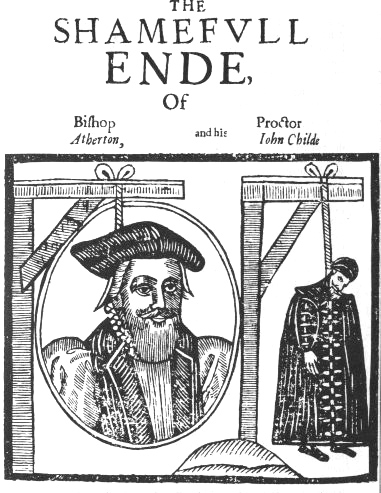
On this date in 1640, John Atherton achieved the unenviable distinction of being the only Anglican bishop hanged for buggery.* (His proctor, and alleged lover, John Childe, got the same treatment a few months later.)
Suppose a Devill from th’infernall Pit,
More Monsterlike, then ere was Devill yet,
Contrary to course, taking a male fiend
To Sodomize with him, such was the mind
Of this Lord Bishop, he did take a Childe
By name, not years, acting a sinne so vilde
-From the text of the pamphlet this image decorates
It may well have been the internecine politics of the day that claimed Atherton’s life, just as the civil wars they engendered in the ensuing decades claimed the original trial records.
While posterity is left to speculation, Atherton was defended in print in those years as well. (Defended as no homo, that is — not defended on principle against ubiquitous anti-gay laws.) If it wasn’t really a voracious sexual appetite (not exclusively same-sex**), goes this argument, it was intra-Protestant infighting, with Atherton’s successful clawback of land for the weak Irish Anglican church stepping on the toes of the local land barons who had recently expropriated it.
Mother Leakey was Atherton’s mother-in-law, and Somerset family members claimed she haunted them — including with a message for the bishop that one of his sisters-in-law actually went to deliver in Ireland. The message isn’t known; in legend, this was a warning from beyond against the prelate’s ungodly behavior; in reality, it was more probably a family shakedown.‡
Despite the skepticism of the Leakey family’s own contemporaries, the facts, allegations, suppositions, and pure flights of fancy somehow managed to blend and recombine into a lasting tale of the paranormal that Minehead still retails to this day.
And it goes right back to the public opprobrium Bishop Atherton endured — as described in that 1641 hanging pamphlet:
“demonstrates the link between the stories of Mother Leakey and Bishop John Atherton … in a highly readable and often entertaining fashion”
… through pride, high fare, and lustfull life,
Incest committed with the Sister of his wife,
For which he sued his pardon, and then fled
To Ireland, where a worser life he led
…
He surely warned was to mend his life,
By his own Sister Master Leakies wife,
Which Master Leakies Mother being dead,
And in her life-time conscious how he led
His lustfull life, her Ghoast in gastful wise
Did oft appeare before her Sisters Eyes,
But she feare-strucken durst not speak unto it,
Till oft appearing forced her to doe it:
Then thus she spake, Mother in Law what cause
You from your rest, to my unrest thus drawes?
Who answered, daughter tis the wicked life
Your Brother leads, warne him to mend his life;
If not, then plainely tell him tis decreed,
He shall be hangd, bid him repent with speede:
Then shall my restless spirit be at rest,
And not till then; Thus vanisht. She addrest
Herselfe for travaile, Into Ireland went
With this sad message unto him was sent:
Which how he tooke to heart may plaine appeare
By the slight answer he returned her,
What must be, shalbe: If I must, I must dye,
Mariage, and hanging, come by destiny.
Thus scoft her counsell, sent her back, and when
Shee was returnd, he grew farre viler then
He was before, if Viler man may be,
For one bad Act before, committed three.
* According to Who’s Who in Gay and Lesbian History, Atherton and Childe were the second pair of alleged homosexual lovers executed in the British Isles. The first was the Earl of Castlehaven in 1631, along with his manservants.
** “[O]ne should note the compound sexual nature of the ‘sodomy’ charge in this context, a portmanteau omnibus of non-procreative sex, which is what ’sodomy’ was widely held to be.”
† Walter Scott footnotes this legend in Rokeby: “Mrs Leakey … dispatched her [daughter-in-law] to an Irish prelate, famous for his crimes and misfortunes, to exhort him to repentance, and to apprize him that otherwise he would be hanged; and how the bishop was satisfied with replying, that if he was born to be hanged, he should not be drowned.”
‡ Archbishop William Laud dispatched a team of ghost-whisperers to investigate the Leakey story well before the ectoplasm hit the fan for Atherton, and they weren’t buying: “certainly it is a fiction and a practice … it may be some money business.” Bishop Atherton had left home under a cloud with the suspicion that he’d had an affair with his wife’s sister, and this was part of the eventual Irish complaint against the horny goat.
On this date in 1989, Sean Patrick Flanagan was executed for murdering two gay men in Nevada.
The ex-Marine been picked up for jaywalking in California, when he went and confessed to the slightly more problematic offense of murder. This is why you should never say anything to police when arrested.
But Flanagan had a whole confessional, expiation thing going on. Besides admitting to strangling two older men with “the thought that I would be doing some good for our society,” he dropped his appeals and volunteered for execution.
I’m just as wicked and nasty as Ted Bundy. I believe if I had not been arrested, I would have ended up being another Ted Bundy against homosexuals.
As is so often the case, the hatred that drove Flanagan to murder was actually directed inward — since the killer himself was also gay. Characterizing his own execution as “proper and just” and staying nose-deep in the Bible until injection time was all part of his uncertain journey of redeeming or defining or accepting himself.
The subsequent headlines were all about how Flanagan checked out of this world telling prosecutor and execution witness Dan Seaton, “I love you.”
“‘He means it in terms of Christian love and forgiveness,” Seaton explained later. No gay stuff.
By the end of Longshanks’ life, the old king was so irate at their relationship (the prince had had the temerity to request a title and castles for Gaveston) that Gaveston was booted out of the country.
(But at least he wasn’t defenestrated, the fate of the fictional Gaveston stand-in “Phillip” in Braveheart.)
Ah, the gay-baiting.
The younger Edward immediately recalled his friend when death came for Longshanks, and Gaveston was resented both by English peers and the young Queen Isabella for the favor the new king held him in.
The purported homosexual relationship between Edward II and Piers Gaveston is commonly believed* though ultimately speculative, reading between the lines of chroniclers who are sometimes bitterly hostile towards these two. “The King loved an evil male sorcerer more than he did his wife,” for instance, is a bit of propaganda — we obviously don’t believe the “sorcery” bit — and even that’s not completely explicit.
There’s a strong circumstantial interpretation to made, but since the particulars of Edward’s behavior with his favorite behind drawn tapestries are permanently unavailable to us, it will suffice us to say that this interpretation has conditioned the “Piers Gaveston” who comes to us in later centuries as a widely-credited cultural artifact.
Whether as calumny or commendation, homosexuality is the first thing everyone “knows” about Piers Gaveston, the emblem of his life and the doomed reign of his sovereign. We meet him from the other side of Stonewall, even when we meet him in Renaissance poetry or Renaissance drama.
The historical, flesh-and-blood Piers — and there’s a very thorough biography of him here** — was certainly defined by more than gay identity, real or imputed.
The personal resentment he inspired in the likes of Lancaster and Beauchamp was political, mapped onto the timeless power struggle between nobles and crown, and within the nobility itself.
The king trusted Gaveston, who was himself just the son of a knight, with plum royal assignments like governing Ireland, and Gaveston executed them effectively; with an immoderate confidence in his own considerable talents, the favorite was not above tweaking his rivals with derisive nicknames.
The Lancaster faction progressively got the upper hand on Edward and Gaveston, and with civil war brewing, they captured the hated Gascon at Scarborough Castle while Edward scrambled unavailingly to raise an army of his own.
He was held privately for nine days before Lancaster — “a sulky, quarrelsome, and vindictive man … quick to resort to violence,” by Alison Weir’s reckoning — decided he had to go. Gaveston was beheaded without color of law at Blacklow Hill near Warwick. A monument to his memory still stands there today.
Thou executioner of foule bloodie rage,
To act the will of lame decrepit age.
The grief-stricken monarch would serve his revenge upon the Earl of Lancaster ten years’ cold, beheading him for treason in 1322 upon the verdict of the man who had by then slid into Gaveston’s place in the king’s favor, Hugh Despenser.
On this date in 1326, the power behind Edward II’s throne — and the presumed lover in his bed — was hanged, drawn and quartered and pointedly emasculated in a grisly public execution as the Queen and her lover took control of England.
(Wince.)
The younger Despenser, being carved up in an illustration from Froissart.
Poor King Edward — that’s the swishy princeling gay-baited in Braveheart — would suffer a horrid demise of his own a few weeks later. He’s the one most conveniently read as a gay martyr.
An upstart knight who unexpectedly lucked into a jackpot inheritance when his wife’s brother died at Bannockburn — that’s the rumble Robert the Bruce starts at the end of Braveheart — Hugh the younger parlayed his newfound position of feudal magnate into the still better gig of royal favorite.
That job was open because its occupants had a distressing tendency to get dead, a fate obviously ordained for Hugh Despenser as well.
But whereas Edward’s childhood pal Piers Gaveston, the murdered former fave, aroused mostly personal pique among rival nobles, Hugh Despenser meant to use his favor to rule.
Despenser exploited his position to build up his wealth and control the king; with his father (you’ll never guess that he went by “the elder”), he became the de facto if never the de jure ruler of the realm.
At one point, his rivals in the nobility turned the tables and got him exiled. Hugh became a pirate in the English Channel while he maneuvered his way back onto dry land in his customary most-favored-consigliere position.
So although the British barons who wanted Despenser’s head were undoubtedly a distasteful lot themselves, and certainly capable of all manner of depravity in pursuit of their own crass self-interest, it doesn’t take a backwards view of human sexuality to get why Hugh Despenser would raise an early 14th century Briton’s hackles.
But you have to give England this: its politics back then were a damn sight more interesting than you get today. Anyone who uses the term “bloodsport” for the modern electoral charade ought to cross cutlasses with the likes of the dread pirate Despenser.
And it gets better. Meaning, for Hugh Despenser the Younger, worse. Much.
Queen Isabella — that’s Sophie Marceau’s hot-for-barbarian imported princess in Braveheart — became estranged from her Hugh-lovin’ husband,* and established herself back in France with her lover Roger Mortimer.
Then, the lovebirds invaded England.
Edward and Hugh were so unpopular at this point that “their” nobles who should have repelled the incursion went in a landslide for the invading adulterers.
Hugh Despenser’s father had already been hanged for his trouble by the time The Younger was taken; the latter tried to cheat the executioner by refusing all food and drink for days, truly a spartan image of desperate self-mortification in a rough day and age.
When you get a load of the death his royal captors had worked out for him — and which they were obliged to deliver to their starving captive hurriedly in Hereford rather than more ceremoniously back in London — you can understand why. After a perfunctory trial that same morning, they tore the former favorite apart.
When the feast was over sir Hugh, who was not beloved in those parts, was brought before the queen and knights assembled; the charges were read to him – to which he made no reply; the barons and knights then passed the following sentence on him: first, that he should be drawn on a hurdle, attended by trumpets and clarions, through all the streets in the city of Hereford, and then conducted to the market-place, where all the people were assembled; at that place he was to be bound on a high scaffold, in order that he might be more easily seen by the people. First, his privates were cut off, because he was deemed a heretic, and guilty of unnatural practices, even with the king, whose affections he had alienated from the queen by his wicked suggestions. His private parts were cast into a large fire kindled close to him; Afterwards, his heart was thrown into the same fire, because it had been false and traitorous, since he had by his treasonable counsels so advised the king, as to bring shame and mischief on the land, and had caused some of the greatest lords to be beheaded, by whom the kingdom ought to have been supported and defended; and had so seduced the king, that he could not or would not see the queen, or his eldest son, who was to be their future sovereign, both of whom had, to preserve their lives, been forced to quit the kingdom. The other parts of sir Hugh thus disposed of, his head was cut off and sent to London.**
It’s reported that Isabella and Mortimer feasted and made merry as they beheld this hideous spectacle. Now that’s bloodsport politics.
Hugh the younger Despenser and his life and times are covered in amazing detail by a couple of active-posting enthusiasts of this particular period who have already been linked elsewhere in this post: the aptly-named Edward II blog (dig his biography of Hugh Despenser, among many other such dramatis personae; also his account of the execution, already cited); and, Lady Despenser’s Scribery (whose entire sidebar is pretty much all about our day’s principal; for the quick tour, see her biography and posts on the “trial” and execution).
* The reason for said estrangement can be situated anywhere one likes along the personal-political spectrum; one recent historical novel speculates (upon no authority but dramatic license) that Hugh raped the queen.
** Remains reportedly discovered last year were speculatively identified as Hugh Despenser’s; the litany of injuries to the body testify to the ghastly death-ritual its owner underwent.
“Who cannot be sorrowful and amazed that he should be a traitor against your majesty? He that was so advanced by your majesty, he whose surety was only by your majesty, he who loved your majesty, as I ever thought, no less than God; he who studied always to set forward whatsoever was your majesty’s will and pleasure; he that cared for no man’s displeasure to serve your majesty; he that was such a servant, in my judgment, in wisdom, diligence, faithfulness, and experience, as no prince in this realm ever had …
If he be a Traitor, I am sorry that ever I loved him, or trusted him, and I am very glad that his treason is discovered in time; but yet again I am very sorrowful; for who shall your grace trust hereafter, if you might not trust him? Alas!”
It was on this date in 1540 that the Machiavellian minister of Henry VIII fell by the instrument he had wielded so ably against so many others.
While Henry strove to get his end away, Thomas Cromwell made the Reformation, setting his energetic hand to the needfully violent reordering of England.
In almost a decade as the king’s chief minister, he had dissolved so many monasteries, annulled so many noble prerogatives, backstabbed so many courtiers, and sent so many of every class to the scaffold that most at court had some reason to hate him. (Cranmer was the only one to (cautiously) object to his old partner’s arrest.)
Hilary Mantel’s acclaimed Man-Booker Prize-winning 2009 novel Wolf Hall humanizes Cromwell’s side of his clash with Thomas More. (Review)
Though it may be, as Edward Hall recorded, that “many lamented but more rejoiced” at Cromwell’s fall from the very height of his power — “and specially such as either had been religious men, or favoured religious persons; for they banqueted and triumphed together that night [of his execution], many wishing that that day had been seven year before” — the reasons for it are murky enough to invite recourse to the royal person’s irrationality.
The bedroom politics get all the press: Cromwell’s bit of marital statecraft arranging Henry’s marriage to Anne of Cleves was a famous dud, but negotiations to end it were well on their way by the time of Cromwell’s arrest.
Why, too, should the minister have been ennobled Duke of Essex in April 1540, months after the disastrous union? That Cromwell, whose own security rested upon the stability of the realm, was a radical Protestant promulgating inflammatory religious ideas — and he was condemned for both treason and heresy, incidentally giving the king wide latitude for just how painfully to kill his former servant — seems to beggar belief.
Once fallen, Cromwell was kept alive long enough to add testimony to the Cleves divorce; that much is clear. But then why keep him alive still three weeks more?
In the end, maybe it was inevitable that one in his position, at his time and place, had to follow to the scaffold the many he had sent thither, just the Tudor version of that familiar “bad advisors” trope: it were not treason to murmur against the aide whose ill counsel did wrong by His Majesty, and so Cromwell stood to accumulate the share of hostility that properly belonged to his sovereign. As an expert practitioner of the game of power politics, Thomas Cromwell could hardly be in a position to complain.
Oh, and by the by: with the German princess on the outs, the king’s wandering eye had fallen upon a niece of Cromwell’s enemy. On the day that Cromwell lost his head, Henry married Catherine Howard. No matter your brilliance, in Henrican England you only had to lose at court politics once, even if the king would be lamenting this injudicious trade within months.
Henry gave his loyal servant the easiest death, beheading on Tower Hill (although it turned out to be a botched job) — alongside a distinctly undercard attraction, Walter Hungerford, the first person executed under the Buggery Act.
Hall records Cromwell playing ball with a fine entry in the scaffold-speech genre that kept his son in the peerage.
I am come hether to dye, and not to purge my self, as maie happen, some thynke that I will, for if I should do so, I wer a very wretche and miser: I am by the Lawe comdempned to die, and thanke my lorde God that hath appoynted me this deathe, for myne offence: For sithence the tyme that I have had yeres of discrecion, I have lived a synner, and offended my Lorde God, for the whiche I aske hym hartely forgevenes. And it is not unknowne to many of you, that I have been a great traveler in this worlde, and beyng but of a base degree, was called to high estate, and sithes the tyme I came thereunto, I have offended my prince, for the whiche I aske hym hartely forgevenes, and beseche you all to praie to God with me, that he will forgeve me. O father forgeve me. O sonne forgeve me, O holy Ghost forgeve me: O thre persons in one God forgeve me. And now I praie you that be here, to beare me record, I die in the Catholicke faithe, not doubtyng in any article of my faith, no nor doubtyng in any Sacrament of the Churche.* Many hath sclaundered me, and reported that I have been a bearer, of suche as hath mainteigned evill opinions, whiche is untrue, but I confesse that like as God by his holy spirite, doth instruct us in the truthe, so the devill is redy to seduce us, and I have been seduced: but beare me witnes that I dye in the Catholicke faithe of the holy Churche. And I hartely desire you to praie for the Kynges grace, that he maie long live with you, maie long reigne over you. And once again I desire you to pray for me, that so long as life remaigneth in this fleshe, I waver nothyng in my faithe.
And then made he his praier, whiche was long, but not so long, as bothe Godly and learned, and after committed his soule, into the handes of God, and so paciently suffered the stroke of the axe, by a ragged and Boocherly miser, whiche very ungoodly perfourmed the Office.
If Cromwell’s dying sentiment concealed any lasting bitterness for the crown, maybe his spirit would take some satisfaction a century later when another of his name and family rose high enough to behead a king.
* Cromwell’s bit about the “Catholic faith” in his dying confession is to be carefully handled; it’s sometimes rendered “the traditional faith,” and occasionally treated by later Protestant polemicists as a phony addition made by Roman apologists. It’s not, appearances aside, walking back the Reformation; according to Charles Carlton’s “Thomas Cromwell: A Study in Interrogation” (Albion: A Quarterly Journal Concerned with British Studies, Vol. 5, No. 2 (Summer, 1973)) our day’s victim “did not see himself as a Catholic separate from the Church, but as a Christian, who, with his King, had escaped the Pope’s usurped authority.” Cromwell is also explicit in this passage about rejecting sacramentarianism, which was part of the heresy accusation against him.

 Bavarian World War I veteran Ernst Röhm (Roehm) had been a National Socialist brawler of the earliest vintage: after the armistice, he was among the Freikorps paramilitaries to topple the short-lived Munich Soviet. He joined the NSDAP’s predecessor, the German Workers’ Party, before Hitler himself, and he stood trial with the future Fuhrer after helping Hitler attempt the Beer Hall Putsch. They were so tight, Hitler politely ignored Röhm’s open homosexuality.

 The able child of a