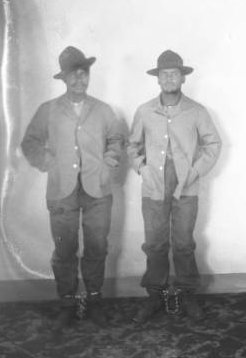
1903: Hilario Hidalgo and Francisco Renteria

Border-related violence and crime due to illegal immigration are critically important issues to the people of our state, to my Administration and to me, as your Governor and as a citizen.

Statement (pdf) by Arizona Gov. Jan Brewer on signing the anti-immigration law, which went into effect July 29, 2010

Some stories are just plain classics.

In February 1903, two Mexicans shot up Goddard Station stagecoach stop, for motivations that were never plain. (There was no robbery, but it might have been revenge.)

The shooters got away, but law enforcement soon enough decided that a couple of railroad workers on the Mexican side of the border matched their description, and contrived to lure them into Arizona where they could be arrested.

Hilario Hidalgo and Francisco Renteria, were put on trial for their lives in Prescott, Ariz., in June 1903, where they were doomed to hang on the strength of eyewitness testimony and thirty minutes of the jurymen’s time. Appeals forbidden, the sentence was executed on this date — not six months after the crime.

With feelings of profound regret and sorrow, I hereby invite you to attend and witness the private and decent and humane execution of two human beings, namely: Richard Roe and John Doe. Crime — Murder.

Said men will be executed on July 31, 1903 at 12 noon. You are expected to deport yourself in a respectful manner and any flippant or unseemly language or conduct on your part will not be allowed. Conduct on anyone’s part bordering on ribaldry and tending to mar the solemnity of the occasion will not be tolerated.

-Sheriff’s invitation to the hanging, quoted in Frontier Justice in the Wild West: Bungled, Bizarre, and Fascinating Executions

The men cracked wise at the reading of their death warrant — “I have heard that repeated so often that if it was a song I would sing it to you,” reported the Los Angeles Times (Aug. 1, 1903) — and with “perfect nerve” checked out, calling only “Adios! Adios!” from the scaffold.

It was the last hanging in Prescott, Ariz.

On this day..

1572: The Martyrs of Gorkum

On this date in 1572, Dutch Calvinists fighting to break away from Spanish domination hanged 19 Catholics at Brielle.


The Martyrs of Gorkum, by Cesare Fracassini.

The heretofore abortive — and severely suppressedDutch Revolt blossomed in 1572 with the April 1 capture of Brielle by the Protestant raiders nicknamed Sea Beggars.

Dutch schoolchildren learn the occasion with the punny rhyme — bril, “glasses”, is a near-homophone for Brielle

“Op 1 april verloor Alva zijn bril”

On April 1st, the Duke of Alva lost his glasses

The mailed fist of imperial Spain in the Low Countries, the Duke of Alva (or Alba) would be forced by Calvinist gains this year onto the back foot; despite a vigorous counterattack that regained some lost territory in 1573, he was soon forced into retirement.

This was still just the opening saga of the Eighty Years’ War, but the Dutch Revolt would weave together theology and nationalism for Netherlands separatists. It already had.

So, small surprise that weeks after nicking the Duke of Alva’s glasses, Dutch rebels conquering other towns started making prisoners of Catholic clergy whose loyalties were suspiciously Habsburgish. Our day’s principals (here are their names; a batch of Franciscans taken are the largest contingent, to which various lay brothers, parish priests, and others were appended) were seized at and around Gorkum (Gorinchem).

The author of this intrepid iconoclastic incursion, William II de la Marck, was likewise the author of these Catholic martyrs’ doom once they had been removed back to Brielle. They were hanged without benefit of trial at an abandoned monastery.

Every sectarian propagandist of 16th century Europe made lurid heroes of his own side’s martyrs, and these were no exception to the pattern; we read in this Catholic source (perhaps while contemplating this devotional image) that

[i]t was on the 9th July 1572 when the execution of the pious sufferers began. On their side they had fully prepared themselves for it by confession and prayer. The executioner went so slowly to work that two hours had elapsed ere the last of the martyrs had taken his place on the gallows, and many of them still lived when morning broke. But the fury of the soldiers was not yet satisfied. They mutilated the dead bodies, cut off their noses and ears, and other limbs, and, alas, shame seems to touch the pen with which we write, bound them to their hats, and returned with these melancholy trophies in triumph into the city!

The location where this day’s unfortunates suffered became a pilgrimage destination, and they were formally enrolled in the minor leagues of Rome’s competitive hagiography circuit in the 19th century.

On this day..

1885: James Arcene, the youngest juvenile offender hanged in the US?

(Thanks to Caitlin at Vast Public Indifference for the guest post -ed.)

On June 26, 1885, two Cherokee men — James Arcene and William Parchmeal — were hanged at Fort Smith, Arkansas. Moments before their deaths, both men made statements, though it is unlikely that their last words were intelligible to many witnesses at the military outpost, owing to the heavy rain and the fact that Parchmeal spoke little English.* Under the eye of Federal Judge Isaac Parker, the notorious “Hanging Judge” of the old Southwest, Arcene and Parchmeal had their limbs bound and their faces covered before being “launched into eternity.”**

In February, Arcene and Parchmeal had been convicted of a murder committed 13 years previously. On November 25, 1872, someone had killed a Swedish immigrant named Henry Feigel on the road near Fort Gibson in Indian Territory (now Oklahoma). The case remained unsolved for over a decade.

In 1884, 12 years after Feigel’s death, a U.S. Deputy Marshall named Andrews arrested Arcene and Parchmeal in connection with the murder. Though documents describing the evidence used to obtain the arrest warrant are not readily available, Andrews was able to convince a judge (probably the same Judge Parker who presided over the trial) that the trail had not gone cold after so many years. Arcene “denied having knowledge of the killing,” but Parchmeal made a statement through an interpreter “admitting being present, but said that he was there under duress and that Arcine did the killing.”†

After both men were convicted, Arcene made a confession stating that he had “shot [Feigel] six times, then both took rocks and mashed the man’s head” before dragging him off the road and robbing him of his boots and 25 cents. Judge Parker sentenced both men to hang.

At first glance, there is little to distinguish this case from the 77 other executions presided over by Judge Parker during his tenure at Fort Smith.‡ Parker had been appointed to the bench in the hope that he would make Indian Territory feel the full might of the federal government, and he did not disappoint. According to one chronicler of the Fort Smith court under Judge Parker,

“Tried, found guilty as charged, sentenced,” was the tale repeated until the mere fact of arrest meant almost certain conviction. The sentence “To die on the gallows” was passed upon more men here than anywhere in history. So numerous were the executions [Parker] ordered and so commonplace the thunderous crash of the gallows trap that street urchins playing outside the old walls would gleefully shout: “There goes another man to hell with his boots on!”

Glenn Shirley, Law West of Fort Smith: A History of Frontier Justice In The Indian Territory, 1834-1896 (1957), 79.

But this execution was peculiar in one significant detail: James Arcene claimed to have been “only a boy [about] 10 or 12 years old” at the time of the murder.† If true, he was one of the youngest criminals in American history to have his crime punished by a federally-sanctioned execution.

It is difficult to verify James Arcene’s age with any degree of certainty. Census records for Indian Territory in the 1870s and 1880s are spotty at best, and few other vital records survive. It is possible that Arcene may have hoped to obtain a pardon by falsely pleading youth, but he did not revise his statement, even when it became apparent that it would do him no good. We may never know how old James Arcene really was — all we can know is that he claimed to have been a child in 1872 and that Judge Parker ignored this information and sentenced the adult who stood before him.§

If James Arcene was a juvenile offender, he looked very much like the other children and adolescents executed in the United States since the era of the American Revolution. Those offenders executed for crimes committed before the age of 18 have disproportionately been African American, Native American, or Hispanic teenagers who have committed crimes against white victims. This is true of the 20th century as well as the 19th: of the 22 juvenile offenders executed for murder in the US between 1976 and 2004, 77% had killed a white victim, though only 50% of homicides perpetrated by juvenile offenders involved a white victim. As of 2004, 9 of the last 10 juvenile offenders executed in Texas, the state responsible for 59% of all juvenile executions, were black or Hispanic. (Figures from the Death Penalty Information Center.)

In March of 2005, the Supreme Court handed down a 5-4 ruling in Roper v. Simmons declaring that states could no longer execute criminals who had committed their crimes while under the age of 18.

* See “Murder for Money,” Daily Arkansas Gazette, 27 June 1885 on rain, and “Hanged on the Gallows,” New York Times, 27 June 1885 on Parchmeal’s need for an interpreter.

** “Murder for Money,” Daily Arkansas Gazette, 27 June 1885.

† “Hanged on the Gallows,” New York Times, 27 June 1885.

‡ Judge Parker sentenced 156 men and 4 women to death. Of these, 79 were actually executed, the rest having died in prison, had their sentences commuted, or were pardoned.

§ It should be noted that many books make the erroneous claim that Arcene was 10 at the time of his execution. This is not the case — all available primary documents agree that he was an adult in 1885. I made this same mistake in my earlier guest post on the case of Hannah Ocuish, having relied on Dean J. Champion’s The American Dictionary of Criminal Justice: Key Terms and Major Court Cases (2005).

On this day..

1989: Sean Patrick Flanagan, self-hating gay man

On this date in 1989, Sean Patrick Flanagan was executed for murdering two gay men in Nevada.

The ex-Marine been picked up for jaywalking in California, when he went and confessed to the slightly more problematic offense of murder. This is why you should never say anything to police when arrested.

But Flanagan had a whole confessional, expiation thing going on. Besides admitting to strangling two older men with “the thought that I would be doing some good for our society,” he dropped his appeals and volunteered for execution.

I’m just as wicked and nasty as Ted Bundy. I believe if I had not been arrested, I would have ended up being another Ted Bundy against homosexuals.

Flanagan

As is so often the case, the hatred that drove Flanagan to murder was actually directed inward — since the killer himself was also gay. Characterizing his own execution as “proper and just” and staying nose-deep in the Bible until injection time was all part of his uncertain journey of redeeming or defining or accepting himself.

The subsequent headlines were all about how Flanagan checked out of this world telling prosecutor and execution witness Dan Seaton, “I love you.”

“‘He means it in terms of Christian love and forgiveness,” Seaton explained later. No gay stuff.

On this day..

1669: Roux de Marsilly, employer of the Man in the Iron Mask?

On this date in 1669, a French Huguenot agent was publicly broken on the wheel in Paris.

On the dangerous political chessboard of 17th century Europe, the allegiance of Restoration England — governed once again by a dynasty with known Catholic sympathies — was a great prize for contending Catholic and Protestant powers on the mainland.*

While Charles II of England and the Catholic Louis XIV of France maneuvered towards a secret accord that would lead to devastating war against the Protestant Netherlands, Roux de Marsilly was busy in London trying to enlist England into a Protestant alliance against France.

Finding the avenues blocked, Marsilly retired to Switzerland and was there abducted by French spies who knew what he was up to.

A trumped-up rape charge served that country’s statecraft, and despite an offer by the prisoner to spill some beans in exchange for his life — and then a suicide attempt —

hee wounded himself … for he knew before hee should dye, butt he thought by dismembering himself that the losse of blood would carry him out of the world …

— Roux could not avoid his fate. In fact, out of fear that Marsilly could still succumb to his self-injury, they

sent word … which made his execution be hastened. Saturday about 1 of the clock he was brought on the skaffold before the Chastelet and tied to St. Andrew’s Crosse all which was while he acted the Dying man and scarce stirred, and seemed almost breathless and fainting …

they went to their worke and gave [Marsilly] eleven blows with a barre and laid him on the wheele. He was two houres dying.

(Both quotes above from this correspondence.)

For all those two agonizing hours, Roux de Marsilly really only merits a footnote in a different story.

The Man in the Iron Mask

The mysterious Man in the Iron Mask was first documented in French custody later in the summer of 1669, and he would remain a guest of the Bourbon dungeons until 1703.

The identify of this person — or maybe persons, since it’s been argued that there are multiple threads conflated into the one legend — has never been conclusively established, much to the profit of literature.

One of the stronger contenders for the crownmask, however, is a prisoner named “Eustace Dauger”, who may in fact have been Roux de Marsilly’s former valet, one “Martin”.

The case for Martin-as-Dauger-as-masked-man is made most comprehensively by Andrew Lang in The Valet’s Tragedy and Other Stories.

The hypothesis, roughly outlined, is that England and especially France were trying to tie up the loose ends of whatever plots Marsilly had authored, and got hands on his servant to interrogate him about the highly sensitive machinations he might have been privy to.

Possibly having established that Martin/Eustace had no actual information to betray, he still remained under lock and key out of some admixture of bureaucratic inertia and the remorseless paranoia of the security state. Crazy.

[T]he Man in the Iron Mask (if Dauger were he) may have been as great a mystery to himself as to historical inquirers. He may not have known WHAT he was imprisoned for doing! More important is the probable conclusion that the long and mysterious captivity of Eustache Dauger, and of another perfectly harmless valet and victim, was the mere automatic result of the ‘red tape’ of the old French absolute monarchy. These wretches were caught in the toils of the system, and suffered to no purpose, for no crime. The two men, at least Dauger, were apparently mere supernumeraries in the obscure intrigue of a conspirator known as Roux de Marsilly.

Marsilly was publicly tortured to death in Paris on June 22, 1669. By July 19 his ex-valet, Dauger, had entered on his mysterious term of captivity. How the French got possession of him, whether he yielded to cajolery, or was betrayed by Charles II., is uncertain. … By July 19, at all events, Louvois, the War Minister of Louis XIV., was bidding Saint-Mars, at Pignerol in Piedmont, expect from Dunkirk a prisoner of the very highest importance–a valet! This valet, now called ‘Eustache Dauger,’ can only have been Marsilly’s valet, Martin, who, by one means or another, had been brought from England to Dunkirk. It is hardly conceivable, at least, that when a valet, in England, is ‘wanted’ by the French police on July 1, for political reasons, and when by July 19 they have caught a valet of extreme political importance, the two valets should be two different men. Martin must be Dauger.

* And, of course, for the Catholics and Protestants in England. This struggle would come to a head in due time, to the grief of the Stuarts.

On this day..

1734: Marie-Joseph Angélique, for burning Montreal

On this date in 1734, a Portuguese-born slave known as Marie-Joseph Angélique was publicly hanged before the burned ruins of old Montreal on an accusation of having set the blaze.

Having recently been caught attempting to abscond with her lover, a white servant named Claude Thibault, Angelique was the instant consensus community suspect when Montreal caught fire on April 10. Forty-six buildings in the still-small frontier town burned; Angelique was arrested the very next morning.

(Thibault fled town, his fate unknown but presumptively no worse than what befell his paramour.)

Nobody died in the fire, but conflagrations were deadly serious back in the bucket brigade era.

The sentence

calls for the said Marie Joseph Angelique in reparation for the Fire caused by Her and other issues brought forward at the trial, to be condemned to make honourable amends Disrobed, a Rope around her Neck, holding in her hands a flaming torch weighing two Pounds before the door and main entrance of the parish Church of the said City of Montreal, where She will be led by the Executor of the high Court And there on her knees state and declare in a loud and intelligible voice that she maliciously and defiantly and wrongly set the Said fire for which She is repentant, [and] ask Forgiveness from God, the King and the Court; this done she is to be taken to the public square of the said City of Montreal to be Hanged until dead at the gallows erected for this Purpose at the said square, and then her dead Body is to be placed on a flaming pyre and burned and her Ashes Cast to the wind, her belongings taken and confiscated by the King; prior to this the said Marie Joseph Angelique is to be subjected to torture in the ordinary and extraordinary ways in order to have her reveal her accomplices …

And so she was.

Although the torture broke Angelique’s now-useless denial of her own guilt, she maintained her defense of Claude Thibault, insisting that she acted alone. It’s up for debate whether she did, in fact, act alone, or act at all — and if Angelique was guilty, what meaning or intent one can ascribe to her action.

There’s a fascinating exploration of this case, including the available primary documents, available in English or French.

On this day..

1940: Tirailleurs Senegalais, for France

On this date in 1940, German forces even then completing their rout of France — the humiliating capitulation was mere hours away — massacred a detachment of African soldiers who mounted a doomed resistance at Lentilly.

Tirailleurs Senegalais were recruited not only from Senegal but from throughout France’s domains in sub-Saharan Africa. (There were also Algerian, Tunisian, and Moroccan tirailleurs.)

Though these soldiers’ own lands were occupied, they were instrumental to defending the freedom of their occupier on European soil: over half a million African tirailleurs are thought to have served les couleurs in the two World Wars, and died in all the horrible ways those slaughterhouses could devise.

In 1940, black troops represented some 9% of the French army, a fact pilloried in German nationalist proaganda.

It’s hardly a surprise that the black man couldn’t catch a break from skull-measuring Aryan race warriors, but then, France too had its own less than comfortable relationship with these dark-hued citizens summoned from distant villages to bleed in the trenches of Europe. The military’s official guidelines emphasized (French link) the “Senegalese’s” special value as cannon fodder.

If a sacrificial mission is necessary, a defense to the death to provide cover for forces to regroup, appeal to the valor of the black fighter.

On the other hand, French authorities put up a monument to black soldiers in the aftermath of World War I. (The occupying Nazis vengefully dismantled it.) Such are the contradictions of colonialism.

Racial reservations notwithstanding, colonial troops were employed throughout the army if for no other reason than that they constituted nearly the tenth part of that army.

Their service record naturally included (French pdf) the over-before-it-started French defense against the Nazi blitz in 1940.

In this instance, knowing full well that the campaign was lost, French officers flipped open the “sacrificial mission” playbook and ordered their African charges to oppose a German march near Lyon “without thought of retreat.”

Since victory was equally out of the question, that left death. Wehrmacht troops duly prepared by Nazi racial typecasting to see their foes as savages were all too ready to wipe out African troops they greatly outclassed.


A monument to the Tirailleurs in Lentilly, France. Image (c) filoer and used with permission.

The Lentilly cemetery “Tata”, final resting place of 188 Senegalese riflemen who died under German artillery or were massacred after the battle by the 3rd SS Division Totenkopf June 19 and 20. Image (c) filoer and used with permission.

For more on the tirailleurs, there’s an extensive French-language blog.

On this day..

1312: Piers Gaveston

On this date in 1312, Edward II’s dearest friend Piers Gaveston was “executed” by the English nobility that had long despised him.

The “notorious royal favourite” had initially been welcomed by Edward I around 1300 as a royal companion for the crown prince.

By the end of Longshanks’ life, the old king was so irate at their relationship (the prince had had the temerity to request a title and castles for Gaveston) that Gaveston was booted out of the country.

(But at least he wasn’t defenestrated, the fate of the fictional Gaveston stand-in “Phillip” in Braveheart.)

Ah, the gay-baiting.

The younger Edward immediately recalled his friend when death came for Longshanks, and Gaveston was resented both by English peers and the young Queen Isabella for the favor the new king held him in.

The purported homosexual relationship between Edward II and Piers Gaveston is commonly believed* though ultimately speculative, reading between the lines of chroniclers who are sometimes bitterly hostile towards these two. “The King loved an evil male sorcerer more than he did his wife,” for instance, is a bit of propaganda — we obviously don’t believe the “sorcery” bit — and even that’s not completely explicit.

There’s a strong circumstantial interpretation to made, but since the particulars of Edward’s behavior with his favorite behind drawn tapestries are permanently unavailable to us, it will suffice us to say that this interpretation has conditioned the “Piers Gaveston” who comes to us in later centuries as a widely-credited cultural artifact.

Whether as calumny or commendation, homosexuality is the first thing everyone “knows” about Piers Gaveston, the emblem of his life and the doomed reign of his sovereign. We meet him from the other side of Stonewall, even when we meet him in Renaissance poetry or Renaissance drama.

The historical, flesh-and-blood Piers — and there’s a very thorough biography of him here** — was certainly defined by more than gay identity, real or imputed.

The personal resentment he inspired in the likes of Lancaster and Beauchamp was political, mapped onto the timeless power struggle between nobles and crown, and within the nobility itself.

The king trusted Gaveston, who was himself just the son of a knight, with plum royal assignments like governing Ireland, and Gaveston executed them effectively; with an immoderate confidence in his own considerable talents, the favorite was not above tweaking his rivals with derisive nicknames.

The Lancaster faction progressively got the upper hand on Edward and Gaveston, and with civil war brewing, they captured the hated Gascon at Scarborough Castle while Edward scrambled unavailingly to raise an army of his own.

He was held privately for nine days before Lancaster — “a sulky, quarrelsome, and vindictive man … quick to resort to violence,” by Alison Weir’s reckoning — decided he had to go. Gaveston was beheaded without color of law at Blacklow Hill near Warwick. A monument to his memory still stands there today.

Thou executioner of foule bloodie rage,
To act the will of lame decrepit age.

The grief-stricken monarch would serve his revenge upon the Earl of Lancaster ten years’ cold, beheading him for treason in 1322 upon the verdict of the man who had by then slid into Gaveston’s place in the king’s favor, Hugh Despenser.

* Not universally accepted, however.

** Bonus: Nineteen things you never knew about Piers Gaveston.

On this day..

2004: Benjamín Altamirano lynched

On this date in 2004, Bolivian Aymara peasants burned to death the mayor of Ayo Ayo.

Disgruntled residents of his fiefdom had accused Benjamin Altamirano (who was also Aymara) of corruption, and received no redress. Likewise had Altamirano complained to the central government of growing threats against him without receiving protection.

The situation came to a shocking head when Altamirano was kidnapped from the capital city of La Paz the night of June 14 and driven overnight to his home in Ayo Ayo. There, according to wire reports,*

[o]fficials said he was then burned to death inside his house, with his body later dragged through the streets and dumped in the town square. Witnesses said he was tied up, set aflame in the town square and hung upside down from a lamppost.

The Andean Altiplano region to which Ayo Ayo belonged was at this time being riven by the Bolivian gas war, a social conflict that would ultimately force the resignation of neoliberal President Carlos Mesa and lead to the election of leftist** indigenous leader Evo Morales.

From 2003 to 2005, the region (on both sides of the Peru-Bolivia border) was paralyzed with repeated peasant protests and the community expulsion of disagreeable state authorities (other government officials fled Ayo Ayo after Altamirano died).

In the words of one unrepentant Aymara quoted in this Guardian piece,

‘We Aymara carry rebellion in our blood,’ said Ramón Coba, who heads the leading Ayo Ayo peasant organisation. ‘Bolivia is totally corrupt, not just the mayor. All of them should be finished in the same way, if not burnt then drowned or strangled or pulled apart by four tractors… It’s the only way they are going to learn.’

* This one ran in the St. Louis Post-Dispatch on June 16, 2004.

** Morales, in 2009:

After more than 500 years, we, the Quechuas and Aymaras, are still the rightful owners of this land. We, the indigenous people, after 500 years of resistance, are retaking the power. This retaking of power is oriented towards the recovery of our own riches, our own natural resources such as the hydrocarbons. This affects the interests of the transnational corporations and the interests of the neoliberal system. Never the less, I am convinced that the power of the people is increasing and strengthening. This power is changing presidents, economic models and politics. We are convinced that capitalism is the enemy of the earth, of humanity and of culture.

Morales has floated elevating indigenous “communal justice” actions like Altamirano’s lynching into the stature of de jure law.

On this day..

1683: James Smith and John Wharry, Covenanter bystanders

Inscription on a marker on the road from Kirkintilloch to Kilsyth* in Scotland:

In this field lies the corpse of John Wharry and James Smith, who suffered in Glasgow, 13 June 1683, for their adherence to the Word of God, and Scotland’s Covenanted Work of Reformation: ‘And they overcame them by the blood of the Lamb, and by the word of their testimony; and they loved not their lives unto the death'” (Rev. xii. 11)

Halt, courteous passenger, and look on
Our bodies dead, & lying under this stone.
Altho’ we did commit no deed,** nor fact
That was against the Bridegroom’s contract,
Yet we to Glasgow were as prisoners brought,
And against us false witness they sought.
Their sentence cruel and unjust they past,
And then our corps on scaffold they did cast.
There we our lives and right hands also lost.
From Glasgow we were brought unto this place
In chains of iron hung up for certain space.
Then taken down interred here we ly–
From ‘neath this stone our blood to heaven doth cry.
Had foreign foes, Turks, or Mahometans,
Had Scythians, Tartars, Arabian Caravans,
Had cruel Spaniards, the Pope’s blood seed,
Commenced the same, less strange had been the deed;
But Protestants, profest our Covenants to,
Our countrymen, this bloody deed could do.
Yet notwithstanding of their hellish rage
The noble Wharry stepping on the stage
With courage bold and with a heart not faint,
Exclaims, This blood now seals our covenant–
Ending, They who would follow Christ should take
Their cross upon their back, the world forsake.


Image (c) Maria ‘Mia’ Gaellman | http://www.mariaphoto.co.uk/

The epitaph above is from this Victorian text, which further observes:

The probability is, that what is called on the new stone “the old tombstone” is not much older than this [the 19th] century, and that it is the successor of an older one on which may have been inscribed the following epitaph:

Halt, passenger, read here upon this stone
A tragedy, our bodies done upon.
At Glasgow Cross we lost both our right hands,
To fright beholders, th’ enemy so commands;
Then put to death, and that most cruelly.
Yet where we’re slain, even there we must not lie,
From Glasgow town we’re brought unto this place,
On Gallow tree hung up for certain space.
Yet thence ta’en down, interred here we lie
Beneath this stone; our blood to heaven doth cry.
Had foreign foes, Turks or Mahometans,
Had Scythian Tartars, Arabian caravans,
Had cruel Spaniards, the Pope’s bloody seed,
Commenc’d the same, had been less strange their deed.
But Protestants, once Covenanters too,
Our countrymen, this cruel deed could do:
Yet, notwithstanding this, their hellish rage,
The noble Wharrie leapt upon the stage.
With courage bold, he said, and heart not faint,
‘This blood shall now seal up our covenant,’
Ending, ‘they who would follow Christ, should take
‘Their cross upon their back, the world forsake.'”

* Kilsyth lays claim to be the birthplace of curling.

** Smith and Wharrie, apparently uninvolved civilians, were seized as the nearest available guys to punish after a Covenanter guerrilla attack near Inchbelly Bridge.

On this day..