1738: Katherine Garret, Pequot infanticide

On this date in 1738, before “a Vast Circle of people, more Numerous, perhaps, than Ever was gathered together before, On any Occasion” in Connecticut, Pequot servant Katherine “Indian Kate” Garret was hanged for murdering her newborn child.

As an unmarried young woman, Garret didn’t want a child to begin with, but she managed to pass off the pregnancy in her master’s house as just putting on a few extra pounds. Finally, one day, she slipped out to the household barn and delivered. The mistress of the house said they later found the dead infant, clubbed to death with a handy wood block.

It took an unusually protracted six-odd months to bring Garret’s case so far as the actual scaffold, giving the ministrations of a local pastor plenty of time to move the once-truculent lass to such devoutness that “with her hands lifted up, as she cou’d, she past out of life, in the posture of one praying.” We have her pious purported dying statement:

The Confession & Dying Warning of Katherine Garret.

I Katherine Garret, being Condemned to Die for the Crying Sin of Murder, Do Own the Justice of GOD in suffering me to die this Violent Death; and also Acknowledge the Justice of the Court who has Sentenced me to die this Death; and I thank them who have Lengthned the Time to me, whereby I have had great Opportunity to prepare for my Death: I thank those also who have taken pains with me for my Soul; so that since I have been in Prison, I have had opportunity to seek after Baptism & the Supper of the Lord & have obtained both. I Confess my self to have been a great Sinner; a sinner by Nature, also guilty of many Actual Transgressions, Particularly of Pride and Lying, as well as of the Sin of destroying the Fruit of my own Body, for which latter, I am now to Die. I thank God that I was learn’d to Read in my Childhood, which has been much my Exercise since I have been in Prison, and especially since my Condemnation. The Bible has been a precious Book to me. There I read, That JESUS CHRIST came into the world to Save Sinners, Even the Chief of Sinners: And that all manner of Sins shall be forgiven, One only Excepted; For His Blood Cleanseth from all Sin. And other good Books I have been favoured with, by peoples giving and lending them to me, which has been blessed to me.

I would Warn all Young People against Sinning against their own Consciences; For there is a GOD that Knows all things. Oh! Beware of all Sin, Especially of Fornication; for that has led me to Murder. Remember the Sabbath day to keep it Holy. Be Sober and wise. Redeem your Time, and Improve it well.

Little Children I would Warn you to take heed of Sinning against God. Be Dutiful to your Parents; For the Eye that Mocks at his Father and despiseth to Obey his Mother, the Ravens of the Valley shall pick it out, and the Young Eagles shall eat it. Little Children, Learn to Pray to God, Sit still on the Lord’s Day, and Love your Books.

I would also Warn Servants, Either Whites or Blacks, to be Obedient to your Masters & Mistresses. Be Faithful in your places and diligent: Above all Fear God; fear to Sin against Him: He is our Great Master.

I would also Intreat Parents and Masters to set a good Example before their Children and Servants, for You also must give an Account to God how you carry it to them.

I desire the Prayers of all God’s People for me, Private Christians, as well as Ministers of the Gospel, that I may while I have Life Improve it aright; May have all my Sins Pardoned and may be Accepted through CHRIST JESUS. Amen.

New London, May 3. 1738.
Katherine Garret.

The spiritual counselor who achieved this transformation, Eliphalet Adams, preached a lengthy sermon on the occasion.

The sound of the sermon — especially considered next to the protracted delay for Garret’s hanging — hints at a communal controversy over employing the death penalty in this case. Adams spends most of it fulminating against acquittals, jury nullification, and the insidious operation of sentimentality such as one might imagine might have attended an unmarried girl having rid of her unwanted infant: “What moving Expressions do sometimes come out of the mouths of poor people on such Occasions! … Judges are melted into tears, Yet they must not be so mollified thereby as to neglect Justice; With tears in their Eyes they must pronounce the righteous Sentence and commend them to the mercy of God, who have forfeited all Claim to be suffered any longer among men; Oh, piteous case, when the[y] cry for Mercy, Mercy must no longer be regarded! They must have Judgment without mercy, who have shewed no mercy.”

Stern stuff, ultimately straight from the dialogue around crime and punishment (capital and otherwise) down to the present day. Most of it, anyway. Some parts have changed:

Tho’ they may be great & Considerable persons who are guilty and they, whose blood they have done Violence unto, may be but Comparatively mean. This should not be so considered as to stop a prosecution, or stifle a testimony, or favour or forward an Escape, A Barbarian is of the meanest Nation, a Servant is of the lowest rank, an Infant is of the most imperfect age, Yet even their blood is required by God and the Laws, when it hath been unjustly shed; Rich and great people are most Honoured, Masters over Servants and Parents over Children, may seem to have most power and authority (I say nothing now of Princes over Subjects, that being a curious Argument and which may need very Cautious handling) Yet even these may not be protected by their greatness, authority or priviledge, if they have done Violence to blood, If they have defaced the Image of God in which every man is made and destroyed his workmanship, they also must flee to the pit and none may stay them.

It’s supposed to be the first hanging in New London. Original documents about Katherine Garret’s sad story are linked from the pamphlet about her case hosted here.

On this day..

1905: Chief Zacharias Kukuri

On this date in 1905, in the midst of Germany’s genocidal destruction of the Herero people in its Southwest Africa colony (present-day Namibia), the Otjosazu chief Sacharias Kamaituara Kukuri was hanged in Windhoek.

More than half the Herero population perished following an abortive attempt to resist German colonization during this unfortunately little-remembered period, perhaps the very first of the 20th century’s ample store of genocides.

Our man’s execution occurred at the moment of a policy pivot: after the horrific extermination policy initially practiced by General Lothar von Trotha, Germany’s Herero policy was “moderating”. Von Trotha’s extermination order had been officially reversed by Berlin; by November of 1905, the murderous general would be recalled to Germany. Instead, they’d be collecting the Herero into concentration camps.

It was into the Windhoek camp that Kukuri arrived as the wounded prisoner of a German ambush.


The concentration camp under the walls of Windhoek’s Alte Feste (Old Fort). Today, the fort is a museum … and the camp, forgotten, is the grounds of a high school. (Source)

Of course, it goes without saying that, even if state policy no longer aimed officially at racial annihilation, the system of concentration camps continued the de facto genocide: the systematic destruction of Herero life in order to incorporate the population as a subject proletariat (enlightened self-interest — the colony’s “economic future would be completely destroyed by the extermination of the indispensable labor power” — is what finally trumped von Trotha). At the same time, camps structured a punitive neglect of Herero living conditions, a years-long “period of suffering” in which Herero died of overwork, malnutrition, disease and neglect as surety against any future resistance. Courts-martial of fighting-age men alleged to have had some hand in resisting by arms the German onslaught completed the salutary lesson.

Missionary sources provide us with eyewitness accounts of conditions in the camps. Missionaries stationed in the Herero Konzentrationslager reported to their superiors in Germany on the extensive and unchecked rape, beatings and execution of surrendered Herero by German soldiers. Missionary Kuhlmann spoke of the delight of settler women witnessing the drawn-out public hangings of captured Herero in Windhoek. At one such hanging, a drooling Herero fighting for his life was berated” ‘You swine, wipe your muzzle’. (pdf source)

Kukuri fell into this last category.

His fate is especially poignant for us (and, convenient to date) thanks to the memoirs of Friedrich Meier, one of the many German Christian missionaries who had poured into Namibia ever since it became a German colony. As Meier’s account of swapping Biblical allusions with Kukuri in the shadow of the latter’s gallows underscores, these missionaries had achieved some inroads.

I did not see the slightest trace of fear on him, instead it was as if he were going to a wedding. ‘Muhonge’, he said at one stage, ‘oami otja Elias mohamakuao na je otjinga me keende kejuru metemba,’ i.e. ‘Muhonge, like Elias, I too travel to heaven in a waggon.’

Having arrived at the execution site, I noticed how he kept looking at the gallows, at which preparations were still taking place. I feared for his tranquility and asked him to stop looking at it. ‘Muhonge,’ he said to me, ‘I hear everything, why should I not look at it? For is it not “my wood” [my cross]?’

When we finally stood underneath the gallows, we prayed together that beautiful song: ‘So then take my hand and lead me.’

German:

English:

Possibly he noticed that I was worried about him. Anyway when I was finished he said, ‘It would appear that you still fear that I am afraid, but have I not told you: “When a father calls his child, does that child then fear to go to him?” Give my wife, who is in Okahandja, my greetings and tell her that I have died in the faith of the lord Jesus, so too tell my children if you should ever see them.’ I asked him again to be infatuated with the lord Jesus. ‘Lord Jesus, you help me,’ with this, after he had given me his hand, he climbed up the ladder. Soon the noose was laid around his neck. And then — never will I forget that moment — the unheard-of happened, as he fell the noose slipped and the wretch fell to the ground. He lost consciousness for a moment, so too, the observers were dumbstruck. Today I still see how his eyes sought me out. Soon, however, two soldiers were there, they lifted him up, and then a little to the side, on orders of the major who led the proceedings, he was shot.

Kukuri’s grave can still be seen at the Gammans cemetery (German link) in Windhoek.

His memory as an emblem of Herero dignity under persecution also remains in present-day Namibia.

Anette Hoffmann (in “The Merits and Predicaments of Opacity: Poetic Strategies of Evasion and Resistance” for the fall 2007 Research in African Literatures) relates a later “praise poem” for 1959 Herero martyrs, whose allusion to the hanged chief (as “Hauzeo”) emphasizes his agency, rather than his victimhood.

For he as the son of the chief Kukuri and must die since Samuel Maherero had escaped to Botswana. They said that if they kill him, then that could serve as a symbol that they had exterminated the sovereignity of the Herero … he was taken to a tree near the White’s cemetery in Otjomuise, which is still here today. I can show you his grave. He is still there until now, near the railway line to Aris … when he was taken to the tree, the tree of Hauzeu, as you hear about it, it was said: now you will be hanged to die. Heavily wounded as he was, he had a rope around his neck and was hanged. However, his weight broke the rope. Then the Germans said he was innocent and had to be released. But he himself insisted to be hanged again … [he said] “I have come to see the children of Tjamuaha’s house, those left in the camps of enslavement: to see them with my own eyes … this is why I have come: take me up the tree.” They did and he died. He lies at Hauzeu’s tree. He had given himself to be hanged.

On this day..

1959: Leonard Shockley, the last juvenile executed?

On this date in 1959, Leonard Shockley was gassed in Maryland.

The appeals court that considered his case found it “perfectly clear that Leonard killed the victim in an attempt to perpetrate a robbery or a rape,” during a heist committed jointly with Leonard’s older brother.

On that basis, young Shockley achieved the distinction of being the second-last person ever put to death for a crime committed as a 16-year-old. For a very long while, it really looked like he might be the last, but Oklahoma’s 1999 execution of Sean Sellers usurped the claim.

While it makes little ethical difference, from the standpoint of attributing criminal culpability, whether a 16-year-old offender is executed promptly at age 16 or held for a lifetime in prison and executed in his eighties, Shockley may also be the last human put to death on American soil before he had attained his own majority. Shockley’s birthdate invariably reports as “1941 or 1942”,* and in the absence of the sort of primary research a blogger is naturally loath to conduct, we’re left with conflicting sources on the subject.

The Washington Post‘s headline the following day annonced, “Slayer, 18, Dies In Gas Chamber”. (Surmounting the text of the perfunctory Associated Press story it ran.)

Whereas the Baltimore Sun reported, “Youth, 17 Dies in Gas Chamber: Shockley Executed for Slaying of Shore Mother”. (Alas, no screenshot: it’s cited by Victor Streib, an anti-death penalty academic.)

So it’s not completely clear whether Shockley enjoys this particular claim to fame. Well, not enjoy it exactly. Of course not that. And poor Sarah Hearne didn’t enjoy being slashed to death; this is also understood. Let’s just say, a sad affair and a minor milestone, and leave it at that.

* The crime was in January 1958, 15 months before the execution. It’s simple enough to work out when Shockley’s birthday would have to fall for the various scenarios.

On this day..

1915: 22 Singapore mutineers

On this date in 1915, “the sentences of the court-martial on a batch of 45 mutineers of the 5th Light Infantry were promulgated in public” — as the Straits Times reported — “and, in the case of 22 who were condemned to death, the sentences were executed on the spot.”

A crowd of fifteen thousand watched the spirited Indian sepoys shot dead for revolting the previous month.

This demoralized 800-strong garrison of Punjabi Muslims — who had, it need hardly be added, a noble history of insurrection to think upon — was already deployed far from home to look after the imperial interests of the London gentry while British lads mustered for bayonet charges in No Man’s Lands.

The last straw for these sepoys was a rumor that they were to be shipped to the European theater and made to turn their weapons against the Turkish sultan, their Muslim coreligionist.*

On February 15, 1915, helpfully covered by the celebratory fireworks of the Chinese New Year, about half the garrison left its barracks, attacked its British officers, and started killing any European they came across. (Many British familes took refuge in jail cells.)

Around 40 died in a few days before a mixed British-French-Russian-Japanese force arrived to crush the revolt. It was just one among a number of insurrectionary outbreaks during the war to rattle Britain’s possessions in Asia and elsewhere.

Punishments meted out this day were not the end of it at all; the court of inquiry sat until May, sentencing several dozen to death and many others to prison terms or penal transportation.

And if the mutiny never really threatened British control of Singapore, the ethnic and religious fissures it exposed in the imperial order have obvious resonances (pdf) for our present day.

And not only in the event, but in the aftermath. Prof. C.M. Turnbull noted (pdf)

In order to distinguish mutineers from peaceable citizens, all Indian residents were required to register and obtain passes. This aroused considerable anger, which was exacerbated by the cavalier attitude of some registration officers, who acted as if all Indians were to blame.

* The Ottomans had also issued a call to jihad with the onset of war, hoping to drive just this sort of wedge among Britain’s colonies.

On this day..

1875: Tiburcio Vasquez, California bandido

A spirit of hatred and revenge took possession of me. I had numerous fights in defense of what I believed to be my rights and those of my countrymen. I believed we were unjustly deprived of the social rights that belonged to us.

Tiburcio Vasquez

On this date in 1879, legendary Californio outlaw Tiburcio Vasquez was hanged in San Jose.

Born to a respectable family (his grandfather was the first mayor of San Jose) when the land was under Mexican control, Vasquez was among the many chagrined to find themselves demoted to second-class citizenry by the norteamericano conquest of the Mexican-American War.

That occurred when Vasquez was in his early teens, and soon thereafter the young man was plying California’s ill-policed byways with the whole litany of depredations characteristic of the frontier outlaw: livestock rustling, highway robbing, shopkeep stickups.*

One of the latter furnished the proximate cause of his death and probably the most infamous single incident among his exploits: an armed robbery in Tres Pinos** that resulted in three shooting deaths and a serious manhunt.

For Vasquez, the end of the rope (last word: “Pronto”) was just the last act of a legendary career, of poetry and horsemanship and countless enchanted inamoratas. He was renowned in his own time, and has graduated since into a mythical, and potently symbolic, figure of the other peoples of the Golden West.

For this anniversary of Tiburcio Vasquez’s execution, we’re pleased to welcome John Boessenecker, author of the recent biography Bandido: The Life and Times of Tiburcio Vasquez . (Find another topical interview with this same author here.)

Book CoverHow did you separate fact from folklore researching this outlaw? How much do we really know about him?

Generally speaking the whole genre of outlaws and lawmen is sort of known for bad research and myths and crazy stories. It tends to attract — here I’m denigrating myself– people who are a little off. Like myself. The movie buffs tend to get reality mixed up with what they’ve seen in the movies.

The whole genre has attracted poor research and sensational writers since the days of the dime novels. Though there are real historical groups: the Wild West History Association is probably the best example — True West magazine and Wild West magazine do a god job of publishing authentic history.

With Vasquez in particular, he became a folk hero in his own lifetime to disadvantaged Hispanics.

He was personally very well-liked; as a general rule, he didn’t rob Hispanics (although he did from time to time); he paid for safe harbor and food; he was a terrific dancer; he wrote poetry to is female admirers. He was a bigger-than-life personality, sort of the life of the party.

Among the larger Hispanic community as he became more notorious in the 1870s, he became a folk hero in his own lifetime. A lot of the myths are exaggerations of things he really did.

When the colonized cannot earn a living within the system, or when they are degraded, they strike out. The most physical way is to rebel. This can be done in an organized way, as was done by Juan Cortina in Texas, or it can express itself in bandit activity. An analysis of the life of Tiburcio Vasquez clearly demonstrates that, while in the strict sense of the word he was a criminal, at the same time his underlying motivation was self-defense. Some Anglo-American folklorists have attempted to portray Tiburcio Vasquez as a comical and oversexed Mexican bandit … dismiss[ing] the legitimate grievance of Chicanos during the nineteenth century. While it is true that Tiburcio Vasquez was an outlaw, many Mexicans still consider him a hero.

Rodolfo Acuña, Occupied America: A History of Chicanos

His outlaw career seems like it’s bound up in this Anglo-Hispanic cultural collision. To what extent does that influence how he’s “read” by others?

His life is sort of a microcosm of what was going on. The first portion of my book deals with the rise and fall of the native settlers of California.

With the loss of California in the Mexican-American War and then the discovery of gold, they became second-class citizens in their own land. So Vasquez becomes a folk hero — he robbed stagecoaches, thumbed his nose at the sheriff, and got away.

But he was also a bandit.

In the 1960s, the so-called Chicano historians (pdf) latched on to Vasquez, and they actually believed he was a Robin Hood figure or a “social bandit”. This is a total crock.

You find these same outlaw myths in all cultures. Vasquez is no different, though he’s better documented than most. People would sing corridos about him.

There were some quotes by him that says that he was driven to it, the Anglos drove me to it — but that’s no different from Jesse James or Billy the Kid saying they were driven to it, even if it’s true. Most of these guys I’m talking about are or were history professors; they should have known better.

What led you to this story?

When I was a kid in the early 60s I watched all the westerns. Clint Eastwood and Steve McQueen were my favorite. But then I wanted to know, was there a Wild West here in California? So when I got into high school I went and read everything I could get my hands on about early California history.

Vasquez and Black Bart were pretty much the most famous early California outlaws. So I started researching Vasquez in high school, and collected information for about 40 years, but it took me another four years to write it.

There’s never been a biography about Vasquez. There were three paperback books published about him, one after he was captured and two right after he was hanged — they’re not dime novels, but they’re sort of semi-fictional. There have been many magazines, many book chapters since, but everything published about him has just been a rehash of those three books. (n.b. — here’s a pdf of one of those original 1870s books -ed.)

It must have been a compelling story for you to stick with it for 40 years.

It’s just sort of a great story from early California. Vasquez was very colorful.

He fell under the influence of a guy named Anastacio Garcia when he was about 16 years old, and his parents seem to have separated. He had a large family; all of them were extremely honest. One of his brothers was a very prominent rancher; another brother served a term as a justice of the peace in Los Angeles County.

Vasquez, possibly because his father wasn’t around, fell under the influence of Garcia and got involved in the Roach-Belcher feud. Garcia was a hired gun, and the two of them were involved in a brawl in a Fandango house in 1854 and one of them killed a local constable. Tiburcio Vasquez fled Monterrey and never appeared openly after that.

But he basically did not change.

He was engaged to Garcia’s sister when he was 17 and she apparently broke it off. That seemed to have embittered him because he never had another serious relationship again with another woman. He was a real rounder, he got shot over women, took off with the wives of other gang members.

That was very foolish — that’s what got him the noose, when a cuckolded gang member testified against him at trial. He never made any effort to change; he was what you call a career criminal.

He was a very cultured person, and even if you compare him to more modern-day criminals like Clyde Barrow or Pretty Boy Floyd or John Dillinger, none of them had that kind of culture. He really was sort of the prototype of that sort of charismatic bandit who at the same time is both charming and deadly.

Probably the thing to me that was the most fascinating was the information I dug up about his family: his parents, his sisters who were very loyal to him; his brothers who all tried to get him to go straight. I was very pleased to meet the descendants of some of his brothers, so it was fascinating to reconstruct his family life to try to explain his personality.

So what was the nature of that bandit career?

Well, he wasn’t a remorseless killer, though he was involved in nine murders — he always said it was someone else.

The one that he was hanged for, his gang killed three people in a robbery. He claimed someone else pulled the trigger. Some witnesses said it was Vasquez himself, but under the law then and now, if you band together to commit a felony and someone dies, everyone involved is culpable for murder.

He’d been doing a lot of robberies before then, but he’d do them in remote areas. He tried not to kill anyone; he’d tie people up — but he was also involved in a lot of gunfights. Basically he’d shoot to escape. In doing the research I found that he had fired into a brothel in Santa Cruz and wounded three people; another time he fired into a stagecoach station.

One of the great Vasquez stories is, he gets out of San Quentin and he goes to San Juan Bautista which is one of the most picturesque villages in California then and now — it was one of his favorite hangouts. One of his gang members, Salazar, had tried to go straight. Vasquez shows up at San Juan and finds out that Salazar has married this gorgeous 15-year-old named “Pepita” and he and another gang member lust after her and get her to run off with the gang. So Salazar comes gunning for him; they have a gunfight right there in front of the mission, and Salazar shoots Vasquez through the chest and damn near kills him. His gang gets him out of it … the girl gets pregnant, evidently with Tiburcio’s child and she dies of a botched abortion. It’s sort of the Vasquez story in a microcosm, it looks pretty romantic on the surface and you look a little deeper and it becomes pretty grisly.

He gave a lot of interviews after he was captured and they give color to the story. There’s the natural human inclination to paint yourself in the best light.

None of which helped him avoid execution.

His hanging was actually the most publicized hanging in the history of the Pacific coast; newspapers came from Canada, New York all over the country to witness the hanging.

He was hanged in front of a big crowd, a thousand people or more present. People climbed trees and telegraph poles became the jailhouse was packed. The sheriff had 300 or 400 invitations issued and then many many more were clustered around.


Executed Today would be remiss not to add that our day’s gallows-bird was the namesake of the Vasquez Rocks, a small Natural Area Park north of Los Angeles where the outlaw used to hide out.


The Vasquez Rocks. (cc) image from KateMonkey.

This striking triangular rock formation, thrust out of the earth by tectonic action, has been used extensively in film productions of every genre since at least the 1930s, including with almost compulsive frequency in the Star Trek franchise — e.g., Captain Kirk fighting the Gorn:

* There’s a good deal of material about Tiburcio’s career linked here.

** The Tres Pinos robbed by Vasquez’s gang is now known as Paicines; it would lose its original name to the distinct settlement that grew up around the Tres Pinos train station 4.7 miles away.

On this day..

1995: Flor Contemplacion, OFW

On this date in 1995, Filipina maid Flor Contemplacion was hanged for murder in Singapore.

Contemplacion had, four years before, strangled a fellow-maid and drowned that maid’s four-year-old charge.

That’s what she confessed to, at least. Even though Contemplacion’s camp would eventually argue that the confession had been coerced, or that she’d been possessed by a strange epileptic, Contemplacion herself never really walked back that admission.

Still, Flor Contemplacion the cause celebre and Flor Contemplacion the cultural phenomenon was never only about the woman’s innocence, even if many do still believe she was framed.

By whatever happenstance of timing and circumstance, widespread publicity of her case in the Philippines during the months leading up to her hanging tapped a national discontent among her countrymen and -women about “OFWs” — overseas Filipino workers.

This economic sector — exported labor — had been intentionally nurtured (pdf) by Manila beginning with a 1974 labor code, and over the ensuing generation ballooned twentyfold into a positively enormous phenomenon.* By the time Flor Contemplacion hanged, everybody in the Philippines knew people who had worked overseas, and whose wage remittances were indispensable (pdf) for supporting their families in the Philippines. (And increasingly, the entire national economy.)


Boom of the overseas Filipino workers sector, 1975 – 2000 (1975 = 1). Source of figures; there are more official OFW stats here.

Ascendance of the OFW industry brought with it the discontents attendant with scattering wholesale quantities of the populace to unfamiliar corners of the globe, many of them to confront the timeless varieties of workplace abuse from positions of special vulnerability: “The dark reality,” one organization says this year, of “low wages, horrid working conditions, little protection for human rights, exploitation, harassment, threats, illegal arrests, imprisonment, criminalization, and deportation.”

To say nothing of the political discontents raised by such a discomfiting abdication of autarky, and the “domestic anxieties” (pdf) of developing “the embarrassing reputation that we are a country of DHs [domestic helpers], entertainers, and even prostitutes.” This is, truly, a rich and complex tapestry.

Flor Contemplacion is practically the patron saint of the indicted Filipino/a abroad, and her fruitless clemency appeal the political breakout of OFWs and their allies as a constituency to reckon with.

The effect was immediate. Contemplacion hadn’t had any great level of consular support early in her criminal process — the time when it might have made the most difference. (The Philippines embassy in Singapore later took considerable heat for this fact.)

But as the story made headlines and some sketchy witnesses accused the victim’s widower husband of being the real perpetrator, the case became a national sensation. Recently-elected president Fidel Ramos, who campaigned on restoring the previously-abolished death penalty in the Philippines, not only had to put on the full-court press for this condemned woman but incongruously declared her a “national hero”; his wife personally received Contemplacion’s remains at the airport. Leaders and ordinary people from Catholics to Communists rallied (sometimes rioted) in anger.

(Singapore was just at this time establishing its own reputation as the place that never gives diplomatically expedient clemencies. Never.)

Whatever the domestic controversies, the labor-export business has only continued to grow in the generation since Contemplacion’s hanging. To this day, the Filipino public has shown great sympathy with OFWs entangled in alien criminal justice systems, and demanded diplomatic support — regardless of particular individuals’ putative guilt.

Regrettably, it is often called to do so: from Saudi Arabia to China, the plight of Filipinos executed abroad remains a recurrent and emotionally charged theme in the country.

Flor Contemplacion’s name, well-known still anywhere in the archipelago, was back in the news last year … when her three sons all drew lifetime prison sentences for drug-smuggling.

On this day..

1945: Lena Baker

What I done, I did in self-defense, or I would have been killed myself. Where I was I could not overcome it.

-Lena Baker’s final statement

The state of Georgia has only ever electrocuted a single woman: African-American maid Lena Baker, put to death on this date in 1945 for murdering her abusive employer.

Baker was a sharecropper and a former sex worker hired to care for white mill owner Ernest Knight as he recuperated from a broken leg. This, as Baker’s biographer Lela Bond Phillips puts it, “developed into a sexual relationship.”

A twisted, sometimes-violent relationship.

Both Knight and Baker were alcoholics, and the Knight liked to keep his domestic in the gristmill for days on end.*

As an interracial liason, it was also entirely taboo; Knight’s son tried everything to separate his dad from this scandalous arrangement, including moving the family and beating up Baker.

Knight pere was even more committed to keeping her.

On the night of April 29-30, 1944, the elder Knight locked Baker up in the mill, after she’d attempted to flee him. Baker testified that after Knight got back from church — it was Sunday, after all — Baker tried to leave over Knight’s threats. The two fought over Knight’s pistol, and the fight ended when the pistol discharged through Knight’s head. As to how it went off or who pulled the trigger, Baker said she didn’t know.

Although the irascible, hard-drinking Knight wouldn’t have won any popularity contests among his white neighbors, this breach of the color line was prosecuted both vigorously and speedily: a one-day trial that August (the all-white, all-male jury goes without saying, right?) sufficed to send the maid to her death.**

She’s (obviously) the subject of the 2008 film Hope & Redemption: The Lena Baker Story.

* Virtual imprisonment of domestic labor: not a thing of the past.

** In 2005, the Georgia Board of Pardons and Paroles — which turned down Baker’s clemency application in early 1945 — issued a posthumous pardon suggesting that a non-death penalty manslaughter charge would have been the more appropriate conviction. Baker’s family and defenders read that as vindication; there’s a detailed NPR story about it here.

On this day..

1864: Martin Robinson, treacherous guide

On this date in 1864, a Union officer frustrated of a design to raid Richmond during the U.S. Civil War hanged a local African-American guide whom he thought had intentionally misled him like Susanin.

The account of an army chaplain attached to the 5th New York Cavalry explains:

The guide, a negro, had misled us during the night, and, to obviate the delay of retracing our steps. Col. Dahlgren, on the representations of the negro that an excellent ford was to be found at Dover Mills, concluded to cross at that point. After two hours’ halt we again moved on, and soon reached Dover Mills, but only to meet disappointment.


Dover Milles, Civil War era illustration

The negro had deceived us, no ford existed at this point nor any means of crossing the river. He then stated that the ford was three miles below: this was obviously false, as the river was evidently navigable to and above this place, as we saw a sloop going down the river.

… he came into our lines from Richmond … [and] was born and had always belonged in the immediate vicinity of Dover Mills, was very shrewd and intelligent, and it would seem impossible that he should not know that no ford existed in the neighborhood, where he had seen vessels daily passing. Col. Dahlgren had warned him that if detected acting in bad faith, or lying, we would surely hang him, and after we left Dover Mills, and had gone down the river so far as to render further prevarication unavailing, the colonel charged him with betraying us, destroying the whole design of the expedition, and hazarding the lives of every one engaged in it, — and told him that he should be hung in conformity with the terms of his service. The negro became greatly alarmed, stated confusedly that he was mistaken, thought we intended to cross the river in boats, and finally said that he had done wrong, was sorry, etc. The colonel ordered him to be hung, — a halter strap was used for the purpose, and we left the miserable wretch dangling by the roadside.

Our correspondent terms this the case of the “Faithless Negro”, but posterity has the luxury of a less paranoiac reading than indulged by a troupe of hotheaded commandos deep in enemy territory all a-panic as their expedition implodes. The James River was just plain swollen with winter rains. Bad luck all around.

A Goochland County marker marks the spot of the botched crossing and subsequent execution.

But we’re really just getting started. Stay tuned for some serious blowback from this bootless military debacle.

The full story of the raid is a tangled and contested affair, but it’s well worth perusing in detail. To sum up:

This expedition’s leader, Col. Ulric Dahlgren, abandoned the effort and in the attempt to fall back, rode into a Confederate ambush the next day. He died in the fusillade, while his men were captured.

The body of this late Col. Dahlgren, on whose authority our misfortunate guide was put to death, was found by the Confederates to bear some startling papers* … indicating that the intent of his ill-starred expedition was not merely to liberate starving northern prisoners, but that “once in the City it must be destroyed & Jeff. Davis and Cabinet killed.”

Within days, the story was abroad and Richmond newspapers floridly outraged at this proposed breach of chivalrous warfare.

Though Confederate General Robert E. Lee was able to quash public demands for the Dahlgren party’s summary execution, the documents may indeed have marked a turning point in the war’s conduct, a public announcement of total warfare sufficient for the South to “inaugurate a system of bloody retaliations.”** If so, it was a well-timed license: the Confederacy was in the process of being steamrolled and would soon require recourse to more desperate strategems.

After Dahlgren, argues Come Retribution: The Confederate Secret Service and the Assassination of Lincoln, “there was an increase in Confederate clandestine activity designed to encourage the antiwar faction in the North to organize and revolt” — even including a mirror-image Confederate cavalry raid on Washington D.C. with an eye towards capturing Lincoln.

There are, in fact, some historians who postulate that it was “bloody retaliation” for Dahlgren’s attempt on the Confederate president that ultimately led southern agents to initiate the late-war plots against Abraham Lincoln’s person — resulting ultimately in Lincoln’s assassination:

Ulric Dahlgren, and [his] probable patron [U.S. Secretary of War] Edwin Stanton set out to engineer the death of the Confederacy’s president; the legacy spawned out of the utter failure of their effort may have included the death of their own president.

That is some blowback.

Books exploring the alleged link between the Dahlgren Papers and the Lincoln assassination

* It must be said that the Dahlgren papers have been continually contested as frauds from the moment they were known, though many historians do indeed consider them legitimate. We are in no position to contribute to that debate, and for the purposes of this post’s narration the question is immaterial: the papers, forged or not, certainly existed, were widely publicized, and genuinely angered many southerners.

** These words are the demand of the March 8, 1864 Richmond Dispatch.

On this day..

1870: Wyatt Outlaw lynched by the Ku Klux Klan

On this date in 1870, the lynching of a mulatto freedman in Alamance County, North Carolina sounded the tocsin for ex-Confederates’ rollback of Reconstruction.

Perhaps America’s most tragic period, the aftermath of the Civil War saw a too-brief attempt to enforce ex-slaves’ civil rights, before it succumbed to violent counterattack. The prevailing historiography in the century-long era of Southern apartheid that followed remembered it as a time of impertinent Negroes ravishing Dixie’s virtue by being seated in the legislature and giving orders to their natural betters.

Winners write history, after all.

Those of the pro-Republican coalition at the time, before Northerners folded their hand, had a mind to write a different history.

Alamance County was one epicenter of this aborted alternative. The enclave was cool to secession from the beginning, and in the early years of Reconstruction had a live black-white coalition. Wyatt Outlaw, a mixed-race Alamance native who had fought for the Union, was a local leader in it. A member of the antislavery Union League, which registered freedmen as voters throughout the South, he was appointed a town commissioner for Graham, N.C. under the state’s new constitution.

This made him a prime target of Ku Kluxers. On the night of February 26, 1870, an armed party of white supremacists about 100 strong raided his home and strung him up on an elm tree facing the county courthouse. Pinned to his corpse for the edification of the morning’s churchgoers was a note:

“Beware you guilty — both white and black.”

North Carolina Governor William Holden complained to the U.S. Senate of federal unwillingness to act against such outrages.

What is being done to protect good citizens in Alamance County? We have Federal troops, but we want power to act. Is it possible the government will abandon its loyal people to be whipped and hanged? The habeas corpus should be at once suspended.

After another pro-Reconstruction politician was murdered later that year, Holden boldly took the initiative himself and called out the troops to arrest suspected Klansmen. But the right-wing Democratic party won midterm elections in 1870, and promptly impeached Holden for this atrocious tyranny; he was the first U.S. governor ever removed from office by impeachment.*


A “carpetbagger” ally of Wyatt Outlaw named Albion Tourgee — a judge who stood as one of North Carolina’s most prominent and hated advocates for African American equality — later wrote a novel about his experiences, A Fool’s Errand, by One of the Fools. Now in the public domain and available free online, this book’s portrayal of the Reconstruction South is receiving renewed scholarly appreciation** — including Tourgee’s catalogue of terrorism against emancipated blacks and the Republican government. The novel was a sensation (pdf) in its time.

One of the characters in Fool’s Errand is a nearly exact representation of Wyatt Outlaw: “Uncle Jerry Hunt”, who resists the Klan. It is “chiefly through Uncle Jerry’s persuasions, and because of his prominence and acknowledged leadership, this spirit had gone out among the colored men of the county.” He meets a graphic end that almost journalistically reports Outlaw’s real fate.

It was a chill, dreary night. A dry, harsh wind blew from the north. The moon was at the full, and shone clear and cold in the blue vault.

There was one shrill whistle, some noise of quietly moving horses; and those who looked from their windows saw a black-gowned and grimly-masked horseman sitting upon a draped horse at every corner of the streets, and before each house, –grim, silent, threatening. Those who saw dared not move, or give any alarm. Instinctively they knew that the enemy they had feared had come, had them in his clutches, and would work his will of them, whether they resisted or not. So, with the instinct of self-preservation, all were silent–all simulated sleep.

Five, ten, fifteen minutes the silent watch continued. A half-hour passed, and there had been no sound. Each masked sentry sat his horse as if horse and rider were only some magic statuary with which the bleak night cheated the affrighted eye. Then a whistle sounded on the road toward Verdenton. The masked horsemen turned their horses’ heads in that direction, and slowly and silently moved away. Gathering in twos, they fell into ranks with the regularity and ease of a practiced soldiery, and, as they filed on towards Verdenton, showed a cavalcade of several hundred strong; and upon one of the foremost horses rode one with a strange figure lashed securely to him.

When the few who were awake in the little village found courage to inquire as to what the silent enemy had done, they rushed from house to house with chattering teeth and trembling limbs, only to find that all were safe within, until they came to the house where old Uncle Jerry Hunt had been dwelling alone since the death of his wife six months before. The door was open.

The house was empty. The straw mattress had been thrown from the bed, and the hempen cord on which it rested had been removed.

The sabbath morrow was well advanced when the Fool [i.e., Tourgee himself] was first apprised of the raid. He at once rode into the town, arriving there just as the morning services closed, and met the people coming along the streets to their homes. Upon the limb of a low-branching oak not more than forty steps from the Temple of Justice, hung the lifeless body of old Jerry. The wind turned it slowly to and fro. The snowy hair and beard contrasted strangely with the dusky pallor of the peaceful face, which seemed even in death to proffer a benison to the people of God who passed to and fro from the house of prayer, unmindful both of the peace which lighted the dead face, and of the rifled temple of the Holy Ghost which appealed to them for sepulture. Over all pulsed the sacred echo of the sabbath bells. The sun shone brightly. The wind rustled the autumn leaves. A few idlers sat upon the steps of the court-house, and gazed carelessly at the ghastly burden on the oak. The brightly-dressed church-goers enlivened the streets. Not a colored man was to be seen. All except the brown cadaver on the tree spoke of peace and prayer–a holy day among a godly people, with whom rested the benison of peace.

The Fool asked of some trusty friends the story of the night before. With trembling lips one told it to him,

“I heard the noise of horses–quiet and orderly, but many. Looking from the window in the clear moonlight, I saw horsemen passing down the street, taking their stations here and there, like guards who have been told off for duty, at specific points. Two stopped before my house, two opposite Mr. Haskin’s, and two or three upon the corner below. They seemed to have been sent on before as a sort of picket-guard for the main body, which soon came in. I should say there were from a hundred to a hundred and fifty still in line. They were all masked, and wore black robes. The horses were disguised, too, by drapings. There were only a few mules in the whole company. They were good horses, though: one could tell that by their movements. Oh, it was a respectable crowd! No doubt about that, sir. Beggars don’t ride in this country. I don’t know when I have seen so many good horses together since the Yankee cavalry left here after the surrender. They were well drilled too. Plenty of old soldiers in that crowd. Why, every thing went just like clock-work. Not a word was said–just a few whistles given. They came like a dream, and went away like a mist. I thought we should have to fight for our lives; but they did not disturb any one here. They gathered down by the court-house. I could not see precisely what they were at, but, from my back upper window, saw them down about the tree. After a while a signal was given, and just at that time a match was struck, and I saw a dark body swing down under the limb. I knew then they had hung somebody, but had no idea who it was. To tell the truth, I had a notion it was you, Colonel. I saw several citizens go out and speak to these men on the horses. There were lights in some of the offices about the court-house, and in several of the houses about town. Every thing was as still as the grave,–no shouting or loud talking, and no excitement or stir about town. It was evident that a great many of the citizens expected the movement, and were prepared to co-operate with it by manifesting no curiosity, or otherwise endangering its success. I am inclined to think a good many from this town were in it. I never felt so powerless in my life. Here the town was in the hands of two or three hundred armed and disciplined men, hidden from the eye of the law, and having friends and co-workers in almost every house. I knew that resistance was useless.”

“But why,” asked the Fool, “has not the body been removed?”

“We have been thinking about it,” was the reply; “but the truth is, it don’t seem like a very safe business. And, after what we saw last night, no one feels like being the first to do what may be held an affront by those men. I tell you, Colonel, I went through the war, and saw as much danger as most men in it; but I would rather charge up the Heights of Gettysburg again than be the object of a raid by that crowd.”

After some parley, however, some colored men were found, and a little party made up, who went out and saw the body of Uncle Jerry cut down, and laid upon a box to await the coming of the coroner, who had already been notified. The inquest developed only these facts, and the sworn jurors solemnly and honestly found the cause of death unknown. One of the colored men who had watched the proceedings gave utterance to the prevailing opinion, when he said,–

“It don’t do fer niggers to know too much! Dat’s what ail Uncle Jerry!”

And indeed it did seem as if his case was one in which ignorance might have been bliss.

The multitalented, ahead-of-his-time Tourgee might well have uttered the same sentiment in 1896, when he was the lead attorney on the losing side of Plessy v. Ferguson — the Supreme Court’s landmark sanction of the color line that Uncle Jerry’s hangmen had drawn.

There are a couple of interesting journal articles touching on Alamance County during Reconstruction which are freely available as pdfs from the Journal of Backcountry Studies: “Other Souths”: The Civil War and Reconstruction in Alamance County, North Carolina and Scalawags Among Us: Alamance County Among the “Other Souths”.

* Narrowly beating Nebraska’s David Butler, who got the boot a few months later. Holden remains the only governor to suffer this indignity in North Carolina history; there has been a recent push in the Raleigh legislature to posthumously pardon him. Holden’s own memoirs are also available free online.

** Along with the book’s contention that northern Republicans were to blame for vacillating on Reconstruction. “This cowardly shirking of responsibility, this pandering to sentimental whimsicalities, this snuffling whine about peace and conciliation, is sheer weakness … [the North is] a country debauched by weak humanitarianisms, more anxious to avoid the appearance of offending its enemies than desirous of securing its own power or its own ends.”

On this day..

1912: Thomas Jennings, fingerprinted

One hundred years ago today, Thomas Jennings was ushered the scaffold … while Thomas Jennings’s fingerprints ushered in a new age of policework (pdf).

Hegemonic authority had been on a long march towards a forensic regime that could affix an oft-ephemeral identity to the profoundly corporeal body.

In the late 19th and early 20th century, investigative techniques and jurisprudence marched double time to keep pace with new techniques — from photography to the unwieldy system of Bertillonage.

A variety of American institutions — the U.S. Army, a number of prison systems — had begun systematically cataloging their respective inmates’ fingerprints in the preceding years, but it was in the Jennings case that the system really earned its whorls. It was the first U.S. murder case pinned on fingerprint evidence.

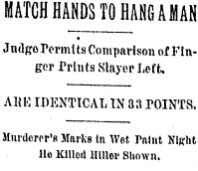
In September 1910, a Chicago homeowner in the present-day Beverly neighborhood surprised an intruder, and was shot dead. (pdf) In the course of the fight or the flight, the prowler splooshed his left hand into some wet paint on a railing.

Thomas Jennings, a paroled burglar, was arrested near the scene, and his fingerprints shown to match those left in the grieving Hiller household. A prosecution expert even gave a courtroom demonstration of dusting for prints.

This was as novel to judges as to jurymen, and given the dearth of other positive evidence against Jennings, the Illinois Supreme Court was called upon to deliberate upon the humble dactylogram. In the summer of 20111911, it stopped Jennings’ hanging just hours before it was to take place.

But its final word in December 20111911 only fitted the homebreaker’s noose.

We are disposed to hold from the evidence of the four witnesses who testified, and from the writings we have referred to on this subject, that there is a scientific basis for the system of fingerprint identification, and that the courts cannot refuse to take judicial cognizance of it …

Such evidence may or may not be of independent strength, but it is admissible, with other proof, as tending to make out a case. If inferences as to the identity of persons based on voice, the appearance or age are admissible, Why does not this record justify the admission of this fingerprint testimony under common law rules of evidence.

Courtrooms all around the world soon agreed, and within a generation the awesome investigative power of the fingerprint had fugitives going so far as to slice or burn off those incriminating little pads of flesh — the crime scene gold standard until the advent of DNA testing.

Jennings was hanged this date in a state-record five-man batch (the others, Ewald and Frank Shiblawski, Philip Sommerling, and Thomas Schultz, had all committed an unrelated murder together).

On this day..