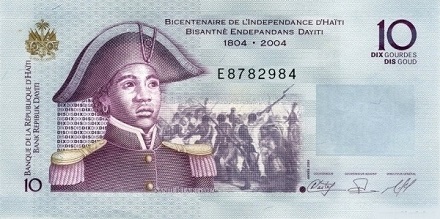
1802: Sanite Belair, tigress

On October 5, 1802, Haitian soldier Suzanne Bélair, called Sanité Bélair, was shot with her husband by the French.

This “tigress” is the most famous of the Haitian Revolution’s numerous female protagonists. A free black woman, she married Charles Belair, the nephew and aide of the man who in the 1790s established pre-eminence on Saint-DomingueToussaint L’Ouverture.

L’Ouverture tragically vacillated when the French made their move in 1802 to reverse the revolution’s gains and re-establish slavery, but the tigress rallied General Belair to take the field in resistance — and not only rallied him, but fought alongside him as a regular in his army, attaining the rank of Lieutenant.

It’s said that at her capture, when threatened with beheading, she successfuly asserted the right to an honorable soldier’s death by musketry, and standing before their muzzles cried “Viv libète! Anba esclavaj!” (“Long live freedom! Down with slavery!”)

On this day..

1821: Jose Miguel Carrera, Chilean patriot

Mercurial Chilean patriot Jose Miguel Carrera was shot on this date in 1821.

Born in a Santiago that was then a part of Spain’s Captaincy General of Chile, Jose (English Wikipedia entry | the far more detailed Spanish) was an officer in the mother country fighting Napoleon when the latter deposed the Spanish king. As the collapse of the Spanish monarchy nicely dovetailed with the scandal-plagued collapse of its Chilean viceroy, there was soon a semi-independent junta government directing the Captaincy.*

Carrera hurried home to join it … and in 1811, he seized control of it in a coup d’etat.** As a progressive dictator type, Carrera would go on to promulgate a constitution, set the stage for slavery abolition by declaring “freedom of the womb”, introduce the country’s first printing press, and establish diplomatic relations with the United States. Carrera’s sister Javiera even sewed the first Chilean flag.

The entire Carrera family would play a leading part in their nation’s birth throes, although whether for good or for ill history has hotly disputed. Our man Jose put himself at the head of the army to meet the Spanish reconquista force in the field — leaving his brother Juan Jose at the head of an unstable government — and by 1814 was mired in a virtual civil war against his former subordinate turned rival Bernardo O’Higgins. Spain (temporarily) recaptured Chile from its divided patriots, who by and large fled into exile.

Never a soul to eschew adventure, Carrera spent the next several years in derring-do plots. He finagled a flotilla from the Yankees, sailed it back to Argentina where he was arrested, and escaped captivity to Montevideo from which perch he waged a propaganda campaign against the Argentine government. By that time his enmity with Argentine revolutionary Jose de San Martin was quite personal: the O’Higgins-aligned San Martin had captured Carrera’s brothers Juan Jose and Luis and had them shot in Mendoza in 1818.

Carrera threw himself into the federalist war against San Martin’s unitary government in Argentina. The hated O’Higgins — who had by now declared Chilean independence and made it stick — routed aid to his longtime rival’s enemies. He was at last betrayed to his death after a defeat at Punta del Medano, and like his siblings, given over to a firing squad in Mendoza.


The Last Moments of J.M. Carrera.

* Present-day Chile’s independence day, September 18, marks the founding of this junta in 1810. It was Carrera who established the holiday.

** Actually Carrera authored two distinct coups in 1811: one to replace the junta with a new council, in September 1811 — and a second to replace that new council with himself that November. In January of 1812, he then replaced his November governing council in a move that essentially made him the dictator. Let’s say that institution-building wasn’t Carrera’s thing.

On this day..

1891: Bir Tikendrajit, Patriots’ Day martyr

August 13 is marked as Patriots’ Day in the Indian state of Manipur for the execution on that date in 1891 of Prince Bir Tikendrajit.

The Kingdom of Manipur numbered among scores of “princely states” — nominally independent tributaries of the British Raj.

Part of the deal for these princely states was that the British guaranteed the throne and the succession of the cooperating ruler, but these were pragmatists. When the warrior chief Tikendrajit deposed Manipur’s raja in the fall of 1890, the British waffled and for several months the revolution appeared to be a fait accompli.

Eventually, Lord Lansdowne decided to let stand the resulting transfer of power to the ex-raja’s brother, but do right by their “guarantee” by marching 400-500 Gurkhas into Manipur to demand surrender of Tikendrajit for punishment.

This intention met unexpectedly fierce resistance, and Manipuri soldiers eventually overwhelmed the British, slaughtering most of the soldiers as well as the expedition’s leader, J.W. Quinton, High Commissioner for neighboring Assam.

Tikendrajit had the honor of commanding Manipuri’s forces in the brief ensuing conflict: the Anglo-Manipur War. It lasted only a few weeks, as the British scaled their punitive deployments up from “token” to “overwhelming” and by the end of April hoisted the Union Jack over Kangla Palace.

Tikendrajit was hanged on the evening of August 13, 1891, along with an aged general named Thangal, on the polo grounds of Imphal. Today that place is known as Bir Tikendrajit Park, in honor of a man remembered as a patriotic hero.

Three other Manipuri leaders were hanged for the rebellion, and 22 suffered penal transportation.

On this day..

1916: Nazario Sauro, Italian patriot

On this date in 1916, Italian nationalist and sailor Nazario Sauro was hanged by an Austro-Hungarian military court in Pula, Croatia.

Born in the Habsburg-controlled port of Koper at the crown of the Adriatic Sea,* young Sauro (English Wikipedia entry | Italian) evinced a much greater affinity for the seas than his schooling and had his first command — a merchant ship — by the tender age of 20.

Besides seamanship, his birthplace blessed or cursed him with the fin de siecle‘s ferment of Italian irredentism: his native Istria was one of those outlying lands with an ample Italian heritage laboring under the moldering Austrian boot. Patriots pined to append it to Mazzini’s energetic young state.

So, Sauro alongside his nautical career developed an avocation in remaking the map. He took pains to monitor harbor defenses during his shipping runs around the Adriatic; nor was his conviction in national self-determination confined to his own country, for he won admiration in Albania by smuggling supplies to anti-Ottoman rebels there.

With the outbreak of World War I, Sauro — then nearing 34 years of age — hopped a train over the border into his true nation and enlisted in Venice to fight against Austria. Considering that he was still a subject of Austria, this action invited a treason charge were he ever to be captured … and this finally occurred when now-Lt. Sauro ran aground in a submarine in the Austrian Bay of Kvarner on July 30, 1916. Once someone recognized him from his long prewar career at sea, his fate was sealed.


Lyrics here

Still a celebrated patriotic martyr to this day, number of cities around Italy host monuments to Sauro and streets named for Sauro; he’s also honored by the Italian navy’s Sauro-class submarine. Mussolini had a grand statue of the illustrious native son erected in Koper in 1935, when that city was under Italian control … but Nazi Germany tore it down in 1944 once relations between the former Axis partners went pear-shaped.

* Koper is in present-day Slovenia, but within literal (and littoral) walking distance of Italy.

On this day..

1381: John Ball, radical priest

Radical priest John Ball was hanged, drawn, and quartered on this St. Swithin’s Day in 1381 for the edification of the 14-year-old king whom he had very nearly deposed.

The wandering “hedge priest” Ball emerged out of St. Albans in the heart of the calamitous fourteenth centry spitting class leveling to rapt audiences of aggrieved peasants. He paid the price with at least three stints in prison. In 1366, an edict forbade his would-be flock from hearing his seditious theology demanding clerical poverty and (so complained the Archbishop of Canterbury) “putting about scandals concerning our own person, and those of other prelates and clergy.”*

But there was a reason that Ball’s illicit sermons could command such attention, and ordering him to shut up was mere whistling past the graveyard.

Ravaged by war and plague and heavy-handed wage suppression, England’s seething 99% broke into rebellion in June 1381.

Wat Tyler’s rebellion was one of the most spectacular risings England ever saw, and one of the first acts of peasants marching on London was to liberate Ball from ecclesiastical custody in Maidstone.

Ball preached to his rescuers at Blackheath, coining his great egalitarian slogan-couplet, “When Adam delved and Eve span, Who was then the gentleman?”

When Adam delved and Eve span, Who was then the gentleman? From the beginning all men by nature were created alike, and our bondage or servitude came in by the unjust oppression of naughty men. For if God would have had any bondmen from the beginning, he would have appointed who should be bond, and who free. And therefore I exhort you to consider that now the time is come, appointed to us by God, in which ye may (if ye will) cast off the yoke of bondage, and recover liberty.

They came breathtakingly close to accomplishing it.

For a few days that pregnant June the rebels controlled London, even putting to death the Archbishop of Canterbury and mounting his head on London Bridge — and Ball the “mad priest” stood in leadership alongside Wat Tyler and Jack Straw. Peasant rebellions are usually destined to end horribly; maybe this was one always was too, but it achieved very much more — terrifyingly much, to England’s ruling class — than previous other disturbances by the pitchfork crowd. By appearances, Wat Tyler and John Ball and the rest were within an ace of overturning England’s feudal hierarchy. Certainly they had the opportunity to slay young king Richard II, whose courage in command at this moment might have saved the crown to be taken from his descendants. During face-to-face negotiations between Richard and Wat Tyler himself, the rude peasant was murdered — and Richard acted smartly to bluff his villeins into marching away at a moment when they could easily have turned regicidal.

The beheaded movement was soon dislodged from London, and while promises of mercy (not always observed) did for the mass of rebels, those in its leadership could never hope for the same — least of all a career rabble-rouser. Ball was hunted down in hiding, and this time would be indulged no ecclesiastical detention: instead, his head replaced the Archbishop of Canterbury’s on London Bridge.

Wat Tyler’s name attaches to the rebellion, but for posterity it is the words of Ball, few as have survived for us, that describe its aims in something like its own voice.

Those words still make for a powerfully current critique in our own oligarchical age. When in 2015 a marker was unveiled commemorating the peasants’ rebellion, it was done on this anniversary of John Ball’s execution — and with a summons to equality he issued that has never yet been answered.

Things cannot go on well in England nor ever will until everything shall be in common. When there shall be neither Vassal nor Lord and all distinctions levelled.

* Ball’s radicalism also helped turn English elites against the religious reforms sought by John Wycliffe, who was still alive during the 1381 peasants’ rebellion.

** In the early 20th century, socialist priest Conrad Noel had a marker with the same words hung at Thaxted Parish Church, where it can still be seen today.

On this day..

1844: Joseph Smith, founder of Mormonism, lynched

Joseph Smith, the strange founder of America’s most successful home-grown religion, was lynched on this date in 1844 at the jail in Carthage, Illinois.

Mormonism today boasts some 15 million adherents but it all started in the 1820s when Smith, then an energetic young mystic in the revival hotbed of western New York, claimed to have been guided by an angel to plates engraved in a made-up language that only he could translate and only that one time because the plates disappeared back to angelic custody after Smith’s perusal. It will not be news to this site’s LDS readers that few outside the faith place this origin story on the near side of the laugh test, but then, it is the nature of religions to appear ridiculous to outsiders: Christ crucified is unto the Greeks foolishness.

Smith’s heretical story of America as the ancient zone of a literal “New Jerusalem” founded by Israelites with a theretofore unknown gift for transoceanic navigation was certainly a stumbling-block for Protestant American neighbors, who harried from state to state — a practically Biblical sojourn through the desert — the fast-growing community. It came to pass* that the young man’s implausible scripture struck a resonant chord for the young nation.

“It was a really powerful religion,” says John Dolan in an episode of the War Nerd podcast.** “It said, our people have always been here, America is the promised land, you’re at home here. And that meant so much to 19th century Americans.”

The strange new sect’s capacity for punching above its weight in the missionary game also unleashed violently hostile reactions, marrying to its settler theology a compelling lived experience of persecution. The march of the movement across the continent has an astonishing, can’t-make-this-up character — “full of stir and adventure” in Mark Twain’s words, so again a perfect fit for America.

A few books about Joseph Smith

Smith took his fledgling faith from its New York birthplace to Kirtland, Ohio — where he was fortunate to survive a tarring and feathering in 1832 — and then onward to Missouri where a dirty vigilante war led the governor to issue a notorious “extermination order”: “the Mormons must be treated as enemies, and must be exterminated or driven from the state if necessary for the public peace.” Scrabbling for a homeland and pursued by a Missouri treason charge (!) Smith ducked over the western border to Illinois and set up a Mormon town called Nauvoo.

The faith was barely a decade old and still struggling to find an equilibrium. While Smith fought the last battle by creating a gigantic militia to protect his flock from the sorts of military attacks it had faced in Missouri — which state still sought Smith’s head in the 1840s — he attained his martyrdom as the fallout of prosaic internal politics. Seeking to suppress schismatic Mormons, Smith in June 1844 ordered the destruction of their critical newspaper, the Nauvoo Expositor.†

By now having worn out his welcome with yet another state, the unpopular Smith became the subject of an Illinois arrest warrant as a result of this lawless attack on his rivals. Expecting better treatment than Missouri would have offered him and angling to keep Mormons in an amicable relationship with neighbors, Smith this time chose to turn himself in to face trial for inciting a riot, along with his brother Hyrum Smith and two other Mormon leaders, Willard Richards and John Taylor.‡

But in this case, the law did not take its course.

On the afternoon of June 27, 1844, a mob of 200 armed men stormed the jail in Carthage where the Mormons were held, meeting only token resistance. (Indeed, many of the force assigned to guard the Mormons joined the attackers instead.) They gunned down Hyrum Smith on the spot and drove Joseph Smith — firing back all the while — to a window where a fusillade knocked him out of the second story. His body was shot up and mutilated; one of the numerous accounts of those moments even has it that the corpse was propped up for a summary firing squad “execution.”

Whatever else one could say of Joseph Smith, he forged a community that survived its founder’s death, and is thriving still nearly two centuries on. With Smith’s passing, leadership of the Mormons fell to Brigham Young, who brought the Mormons out of Illinois for their destiny in Utah.

* Smith — or the angel Moroni, if you like — amusingly abuses the portentous clause “it came to pass” in the Book of Mormon, repeating it in about one-fifth of the tome’s verses.

** Also recommended: Dolan’s article on Joseph Smith as an outstanding product of an era of “text-finding” — his spuriously “ancient” book offering pious Americans their greatest desideratum, a national link to God’s Biblical chosen people much like James MacPherson‘s forged Ossian epic thrilled the patriotic fancies of Scots discomfitingly swallowed up into Great Britain.

† The Expositor published only one single issue: the June 7, 1844 edition that caused its immediate suppression and eventually Smith’s death.

‡ Both Richards and Taylor survived the mob attack on Carthage Jail. Taylor in 1880 succeeded Brigham Young as president of the church.

On this day..

1849: Quddus

On the Baha’i calendar, this date in 1849 marked the martyrdom of Quddus.

The 18th and last of the “Letters of the Living” comprising the original disciples of the the faith’s founding prophet the Bab, Quddus was a charismatic young mullah of whom it was said that “whoever was intimately associated with him was seized with an insatiable admiration for the charm of the youth.” Denis MacEoin even argues that Quddus’s preaching verged on asserting divinity, and he might have been an incipient rival to the Bab himself for leadership of the new religion.

Under either leader the movement was officially excommunicate to the ulama, and its heretical proselytizing consequently generated no shortage of martyr-making backlash. The backlash in question for this post began with an anti-Baha’i riot in the Mazandaran city of Barfurush (today, Babol) which drove a few hundred adherents to the nearby Shrine of Shaykh Tabarsi where they took refuge behind ad hoc defensive fortifications.

The Persians’ ensuing besiegement of this redoubt constitutes the Battle of Fort Tabarsi — and if the designation sounds a bit exalted for mob control it was dearly earned by the surprising (and to Persia, embarrassing) Baha’i resilience. Under Quddus’s leadership the makeshift fort held out for seven months. Half of those original 18 “Letters of the Living” disciples would die in the engagement — the largest upheaval during those formative years.

At last, having finally been reduced to near-starvation by the encirclement, the Baha’i defenders surrendered on the guarantee of safe passage — a guarantee that was immediately violated, with most of the former “garrison” massacred on the spot on May 10.

Quddus was preserved for special treatment in Barfurush several days later: not judicial execution, but simply handing over to an angry rabble who tore him apart.

The Bab, already imprisoned pending the passion he would suffer the following year, was said to be so devastated at learning of Quddus’s fate that he could scarcely write any longer: “the deep grief which he felt had stilled the voice of revelation and silenced His pen. How deeply He mourned His loss! What cries of anguish He must have uttered as the tale of the siege, the untold sufferings, the shameless betrayal, and the wholesale massacre of the companions of Shaykh Tabarsi reached His ears and was unfolded before His eyes!” (Source)

On this day..

1781: Diego Corrientes Mateos, Spanish social bandit

On this date in 1781, the Spanish social bandit Diego Corrientes Mateos was hanged and quartered in Seville.

A robber who plied the roads from Portugal to his native Seville, Corrientes (English Wikpedia entry | Spanish) was said to be of farmworker stock himself. His consequent good treatment of the rural common folk enabled him to operate with great freedom and situated him as a Robin Hood character; folklore has consequently inflated the valor of his exploits and the bile of Sheriff of Nottinghamesque pursuers like the lieutenant governor of Seville. For example, surprising his adversary on one occasion, Corrientes is supposed to have remarked, “I have learned that you boast you will be able to capture me.”

“Yes, and hang you,” shot back Francisco de Bruna.

“Then I must spare your life so you can fulfill your promise,” the sporting Corrietes allowed. (The reader will discern that Francisco de Bruna soon made good his threat.)

By the 19th century, he’d become a positive fixture of romantic and nationalist literature.

On this day..

1810: Andreas Hofer, Tyrolean patriot

On this date in 1810, Tyrolean hero Andreas Hofer was shot in Mantua.

Andreas Hofer monument at Bergisel, where Hofer fought four battles in 1809. (cc) image by Mathias Bigge.

Hofer (English Wikipedia entry | German) was the heir to his father’s Sandhof Inn in tiny St. Leonhard — a village today that’s just over the Italian border but was in Hofer’s time part of a Tyrol undivided by nation-state borders.

This county took pride in its ancient affiliation to the House of Habsburg, who had once even made its imperial headquarters in Tyrolean Innsbruck. When in the aftermath of crushing Austria at Austerlitz the rampant Corsican transferred Tyrol to the overlordship of his ally the King of Bavaria, he did not transfer their affections: indeed, when Bavaria imposed upon its new prize the Bavarian constitution, along with added levies of taxation and military conscription, she sowed the dragon’s teeth.

Hofer emerged as one of the leaders of the anti-Bavarian party in the Tyrol’s south, and joined an 1809 delegation to Vienna to secure Habsburg support for an internal rising.

The Tyrolean Rebellion broke out in March 1809 with direct coordination from Austria — which declared war on April 9, and attacked France on several fronts hoping to regain Tyrol and various other baubles of Germanic patrimony lately lost to Napoleon. Unfortunately for the irregulars in the south Tyrol, who under Hofer and others won several early skirmishes, the French once more handed Austria a decisive defeat at Wagram July 5-6 of that year, knocking Vienna out of the war almost as speedily as she had entered it.

The consequences of Wagram were far-reaching: still more choice provinces (Salzburg, West Galicia, Trieste, Croatia) stripped away from an empire stumbling into second-ratehood. Not yet numbered among them, one could readily discern the imminent fate of our party — as did the English editorialist who cried, “O, the brave and loyal, but, we fear, lost Tyrolese!”

By this time the self-described “Imperial Commandant”, Hofer’s successful engagements could not disguise an increasingly untenable position. The militiamen who had so brightly embarked on national liberation that spring withered up and blew away in the ill autumn wind. Hofer himself hid from his enemies in one of the panoramic mountain refuges that still decorate his homeland’s inviting hiking-grounds — but the price on his head could reach him even there, and a countryman betrayed his humble hut to the French. He was surprised there and removed to Mantua for a condemnation that was allegedly came ordered straight from Napoleon.

Hofer’s martyrdom has lodged firmly in Tyrolean lore. A plaque in the town of Menan marks the spot where he was kept overnight en route to his fate in Mantua. A folk song that emerged in the 1830s and 1840s, Zu Mantua in Banden, celebrates Hofer’s sacrifice and is now the official Tyrolean anthem. (“To Mantua in chains / Loyal Hofer was led / From Mantua to Death / The enemy had him sped …”)

On this day..

1946: Gen. Leopold Okulicki murdered in Soviet prison

The fate of the last Commander in Chief of Home Army General Leopold Okulicki “Niedzwiadka”, imprisoned in Moscow and murdered there, symbolize the postwar fate of the Home Army and of Poland.

-2012 resolution of the Polish parliament

On this date in 1946, Polish Home Army General Leopold Okulicki was murdered by the NKVD in a Moscow prison.

Okulicki (English Wikipedia entry | the much more detailed Polish) embarked his military career at the tender age of 16, when he ditched school in favor of an Austrian legion on the eastern front of World War I — then segued directly into newly independent Poland‘s subsequent war against the Soviets.

Already a veteran soldier, Okulicki proceeded to the Warsaw military academy and made soldiering his career. He had advanced to the brass by the time Hitler and Stalin destroyed Poland in 1939. Okulicki had the tragic honor to maintain the hopeless defense of Warsaw, but went underground thereafter with the remains of the Polish state — hunted by Germans and Soviets alike.

The NKVD caught him in January 1941, but his residence in the discomfiting environs of Lubyanka prison was ended by the Soviet Union’s arrangement with Poland following Operation Barbarossa. Paroled back into the field, he played a leading part for the Polish Home Army for the balance of the war — finally becoming its supreme commander in the last weeks of the war.

Now that the Nazis were no longer knocking on the gates of Moscow, the Soviets renewed their interest in detaining Okulicki, which was again effected with relative ease. (Comparing German and Soviet secret police, Okulicki would say that the NKVD made the Gestapo look like child’s play.) Sentenced “only” to a 10-year prison term at the Russians’ postwar show trial of Polish leadership, Okulicki disappeared into Soviet detention and was never seen again.

In the Khrushchev era, the USSR revealed that Okulicki had died on Christmas eve of 1946 at Butyrka prison; subsequent revelations of the medical records there revealed that he had succumbed to organ damage suggestive of having been beaten to death — perhaps as punishment for hunger-striking.

The post-Communist Russian state has posthumously exonerated Okulicki of his show-trial conviction; he is, of course, an honored figure in post-Communist Poland where many streets and squares bear his name.


Plaque honoring Gen. Okulicki in Warsaw. (cc) image from Tadeusz Rudzki.

On this day..