On this date in 1867, the Mexican general and onetime president Antonio Lopez de Santa Anna avoided execution at his court-martial.
Best recognized north of the Rio Grande for overrunning the Alamo, Santa Anna actually enjoyed an amazing career with a near half-century as Mexico’s definitive caudillo.
Antonio López de Santa Anna joined the military he would come to personify as a 16-year-old cadet in 1810 … except it was the Spanish colonial army, where he had hands-on training in the cold counterinsurgency tactics he would subsequentlyapply in his maturity.
Within barely a decade, the ambitious young officer was advanced to general — the last step by dint of his timely adherence to the incoming emperor of now-independent Mexico, Agustin de Iturbide.
Iturbide was destined for a firing squad, but Santa Anna had a better knack for tacking with his new country’s political gales — turning against his recent patron just in time to help depose the guy.
Santa Anna’s P.T. Barnum*-quality panache for shameless self-promotion — at one pont he repelled Spain’s last attempted reconquista and pronounced himself the “Napoleon of the West” — soon self-promoted himself right to the presidency. From 1833 to 1855, he held the office during 11 distinct stints.
His dictatorial exercise of power and abundant graft aroused resistance from more than just Texan Anglos, so he was often engaged in suppressing internal rebellions, and occasionally in being chased by them into exile. His last turn at president was aborted in 1855 by liberal reformers. Santa Anna fled to Cuba.
Considering the mad twists of fortune in his long career, it’s a miracle that none of his enemies ever actually executed Santa Anna. He was: both adoit and lucky to avoid purging during the tumultuous 1820s; captured by rebelling Texans, who preferred to avenge Alamo by forcing him to treaty terms; handed over to the U.S. government, which eventually sent him back to Mexico; captured again by rebelling Indians in Veracruz who sold him to the Mexican government which sent him to exile; and, tried by the liberals who finally toppled him, but in absentia since he had escaped once more. He had more lives than a cat; small wonder that here in his sixties and seventies he still wasn’t done plotting.
A full decade out of power, Santa Anna spent 1866-1867 in Staten Island, New York,** until the fall of Mexico’s French-backed Emperor Maximilian induced him once more — at the age of 73 — to sail for home with one last summons to his banner. Instead he was captured in a position that must have looked like curtains for sure.
The New York Times actually reported on July 5, 1867 that Santa Anna had been summarily executed; in fact, the restored liberal government of Benito Juarez clapped the nettlesome general in prison and subjected him to a court martial that ran Oct. 7-10. Juarez allegedly expected the old snake to be convicted of treason and finally executed, but like the Times, Juarez too was frustrated: the commission sentenced Santa Anna to exile and he was carried away to Havana once again.
It proved to be a waking death: cheated of the glory of a firing squad, the old general was pitiably forgotten.
“His schemes” — for still he schemed — “became increasingly the ravings of an old, deluded, sick man,” writes Robert Scheina in Santa Anna: A Curse Upon Mexico.
Permitted with Juarez’s death in 1874 to return to Mexico, Santa Anna now fought only for a pension. (He lost that fight.) So long his country’s first man, he “became increasingly depressed which was only relieved by his increasing senility. Santa Anna was suffering the worst possible punishment — obscurity and irrelevancy.” He died penniless of diarrhea in 1876.
** Santa Anna’s legacy in the United States (apart from that Alamo unpleasantness) was the importation of chicle, which the general liked to chew. Santa Anna’s American secretary, Thomas Adams, used it to create the chewing gum marketed as chiclets.
The Christian bishop of Carthage, Cyprian, was condemned by Roman authorities on this date and immediately beheaded.
Not one of your dubiousancientmartyrs fogged with legend, Cyprian was a major public figure in his own time; dozens of epistles and treatises of his survive. An epidemic that ravaged the Roman Empire in the 250s and 260s is known from his description of it; hence it is remembered as the Plague of Cyprian.
The real-life Cyprian had different plagues to fight.
The essential challenge of Cyprian’s day — and the one that would see him to martyrdom — was the onset of anti-Christian persecution after the relative tolerance of the 240s. Cranky senator turned general Decius claimed the purple in 249 on a programme of traditional values that included a demand that all* obtain a magistrate’s certificate confirming that they had performed public sacrifice to the pagan gods. We don’t want anyone tempting divine vengeance here.
The Christian community had grown, little molested of late, to encompass many peaceable adherents who were not necessarily prepared to sell their lives over a stick of incense. Now, it fragmented under the Decian persecution — which was applied by different governors with varying levels of severity. Some Christians made the requisite sacrifices; others paid bribes to get the paperwork. Some fled to hiding: Cyprian himself did so, and some Christian ultras criticized him for failing to embrace martyrdom.
Decius died in 251, leaving the Christian minority with a controversy over how to handle the so-called lapsi who had made some concession to the idols of Rome: perspectives arrayed from the most lax (welcome everyone back with minimal hassle) to the most punitive (expel them all: this was the Novatian heresy). Cyprian had a middle-ground position in this dispute; his De Lapsis preserves his intervention, accepting readmission but under conditions of suitable penance administered by the clergy.
In such a case there remains only penitence which can make atonement. But they who take away repentance for a crime, close the way of atonement. Thus it happens that, while by the rashness of some a false safety is either promised or trusted, the hope of true safety is taken away.
But you, beloved brethren, whose fear is ready towards God, and whose mind, although it is placed in the midst of lapse, is mindful of its misery, do you in repentance and grief look into your sins; acknowledge the very grave sin of your conscience; open the eyes of your heart to the understanding of your sin, neither despairing of the Lord’s mercy nor yet at once claiming His pardon. God, in proportion as with the affection of a Father He is always indulgent and good, in the same proportion is to be dreaded with the majesty of a judge. Even as we have sinned greatly, so let us greatly lament. To a deep wound let there not be wanting a long and careful treatment; let not the repentance be less than the sin. Think you that the Lord can be quickly appeased, whom with faithless words you have denied, to whom you have rather preferred your worldly estate, whose temple you have violated with a sacrilegious contact? Think you that He will easily have mercy upon you whom you have declared not to be your God? You must pray more eagerly and entreat; you must spend the day in grief; wear out nights in watchings and weepings; occupy all your time in wailful lamentations; lying stretched on the ground, you must cling close to the ashes, be surrounded with sackcloth and filth; after losing the raiment of Christ, you must be willing now to have no clothing; after the devil’s meat, you must prefer fasting; be earnest in righteous works, whereby sins may be purged; frequently apply yourself to almsgiving, whereby souls are freed from death.
This is more or less the position the Church as a whole arrived at — a fairly liberal readmissions policy in the scheme of things. Unfortunately for Cyprian and his flock, the question would soon grow pressing once again: the emperor Valerian resumed the persecution in 257.
Cyprian was first sent into exile, then brought to Carthage for examination at a villa thronged with his supporters, who are said to have roared in support when Cyprian refused to sacrifice and demanded, “Let us be beheaded with him!”
The bishop attained his hieromartyr‘s laurels directly after the verdict, with Carthage’s Christians clamboring alongside him to the execution grounds. Afterwards, the faithful collected his remains and interred them lovingly, erecting a church over the bones that the Vandals would eventually ravage.
Even in his death under persecution, Cyprian’s biography reflects the growing weight of Christianity in Rome — not least in the fact that it was consequential enough to attract imperial backlash under the right circumstances. The reluctance of provincial magistrates to make hecatombs of their neighbors whatever the edicts demanded has been widely noted — like the proconsul Antoninus, who sent away confessing Christians who wished to solicit their own martyrdoms with the exasperated words, “if you are thus weary of your lives, is it so difficult for you to find ropes and precipices?”
“The life of Cyprian is sufficient to prove that our fancy has exaggerated the perilous situation of a Christian bishop,” Edward Gibbon wrote — a paradoxical observation to make of a martyr, but we notice that Cyprian’s noisy Christian supporters don’t seem to have been harried even in the midst of the prelate’s execution. Thereafter, “the funeral of Cyprian was publicly celebrated without receiving any interruption from the Roman magistrates; and those among the faithful, who had performed the last offices to his person and his memory, were secure from the danger of inquiry or of punishment. It is remarkable, that of so great a multitude of bishops in the province of Africa, Cyprian was the first who was esteemed worthy to obtain the crown of martyrdom.”
* Jews were exempted; Romans had respect for the antiquity of that monotheistic religion which was not extended to the novel concoctions of Christianity.
On this date in 1949, Lebanese writer and political leader Antoun Saadeh was shot following a failed coup by his Syrian Social Nationalist Party.
Born to a globetrotting journalist, the young polyglot Saadeh was living abroad in Brazil when his native Lebanon fell from the collapsing Ottoman Empire into French hands.
He returned in 1930 to Lebanon an irredentist on the make and churned out a prodigious literary output: fiction, newspaper stories, political pamphlets.
It was his vision for a “Greater Syria” that would define the man’s legacy, and cause his death. In 1932 he secretly founded the Syrian Social Nationalist Party to advocate for a vast Syrian state encompassing what now comprise Syria, Lebanon, Jordan, and Israel/Palestine. At its most ambitious this prospective state dreamt itself inscribed upon the whole Fertile Crescent from the Tauras Mountains to the Persian Gulf.
The SSNP still exists in Syria and Lebanon to this day, but it was a big cheese in the French Mandate by the late 1930s — when the imminent end of colonialism put the future shape of the entire region into question. Saadeh, harried by French authorities who had clapped him in prison a couple of times, emigrated to Argentina and carried on the struggle through exile publications.
In 1947, Saadeh returned to a rapturous reception in now-independent Lebanon:
But his pan-Syria idea was distinctly at odds with what had happened on the ground. Whatever the colonial roots of the borders that had been set down, they defined not only zones on a map but elites with an interest in their maintenance. Lebanon’s founding “National Pact” arrangement among Christians and Muslims also committed all involved to Lebanon as an independent state not to merge with Syria.
So despite (or rather because of) Saadeh’s popularity, the SSNP faced renewed crackdowns in 1948. Revolutionaries, reformers, and pan-Arabist types were surging throughout the region thanks to the distressingly shabby performance of Arab armies in their 1948 war to strangle Israel in its crib. (Lebanon fielded only a tiny force in this fight which also won no laurels; instead, Israel began its long tradition of occupying southern Lebanon.) Saadeh was certainly alarmed by the birth of a Zionist state so inimical to his own programme; “Our struggle with the enemy is not a struggle for borders but for existence,” he declared in 1948.
On July 4, 1949, the SSNP put its muscle to the test by attempting to seize state power in Lebanon — and disastrously failed. Saadeh had traveled to Damascus hoping to gain the support of the Syrian military dictator Husni al-Za’im;* instead, al-Za’im simply handed Saadeh right back to Lebanese authorities who had him tried in secret and swiftly executed.
On this date in 1718,* Peter the Great’s hand-picked court condemned his son and onetime heir apparent Tsarevich Alexei to death for plotting treason.
Probably no single figure more strikingly underscored Peter’s violent rupture of the old Russia than Alexei: “timid, secretive and lacking in self-confidence,” he was Peter’s opposite in nearly every particular — his nemesis, literally from birth.
The product of Peter’s unsatisfactory first dynastic marriage to a conservative boyar princess, Alexei got abandoned along with his mother Eudoxia Lopukhina when Peter went on his years-long jag through western Europe.
Peter eventually forced the tsaritsa into a convent so he could take up with the ambitious emigre beauty Anna Mons, but the firstborn son was not so easily discarded.
Often malignantly ignored in his youth, Alexei spent his teen years being browbeaten by Peter who rightly despaired of ever making the boy into a king who could carry Peter’s legacy.
Where the father was preternaturally energetic, the son was feeble and reticent; Peter’s irritated letters to Alexei frequently complain of his laziness. (“I am incapable of exertion,” Alexei whinged.) Where the father had a curious mind for the Age of Enlightenment, the son was a dreamer who preferred the mysteries of the Orthodox religion. The boy showed little interest in politics or statecraft, but his position as the firstborn son meant that politics and statecraft were interested in him. Alexei just wanted to go to church and fool around with his Finnish mistress; he feigned or induced illness to avoid the instructional tasks his father appointed him, and once even tried to shoot himself in the hand to duck work.
The father called on all of his legendary severity fruitlessly trying to twist this malformed sapling into a sovereign when the boy’s every characteristic seemed to reproach Peter’s mission of a new and reborn Russia.
“How often have I scolded you for this, and not merely scolded but beaten you,” Peter wrote the boy when the latest assignment was not accomplished to his satisfaction. “Nothing has succeeded, nothing is any use, all is to no purpose, all is words spoken to the wind, and you want to do nothing but sit at home and enjoy yourself.” Start with scolding, proceed to beating — Peter’s philosophy of management as well as child-rearing.
Ever more fearful of his hated father, Alexei in 1716 gave Peter one final and greatest embarrassment by spurning his father’s last ultimatum to join the Russian army on campaign. Instead, the tsarevich fled to the protection of the Holy Roman Emperor Charles VI. Charles put him up in Naples for a year until Peter’s courtier Count Tolstoy** finally persuaded Alexei to return.
Alexei hoped he had arranged to get out of the royal-succession game and live as a private citizen, but where princes of the blood are concerned this option is more easily conceived than accomplished. Peter well knew that the Orthodox clergy and many aristocrats awaited his death as their opportunity to roll back his reforms; the pious Alexei was inevitably a focus of these hopes and the boy embraced rather than shunned the association. Moreover, the twerp had made Peter look the fool before all of Europe with his running-away act.
Instead, the prince — whose return to Russia under the circumstances really was quite naive — found himself faced with a cruel inquisition.
Detail view (click for the full image) of Nikolai Ge’s 1871 painting “Peter the Great Interrogating the Tsarevich Alexei Petrovich in Peterhof” (via Wikimedia Commons)
Gibbon wrote of Marcus Aurelius that in permitting his notorious son Commodus to become his heir, “he sacrificed the happiness of millions to a fond partiality for a worthless boy, [and] chose a successor in his own family, rather than in the republic.”
Peter the Great easily possessed the iron resolution that the ancient Stoic lacked.
The tsar had learned seamanship in his youth by working in European dockyards; had learned soldiery by enrolling himself in the ranks and working his way up from drummer-boy. In his childhood he had seen the palace guard run amok in the Kremlin slaughtering his own family, bided his time until he could topple the power of his half-sister and take Russia in hand, and then wrought on those mutinous soldiers a terrible revenge.
And he had set for his reign a self-consciously world-historic mission, to force an unwilling nation into the European family. This enterprise of relentless, exhausting hubris the tsar applied everywhere from the cut of his noblemen’s facial hair to the whole-cloth creation of the Westward-facing capital city St. Petersburg.
Just so did Peter address himself to his truculent son.
“I will deprive you of the succession, as one may cut off a useless member,” he threatened in a come-to-Jesus letter of 1715, when Alexei was already 25 years old.
Do not fancy that, because I have no other child but you, I only write this to terrify you. I will certainly put it in execution if it please God; for whereas I do not spare my own life for my country and the welfare of my people, why should I spare you who do not render yourself worthy of either? I would rather choose to transmit them to a worthy stranger than to my own unworthy son.
Peter, to borrow a phrase redolent in Russian historiography, mourned not the cracked eggs that made his omelette.
And sometime after Alexei’s flight to Naples, Peter had clearly come to the understanding that for the good of his nation that unworthy son must indeed be spattered.
This episode places Peter in a monstrous light, just as would Marcus Aurelius appear to us had he contrived to murder the future tyrant Commodus when the latter was a mere callow youth. We do not have the luxury of seeing the path not taken, but it ought be said in the towering tsar’s defense that his disdain for the crown prince’s ability is difficult not to share. Alexei’s character stacks flaw upon flaw; no doubt Peter’s upbringing, by turns distant and brutal, was stamped upon it. Let the father bear that failure, but it does not relieve the sovereign’s choice: was he to confide his country and his legacy to the hands of this goblin? Was it even tolerable to leave this firstborn cooling his heels in a monastery, waiting for Peter’s death to cast off cowl and abdication and be acclaimed king by Old Russia?
Peter’s own youth, when he was part of an unresolved dynastic rivalry awkwardly sharing power, had been mired in plots and counterplots. Now, he could scarcely help but suspect that Alexei was also a piece of some conspiracy intending to undo Peter — whether in life or in death.
He forced the son to name his confidantes, then put those confidantes to torture and followed their accusations. In March of 1718, several men were broken on the wheel in Red Square; Alexei’s mother, long ago exiled to a convent, was menaced through her brother who was beheaded and her lover who was publicly impaled. Others got off with whippings, brandings, beatings, exile.
Not long after, that Finnish mistress of Alexei returned to the rodina herself. During his mission to Italy, Count Tolstoy had compromised her, and now she willingly supplied Peter the evidence of his son’s treason: that he spoke often of the succession, and how he would abandon St. Petersburg, let the navy rot, and restore the rights of the church; that he thrilled to every rumor of Peter’s illness and even to a mutiny. (Alexei would later acknowledge to his father’s face that had the mutineers acclaimed him tsar, he would have answered the summons.)
Peter empowered a very reluctant secular court to examine Alexei as a traitor without deference to his royal person. In a word, this meant torture — and on June 19, the frail Alexei was lashed 25 times with the knout, a terrible whip reinforced with metal rings that flayed a man’s back into carrion-meat and could even break the spine. Alexei managed to endure it, so on June 24 his suppurating wounds were reopened with another 15 strokes of the cruel scourge.
Under this inhuman torment, Alexei admitted wishing his father’s death — not much of an admission since he had already said as much to dad in the weeks before. But this gave his magistrates enough to condemn the tsarevich to death later that same night, for compassing the death of the king. The reality was that Alexei, vapid and indolent, had only one design on the death of his father: to await it with hope.
What we do not quite know is whether or how this sentence was actually effected. Peter wavered and did not sign the sentence — but as contemporaries saw it, God signed it.
On the morning of June 26, Peter and a number of other court dignitaries went to Peter and Paul Fortress. The fortress’s logs do not specify whether this was yet another round of torture for Alexei; stories would later circulate that Peter or a subaltern murdered the boy here by crudely beating him to death or privately beheading him, sparing the realm the spectacle of the broken crown prince mounting the scaffold.
But the official story, that an already-faltering Alexei begged Peter’s forgiveness as he succumbed to the shock notice of his condemnation, could easily be true: 40 strokes of the knout were enough to take the life of a much firmer constitution than Alexei’s.
By any measure, Peter authored the death of his son under the pall of execution, if not its literal fact — and for all the instances of royal-on-royal violence supplied by the annals, this filicide is nearly unique: Peter the Great, Emperor of All Russia, tortured his disappointing son to death.
Peter the Great died in 1725 at age 52 — according to legend, catching his death by forging into the freezing Finnish Gulf to rescue some drowning soldiers. (“I do not spare my own life for my country and the welfare of my people …”) Peter’s wives had borne him eight legitimate sons over the years, but Alexander, Pavel, Peter, another Pavel, another Peter, yet another Pavel, and yet another Peter had all died in early childhood. This was to be (after the brief reign later in the 1720s of Alexei’s sickly son Peter II) the end of the direct male line of Romanovs.
Instead, Peter was succeeded by his remarkable wife Catherine, by origin a Latvian peasant — and the 18th century would be dominated by female monarchs, culminating with Catherine the Great.
* It was June 24 by the Julian calendar still in use in Russia at that time. By the modern Gregorian calendar, Alexei Petrovich was condemned on July 5, and died on July 7.
An army officer who worked his way up to the brass via his exploits in the Second Balkan War and then in World War I, Antonescu emerged as a major nationalist politician in the interwar period. He was the elite political figure who allied with Corneliu Codreanu‘s Iron Guard movement.
Antonescu became the Defence Minister in a a far-right government, was temporarily shouldered out of the state by King Carol II‘s coup, and then re-emerged as the leading alternative when Carol’s government was undone by the tectonic political crises in the run-up to World War II. After territorial concessions wrung by Romania’s neighbors triggered protests against the king in Bucharest, Antonescu on September 5, 1940, forced Carol to transfer dictatorial power to him — and shortly thereafter, he forced Carol to abdicate altogether.*
That left Carol’s son Michael the figurehead of state, and Ion Antonescu the actual strongman — at least, once he tamed the Iron Guard.
Antonescu oriented Romania towards Hitler’s Germany, including a fairly enthusiastic involvement in the Holocaust.**
For Germany, it was an important alliance: Romania’s oil fields were essential to powering the Reich’s mechanized army. And Romania ultimately fielded the largest Axis army other than Germany and Italy themselves with well over one million men under arms by the summer of 1944. For Romania, well, opportunism is as opportunism does: as Antonescu put it, echoing an ancient argument, “in today’s circumstances a small country which is under threat, such as ours, does not do what it wishes, but what it can.”
The Romanian “General Antonescu Army Group” joined the fateful invasion of the Soviet Union. Romanian divisions were prominent at Stalingrad where some 150,000 were lost as casualties or prisoners.
The turn of the war’s tide put Romania in a grievous dilemma whose parameters ran something like this:
Maintain Antonescu’s personal grip on power
Maintain the territorial expansion Romania had achieved early in the war
Exit the war without going down in Germany’s Gotterdammerung
Antonescu might perhaps have negotiated without the desperation due his position,† and dilated with his decreasingly patient enemies while the Germans flattered him with the dream that he could still retain conquered Bessarabia (present-day Moldova). Only with the Soviet army on his doorstep was Antonescu finally disabused of the statesman’s dream and office both — when King Michael ousted Antonescu and immediately switched Romania to the Allied side.‡ This move accepted the Soviet occupation that was about to become a fait accompli, and put Romanian soldiers into the field for the last months of the war fighting against their former German allies.
It also put Antonescu into Soviet custody. He rode out the war under guard in Moscow, then was shipped back to postwar Romania where he would serve as the feature attraction of the People’s Tribunals.
One hundred eighty-seven people answered war crimes charges to these bodies; there were 13 death sentences, but only four were actually executed.§ All four — Transnistria governor Gheorghe Alexianu, Interior Minister Constantin Vasiliu, and Foreign Minister Mihai Antonescu (no relation — were shot on this date at Jilava. The executions were filmed.
* Carol went into exile, never to see his native soil again. He died in Portugal in 1953.
** “Of all the allies of Nazi Germany, Romania bears responsibility for the deaths of more Jews than any country other than Germany itself,” according to a 2003-2004 commission. “Efforts to rehabilitate the perpetrators of these crimes are particularly abhorrent and worrisome. Nowhere else in Europe has a mass murderer like Ion Antonescu, Hitler’s faithful ally until the very end, been publicly honored as a national hero.” (The full report is available here; the quoted lines come from its executive summary.)
† Berlin was keeping an eye on Romania’s separate-peace feelers, too, and had prepared a plan to occupy Romania should it attempt to desert the Axis. This is precisely the fate that befell Nazi-allied Hungary … but in Romania’s case, Germany never had the moment to implement the plan.
‡ Michael was, like his father, forced into exile in 1947; he did not return to Romania until after the collapse of Communism. Now in his nineties, King Michael is still alive as of this posting and remains the claimant should Romania ever re-establish its monarchy.
§ Six of the 13 death sentences were delivered in absentia. Notable among those fled souls was the Hungarian writer Albert Wass: Wass had escaped to the United States, which refused repeated appeals by Communist Romania to deport him. There is a running struggle in both Hungary and Romania over whether to rehabilitate Wass or posthumously rescind his death sentences. (Postwar Hungary condemned him, too.)
Iraqi cleric Muhammad Baqir al-Sadr was hanged on this date in 1980 in Saddam Hussein’s Iraq.
One of the greatest Shia scholars of the 20th century, Sadr laid the groundwork for modern Islamic banking. During the ascendancy of Arab nationalism, Sadr wrote sharp critiques of the rival Cold War systems and helped to found the Islamic Dawa Party.*
As a Shia religious party, Al-Dawa stood starkly at odds with the Sunni-based and secular Ba’ath dictatorship — and Sadr faced state harassment throughout the 1970s. Following the 1979 Iranian Revolution, whose leadership explicitly took inspiration from Sadr, Baghdad eliminated Sadr fearing he might lead a similar uprising in Iraq’s Shia south. (Sadr’s sister Amina al-Sadr — known as Bint al-Huda — was also arrested and executed around the same time.)
And Saddam Hussein may have been quite right to fear this. The name Sadr, of course, will be familiar to any observer of contemporary Iraq — for Muhammad Baqir al-Sadr’s son-in-law Muqtada al-Sadr today holds sway in the south and in Baghdad’s Shia stronghold, Sadr City.
* Iraq’s president from 2006 to 2014, Nouri al-Maliki, represented the Dawa Party. He was known to show off to guests the ring Muhammad Baqir al-Sadr wore when he attained his martyrdom.
A peasant revolutionary from the European frontiers of tsarism, Kalinouski is a present-day independence hero for Poland, Belarus, and Lithuania. (His name is variously rendered Konstanty Kalinowski, Kastus Kalinouski, and Konstantinas Kalinauskas for those respective homelands.)
Dissatisfaction with membership in this adoptive empire progressed differently among different demographics of the old Commonwealth, but it really blossomed in the wreckage of the 1850s Crimean War. Chastened after being drubbed by an industrial power, Russia finally emancipated her serfs — but the emancipation proved to bear as much confiscation as liberation, to the chagrin of the emancipatees.
In Poland, Belarus, and Lithuania, peasant anger at the raw deal dovetailed nicely with stirring national sentiment. Kalinouski, a young barrister, launched the flagship (clandestine) publication for that audience, Muzyckaja Prauda (Peasant’s Truth). It was one of the first periodicals published in Belarusian, and it was not calculated to reconcile his countrymen to Moscow.
Six years have passed since the peasants’ freedom began to be talked about. They have talked, discussed, and written a great deal, but they have done nothing. And this manifesto which the tsar, together with the Senate and the landlords, has written for us, is so stupid that the devil only knows what it resembles-there is no truth in it, there is no benefit whatsoever in it for us.
-From the first issue of Peasant’s Truth
Kalinouski’s literary adventures mirrored a prominent role among the leadership of the January Uprising to throw off the Romanov yoke.
But it proved to be the case that, although scrapping with Great Britain might be one thing, the Russian army was more than a match for her internal foes. It crushed the January Uprising.
In prison awaiting execution, Kalinouski bequeathed one last literary vindication, his Letters from Beneath the Gallows.
Friends, my brothers!
From under the Russian gallows I am writing to you for the last time. It is sad to leave my native land and you, my dear people. My breast sighs and my heart is sore, but it is not a sad lot to perish for your truth. Hear my last words in sincerity, my people, for it is as if they were written from this world only for your good … as day and night do not reign together, so also true learning does not go together with Russian slavery. As long as this lies over us, we shall have nothing. There will be no truth, no riches, no learning. They will only drive us like cattle not to our well-being, but to our perdition.
… go and fight with the whole people for your human and national rights, for your faith, for your native land. For I say to you from beneath the gallows, my people, you will only then live happily, when no Russian remains over you! (Source)
A plaque in Vilnius marks the spot of Kastus Kalinouski’s execution on 22 March 1864 (10 March by the Julian calendar).
On this date in 1791, the Inquisition in Rome condemned magician Alessandro Cagliostro to death — a sentence immediately commuted to imprisonment for the remainder of his life, which turned out to be only four more years.
Cagliostro’s rich career as European courts’ thaumaturge of choice might have been decreed by the stars right down to his pitch-perfectly sinister moniker. Is this the shadowy diabolist whom the title character of in The Cabinet of Dr. Caligari is meant to evoke?
In fact, his birth name was Giuseppe Balsamo.
Naughty by nature from the time of his youthful expulsion from the Order of St. John, Balsamo — the hobgoblin familiar haunting the adult prophet’s cimmerian shadows — hailed originally from a penniless Sicilian family. (Though Cagliostro claimed for himself a suitably exotic childhood in Arabia and Egypt)
What he wanted in native wealth he more than made up for in enterprise — both for self-education in sorcery, alchemy, and other forbidden arts, and for leveraging his expertise in lustrous capers.
Hopping from court to court, Cagliostro carved out a career moving forgeries of spiritual or temporal potency alongside his legitimate profession as a doctor and chemist and his growing public profile as an influential spiritualist. He broke through as a young man in the train of a cardinal in Rome, using this in to market on the side fake artifacts alleged to have been pilfered from the Vatican’s mysterious Egyptian troves, as well as to seduce a local girl named Serafina whom he married at age 18. Serafina would be his lifelong companion on his adventures.
Cagliostro turned up over the ensuing two decades in Russia, Poland, Germany, and England, where he was inducted into the Freemasons in 1776. He’s been credited with creating masonry’s Egyptian Rite, and with energetically propagating it in the 1780s;* indeed, it was his adherence to Freemasonry — and his sacrilegious boldness opening a masonic lodge in Rome under the nose of the pontiff — that led to his 1789 arrest.
His seances and magic potions made him a great favorite of the Versailles court for a number of years, until a glancing association with the Affair of the Diamond Necklace so damaging to the reputation of Marie Antoinette forced Cagliostro’s expulsion from France.
Considering his Mephistophelian** reputation, now very well known in Europe, Cagliostro’s return thereafter to the belly of papal power seems most unwise. Perhaps (as this biographer supposes) it was the influence of Serafina, homesick after so many years separated from her native haunts. Cagliostro’s next ports of call were the Vatican’s Castel Sant’Angelo and (after an escape attempt) the lonely Fortress of San Leo — and even his end was so shrouded in mystery and conjecture that the subsequent conqueror Napoleon commissioned an official investigation to convince everyone that he’d really shuffled off the mortal coil.
Giuseppe Balsamo, attainted and convicted of many crimes, and of having incurred the censures and penalties pronounced against heretics, dogmatics, heresiarchs, and propagators of magic and superstition, has been found guilty and condemned to the said censures and penalties as decreed by the Apostolic laws of Clement XII and Benedict XIV, against all persons who in any manner whatever favour or form societies and conventicles of Freemasonry, as well as by the edict of the Council of State against all persons convicted of this crime in Rome or in any other place in the dominions of the Pope.
Notwithstanding, by special grace and favour, the sentence of death by which this crime is expiated is hereby commuted into perpetual imprisonment in a fortress, where the culprit is to be strictly guarded without any hope of pardon whatever. Furthermore, after he shall have abjured his offences as a heretic in the place of his imprisonment he shall receive absolution, and certain salutary penances will then be prescribed for him to which he is hereby ordered to submit.
Likewise, the manuscript book which has for its title Egyptian Masonry is solemnly condemned as containing rites, propositions, doctrines, and a system which being superstitious, impious, heretical, and altogether blasphemous, open a road to sedition and the destruction of the Christian religion. This book, therefore, shall be burnt by the executioner, together with all the other documents relating to this sect.
By a new Apostolic law we shall confirm and renew not only the laws of the preceding pontiffs which prohibit the societies and conventicles of Freemasonry, making particular mention of the Egyptian sect and of another vulgarly known as the Illumines, and we shall decree that the most grievous corporal punishments reserved for heretics shall be inflicted on all who shall associate, hold communion with, or protect these societies. (Source)
Thereafter widely denounced and renounced as a rank charlatan, Cagliostro at the very least rates as of the more outstanding adventurers of his time — a distinction that bequeathed him an impressive artistic afterlife from Alexandre Dumas to Christopher Walken.
Nor have his grander poses entirely wanted for supporters in posterity, particularly among adherents to the still-extant Masonic rite he initiated. (Aleister Crowley also suggested that he might have been Cagliostro in a previous incarnation.)
W.R.H. Trowbridge’s 1910 biograhy Cagliostro: The Splendour and Misery of a Master of Magic is in the public domain and available free online.
** “Mephistophelian” might be the literally applicable word. When the mysterious Cagliostro’s possible identity as the exiled Sicilian swindler Balsano was first exposed, eventual Faust author Johann von Goethe happened to be in Palermo — and he took it upon himself to investigate personally by calling on Balsano’s family. (“You know my brother?” “All Europe knows him.”)
On this date in 1715, the legendary outlaw Filip Mengstein was broken on the wheel in Dresden’s marketplace, along with four henchmen.
With the wiseguy nickname “Lips Tullian”, our cutthroat’s gangland derring-do cuts a truly timeless profile. But it happens that Lips did his cutting in the environs of Saxony and Bohemia, exploiting for many years lax domestic security in the Holy Roman Empire occasioned by the preoccupations of the Great Northern War. Legend has it that he was a former dragoon forced to take to the road around 1702 when he slew a comrade in a duel.
From wilderness haunts — there’s still a “Lips Tullian Hill” in Saxony’s Tharandt Forest — Tullian’s “Black Guard” gang sallied into towns to raid prosperous homes and churches. When caught, he had a knack for the dramatic breakout, returning again and again to his gang.
Alas, it was an unsuccessful escape attempt in 1713 that finally caused his captors of the day to realize who they had and put him to torture and, eventually, the brutal breaking-wheel execution.
Immortalized in subsequent folklore, especially in Bohemia, Lips Tullian is best noted recently as the subject of a popular 1970s Czech comic published (until Communist authorities suppressed it) by Mlady Svet. The illustrator Kaja Saudek based his Lips Tullian on the romantic 19th century interpretation of Kvidon de Felses — presenting him as a gold-hearted rogue with an impressively chiseled physique.
On this date in 1937, Ethiopian prince Desta Damtew — the son-in-law of Emperor Haile Selassie — was captured by the Italian troops occupying his country, and summarily executed.
When Italy invaded Ethiopia in 1935, it committed a disproportionate quantity of its forces to the northern reaches of its target. Consequently, resistance was stronger in the south — and Ras Desta was one of its chiefs. In January 1936 he led Ethipoian forces at the Battle of Ganale Doria.
Though the two sides had forces of similar sizes, Italy’s was the mechanized, industrial army — and the Ras was routed by Gen. Rodolfo Graziani. It was a milepost for Graziani on his way to lasting infamy in Ethiopia as the conquered realm’s brutal Viceroy for 1937. (He was recalled at year’s end.) Graziani vowed that Italy would dominate Ethiopia “at whatever cost” and threatened “extreme severity towards anyone who resisted.”
On February 19, 1937 — Yekatit 12 by the Ethiopian calendar — two ethnic Eritreans expressed their resistance by pelting Graziani with grenades. He had shown his viceregal person at a hearts-and-minds almsgiving, and having been received with such cordiality, he returned immediately to the Extreme Severity plan.
While doctors dug shrapnel out of Graziani, somehow saving his life, an aide named Guido Cortese condemned untold numbers of humans to punitive death with a dread order:
Comrades, today is the day when we should show our devotion to our Viceroy by reacting and destroying the Ethiopians for three days. For three days I give you carte blanche to destroy and kill and do what you want to the Ethiopians.
For the next several days, Italian forces delivered a punitive rampage to their new subjects, claiming up to 30,000 lives.**
Desta Damtew, who had been lucky to flee the battlefield slaughter after Ganale Doria, was not directly a casualty off this three days’ bloodbath, but when he was captured in the bush along with fellow insurgent commander Beyene Merid, no-quarter treatment was a given. Both men were immediately shot.
The flow’r of a nation’s strength
Had thrown their valour and their might
Against the charging hordes of death
In history’s most unequal fight!
One man remained — the last of them —
To stand for Ethiopia:
All else surrendered, died or fled
But, he, the lion-hearted-Ras Desta.
Graziani, Italian butcher
Had valiant Desta quickly shot,
To seal his lips and tie his hands
In fear of what he called a plot.
With death of such a noble man,
A reign has passed to history;
But time will bring to us again
More men to fight for victory.
* Ras is a title, literally meaning “Head” and akin to “Prince” or “Duke”. Before he was royalty, Haile Selassie was born Tafari Makonnen, and then eventually known as Ras Tafari … hence, rastafarianism.
** According to Ethiopian figures. Italy’s numbers put the post-Yekatit 12 casualties “merely” in the hundreds.

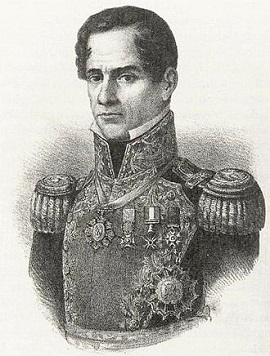 Best recognized north of the Rio Grande for overrunning the Alamo, Santa Anna actually enjoyed an amazing career with a near half-century as Mexico’s definitive caudillo.
 Not one of your
  Born to a globetrotting journalist, the young polyglot
  Probably no single figure more strikingly underscored Peter’s violent rupture of the old Russia than Alexei: “timid, secretive and lacking in self-confidence,” he was Peter’s opposite in nearly every particular — his nemesis, literally from birth.

 One of the greatest Shia scholars of the 20th century, Sadr
  A peasant revolutionary from the European frontiers of tsarism,
 In fact, his birth name was Giuseppe Balsamo.
 With the wiseguy nickname
 An aristocrat who married Selassie’s