1601: Starina Novak, hajduk

On this date in 1601, Serbian-Romanian hajduk Starina Novak was slow-roasted in Cluj with two of his captains.

The hajduk in the Balkans was a romantic figure who mixed traits of the “social bandit” outlaw with those of anti-Ottoman guerrilla. Colorful characters answering the archetype persisted into the 20th century.

Novak, who was around 70 by the time of his death, is still celebrated for his feats of arms on the soldiering side of the ledger in a running conflict with the Ottomans. Most of the sites about Starina Novak are in Serbian, like this one.

He emerges as a commander of Serbian and Bulgarian auxiliaries fighting with Michael the Brave in the 1590s to carve out of the Ottoman realm a kingdom of Wallachia, Transylvania, and Moldavia — roughly, present-day Romania plus Moldova. The enterprise was as glorious as its destiny was tragic.

By 1601 an Italian officer aptly christened Giorgio Basta had had enough of his erstwhile allies and double-crossed hajduk and upstart king alike.

The former he shopped as a traitor to Michael’s Hungarian allies, who put him to the stake in Cluj and made sure to throw water on the burning partisan throughout in order to prolong the ordeal. (The charred corpses of Novak and his associates were then impaled.) A few months later, Basta had Michael the Brave assassinated, and placed himself at the head of Michael’s hard-won kingdom.


A statue of Starina Novak keeps vigil in the city where he died. (cc) image from Bogdan Pop.

Being a national hero means your prior career in brigandage gets a little Robin Hood elbow grease.

In the Serbian epic “Starina Novak and Knez Bogosava” — translated here by polyglot friend of the site Sonechka — Novak attributes his turn to banditry to the impositions of his rulers, specifically (and ahistorically) blaming the 15th century despot’s wife Jerina for overtaxing him.

Novak and Radivoj are imbibing wine
By the brisk waters of Bosna,
At a certain Prince Bogosav’s.
And having sated themselves with wine,
Prince Bogosav began to talk:
“Brother, Old Novak,
Tell me straight, as if confessing,
Why did you, brother, become a hajduk?
What compels you
To break your neck, to wander the forest
As a brigand, pursuing your ignoble employ,
Unto your senescence, when your time has passed?”

Replies Old Novak:
“Brother, Prince Bogosav,
When you ask, I answer in earnest —
It was truly not my wish.
If you could recollect
The time when Jerina was building Smederevo
And ordered me to toil.
I labored for three years,
I pulled the trees and carried stones,
All on my own cart and oxen.
And in three years term,
I gained not a dinar,
Not even opanci to put on my feet.
But that, brother, I would have forgiven!
Having built Smederevo,
She began to mount towers,
To engild the gates and windows,
And imposed the duty on the vilayet,
For each house – three measures of gold,
Which is three hundred ducats, brother!
Those who had, gave her the treasure;
Those who gave, stayed.
I was a pauper,
With nothing to give,
I took my pickax, which I toiled with,
And with this pickax I turned to banditry,
No longer could I linger anywhere
In the domain of cursed Jerina,
But ran away to the icy Drina,
Then reached stony Bosnia.
And when I neared Romania,
I met a Turkish wedding party –
Escorting a noble girl,
All passed in peace,
Save for the Turkish groom.
On the great dark brown steed,
He did not want to pass in peace.
He pulls his three-tail whip
(encumbered with three bolts of weight)
And lashes me across my shoulders.
I begged him thrice in the God’s name:
‘I beg you, Turk,
So blessed you with fortune and heroism,
And happy joviality,
Go on, proceed along your way with peace —
Do you see that I am a poor man!’
Withal the Turk would not budge.
And ache had grasped me,
And the anger grew,
I pulled my pickax from my shoulder
And struck the Turk, mounting on his brown steed.
The blow was so light
That it threw him off his horse,
I came upon him,
Hit him twice, and then again three times
While rending him asunder.
I rummaged through his pockets,
And found there three bags of treasure;
I stashed them in my bosom;
Untied his sword,
Having untied it from his belt, I have attached it to my own;
In place I left the pickax,
So that the Turks will have a tool with which to bury,
And thenceforth I mounted his brown steed,
And headed straight to the Romanian forest.
This all was witnessed by the wedding party
That dared not pursue me.
They wanted not or dared not.
It happened forty years back.
I grew more fond of my Romanian forest
Than, brother, of a palace;
Because I guard the mountenous road,
I wait for young Sarajevans
And take their gold, and silver,
And finer cloth, and satin;
I dress myself and the gang;
So I can come and flee,
And stay in horrid places —
I fear nothing but God.”

For Bosnian-Serbian-Croatian speakers with a lot of time on their hands, here’s a reading of the original:

On this day..

Feast Day of St. Andrew

Now after that John was put in prison, Jesus came into Galilee, preaching the gospel of the kingdom of God, and saying, The time is fulfilled, and the kingdom of God is at hand: repent ye, and believe the gospel.

Now as he walked by the sea of Galilee, he saw Simon and Andrew his brother casting a net into the sea: for they were fishers. And Jesus said unto them, Come ye after me, and I will make you to become fishers of men. And straightway they forsook their nets, and followed him.

Mark 1:14-18

“Walks on the Water” by the Russian band Nautilus Pompilius
Translation from friend of the blog Sonechka; alternate version here

Apostle Andrew was fishing from a wharf.
While the Savior was walking on the water.
Andrew was pulling fishes from the sea,
While the Savior – fallen men.

Andrew cried out: “I will leave the wharf,
If you reveal the secret to me.”
And the Savior answered: “Be calm, Andrew.
There is no secret here.

“You see, yonder, on the mountain
Towers a cross,
Underneath are a dozen soldiers.
Hang on it for a while.
And when you get bored,
Return back here
To walk on the water with me.”

“But, Master, the helmets are adorned with glistening horns,
A black raven circles the cross.
Explain to me now, take pity on the fool,
And leave the crucifixion for later.”

The Messiah gasped and with ire
Stamped his foot on the smoothness of water.
“You are indeed a fool.” — And Andrew in tears
Shuffled off home with his fishes.

November 30 is the feast date of St. Andrew the Apostle, Christ‘s very first disciple along with his brother St. Peter.

Andrew gets pretty short shrift in the New Testament compared to his brother, even though the Gospel of John actually credits our man with being the first of the two boys to cotton to the Nazarene’s preaching.

Despite playing such a minor role in the sacred texts, he has a cultural footprint far in excess of fellow apostolic extras like Saint Bartholomew.

After the master’s crucifixion, Andrew is supposed to have preached in Turkey and Greece. Romanian and Kievan Rus’ traditions posit that he wandered even further north to make the first Christian inroads among their pagan forebears; as a consequence, Romania, Russia, and Ukraine are all among the countries that count Andrew as a patron saint, along with the place of his martyrdom, Greece.

The most recognizable such patronage, of course, is Scotland.

The story has it that a legendary Roman monk in the fourth century brought three fingers, an arm bone, a kneecap, and a tooth formerly comprising the saint from Patras, where Andrew died, to a monastery on the coast of Fife. The subsequent settlement has been known as St Andrews for over 800 years, so if you like that might make Andrew the patron saint of golf, too.**

Scotland’s flag, the ☓-shaped heraldic saltire pictured above, evokes Saint Andrew’s distinctive execution device, the aptly-named (and kink-friendly) St. Andrew’s Cross.

Like his brother’s physiologically improbable upside-down execution, this is supposed to have represented the disciple’s own unworthiness to die the same death as the Savior, and Roman executioners’ surprising accommodation of such scruples.

St. Andrew’s Day is an official holiday in Scotland. In many other countries of central and Eastern Europe, the vigil preceding St. Andrew’s Day has long been associated with folk magic for divining the identity of an unmarried maid’s future husband.


Detail view (click for the full image) of Henryk Siemiradzki’s 1867 painting Siemiradzki Noc-Andrzeja.

Andre, Andrei, or Andreas are equivalents; it’s thanks to a November 30 christening that San Andreas Lake got its name, and in turn conferred same on the associated continental fault that keeps Californians employed making disaster movies about their own selves going the way of Atlantis.

* There is also an apocryphal Acts of Andrew, whose original text has been lost but is known in summation indirectly through other authors. It is thought to date to the third century.

** It was Archbishop James Hamilton — later executed — who gave the residents of St Andrews standing access to golf’s Holiest of Holies, the Old Course at St Andrews.

On this day..

1793: Antoine Barnave, constitutional monarchist

I want a hero: an uncommon want,
When every year and month sends forth a new one,
Till, after cloying the gazettes with cant,
The age discovers he is not the true one

Barnave, Brissot, Condorcet, Mirabeau,
Petion, Clootz, Danton, Marat, La Fayette
Were French, and famous people, as we know;
And there were others, scarce forgotten yet,
Joubert, Hoche Marceau, Lannes, Desaix, Moreau,
With many of the military set,
Exceedingly remarkable at times,
But not at all adapted to my rhymes.

-Lord Byron, Don Juan

On this date, French Revolution orator Antoine Barnave — a founder of the short-lived Feuillants faction — became short-lived himself courtesy of the Paris Terror.

Just one of the side courses when the Revolution devoured its own children, Barnave (English Wikipedia entry | French) was a smart young avocat in the 1780s who distinguished himself at the Parlement of Grenoble.

Avant-garde ideas like political power redistributed to reflect “the new distribution of wealth” were just the sort of revolution that a wealthy lawyer could get behind.

Duly elected at the ripe old age of 27 to France’s watershed (and last) Estates-General of 1789, Barnave was a very early member of the Jacobin Club. You know, before it was cool.

Barnave’s genteel vision of the Revolution transferring the estates of the ancien regime into the mercantile hands of his friends in the bourgeoisie fell spectacularly to pieces in 1791.

That April, Mirabeau died. He was Barnave’s great debating rival in the Jacobin Club, but both men actually represented the same fundamental persuasion: constitutional monarchy. Needless to say, this Revolution was not built to halt at that particular milepost.

Within mere weeks, almost as if the players had been awaiting the literal death of Mirabeau’s moderation, events hurtled past Barnave’s sensibilities. The desperate royal family made its ill-chosen flight to Varennes in June, and the well-regarded Barnave was one of the Constituent Assembly delegates sent to escort Louis XVI back to a Paris now boiling with republican sentiment. Did not the sovereign’s literally attempting to desert from his patrimony entail an abandonment of his station?

In perhaps the pinnacle of Barnave’s rich career in political oratory, he delivered to the National Assembly on July 15 a thundering no to that proposition, challenging his fellow delegates to choose “between attachment to the Constitution and resentment against a man.”

I ask to-day of him among you who may have conceived every kind of prepossession and the deepest and most violent resentment against the executive power — I ask him to tell us whether his anger with that power is greater than his attachment to the law of his country.

Those who would thus sacrifice the Constitution to their resentment against one man seem to me far too liable to sacrifice liberty in their enthusiasm for another; and since they love a republic, now is the time to say to them: How can you wish for a republic in a nation where you hope that the action, easily pardoned after all, of an individual who has much to plead in his justification, that the action of an individual, who though certain qualities of his are now condemned, long possessed the people’s affection — when, I say, you hoped that the deed he has done might change our Government, how was it that you were not afraid that this same variableness of the people, if once they were moved by enthusiasm for a great man, by gratitude for great deeds — because the French nation, you know it, can love much better than it can hate — would overthrow your absurd republic in one day? (Source)

Barnave, to his grief, was entirely clear on what he desired in July of 1791: “all change is fatal now; all prolongation of the Revolution is disastrous now; the real question to my thinking is this, and the national interest is bound up with it; are we going to end the Revolution, or are we going to begin it again?”

His speech carried the motion on July 15th: Louis remained king. Still, the Revolution did not exit into past tense on Barnave’s say-so, and certainly not on so insubstantial a basis as “a resolve to be peaceful, a common resolve, a drawing together.”

He had the applause of the Assembly, which printed his speech for national distribution. But tempestuous debates broke out in Jacobin clubs and other radical circles, and amid intemperate accusations of treasonable conduct by the all-change-is-fatal-now crowd there were oaths sworn never to recognize the kingship of Louis XVI.

On July 17, a huge crowd led by Georges Danton filled the Champs de Mars to petition Louis’s removal. And in response to the Jacobin Club’s announced intention to support this demonstration — which turned into a galvanizing massacre when the Marquis de Lafayette had his national guardsmen fire on the protesters — Barnave with his friends and political allies Adrien Duport and Alexandre Lameth dramatically abandoned the Jacobins and split off the rival Feuillants.

In their day, this so-called “triumvirate” had been the Jacbins’ left wing. By now, they were the the revolution’s conservatives: the monarchists against the republicans, and the guys who liked the Revolution’s existing changes just fine.

“If the Revolution takes one more step, it cannot do so without danger,” Barnave intoned in that July 15 address of his. (Source) “If it is in the direction of liberty, the first act to follow could be the destruction of royalty; if it is in the direction of equality, the first act to follow could be the violation of property … is there still to be destroyed an aristocracy other than that of property?”**

Not everyone found those one-more-steps quite so terrible to contemplate as did the the silver-tongued Grenoble barrister.


Political cartoon of the Janus-faced Barnave — the man of the people in 1789, turned the man of the royal court in 1791.

If we have the luxury from posterity to smile at the notion of the Revolution’s peacably halting itself in 1791, the Feuillants had cause in their moment to think they could pull the trick.

Their move at first dramatically weakened the Jacobins, as the ranks of moderates flocked to Barnave’s prestige and eloquence. The Paris Jacobin Club lost three-quarters of its membership almost overnight, and most of its Assembly deputies. Public sentiment, at least so well as its contemporaries could discern, veered towards Barnave as well, and he was able to finalize the long-awaited Constitution of September 1791 preserving a number of important executive powers for the king’s own person.

The period of governance under that constitution opened with an address by the king that Barnave had written for him; its first few months are the “Feuillant Ministry”. Barnave was the beleaguered royal family’s chief advisor in this period.

But the Feuillant Ministry was crumbling almost from its inception. Its supporting club was founded on abhorrence for the popular politics whose force was still being uncovered in the Revolution; Barnave wanted nothing so much as the end of such societies altogether. So while the monarchists had secretaries exchanging delegated backslaps at private confabs, the reduced Jacobins — now the most passionate rump, helpfully purged of their milquetoast liberals — redoubled themselves under the sway of men like Marat and Robespierre. Barnave’s apparent alignment with the now-constitutional monarch gave legs to the “royalist” charge that was more and more laid at his feet, and Jacobin Clubs soon began receiving as prodigals former members who had found their dalliances with the Feuillants unsatisfactory.

Barnave and his faction came under relentless siege by pamphleteers, journalists, and radical democrats. One wonders if, in the end, Barnave took some cold comfort in having seen an implacable antagonist like Brissot precede him to the guillotine when his own Girondin faction, formerly the fire-eaters, tipped over the Revolution’s starboard bulwarks.

Meanwhile, the impolitic demand emanating from Marie Antoinette’s brother, the Holy Roman Emperor that the French royal family be safeguarded put France on its way to war with Austria, an outcome entirely contrary to not taking one more revolutionary step.

The hounded Barnave retired to Grenoble in January 1792 by which time the constitution he had so diligently promulgated had already virtually ceased to function, and he himself lost influence with both the king and the Assembly. In the months to follow the war tocsin undid his fellow-constitutionalists remaining in Paris. Consigned to the sidelines, their faction was arrested as royalists after the August 10, 1792 overthrow of the Bourbons.

Barnave’s papers were inventoried for hints of treasonable correspondence with the fallen king and queen, but as the curtain had not yet raised on the Terror — and Barnave had not been deported to the prisons of the capital in time for the September Massacres — he had an uncommonly lengthy period of political imprisonment. Barnave exercised this time composing his De la Révolution et de la Constitution (later published as Introduction à la révolution française), an economic history arguing that the rise of industry and manufacturing had transferred the leading role from France’s aristocrats to her bourgeoisie.

With the onset of the Terror, he was shipped to Paris to face treason charges owing to correspondence with Marie Antoinette, where his famous oratory took its last public turn for an audience that had stopped up its ears.

Finally, citizens, I recall this to you; I might have left France in all safety. Perhaps those who still love me will have reason to lament that I did not do what was so easy for me; but, whatever happens, I shall not have to reproach myself with having challenged the judges of my country, with having cast doubts on their integrity, their justice. I shall be sacrificed perhaps, but I had rather owe my ruin to human error than have pronounced my own condemnation. I shall carry to the scaffold the same calmness which you have seen me show in the debate, and to the last moment I shall pray for the welfare of my country. (Source)

He was beheaded with four other people at the Place de la Revolution on the morning of the very next day.

French speakers might enjoy this public domain book by Jules Gabriel Janin. This post has also quoted several times from Eliza Dorothy Bradby’s 1915 English biography of the man.

* It later emerged that Mirabeau was being paid by the royalist party.

** One of the steps towards equality so troubling to Barnave had been a push among Jacobin radicals to resolve upon the emancipation of black slaves in the colonies. Fretting the loss of, e.g., the lucrative sugar revenues of Saint-Domingue (Haiti), Barnave staunchly opposed this; he was one of the leading lights of the pro-slavery Massiac Club. (French link)

On this day..

1936: Jose Antonio Primo de Rivera, Falange founder

On this date in 1936, the Spanish Republicans shot Don José Antonio Primo de Rivera y Sáenz de Heredia, 1st Duke of Primo de Rivera, 3rd Marquis of Estella, Grandee of Spain.

The son of Spain’s 1920s dictator, Primo de Rivera founded in 1933 the Falange, Spain’s native fascist movement.

At the October 29 founding convention that year at Madrid’s Theatre of Comedy, Primo de Rivera scathingly pilloried the wan democratic rituals that coming years’ conflict would sweep aside. “The most ruinous system of wasted energy,” he jeered at liberal democracy, where men with leadership waste their talents in hollow electoral hustling and parliamentary rigmarole while the nonsensical ephemeral whims of a formless plurality pass for the vision he attributed to the time before Rousseau ruined everything. “What alone mattered to the liberal state was that a certain number of gentlemen be sitting at the polling station, that the voting start at eight o’clock and end at four, that the ballot boxes not get smashed — when being smashed is the noblest aspiration of all ballot boxes.” (The full speech is available in Spanish here.)

Primo de Rivera espoused for Falangismo the same impulses — of unity, of destiny, of national rebirth, of the triumphant collective — that animated Europe’s similar extreme right stirrings in those years. Only 35 years before, Spain had lost her empire, near enough in memory to inform an acute ache of loss.

In a poetic sweep we will raise this fervent devotion to Spain; we will make sacrifices, we will renounce the easy life and we will triumph, a triumph that — you know this well — we shall not obtain in the upcoming elections. In these elections vote the lesser evil. But your Spain will not be born out of them, nor does our frame for action reside there. That is a murky atmosphere, spent, like a tavern’s after a night of dissipation. Our station is not there. I am a candidate, yes, but I take part in these elections without faith or respect. And I say this now, when so doing may cost me every vote. I couldn’t care less. We are not going to squabble with the establishment over the unsavory left-overs of a soiled banquet. Our station is outside though we may provisionally pass by the other one. Our place is out in the clear air, beneath a moonlit sky, cradling a rifle, and the stars overhead. Let the others party on. We stand outside vigilant; earnest and self-confident we divine the sunrise in the joy of our hearts.

Unlike the Naziism in Germany or Fascism in Italy, Falangism never grew into a force capable of conquering state power itself. Just thirty-three months after Primo de Rivera’s founding address, the Spanish Civil War erupted. The Falangists’ alliance with Francisco Franco — after the war, they would be combined with the Carlists into the only legal political association* in Francoist Spain — spelled great gains for their membership rolls but it was still the General who called the shots.**

Primo de Rivera’s share in this alliance was a voluptuous cult of personality as Spain’s preeminent right-wing martyr, fine posthumous work if you can get it mitigated only by the necessity of undergoing the martyrdom. The fascist prophet was already in prison at the time Franco struck the first blow of the war: he’d been arrested in Madrid on weapons charges. From his cell he carried on a brazen correspondence with Nationalists conniving to subvert the hated Spanish Republic, and when his activities were discovered and prosecuted that autumn in light of Franco’s July revolt they could scarcely have been better framed to incur the utmost measure of judicial wrath.

In consequence of his martyrdom, November 20 remains down to the present a hallowed day for the far right in Spain.


“Cara al Sol” (“Facing the Sun”) is the Falangist anthem; the lyrics are generally credited to Primo de Rivera.

* The Falange Española Tradicionalista y de las Juntas de Ofensiva Nacional-Sindicalista, or “Spanish Traditionalist Phalanx of the Assemblies of National-Syndicalist Offensive” (FET y de las JONS) — or less exhaustingly, the Movimiento Nacional (National Movement).

** Primo de Rivera and Franco didn’t like each other much personally, either.

On this day..

1793: Madame Roland, éminence grise

(Thanks to Amelia Fedo, a graduate student in French literature, for the guest post.)

On this date in 1793, Manon Roland (née Phlipon)* was guillotined as part of the Girondist purges in the Paris Terror.

As Olympe de Gouges — who preceded her to the guillotine by only a few days — observed, being a woman may have prevented her from holding political power under her own name, but it didn’t stop her from losing her own head.

Born in Paris to a bourgeois engraver, she married up through her alliance with quasi-aristocrat Jean-Marie Roland de la Platière. Twenty years her senior, he was chosen by her for his class status and intellect rather than for the love he inspired.

Ambitious from the start, Madame Roland took advantage of her husband’s (and later, her Girondin not-quite-lover François Buzot‘s) engagement in civic life to catapult herself into the role of behind-the-scenes stateswoman. She had been prepared for this role since childhood, when she had voraciously read Rousseau and Plutarch. Unlike Olympe de Gouges, she internalized the idea that women did not belong in politics — yet still she yearned to have an influence on the Republic.

And she did indeed succeed in wielding political power, with enough competence that Robespierre wanted her guillotined at least as much as her husband: everyone knew that she was the real force to be reckoned with.

Her political career was inextricably tied to her husband’s. Unable to hold political office herself, she lived vicariously through him. At first he was a bureaucrat, and she his secretary and personal assistant; but then he became involved in Parisian politics and was eventually appointed Minister of the Interior.

It was his wife who encouraged him to accept the position; for a year now she had been hosting salons frequented by a wide range of political movers and shakers, and she was itching to get in the game.

Monsieur Roland did not have a brilliant career as minister. His wife was the one with the vision and energy (the historian Lucy Moore claims that every good idea he had was hers); although devoted to Republican ideals he remained something of a milquetoast, and was attacked both by the snobby old guard (the lack of buckles on his shoes caused a scandal) and by the extreme left.

Although Madame Roland identified with Robespierre and was a good deal more radical than the Girondins (especially in her feelings about the monarchy), she and her husband were still officially associated with them. As such, they were swept up in Robespierre’s purges.

There were a few pre-Terror false alarms: a warrant was issued for Monsieur Roland’s arrest after the September Massacres, which Danton put the kibosh on; and in 1792, Madame Roland was dragged into court on trumped-up charges of corresponding with émigrés, but was able to use her oratorical skills to get herself acquitted.

When the Terror began, Monsieur Roland opted to keep his head down in the hopes of keeping it on, and resigned from his post as minister.

It was too late. In May 1793 Madame Roland was arrested again — unaccompanied by her husband, who had managed to escape into hiding.

She was subjected to a show trial like so many before and after her; although she had prepared a defense, she was not allowed to read it. Given that she was accused of “conspiring against the unity and the indivisibility of the Republic and attempting to introduce civil war,” neither her verdict nor her sentence are much of a surprise.

She was preoccupied with her husband (whom she declared would be driven to suicide by her execution), with Buzot (who was in grave danger of suffering her same fate), and with her own legacy. She seized the opportunity to be a martyr like the men she so admired — men who had been able to act in the open, rather than behind the scenes — and took advantage of the free time she had in prison to write her memoirs.

Most sources give similar accounts of her behavior before and during the execution. Content to die for her principles — or, perhaps, simply resolved to make a show of contentment — she maintained great calm and resignation in her final hours. The only favor she asked of anyone was that her childhood friend Sophie Grandchamp wait for her on the Pont-Neuf so that they could see each other when the tumbrel passed.

Influencing people up to the very end, Roland’s last political act was an attempt to impart some of her courage to the man who would share her tumbrel, a forger of assignats named Lamarche.

Lacking the sort of great social narrative that would give meaning to his death (such as a personal feud with Robespierre), Lamarche did not share Roland’s sanguine attitude; he thus found himself the recipient of a performance designed to alter his mood, consisting mostly of jokes, distractions, and modeled behavior. The events surrounding her execution have passed into legend, but various sources agree that she quipped to Lamarche after his hair was cut, “It suits you wonderfully. You have the head of a Roman.”

She also urged the executioner to leave her own hair long enough to serve as a suitable handle — for him to show her head to the crowd, of course.

As much as she detested Danton, it appears she had a few things in common with him after all.

Counterintuitively, it was considered a privilege to be guillotined first; it was merciful, the reasoning went, to kill someone before they could see others die. Roland chose to pass up this “privilege”; most attribute this to her desire to spare Lamarche the sight of her death, but Lucy Moore points out in Liberty: The Lives and Times of Six Women in Revolutionary France that she may have rejected the logic of such a “mercy” altogether and wished to live — like Madame du Barry — even a few moments longer.

After mounting the scaffold, she addressed a statue of Marianne, left over from a festival held in the Place de la Révolution; she is traditionally said to have exclaimed, “O liberty, what crimes are committed in your name!”, although a less reputable source (i.e., the apocryphal Sanson memoirs) assigns her the more prosaic last words, “Oh! Liberty, how they’ve tricked you!”

As she had predicted, her husband committed suicide two days later, falling on his sword as soon as he learned of her fate.

*This is only one of many names she has been called; Siân Reynolds explains in Marriage and Revolution: Monsieur and Madame Roland that “Manon” is a childhood name, and her adult name remains mysterious; it was either “Marie,” “Jeanne,” or “Marie-Jeanne.”

A few books about Madame Roland

On this day..

1816: Francisco Jose de Caldas, wise person

Colombia polymath Francisco Jose de Caldas was shot on this date in 1816 during the Spanish commander Pablo Morillo‘s decimation of rebellious intelligentsia in separatist New Granada.

While Europe was mired in the Napoleonic Wars, those United Provinces of New Granada — roughly modern Colombia, which remembers its short-lived New Granada predecessor as la Patria Boba, the Foolish Fatherland — had asserted their independence. As we have detailed previously, it was Morillo who arrived from the mother country to disabuse them of this dream. Morillo did it with such a flair for the merciless that he earned the nickname El Pacificador.

Morillo conquered Bogota by May 1816 and for the rest of the year put large numbers of the pro-breakaway intelligentsia to political trials in an apparent attempt to cripple any future independence movements. (It didn’t work; during this very period, future liberator Simon Bolivar was making his first landings in Venezuela.)

A history by Jose Manuel Restrepo, a political figure of New Granada who was fortunate enough to escape the crackdown, lamented the fate of the men with whom he had once dreamed the dream.

for the space of six months, scarcely a week passed without the execution, in Santa Fe or the provinces, of three, four, or more individuals, shot as traitors. Thus perished the persons of the greatest wisdom, the most virtuous and wealthy, in New-Granada. The object which Morillo had in view, was to extinguish intelligence, remove men of influence, and destroy property, so that, in future, there should be none capable of originating or directing another revolution. New-Granada has deplored, and will for a long time deplore, among other illustrious victims, the loss of Doctors Camilo Torres, Joaquin Camacho, Jose Gregorio and Frutos Gutierrez, Crisanto Valenzuela, Miguel Pombo, Jorge Lozano, Francisco Antonio Ulloa, and Manuel Torices; and of military men, general Custodio Rovira, Libario Mejia, and the engineer Francisco Jose de Caldas. The murder of this celebrated mathematician and philosopher, was a piece of wanton cruelty on the part of Morillo. The exact sciences lost much by his premature death; and the geography of New-Granda especially, retrograded beyond measure, by the loss of the precious works which he had nearly perfected.

The spirit of these dark days is summarized by a reply Morillo supposedly made to petitions for him to spare the wise Caldas: “Spain does not need wise people.”

Present-day Colombia memorializes Francisco Jose de Caldas in the name of a department and numerous public monuments. (He also used to be on the 20-peso note when such a thing existed. Colombia’s smallest paper bill today is 1,000 pesos.)


Statue of Caldas on Bogota’s Plaza de Caldas. (cc) image from Mauromed.

On this day..

1651: Marubashi Chuya, Keian Uprising conspirator

On this date in 1651, the ronin Marubashi Chuya was crucified for a failed attempt to topple the Tokugawa shogunate.

Allegedly disaffected of the national unification dynasty by having lost his father to battle against it, Marubashi orchestrated, along with a fellow martial arts adept named Yui Shosetsu, a daring plot betrayed only by illness. When shogun Tokugawa Iemitsu died in 1651, leaving power to a 10-year-old heir, the conspirators meant to set fire to Edo (Tokyo) and seize Edo Castle as well as other cities.

But Marubashi came down with a very ill-timed fever and in delirium raved treasonable plot details that got passed along to Tokugawa authorities. The so-called Keian Uprising never made it into execution.


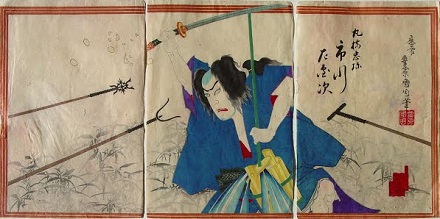
The Keian Uprising inspired many literary interpretations. This 1883 woodblock print depicts actor Ichikawa Sadanji as Marubashi Chûya.

This is more than can be said about the uprisers.

Yui managed to commit seppuku before capture, but Murabashi and a number of the other rebels paid the ultimate price. So too did family members of the rebels.

Marubashi’s is reputed to be the first execution to take place at the Suzugamori execution grounds. The little quarter-acre patch maintained this grim role for the ensuing 220 years, during which time an estimated 100,000 people were put to death there.

That venerable execution grounds was retired in 1871. There’s a memorial marking its onetime site in present-day Tokyo near the junction of Kyu-tokaido Street and Daiichikeihin Avenue.

On this day..

1971: Victor Apaza Quispe, Arequipa folk saint

From Frank Graziano’s Cultures of Devotion: Folk Saints of Spanish America:


In Arequipa, there is active devotion to Victor Apaza Quispe, who was born in the Miraflores district in 1932. Apaza led a vagrant life supported by odd jobs after fleeing his abusive father. In a variant version that he related to inmates, he was sold by his father into farm labor. Apaza married in 1953, continued a life of transient jobs and petty crime, drank heavily, and physically abused his wife and daughter until he finally abandoned the home. When he returned ten years later, the marriage was beyond repair. In January 1969, Apaza dreamed that his wife was unfaithful to him. He went to the location revealed in the dream and saw the shadowy figure of a man escaping. His wife, also there, was not as fortunate. Apaza beat her to death with a rock.

It was later revealed that the crime was premeditated and carefully planned. Apaza originally denied responsibility but confessed his guilt once the evidence mounted against him. Later, during appeals for clemency, he again declared his innocence. He was convicted partially on the evidence of his two daughters, who wittingly or unwittingly offered testimony that supported the death penalty. Apaza did not understand the sentence until his lawyer translated it for him into Quechua. He hugged his lawyer, the two of them crying, and then collapsed into his chair.

People in the courtroom were shocked by the death sentence. The rarity of the event — this would be the first execution in Arequipa — resulted in extensive press coverage. Apaza suddenly gained a celebrity derived less from his crime than from the punishment. The press represented him as a poor, simple man and a good Christian. According to Apaza’s defense attorney, “the very foundation of society was shaken” when the public learned that Apaza had been sentenced to death. Horror and indignation were aroused because the imminent execution was “an unjust action of human justice.” Divine justice would make amends.

Apaza faced the firing squad in prison on September 17, 1971. (The drama is intensified in some folkloric versions by locating the execution in Arequipa’s main plaza.) Arequipa’s residents were outraged, even traumatized, and some fifteen hundred attended Apaza’s funeral. They organized themselves into squads, taking turns to carry the coffin.

Apaza had been in prison for two years before he was executed. Like Ubilberto Vasquez Bautista in Cajamarca, he became a model prisoner and something of a populist. Fellow inmates described Apaza as a good, hardworking, honest man. In 1971, the 531 men incracerated with him sent a letter to the court petitioning clemency, in part because Apaza had proven himself to be “an honorable man and dedicated to his work.” The prison chaplain, a Jesuit, found Apaza to be pious and God-fearing, and the warden thought he was a “completely good” man. Later, retrospective press accounts described Apaza and Ubilberto together as “innocent men crushed by the Kafkaesque and labyrinthine cruelties of the administration of justice in Peru.”

Book CoverThe devotees with whom I spoke in Arequipa knew little about Apaza. Even the official rezador, a man who prays for tips at the shrine, did not have the story clear. Many devotees had a vague idea that Apaza had been executed under circumstances that suggested injustice, however, and the key word offered by all was “innocent.” Some believed that the true killer confessed the crime after Apaza was executed.

When I asked devotees how they knew that Apaza was innocent, one woman astonished me with her answer: “because a sinner cannot work miracles.” I later encountered this same response in other devotions. Once a folk saint’s fame for miracles is accepted as true, then this truth — this evidence — revises backward to create the conditions necessary for the production of miracles. Miracles make Apaza’s apparent guilt impossible, so the verdict is reversed. Innocence causes miracles, and miracles cause innocence. Miracles occur within the circularity defined by these parameters.

Apaza is miraculous, like all folk saints of this prototype, because “he died innocent and is beside Our Lord.” “You were shot, you suffered,” people said when they requested the first miracles, because these misfortunes qualified Apaza for sainthood.

On this day..

1771: Matthias Klostermayr, the Bavarian Hiasl

On this date in 1771, the German outlaw Matthias Klostermayr was broken on the wheel in Dillingen.

The “Bavarian Robin Hood” (English Wikipedia entry | German) led a band of poachers (their merriness or lack thereof is unrecorded) who in the 1760s did a famous business, exploiting the jigsaw of tiny statelets in the region to keep the heat off by ducking across a border every few weeks.

Their exploits zestily raiding the hated private hunting preserves of haughty lords elevated them in the popular imagination to social bandits. They’re really said to have distributed a portion of their booty to the poor. They were slated with nine homicides during their run, of game wardens or soldiers whom they did not hesitate to handle much less generously. The gang’s long run proliferated legends multiplying their prowess, even crediting them with supernatural powers like invulnerability to bullets.

Klostermayr was the subject of folk songs even in his lifetime, and that exposure meant that he eventually became the subject of multilateral coordination among the principalities whose limited jurisdictions he so expertly exploited. A 1769 mutual-assistance arrangement permitted authorities to cross the border in hot pursuit; by the end of 1770, an outright military expedition with 300 troops had been arranged. They took Klostermayr by storm on January 14, 1771 in the town of Osterzell; the theater and the shooting club still carry Klostermayr’s name in Osterzell, a small testament to the robber’s enduring popularity two and a half centuries on from his death.

That death was bound to be a demonstrative one, revenging all the offenses Klostermayr had done to his superiors.

The agonizing public shattering of his bones on the breaking wheel, preserved for us in graphic drawings, did no disfavors to the bandit’s fame. Buttressed by his thinly-veiled appearance a few years later as the protagonist of Schiller‘s first play, The Robbers, Klostermayr’s renown persists in Germanophone Europe right down to the present day.


Detail view (click for a larger image) of the terrifying device on which Bavarian outlaw Matthias Klostermayr was stretched out to have his limbs crushed with a breaking-wheel on September 6, 1772.

Detail view (click for a larger image) of Matthias Klostermayr being broken on the wheel.

On this day..

1782: Bartolina Sisa, indigenous rebel

September 5 is International Indigenous Women’s Day, in honor of the torturous execution in Bolivia on this date in 1782 of the Aymara peasant rebel Bartolina Sisa.

Sisa (English Wikipedia entry | Spanish) shared with her husband Tupac Katari leadership of a huge indigenous uprising against the Spanish.

Eighteen months before Bartolina’s execution, she and Tupac Katari — Julian Apasa, to use his given name before he staked out a nom de guerre claiming the inheritance of Tupac Amaru and Tomas Katari — laid La Paz* under siege with an army 40,000 strong. Over the course of that spring summer, the Bolivian capital lost 10,000 souls and teetered on the brink of collapse — actually in two separate three-month sieges with a brief interim between.

Bartolina Sisa was recognized by the rebels as the coequal of her husband; the two took command decisions together in consultation.

As such, when the siege was finally relieved and the natives defeated that October, Sisa was in line to share her husband’s fate. This was easy to effect because she had been betrayed into Spanish hands between the first and second sieges. Her enemies refused Tupac Katari’s every blandishment to exchange her, and in time had the cruel pleasure of forcing her to watch her defeated husband’s butchery. Nearly a year later Sisa tasted a like fate, and her body was thereafter chopped up to display as a warning in various towns to cow potential future native insurgents.

A present-day peasant women’s union bears Sisa’s name, the Bartolina Sisa Confederation; the president of Brazil’s 2006 Constituent Assembly that drafted the country’s current constitution was an indigenous Quechua woman named Silvia Lazarte, who was the Bartolina Sisa Confederation’s former executive secretary.

* The city‘s full original name was Nuestra Señora de La Paz, “Our Lady of Peace”. It was founded in 1548 at the site of a former indigenous village and the “peace” referred to is the restoration of calm after Gonzalo Pizarro‘s rising.

On this day..