1865: Gerardo Barrios, Salvadoran statesman

August 29 is a National Day of Commemoration in El Salvador, honoring the execution on this date in 1865 of the country’s beloved ex-president Gerardo Barrios.

Today, you’ll find Barrios (English Wikipedia entry | Spanish) entombed adjacent Francisco Morazan, an apt deposition for both those great statesmen of Central American union. Barrios was just old enough — he enlisted at age 14 — to have served in Morazan’s army of the United Provinces of Central America, the abbreviated political expression of a wonderful vision for Spain’s former possessions. “This magnificent location between the two great oceans,” Bolivar once enthused of Central America,

could in time become the emporium of the world. Its canals will shorten the distances throughout the world, strengthen commercial ties with Europe, America, and Asia, and bring that happy region tribute from the four quarters of the globe. Perhaps some day the capital of the world may be located there, just as Constantine claimed Byzantium was the capital of the ancient world.

El Salvador was the capital of this prospective emporium, and not only in the sense that its government met at San Salvador.* As the “provinces” of Guatemala, Honduras, Nicaragua and Costa Rica pursued more autonomy and, eventually, outright independence, El Salvador was also the bastion of support for the failing union. It’s where Morazan fell back to as the United Provinces fractured, and it’s where he landed to mount a doomed reunification campaign.

Gerardo Barrios, come to political maturity as well as to manhood in Morazan’s service, was a Senator by the time the union ended. He followed Morazan into exile, and he raised a battalion for the abortive restoration attempt that cost Morazan his life.

After Morazan’s execution, Barrios increasingly became the key leader of remaining unionist aspirations, which also meant leadership of El Salvador’s liberal faction. This was the country — independent at last because all her sister provinces had declared independence from her — that Gerardo Barrios assumed leadership of in 1859,** a generation on from Morazan’s execution. Actual political reunification of the former provinces was by then as distant and gauzy a dream as Bolivar’s Byzantium; perhaps their most noteworthy common-purpose act in the meantime had been the coordinated defeat of American filibuster William Walker, an operation for which Barrios provided essential behind-the-scenes diplomacy.

So Barrios’s executive tenure would be a crucial period of state-building for Nicaragua: building up roads, schools, and other pillars of civil infrastructure; professionalizing the army; promulgating a comprehensive legal code; and economic development.†

It is from this farsighted era that Barrios won lasting fame as his country’s great statesman. And crowning the period with martyrs’ laurels has surely not done his reputation a bit of harm. His regional rivalry with the Guatemalan caudillo Rafael Carrera broke out into war in 1863, which quickly pulled in Honduras (on the side of El Salvador) and Nicaragua and Costa Rica (on the side of Guatemala). The populist Carrera, Guatemala’s “supreme and perpetual leader for life,” had been the central anti-unionist and anti-liberal figure dating back to the Morazan era, and besides his international alliances he gained the support in 1863 of Salvadoran Catholic clergy opposed to the secularization part of Barrios’s modernizing project. Finally encircled by his enemies in a besieged San Salvador in October of that year, Barrios was once again forced into exile.

Carrera died on April 14, 1865‡ and with the passing of the local hegemon Barrios — by now cooling his heels in Panama — saw an opportunity to regain leadership of his country. But the attempted rising that was to augur his re-entry into El Salvador came to nothing, and Barrios realizing the failure turned around to return to Panama almost as soon as he had arrived. Alas for him, a storm grounded his schooner in Nicaraguan waters.

Nicaragua extradited Carrera back to his native soil, albeit with an arrangement that the prisoner — who had been declared a traitor in absentia during his exile — would not face the death penalty. Once the man was in hand, El Salvador reneged on that part of the agreement and subjected Barrios to a military trial. “Today Duenas pronounces my sentence,” Barrios observed of his successor and enemy late the night of August 28, when the tribunal condemned him to be shot just hours thereafter. “But tomorrow I receive the verdict of history.”

The latter judgment has been an unmitigated victory for our man. His life is taught to schoolchildren and his image has graced the Salvadoran currency repeatedly. Two Salvadoran towns (Gerardo, and Barrios) are named in his honor, and many others have streets or plazas that bear his name, including a huge one in the center of San Salvador, ornamented with a monumental equestrian statue of its namesake.


(cc) image from Bradier044 of the Barrios statue in San Salvador’s Plaza Gerardo Barrios, also known as Plaza Civica.

* San Salvador, which is the present-day capital of El Salvador, was the capital of the United Provinces from 1834. Prior to that time, the capital was Guatemala City.

** Barrios had also been president on a brief interim basis for a few months in 1858.

† If you enjoy brewing a morning pot of El Salvador’s top agricultural export, coffee beans, tip your mug to Barrios: he’s credited with introducing coffee cultivation in the country.

‡ The same date John Wilkes Booth shot Abraham Lincoln.

On this day..

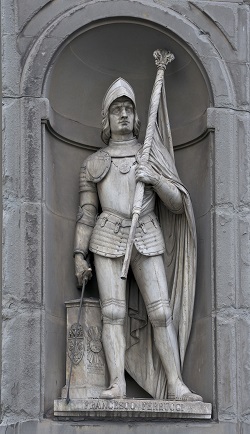
1530: Francesco Ferruccio, victim of Maramaldo

On this date in 1530, Francesco Ferruccio (or just Ferrucci) and his executioner Fabrizio Maramaldo clinched their immortality at the Battle of Gavinana.

The battle was the tragic final scene of the War of the League of Cognac, in which an alliance of Italian city-states tried to expel the Habsburg Holy Roman Emperor Charles V from the peninsula. Charles had already in effect decided matters by forcing the French out of the fight, which also brought about the capitulation of the Vatican.

Left alone in the fray, doughty Florence — ever so briefly at this moment restored as a Republic, having given the Medici the boot — continued to hold out against impossible odds. A vast imperial army swollen by landsknechts whose mercenary arms were now unnecessary elsewhere in Italy besieged Florence on October 24, 1529.


The Siege of Florence, by Tuscan Renaissance Man Giorgio Vasari.

The intrepid Florentine commander Francesco Ferruccio (English Wikipedia entry | Italian) strove to take his hopeless fight to the enemy. After a plan to coerce papal support by striking Rome was vetoed, Ferruccio mounted a march through the Apennines to threaten the Imperials’ rear.

He was intercepted at Gavinana, a battle decided by the arrival of landsknecht reinforcements under the command of the notoriously cruel condottiere Fabrizio Maramaldo.

Maramaldo would elevate himself for posterity out of the ranks of his merely brutal brethren by finding Ferruccio, badly wounded, his prisoner, and putting him to immediate death by his own hand — an execution that resulted in Florentine capitulation one week later, and the installation of Alessandro de’ Medici as Duke of the now ex-Republic.*

While admittedly borderline as an “execution” suitable for this here site, Ferruccio’s defiance in the face of his killer and his last denunciation of Maramaldo — “Coward, you kill a dead man!” — became the stuff of legend in a later Italy. (It also helped Ferruccio’s case for the nationalist pantheon that he died fighting against the Germans, not against the next city-state over.)

The romantic novelist Francesco Domenico Guerrazzi** made Ferruccio the subject of his magnum opus L’Assedio di Firenze, and before you knew it the name was on the lips of every risorgimento Tom, Dick and Francesco. Garibaldi invoked him in speech; Goffredo Mameli wrote him into the national anthem.


Every man has the heart
and hand of Ferruccio …

Under the Italian state those men helped to make, Ferruccio was appropriated as the name of a battleship; fascist Italy especially found Ferruccio congenial to the national-pride project and valorized the martyr relentlessly.


1930 Fascist Italy stamp depicting — for the 400th anniversary of the occasion — Fabrizio Maramaldo murdering his prisoner Francesco Ferruccio. Other Februccio stamps from the same period can be found on the man’s Italian Wikipedia page.

For Maramaldo, a less flattering but possibly more durable legacy: Italian gained the noun maramaldo, the adjective maramaldesco, and the verb maramaldeggiare to signify bullying or cruel domineering.

* Alessandro had a reputation for despotism, and was assassinated a few years later by his cousin Lorenzino de’ Medici in a tyrannicide that was Brutus-like in both its motivation and effect. That later affair is the subject of the 19th century play Lorenzaccio.

** Guerrazzi also did his bit for the legend of Beatrice Cenci.

On this day..

1155: Arnold of Brescia

At some point in the first weeks of June 1155 — nobody knows the exact date, but it precedes June 18 — the Roman authorities disposed of Arnold of Brescia.

For a decade the tongue of a fragile new Roman Republic, Arnold was a student of the cutting-edge theologian (and castrated romantic) Peter Abelard. Arnold held the temporal pretensions of the Vatican invalid, a theology sublimely according with the popular revolt that from 1143 overturned Rome’s overweening princes and even slew a pope in a melee on the Capitoline.

The Senate long forsaken was re-founded by this new Republic and an equestrian order re-founded to resume to the rights of a now-growing middle rank. The slain pope’s successor became a refugee tenant of the neighboring cities, orchestrating crusades against Turks, Moors, and Wends — but dying at Tivoli in 1153 still awaiting a prince who would restore his own person to the authority of the Eternal City.

That prince, however, had just begun to stir. The Hohenstaufen king Frederick I had concluded in the months before Pope Eugenius’s death a compact to restore the pontiff, which policy dovetailed nicely with an intent to show the German power against other wayward cites in Italy. It was Frederick’s Italian subjects, and conquests, who gave this man the distinctive name by which history recalls him: Barbarossa, or “red-beard”.

All these years — or at least, from 1145, when he surfaced in the rebellious city from past years’ exile in Zurich — Arnold of Brescia’s “eloquence thundered over the seven hills.” (Gibbon)

Blending in the same discourse the texts of Livy and St. Paul, uniting the motives of Gospel, and of classic, enthusiasm, he admonished the Romans how strangely their patience and the vices of the clergy had degenerated from the primitive times of the church and the city. He exhorted them to assert the inalienable rights of men and Christians; to restore the laws and magistrates of the republic; to respect the name of the emperor: but to confine their shepherd to the spiritual government of his flock. Nor could his spiritual government escape the censure and control of the reformer; and the inferior clergy were taught by his lessons to resist the cardinals, who had usurped a despotic command over the twenty-eight regions or parishes of Rome.

The absentee pope excommunicated Arnold in 1148. It was to no effect until Barbarossa’s legions neared the city.

As King Frederick approached, Pope Adrian IV* applied a deft turn of the screw by laying Rome itself under an interdict, depriving his quarrelsome flock of both spiritual balm and pilgrim revenue and at long last forcing the heresiarch’s ejection.

Arnold was seized in Tuscany and delivered to the Roman curia for punishment; the record of when or where this occurred is lost, but it is specified in the particular that his corpse was reduced to ashes that were scattered to the Tiber — proof against the prospect of a plebeian graveside shrine.

On June 18 even as his soldiers tamed Rome’s resisting republicans, Barbarossa accepted the crown of the Holy Roman Empire from the hands of Pope Adrian in St. Peter’s Basilica.**

Though Arnold had vanished into the Tiber’s silt, the thirst of his former flock for spiritual succor beyond that which the worldly Vicar of Christ could offer did not die so easily. Succeeding movements — indeed, perhaps, one continuous movement — took up Arnold’s objection to the clergy’s worldly emoluments and his summons to plain virtue. There are the Arnoldists to start with, but a bare few years after Arnold’s death emerge Peter Waldo of the heretical Waldensians, as well as the Cathars in southern France; a generation on finds St. Francis of Assisi, giving way to 13th and 14th centuries thick with oft-suppressed popular reform currents — the Beguines, the Apostolic Brethren, even the Fraticelli who criticized other followers of the aforementioned St. Francis for having already abandoned the poverty of his order.

Later Protestants would claim all these, and Arnold too (Arnold reportedly opposed infant baptism), as their forebears, which is why we have the nice Colosseum’s-shadow picture above from Foxe’s Martyrs’ Mirror. Just how literally one should take that lineage might be a matter of debate, but there is little doubt that Arnold of Brescia’s critique maintained its potency into that era and keeps it still in the modern age — one reason that the incinerated firebrand could still make a powerful subject for a risorgimento writer like Giovannini Battista Niccolini 700 years later.

* Born Nicholas Breakspear, Adrian remains to this day the only English pope ever.

** Popes and Holy Roman Emperors were most usually rivals rather than allies in peninsular politics; indeed, the Roman Republic had issued its own summons to Frederick’s predecessor to come to its aid — and rule Rome with its support — to humble the pretensions of the papacy. Arguably, Barbarossa missed a trick by not availing that potential alliance and instead exalting the pontifex maximus in the manner of his coronation: Barbarossa probably thought so himself often enough during his running rivalry over the ensuing generation with Pope Alexander III.

On this day..

1942: Vladislav Vancura, “Marketa Lazarova” author

On this date in 1942, leftist Czech novelist Vladislav Vancura was executed at Prague’s Kobylisy shooting range.

An “unsung giant” of European letters, the Bohemian doctor burst onto the literary scene in the 1920s with Pekar Jan Marhoul (Baker Jan Marhoul) and Pole orná a válecná (Fields to Plough, Fields of War). But he was notable for a remarkable perspicacity in style, genre, and artistic perspective throughout his career. He’s often referred to as a poet in prose, and maybe for this reason was equally keen on writing for and directing cinema.

Milan Kundera credited Vancura with “probably the richest vocabulary that any Czech writer has ever had; a vocabulary in which the language of every era is preserved, in which words from the Bible of Kralice [the first complete translation of the Bible into Czech] stand humbly side by side with modern argot.”

His greatest commercial success and possibly his crowning achievement was Marketa Lazarova, a short novel (120 pages in the original Czech) set amid a feud of nobles in he Middle Ages. Only tranlated into English in 2013, it “does for Czech literature something akin to what James Joyce did for English-language literature with Ulysses: breaking with the realism that previously dominated to open up a new frontier in the realm of style.”

Here’s an excerpt (via):

Folly scatters without rhyme or reason. Lend an ear to this tale of a place in the county of Mladá Boleslav, in the time of the disturbances, when the king strove for the safety of the highways, having cruel troubles with the nobles, who conducted themselves downright thievishly, and what is worse, who shed blood practically laughing out loud. You have become truly too sensitive from musing upon our nation’s nobility and fair manners, and when you drink, you waste the cook’s water, spilling it ‘cross the table, but the men of whom I speak were an unruly and devilish lot. A rabble which I cannot compare to anything else than stallions. Precious little cared they of that which you account as important. Comb and soap! Why, they did not heed even the Lord’s commandments.

‘Tis said that there were countless such ruffians, but this story concerns itself with none save the family whose name most surely calls to mind Václav unjustly. Shifty nobles they were! The eldest amidst this bloody time was baptized with a graceful name, but forgot it and called himself Kozlík till the time of his beastly death.

Vancura’s death was plenty beastly too, albeit not particularly surprising: Communist avant-garde artists in German-occupied Slavic countries didn’t usually fare the best during the war years, and Vancura compounded his risk by taking active part in the resistance. He was among hundreds of Czechs arrested, tortured, and executed in the bloody German crackdown that followed the May 27, 1942 assassination of Reinhard Heydrich.

On this day..

1864: Nikolay Chernyshevsky’s “civil execution”

On this date in 1864, the Russian writer Nikolay Chernyshevsky was publicly executed in St. Petersburg.

Then he was shipped to Siberia.

Chernyshevsky’s punishment was only a pantomime “civil execution,” somewhat akin to the symbolic executions by effigy elsewhere in Europe. In this case, the faux death penalty was imposed not upon a peeling portrait but on Chernyshevsky’s actual person: “The hangmen led Chernyshevsky to the scaffold on Mytninskaya Square in St. Petersburg, made him kneel down, broke a sword over his head and then chained him to the pillory. Chernyshevsky stood calmly under the rain waiting for this mockery to come to an end.” (Source)

The pillory, exposed to the hoots and brickbats of an offended populace, was supposed to be a humiliation to its sufferer; occasionally, it even proved lethal. Not so for Chernyshevsky: the crowd stood silently. Someone threw a bouquet of flowers.

This ludicrous theater was enacted to punish Chernyshevsky for his leadership of the St. Petersburg intellectual circle that gave birth to the Narodnik movement. Literally “going to the people,” this was a peasant-focused populist-democratic-socialist philosophy paradoxically germinated among Russia’s small coterie of intellectual elites.

Think Marxism for a feudal society here: the Narodnik adaptation was the hope that Russia’s vast peasantry could be roused to serve the part of a revolutionary working class, and skip Russia directly to a socialism still preserving communal traditions unsullied by that interim period wherein (per Marx in the Communist Manifesto) capitalism had “pitilessly torn asunder the motley feudal ties … [and] left remaining no other nexus between man and man than naked self-interest.”

This is why Chernyshevsky and the Narodniks viewed the “emancipation” of serfs of 1861 with a gimlet eye: it was a shift towards capitalist property relations, in which the feudal shackles were merely replaced with new, and heavier irons. Chernyshevsky subversively urged his “emancipated” countrymen to view the move as a heist.

It is of course unlikely that many of the actual peasant malcontents stirred up in the wake of the emancipation perused Chernyshevsky’s “To the Manorial Peasants from Their Well-Wishers, Greetings”. But other bourgeois radicals who did read that sort of thing would in due time — after the suppression of the Narodniki in the 1860s and 1870s drove its underground remnants to terrorism — spawn the revolutionary network Narodnaya Volya, and assassinate the tsar who enacted that emancipation, Alexander II.

Chernyshevsky was more a writer than a fighter. He spent his pre-“execution” imprisonment in Peter and Paul Fortress forging his definitive contribution to the movement — the novel What Is To Be Done?.*

(Our own Sonechka regards What Is To Be Done? as quite possibly Russia’s single worst literary product, but the didactic novel imagined (in the dreams of its principal character, Vera Pavlovna) an egalitarian future, including for women. Chernyshevsky himself wrote that he “possess[ed] not one bit of artistic talent … any merit to be found in my tale is due entirely to its truthfulness.”)

Whatever its artistic shortcomings, What Is To Be Done? entered the revolutionary literary canon. Vladmir Ilyich Ulyanov — better known as Lenin — wasn’t even born until 1870 but as a young man he admired What Is To Be Done? In 1902 Lenin himself published a political pamphlet under that same title.

Far less impressed were the likes of Dostoyevsky, himself a former radical who also underwent mock execution in his time. Unlike Chernyshevsky, Dostoyevsky apostasized from his revolutionary credo; Dostoyevsky’s 1864 Notes from the Underground is “a bitter artistic answer” to (and in several spots a direct parody of) Chernyshevsky’s magnum opus.

* What Is To Be Done? responds to Turgenev‘s Fathers And Sons. A previous Narodnik classic by Alexander Herzen asked the parallel question Who Is To Blame?.

On this day..

1683: Yaoya Oshichi, fire horse

On this date in 1683,* Yaoya Oshichi gave her life for her red-hot love … and the want of a little white lie.

The greengrocer’s daughter Oshichi (English Wikipedia page | Japanese) legendarily fell in love with a priest of the nearby temple while taking refuge there during one of Edo’s many fires (Japanese link), and in a truly adolescent outburst proceeded to start another fire in the hopes of meeting him again. (Alternate version: it was Oshichi’s gesture that actually started the linked conflagration.)

As a 16-year-old, Oshichi was just barely eligible to suffer the full weight of the law for a capital crime.

In an age of scanty documentation, however, the pitying magistrate (Japanese link) hearing her case is supposed to have asked her in a hinting sort of way, “you’re 15, right?”

Either not catching his drift or else honest to a fault, Oshichi replied that, no, she was 16, thank you very much, and reiterated the point when it was followed-up … thus dooming herself to the stake.


Yaoya Oshichi’s execution.

A few years after this outstandingly tragic demise, poet Ihara Saikaku popularized the tale in his Five Women Who Loved. She’s been waxing immortal ever since in every manner of artistic interpretation, and remains a popular figure for joruri and bunraku and kabuki.

(When next in Tokyo, pay your own respects at her tomb.)

Meanwhile, Yaoya Oshichi’s apparent birth in the zodiacal “fire horse” year of 1666 — fire horses are supposed to be an especially passionate, impulsive bunch — followed by her unfortunate fiery end helps make such cycles superstitiously inauspicious for prospective parents, especially prospective parents of girls.

The year of a fire horse only rolls around once every six decades; in the last one, in 1966, Japanese “fertility dropped by over 25%;” even “the fertility rate of Japanese Americans in California and Hawaii also dropped by 3.3% and 1.8%, respectively, in the same year.”** The abortion rate in Japan for that one year spiked nearly 50% above expected without any other apparent cause.† It’s something to watch for when the next batch of little fire horses are due, in 2026.

* “The 29th day of the 3rd month” is widely cited as “March 29”, but it actually appears to refer to the 29th day of the 3rd month of the third year of the “Heaven’s Blessing” era. That third month spanned the Gregorian dates of March 28 through April 26, 1683.

** Jungmin Lee and Myungho Paik, “Sex Preferences and Fertility in South Korea during the Year of the Horse,” Demography, Vol. 43, No. 2 (May, 2006).

† Kanae Kaku, “Increased induced abortion rate in 1966, an aspect of Japanese folk superstition,” Annals of Human Biology, Vol. 2, No. 2 (1975).

On this day..

1979: Amir-Abbas Hoveyda, Iranian Prime Minister

On this date in 1979, just days after a referendum overwhelmingly voted revolutionary Iran an Islamic Republic, its former Prime Minister was convicted by a drumhead tribunal in Qasr Prison. Minutes after the trial closed, he was shot to death in a prison courtyard.

The western-educated Amir-Abbas Hoveyda (or Hoveida) shimmied up the diplomatic ranks in the 1940s and 1950s, and became Prime Minister after Hassa Ali Mansur was assassinated in 1965.

Hoveyda held the office for twelve and a half years, longer than anyone in modern Iranian history. He had been noted as a progressive young statesman interested in reforming Iran. But his years in government notably failed to restrain Iran’s endemic corruption and state violence. That he was a debonair polyglot with a discerning taste in whisky cut more ice with his foreign admirers than his future judges.

Not long after the economic crisis of the 1970s forced him from office, the Iranian Revolution collapsed the entire state to which he devoted his public service.

Embracing either martyrdom or naivete, Hoveyda turned himself into the authorities of newborn revolutionary Iran, and soon found his name on the marquee for a spate of revolutionary trials. From mid-February, every day or two would bring fresh headlines of six or eight or 11 more shot for complicity in the ancien regime. Away from the capital, others suffered the same fate, mostly hidden from the world.

Revolutionary Iran’s first Prime Minister, Mehdi Bazargan — a raving bleeding heart by the yardstick of what was to come — forced a halt to the bloodbath by threatening to resign and denouncing the trials as “irreligious, inhuman and a disgrace” on national television. Revolutionary tribunals suspended on March 16, interrupting Hoveida’s prosecution — or merely protracting his death rattle.

But Bazargan had less weight to throw around than he might have thought. He would accede himself unhappily to the resumption of the revolutionary courts in early April, and eventually resign late in 1979 over the U.S. embassy hostage-taking.

Unimpeded now, those courts stayed busy with near wall-to-wall prosecutions of hundreds of former officials of the hated Shah.

It was, indeed, technically that same day — around 1 a.m., following a marathon 15-hour court session — that a half-dozen former military men met the same fate in Qasr Prison. Gen. Iraj Amini-Afshar, Gen. Mohammed-Javad Molavi Taleghani, Col. Mashallah Iftikhar Manish, Col. Hadi Gholestani, Lt. Bhadour Bahadouri, and a rank-and-file soldier named Mustafa Sadri were all shot for having fired on revolutionary crowds in Isfahan the previous December.

After a good night’s sleep, they were ready to have done with Hoveyda.

The notorious revolutionary “hanging judge” Sadeq Khalkhali ordered the execution shortly before 6 p.m. that evening, for immediate dispatch. Khalkhali is even been rumored to have personally finished off the former Prime Minister.*

* I’m skeptical of the anecdote in Khalkhali’s current Wikipedia page that the judge shot Hoveyda to pre-empt a possible stay. Virtually all the pre-execution 1979 reporting I’ve seen agreed that Hoveyda had no prospect of clemency given the political situation, and that the end of the Bazargan moratorium and resumption of the trials was tantamount to his death sentence.

Middle East correspondent Robert Fisk remembered a somewhat topical anecdote about the judge; it’s from Fisk’s The Great War for Civilisation: The Conquest of the Middle East:

I had sat at the feet of Hojatolislam Sadeq Khalkhali, the “hanging judge”, as he listed those of the Shah’s family sentenced to death in absentia. Khalkhali it was who had sentenced a14-year-old boy to death, who had approved of the stoning to death of women in Kermanshah, who earlier, in a mental hospital, would strangle cats in his prison cell. “The Shah will be strung up; he will be cut down and smashed,” he told me. “He is an instrument of Satan.”

Weeks later, in Evin prison, he discoursed again on the finer details of stoning to death. I still have the cassette of our conversation, his lips smacking audibly on a tub of vanilla ice cream as he spoke.

On this day..

1713: Juraj Janosik, Slovakian social bandit

On this date (most likely) in 1713, Slovakian “Robin Hood” figure Juraj Janosik was hung on a hook in Liptov County for his outlawry.

Janosik was a flesh-and-blood man, but much of what is known or believed about him lies squarely in the realm of folklore.

He hailed from the village of Terchova. You’ll find Terchova today just on the Slovakian side of the Polish border; in Janosik’s time, this was the Habsburg Kingdom of Hungary.


In Janosik’s native Terchova, a walking path leads to a monumental statue of the famed outlaw. (cc) image from Andre Skibinski.

Janosik is said to have fought with the anti-Habsburg Kuruc guerrillas in his youth, then joined the imperial army when that rebellion fizzled, then found his short life’s calling when detailed to guard a brigand named Tomáš Uhorcík. The two went into (Uhorcík’s) business together in about 1711, and Janosik’s natural aptitude soon made him the leader of their robber band.

From pine-forest lairs the merry bandits preyed on aristocrats and rich merchants throughout their mountainous home territories and into Moravia, Silesia, and Slovakia and are supposed to have taken chivalrous care not to injure their prey other than financially. They’re inevitably also credited with sharing the fruits of their heists with the poor.

When Janosik became celebrated in later centuries his virtues both moral and martial would multiply by each astonishing retelling. In this Polish verse, for example, Janosik is less Robin Hood and more Terminator as he boldly presents himself at a royal tourney and avenges the honor of Slovakian maids raped by some of the contending knights.

“O king, an accusation I bring thee!” he proclaimed.
“Our women are dishonored, our village maidens shamed!
Twelve of our maidens ravished — on these twelve knights the guilt! —
Twelve of our village maidens! Let blood for blood be spilt!

“Twelve cottages dishonored — twelve homes lament today …
Sire, throned on gold, be gracious — give ear to me, I pray!
Blood must be shed, and bloody must be the foeman’s face;
I come, I come avenging our Slovak maids’ disgrace!”

Then all men stood astounded, and silent fell the ring.
“What word is this? How durst thou? Who art thou?” asked the king.
“A hill-born outlaw, hetman Janosik, that am I.”
Then marvelled all the courtiers, and king enthroned on high.

And the king’s visage slowly with rising wrath was lit,
And his moustache was bristling, his grizzled brows were knit.
Upon that band of Magyars, twelve gentlemen, he glowered.
Beneath the crested headgear twelve heads were earthward lowered.

“What, willest thou to fight them, all twelve, and brow to brow?”
— “With all, O king,” Janosik made answer; “all, and now!
O king, twelve fields of harvest a single gust will clear;
Thus let me, single-handed, meet these twelve warriors here.”

Then the king’s sceptre signalled; the trumpets gave one blast.
Janosik fixed his girdle, and off his mantle cast.
The king and all the courtiers, they marvelled to behold
The shirt that came from Juhasz, the trousers looped with gold.

There from his cap a bundle of discs, all golden, rayed,
And moved he ever so little, the cap a tinkling made.
A row upon his axe-haft of brazen rings he had;
At every step he swung it. His shoes in steel were clad.

His hand had gripped the hatchet, and there he took his stand.
Heralds struck up; then signalled the king, with sceptred hand;
Twelve lances, like a forest thick-timbered, took their aim,
And at Janosik’s bosom twelve lances flying came.

Hola! in golden Budzyn, hola! how went it, tell!
And in the king’s chief city what thing that day befell?
Upon that day what pastime might there the king await
In his dear daughter’s honor, by his town’s golden gate?

Now on the sand, all shattered, twelve lances fell and crashed,
And off the polished helmplates twelve glittering sabres flashed.
For see! up sprang Janosik, and raised his arm to strike,
Whistled the tune of Juhasz, and whirled around his pike.

How like a flame of lightning that hatchet circled round!
Erdoedy, count, with vizor hewn through, was on the ground;
Pallavicini, margrave, had rent his horse’s rein;
His riven skull was soiling the sand with bloody stain.

And now Prince Bathyani on his left side had dropt;
Right hand and sword were severed. Count Palffy’s brows were chopt.
And soon Prince Esterhazy upon the sand lay low,
Scrabbling the ground; and straightway his face was white as snow.

Not long did Count Festetics smile in the light of day,
But by the brothers Toskoel fell dead — and dead were they.
And then, before Janosik, the remnant lay in death.
When the twelfth corpse had fallen, he drew a mighty breath,

And leaned upon his weapon; like some rich beechtree then
He stood; there lay before him twelve haughty gentlemen;
Twelve golden suits of armor and twelve sharp sabres lay;
And dumbly gazed the people upon that mortal fray.

And no man spoke, and all men a tomblike silence kept.
To the king bowed Janosik, and low his cap he swept.
Then in their blood were carried twelve corpses from that place
And thus avenged Janosik those Slovak maids’ disgrace.

But the actual Janosik was quite vincible.

His career only really lasted a year or so; he was captured in 1712, escaped, and was soon re-taken. It seems that despite the marauders’ usual care for the safety of their victims, they managed to kill a Father Juraja Vertíka.

March 17, 1713 was the date of Juraj Janosik’s conviction and death sentence; though not explicitly recorded of Janosik, the usual practice would have been to carry out such a sentence without delay. Many of his comrades met similar fates: Uhorcík, for instance, was put to death a month after Janosik.


Janosik Hanged, by Miloš Jiránek (1906). (Via)

The bandit’s legend has survived and thrived after his death in literally hundreds (per Hobsbawm) of poems, legends, and folk ballads, like Jan Botto’s epic “The Death of Janosik”.

Oddly, Martin Votruba argues,** there is no indication that anyone in 1713 or the years following celebrated Janosik with anything like the fervor he eventually attained.

Janosik is all but invisible as a literary figure until the late 18th century, according to Votruba. Pesumably his name attached to miscellaneous anecdotes and exploits — enough to keep it in the conversation of bandits.

Around the turn to the 19th century Janosik’s person seems to have become gradually conjoined to stories and songs about other brigands, both real and fictional, just as these characters were booming in literary popularity. Juraj Janosik went from being just a guy who’d be mentioned in passing in a list of bandits, to the bandit. (Votruba guesses that the linguistic similarity our fellow’s surname had with with generic male name Jan, Janik, or Janko — variations on “John” that were commonly used for entirely legendary outlaws in folk songs — helped to form the connection)

Only in the 1830s and 1840s did the long-dead outlaw, who by then dominated lowbrow bandit-legend folklore, begin to take on the form familiar today — that of “a benevolent, rebellious, tragic, quasi-folkloric freedom-fighter” called “Janosik.” And “since this happened in a period of mounting ethnic activism in central Europe, Janosik could not become merely a romantic hero. The Slovak literary and social discourse highlighted his ethnicity, which then appeared in implicit contrast to the ethnicity of the now politically overpowering Hungarians.” The rich guys Janosik robbed — not ethnically specified in the earliest sources — now became oppressive foreign lords. Janosik’s growing corpus of attributed exploits now earned elite artistic attention.

He’s never looked back since.

In the 20th and 21st centuries, he’s been the subject of many film treatments, most recently in 2009.

* Translation by Oliver Elton from the Slavonic and East European Review. American Series, Vol. 2, No. 2 (November 1943)

** Martin Votruba, “Hang Him High: The Elevation of Janosik to an Ethnic Icon”, Slavic Review, Vol 65, No. 1 (Spring 2006).

On this day..

c. 415 B.C.E.: The men of Melos

On an uncertain date in the winter of 416-415 B.C.E., the island of Melos surrendered to an Athenian siege during the ruinous Peloponnesian War.

Athens put all of Melos’s adult men to death, selling its women and children into slavery.

This ghastly event is covered by ThucydidesHistory. Thucydides’ account of the diplomatic negotiation between the mighty Athenians and the hopelessly outmuscled Melians is the subject of the Melian dialogue — a timeless classic of philosophy and statecraft.

The Athenians’ coldly realistic position — and their ultimate disposition of their conquest — is summed up in the wonderful epigraph, “the strong do what they will, and the weak suffer what they must.” (And numerous variations of this translation.)

As the reigning naval power, Athens (at war with a league led by its rival, the land power Sparta) had decided that an independent and neutral Melos would no longer be in the offing. The Melian dialogue pits Athens’ ultimatum to Melos to submit and save itself, against the Melians’ vain attempt to assert the justice of their cause; likewise, it is the dialogue of an imperial order against a holdover independent city-state from a fading era.

It’s a riveting read. The excerpts below are from this public-domain translation; there are others here and here.

Athenians: Well, then, we Athenians will use no flue words; we will not go out of our way to prove at length that we have a right to rule, because we overthrew the Persians; or that we attack you now because we are suffering any injury at your hands. We should not convince you if we did; nor must you expect to convince us by arguing that, although a colony of the Lacedaemonians, you have taken no part in their expeditions, or that you have never done us any wrong. But you and we should say what we really think, and aim only at what is possible, for we both alike know that into the discussion of human affairs the question of justice only enters where the pressure of necessity is equal, and that the powerful exact what they can, and the weak grant what they must.

Melians: Well, then, since you set aside justice and invite us to speak of expediency, in our judgment it is certainly expedient that you should respect a principle which is for the common good; and that to every man when in peril a reasonable claim should be accounted a claim of right, and any plea which he is disposed to urge, even if failing of the point a little, should help his cause. Your interest in this principle is quite as great as ours, inasmuch as you, if you fall, will incur the heaviest vengeance, and will be the most terrible example to mankind.

Athenians: The fall of our empire, if it should fall, is not an event to which we look forward with dismay; for ruling states such as Lacedaemon are not cruel to their vanquished enemies. And we are fighting not so much against the Lacedaemonians, as against our own subjects who may some day rise up and overcome their former masters. But this is a danger which you may leave to us. And we will now endeavour to show that we have come in the interests of our empire, and that in what we are about to say we are only seeking the preservation of your city. For we want to make you ours with the least trouble to ourselves, and it is for the interests of us both that you should not be destroyed.

Melians: It may be your interest to be our masters, but how can it be ours to be your slaves?

Athenians: To you the gain will be that by submission you will avert the worst; and we shall be all the richer for your preservation.

Melians: But must we be your enemies? Will you not receive us as friends if we are neutral and remain at peace with you?

Athenians: No, your enmity is not half so mischievous to us as your friendship; for the one is in the eyes of our subjects an argument of our power, the other of our weakness.

Over and over the Melian envoy is dismayed by his visitors’ indifference to the moral high ground. Frustrated of any concession, he resolves his embattled city to embark upon the remote hope of resistance in preference to voluntary servitude — leading the Athenians to part with this chilly sentiment:

You told us that the safety of your city would be your first care, but we remark that, in this long discussion, not a word has been uttered by you which would give a reasonable man expectation of deliverance. Your strongest grounds are hopes deferred, and what power you have is not to be compared with that which is already arrayed against you. Unless after we have withdrawn you mean to come, as even now you may, to a wiser conclusion, you are showing a great want of sense. For surely you cannot dream of flying to that false sense of honour which has been the ruin of so many when danger and dishonour were staring them in the face. Many men with their eyes still open to the consequences have found the word honour too much for them, and have suffered a mere name to lure them on, until it has drawn down upon them real and irretrievable calamities; through their own folly they have incurred a worse dishonour than fortune would have inflicted upon them. If you are wise you will not run this risk; you ought to see that there can be no disgrace in yielding to a great city which invites you to become her ally on reasonable terms, keeping your own land, and merely paying tribute; and that you will certainly gain no honour if, having to choose between two alternatives, safety and war, you obstinately prefer the worse. To maintain our rights against equals, to be politic with superiors, and to be moderate towards inferiors is the path of safety. Reflect once more when we have withdrawn, and say to yourselves over and over again that you are deliberating about your one and only country, which may be saved or may be destroyed by a single decision,

Athens wasn’t kidding.

Finding no traction with the Melian delegation, the greater power immediately besieged Melos. Thucydides recounts the Melians’ subsequent fate:

So the summer ended.

In the following winter the Lacedaemonians had intended to make an expedition into the Argive territory, but finding that the sacrifices which they offered at the frontier were unfavourable they returned home … About the same time the Melians took another part of the Athenian wall; for the fortifications were insufficiently guarded. Whereupon the Athenians sent fresh troops, under the command of Philocrates the son of Demeas. The place was now closely invested, and there was treachery among the citizens themselves. So the Melians were induced to surrender at discretion. The Athenians thereupon put to death all who were of military age, and made slaves of the women and children. They then colonised the island, sending thither 500 settlers of their own.


On top of everything else, the Athenian sack put an end to the production of Melian reliefs. (The island still had the glory of the Venus de Milo to look forward to, however.)

If there was a consolation for the scattered remains of the ruined Melian polis, it was that Athens’ cruel imperial hubris led it just months later to launch a catastrophic invasion of Sicily.

That defeat helped turn the Peloponnesian War decisively against Athens. Just eleven years after overrunning Melos, haughty Athens itself surrendered to a Spartan siege.

Thucydides, an exiled former Athenian general, deploys the classical dialogue form to great effect; his own perspective on the various arguments advanced in the Melian debate is difficult to discern with confidence. Clearly, however, it’s a topic of great interest to Thucydides, as his account dwells repeatedly on the conundrums touching justice and international relations: he’s one of the first intellectuals to explore what’s now thought of as the “realist” view of foreign policy. Compare the Melian Dialogue, for instance, to the Athenian demos‘s Mytilenian Debate; or, to the Plataean speech making a Melos-like appeal to the powerful Spartans.* And in one early passage, private Athenians appeal to Sparta and Corinth not to commence on war against the hegemony of Athens with words similar to those later used at Melos: “It has always been a rule that the weak should be subject to the strong; and besides, we consider that we are worthy of our power. Up till the present moment you, too, used to think that we were; but now, after calculating your own interest, you are beginning to talk in terms of right and wrong. Considerations of this kind have never yet turned people aside from the opportunities of aggrandizement offered by superior strength.”

At any rate, Thucydides’ proud city-empire would never recover from the inglorious fall inflicted by this war. The result was a fourth-century power vacuum which the Macedonia of Philip II and Alexander the Great eventually rose to fill.

* Thucydides also reports the Athenians hoisted by their own realpolitik when, in the Sicilian invasion, they attempt to appeal to Camarina for support. That city spurns the appeal, fearing subjugation should expansionist Athens prevail, and the revenge of their overwhelmingly powerful neighbor Syracuse otherwise.

On this day..

1556: Hemu

This date in 1556 saw the Second Battle of Panipat in India … and the consequent beheading of the losing commander.

Hem Chandra Vikramaditya was the unfortunate object of this treatment, a remarkable Hindu who was born a commoner and died a king.

The early 16th century saw the birth of the Mughal Empire as Turkic Muslim tribes led by the conqueror Babur swept away the Pashtun sultanates in north India. The First Battle of Panipat back in 1526 cinched this conquest.

In this unsettled environment, an able man could rise. Few were abler than Hem Chandra, more familiarly known to posterity as Hemu.

Born to a family of Hindu priests in a time when Hindu kings had not ruled his homeland for centuries, Hemu first came to prominence as a merchant supplying provisions, and later armaments, for the imperial army. He proved so capable that Islam Shah took him on as an adviser.

Now, despite the Mughal conquest, Islam Shah was actually an Pashtun. A weak succession after Babur had thrown the Mughals into retreat, and most of their once and future territory was now under the temporary authority of the Sur Empire.

Following Islam Shah’s death in 1554, the political situation for the Sur Empire fell into confusion. A boy-emperor successor was murdered to give way to a drunk, and Hemu emerged as the de facto authority in the chaotic realm … which in practice meant racing around dealing with various military threats.

Hemu put down the many internal revolts that flowered after Islam Shah’s death, but his greater problem was the resurgent Mughals.

Babur’s heir Humayun had been driven into exile in Persia years ago. Now he returned at the head of an army to retake his patrimony. Even when Humayun himself died in the process (he fell down a flight of stairs*), he bequeathed Hemu a potent foe in the form of his teenage heir Akbar — the sovereign who would eventually be esteemed the Mughals’ greatest emperor.

Even so, Hemu was routing all who stood against him. The onetime merchant had proven himself “one of the greatest commanders of the age,” in the words of Victorian historian John Clark Marshman. “He never shrank away from the battlefield and when the fight was most fierce, he did not bother for his personal safety and always fought with his adversaries courageously along with his comrades.”

On October 7, 1556, Hemu whipped Akbar at the Battle of Delhi. Entering the ancient capital, Hemu proclaimed himself emperor under the regnal name Raja Vikramaditya. And why not, after all? The kingdom already only maintained itself by Hemu’s own brilliance; he’s reputed to have had an undefeated combat record at this point.

But sometimes a single loss is all that’s needed.

Hemu was the first Hindu emperor in 350 years, but he only held the position for a month.

The new emperor again met Akbar (and Akbar’s regent Bairam Khan) on the fifth of November at Panipat, and this time the Mughals won. Hemu’s valorous exposure to danger proved his undoing when he was struck in the face by an enemy arrow.

As his once-unconquerable army routed, the captured Hemu was taken as a prisoner to his rival ruler — unconscious, and already dying. Again, the accounts vary;** in the classical version, Akbar nobly refuses to put the captive to death. Elphinstone‘s History of India, glossing some earlier Muslim historians, writes that

Bairam was desirous that Akbar should give him the first wound, and thus, by inbruing his sword in the blood of so distinguished an infidel, should establish his right to the envied title of ‘Ghazi’ or ‘Champion of the Faith’; but the spirited boy refused to strike a wounded enemy, and Bairam, irritated by his scruples, himself cut off the captive’s head at a blow.

However, there are other versions of this story in which the 14-year-old Akbar is not so reticent.

Whoever chopped it, the severed head was sent to Kabul to cow Hemu’s Pashtun supporters, while the torso was publicly gibbeted outside Purana Quila. Hemu’s followers were massacred afterwards in numberless quantities sufficient, so it is said, to erect minarets of their skulls.

Akbar ruled the Mughal state until his death in 1605.

* Humayun’s monumental tomb is a UNESCO World Heritage Site today.

** See Vincent A. Smith, “The Death of Hemu in 1556, after the Battle of Panipat,” Journal of the Royal Asiatic Society of Great Britain and Ireland (July 1916). Smith’s opinion is that Akbar probably did cut off Hemu’s head personally, but might later have spun the incident in a less distasteful direction.

On this day..