On this anniversary date of King Charles I’s beheading, the two-years-dead corpse of the late Lord Protector Oliver Cromwell was hung in chains at Tyburn and then beheaded, along with the bodies of John Bradshaw and Henry Ireton.
The great-great-grandnephew of ruthless Tudor pol Thomas Cromwell rose higher than any English commoner, high enough to be offered the very crown he had struck off at Whitehall. Oliver Cromwell declined it in sweeping Puritan rhetoric just as if he hadn’t spent weeks agonizing over whether to take it.
“I would not seek to set up that which Providence hath destroyed and laid in the dust, and I would not build Jericho again.”
The House of Stuart never could rebuild its Jericho while the Lord Protector ran the realm* — thirteen years, writes Macaulay, “during which England was, under various names and forms, really governed by the sword. Never, before that time, or since that time, was the civil power in our country subjected to military dictation.”
“Cromwell lifting the Coffin-lid and looking at the body of Charles I”, by Hippolyte (Paul) Delaroche — a French painter with an affinity for English executionscenes. The painting is based on an apocryphal but irresistible legend, also used by Nathaniel Hawthorne in a tedious short story.
The English Commonwealth foundered after Cromwell’s death, however, and restoration of the monarchy — a rock, as it turned out, on which the Puritans’ bourgeois revolution could erect its colossus — came with the price of a few examples being made.
Of course, “executing” dead guys displays about as much strength as it does sanitation, and for all Charles II‘s demonstrative vengeance, the politically circumscribed throne he resumed was very far from his father’s dream of absolutism. Between the late dictator and the new king, the future belonged to the corpse clanking around on the gibbet.
When the able Charles II followed Cromwell into the great hereafter, his brother James II promptly fumbled away the crown with his anachronistic insistence on royal authority and his impolitic adherence to Catholicism.**
In the emerging England of the century to come, the divine right would depart the Stuarts for another dynasty more amenable to the rising authority of the parliament whose sword Oliver Cromwell once wielded.
* Resources on the particulars of Cromwell’s career, the English Civil War, et al, are in plentiful supply online. This BBC documentary is a very watchable overview: part I; part II; part III; part IV.
** James II remains England’s last Catholic monarch.
The set of any given Tudor-era costume drama is a walking Who’s Who of scaffold superstars, most notably, of course, the wives of Henry VIII. That king’s bed did not cease exuding power and danger with Henry’s death.
With Henry’s demise, the crown fell to the only legitimate son the old man had produced in a lifetime of trying, the sickly 9-year-old Edward VI, son of Henry’s beloved* third wife Jane Seymour.
Jane’s brothers had leveraged their late sister’s favor into political muscle, and Edward Seymour smoothly outmaneuvered rival factions late in Henry’s life to set himself up as the true ruler of England during the boy king’s regency.
Created Duke of Somerset and Lord Protector,** Edward ran the country for going on three years, executing the other Seymour sibling as a rival along the way.
But the power of the king’s office without the attendant legitimacy turned out to be a double-edged blade.
Edward inherited a campaign against Scotland (and France) to secure the betrothal of the king to the young Mary Queen of Scots, then just beginning her own lifetime as a political and matrimonial football.
That wearisome (and costly) military scenario could only exacerbate the enmities a somewhat tin-eared Somerset generated in the course of everyday politics at the treacherous Tudor court. Catholics resented his liberal religious policy (Thomas Cranmer produced the first Book of Common Prayer on Edward Seymour’s watch); noble rivals wheedled and flattered the youthful king in his charge; and Edward Seymour’s populist political style rubbed stodgier nobles the wrong way without quite satisfying discontent among commoners† who rebelled widely in 1549, a year of terrible harvests and economic breakdown. By October of 1549, he had been politically isolated and was supplanted by John Dudley. (Guess what happened to him.)
Interestingly, that transition initially looked to be as bloodless a coup d’etat as 16th century England could enjoy: Seymour did a couple months in the Tower of London but accepted his place and not only rejoined the Privy Council but dynastically married his daughter to Dudley’s heir.
All it took, however, was an ounce of paranoia on Dudley’s part to suspect the former Lord Protector of plotting against him. The peers of the realm wouldn’t convict him of a trumped-up treason charge, but “compromised” with a felony conviction that had, for old man Somerset, the exact same result.
We have an account of the Duke’s oddly portentous end from diarist Henry Machyn, whose record of the scene in the original text of Early Modern English we present here beside its “translation” — courtesy of Machyn diaries here and here.
[The xxij of January, soon after eight of the clock in the morning, the duke of Somerset was beheaded on Tower hill. There was as] grett compeny as have bene syne . . the kynges gard behynge there with ther ha[lbards, and a] M1. [i.e., a thousand] mo with halbards of the prevelege of the Towre, [Ratcliffe,] Lymhowsse, Whyt-chapell, Sant Kateryn, and Strettford [Bow], as Hogston, Sordyche; and ther the ij shreyfs behyng th[ere present] seyng the execusyon of my lord, and ys hed to be [smitten] of, and after shortely ys body was putt in to a coffin, [and carried] in to the Towre, and ther bered in the chyrche, of [the north] syd of the qwyre of sant Peters, the wyche I beseeche [God] have mercy on ys sowlle, amen! And ther was [a sudden] rumbelyng a lytyll a-for he ded, as yt had byn [guns] shuttyng [i.e., shooting] and grett horsys commyng, that a M1. [i.e., a thousand] fell [to the] grond for fere, for thay that wher at the on syd [thought] no nodur butt that one was kyllyng odur, that [they fell] down to the grond on apon anodur with ther halb[ards], they thought no nodur butt that thay shuld . . . . . sum fell in to [the] dyche of the Towre and odur plasys, . . . and a C. [i.e., 100] in to the Towre-dyche, and sum ran a way for [fear.]
He [the Duke of Somerset] was beheaded soon after eight o’clock in the morning, being brought to his execution the sooner to prevent the concourse of the people, who would be forward to see the last end of one so well beloved by them. It was the greatest company as have been seen. The King’s guard being there with their arms, there were a thousand more with halberds of the privilege of the Tower, from Ratcliff, Limehouse, Whitechapel, St. Katherine, and Stratford Bow, as Hoxton, Shoreditch.
And there the two sheriffs being there present seeing the execution of my lord. And his head to be off. And after shortly his body was put into a coffin and carried into the Tower and there buried in the church of the north side of the choir of St. Peter. The which I beseech God have mercy on his soul. Amen.
And there was a sudden rumbling a little before he died as it had been guns shooting and great horses coming, that a thousand fell to the ground for fear. For they that were at the one side thought no other but that one was killing other. That they fell down to the ground, one upon another with their halberds. They thought no other but that they should flee. Some fell into the ditch of the Tower and other places, and a hundred into the Tower ditch, and some ran away.
* Henry was buried next to Jane, a meek spouse who had stayed out of politics, given him an heir, and died from the birth.
† Notably, Somerset ordered a commission to look into nobles enclosing common land, a burning issue throughout the century. Some think this raised hopes in the hoi polloi for a resolution to the great class conflict that the Duke didn’t have the juice to implement.
No brutality, no torture has ever made me plead for mercy, because I prefer to die with my head up, with unshakable faith and deep confidence in the destiny of my country, rather than live in submission and spurning of scared principles.
One person’s “murdered under controversial circumstances” is another person’s “executed.” By most unbiased accounts, Patrice Lumumba was both.
A strident anti-colonialist caught in the most inflammatory of Cold War power struggles, Lumumba remains a controversial figure.
In 1956, Patrice Lumumba was a mail clerk in Belgian Congo recently out of prison for embezzlement of post office funds. Though previously involved with the Liberal Party of Belgium, a colonialist political party, after prison, he helped found the Mouvement National Congolais, a pro-independence national party (an important distinction at the time, as most pro-independence parties were at least partially tribal in nature).
Convicted in 1959 of inciting an anti-colonial riot and sentenced to 6 months in prison, Lumumba was released early as Congo won its independence and the MNC became an important political force. Just how important became apparent the following June, when the 35-year-old Lumumba was ratified as the newly independent Congo’s first prime minister.
From criminal to high statesman in just over a year, Lumumba took his new power in stride, and watched in disgust as the deposed King Baudouin of Belgium attended the new nation’s first Independence Day celebration, and before a fawning international media condescendingly congratulated Belgium’s colonial beneficence to its former slave plantation.
Struck from the day’s official celebrations in favor of the the lukewarm exhortations of the new President Kasa-Vubu, Lumumba found time on the day’s unofficial program. Strident, emotional, and unabashed in its anticolonialist, nationalist, and pan-Africanist bent, Lumumba’s famous speech was roundly criticized by the domestic and foreign press, but well-received by the crowd and ultimately delivered directly to history.
Lumumba’s tenure as prime minister was short-lived, however.
Mere weeks after independence, a mutiny on army bases broke out in reaction to Lumumba’s ill-fated decision to leave the military out of a government pay raise. The resulting anarchy quickly spread throughout the country, and the province of Katanga, with the support of King Baudouin and powerful mining companies, declared independence. As United Nations troops failed to quell the situation, Lumumba appealed to the Soviets, whose intervention succeeded only in causing Lumumba’s political support to crumble.
Kasa-Vuba dismissed Lumumba in September; in response, Lumumba declared Kasa-Vuba deposed — quite illegally, as it happens — and appealed to the Senate, from whom he managed to win a vote of confidence.
At this point, in the heat of the Cold War, things got interesting.
Deposed again, this time in a CIA-endorsed coup, Lumumba found himself under house arrest and under the protection of UN troops. Not certain whether to trust the rule of the various laws surrounding him, Lumumba slipped out under the cover of night and escaped to nearby Stanleyville (now Kisangani), where he believed he had enough supporters to set up his own government — and army, whom one supposes he had by then resolved to pay rather better.
Pursued by forces loyal to the new government, Lumumba was captured and arrested in early December 1960 and charged with “inciting the army to rebellion.” Devoid of his former UN protection, the man who would be the leader of a newly free nation watched as he became a pawn in a much larger struggle. UN Secretary General Dag Hammarskjöld appealed to the process of law –- whatever that was –- while the USSR jumped a step ahead, demanding that Lumumba be immediately released and reinstated as prime minister and all UN forces withdrawn.
So much for that. The UN Security Council convened, and, a week later, the USSR’s resolution was defeated. Another, Western-backed resolution that would have given the UN power to act as impartial arbitrator was vetoed by the USSR.
At this point, caught between hostility of Cold War politics and the ever-hazy idea of “international law,” Lumumba languished in the military barracks of an even more hostile government. Hearing of plans for his transfer to barracks at the now-subdued Katanga province, Lumumba was wild on the plane trip and was forcibly restrained after appealing to other passengers to intervene on his behalf. Late at night after his arrival at his new prison, Lumumba was driven to an isolated spot and executed by firing squad. News of his death was not released until three weeks later, when it sparked protests in several European cities over the role of the Belgian government, which denied any involvement.
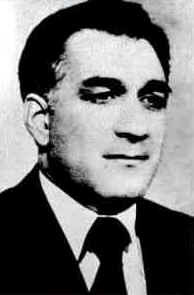
On this date in 1979, the 104-day term of Afghan president Hafizullah Amin met a violent end as a Soviet-engineered coup raised the curtain on a war destined to bring misery to both Cold War combatants.
The Soviet Union’s ongoing intervention in Afghan politics had through the 1970’s steadily mired it deeper into an unstable political situation.
Now, it was running out of patience with the country’s president, Hafizullah Amin.
He’d got the best of rival Nur Mohammad Taraki in a power struggle that September, but to the political chaos and the blossoming Islamic insurgency roiling his country, Amin added a level of brutality that was all his own, and a streak of diplomatic independence that was distinctly unwelcome in Moscow.
Amin was a Communist himself, and both he and the predecessor he’d murdered had wanted ever-increasing Soviet aid to keep the country stable.
Though Kabul radio would announce that Amin had been tried and summarily executed for “crimes against the state,” the short-lived dictator’s fate had been decided two weeks before when the Soviet Politburo passed a secret resolution for his ouster — having lost whatever confidence it had once held in him as a dependable satellite governor.
has seemed deeply troubled by the inability of either the Taraki or Amin governments to put down the rebellions in Afghanistan, which have been largely tribal but also militantly anti-Communist.
Amin survived a KGB poisoning, so the Red Army dispensed with subtlety by raiding the palace, plucking their preferred satrap out of exile in eastern Europe to take Amin’s place.
It would not see the last of Afghanistan until 10 years, 15,000 Soviet dead, and hundreds of thousands of Afghan casualties later.
A memorial in Ekaterinburg, Russia, to the Soviet dead in the Afghan war. Image courtesy of beatdrifter (Andy Holmes).
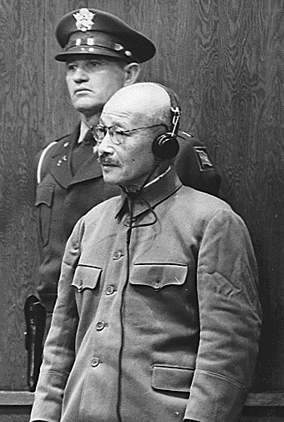
On this date in 1948, seven “Class A” war criminals, including Japan’s wartime Prime Minister Hideki Tojo, were hanged at Sugamo Prison by the American occupation authorities.
Like other Axis heads of state, Tojo was in for a bad end: he shot himself in the chest before American troops could arrest him, but missed his heart even though a doctor had helpfully marked the spot on his chest for him.
Fail.
However inevitable Tojo’s postwar fate, however, he was not exactly of a kind with the likes of Hitler and Mussolini. Indeed, he’d been cashiered from his Prime Ministerial gig in 1944 by the real power behind the throne — the Japanese military.
Unlike the “Fuhrer” and “Il Duce,” Tojo was a reflector, not a creator, of national thought. His word was not law. It was not his command or dictate. He was one among many and not even the first among equals. He was a militarist — misguided, naive, and narrow in outlook; he regarded war as a legitimate instrument of national policy; he apparently believed what he told the court, and failed to recognize the patent contradictions between his contentions and the facts. This had been his undoing.
That’s Robert Butow in Tojo and the Coming of War. Butow argues that the titular authority in Japan (he became Prime Minister shortly before the bombing of Pearl Harbor), a dedicated, patriotic officer of adequate talents but limited vision, came much too late and controlled much too little to be seen as the equal of the European theater’s villains.
The Japan of which General Hideki Tojo became premier was operated by remote control. It was a country in which puppet politics had reached a high state of development, to the detriment of the national welfare. The ranking members of the military services were the robots of their subordinates — the so-called chuken shoko, the nucleus group, which was active “at the center” and which was composed largely of field-grade officers. They, in turn, were influenced by younger elements within the services at large and by ultranationalists outside military ranks. The civilian members of the cabinet were the robots of the military — especially of the nucleus group, working through the service ministers and the chiefs of the army and navy general staffs. The Emperor himself, through no fault of his own, was the robot of the government — of the cabinet and the supreme command, a prisoner of the circumstances into which he was born … Finally, the nation — the one hundred million dedicated souls, the sum and substance of Japan, from whom the blood and toil and tears and sweat of Churchill’s phrase were wrung — the nation was the robot of the throne.
He was the man for his time and place. He fit right in.
The former premier embraced responsibility, diligently shielding the Emperor from any intimation of guilt (some argue this was the procedure’s entire raison d’etre, from the perspective of both the prosecution and the defense), and walked a dignified and honorable last mile in the courtrooms of the victor’s justice, presenting his perspective as he knew it in the context of a wish for peace between the late antagonists.
1. I deny that Japan “declared war on civilization.”
2. To advocate a New Order was to seek freedom and respect for peoples without prejudice, and to seek a stable basis for the existence all peoples, equally, and free of threats. Thus, it was to seek true civilization and true justice for all the peoples of the world, and to view this as the destruction of personal freedom and respect is to be assailed by the hatred and emotion of war, and to make hasty judgments.
3. I would like to point out their [my accusers’] inhumane and uncivilized actions in East Asia ever since the Middle Ages.
4. In the shadow of the prosperity of Europe and America, the colored peoples of East Asia and Africa have been sacrificed and forced into a state of semi-colonization. I would point out that the cultural advance of these people has been suppressed in the past and continues to be suppressed in the present by policies designed to keep them in ignorance.
5. I would point out that Japan’s proposal at the Versailles Peace Conference on the principle of racial equality was rejected by delegates such as those from Britain and the United States.
6. Of two through five above, which is civilization? Which is international justice? Justice has nothing to do with victor nations and vanquished nations, but must be a moral standard that all the world’s peoples can agree to. To seek this and to achieve it — that is true civilization.
7. In order to understand this, all nations must hate war, forsake emotion, reflect upon their pasts, and think calmly.
The “Class A” convicts not executed along with Tojo were freed afterwards.
Tojo has enjoyed a bit of a latter-day resurgence in the public regard, product of the nationalist right’s resurgence in Japan. The hanged man’s granddaughter Yuko Tojo has waged a tireless campaign to clear him.
Further to that end, his ashes — and those of the other Class A convicts — were covertly added to the controversial Yasukuni Shrine, and remain there to this day. That public tribute to principals of Japan’s bloody foreign occupations has become a hot political football between Japan and other nations, especially China.
Japan … faced considerable military threats as well.
Japan attempted to circumvent these dangerous circumstances by diplomatic negotiation, and though Japan heaped concession upon concession, in the hope of finding a solution through mutual compromise, there was no progress because the United States would not retreat from its original position. …
Since events had progressed as they had, it became clear that to continue in this manner was to lead the nation to disaster. With options thus foreclosed, in order to protect and defend the nation and clear the obstacles that stood in its path, a decisive appeal to arms was made.
* According to John Dower’s Embracing Defeat, the suicide scenario angered some nationalists because Tojo only “belatedly summoned the will to die,” and “chose the foreigner’s way of the bullet rather than the samurai’s way of the sword, and then botched even this.”
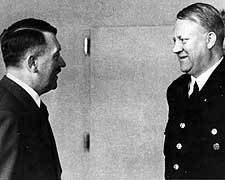
Just deserts for his efforts as chief of the fascist party Nasjonal Samling to aid the Nazi conquest of his home country. Quisling interrupted a radio broadcast on April 9, 1940 to proclaim himself Prime Minister* and order cooperation with invading Germans.
Although Quisling’s lack of popular support compromised his value even as a puppet, he remained as Minister President of Norway through the war — a crucial tool in Germany’s counter-encirclement jousting with Britain, nicely explained at the outset of Frank Capra’s American propaganda flick Why We Fight:
He enjoyed public regard commensurate with his station.
A 1944 cartoon in Sweden (which remained tenuously neutral and unoccupied during the war) indicates that Quisling had already made his name a byword for treachery. The caption reads:
“I am Quisling.”
“And the name?”
On this date in 1849, the shining lights of Hungary’s 1848 revolution met the Austrian Empire’s firing squadsexecutioners. (Correction: Most were hanged, not shot. See comments.)
Probably no polity in Europe stood more fundamentally in danger from the wave of 1848 revolutions than the Habsburg Empire. While governments would be overthrown and power renegotiated across the continent, the Austrian state’s dynastically welded hodgepodge of mingled ethnicities appeared existentially at odds with the nationalist stirrings afoot.
And none of those ethnicities answering to Vienna stirred as vigorously as the Hungarians.
The Hungarian Diet established a national government under Lajos Batthyány (English Wikipedia page | Hungarian) (or Louis Batthyani) in the spring of 1848* and soon pushed for more self-determination than Austria was prepared to countenance.
[T]he house of Hapsburg-Lorraine, as perjured in the sight of God and man, has forfeited its right to the Hungarian throne …
Three hundred years have passed since the Hungarian nation, by free election, placed the house of Austria upon its throne, in accordance with stipulations made on both sides, and ratified by treaty. These three hundred years have been, for the country, a period of uninterrupted suffering.
…
This dynasty … which can at no epoch point to a ruler who based his power on the freedom of the people, adopted a course toward this nation from father to son, which deserves the appellation of perjury.
The house of Austria has publicly used every effort to deprive the country of its legitimate independence and constitution, designing to reduce it to a level with the other provinces long since deprived of all freedom, and to unite all in a common link of slavery.
Guess how that turned out.
Lajos Batthyany portrait by Hungarian painter Miklos Barabas.
It wasn’t much of a contest in the field, leaving this day’s doings the shooting of Batthyany at Pest (the city later merged with Buda and Obuda to form Budapest) and 13 Hungarian generals — the so-called 13 martyrs of Arad — in a Translyvanian city that is today part of Romania.
This was not, however, the last the Habsburg dynasty would hear of Hungary’s frustrated national aspirations.
All that stuff we said about you Habsburgs? Bygones.
While becoming half of a dual capital opposite Vienna meant a late 19th-century renaissance for Budapest, this cure by the Empire for its internal pressures proved almost as harmful as the disease. The pressures immediately discharged would pale in comparison to the conflicts Hungarians’ now-privileged status helped provoke with Slavs and other ethnic minorities (exacerbated by Hungarians’ ability to block Austrian foreign policy). In an early preview of a now-familiar pattern, the proto-nation-state of Hungary was a nastier piece of work for its ethnic minorities than the decadent old melting-pot ruled from Vienna … and the road from this day’s executions to the Austro-Hungarian Compromise ran straight on to 1914 Sarajevo and the graveyard of Habsburg history.
As for the executions this day, Batthyany was saluted by the great Hungarian composer Franz Liszt in his Funerailles:
More prosaically and much more pervasively, a legend that Austrians were jovially toasting the death of the 13 Martyrs as they were being executed translated into a still-active tradition against clinking beer glasses in Hungary.
The Martyrs of Arad (Sixth of October) by Janos Thorma
** Franz Joseph was no mere abstract emblem of imperial absolutism: he had assumed the Austrian throne in December 1848 upon the abdication of his feebleminded uncle specifically to free the crown from the oaths his predecessor had taken to various reforms. From the Hungarian perspective — and the declaration excerpted above dwells at length on the perfidy of this maneuver — he was installed to crush the revolution.
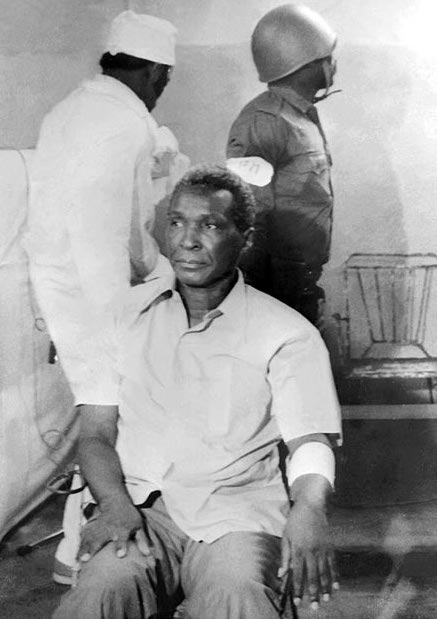
In the early afternoon this date, Equatorial Guinea’s former President for Life was sentenced to death with six aides at the end of a four-day trial for murder, treason, embezzlement, and genocide.
That evening, the seven were shot at Malabo’s Blabich Prison.
He quickly created a one-party state and increasingly nutty cult of personality, answering to such horror-comic nicknames as “Unique Miracle”.
Nguema’s Unique Miracle for Equatorial Guinea was a Pol Pot-style catastrophe, killing or driving out most of the population (including Nguema’s own wife), eviscerating the economy, and getting into military brinksmanship with neighboring Nigeria.*
His nephew, Teodoro Obiang Nguema Mbasogo, overthrew him a few weeks before this date. Despite the speedy resolution of the case, international observers on the scene considered it a fair enough trial and the dictator’s guilt duly established; procedurally, the execution happened immediately because he was tried by the highest court in the land and there was nowhere to appeal.
Francisco Macias Nguema during his trial.
Still, the shooting itself was handled by hired Moroccan troops, rather than citizens of Equatorial Guinea: Nguema had convinced quite a lot of people that he had magic powers, and the locals weren’t eager to be the ones to test the proposition.
* Francisco Macias Nguema’s daughter, “Empress Bella Syttam Macias”, lives in Utah and defends her dad. She seems to have been too young to have been personally involved in anything unsavory in the 70’s.
On this date in 1402, a Prussian commoner was put to death on the road between Falsterbo and Skanor in Sweden for masquerading as the long-dead King Olaf IV.
The real Oluf IV Haakonsson — or Olav, or Olaf — had inherited the crowns of Denmark and Norway and a claim to that of Sweden’s but died at the age of 17 in 1387. His mother, Margaret I (or Margrethe I), the real power behind the teenager, ruled outright upon her son’s death.
She proved an able hand and far-sighted ruler, cautiously welding Denmark, Sweden and Norway into the Kalmar Union that would hold until the 16th century. They called her “the Semiramis of the North,” centuries before Catherine the Great nicked the nickname.
But her son’s youthful demise had set persistent rumors abroad — that he was poisoned, for instance, and more to the point for our purposes, that he wasn’t dead at all.
So when his spitting image was recognized, and hailed as the prince of the realm … well, back in the day, equally audacious identity theft was attempted for much smaller stakes than a throne.
Anyway, “Olaf” got some robes befitting Olaf’s station and banged out some letters to Margaret demanding his kingdom back, and Margaret said, come on down.
That goes to show how far looks will take you in life.
Unfortunately for Olaf, his regal jawline wasn’t capable of enunciating Danish speech … so the jig was up as soon as he got to Margaret. One hopes he got a good ride out of his brief masquerade, because he was burned to ashes — possibly after being broken on the wheel — along with those presumptuous letters.
The traditional last day of the harvest season celebrated on September 29, Michaelmas was once a four-star holiday on the medieval calendar.
There’s a fair amount of commentary online saying that an “Old Michaelmas” used to be celebrated on October 10 or 11. But that looks to this writer like an interesting inversion stemming ultimately from the celebration’s fall into obscurity as the entity once known as Christendom has become more secular and less agrarian — although it’s admittedly nothing to do with the fate of False Olaf, or Semiramis for that matter.
In 1752, when England finally switched to the Gregorian Calendar, the switch took place in early September.*
For logistical pragmatism (the harvest wasn’t going to come in 11 days earlier just because the calendar changed), the then-imminent Michaelmas got pushed back 11 days to October 10. October 10 then became known as “Old Michaelmas,” no longer Michaelmas by the church calendar but the 365-day interval from when it used to be celebrated, and more importantly, the real end of the harvest season.**
In the next century, the difference between Julian and Gregorian calendars would have advanced to 12 days, placing Old Michaelmas on the 11th; by this present day, it’d be 13 days in principle, but the original meaning of the holiday and the host of cultural traditions associated with it have fallen away … so “Old Michaelmas” is a footnote still pinned to October 10th or 11th, and moderns rediscovering it suppose from the name that it’s the former date of the feast.
* People inclined to think of their death dates as foreordained in heaven’s celestial notebook protested the switch: “give us back our 11 days!” This reform, incidentally, also moved the official beginning of the New Year to January 1 from Michaelmas’ springtime “Quarter Day” counterpart, March 25; winter dates from years prior are often written with both years, e.g. 1738/9. “Old Lady Day“, April 6, is still the beginning of the fiscal year in England, and Thomas Hardy uses its traditional contractual character in Tess of the D’Urbervilles (Aside: Tess’s hanged real-life inspiration) when the title character takes a farm job running through that date:
Tess was so wrapt up in this fanciful dream that she seemed not to know how the season was advancing; that the days had lengthened, that Lady-Day was at hand, and would soon be followed by Old Lady-Day, the end of her term …
At length it was the eve of Old Lady-Day, and the agricultural world was in a fever of mobility such as only occurs at that particular date of the year. It is a day of fulfilment; agreements for outdoor service during the ensuing year, entered into at Candlemas, are to be now carried out. The labourers — or “work-folk”, as they used to call themselves immemorially till the other word was introduced from without — who wish to remain no longer in old places are removing to the new farms.
… With the younger families it was a pleasant excitement which might possibly be an advantage. The Egypt of one family was the Land of Promise to the family who saw it from a distance, till by residence there it became it turn their Egypt also; and so they changed and changed.
** Residents of the former Soviet Republics who switched to the Gregorian calendar in the 20th century still celebrate both the familiar January 1 New Year’s and “Old New Year’s” 13 days later, and the same trick with the (lesser, there) holiday of Christmas too … packing four party occasions into a three-week span.
On an uncertain date around this time — sort of — in 46 B.C.E., the Gallic chief Vercingetorix was marched as Julius Caesar’s star captive in Rome, then strangled in prison.
A nobleman who in the course of things would have been destined for that class of domestic elites bought off by Rome for orderly management of conquered provinces, Vercingetorix instead mounted a massive and effective semi-guerrilla resistance. A few months after Caesar had declared “Mission Accomplished” and Gaul at peace, it rose in arms … and, as Vercingetorix rolled out a scorched-earth defense, in flames.
Julius Caesar, then serving a long and lucrative career as Governor of Gaul, managed only with difficulty — and staggering bloodshed — to pacify the province at the Battle of Alesia. It was a signal military engagement in the development of the Roman Empire, cementing Roman power in Gaul for centuries to come.
The wily barbarian’s revolt and the very serious danger it posed to Caesar’s ambitions are the subject of a five-part BBC documentary.
Vercingetorix’s allegedly theatrical surrender to Caesar essentially ended the Gauls stubborn, centuries-long resistance to Roman dominion.
Yes, that’s the Highlander, Christopher Lambert, playing the French Braveheart version of barbarian heroism in Druids. HBO’s series Rome went with a less romantic version:
Either way, the once-intractable province became the bastion from which Caesar would overthrow the foundering Roman Republic.
Political rivals in the capital for whom Caesar’s Gallic campaign was nothing to celebrate denied Caesar a ceremonial Triumph and maneuvered to check the ambitious general. When the conflict came to a head in 49 B.C.E., Caesar’s bold move from the provincial borders of Gaul into Italy — crossing the Rubicon — ignited civil war in Rome.
Vercingetorix languished in Roman chains all along, until Caesar finally mopped up his enemies in the field and returned to Rome, where he celebrated an extravagant quadruple Triumph for his various military achievements.
when he returned to Rome he had four triumphs together: one for his Gallic wars, in which he had added many great nations to the Roman sway and subdued others that had revolted; one for the Pontic war against Pharnaces;* one for the war in Africa against the African allies of L. Scipio, in which the historian Juba (the son of King Juba), then an infant, was led a captive. Between the Gallic and the Pontic triumphs he introduced a kind of Egyptian triumph, in which he led some captives taken in the naval engagement on the Nile.** Although he took care not to inscribe any Roman names in his triumph (as it would have been unseemly in his eyes and base and inauspicious in those of the Roman people to triumph over fellow-citizens), yet all these misfortunes were represented in the processions and the men also by various images and pictures, all except Pompey, whom alone he did not venture to exhibit, since he was still greatly regretted by all. The people, although restrained by fear, groaned over their domestic ills, especially when they saw the picture of Lucius Scipio, the general-in-chief, wounded in the breast by his own hand, casting himself into the sea, and Petreius committing self-destruction at the banquet, and Cato torn apart by himself like a wild beast. They applauded the death of Achillas and Pothinus, and laughed at the flight of Pharnaces.
It is said that money to the amount of 60,500 silver talents was borne in the procession and 2822 crowns of gold weighing 20,414 pounds, from which wealth Caesar made apportionments immediately after the triumph, paying the army all that he had promised and more. Each soldier received 5000 Attic drachmas, each centurion double, and each tribune of infantry and perfect of cavalry fourfold that sum. To each plebeian citizen also was given an Attic mina. He gave also various spectacles with horses and music, a combat of foot-soldiers, 1000 on each side, and a cavalry fight of 200 on each side. There was also another combat of horse and foot together. There was a combat of elephants, twenty against twenty, and a naval engagement of 4000 oarsmen, where 1000 fighting men contended on each side. He erected the temple to Venus, his ancestress, as he had vowed to do when he was about to begin the Battle of Pharsalus, and he laid out ground around the temple which he intended to be a forum for the Roman people, not for buying and selling, but a meeting-place for the transaction of public business, like the public squares of the Persians, where the people assemble to seek justice or to learn the laws. He placed a beautiful image of Cleopatra by the side of the goddess, which stands there to this day. He caused an enumeration of the people to be made, and it is said that it was found to be only one half of the number existing before this war.
War is hell.
At the Gallic triumph, Vercingetorix — by far the most fearsome enemy Caesar had to display vis-a-vis a five-year-old child and the sister of his lover — was at last the center of attention again for a day. Still defiant, he was marched through the Eternal City, then strangled at the Tullianum, or Mamertine Prison.
But which day? The bare fact is that we just don’t know, but this one has more than the typical imprecision that characterizes dating ancient events. This footnote on a page about Egyptian royalty grapples with the timing.
four times in one month, each Triumph succeeding the former by an interval of a few days.
Since Cassius Dio claims that Caesar dedicated the Temple of Venus (datable to late September of 46) on the last day of the last Triumph, that presumably makes September the “one month” of the various celebrations.
That’s about as close as it gets, but even “September” comes with a caveat. During his few months in Rome between campaigns, Caesar accomplished a frenetic civil agenda (it helps to be dictator). Perhaps none is of such recognizable consequence for posterity as reform of the wacky solar-lunar hybrid Roman calendar — and 46 B.C.E. was the very year he implemented it.
Disdaining incrementalism, Caesar tackled the mess the Roman calendar had become at once, by stuffing the year 46 up to 445 days. As a result, 365 days after the execution of Vercingetorix was not September of 45, but July (or possibly June) — and those months are sometimes given for the dates of Caesar’s Triumphs on this basis. Since Caesar actually won his decisive battle in April of 46 B.C.E. and returned to Rome that July, the potential for confusion multiplies: if you’re not accounting for the exceptional calendar, July Triumphs appear initially plausible.
It is here that one beholds the essential subjectivity behind a putatively mechanistic device like a calendar: if Vercingetorix was executed in spring or summer, was he executed in September?
Whenever it was that he was throttled in the Mamertine, Vercingetorix did not go quietly. If his cause of resistance to Roman authority was doomed for the time being, the eternal allure of rebellion — and, as the Gallic lands later germinated France, the proto-nationalism of his cause — secured him his own symbolic immortality.
Napoleon III, with his complex relationship to the Gallic and Italic dreams of another age, was just the man to put up this statue of Vercingetorix where the barbarian was thought to have made his last stand. Its inscription reads:
La Gaule unie
Formant une seule nation
Animée d’un même esprit,
Peut défier l’Univers.

 “Cromwell lifting the Coffin-lid and looking at the body of Charles I”, by Hippolyte (Paul) Delaroche — a French painter with an affinity for English execution scenes. The painting is based on an apocryphal but irresistible legend, also used by Nathaniel Hawthorne in a tedious short story.
 With Henry’s demise, the crown fell to the only legitimate son the old man had produced in a lifetime of trying, the sickly 9-year-old
 Now, it was running out of patience with the country’s president,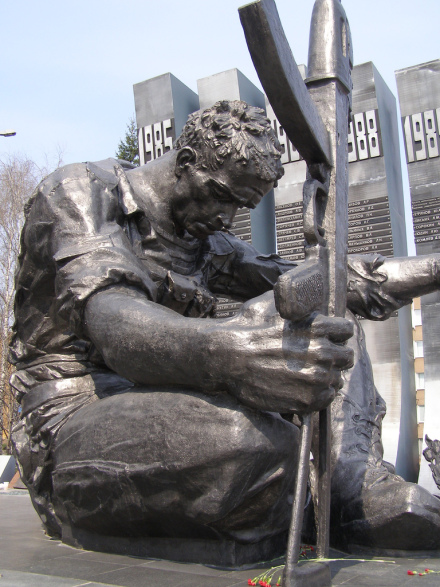

 However inevitable Tojo’s postwar fate, however, he was not exactly of a kind with the likes of Hitler and Mussolini. Indeed, he’d been cashiered from his Prime Ministerial gig in 1944 by the real power behind the throne — the Japanese military.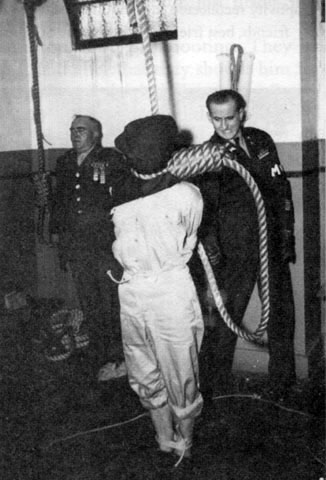
 By the time of his death, the Nazi collaborator (