1860: (William) Walker, Nicaragua Ranger

On this date in 1860, a kid from Tennessee who had made himself President of Nicaragua got his grateful subjects’ comeuppance in the form of a fusillade.

It was westward the wagons that first bestirred the pioneering blood of William Walker, a scion of privilege with an Ivy League medical degree, who uprooted for San Francisco in 1849.

But the “grey-eyed man of destiny” had an altogether grander gold rush in mind, as he stared pensively into the middle distance.

The air was fervid with Manifest Destiny, and most Americans reckoned that the entire hemisphere was its rightful Manifestation. In a time when private settlers effected the statecraft of conquering the Great Plains, was it really any crazier for Walker to fancy privately conquering some distracted European power’s American colonies?

Walker was one of — soon to be the most famous of — a whole class of such characters: filibusters, a word etymologically rooted in piracy but now claimed by the bustling ranks of soldiers of fortune with private militias bent on detaching some parcel of land from south of the border, for money or glory or what have you.*

Oh, and “what have you”? That means slavery.

Nicely dovetailing the individual spur to derring-do, the South’s structural impulsion to expand slaveholding territories to maintain political parity encouraged — and often bankrolled — filibuster adventuring.

It is to these unwholesome fellows that the United States likely owes its sovereignty over Texas, which was pelted with Anglo filibustering expeditions in the early 19th century, helping set the table for the revolution that severed the Lone Star state from Mexico; arguably, the Texas Revolution itself was a (fantastically successful) filibuster.

So Walker had the glittering destinies manifest before his grey eyes when he put off the white collar career to play soldier. After an abortive 1853 attempt to set up his own country in Mexico’s Baja California — a jury instantly acquitted him of waging war on a neutral power; filibustering, and damn near anything that promised America more Manifestly Destined land, was as popular as it was illegal — Walker moved on war-torn Nicaragua under the guise of a “colony”. With a few hundred men, he was able to conquer the capital and set himself up as head of state.

Who knows whether he could have had a future if he’d done it differently. In the actual fact, he wasn’t as hot an administrator as his ego might then have been telling him. He revoked Nicaragua’s anti-slavery edicts, of course; though this sparked resistance, more damaging may have been revoking a Vanderbilt trade concession and bringing a tycoon into the private warfare game on the opposite team.

Cornelius Vanderbilt-backed opponents drove Walker out of Nicaragua in 1857. Not knowing when he was beat, the ex-Presidente kept knocking around stateside piecing together several expeditions, each sadder than the last … until in 1860, when a landing at Honduras collapsed, and he surrendered himself to a British (rather than American) officer. Europeans with colonies to exploit didn’t have much use for filibustering, and Walker had made everyone nervous by openly aspiring to conquer Nicaragua’s neighbors — including British assets. Rather than return him home where he could continue scheming to meddle in the future canal zone, the Brits handed him over to the Hondurans, who stood him in a court-martial, then stood him up against a wall.

Alex Cox (Repo Man) turned this bizarre biography into a film, back when Ronald Reagan’s filibusters narco-terrorists “moral equals of our founding fathers” were having their own unofficial way with the country Walker once governed:

And for a corner of Americana little-known to most in the U.S. — well, the colorful, nigh-unbelievable quality of the action has overridden its obscurity when it comes to the written word.

Various books about William Walker and Filibustering

* More familiar for most Americans is “filibuster” as a legislative maneuver — refusing to yield the floor during debate to forestall the passage of a bill. Not surprisingly, this usage came online at the same time mercenary filibusters were active, and proceeds from the word’s original sense of “piracy”.

On this day..

1990: Samuel K. Doe

On this date in 1990, deposed Liberian strongman Samuel Kanyon Doe was tortured and summarily executed in Monrovia by the putschists that overthrew him … and gruesomely filmed in the process.

Doe had come to power killing his predecessors — personally murdering, some sources say, President William Tolbert in 1980, then executing his chief aides.

That coup toppled civilian authority in the west African country now permanently prefixed with the adjective “troubled.” “The first of the monsters,” the War Nerd called him: Doe’s murderous rule through the 1980’s set up the succession of current war crimes prisoner Charles Taylor.

Samuel Doe’s turn in the obituaries arrived in particularly grisly fashion, with Taylor rival/semi-ally* Prince Johnson swilling beer as he interrogated — and ordered the ear sliced off — the groveling former head of state before having him executed. (Or if you like, just plain murdered.) The video shot of Doe’s ordeal became an international sensation … so it’s a little surprising that only this paltry excerpt seems to be readily available online:

* And current Liberian Senator! He feels just awful about the whole torturing-the-President-to-death thing.

On this day..

1305: William Wallace, Braveheart

On this date in 1305, Scottish knight Mel Gibson — er, William Wallace — was hanged, drawn and quartered at Smithfield for treason to a British crown he refused to recognize.

Just like so:

Well, close enough. Some wags have alleged one or two historical liberties in Braveheart.

Among the lesser (but more pertinent here): that they weren’t — you knew this already — offering the former Guardian of Scotland the opportunity to reduce his suffering with a public submission, or use the stage for theatrical defiance. Hanging, drawing and quartering was a brand new execution Edward I was experimenting with for emasculating, disemboweling, and (so the idea went) utterly cowing the rebellious hinterlands of the British Isles. Wallace may have been just the second person to suffer it.

But only a pointy-headed blogger could possibly care when the main point is that back before Christendom succumbed to nancy decadences like Vatican II, men wore woad, defenestrated queers, and tapped top-shelf babes.


Among the few things known for certain about William Wallace is that he did not score with Isabella of France. Or with Sophie Marceau.

Facts? This is show business!

Mel’s bloodbath only riffs the already-fantastic 15th century epic of “the Wallace” by Scottish minstrel Blind Harry, which in turn got a lyrical call-out in Robert Burns’ 18th century Scottish patriotic tune Scots Wha Hae.

National martyrs — and, sure, it helps to die at the right time, as Wallace did just before Robert the Bruce secured Scottish independence — feed a train of hungry authors and ready audiences in every time, place and medium.

However genuinely flesh-and-blood the limbs that wrought his feats and were torn apart on this day, Wallace returns to his generations of interlocutors half-shrouded in mythology. Seven centuries on, his contested (and sometimes absurd) use as precedent or metaphor stakes a claim to his Truth at least as compelling as battlefield tactics at Stirling Bridge. What does he “really” have to tell us? No matter how grisly his end, William Wallace doesn’t get to decide: it’s between you, me, Mel, and a few billion other folks.

Only a character really worth remembering is worth that kind of fictionalizing.

On this day..

408: Stilicho, whose execution let in the barbarians

Sixteen hundred years ago today, the general whose talents were the last bulwark against barbarian conquest of the Western Roman Empire submitted for the sake of civil peace to execution at the hands of a callow boy-emperor.

The half-Vandal patrician Stilicho comes to the notice of posterity late in the reign of Theodosius the Great, the last Roman to rule both Eastern and Western Empires. At Theodosius’s death in 395, his two sons ascended the separate thrones.

Honorius, a 10-year-old child, took the purple in the west and somehow held it for 28 lackluster years that saw Rome’s long erosion finally set the realm on the slide into collapse.*

An apt commander, Stilicho had held Visigoth king Alaric at bay in two invasions of Italy (the crucial Battle of Pollentia stanched the first).


Stilicho and his wife Serena, with their child: two were executed, one was murdered.

Distrusted because of his part-barbarian parentage — and hated by the still-significant pagan community for burning the Sibylline Books — Stilicho’s service never made him popular. Because Alaric had escaped his battlefield defeats, it was whispered that Stilicho had connived with him … and Stilicho’s alliance of his legions with Alaric against other barbarians in Illyrium and Burgundy only heightened the suspicions.

We have little reliable basis to judge the possible truth of these accusations; the fundamental fact was that Rome no longer exercised its accustomed hegemony, and its principals needed to balance interests, cut deals and allocate scarce resources in ways that would have been unthinkable a century or two before.** The army itself was mostly barbarian; Alaric himself had once been a Roman officer.

In the story as related by Zosimus — a later Byzantine historian, a pagan famously abusive towards Christians and elsewhere critical of Stilicho, here softening his stance as he turns to savage his executioners — a wormtongued advisor got the ear of the still-youthful emperor and turned him against the general who was holding back the cataclysm.

Stilicho … was not conscious of any ill intention either against the emperor or the soldiers, [but] Olympius, a native of the vicinity of the Euxine sea, and an officer of rank in the court-guards, concealed under the disguise of the Christian religion the most atrocious designs in his heart. Being accustomed, because of his affected modesty and gentle demeanor, to converse frequently with the emperor, he used many bitter expressions against Stilicho, and stated that he was desirous to proceed into the east, from no other motive than to acquire an opportunity of … placing the empire in the hands of his own son, Eucherius. … Olympius, accustoming himself to visit the sick soldiers, which was the master-piece of his hypocrisy, dispersed among them, likewise, similar insinuations. … they were excited almost to madness … then dispersing themselves about the city, killed as many of the magistrates as they could lay hands on, tearing them out of the houses into which they had fled, and plundered all the town. … The tumult continued till late in the night, and the emperor fearing lest any violence should be committed against his own person also, for which reason he withdrew. … There likewise perished so great a number of promiscuous persons as is beyond all computation.

When intelligence of this reached Stilicho, who was then at Bononia, he was extremely disturbed by it. Summoning, therefore, all the commanders of his confederate Barbarians, who were with him, he proposed a consultation relative to what measures it would be most prudent to adopt. It was agreed with common consent, that if the emperor were killed, which was yet doubtful, all the confederated Barbarians should join together, and fall at once on the Roman soldiers, and by that means afford a warning to all others to use greater moderation and submissiveness. But if the emperor were safe, although the magistrates were cut off, the authors of the tumult were to be brought to condign punishment. Such was the result of the consultation held by Stilicho with his Barbarians. When they knew that no indignity had been offered to the person of the emperor, Stilicho resolved to proceed no further in punishing or correcting the soldiers, but to return to Ravenna. For he reflected both on the number of the soldiers, and that the emperor was not steadfastly his friend. Nor did he think it either honourable or safe to incite Barbarians against the Roman army.

It came to a bad end, Stilicho nobly refusing the prospect of his allies upholding his cause by arms:

Stilicho being therefore filled with anxiety concerning these circumstances, the Barbarians who were with him were very desirous of putting in force their former resolutions, and therefore endeavoured to dissuade him from the measures which he afterwards thought proper to be adopted. But being unable to prevail with him, they all determined to remain in some place until they should be better apprized of the emperor’s sentiments towards Stilicho, … In the meantime Olympius, who was now become master of the emperor’s inclination, sent the imperial mandate to the soldiers at Ravenna, ordering them immediately to apprehend Stilicho, and to detain him in prison without fetters. When Stilicho heard this, he took refuge in a Christian church that was near, while it was night. His Barbarians and his other familiars, who, with his servants, were all armed, upon seeing this expected what would ensue. When day appeared, the soldiers, entering the church, swore before the bishop that they were commanded by the emperor not to kill Stilicho, but to keep him in custody. Being brought out of the church, and in the custody of the soldiers, other letters were delivered by the person who brought the first, in which the punishment of death was denounced against Stilicho, for his crimes against the commonwealth. Thus, while Eucherius, his son, fled towards Rome, Stilicho was led to execution. The Barbarians who attended him, with his servants and other friends and relations, of whom there was a vast number, preparing and resolving to rescue him from the stroke, Stilicho deterred them from the attempt by all imaginable menaces, and calmly submitted his neck to the sword. He was the most moderate and just of all the men who possessed great authority in his time. … he never conferred military rank for money, or coverted the stipend of the soldiers to his own use. … In order that no studious person, or astrologers, may be ignorant of the time of his death, I shall relate that it happened in the consulship of Bassus and Philippus, during which the emperor Arcadius submitted to fate, on the twenty-second day of August.

This date is the end of the line for Stilicho, but hardly the end of the troubles that laid him low. A spasm of mob violence against barbarians on the peninsula ensued; the executed general’s son was among those murdered. Teutons, many of them Roman soldiers, in turn flocked to the banner of Alaric, who promptly swarmed into the enfeebled Italian lands and for the first time in 800 years sacked Rome.

Romans knew just who to blame: Stilicho’s widow, who was herself executed at the order of the Senate. In Gibbon’s relating:

The first emotions of the nobles, and of the people, were those of surprise and indignation, that a vile Barbarian should dare to insult the capital of the world: but their arrogance was soon humbled by misfortune; and their unmanly rage, instead of being directed against an enemy in arms, was meanly exercised on a defenceless and innocent victim. Perhaps in the person of Serena, the Romans might have respected the niece of Theodosius, the aunt, nay, even the adoptive mother, of the reigning emperor: but they abhorred the widow of Stilicho; and they listened with credulous passion to the tale of calumny, which accused her of maintaining a secret and criminal correspondence with the Gothic invader. Actuated, or overawed, by the same popular frenzy, the senate, without requiring any evidence of his guilt, pronounced the sentence of her death. Serena was ignominiously strangled; and the infatuated multitude were astonished to find, that this cruel act of injustice did not immediately produce the retreat of the Barbarians, and the deliverance of the city. That unfortunate city gradually experienced the distress of scarcity, and at length the horrid calamities of famine.

Alaric made out quite a lot better.

* Such, at least, is the conventional assessment of Honorius. For a take friendlier to the emperor (and less so to Stilicho), see here.

** Stilicho, incidentally, called home the second-last legion of Roman troops from Britain for use closer to home, and the island’s remaining Roman presence was cut off by barbarian incursions into Gaul during his lifetime … setting that island on its independent way (into, if you like, the Arthurian age); Honorius would later answer a plea for help from those lands with a note to the effect of, “good luck on your own.”

On this day..

1794: Maximilien Robespierre, Saint-Just and the Jacobin leadership

On this date in 1794, the curtain — and the blade — fell on the Terror.

Maximilien Robespierre, who had breakfasted the previous day as master of France, was guillotined this evening with his chief lieutenants and partisans.

His fall came as sudden and inevitable as his rise had been unpredictable.

Five years before, Robespierre was an unprosperous Arras attorney of fashionably liberal philosophies, and you wouldn’t have given a sou for the prospects of his being remembered five minutes after he died. Yet it would come that his inseparable lieutenant Saint-Just would remark with understatement, “The words we have spoken will never be forgotten on earth.”

The historic convocation of the Estates-General thrust him onto the political stage where he would make the dread name that follows him, starting off in the Revolution’s inception as a far-left deputy. He took a notable early stand against the death penalty, with several arguments that are quite familiar by our day:

The first obligation of a legislator is to form and preserve public morals, the source of all freedom, source of all social happiness. When in running to a particular goal he turns away from this general and essential goal he commits the most vulgar and dire of errors. The king must thus present to the people the purest model of justice and reason. If in place of this powerful, calm and moderate severity that should characterize it they place anger and vengeance; if they spill human blood that they could spare and that they have no right to spread; if they spread out before the people cruel scenes and cadavers wounded by torture, it then alters in the hearts of citizens the ideas of the just and the unjust; they plant the seed in the midst of society of ferocious prejudices that will produce others in their turn. Man is no longer for man so sacred an object: we have a less grand idea of his dignity when public authority puts his life at risk. The idea of murder inspires less fear when the law itself gives the example and the spectacle. The horror of crime is diminished when it is punished by another crime. Do not confuse the effectiveness of a penalty with the excess of severity: the one is absolutely opposed to the other. Everything seconds moderate laws; everything conspires against cruel laws.

For Robespierre, it was an abomination for the nation to deal out death within its community, but his Rousseauan elevation of the collective and abstract People made extirpating existential threats to the community itself an altogether different matter.

The future tyrant’s anti-death penalty case for executing the deposed Louis XVI, flowing directly from those principles, makes interesting reading and is excerpted at length (all emphases added) here for its topicality:

When a nation has been forced to resort to the right of insurrection it returns to a state of nature as regards its tyrant. How can the latter invoke the social compact? He has annihilated it. The nation can preserve it still, if it thinks fit, in whatever concerns the interrelations of its citizens: but the effect of tyranny and insurrection is to break it entirely as regards the tyrant; it is to throw them into mutual war; the tribunals, the judiciary procedures, are made for the members of the city. … The right to punish the tyrant and that to dethrone him are the same thing. The one does not admit of different forms from the other. The tyrant’s trial is insurrection; his judgment is the fall of his power; his penalty, whatever the liberty of the people demands.

Peoples do not judge like judiciary courts. They pass no sentences; they hurl the thunderbolt. They do not condemn kings: they thrust them back into oblivion; and this justice is not inferior to that of courts. If they arm themselves against their oppressors for their own safety, why should they be bound to adopt a mode of punishing them which would be a new danger to themselves?

As for me, I abhor the penalty of death so lavish in your laws, and I have neither love nor hatred for Louis. Crimes only I hate. I have asked the Assembly, which you still call Constituent, for the abolition of the death penalty, and it is not my fault if the first principles of reason seem to it moral and political heresies. But if you never bethought yourselves to invoke them in favor of so many unfortunates whose offenses are less their own than those of the government, by what fatality do you remember them only to plead the cause of the greatest of all criminals? You ask an exception to the death penalty for him alone against whom it can be legitimate! Yes, the penalty of death generally is a crime, and for that reason alone, according to the indestructible principles of nature, it can be justified only in cases when it is necessary for the safety of individuals or the social body. Public safety never demands it against ordinary offenses, because society can always guard against them by other means and make the offender powerless to harm it. But a dethroned king in the bosom of a revolution which is anything but cemented by laws, a king whose name suffices to draw the scourge of war on the agitated nation, neither prison nor exile can render his existence immaterial to the public welfare: and this cruel exception to ordinary laws which justice approves can be imputed only to the nature of his crimes.

It is with regret that I utter this fatal truth. But Louis must die, because the country must live.

“Pity is treason.”

Months later, as head of the Committee of Public Safety — the Orwellian name harkens to the body’s power to judge who lay inside the community and who, lying outside, made war upon it — he would find an inexhaustible fifth column of kindred threats to the Revolution.

But Revolutionary France really was in a war for its survival, against external and internal foes alike. The monarchist for whom crime multiplied upon crime every day after the Tennis Court Oath has the easiest time of this period, for every step brings a new monstrosity. And it is well enough to call Robespierre illiberal, to shudder at his prim and icy persona.

But if the French Revolution’s liberte, egalite, fraternite is a legacy for celebration — as it is to much of the west, and much of the world — one must grapple with the place of this man and his methods.

Merely because they are the paths not taken, one hardly seems entitled to assume that at that tumultuous moment the rule of a constitutional monarchy heir to all the monstrosity of the ancien regime, the government of the Girondins who had launched the nearly fatal war against Austria, or that of Danton‘s haute bourgeoisie would necessarily have delivered France to a better place, or even a different one.

For a Dickens, Robespierre’s Terror is simply the appalling wrong turn of a high-minded movement. For Trotsky, “the Incorruptible”* is the admirable sword of France’s bourgeois revolution who effects the needful task of annihilating the feudal nobility, who presses fearlessly forward seeing that the only alternative is the slide into Bonaparte. Between the two lie many readings of the man.

Whether an aberration, a visionary, or a necessity, he waded a sea of blood for his frightening twins Virtue and Terror.

The fall of 9 Thermidor preceded Robespierre’s execution by a full — and very eventful — day. Arrested by the Convention, he was promptly liberated by his base in the Paris Commune which came within a whisker of overthrowing the Convention at that very moment. Instead, a frantic few hours of marshaling the armed power of the Revolution’s rival claimants to leadership ensued ending in a fray which saw the Robespierrists overpowered.

Robespierre was shot through the jaw in the process of signing an appeal to arms — some say a botched suicide, but a wound from the invading national guard is more generally believed; at any rate, the bloodied document with his signature begun “R-o-” is one of the age’s most arresting historical artifacts.

Horrifically injured, he lay most of the following day exposed for public derision before he was hauled with his party to the guillotine, re-erected in the Place de la Revolution for this most memorable execution. In Carlyle’s florid (and free) narration:
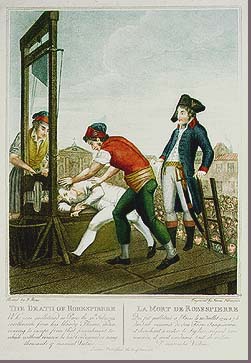
Robespierre lay in an anteroom of the Convention hall, while his Prison-escort was getting ready; the mangled jaw bound up rudely with bloody linen: a spectacle to men. He lies stretched on a table, a deal box his pillow; the sheath of the pistol is still clenched convulsively in his hand. Men bully him, insult him: his eyes still indicate intelligence; he speaks no word. … -O reader, can thy hard heart hold out against that? His trousers were nankeen; the stockings had fallen down over the ankles. He spake no more word in this world.

Fouquier had but to identify; his Prisoners being already Out of Law.** At four in the afternoon, never before were the streets of Paris seen so crowded. From the Palais de Justice to the Place de la Revolution … it is one dense stirring mass; all windows crammed; the very roofs and ridge-tiles budding forth human Curiosity, in strange gladness. … All eyes are on Robespierre’s Tumbril, where he, his jaw bound in dirty linen, with his half-dead Brother, and half-dead Henriot, lie shattered; their “seventeen hours” of agony about to end. The Gendarmes point their swords at him, to show the people which is he. A woman springs on the Tumbril; clutching the side of it with one hand; waving the other Sibyl-like; and exclaims: “The death of thee gladdens my very heart, m’enivre de joie;” Robespierre opened his eyes; “Scelerat, go down to Hell, with the curses of all wives and mothers!” — At the foot of the scaffold, they stretched him on the ground till his turn came. Lifted aloft, his eyes again opened; caught the bloody axe. Samson wrenched the coat off him; wrenched the dirty linen from his jaw: the jaw fell powerless, there burst from him a cry; — hideous to hear and see. Samson, thou canst not be too quick!

Samson’s work done, there bursts forth shout on shout of applause. Shout, which prolongs itself not only over Paris, but over France, but over Europe, and down to this generation. Deservedly, and also undeservedly. O unhappiest Advocate of Arras, wert thou worse than other Advocates? Stricter man, according to his Formula, to his Credo and his Cant, of probities, benevolences, pleasures-of-virtue, and such like, lived not in that age. A man fitted, in some luckier settled age, to have become one of those incorruptible barren Pattern-Figures, and have had marble-tablets and funeral-sermons. His poor landlord, the Cabinet-maker in the Rue Saint-Honore, loved him; his Brother died for him. May God be merciful to him, and to us!

Part of the Themed Set: Thermidor.

* Even his enemies agreed — sometimes adding it to the bill of particulars against him — that Robespierre lived a life of personal moderation; he lived as a boarder with a working-class family, and disdained to avail the politician’s typical harvest of political graft.

** The Convention had decreed Robespierre’s outlawry when he escaped custody; his immediate execution was, of course, akin to the logic he had once turned against the king.

On this day..

1918: Tsar Nicholas II and his family

In the small hours after midnight on the night of July 16-17 90 years ago, the former Tsar Nicholas II, his wife, children, and four family retainers, were shot in a Yekaterinburg basement by their Bolshevik jailers.

Doting family man, vacillating dictator, as weak and rich as Croesus … the doomed Emperor and Autocrat of All the Russias was a man small of stature. His reign emerged under a bad star when 1,300 Muscovites were trampled to death in the crush for his coronation largesse; 18 years later, Nicholas‘s support for Serbia against Austria-Hungary was instrumental in pitching Europe into World War I, a blunder for which he reaped a whirlwind long in the making.

When an anti-Bolshevik force approached Yekaterinburg (or Ekaterinburg), where the deposed royals had been stashed in a commandeered private residence,* Yakov Sverdlov (for whom the city was subsequently renamed) ordered the prisoners shot — not only the tsar, but his beloved wife, their hemophiliac heir, and those four daughters who had to be bayoneted because the state jewels secreted in their corsets shielded them from the gunfire.

The executioners (here’s the account of their leader; here’s another guard’s version) did their best to destroy and conceal the remains, helping fuel subsequent rumors that one of the children had survived and escaped.

Those rumors are only now, with post-Soviet investigation and DNA forensics, being debunked, and not yet to the satisfaction of all comers. This very week, Moscow affirmed (though the Orthodox church has not accepted) that the last of Nicholas’s family had been accounted for:

Modern nostalgia for this unimpressive sovereign is making a minor comeback, with Nicholas absurdly contending in a current poll for the title of “greatest Russian” … supported not only by the miseries of the state that succeeded his, but by the family’s decent and accessible private life.

Even a monarchist — especially a monarchist! — shouldn’t reason that the greatest monarch is the one who drove the bus over the cliff. But much is forgiven a martyr. Indeed, like Charles I of England, the last Romanov monarch has been posthumously saddled with divine sanction; he and all the family are certified “passion bearers”. (Update: And possible future relics!)

A handful of the many books about the Romanovs and their fall

* The Ipatiev House where the tsar was held (and shot) no longer stands. On its spot is a church consecrated five years ago yesterday to the Romanov canonization.

Update: The Romanovs were officially rehabilitated by the Russian Supreme Court on October 1, 2008.

On this day..

1685: James Scott, Duke of Monmouth

On this date in 1685, the haughty Duke of Monmouth mounted the scaffold at London’s Tower Hill to suffer beheading for treason, and tipped the headsman with the words, “Here are six guineas for you and do not hack me as you did my Lord Russell. I have heard you struck him four or five times; If you strike me twice, I cannot promise you not to stir.”*

Upon this tart public reminder of his recent and infamous failure of craft, the eponymous executioner Jack Ketch quite came apart.

Monmouth, certainly, would have appreciated the advance that would bring the guillotine. Beheading by a free-swinging axe was a ghoulishly inexact procedure: bad aim, insufficient force, an untimely flinch, or the tough neck muscles of a grizzled campaigner regularly complicated the process, often to the fury of spectators. Jack Ketch is sometimes reported a sadist, and sometimes a professional hangman so rarely summoned to give a nobleman the chop that he simply lacked proficiency. Either way, he’d been on the job for a generation by this time: his reputation for infelicity with the blade preceded him.

Historical fiction from the perspective of the Duke of Monmouth.

Monmouth, an illegitimate son of King Charles II, had cause to dread Ketch’s offices for the rebellious culmination of a long power struggle with his uncle, the future King James II.

The personal contest between these men for the throne of England was the echo of the decades-old struggles straining the English polity — the Reformation and the reach of royal authority.

As it became known that the king’s brother James had gone from Catholic sympathizer to Catholic convert, Protestants began maneuvering to keep him from inheriting the crown. For three years, Parliament pushed the Exclusion Bill, which would have excluded James from succession.**

Favor among the bill’s supporters settled on the Protestant playboy Monmouth — politically convenient rumors that he was actually a legitimate child began circulating. “Weak, bad, and beautiful,” this unfriendly-to-Monmouth free book has him; whatever he was, his allies in the House of Commons were handily outmaneuvered. The Exclusion measures failed, and in 1685, James II began his reign as England’s last Roman Catholic monarch.

Monmouth’s hopes had been raised, however, and he proceeded to invade England at Dorset with a somewhat ragtag army that was routed by the Protestant royal troops who remained loyal to James at the Battle of Sedgemoor — not quite the last battle fought on English soil, but the last consequential one (the last fought with pitchforks makes a livelier distinction). Monmouth was caught trying to get away in a shepherd’s disguise. Other fugitives of his cause were hunted mercilessly.

The defeated duke was reputedly not above begging the sovereign for his life; obviously, that didn’t work out. But his cause was a popular one, nearing reverence among some commoners. Jack Ketch may have had a case of the butterflies even before the duke undressed him … and as it turns out, Ketch almost left the scaffold worse than his victim.

Here is the scene in Macaulay’s words:

The hangman addressed himself to his office. But he had been disconcerted by what the Duke had said. The first blow inflicted only a slight wound. The Duke struggled, rose from the block, and looked reproachfully at the executioner. The head sank down once more. The stroke was repeated again and again; but still the neck was not severed, and the body continued to move. Yells of rage and horror rose from the crowd. Ketch flung down the axe with a curse. ‘I cannot do it,’ he said; ‘my heart fails me.’ ‘Take up the axe, man,’ cried the sheriff. ‘Fling him over the rails,’ roared the mob. At length the axe was taken up. Two more blows extinguished the last remains of life; but a knife was used to separate the head from the shoulders. The crowd was wrought up to such an ecstasy of rage that the executioner was in danger of being torn in pieces, and was conveyed away under a strong guard.

In the meantime many handkerchiefs were dipped in the Duke’s blood; for, by a large part of the multitude he was regarded as a martyr who had died for the Protestant religion.

Just the sort of soil for posthumous tall tales — that his execution was bogus and he was in hiding to return again, or had been packed off to France to become the Man in the Iron Mask. One possibly better-founded legend is that his head was set back upon its stump to sit him for what must have been a pungent portrait.

Protestant opponents of James were much thicker on the ground than the Duke’s own person, of course. They soon succeeded where Monmouth had failed.

* Slightly different versions of this address from the Duke to the executioner are recorded. Macaulay omits the “if you strike me twice” clause but adds “My servant will give you some more gold if you do the work well”; a more polite (barely) construction suggests “Do not serve me as you did my Lord Russell.”

** The factions in this dispute — the “Petitioners” (supporting the bill) and the “Abhorrers” (supporting the king) — evolved into the Whig and Tory political parties.

Part of the Themed Set: Embarrassed Executioners.

On this day..

472: Anthemius, twilight emperor of Rome

On this date in 472, one of the last “twilight emperors” of the western Roman Empire — and the last of any conspicuous ability — was beheaded by his rebellious general Ricimer.

Here in Rome’s dying days, the dangerous, centuries-old game for the purple was played with the twist of political triangulation with barbarian kings who had set up permanent shop within the old empire’s borders.

Maybe it was his closet paganism, or his Greek patrician breeding, or the way he slung his toga — whatever it was, Anthemius didn’t have the knack for winning them over.

Born and reared in Constantinople, Anthemius was being groomed for succession in the relatively less treacherous eastern empire when his royal patron (and father-in-law) suddenly got gangrene and died.

The Alan commander who held military power in the east wasn’t into Anthemius, so he got the Al Gore treatment and Leo I got the laurels. Interestingly, although barbarian tribes were establishing themselves as the power behind the throne — and this was even more true in the west — they were not yet prepared to assert the imperial majesty in their own names. That last feeble cultural bulwark, however, would not hold out much longer.

Leo “rewarded” Anthemius for taking it all in stride by appointing him emperor of the perilous west. (He also rewarded the kingmaking barbarian chieftain by having him murdered. “Leo the Butcher,” he’s called.)

That pissed off legendary Vandal king Genseric (or Gaiseric, or Geiseric), who had sacked Rome in 455 and settled into a long career lucratively plundering the Mediterranean. And with good reason: Leo’s idea was for the two emperors jump Genseric.

Now, before this time Leo had already appointed and sent Anthemius as emperor of the west, a man of the senate of great wealth and high birth, in order that he might assist him in the Vandalic war. And yet Gaiseric kept asking and earnestly entreating that the imperial power be given to Olybrius, who was married to Placidia, the daughter of Valentinian, and on account of his relationship well-disposed toward him, and when he failed in this he was still more angry and kept plundering the whole land of the emperor. (Procopius)

That war was a debacle and left Genseric merrily raiding Italy, but Anthemius’ real problem was domestic: his new realm had its own Germanic commander who also preferred to pick his own emperors, and he took an instant dislike to the foreign ponce. Anthemius and Ricimer managed a brief detente, during which the new guy tried to take Gaul back from the Visigoths (no dice), but the two fell to fighting in 472. After a brief siege, Ricimer overran Rome and set up in Anthemius’ place that Genseric-favored Olybrius (who would last all of 39 days).

Anthemius took refuge in one of Rome’s churches — either St. Peter’s or Santa Maria in Trastevere — where he was betrayed, and beheaded by (naturally) Ricimer’s Burgundian nephew.

On this day..

1979: Two former dictators of Ghana with four of their aides

On this date in 1979, the putschist government of Ghana shot former military rulers Frederick William Kwasi Akuffo and Akwasi Amankwaa Afrifa along with four others at the Teshie Military Range for corruption.

Twenty-two years before, Ghana had become the first black sub-Saharan former colony to gain independence, but after a 1966 coup it had staggered through political and economic chaos. Six different men had been head of state in that span, three of them deposed by coups. By 1979, General Fred Akuffo‘s government was the target of explosive anger.

Enter Flight Lieutenant Jerry Rawlings, who had actually failed in a coup attempt in May and was in line for execution himself before his mates toppled the government on June 4.

Seeking to stabilize the situation — and, Rawlings himself has said, riding the tiger of popular fury — the new government served up a few high-profile morsels on charges of pilfering the treasury in order to forestall a general slaughter of senior officers by the armed forces’ lower ranks.

There was no alternative. We had to contain it within the military so it didn’t spill into the civil front — if it had it would have been terrible.

We had no choice but to sacrifice the most senior ones — the commanders.

Another former head of state, Gen. Ignatius Kutu Acheamphong, had been shot earlier in the month; on this date, Akuffo and Gen. Akwasi Afrifa, one of the original 1966 plotters who had ruled Ghana in 1969-70, followed him. Afrifa, ironically, had written to Acheamphong worrying that political upheaval and military discipline could find them … well, where it eventually found them:

I feel greatly disturbed about the future after the government … In order to discourage the military from staging coups in the future, how about if they line all of us up and shot us one by one? I do not certainly want to be arrested, given some sort of trial and shot.

All these shootings had an unseemly character of haste and summary justice; charges against the four senior ministers* shot along with the former rulers have struck an especially sour note. Rawlings has claimed that he only wanted the two former heads of state shot and tried unsuccessfully to stop the other four executions.

I attempted to prevent it and sent an officer but the firing squad shot the officers before their commander could give the order … you must understand our country was in a state of rage then, not different from what Russia was when it had its revolution.

I was a partial hostage to that situation. I had no force. The authority that I enjoyed was my moral authority with the people. Their action (the execution of the senior officers by the boys) was to curtail the anger of the nation.

Rawlings would hand power over to a civilian government, which he then overthrew again in 1981 — looking like this:

He would run Ghana for the next two decades, the last eight years after winning elections. Rawlings’ legacy is much up for debate, but to many he cuts the figure of a benevolent dictator (how many former strongmen have fan pages?) whose human rights abuses were mild in the scheme of things and helped usher in a relatively prosperous and democratic Ghana that stands a very far cry from the country he took over in 1979.

Rawlings himself has graduated to a sort of global elder statesman — for instance, he recently called for fair elections in Zimbabwe. And he has not been hesitant to justify his political actions, as in this interesting BBC interview from 2005 — in which, pressed on the executions of the former state ministers, he concedes:

There were some of them who probably deserved it. Pardon me for putting it that way. There were some of them who did not — very brilliant, beautiful officers. But we had no choice but to make that sacrifice.

The bodies of all the officers executed in June of 1979 were exhumed for “fitting burial” under Rawlings’ successor in 2001.

* One of the aides held the Ghanaian high jump record at the time of his death, a mark not surpassed until 1996.

On this day..

1958: Imre Nagy, former Prime Minister of Hungary

Fifty years ago today, the onetime Hungarian Prime Minister and three others associated with the country’s shattered 1956 revolution were hanged in Budapest for treason by the Soviet-backed Hungarian government.

A moderate Communist, Imre Nagy assumed leadership of Hungary from 1953 to 1955, a period of ideological thawing after the death of Joseph Stalin.

Nagy charted a “new course” towards Austrian-style neutrality or Yugoslavian-style “national Communism” not yoked to Moscow, opposed domestically by his predecessor and rival Matyas Rakosi, who eventually ousted the reform-minded minister.

But Nagy’s anti-Soviet credentials saw him elevated back to the office by popular acclamation during the 1956 Hungarian Revolution — an interval of the nation’s history still deeply cherished in Hungary today. Here’s a recollection by newsreel montage to the strains of Beethoven’s salute to the national martyrs of another time and place.

Nagy held the office for only ten days before Soviet intervention crushed the revolution. He issued this radio appeal to the world (in Hungarian, followed by the English version at about 0:34) on November 4, 1956:

[audio:Imre_Nagy_broadcast.mp3]

It was an appeal against all geopolitical realities; Hungary was the Soviet Union’s sphere, and western counter-intervention could have precipitated World War III. Verbal outrage abounded, of course:

But Khrushchev gibed that the United States had “supported” the revolution “in the nature of the support that the rope gives to a hanged man.”

For all that, the abortive revolution has won the benediction of history: still venerated in Hungary, and arguably a turning point in the postwar world when the Soviet Union set itself unmistakably and, eventually, fatally against the legitimate aspirations of its subjects.

Nagy’s statue in Budapest’s Martyrs’ Square. Creative Commons photo by Martin Ujlaki.

Less the leader of this stirring movement than carried along by it, Nagy nevertheless embraced the revolution fully.

His government hardly had the opportunity to implement any sort of programme, but it gestured towards multiparty parliamentary democracy. Nagy attempted to withdraw Hungary from the Warsaw Pact. And to the fame of his memory, he refused Soviet blandishments after his capture to recant and accede publicly to the new Hungarian government.

For these principles, Nagy, his defense minister Pal Maleter, and revolutionary officials Miklos Gimes and Jozsef Szilagyi underwent a weeklong trial June 9 to 15, culminating in execution on this date — all strictly hush-hush, and not announced until the bodies were cold.

Though secret, the trial was tape-recorded in its entirety. This past week, to coincide with the anniversary of the affair, the full 52 hours of audio were publicly aired for the first time — over the same June 9-15 span, and at the location of the original trial. The recordings are held by the Open Society Archives, which maintains a wealth of information on the 1956 revolution (such as, topically, this ‘death circular’ issued by anti-Soviet Hungarians). Formerly held under lock and key, the audio files are not yet published for public distribution at this point, but one would expect that it’s only a matter of time.

Nagy and his companions were officially rehabilitated and, on this date in 1989, reburied with honors; tens of thousands turned out to pay respects that had been officially prohibited for 33 years. In this chaotic period as Soviet domination of eastern Europe crumbled, their fellow-traveler Bela Kiraly (who gives a fascinating account from the inside of the Revolution in this 1996 interview) returned from exile for the reinternment ceremony and found that he was technically still under the sentence of death he had received in absentia at Nagy’s trial.

On this day..