1624: Marco Antonio de Dominis, posthumously

On this date in 1624, the recently-deceased body of unscrupulous Croatian prelate Marco Antonio de Dominis was burned at Rome’s Campo dei Fiori, along with all his manuscripts.

Hypothesizing

As a precocious young man Dominis taught mathematics, rhetoric and philosophy; in 1611, he produced a scientific treatise on the formation of rainbows through light refraction, De radiis visus et lucis. A century later, Isaac Newton would write* in Opticks that

it is now agreed upon, that this Bow is made by Refraction of the Sun’s Light in drops of falling rain. This was understood by some of the Antients, and of late more fully discover’d and explain’d by the famous ANTONIUS DE DOMINIS Archbishop of Spalato.**

More opportune was his advocacy of a moon-induced tide, which idea his contemporary Galileo erroneously scorned.†

Though he makes a “great men of Croatian science” list, the scientific dabblings are not what the man was chiefly known for.

Apostatizing

A caricature of Dominis made an appearance, around the time of the man’s bodily demise, in Thomas Middleton’s play A Game at Chess, as the “fat bishop” who switches sides from black to white and back.

And that’s the man’s legacy, in a nutshell.

Elevated to Bishop of Senj, and then Spalato, he got the Inquisition after him and raised dust for England and the Anglican church in 1616.

They called you great-bellied-Doctour, made fat under Antichrist; and some there were also that sayd, that before you ranne away from the Pope, you got your owne Neece with child, and that feare to be punished for it, made you trudge away with your great load of flesh in such hast.

John Floyd

In Albion the absconded archbishop settled into a fine tenured appointment on the king’s dole to denounce the papists like only a convert can do. As A Game at Chess would indicate, he also earned fame for his avarice and gluttony, and who knows how many other deadly sins.

The rep for opportunism grew when Dominis defected back to Holy Mother Church upon the election of an old intimate as Pope Gregory XV. His well-worn welcome in England as anti-papal vituperator had, too, become complicated by the progress of the proposed Spanish Match to wed Prince Charles to Europe’s leading Catholic monarchy — an ultimately abortive project, but nearing the acme of its fortunes at the time Dominis returned to Italy.

(The Spanish Match is the protracted political and diplomatic dance whose progress A Game at Chess allegorically tells. Dominis arranged his return to the Catholic fold through the Spanish ambassador in England, making the former a fit character for the playwright to project the double-dealing and skullduggery of the rivals’ negotiations.)

Theosophizing

Unfortunately for our unprincipled Renaissance man, Gregory himself yielded up the ghost almost immediately and left the Church in the hands of the aggressive Urban VIII. (Urban is the guy who forced Dominis’s old tidal rival Galileo to retract heliocentrism.)

Dominis — who seems to have been an ecumenical guy, maybe just a fancy way of saying he could accommodate any doctrine amenable to his ambition‡ — was evidently still trafficking with the unorthodox even after he returned, recanted, and renounced. (Renunciation in English | Latin).§

One contemporary reportedly said of Dominis

he was a malecontent knave when he fled from us, a railing knave while he lived with you, and a motley parti-coloured knave now he is come back.

The Inquisition imprisoned Dominis, and his death in Castel Sant’Angelo was not sufficient to end heresy proceedings against such as he left behind.

[H]is body was put into a well-pitched coffin, and that into another greater than it … until such time as the cause of the said Archbishop, still depending, should be determined by the Sacred Congregation; that according to their sentence, whatever justice did require, might be done upon him.

The sentence being framed and ready to be put in execution, the said body was … taken the twentieth of this present month of December, forth from the convent where it was left, and carried to the church of Minerva, and there laid upon a table in an eminent place, together with his picture and a little sack of books which he had printed; and where it stood all the night.

The next morning … the most illustrious and most reverend lods cardinals, supreme inquisitors, with many others … proceeded unto a definitive sentence, which was, to declare him unworthy of the favour of the Holy See apostolic, to deprive him of all his honour, benefit, or dignity, confiscate his goods, and give him over to the secular powers, as de facto they then gave him over, that he and his picture, together with the books he had written, should be burned …

INSCRIPTIO

MARCUS ANTONIUS DE DOMINIS,

LATE ARCHBISHOP OF SPALATRO,

Most impiously bent his style against the Church of God, which had extraordinarily well deserved of him; having wounded her and stabbed her through, he so left her without cure, and wretchedly betook himself to the English altars, that thence the swine might the more securely gruntle against the Pope and Catholics. Returning home again, but no convert, his apostatic spirit he forsook not. He died (and the voice of a penitent man would he had not uttered) impenitent. (Source)

* Dominis is still today sometimes credited as the first to explain both primary and secondary rainbows, in preference to Descartes, who nailed them 20 years later. According to The Rainbow Bridge: Rainbows in Art, Myth, and Science, that gave far too much credit to Dominis for either originality or accuracy, and may have been written intentionally to undercut Descartes. (R.E. Ockenden made the same claim about Newton’s exaggeration in “Marco Antonio de Dominis and His Explanation of the Rainbow” in the not-exactly-current Dec. 1936 Isis).

Maybe Newton explicator and Executed Today guest blogger Thomas Levenson of the Inverse Square blog could refract some light on this.

** Spalato, i.e., Split, the scenic Dalmatian city where the great Roman Emperor Diocletian famously retired to tend his cabbages.

† “Lately,” Galileo sniffed, “a certain prelate has published a little tract wherein he says that the Moon, wandering through the sky, attracts and draws up toward itself a heap of water which goes along following it.” As cited in Understanding the Heavens: Thirty Centuries of Astronomical Ideas from Ancient Thinking to Modern Cosmology.

There’s an interesting treatment of Galileo’s stubborn adherence to a wrong idea about the tides in a history-of-ideas context in “Galileo’s Claim to Fame: The Proof That the Earth Moves from the Evidence of the Tides,” by W. R. J. Shea in The British Journal for the History of Science, Vol. 5, No. 2 (Dec., 1970)

‡ Though he’s frequently read as a mere trimmer, it’s possible to give Dominis a much more sympathetic take. King James VI and I and the Reunion of Christendom argues that

it is difficult to explain his movements on this basis alone. Both in his journey to England and in his journey to Rome he took great risks, and in both cases gave up a reasonably secure position for one much less certain. Hacket, in the late seventeenth century, saw him not only as a place-seeker but as a man obsessed with an idea: “He lived and died with General Councils in his Pate, with Wind-Mills of Union to concord Rome and England, England and Rome, Germany with them both, and all other Sister-Churches with the rest, without asking leave of the Tridentine Council.” … [he] died for an ecumenical ideal which is only now, perhaps, beginning to be understood and appreciated … [and his] move [back to Rome] was the desperate attempt of a lonely, egotistical, and gifted man to find personal and spiritual fulfillment and, at the same time, to help to restore unity and coherence to a Europe being torn apart by religious conflict and war.

§ The Catholic Encyclopedia has Dominis re-relapsing when his pension expired along with Pope Gregory.

On this day..

1971: Martyred Intellectuals’ Day in Bangladesh

This date’s observance marks the systematic execution by (West) Pakistani forces of the intellectual class of East Pakistan at the end of the civil war which would detach the east as the independent nation Bangladesh — an unavenged war crime as cynical as it was brutal.


Executed intellectuals in the Dhaka Rayerbazar, 1971.

This was not a single discrete massacre, but a continuing policy during the March-December 1971 war. December 14, just two days before the Pakistani army surrendered, was the peak date of a dreadful endgame paroxysm that saw hundreds of scholars, teachers, lawyers, doctors, artists, writers, engineers, and the like rounded up and summarily executed in a bid to decapitate the new Bengali state’s intelligentsia.

Though the martyrs were subsequently venerated in Bangladesh, the higher-stakes regional geopolitics have always made effective redress a nonstarter.

On this day..

1982: Suriname’s “December murders”

This was the date in 1982 of the “December murders” (“Decembermoorden”), when 15 opponents of Suriname’s military dictatorship were shot at Fort Zeelandia.

(The 15 people shot each have an entry on the Dutch Wikipedia, accessible through its Decembermoorden entry.)

Though the killings weren’t secret at the time, their circumstances have always been murky, beyond the plain fact of being murders of political dissidents — “counterrevolutionaries,” in the parlance of the “Socialist Republic”.

President Desi Bouterse had seized power in a coup in early 1980, and some of the casualties this day might have been suspected of plotting to pull the same trick on him: at least, several were made to read statements to that effect. Others were regime opponents of a less existential menace: dissident university professors; critical journalists; a prominent former footballer. (When in Paramaribo, take in a match at Andre Kamperveen Stadion, which is named for him.)

Bouterse took political responsibility for the slaughter while claiming not to have ordered it. But it’s long been said that Bouterse was actually present for the shootings, personally interviewing/interrogating/”judging” the prisoners. (That’s what the massacre’s lone survivor, the since-deceased Fred Derby, said. (Dutch link))

Decades later, Bouterse — now an ex-dictator — is finally facing trial for the December murders, including fresh evidence of his involvement in the day’s notorious affair.

On this day..

1871: Louis Rossel, Théophile Ferré, and Sergeant Bourgeois, Communards

On this date in 1871, three very disparate men of the recently quashed Paris Commune were shot together at Satory.


Louis Rossel (top) and Theophile Ferre. The mysterious Bourgeois will have to be imagined.

Louis Rossel (French Wikipedia link | English) got the press — the public sighs, the clemency campaign, the big show by Adolphe Thiers of considering mercy. “Rossel,” French scribbler Jules Barthelemy-Saint-Hilaire wrote, “is a man whose hand we grasp even when we shoot him.”

Rossel, to the elites of the Third Republic, was one of them. (Here’s a very sympathetic extended biography via Google books.)

The highest-ranking officer (a colonel) to serve the Commune, a writer of books and thinker of thoughts, the fuzzily lefty Rossel had gone to Paris to serve “the people” when France’s capitulation during the Franco-Prussian War put the capital at the mercy of the Germans.

Rossel was briefly Minister of War for the Commune, but he broke with its leadership’s fire-eating ways and then hung about the city while events played out around him. For his adherents, he was the loyal patriot who had renounced the rebellion. For the rebels … pretty much the same (Rossel resigned/was forced from power three weeks before the Commune fell).

But for the brass, the youngster’s March resignation letter abandoning the Thiers government for the Parisian masses was a little more dangerous than your garden-variety liberalism.

Having learned … that two parties are struggling for mastery of the country, I do not hesitate in joining the side which has not concluded peace [with the Germans], and which has not included in its ranks generals guilty of capitulation. (Source)

Without doubt, Theophile Ferre (French Wikipedia link | English) was a true believer, a radical agitator from way back. Ferre was part of the Commune leadership, and directly involved in the execution of hostages during its desperate last week.*

As such, his sympathy from the bourgeois public was zero, and his prospects of commutation were even worse than that. Ferre took his solace from his faith in the cause.

Joining these two in a sort of literary triad was one “Sergeant Bourgeois” (seriously), a straight-from-central-casting grunt “condemned to death for having struck one of his officers, and for having afterwards taken part in the Commune.”** His role in the story is to be the virtuous avatar of The People, understood to have died in a manner confirming the interlocutor’s take on the Commune, whatever that take might be.

Thus, Lissagaray (French link), eloquently reviling that milquetoast fop Rossel:

For twelve weeks death remained suspended above the heads of the condemned. At last, on the 28th November, at six o’clock in the morning, they were told that they must die. Ferré jumped out of bed without showing the slightest emotion, declined the visit of the chaplain, wrote to ask the military tribunals for the release of his father [also imprisoned -ed.], and to his sister that she should have him buried so that his friends would be able to find him again. Rossel, rather surprised at first, afterwards conversed with his clergyman. He wrote a letter demanding that his death should not be avenged — a very useless precaution — and addressed a few thanks to Jesus Christ. For comrade in death they had a sergeant of the 45th line, Bourgeois, who had gone over to the Commune, and who showed the same calm as Ferré. Rossel was indignant when they put on the handcuffs; Ferré and Bourgeois disdained to protest.

The day was hardly dawning; it was bitterly cold. Before the Butte of Satory 5,000 men under arms surrounded three white stakes, each one guarded by twelve executioners. Colonel Merlin commanded, thus uniting the three functions of conqueror, judge, and hangman.

Some curious lookers-on, officers and journalists, composed the whole public.

At seven o’clock the carts of the condemned appeared; the drums beat a salute, the trumpets sounded. The prisoners descended, escorted by gendarmes. Rossel, on passing before a group of officers, saluted them. The brave Bourgeois, looking on at the whole drama with an indifferent air, leant against the middle stake. Ferré came last, dressed in black and smoking a cigar, not a muscle of his face moving. With a firm and even step he walked up and leant against the third stake.

Rossel, attended by his lawyer and his clergyman, asked to be allowed to command the fire. Merlin refused. Rossel wished to shake hands with him, in order to do homage to his sentence. This was refused. During these negotiations Ferré and Bourgeois remained motionless, silent. In order to put a stop to Rossel’s effusions an officer was obliged to tell him that he was prolonging the torture of the two others. At last they blindfolded him. Ferré pushed back the bandage, and, fixing his eyeglass, looked the soldiers straight in the face.

The sentence read, the adjutants lowered their sabres, the guns were discharged. Rossel and Bourgeois fell back. Ferré remained standing; he was only hit in the side. He was again fired at and fell. A soldier placing his chassepôt at his ear blew out his brains.

By unsurprising contrast, the New York Times reporter found Rossel’s act more convincing than Ferre’s.

Throughout this trying morning ROSSEL was calm and resigned to his fate, and all of his remarks are manly and touching …

It was a cold, dark, November morning, a heavy fog obscuring everything at 6 &frac12, and the street lamps were still lighted. During this time FERRE had dressed himself with unusual care, putting pommade upon his hair, and spending a long time in brushing his clothes … BOURGEOIS rose jauntily from his bed, made his ablutions like a soldier, then listened to the consolation of the priest. After this he lighted a cigar, and went out jauntily, with light military tread, and with his kepi cocked upon one ear. He was cool, but there was no bravado about him, while FERRE seemed to be constantly searching for effect …

ROSSEL … stood calmly before the platoon awaiting the signal to fire.

Meantime Bourgeois had marched gaily to his post, saluting the troops as he passed, and in a business-like way threw down his cigar, threw open his coat, and stood in an easy position, awaiting the word. FERRE was a poseur to the last. A number of times he changed his position, looking at his legs and then at the few spectators, but no position seemed to satisfy him. He then cast a rapid glance toward BOURGEOIS, and immediately struck the soldier’s attitude.

Seeing these archetypes reduced to corpses, the London Times‘ correspondent could hardly resist.

As I cast a last look at them, I could not but feel how different was the spirit which had animated each at the last moment. Rossel had died commending his soul to God; Borugeois had gone through the form of confession, and died probably in the ignorance of a superstitious soldier, while Ferre died, caring as little for his own life as he had for those of others … a Materialist.

* Ferre is supposed to have personally announced the death sentence to Archbishop Georges Darboy, the marquee martyr to the Commune.

** London Times, Nov. 30, 1871.

On this day..

1944: Georges Suarez, collaborationist editor

On this date in 1944, the restored French Republic shot the editor of the collaborationist newspaper Aujourd’hui (Today).

Suarez‘s (linked page in French) writings (French again) had endorsed the German occupation and called for steps even beyond what the Germans were prepared to take: the wholesale taking of Anglo hostages as proof against Allied bombing raids, for instance.

His trial and execution were the first of many suffered by pro-Vichy writers and journalists condemned by the vengeful free French courts for their part in the Nazi occupation, especially in the first months after liberation. The public intellectuals of the wartime government were, as a matter of fact, in the dock faster than the government itself.

Alice Kaplan, writing of the more infamous collaborationist writer Robert Brasillach who would follow Suarez’ footsteps in a few weeks, observes:

Writers were easy to try. Their files, crumbling now, are rather thin: clippings of their articles from the collaborationist press, underlined in red and blue ink with an occasional commentary; a report by the prefecture of police outlining their political affiliations and behavior during the Occupation; a list of witnesses called by the defense and the prosecution; interviews of the accused, before the trial, going over the charges against him; letters from friends — and enemies — sent to the judge before the trial. It was easier to organize a case against a journalist than a case against a common-law criminal or a financial collaborator. The bulk of the evidence was in newspaper clippings, quickly compiled.

“Treason is a matter of dates,” Suarez’ lawyer averred, channeling Talleyrand. But at this early date of freedom, not six months after Omaha Beach had been wrenched from German hands, there was much less sympathy for the philosophic vagaries of history than some subsequent writers would enjoy — and there was a good deal of indictable behavior:

Whether they faced the charge of treason or of national indignity, the writers were accused of having espoused numerous elements of Nazi ideology: anti-communism; anti-Semitism; support for the releve (the system designed to send French workers to Germany in exchange for French POWs); support for the Milice (Vichy’s police force); support for the German and French troops fighting the Soviets on the Eastern front; attacks against de Gaulle and the Resistance; participation in collaborationist organizations; trips to Germany during the Occupation, in particular to the International Writers’ Congress at Weimar in 1941.

Philip Watts, Allegories of the Purge

In addition to its noteworthy history in the postwar purge of journalists, Kaplan reports that Suarez’s trial may also have been the first in French history for which women were eligible to serve as jurors — although none of the women in the jury pool were ultimately seated, and the milestone seems not to have been widely noticed even at the time.

The execution itself was badly botched: Suarez is said to have survived both the initial fusillade and a second barrage from the firing squad before a third round finished him off.

On this day..

1946: The Nuremberg Trial War Criminals

Victor’s justice was never better served than this date in 1946, when the brass of Third Reich hung for crimes against humanity during the late World War II.

[audio:http://www.stelzriede.com/ms/mus/nuremexe.mp3]

(From this page of original period audio files.)

The landmark legal proceeding* is covered well enough in many other sources for this humble venue to break new ground.

Apart from trailblazing international law, the trial was notable for the gut-punching film of German atrocities; this relatively novel piece of evidence is available for perusal thanks to the magic of the Internet. Caution: Strong stuff. An hour’s worth of Nazi atrocities.The climactic hangings in the predawn hours this day in Nuremberg were conducted by an American hangman who used the American standard drop rather than the British table calibrated for efficacious neck-snapping. As a result, at least some hangings were botched strangulation jobs, a circumstance which has occasionally attracted charges of intentional barbarism.

Media eyewitness Kingsbury Smith’s taut report of the night’s executions (well worth the full read) described just such an ugly end for propagandist Julius Streicher.

At that instant the trap opened with a loud bang. He went down kicking. When the rope snapped taut with the body swinging wildly, groans could be heard from within the concealed interior of the scaffold. Finally, the hangman, who had descended from the gallows platform, lifted the black canvas curtain and went inside. Something happened that put a stop to the groans and brought the rope to a standstill. After it was over I was not in the mood to ask what he did, but I assume that he grabbed the swinging body of and pulled down on it. We were all of the opinion that Streicher had strangled.

There were in all 12 condemned to death at Nuremberg; all hanged this day except Martin Bormann (condemned in absentia; it was only years later that his death during the Nazi regime’s 1945 Gotterdammerung was established) and Hermann Goering (who cheated the executioner with a cyanide capsule two hours before hanging). The ten to die this day were:

* Its resultant Nuremberg Principles comprise a lofty articulation of principles whose actual application, as Noam Chomsky has observed, would have meant that “every post-war American president would have been hanged.”

On this day..

1536: William Tyndale, English Bible translator

“Lord, open the King of England’s eyes!” cried William Tyndale at the stake this date in 1536 … just before he was strangled and burned.

“Translated the Bible into English,” reads Tyndale‘s epigraph; in the Protestant blossoming, this Herculean academic labor was also of itself a dangerous religious and political manifesto.

As with Martin Luther’s translation of the Bible into German, Tyndale’s English version threatened, and was intended to threaten, papal ecclesiastical authority. In undertaking the work, Tyndale defied the 1408 “Constitutions of Oxford”, an English clerical pact further to the suppression of the Lollards and kindred post-John Wycliffe heresies which expressly prohibited rendering scripture in the vernacular.

In Protestant hagiographer John Foxe‘s Book of Martyrs, a young Tyndale exasperated with a Romish divine memorably declared,

“I defy the pope, and all his laws;” and added, “If God spared him life, ere many years he would cause a boy that driveth the plough to know more of the Scripture than he did.”

Tyndale would give his life to, and for, that ploughboy.

On the lam in Protestant Germany, Tyndale produced an English New Testament, and then an Old Testament, of startling poetry.

The scholar also kept a reformist voice in the day’s robust theological pamphleteering — trading fire, for instance, with Sir Thomas More.

Even when the once-staunch Catholic Henry VIII broke with Rome over Anne Boleyn, the English manhunt for Tyndale continued: Henry’s reformation did not share radical Protestant objectives like scriptural authority, and the king was not shy about enforcing his version of orthodoxy.

Tyndale was equally stubborn in defense of his life’s mission to put a Bible in the hands of the English ploughboy. Offered the king’s mercy to return and submit, Tyndale countered by offering his silence and martyrdom if Henry would but publish the Good Book in English.

I assure you, if it would stand with the King’s most gracious pleasure to grant only a bare text of the Scripture to be put forth among his people, like as is put forth among the subjects of the emperor in these parts, and of other Christian princes, be it of the translation of what person soever shall please his Majesty, I shall immediately make faithful promise never to write more, not abide two days in these parts after the same: but immediately to repair unto his realm, and there most humbly submit myself at the feet of his royal majesty, offering my body to suffer what pain or torture, yea, what death his grace will, so this [translation] be obtained. Until that time, I will abide the asperity of all chances, whatsoever shall come, and endure my life in as many pains as it is able to bear and suffer.

Luckily for posterity, the English crown wasn’t biting, leaving Tyndale’s mellifluous rendering of Holy Writ to enter the English tongue.

And leaving Tyndale, eventually, to enter the martyrs’ ranks.

In 1536, an English bounty hunter befriended the fugitive translator and betrayed him to the authorities in Vilvoorde, near Brussels. It was the Catholic Church and the Holy Roman Empire that did the dirty work of their rivals in the Isles.

And — the Lord works in the mysterious ways, they say — Tyndale’s dying prayer was indeed answered.

By the end of the decade, a Bible in English drawn from Tyndale’s version (revised by former Tyndale assistant Myles Coverdale under Thomas Cromwell‘s direction; prefaced by Thomas Cranmer) was by regal authority placed in every parish of the Church of England.

The Tyndale Bible became the basis for the King James Bible that remains for many authoritative to this day … and Tyndale’s work lodged in the textual DNA of the evolving English Bible(s) in the five centuries since his death. (The wonderful site The King’s English deals with the linguistic legacy of the King James Version; many of the examples in fact trace back to Tyndale.)

Works by and about William Tyndale

Audiophiles should consider this podcast from a Protestant perspective, located here.

[audio:http://www.bethanybaptist.co.uk/mp3/2008-05-09-pm-Brian-Edwards.mp3]

On this day..

1898: The Six Gentlemen of the Hundred Days’ Reform

This afternoon in 1898, six liberals got the chop for their hopeless attempt to give a tottering empire the reforms it desperately needed.

The Hundred Days’ Reform — actually 103 days, from June 11 to September 21 — marked the attempt by China’s Guangxu Emperor to implement a far-reaching modernization programme backed by forward-thinking officials with a mind to correct China’s supine position vis-a-vis the West, and even vis-a-vis its neighbors.

“Reform has never come about in any country without the flow of blood. No one in China in modern times has sacrificed himself for the cause of reform, and because of this China is still a poor and backward country. Therefore, I request that the sacrifices begin with myself.” –Tan Sitong

The Wuxu Constitutional Reform still stands as the great attempt made by Chinese progressives who tried to follow the example of the modern powers in order to save China from extinction. Represented by Kang Youwei and Liang Qichao, the bourgeois reformists were imbued with the spirit of national salvation; they carefully set about designing a blueprint for a constitutional monarchy based on the example of Western countries. They advocated the establishment of parliament and a national conference, and wanted to see honest and fair-minded people with the courage to criticize authority installed in a position of power. National policies should be discussed by the monarch and the people. They also wanted a constitution to stipulate the rights and obligations of the monarch, officials, and the people. The constitution was to be the highest code for all people in the country. They also wanted to establish a system featuring a tripartite balance of forces: parliament was to legislate, the magistracy to deal with issues of justice, the government with administration. All of these would be under the monarch.

The constitutional reform was to take place with radical intellectuals submitting their memoranda to Emperor Guang Xu, who alone had the power to promulgate them. The feudal diehards being in a position of strength and the national bourgeoisie being weak, however, the new politics survived no more than 100 days or so. When the forces of reaction inevitably clamped down on the movement, the six reformists who had inspired the movement for constitutional reform met their deaths like heroes.

Although sincere in its aspirations, the reform movement was bound to fail, as it depended on a reform “from top to bottom”, which ultimately had to be enacted by the emperor. The Hundred Days’ Constitutional Reform, however, remains a landmark event in the modern history of China, its failure notwithstanding. The Chinese bourgeoisie in fact succeeded in spreading democratic and constitutionalist ideas widely, and this had a significant effect on future generations. The political and legal theory of the Western bourgeoisie could now take root in the soil of China.*

The emperor’s Machiavellian conservative aunt, the Empress Dowager Cixi, who had been the power behind the Chinese throne since 1861, made the sure reform didn’t see two hundred days with a “coup” that didn’t formally overthrow the Emperor — just made him irrelevant.

Troublemakers further down the food chain didn’t get off so easily.

Kang Youwei, the reform movement’s chief exponent, escaped to Japan. Six others suffered the wrath of the Dowager Empress: Kang Guangren (Kang Youwei’s brother), Lin Xu, Yang Shenxiu, Yang Rui and Liu Guangdi … along with the young reformer Tan Sitong, who notably refused imprecations to flee arrest.

The sword’s blade across my neck,
I look toward heaven — laughing.
-Etched on a prison wall, allegedly by Tan Sitong


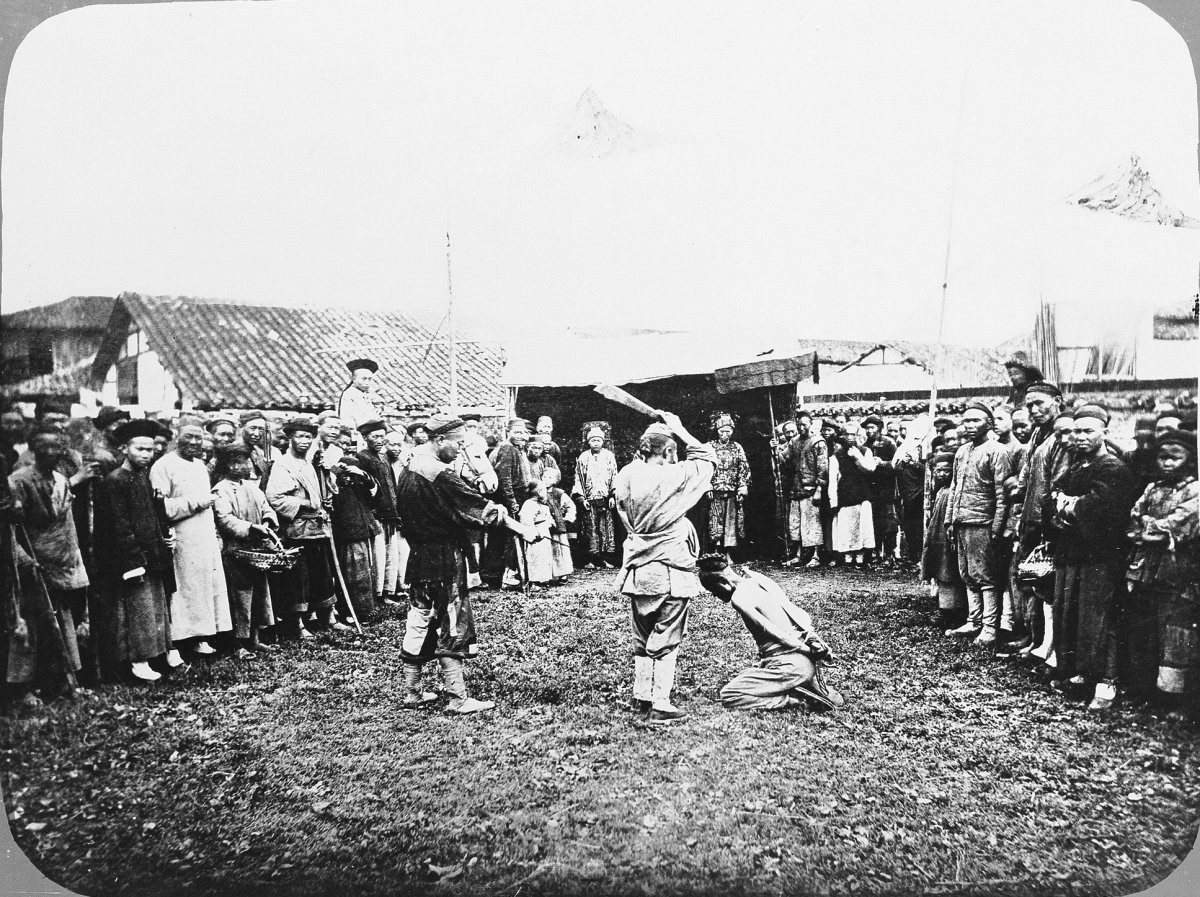
Photo of an unspecified 1867 Qing beheading in Canton.

* “The Chinese Legal Tradition and the European View of the Rule of Law” by Wu Shu-Chen in The Rule of Law History, Theory and Criticism, Part VI.

On this day..

1941: Olga Kameneva, Christian Rakovsky, Maria Spiridonova and many others by the NKVD

On this date in 1941, as Nazi armies surged into the USSR, the Soviet NKVD summarily executed a reported 157 prisoners held in the soon-to-be-Nazi-occupied city of Oryol (Orel).


Kameneva (top), Rakovsky (middle) and Spiridonova.

Most prominent among them were:

  • Olga Kameneva, a pol in the 1920’s, she was the sister of recently-murdered Communist heretic/Stalin gadfly Leon Trotsky, and she was the widow of executed Old Bolshevik Lev Kamenev.
  • Christian Rakovsky, internationalist Bulgarian revolutionary turned Soviet diplomat. Rakovsky, Dmitry Pletnyov and Sergei Bessonov had been the only three to avoid execution at the Trial of the 21, one of Stalin’s red-letter purges. But all three were shot together this day.
  • Prominent Left SR Maria Spiridonova, a revolutionary who had taken four decades of beatings from tsarist and Bolshevik alike, and who Emma Goldman saluted as “one of the most sincere, well-poised, and convincing” opponents of the Soviet regime.

Many other political transgressors less memorable than these went along with them, leftover targets of opportunity from a generation’s internecine purges and counterpurges.

Why bother to spend the resources evacuating an enemy of the people? By this time, Operation Barbarossa was nearly three months old, and mass prisoner executions ahead of the advancing Germans were a practiced art. One difference this day: this hecatomb was not in the western Soviet Republics, but in Russia proper.

In the autumn of 1941, the Left SRs Spiridonov, Izmailovich, and Mayorov, the Maximalist Nestroyev, and the SR Timofeyev were among the 157 prisoners shot in the Medvedevsky woods. (A Century of Violence in Soviet Russia

As many of them might have been denounced as “fascist” in their time for not hewing the correct revolutionary line, one doubts they would have enjoyed any more comfortable treatment at the hands of the Wehrmacht, which overran Oryol on Oct. 3.

On this day..

1852: Fatimih Baraghani, Tahirih the pure

On this date in 1852, the Persian poet Fatimih Baraghani was strangled with her veil in a Tehran garden for her women’s rights advocacy.

She’s best known as* Tahirih, the title meaning “pure one” given her by the Bab.

The moniker denoted the latter’s support of her in the Babi community that would eventually develop into the Baha’i faith. Tahirih was notable even within that outlawed sect for her staunch advocacy of female emancipation; in 1848, she dramatically unveiled in public at a conference to underscore her rejection of Islamic gender law.

Known for her intelligence as well as her militancy, she came under increasing police pressure. She was killed along with about 30 of her faith in the Persian crackdown on Babism after an assassination attempt on the Shah.

Her reported last words were modern-sounding indeed:

You can kill me as soon as you like, but you cannot stop the emancipation of women.

Most readily available material about this inspirational character tends to the devotional, as with this video series; Executed Today does not necessarily endorse the position that at her apparent death she actually only escaped to trans-dimensional hiding.

* Fatimih Baraghani is also known as Qurratu’l-‘Ayn, or Qurrat al-‘Ayn — “consolation of the eyes.”

On this day..