1793: The Girondists

On this date in 1793, in a revolutionary Paris where the machinery of the Terror was clattering to life, five tumbrils bore to the guillotine twenty former Girondist ministers to the National Convention — plus the corpse of their late colleague Dufriche de ValazĂ©, who had cheated the executioner by killing himself.

Named for the region of Aquitaine from which their leading lights hailed, the Girondists (or Girondins) had in the compressed history of the Revolution ascended from fringe democratic party to governing party even as the political facts shifted under their feet. Finding themselves the conservative party in an assembly increasingly dominated by radical Montagnards and the Paris mob, the Girondists’ tactlessness and stubborn refusal to deal with Georges Danton after his (still historically murky) involvement in the riotous slaughter of prisoners during the September Massacre eroded their position.

As the terrible year of 1793 unfolded, the Girondins discovered themselves successively overthrown, expelled from the Convention, proscribed, and hunted. Though many more — Girondists and others — were to follow in their steps, the trial of these 21 before the Revolutionary Tribunal and subsequent guillotining, the first notable mass-execution of the Revolution, raised the curtain on the Terror.


L’ultime adieu des Girondins le 31 Octobre 1793, by Paul Delaroche

Decades later, the English historian Lord Acton remembered the faction’s doomed heroism.

[The Girondins] stood four months before their fall. During that memorable struggle, the question was whether France should be ruled by violence and blood, or by men who knew the passion for freedom. The Girondins at once raised the real issue by demanding inquiry into the massacres of September. It was a valid but a perilous weapon. There could be no doubt as to what those who had committed a thousand murders to obtain power would be capable of doing in their own defence.

Almost to the last moment Danton wished to avoid the conflict. Again and again they rejected his offers. Open war, said Vergniaud, is better than a hollow truce. Their rejection of the hand that bore the crimson stain is the cause of their ruin, but also of their renown. They were always impolitic, disunited, and undecided; but they rose, at times, to the level of honest men.

They were easily beaten and mercilessly destroyed, and no man stirred to save them. At their fall liberty perished; but it had become a feeble remnant in their hands, and a spark almost extinguished. Although they were not only weak but bad, no nation ever suffered a greater misfortune than that which befell France in their defeat and destruction.

That Pierre Vergniaud who scorned the hollow truce was the last to mount the scaffold this day — a shining orator of the Revolution who captured the calamity engulfing his nation in another well-remembered aphorism, “the Revolution devours its own children.”

On this day..

1618: Walter Raleigh, age of exploration adventurer

On this date in 1618, schemer, explorer, and lover Walter Raleigh fell permanently out of favor.

One of the biggest wheels of Elizabethan England, Raleigh (who also rendered his name Rawleigh, Rawley, and most commonly, Ralegh) charmed his way into the Queen’s inner circle, and possibly her pants, and was even thought to be a contender for her hand.

In between gorging on royal monopolies, scribbling poetry, popularizing tobacco, and introducing the potato to Ireland [allegedly], Raleigh got his New World on by attempting to colonize Virginia,* helping fund it with privateering operations against England’s rivals in the land-grab game. The city of Raleigh, North Carolina — present-day North Carolina was part of the Virginia Colony back in the day — is named for him.

Proud, powerful, and the queenie’s pet. Just the sort of courtier other noble suckups loved to hate.

When the palace fave secretly dallied with one of the Queen’s ladies-in-waiting, he went on the royal outs and got real familiar with the Tower of London. Though he managed to patch up with Elizabeth, things were never quite the same for Sir Walter. Elizabeth’s successor James I put him back in prison (suspending a death sentence) for supposedly participating in the Main Plot.

Raleigh passed the time under lock and key burnishing his Renaissance man rep by writing various poetry and treatises, including an account of his voyage to Guyana. Convinced the legendary city of El Dorado was in the vicinity, Raleigh eventually prevailed upon James to release him to make another run at it.

But a dust-up with a Spanish outpost in South America left his son dead, and the Spanish ambassador hopping mad. Raleigh was arrested upon his return, and the death sentence reinstated.

At 66 years of age or so, Walter Raleigh had had a pretty good run.

He took his punishment with equanimity, writing tenderly to his wife, and examining the blade that would take off his head on the scaffold with the observation,

“This is a sharp Medicine, but it is a Physician for all Diseases.”

His wife creepily kept the severed head for the remaining 29 years of her life.

There’s a more detailed tour of Raleigh’s life here, and a site linking many works by and about Raleigh here.

* As Governor of Virginia, Raleigh forbade injuring Indians on pain of death, according to Giles Milton’s Big Chief Elizabeth. Raleigh’s “imperialism with a human face” policy had exchange programs of Indians visiting England, most notably Pocahontas.

On this day..

1553: Michael Servetus, but not to defend a doctrine

On this date in 1553, Calvinist Geneva showed it could keep up with the Inquisition by burning the theologian Michael Servetus as a heretic.

A generation or two into the Protestant Reformation, and the ministers of Rome were in full-throated I-told-you-so. The splintered religious authority had set all manner of alien doctrine afoot in the land. Adult baptism! No original sin!

Servetus believed all this queer stuff. He also believed in a unitarian — that is, not trinitarian — deity.

Catholics and Protestants both hunted him from pillar to post for heresy.

After busting out of the Inquisition’s clutches in France, Servetus fled towards Italy, but made an unaccountable stopover in John Calvin’s Geneva. He well knew that capture here would be fatal: he had had an acrimonious correspondence with Calvin. Was he seeking thrills? Martyrdom? A place in this blog?

“I will burn, but this is a mere event. We shall continue our discussion in eternity.”

He quaffed all those bitter cups when he was recognized hanging out at a church service and condemned to death for sundry heresies after a sensational trial heavy with theological artillery, personal vituperation, and municipal politics. Calvin, gracious in victory, requested beheading rather than burning. He was scorned as needlessly merciful.

Of course, all manner of Christian fauna were being martyred by other Christians in the 16th century. Still, the Spanish physician is an interesting dude.

His rejection of the Trinity has secured him honored consideration from various latter-day sects, from Jehovah’s Witnesses to Oneness Pentecostals to general humanists to Unitarian Universalists:

Besides all that stuff, in his day-job capacity as doctor, Servetus was apparently the first European to understand pulmonary respiration. Nobody even noticed that until decades after his death.

“To kill a man is not to defend a doctrine, but to kill a man.”*

The execution of this smart, odd duck for non-violent heresy is not generally considered the highlight of Mr. Predestination’s career, but you can get some of Calvin’s side of the story in this collection of his letters. It’s worth allowing that heretics were being burned by the thousand elsewhere in Europe at this time; Servetus is noticeable in part because what was routine in England or Spain was exceptional in Geneva.

Servetus’ ashes will cry out against [Calvin] as long as the names of these two men are known in the world. –Walter Nigg

* This observation, sometimes attributed to Servetus himself, was in fact uttered by Sebastian Castellio.

On this day..

Feast Day of Boethius

(Thanks to Jeffrey Fisher [jeffreyfisher at me.com] for the guest post.)

Today is the feast day of Neoplatonic philosopher and Christian theologian Boethius (Anicius Manlius Severinus Boethius), author of The Consolation of Philosophy, and according to tradition martyred in 524 or 525, or possibly 526, by the Ostrogothic king Theodoric.

Well, maybe.

We know roughly as much about why Boethius was killed as when or how. We do know that he came from a line of prominent Romans (including a couple of popes back there, depending on who you count as “pope”), was himself consul in 510, and his sons were rather astonishingly joint consuls in 522. At that time he moved up to Ravenna accepting an appointment at Theodoric’s court as the Master of Offices, something like the equivalent of chief of staff, managing the work of Theodoric’s officers.

But then things went horribly wrong.

There is a long tradition, going back at least to the eighth century, regarding Boethius as having been executed for maintaining the Catholic faith against the Arian Theodoric. While Theodoric was probably paranoid about spies representing the Catholic eastern emperor-in-waiting Justinian (who would, in fact, later “reconquer” the Italian peninsula), and Boethius claims in the Consolation that he was hated for being smarter than everyone else, the truth is probably that he was caught up in the usual machinations of an imperial court.

A member of the Senate was accused of treasonably conspiring with Justinian’s predecessor Justin I against Theodoric. Boethius defended the accused (apparently the only person to do so, although the charges were surely trumped up), and in the Consolation, Boethius says he was only defending the Senate (implying that the accusations were meant to undermine the authority of the Senate by challenging its loyalty to the king).

In any event, the sources we have say that Boethius was condemned by the Senate (who appear to have thrown him under the bus) without being able to speak in his own defense. After an indeterminate time of imprisonment, he was executed.

It was while he awaited death that he wrote his most famous and arguably most influential work, The Consolation of Philosophy.

A few of the many editions of The Consolation of Philosophy available. Others are available free at Project Gutenberg (here, here and a Latin one here), as is a podcast version.

Boethius’ translations of and commentaries on ancient Greek philosophy were the only such texts available in Europe for much of the Middle Ages, but the Consolation was translated and widely read even outside of the philosophical circles in which his other work was so important.

Written in the form of Menippean satire (alternating verse and prose) as a dialog between Boethius and Philosophy, the Consolation is Boethius’s attempt to think through and make sense of the sad state of his affairs.

Ultimately, it was both the universal nature of the problem (why are these horrible things happening to me?) and the compelling way in which he tackled the problem (a combination of Plato, Aristotle, and Stoicism) that have made this text so widely read and imitated.

There is no way in this space to do justice to the Consolation, which addresses the very idea of philosophical discourse (“would you like us to clash together our arguments, for perhaps out of a conflict of this kind some beautiful spark of truth my fly out?”), the nature of time and God’s perspective outside of time, the difference between providence and fate, and the nature of and way to the Good itself.

But the gist of Boethius’s argument about the sufferings of the good person maybe be quickly summarized. In short, Boethius has forgotten his true nature, which never changes, and gotten caught up in the things of this world, which come and go. If he but remembers himself, he will have something no injustice, no turning of the wheel of fortune, can take away from him. And as for the unjust and the evil, they also have their “reward”:

But since goodness confers on each man his reward, he will only lack it when he has ceased to be good. [ . . . Now] since the good itself is happiness, it is clear that all good men are made happy for this reason, that they are good. But those that are happy, it is agreed, are gods; and therefore that is the reward of good men, which no time can lessen, no man’s power diminish, no man’s wickedness obscure, to become gods. These things being so for good men, no wise man can doubt either of the punishment inseparable from evil men; for since good and evil, and also punishment and reward, are directly opposite to one another, what we see added in the case of the good man’s reward must necessarily be reflected in an opposite manner in the evil man’s punishment. As therefore goodness itself is the reward for good men, so for wicked men wickedness is itself the punishment.

On this day..

1936: Antonio José, forgotten composer

On this date in 1936, the Spanish composer Antonio José was shot by Falangists during the Spanish Civil War.

The 33-year-old Burgos native (English Wikipedia page | the more detailed Spanish) was a rising young star, a writer, teacher and “folklorist” who had only that April earned plaudits for a paper on popular songs at an international musicology conference.

That July, the Spanish Civil War erupted … and the fascists clapped him in irons and shot him in the marshes near Estepar, Spain. I have not been able to find any clear documentation as to specifically how he earned the death sentence — which is not to say that the Spanish Falange deserves the benefit of the doubt for the regularity of its judicial procedures.

Despite Maurice Ravel’s (pre-Civil War) opinion that Jose would become “the Spanish composer of our century,” Jose’s work vanished into obscurity after his untimely death. Pieces like this Sonata Para Guitarra have only recently been widely rediscovered.

On this day..

1967: Ernesto “Che” Guevara

As of 1:10 p.m. Bolivia time this date in 1967, Ernesto “Che” Guevara was no longer a man: he was only a god.

The Argentinian-born doctor turned Cuban revolutionary icon and the man who wrote the book on guerrilla warfare had put abroad to foment insurgency. His efforts in the Congo foundered; his bid to replicate the Cuban revolution in Bolivia was doing likewise when he was captured.

After holding him overnight, the government sent a coded order to execute him in the field. Che had done the same thing with his own hands to several who betrayed the Sierra Maestra guerrillas.

Soldier Mario Teran drew the short straw for a footnote to destiny; when he hesitated, Che chastised him with the legendary parting words “that someone invented or reported”:

“Shoot, coward, you’re only going to kill a man.”

Maybe so, but the man looked Christ-like when they put his body on display for the press. As certain as they made his death, still Che lives.

CIA asset (and George Bush Sr. confidante) Felix Rodriguez took his watch as a trophy. The rest of Che Guevara belongs to the world.*

This site could hardly attempt a definitive rendering of such a towering and controversial figure, a task fit for two, three, many biographies.

Lengthy video documentaries are here and here. Many of Che’s own words are collected here. Declassified U.S. National Security Archive documents relating to his capture and death are here.

And highly recommended is SovMusic.ru’s huge library of Che Guevara mp3 files — like this Francesco Guccini song:

[audio:Che_Guevara_Francesco_Guccini.mp3]

“We cannot be sure of having something to live for unless we are willing to die for it.”

-Che Guevara

* Especially, of course, its marketers.

On this day..

1589: Dietrich Flade, for leniency towards evildoers

On Sept 18, 1589, a magistrate and deputy governor in Trier, a city embroiled in a witch-burning campaign, was himself delivered that fate.

The winds of the Reformation swirled mercilessly at that time, and Dietrich Flade sat on the bench charged with maintaining order in Trier. Flade held a Doctorate of Civil and of the Canon Law, and he was well-connected in the magisterial Germany of the day. He just happened to be alive at the wrong time. George Lincoln Burr provides an extensive account of Flade’s ill-fated time on the bench, including this foreboding look:

But the storm that was to rob him of fortune, fame, and life was already brewing all along the horizon. The witch-trials, which, during the earlier part of the century, had appeared only sporadically, were settling here and there into organized persecutions. In the neighboring Lorraine, the terrible Nicolas Remy was already exercising that judgeship, as the fruit of whose activity he could boast a decade later of the condemnation of nine hundred witches within fifteen years; and just across the nearer frontier of Luxemburg, now in Spanish hands, the fires were also blazing. Nay, the persection had already, in 1572, invaded the Electorate itself.

In six years, the diocese of Trier oversaw the execution of 368 witches, many of whom confessed only under torture. The anti-witchcraft campaign was so expansive that some towns were left with few if any women. The hysteria was widely reviled by the academics of the time, including both Flade and Cornelius Loos.

Loos was so disturbed by the events occurring around him that he wrote a book in objection; before it could gain distribution, however, Loos was arrested and jailed. It was four years before he was released, only after recanting his entire treatise and acknowledging the authority of the Pope.

Flade (German Wikipedia link) was not as lucky.

As judge, he was too light with suspected witches and allowed many to go free or get off with light sentences. Worst of all, he let the unsettled Reformation continue without his intervention on behalf of the church. His “trial” was brutal*, with an extracted confession from five heinous torture sessions serving as evidence against him. As high-ranking as Flade was, though, he was executed rather mutedly in Treves.

Not without reason, Burr suspects the motive was entirely political on the part of Archbishop Johann von Schöneburg. Von Schöneburg immediately stepped up his campaign to ensure his dominion, moving to larger mass executions and damning the populace to a generation of loss — except the executioner, of course, who was paid handsomely for the deed.

The persecutions were spurred on by both similar events elsewhere in the world and the writings of those directly involved. France, and, of course, Spain both featured notable witchcraft courts. One bishop under Von Schoeneburg, Peter Binsfield, was tasked with scribing works to defend the practice, which he dutifully discharged in 1589 and 1591; these were followed shortly by Jesuit Peter Thyraeus** (1594) and the aforementioned Nicholas Remy (1595). By that time, however, the furor in Trier had, in more ways than one, burned itself out: by 1593, with too few people to tend the land and sustain the towns, the area around Trier had become an economic crater, and the persecutors put a reluctant end to the madness.

Badly damaged page from Flade’s original trial transcription, courtesy of the Cornell University Library’s Witchcraft Collection.

* One of the founders of Cornell University, A.D. White, joined forces with Burr to acquire the one known copy for that university’s library in 1883. Burr intended to transcribe the text but apparently never completed the job, instead delivering several talks and writing an tract on the subject that includes extensive footnotes.

** Thyraeus also wrote one of the age’s definitive considerations of lycanthropy, shapeshifting and werewolfism — another demonic manifestation simultaneously afoot in Germany.

On this day..

1938: Nikolai Kondratiev, purged economist

On this date in 1938, Stalin’s purges claimed Soviet economist Nikolai Kondratiev.

Not the most recognizable name in the Soviet Union’s 1930’s bloodletting, Kondratiev — also transliterated Kondratieff — was a pre-Keynesian economist of some note, who had a prominent hand in the fledgling USSR’s early agricultural direction.
Thus far goes the portfolio of many a forgotten academic or bureaucrat shot by Stalin.

But Kondratiev made a contribution still much remembered — and one that might just be due to re-emerge from its occult hibernation.

In a series of 1920’s papers, Kondratiev worked out the theory that capitalism had 50-to-60-year economic supercycles. Though not strictly the first to so hypothesize, he put the idea on the map; the (alleged) pattern still bears the name “Kondratiev wave” or “Kondratiev cycle”.

His belief that the intermittent major crises punctuating capitalism were not building towards systemic implosion but clearing the economic debris of bygone ages and allowing new growth were not the least of what got him into hot water with Stalin.

“Creative destruction,” as Joseph Schumpeter would call it, adapting the idea.

Though sidelined from mainline economics for much of the 20th century, Kondratiev waves have never gone entirely out of fashion. Congenial to any number of collateral theoretical hobbyhorses — technological innovation, entrepreneurship, generational psychology, statecraft, and the eternal bracing for end times right around the corner — Kondratiev waves are a niche player in economic theory both conventional and otherwise.

Here’s a site that lovingly describes them.

Its problem, even if you happen to buy into the concept, is its near uselessness as a predictive tool: half-century cycles don’t just arrive like clockwork, and the timing and very existence of particular cyclical epochs is highly dependent on the interpreter’s choice of data. The margins of error run out to decades. You never know at any given moment what you’re looking at — so you can find the supercycle crashing in 1998, or beginning its springtime of growth in this decade.

That very uncertainty accounts for Kondratiev’s intermittent mainstream resuscitation during economic crisis: when worried about Where Things Are Headed, some version of a Long Wave theory is almost sure to have a story to tell.

According to the New York Times‘ database of past articles, the word “Kondratieff” (its preferred transliteration; “Kondratiev” yields stories about New York Rangers prospect Maxim Kondratiev) went essentially unmentioned in the post-World War II paper before appearing in 20 articles from 1973 through 1984 — the period when the capitalist core was buffeted by energy crisis, stagflation, and the punishing Paul Volcker recession of the early Eighties.

And then Kondratiev/Kondratieff faded from the Grey Lady; after a few appearances during Wall Street’s woes in the late 80’s, it doesn’t seem to have appeared in print there since an offhanded reference in a 1992 William Safire column.

Have you seen the news lately? It’s mighty Kondratiev-friendly. His cycle of exclusion has probably just about run its course, and if you’re the wagering type, I’ll take Thomas Friedman against the field.

Behind the theorems, of course, there was the flesh-and-blood man; it so happens that not many dismal scientists went as poignantly as our principal.

Initially imprisoned in 1930, Kondratiev served eight years before he was re-sentenced and executed; he ached for the separation with his family. Kondratiev’s daughter, Elena — Alyona or Alyonushka in the Russian diminutive — preserved his correspondence to her, the only remnants of her father in her life.

The last letter — as it turned out; plainly the writer had no inkling of it — was dated August 31, 1938.

My sweet darling Alyonushka.

Probably your holidays are over now and you are back at school. How did you spend the summer? Did you get stronger, put on weight, get tanned? I very much want to know. And I would like very, very much to see you and kiss you many, many times. I still do not feel well, I am still ill. My sweet Alyonushka, I want you not to get sick this winter. I also want you to study hard, as you did before. Read good books. Be a clever and a good little girl. Listen to your mother and never disappoint her. I would also be happy if you managed not to forget about me, your papa, altogether. Well, be healthy! Be happy! I kiss you without end.

Your papa.

(From Orlando Figes’ The Whisperers: Private Life in Stalin’s Russia.)

On this day..

1850: Prof. John Webster, for the timeless conflict between donors and academics

On this date in 1850, a 57-year-old Harvard professor expiated upon a gallows at Boston’s Leverett Square the murder of one of the university’s donors.

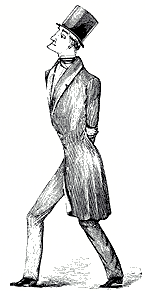
The buzz of Boston in 1849-50, the Parkman-Webster murder case began with the disappearance of one of the crimson’s great benefactors, George Parkman, a Boston Brahmin known for his Ministry of Silly Walks gait about town (see right). According to Oliver Wendell Holmes, Sr. (who appeared as a witness at the trial of Parkman’s accused murderer), “he abstained while others indulged, he walked while others rode, he worked while others slept.”

Also, he inherited a ridiculous sum of money, and was tight with the debtors to whom he lent it.

Back before collection agencies, Parkman disappeared in November 1849 while making the rounds to shake down his borrowers. Within days, suspicion settled on Harvard anatomy and geology professor John Webster, who had squandered his own pile of money buying rock collections and maintaining appearances and such, and sank into desperate hock to the jutting-chinned ambulator who had helped him land the Ivy League appointment in the first place.

A weighty circumstantial case soon formed against Webster, with the invaluable aid of a snoopy janitor who turned up human remains in the office and testified to incriminating-sounding conversations.

Elites-on-elite crime epidemics always churn the scandal mills. Henry Wadsworth Longfellow’s wife Fanny wrote a friend,

You will see by the papers what dark horror overshadows us like an eclipse. Of course we cannot believe Dr. Webster guilty, bad as the evidence looks. … Many suspect the janitor, who is known to be a bad man and to have wished for the reward offered for Dr. Parkman’s body. … I trust our minds will be soon relieved, but, meanwhile, they are soiled by new details continually.

“Harvard professors do not often commit murder,” or so they say. (This was still a century before Robert McNamara.)

Boston high society was about to see a whole different side of Harvard.

Although perhaps individually explicable — anatomists had plausible reasons to have human remains at work, and other anatomists than Webster could have had access to his office — the cumulative weight of Webster’s ham-handed attempts to declare that he had paid up his debts to Parkman just before the latter’s mysterious disappearance, of the discovery of what (disputed) dental forensics declared to be Parkman’s dentures, of the ghastly appearance of a torso (disputedly) declared to be Parkman’s stuffed in a tea chest at Webster’s offices started to really make the man look guilty.

In view of a mediocre defense, the jury convicted Webster of whacking his own professional benefactor, in the university building erected on said benefactor’s donated plot of land.

Talk about donor recognition.

While the prof’s seeming post-conviction acceptance of guilt — in a plain strategem to secure clemency — and generally shifty demeanor have cemented him as the definitive perpetrator in the standard historical reading,* Fanny’s snobbish take on the “bad man,” janitor (and moonlight body-snatcher) Ephraim Littlefield, has not been entirely lost to the tradition.

At the end of the day, everything about the case is circumstantial — indeed, besides being historically noteworthy for the first use of dental forensic evidence in a murder trial (forensics we might find rather speculative and unconvincing today), Webster’s case generated a landmark ruling from the judge’s jury instruction establishing “reasonable doubt” as the threshold for criminal conviction rather than the “absolute certainty” Webster’s prosecutors had no hope of attaining; that ruling influences American jurisprudence down to the present day.

And one cannot but notice how many of the circumstances — creepily playing Sherlock Holmes with a freelance dig into the professor’s furnace to discover charred bones, for instance — were provided by the fellow-suspect-turned-star-witness Littlefield, who niftily reaped the $3,000 reward for his offices in substituting Webster for himself under the pall of suspicion.

According to peripatetic crime blogger Laura James, a forthcoming (2009) book promises to revisit the sensational trial, “to examine all the intricacies for ourselves — not aided by the eager voice of the janitor.”

* Bemis, one of the prosecutors, wrote the go-to source on the Webster trial, available from Google Books; another contemporaneous account is here.

On this day..

1966: Sayyid Qutb

On this date in 1966, author and intellectual Sayyid Qutb was hanged for plotting to overthrow the Egyptian state.

Qutb — whose names can be transliterated many ways (SaĂŻd, Syed, Seyyid, Sayid, or Sayed; Koteb, Kotb, Qutub or Kutb) — was one of the most influential Islamist thinkers of the 20th century, and helped shape the ideas of Osama bin Laden.

A traditionally-minded Muslim civil servant in a westernizing Egypt, Qutb’s journey to radicalism is traditionally dated to his late 1940’s study abroad in the U.S. at what is now the University of Northern Colorado, where the decadence, materialism, and lax morality of the global hegemon saw him seeing existential evil in the everyday all around him:

The American girl is well acquainted with her body’s seductive capacity. She knows it lies in the face, and in expressive eyes, and thirsty lips. She knows seductiveness lies in the round breasts, the full buttocks, and in the shapely thighs, sleek legs — and she shows all this and does not hide it.

Qutb left Greeley, Colo., in 1950 with a master’s degree and an intention to mount an Islamic revolution in his home country that would implement sharia and keep shapely thighs safely under wraps. (Qutb never married, bemoaning the scanty pickings of pure fish in the sea. He may have faced the gallows a virgin.)

He hooked up with the outlawed Muslim Brotherhood, landed in Egypt’s famously savage prisons (future president Anwar Sadat was one of his judges), and the experience of torture hardened his commitment to a vanguard-led revolution. He kept up his prolific writing output, penning perhaps his most notable work, Milestones (the text was later used against him at his capital trial).

Qutb’s release in 1964 was only for a few months, before Egyptian security got wind of a new Muslim Brotherhood plot to overthrow the government and rounded up Qutb as the supposed ringleader — or just railroaded him because it didn’t like where he was going with passages like

there are many practical obstacles in establishing God’s rule on earth, such as the power of the state, the social system and traditions and, in general, the whole human environment. Islam uses force only to remove these obstacles so that there may not remain any wall between Islam and individual human beings.

With the benefit of hindsight, one can readily imagine that his martyr’s death did not squelch his movement, but greatened his stature to admiring eyes.

But it was hardly a direct path into an un-critiqued hall of martyrs in an undifferentiated “radical Islam”. While Qutb had his own influence in Egypt, Cairo has managed to keep the lid on the Muslim Brotherhood. Qutbism, however, was exported to Saudi Arabia — which intentionally imported it for various practical and geopolitical reasons — where it flourished, often in a fractious relationship with official Saudi Wahhabism.

One of Qutb’s students was the uncle of Ayman al-Zawahiri, and the hanged intellectual greatly influenced Zawahiri’s own path into radicalism and to al-Qaeda. Since September 11, of course, the path Qutb himself followed has become of much more pressing interest to the West as well as within the Muslim world.

Some noteworthy works by Sayyid Qutb

On this day..