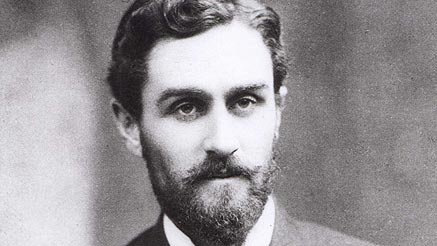
1937: Ikki Kita

On this date in 1937, intellectual Kita Ikki (Kita is the family name) was executed by the Japanese military government for inspiring a failed coup d’etat the previous year.

A onetime socialist turned radical nationalist, Kita — born Kita Terujiro — preached a doctrine of authoritarian national restoration around some socialist-sounding communitarian purpose, coupled with an unapologetic imperialism.

His Outline Plan for the Reorganization of Japan (the translation is from a reader, Sources of Japanese Tradition, partially excerpted here) argues that in the wake of Europe’s self-immolation in World War I, initiative lay with the Land of the Rising Sun — and that the country must adopt a muscular unity of purpose to grasp it.

The entire Japanese people, thinking calmly from this perspective which is the result of Heaven’s rewards and punishments, should, in planning how the great Japanese empire should be reorganized, petition for a manifestation of the imperial prerogative establishing “a national opinion in which no dissenting voice is heard, by the organization of a great union of the Japanese people.” Thus, by homage to the emperor, a basis for national reorganization can be set up.

Truly, our 700 million brothers in China and India have no path to independence other than that offered by our guidance and protection. And for our Japan, whose population has doubled in the past fifty years, great areas adequate to support a population of at least 240 million or 250 million will be absolutely necessary a hundred years from now. For a nation, one hundred years are like a hundred days for an individual. How can those who are anxious about the inevitable developments or who grieve over the desperate conditions of neighboring countries find their solace in the effeminate pacifism of doctrinal socialism? … At a time when the authorities in the European and American revolutionary creeds have found it completely impossible to arrive at an understanding of the “gospel of the sword” because of their superficial philosophy, the noble Greece of Asian culture [meaning Japan, of course] must complete its national reorganization on the basis of its own national polity. At the same time, let it lift the virtuous banner of an Asian league and take the leadership in the world federation that must come. In so doing let it proclaim to the world the Way of Heaven in which all are children of Buddha, and let it set an example that the world must follow.

One could quibble about particulars, but it’s essentially fascism — paralleling Mussolini in doctrine as well as ideological evolution. (According to W.G. Beasley Kita also co-founded a Gen. Jack Ripper-esque Society for the Preservation of the National Essence.)

A military coup was supposed to get the ball rolling, which made him a guru to an aggressive cadre of young officers who tried to seize the government in the February 26 Incident, named for the date in 1936 it took place.

Kita wasn’t himself involved in the coup, but his intellectual sponsorship was enough of a connection for the Kempeitai.* Modern Japanese Thought tartly observes that Kita’s vision for an imperial dictatorship didn’t turn on any misty-eyed allegiance to the emperor’s person.

When he was executed for his role in the mutiny of 1936, he was ordered to recant by saying “long live the emperor” as a final act of reverence and submission. He is reported to have refused by replying that he had vowed long ago never to joke about his own death.

In Fighting Elegy (or Elegy to Violence or Elegy to Fighting), Seijun Suzuki’s 1960’s skewering of militarist 1930’s Japan (review), Kita makes cameos to inspire the main male character to greater feats of violent sublimation of his repressed sexuality. (The following clip is merely the trailer.)

There’s also a 1973 biopic — the last film of Yoshishige Yoshida.

* I don’t have definite documentation on the method of execution; I’m supposing it was hanging, the standard method in Japan since the Meiji period.

On this day..

1916: Sir Roger Casement

On this date in 1916, Roger Casement was hanged for treason by the British crown that had knighted him only a few years before.

Casement died for his part in the Easter Rising, but this Irish nationalist hero’s layered story has long made him a very different sort of cultural marker than, say, James Connolly.

Casement came to public prominence for his damning report on Belgium’s atrocious treatment of natives in its Congo colony, e.g.:

[T]he great decrease in population, the dirty and ill-kept towns, and the complete absence of goats, sheep, or fowls — once very plentiful in this country — were to be attributed above all else to the continued effort made during many years to compel the natives to work india-rubber. Large bodies of native troops had formerly been quartered in the district, and the punitive measures undertaken to his end had endured for a considerable period. During the course of these operations there had been much loss of life, accompanied, I fear, by a somewhat general mutilation of the dead, as proof that the soldiers had done their duty.

. . . Two cases (of mutilation) came to my actual notice while I was in the lake district. One, a young man, both of whose hands had been beaten off with the butt ends of rifles against a tree; the other a young lad of 11 or 12 years of age, whose right hand was cut off at the wrist. . . . I both these cases the Government soldiers had been accompanied by white officers whose names were given to me. Of six natives (one a girl, three little boys, one youth, and one old woman) who had been mutilated in this way during the rubber regime, all except one were dead at the date of my visit.

[A sentry in the employ of one of the concessionary private companies] said he had caught and was detaining as prisoners (eleven women) to compel their husbands to bring in the right amount of rubber required of them on the next market day. . . . When I asked what would become of these women if their husbands failed to bring in the right quantity of rubber . . , he said at once that then they would be kept there until their husbands had redeemed them.

Casement’s is an honorable name in the campaign for the Congo, an early human rights and anti-colonial struggle; in this 92-minute BBC documentary on the notorious depredations in the Congo, the Casement report’s creation and impact are treated from about 1:15:15 through the end:

A similar investigation undertaken in Peru — where the lens focused on British employers, rather than strictly the malfeasance of foreign states — earned him knighthood in 1911, but Casement’s personal evolution from loyal Protestant* imperial operative with a sympathy for the Irish cause to revolutionary nationalist was already underway. “This journey into the depths of the Congo has been useful in helping me discover my own country and understand her situation, her destiny, her reality,” he wrote his sister. “I’ve also found my true self: the incorrigible Irishman.”

He resigned from the consular service and began recruiting for the Irish Volunteers.

As World War I opened, Casement identified British aggression as its cause, an extension of the violent imperial hegemony he chronicled in The Crime Against Europe:

The British Empire was not founded in peace; how, then can it be kept by peace, or ensured by peace-treaties? It was born of pillage and blood-shed, and has been maintained by both; and it cannot now be secured by a common language any more than a common Bible. The lands called the British Empire belong to many races, and it is only by the sword and not by the Book of Peace or any pact of peace that those races can be kept from the ownership of their own countries.

While any Irish Republican would have agreed with that sentiment, the resulting moral and tactical calculus for the Irish cause to ally with the German was not universally embraced — and was certainly anathema to the British.

“In the Streets of Catania”
by Roger Casement

All that was beautiful and just,
All that was pure and sad
Went in one little, moving plot of dust
The world called bad.

Came like a highwayman, and went,
One who was bold and gay,
Left when his lightly loving mood was spent
Thy heart to pay.

By-word of little street and men,
Narrower theirs the shame,
Tread thou the lava loving leaves, and then
Turn whence it came.

Ætna, all wonderful, whose heart
Glows as thine throbbing glows,
Almond and citron bloom quivering at start,
Ends in pure snows.

Casement spent the first two years of the Great War in Germany itself, and arranged a shipment of guns that would have supported the Easter Rising, but thought the aid too little and too late. He had a German U-boat drop him at Ireland, trying to get word to the Republican leadership to postpone the revolt.** Instead, he was picked up three days before the doomed rising and hanged after a sensational trial.†

His “treason” — and of course, the very crime of which he was convicted imports a British legitimacy in Ireland that Casement explicitly rejected — shocked many old associates, but he still had friends in high places. To dampen the international clemency campaign, England circulated the notorious “Black Diaries,” photographs of supposed Casement diary pages detailing the author’s homosexuality.

This dirty (and successful) trick brings a personal-is-political quality to Casement’s legacy as well as an enduring debate over the diaries’ authenticity. Since Irish nationalism gained mainstream acceptance well before homosexuality, right-thinking folk long held the Black Diaries a forgery, and time was you solicited a black eye by saying otherwise in the wrong company.

The gay rights movement has seen a posthumous redefinition of Casement; although homosexuality was not on the indictment against him, one could argue that it was the reason he hanged. Given recent handwriting forensics that support the diaries’ authenticity, the general‡ consensus about the Black Diaries has inverted with the effect of only heightening sympathy for their alleged author, albeit at the expense of some tension over how to situate that characteristic within the whole of Casement’s life and thought.

And that is only one aspect of the shifting place of Casement in the firmament of Republican martyrs since his death. His hagiography waxed in the interwar years, with Yeats among those calling for the return of Casement’s remains in The Ghost of Roger Casement”.

But the humanitarian’s German ties were an inconvenience as World War II raged, and not until afterward was that cause renewed. When his body was finally returned in 1965, an Irish state funeral elided the matter of the diaries.

Even Casement himself, who would be the last to die for the Easter Rising, had a hand in the myth-making. His last mission’s purpose to avert the Easter Rising fit neither the government’s interest in maximizing his perfidy nor Casement’s own in identifying with the Irish cause; he himself therefore owned the Rising fully in his defense which made him fine fodder for Republican hymns like “Lonely Banna Strand”:

RTE radio’s What If? series recently explored Casement’s complex legacy:

[audio:http://www.rte.ie/podcasts/2008/pc/pod-v-240208-27m06-whatif.mp3]

As Casement put it in his voluminous personal writing, “It is a cruel thing to die with all men misunderstanding — misapprehending — and to be silent forever.”

* Casement’s father was Protestant and his mother was Catholic; he lived with a somewhat split identity between the two faiths, but formally converted to Catholicism while awaiting execution (which surely did not hurt his memory to the Irish cause) and his last meal was simply the Host.

** The guns themselves were interdicted by the British navy and ended up scuttled to the ocean floor.

† Since Casement’s incitements to rebellion had occurred on foreign soil, there was some fine legal parsing over whether he could be tried for “treason.” The dispute resolved to the placement of a comma in a medieval law — leading to the epigram/-taph that Casement was “hanged by a comma.” In the midst of war and before an English jury, however, punctuation was an even weaker defense than it sounds.

‡ But still not universal.

On this day..

1747: Alexander Blackwell, who left them smiling

On this date in 1747,* the Swedes beheaded Scottish-born adventurer Alexander Blackwell for meddling with their line of succession.

Blackwell, “a man of mercurial and adventurous temperament,” had his printing business busted in England for having failed to precede it with the required apprenticeship, and was thrown in jail as a debtor.

To extricate the family from poverty, Blackwell’s wife Elizabeth thereupon launched an amazing career as an herbal limner, drawing, engraving, and hand-coloring editions with hundreds of plants that became a standard reference in the field in the late 1730’s, and whose revenues managed to liberate her spouse. (Elizabeth is still remembered on a plaque at the Chelsea Old Church, in her old neighborhood.)

That mercurial ex-deadbeat might have done better to stick close by his now highly esteemed wife (or possibly his brother, a bloviating classicist), but the wanderlust sent Alex abroad to wash ashore in Stockholm as physician to King Frederick I, where he was soon convicted (on evidence uncertain, apart from the torture-extracted confession) of having intrigued to alter the royal line of succession further to enmeshing Sweden in an alliance with Britain.

He protested his innocence on the scaffold. More memorably, perhaps, he laid his head the wrong way upon the chopping block, requiring the executioner to correct him — whereupon Blackwell cracked wise that he, after all, lacked experience at the art of being beheaded.

Mental Floss mined this outstanding exemplar of gallows humor in a cartoon about memorable exits. (Via History News Network.)

* Some sources, like this Google Books biography, offer August 9 as Blackwell’s execution date. The 11-day discrepancy is due to the still-pending adoption of the Gregorian calendar: July 29 was the date on the Julian calendar still in use in the realms both of Blackwell’s birth and death; in 1752 and 1753, respectively, Britain and Sweden would adopt the Gregorian system.

On this day..

1794: Maximilien Robespierre, Saint-Just and the Jacobin leadership

On this date in 1794, the curtain — and the blade — fell on the Terror.

Maximilien Robespierre, who had breakfasted the previous day as master of France, was guillotined this evening with his chief lieutenants and partisans.

His fall came as sudden and inevitable as his rise had been unpredictable.

Five years before, Robespierre was an unprosperous Arras attorney of fashionably liberal philosophies, and you wouldn’t have given a sou for the prospects of his being remembered five minutes after he died. Yet it would come that his inseparable lieutenant Saint-Just would remark with understatement, “The words we have spoken will never be forgotten on earth.”

The historic convocation of the Estates-General thrust him onto the political stage where he would make the dread name that follows him, starting off in the Revolution’s inception as a far-left deputy. He took a notable early stand against the death penalty, with several arguments that are quite familiar by our day:

The first obligation of a legislator is to form and preserve public morals, the source of all freedom, source of all social happiness. When in running to a particular goal he turns away from this general and essential goal he commits the most vulgar and dire of errors. The king must thus present to the people the purest model of justice and reason. If in place of this powerful, calm and moderate severity that should characterize it they place anger and vengeance; if they spill human blood that they could spare and that they have no right to spread; if they spread out before the people cruel scenes and cadavers wounded by torture, it then alters in the hearts of citizens the ideas of the just and the unjust; they plant the seed in the midst of society of ferocious prejudices that will produce others in their turn. Man is no longer for man so sacred an object: we have a less grand idea of his dignity when public authority puts his life at risk. The idea of murder inspires less fear when the law itself gives the example and the spectacle. The horror of crime is diminished when it is punished by another crime. Do not confuse the effectiveness of a penalty with the excess of severity: the one is absolutely opposed to the other. Everything seconds moderate laws; everything conspires against cruel laws.

For Robespierre, it was an abomination for the nation to deal out death within its community, but his Rousseauan elevation of the collective and abstract People made extirpating existential threats to the community itself an altogether different matter.

The future tyrant’s anti-death penalty case for executing the deposed Louis XVI, flowing directly from those principles, makes interesting reading and is excerpted at length (all emphases added) here for its topicality:

When a nation has been forced to resort to the right of insurrection it returns to a state of nature as regards its tyrant. How can the latter invoke the social compact? He has annihilated it. The nation can preserve it still, if it thinks fit, in whatever concerns the interrelations of its citizens: but the effect of tyranny and insurrection is to break it entirely as regards the tyrant; it is to throw them into mutual war; the tribunals, the judiciary procedures, are made for the members of the city. … The right to punish the tyrant and that to dethrone him are the same thing. The one does not admit of different forms from the other. The tyrant’s trial is insurrection; his judgment is the fall of his power; his penalty, whatever the liberty of the people demands.

Peoples do not judge like judiciary courts. They pass no sentences; they hurl the thunderbolt. They do not condemn kings: they thrust them back into oblivion; and this justice is not inferior to that of courts. If they arm themselves against their oppressors for their own safety, why should they be bound to adopt a mode of punishing them which would be a new danger to themselves?

As for me, I abhor the penalty of death so lavish in your laws, and I have neither love nor hatred for Louis. Crimes only I hate. I have asked the Assembly, which you still call Constituent, for the abolition of the death penalty, and it is not my fault if the first principles of reason seem to it moral and political heresies. But if you never bethought yourselves to invoke them in favor of so many unfortunates whose offenses are less their own than those of the government, by what fatality do you remember them only to plead the cause of the greatest of all criminals? You ask an exception to the death penalty for him alone against whom it can be legitimate! Yes, the penalty of death generally is a crime, and for that reason alone, according to the indestructible principles of nature, it can be justified only in cases when it is necessary for the safety of individuals or the social body. Public safety never demands it against ordinary offenses, because society can always guard against them by other means and make the offender powerless to harm it. But a dethroned king in the bosom of a revolution which is anything but cemented by laws, a king whose name suffices to draw the scourge of war on the agitated nation, neither prison nor exile can render his existence immaterial to the public welfare: and this cruel exception to ordinary laws which justice approves can be imputed only to the nature of his crimes.

It is with regret that I utter this fatal truth. But Louis must die, because the country must live.

“Pity is treason.”

Months later, as head of the Committee of Public Safety — the Orwellian name harkens to the body’s power to judge who lay inside the community and who, lying outside, made war upon it — he would find an inexhaustible fifth column of kindred threats to the Revolution.

But Revolutionary France really was in a war for its survival, against external and internal foes alike. The monarchist for whom crime multiplied upon crime every day after the Tennis Court Oath has the easiest time of this period, for every step brings a new monstrosity. And it is well enough to call Robespierre illiberal, to shudder at his prim and icy persona.

But if the French Revolution’s liberte, egalite, fraternite is a legacy for celebration — as it is to much of the west, and much of the world — one must grapple with the place of this man and his methods.

Merely because they are the paths not taken, one hardly seems entitled to assume that at that tumultuous moment the rule of a constitutional monarchy heir to all the monstrosity of the ancien regime, the government of the Girondins who had launched the nearly fatal war against Austria, or that of Danton‘s haute bourgeoisie would necessarily have delivered France to a better place, or even a different one.

For a Dickens, Robespierre’s Terror is simply the appalling wrong turn of a high-minded movement. For Trotsky, “the Incorruptible”* is the admirable sword of France’s bourgeois revolution who effects the needful task of annihilating the feudal nobility, who presses fearlessly forward seeing that the only alternative is the slide into Bonaparte. Between the two lie many readings of the man.

Whether an aberration, a visionary, or a necessity, he waded a sea of blood for his frightening twins Virtue and Terror.

The fall of 9 Thermidor preceded Robespierre’s execution by a full — and very eventful — day. Arrested by the Convention, he was promptly liberated by his base in the Paris Commune which came within a whisker of overthrowing the Convention at that very moment. Instead, a frantic few hours of marshaling the armed power of the Revolution’s rival claimants to leadership ensued ending in a fray which saw the Robespierrists overpowered.

Robespierre was shot through the jaw in the process of signing an appeal to arms — some say a botched suicide, but a wound from the invading national guard is more generally believed; at any rate, the bloodied document with his signature begun “R-o-” is one of the age’s most arresting historical artifacts.

Horrifically injured, he lay most of the following day exposed for public derision before he was hauled with his party to the guillotine, re-erected in the Place de la Revolution for this most memorable execution. In Carlyle’s florid (and free) narration:
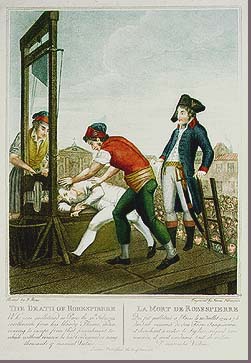
Robespierre lay in an anteroom of the Convention hall, while his Prison-escort was getting ready; the mangled jaw bound up rudely with bloody linen: a spectacle to men. He lies stretched on a table, a deal box his pillow; the sheath of the pistol is still clenched convulsively in his hand. Men bully him, insult him: his eyes still indicate intelligence; he speaks no word. … -O reader, can thy hard heart hold out against that? His trousers were nankeen; the stockings had fallen down over the ankles. He spake no more word in this world.

Fouquier had but to identify; his Prisoners being already Out of Law.** At four in the afternoon, never before were the streets of Paris seen so crowded. From the Palais de Justice to the Place de la Revolution … it is one dense stirring mass; all windows crammed; the very roofs and ridge-tiles budding forth human Curiosity, in strange gladness. … All eyes are on Robespierre’s Tumbril, where he, his jaw bound in dirty linen, with his half-dead Brother, and half-dead Henriot, lie shattered; their “seventeen hours” of agony about to end. The Gendarmes point their swords at him, to show the people which is he. A woman springs on the Tumbril; clutching the side of it with one hand; waving the other Sibyl-like; and exclaims: “The death of thee gladdens my very heart, m’enivre de joie;” Robespierre opened his eyes; “Scelerat, go down to Hell, with the curses of all wives and mothers!” — At the foot of the scaffold, they stretched him on the ground till his turn came. Lifted aloft, his eyes again opened; caught the bloody axe. Samson wrenched the coat off him; wrenched the dirty linen from his jaw: the jaw fell powerless, there burst from him a cry; — hideous to hear and see. Samson, thou canst not be too quick!

Samson’s work done, there bursts forth shout on shout of applause. Shout, which prolongs itself not only over Paris, but over France, but over Europe, and down to this generation. Deservedly, and also undeservedly. O unhappiest Advocate of Arras, wert thou worse than other Advocates? Stricter man, according to his Formula, to his Credo and his Cant, of probities, benevolences, pleasures-of-virtue, and such like, lived not in that age. A man fitted, in some luckier settled age, to have become one of those incorruptible barren Pattern-Figures, and have had marble-tablets and funeral-sermons. His poor landlord, the Cabinet-maker in the Rue Saint-Honore, loved him; his Brother died for him. May God be merciful to him, and to us!

Part of the Themed Set: Thermidor.

* Even his enemies agreed — sometimes adding it to the bill of particulars against him — that Robespierre lived a life of personal moderation; he lived as a boarder with a working-class family, and disdained to avail the politician’s typical harvest of political graft.

** The Convention had decreed Robespierre’s outlawry when he escaped custody; his immediate execution was, of course, akin to the logic he had once turned against the king.

On this day..

1794: Not Thomas Paine

An avidity to punish is always dangerous to liberty. It leads men to stretch, to misinterpret, and to misapply even the best of laws. He that would make his own liberty secure must guard even his enemy from oppression; for if he violates this duty he establishes a precedent that will reach to himself. -Thomas Paine

On this date in 1794, revolutionary firebrand Thomas Paine got a date with the guillotine when the public prosecutor Antoine-Quentin Fouquier-Tinville put his name on the list for the next batch of heads.

Paine — “Mad Tom” to foes of his fire-eating opposition to despotic church and crown — is best-known for his part in the American Revolution; his pamphlet “Common Sense” made an incendiary and influential case for revolution.

More so than any other high-profile compatriot in the cause of American independence, Paine took to heart the age’s revolutionary spirit, the fine principles of solidarity, the zeal to put life and fortune at liberty’s service.

Not content to retire to the estate granted him for his services to the fledgling United States of America — Paine coined that name, by the way — the hellraiser sailed for the Old World to help overthrow the sclerotic Bourbon despotism whose geopolitically-minded aid* had had such material effect for American liberty.

Paine served in France’s National Convention, one of the highest-profile and least-impeachable members of that body as well as one of only two foreigners. These distinctions offered him some safety in the Revolution’s internecine tempests — some, but not quite enough. He drew the ire of the Montagnards by opposing the execution of Louis XVI.

The terrible gears of mass fratricide which apparently doomed Paine as the Terror unfolded turned out to be his refuge, and that of three fortunate fellows with him. Had he gone to the scaffold as a single high-profile traitor, there would have been no mistake about it; now, at the height of the Terror, jailers marked dozens for death by the fallible expedient of chalking their cell doors. If the guillotine made mass execution feasible, the bureaucratic apparatus to manage it was still catching up.

Here’s the version of a Paine’s preservation that he himself later related — albeit second-hand, since he was suffering this day “a violent fever which had nearly terminated my existence” and “was not in a condition to be removed, or to know of what was passing, or of what had passed, for more than a month. It makes a blank in my remembrance of life. The first thing I was informed of was the fall of Robespierre.”

[T]he manner in which I escaped that fate is curious, and has all the appearance of accident.

The room in which I was lodged was on the ground floor, and one of a long range of rooms under a gallery, and the door of it opened outward and flat against the wall; so that when it was open the inside of the door appeared outward, and the contrary when it was shut. I had three comrades, fellow-prisoners with me, Joseph Vanhuile, of Bruges, since president of the municipality of that town, Michael Robins, and Bastini, of Louvain.

When persons by scores and hundreds were to be taken out of prison for the guillotine, it was always done in the night, and those who performed that office had a private mark or signal by which they, knew what rooms to go to, and what number to take. We, as I have said, were four, and the door of our room was marked unobserved by us with that number in chalk; but it happened, if happening is a proper word, that the mark was put on when the door was open and flat against the wall, and thereby came on the inside when we shut it at night, and the destroying angel passed by it. A few days after this Robespierre fell, and the American ambassador arrived and reclaimed me and invited me to his house.

During the whole of my imprisonment, prior to the fall of Robespierre, there was no time when I could think my life worth twenty-four hours, and my mind was made up to meet its fate.

Presumably this would have been a short reprieve, had not Jacobin rule (and rulers) promptly expired.

We noticed two days ago the U.S. mission’s willingness to exert itself for Lafayette’s wife, who surely had not done better service for the American Revolution than had Paine himself.

Paine waited in vain for American intervention, and was incandescent with rage at George Washington and his envoy Gouverneur Morris for abandoning him (Morris was replaced by the more Paine-friendly James Monroe a few weeks later). In a wide-ranging 1796 denunciation of Washington’s conduct and American political tilt towards Britain and away from France, Paine accused his country** of giving the Jacobins the green light to cut off a gadfly’s head.

Could I have known to what degree of corruption and perfidy the administrative part of the Government of America had descended, I could have been at no loss to have understood the reservedness of Mr. Washington toward me, during my imprisonment in the Luxembourg. There are cases in which silence is a loud language.

Soon after I was put into arrestation and imprisonment in the Luxembourg, the Americans who were then in Paris went in a body to the bar of the Convention to reclaim me. They were answered … that I was born in England, and … their reclamation of me was only the act of individuals, without any authority from the American Government.

A few days after this, all communication from persons imprisoned to any person without the prison was cut off by an order of the police. I neither saw, nor heard from, anybody for six months; and the only hope that remained to me was that a new Minister would arrive from America to supersede Morris …

One hundred and sixty-nine were taken out of the Luxembourg one night, in the month of July, and one hundred and sixty of them guillotined. A list of two hundred more, according to the report in the prison, was preparing a few days before Robespierre fell. In this last list I have good reason to believe I was included. A memorandum in the hand-writing of Robespierre was afterwards produced in the Convention, by the committee to whom the papers of Robespierre were referred, in these words:

Demander que Thomas Payne soit de decrete d’accusation pour les interets de l’Amerique, autant que de la France.

I had then been imprisoned seven months, and the silence of the Executive part of the Government of America (Mr. Washington) upon the case, and upon everything respecting me, was explanation enough to Robespierre that he might proceed to extremities.

This venomous open letter and the deistic tract The Age of Reason he was banging out during the Revolution, combined with the frightening turn of the French Revolution itself, helped send Paine’s public regard into decline. “Atheist,” they tutted, and he’s been the most untouchable Founding Father ever since.

Next year is the bicentennial of his death in obscurity and pauperhood; his homelessness, so to say, in the annals of political thought and national pantheons testifies in some ways to the defeat his principles suffered in his very lifetime. The American Revolution turned conservative; France’s fell to despotism; England’s was strangled in its crib.

Even so, he fired the imaginations of many troublemakers still to come. A man of no wealth or position who etched in fire the spirit of his times, Paine saw further and spoke plainer than most of his contemporaries. If a prophet is not welcome in his own country, it scarcely diminishes the power of the prophecy.

And/or, enjoy this free biography at Google Books.

* Given by the French crown in opposition to France’s great rival Britain, of course.

** Paine certainly considered himself American, though he wouldn’t have made that inconsistent with being French, too. The matter of his citizenship between England (where his pamphlets had him attainted in absentia on a capital charge), France and the United States was a contested one at a time when the very notion was being reforged in the heat of revolution; at any rate, as diplomatic pretext for failing to ask for his life, citizenship makes a feeble excuse.

Republican radicals in England didn’t mind claiming him as their own, developing this alternate lyric sheet to the national anthem:

[audio:God_Save_the_Queen.mp3]

God save great Thomas Paine
His ‘Rights of Man’ explain
To every soul.
He makes the blind to see
What dupes and slaves they be,
And points out liberty,
From pole to pole.

Thousands cry ‘Church and King’
That well deserve to swing,
All must allow:
Birmingham blush for shame,
Manchester do the same,
Infamous is your name,
Patriots vow.

Part of the Themed Set: Thermidor.

On this day..

1535: Thomas More, the king’s good servant but God’s first

On this date in 1535, Sir — later Saint — Thomas More kept his conscience at the expense of his head on Tower Hill.

For all More‘s greatness — as intellectual, polemicist, lawyer, statesman, father — none of his many gifts at the end could avail him beside his commitment to Catholicism at the dawn of the English Reformation.

Yet it is for those gifts that he cut such a commanding presence in his times, for those very reasons that his sovereign hounded his first citizen to assent to the divorce and remarriage he was fixed upon.

A devotee and friend of Erasmus from years before, More was in Henry’s more orthodox youth the king’s very scourge of Protestantism. His scatological invective against Martin Luther in Responsio ad Lutherum — much in the impolite tenor of Catholic-Protestant rhetoric continent-wide, it should be noted — is of the sort to crimson the cheeks of the milquetoast modern:

Since he has written that he already has a prior right to bespatter and besmirch the royal crown with shit, will we not have the posterior right to proclaim the beshitted tongue of this practitioner of posterioristics most fit to lick with his anterior the very posterior of a pissing she-mule until he shall have learned more correctly to infer posterior conclusions from prior premises?

Over that hairshirt, he wore the robes of state. But his engagement with the world had a selective bent that must have exasperated his colleague and predecessor as Lord Chancellor, Cardinal Wolsey. Orson Welles and Paul Scofield spar here in the definitive More hagiography A Man for All Seasons over the intellectual’s delicate refusal to dirty his gloves with the great matter of state before them — the annulment the king demanded of his marriage to the Queen (and More’s friend) Catherine of Aragon:

Peas in a pod, these two: Wolsey, the cleric grounded in realpolitik; More, the barrister who trusts to God. (More considered holy orders as a young man.)

Our man’s reputation for honesty in a den of hypocrites has certainly outrun Wolsey’s. Still, all More’s disdain for the deal-making that invests the sovereign majesty and all his foreboding for the relationship he had with his dangerous king were not quite enough to stop him accepting the Chancellorship and the opportunity to stamp out Lutheranism … knowing perfectly well the simultaneous thrust of Henry’s boudoir policy.

It all cuts quite a contrast to More’s (barely) pre-Reformation text, Utopia (available free from Project Gutenberg), which named a literary genre and described an imagined society of tolerant primitive communism that surely would have blanched at its inventor’s coming role in the state’s machinations:

I can have no other notion of all the other governments that I see or know, than that they are a conspiracy of the rich, who, on pretence of managing the public, only pursue their private ends, and devise all the ways and arts they can find out; first, that they may, without danger, preserve all that they have so ill-acquired, and then, that they may engage the poor to toil and labour for them at as low rates as possible, and oppress them as much as they please

[E]very man might be of what religion he pleased, and might endeavour to draw others to it by the force of argument and by amicable and modest ways, but without bitterness against those of other opinions; but that he ought to use no other force but that of persuasion, and was neither to mix with it reproaches nor violence* …

It’s not a given that More himself agrees with every (or even any) sentiment expressed in Utopia, but his most famous work’s criticism of the death penalty too liberally applied makes interesting reading.

[E]xtreme justice is an extreme injury: for we ought not to approve of those terrible laws that make the smallest offences capital … God has commanded us not to kill, and shall we kill so easily for a little money [i.e., execute petty thieves]? But if one shall say, that by that law we are only forbid to kill any except when the laws of the land allow of it, upon the same grounds, laws may be made, in some cases, to allow of adultery and perjury: for God having taken from us the right of disposing either of our own or of other people’s lives, if it is pretended that the mutual consent of men in making laws can authorise man-slaughter in cases in which God has given us no example, that it frees people from the obligation of the divine law, and so makes murder a lawful action, what is this, but to give a preference to human laws before the divine? and, if this is once admitted, by the same rule men may, in all other things, put what restrictions they please upon the laws of God.

This insistence on the supremacy of divine law over human institutions forms the basis of his objection to parliament’s overthrowing the papacy — which he expressed openly only after he was convicted by obviously perjured “jailhouse snitch” testimony

[Y]ou have no authority, without the common consent of all Christians, to make a law or Act of Parliament or Council against the union of Christendom.

Paul Scofield bears enjoying in the role in A Man for All Seasons:

More is sometimes suspected of desiring martyrdom since he marched so unerringly into it, but he also made every attempt to survive Henry’s demand the he affirm the royal remarriage and the king’s ecclesiastical supremacy by withdrawing silently from the public sphere rather than openly opposing it. More had by every account an enviable, downright happy life at his own hearth, and a tender and intellectual relationship with his favorite daughter Meg. (Meg corresponded with her father in prison, collected his works, and retrieved his head from London Bridge.)

But by his way of thinking — Meg tried to talk him out of it — he couldn’t swear to the Act of Succession acknowledging the king’s right to divorce Queen Catherine and disinherit her daughter Mary if Henry decided to force the choice. And in the king’s eyes, there was no middle ground for someone of the ex-Chancellor’s stature.

Henry could see to it, though, to cut his old friend a break and commute the sentence from drawing and quartering to “mere” beheading, here depicted in the past season of the Showtime series The Tudors.

More’s last moments as rendered here — the ironic remark at the foot of the scaffold, “See me safe up: for my coming down, I can shift for myself”;** his generous answer to the headsman’s plea for forgiveness — are well-documented. Undoubtedly, his sturdy martyr’s bearing, the extension of a life of joyful piety, helped cement for posterity the fame he held in life.

And that dying address — “I die the King’s good servant, but God’s first” — gathers in one sentiment free of bombast or self-pity the irreconcilable demands of conscience that would lead many thousands besides More to Henry VIII’s scaffolds, and rings equally true to less lethal challenges to the conscience in every land and time since.

Anne Boleyn, who caused More’s fate, shared it less than a year afterwards.

Thomas More was canonized by the Catholic Church in 1935 — the patron saint of politicians. Rather bizarrely, July 6 is also his feast day on the Anglican calendar, a tribute to the nearly universal regard his memory enjoys.

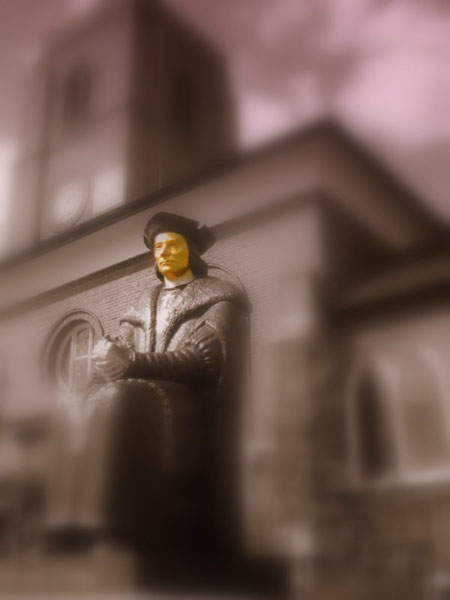
Thomas More's statue at the Chelsea Old Church

Chelsea resident Thomas More’s statue at the (Anglican) Chelsea Old Church.

* Despite its religious tolerance, More’s Utopia — anticipating Dostoyevsky — maintains:

a solemn and severe law against such as should so far degenerate from the dignity of human nature, as to think that our souls died with our bodies, or that the world was governed by chance, without a wise overruling Providence … since a man of such principles must needs, as oft as he dares do it, despise all their laws and customs: for there is no doubt to be made, that a man who is afraid of nothing but the law, and apprehends nothing after death, will not scruple to break through all the laws of his country, either by fraud or force, when by this means he may satisfy his appetites.

** According to the biography published by More’s son-in-law — who married More’s favorite, Margaret — the jest was occasioned by the rickety look of the scaffold. The Mirrour of Vertue in Worldly Greatness; Or, The Life of Sir Thomas More is available free on Google Books.

On this day..

1570: Aonio Paleario, Italian religious reformer

On this date, Antonio della Pagliara was hanged across the Tiber from the Castel Sant’Angelo in Rome for heresy.

The present-day view from the square where Paleario is thought to have been put to death, over the Ponte Sant’Angelo’s span across the Tiber to the Vatican’s imposing citadel.

Better known as Aonio Paleario (English Wikipedia entry | the considerably deeper Italian), the humanist scholar grew into his intellectual career just as Martin Luther’s doctrine was shaking Christendom.

Paleario’s positions were dangerously — and at length, fatally — close to Protestantism. He counted himself a humanist, a great admirer of Erasmus, who from the Low Countries managed to hold his critical positions without running afoul of the Catholic Church.

This would prove an increasingly difficult trick as the century unfolded … especially in the pope’s back yard.

Paleario’s most particular offenses were to take what amounts to the Lutheran side on the primacy of scriptural text over ecclesiastical tradition, and of salvation through Christ alone without the Church’s intermediation. (He also denied Purgatory.)

Since the Italian academic also cottoned to the Protestant-humanist critique of clerical corruption, he pitched Martin Luther and John Calvin on the notion of convening a Christendom-wide ecclesiastical council to reconcile competing sects. He seems to have wanted to reconcile the reformist current of humanism still within the Catholic tradition, and that of those critics who had broken, perhaps not yet irrevocably, with Rome.

The effort ultimately foundered. Instead, the curia-approved Council of Trent formulated a Roman Catholic doctrine that insured the permanent schism with Protestantism.

The Counter-Reformation was on. Still, with contending theologies — and contending polities — afoot in the Italian quiltwork plus his own towering reputation as the greatest orator in Italy, Paleario was able to find protectors and carry on. He taught in Siena, Lucca and Milan for more than three decades, surviving two bouts with the Inquisition before a Rome in crackdown mode finally pinned a heresy rap on him.

By that time, the septuagenarian didn’t much bother to fight it.

If your Eminences have so many credible witnesses against me, there is no need to give yourselves or me any further trouble … Judge, therefore, and condemn Aonio; satisfy my adversaries, and fulfil your office.

The office was fulfilled consuming the old man in flames, but they did extend the favor of hanging him (and apparently exposing the corpse for several days) first.

A book uncertainly attributed to Paleario, Beneficio di Criso (The Benefit of Christ’s Death) is available free at Google Books.

On this day..

1798: Rigas Feraios, Greek poet

On this date in 1798, the Greek revolutionary Rigas Feraios and five co-conspirators were strangled by their Ottoman captors on the Danube River en route to Constantinople to prevent their rescue.

A Vlach by blood, Feraios was a hero — and ultimately a martyr — of Greek independence years before the revolution against Ottoman rule that would deliver it.

A Renaissance man for the Greek Enlightenment, Feraios had a variegated youthful career knocking about the Ottomans’ Balkan possessions and absorbing the revolutionary Zeitgeist abroad in Europe.

Settling in Vienna in his mid-thirties, he brandished his pen in the service of an imagined pan-Balkan, pan-Hellenic uprising to shake off the Turkish yoke. He edited the first Greek newspaper, published a map* and constitution for the imagined realm of the “Inhabitants of Rumeli, Asia Minor, the Islands of the Aegean, and the principalities of Moldavia and Wallachia”, and churned out blood-stirring poetry in Demotic, the vernacular tongue — most memorably, the Thourio, i.e., “War Hymn”.

… and a little taste of the gist, in English:

How long, my heroes, shall we live in bondage,
alone,like lions on ridges, on peaks?
Living in caves, seeing our children turned
from the land to bitter enslavement?
Losing our land, brothers, and parents,
our friends, our children, and all our relations?
Better an hour of life that is free
than forty years in slavery.

This sort of fire-breather is not the sort of man the Ottomans were keen on seeing involve himself with Bonaparte, most especially now that the French kingpin had started outfitting Oriental adventures. The Turks’ Austrian allies nabbed Feraios in Trieste en route to confer with Napoleon’s Italian subalterns about interfering in the Balkans.

Shipped to the governor of Belgrade, Feraios was to be sent to Constantinople for adjudication by Sultan Selim III. A Turkish buddy of the poet’s, however, happened to be blocking the way with a sizable force of his own who’d been administering a rebel statelet carved out of Ottoman territory. Tipped that this gentleman was keen to liberate the Turks’ unwelcome prisoners if they tried to pass, the local authorities had them summarily strangled and their bodies dumped in the Danube.


A Rigas Feraois monument in Belgrade. (Author’s photograph, in terrible light.)

* Including Constantinople. The dream of “Greater Greece” would persist long, and die hard.

On this day..

1820: Karl Ludwig Sand, a curious strand of German history

Alexandre Dumas recognized the name of Karl Ludwig Sand, who lost his head on this date in 1820 in Mannheim, Germany, for the murder of the dramatist and humorist August von Kotzebue.

The assassination of von Kotzebue* worried the Prussian monarchy — then headed by Friederich Wilhelm III — and precipitated a series of proclamations, reforms, and internal struggles that finally led to a full-scale rebellion 30 years later.

A print showing Sand stabbing August von Koetzebue. Sand is reported to have shouted, “Here, you traitor to the fatherland!”

Sand was a member of a Burschenschaft,** a liberal student fraternity organization which appealed to nationalist Germans seeking a unified German nation-state, and he and others in his group regarded von Kotzebue as a plague on their cause. Von Kotzebue was then Councillor of the Russian Legation, the culmination of over a decade in the Russian civil service, and a spinmeister for the Russian regime. In 1816, while Sand was in college, von Kotzebue was tasked with managing the flow of information into the Prussian state in an effort to increase the monarch’s popularity in Germany.

At the very least, then, von Kotzebue had no love for the Burschenshaft movement from the start, which originated in the university town of Jena, and he did not hold back his criticisms in his weekly literature newpaper Literatische Wochenblatt. He casually disparaged the Burschenschaften, as this stab in the review of a novel in one of the earlier editions evidences:

Longing and love in the work is described in a way which, in the judgment of the Jenaer Recensenten, resembles a light Spring rain that is at least refreshing. That is more than one can say of the Jenaer Literature-Zeitung, which roughly resembles an autumnal rain that simply makes one wet without refreshing at all.

But the student organizations were on the rise during Sand’s time at university as a theology student, and the turbulent events in France during his final days in school were having ripple effects across the German populace. It was in this climate that a young man who was “distinguished at once by the gifts of the mind and the faculties of the soul” (as his Gymnasium rector put it) and who sought to become a pastor was drawn to the nationalistic movement. Sand’s opposition to the imperial rule of Prussia became increasingly more urgent after his studies, and he was determined to make a statement through action, eschewing what he called “simply writing and talking.” On March 23, 1819, the 22-year old found von Kotzebue in his house and stabbed him in front of several witnesses. Sand was quickly arrested and sentenced to death.†

A print depicting the Wartburg Festival of 1817, Burschenschaft colors prominently displayed. (Click for larger image.)

As a result of von Kotzebue’s murder, Prince Klemens Wenzel von Metternich set down a series of decrees, known as the Karlsbad Decrees, which sought to quell any thoughts of rebellion before they could fully ferment. The decrees limited both university activity and press activity, constraining the actions of university employees and setting down harsh restrictions on anyone who might dare question the monarch’s authority.

Sand’s contemporaries outside of Germany were hardly pleased with the death of von Kotzebue, which they saw as the precursor to a greater turmoil, and two decades of removal from the event proved a powerful force. By the time Dumas visited the site of Sand’s beheading and penned his own biography of the man, a thorough rendering of Sand’s brief life — much of it reconstructed from Sand’s writings and the memories of those who knew him — the rebellion of the Burschenschaften was once again afoot, this time with permanent consequences for the German people.

In the end, nationalism and constitutionalism were not the panaceas Sand and other Burschenschaefter may have liked. While Sand would hardly have counted as a Nazi (his Puritanical theology would have fallen on deaf ears in that regime), he would have recognized that group’s near-religious fervor of the public book burnings anti pro-German sentiments as a distant echo of the Burschenschaft’s Wartburg Festival.†† Indeed, the so-called Third Reich could never have existed without the Second Reich, whose seeds Sand and his fellow nationalists were sowing a half century early when his fateful date with the axe arrived.

* The name is also spelled “Kozebue” by some sources.

** The Burschenschaften were roughly based on the Lützow Free Corps, an academic paramilitary group which fought during the Napoleonic Wars. During their height of popularity, the Burschenschaften adopted the black-red-gold flag that was reclaimed by the Frankfurt Parliament in 1949 to be the official German flag.

† In the end, Sand and von Kotzebue were buried at the same cemetery.

†† The Wartburg Festival, held in 1817, was a celebration of Martin Luther’s proclamation against the church. An interesting discussion of the appeal of such festivals to the students of the day is given in The Course of German Nationalism: From Frederick the Great to Bismarck.

On this day..

1941: Maurice Bavaud, who couldn’t get a shot off

Early this morning in 1941, a Swiss theology student had his head cut off at Berlin’s Plotzensee Prison for plotting to kill Adolph Hitler.

Maurice Bavaud, 25 at his execution, cuts one of the more quixotic (the link is French) of the many figures who schemed Hitler’s death — and also one of the more affecting, for at this early date he might have spared Europe most of the great war’s horror.

But Bavaud was also, fundamentally, a poor assassin.

Apparently motivated by pique at Germany’s repression of Catholicism — he’s most commonly cast as a lone gunmen, although there are also theories that he was affiliated with a wider network of students — Bavaud slipped into Germany in 1938 and spent the ensuing weeks knocking around Bavaria looking for a chance to do the thing.

That November, the chancellor turned up for the 15th anniversary of the Beer Hall Putsch* … to which Bavaud secured VIP seating. The aspiring assassin had only a low-caliber pistol, but as the Fuhrer passed his vicinity, a copse of saluting arms from the spectators around him obstructed any chance to shoot. November 9, 1938 instead became famous for other reasons.

One can appreciate at this juncture the young man’s discouragement and desire to leave Germany. One can understand that, penniless, he felt obliged to sneak aboard a passenger train. But one will strain very hard to imagine why even the most desperate straits should impel a man to do either of these things while still carrying the incriminating pistol and notes revealing his plans. When he was nabbed for skipping the fare, his situation quickly became catastrophic, with the help of Gestapo torturers. (One can see, in Bavaud’s own hand, a 1940 letter to his family informing them of his sentence here.)

Switzerland essentially exerted no diplomatic effort on behalf of their subject, and this fact informed the Swiss courts which, years after the war, posthumously reduced Bavaud’s sentence. Germany eventually paid reparations to the family of the man who tried to off their head of state.

Update: Maurice Bavaud has been officially rehabilitated by Switzerland.

* He wasn’t even the best failed Hitler assassin in the Bürgerbräukeller that day.

On this day..