1945: Benito Mussolini, his mistress, and his aides

On this date in 1945, Communist partisans shot Benito Mussolini and his mistress, Clara Petacci near Lake Como, along with fifteen or so additional fascist aides and officials.

It was an inglorious end for the flamboyant onetime socialist turned violent rightist, the man who had founded (and named) fascism; whose had inspired Hitler when the latter was still a streetcorner rabble-rouser, and then wandered suicidally into Germany’s orbit.

The next day, the victims’ bodies were hung up in Milan — the heart of Mussolini’s own power and still a stronghold of neo-fascist parties today — at Piazza Loreto for public abuse. The deposed Duce still had it in his power to stir the imagination of his Teutonic partner: news of the Italian dictator’s fate made it to the Fuhrer’s bunker and was said to have steeled Hitler’s resolve to take his own life with the dread vision of what should befall him if he were taken alive.

On this day..

1945: Albrecht Haushofer, German Resistance intellectual

On April 23, 1945, in Nazi Germany’s Berlin-Moabit prison, with the Red Army fast approaching, the SS executed Albrecht Haushofer for his part in the previous year’s July 20 plot to assassinate Adolf Hitler.

A social and political conservative and driving force behind the nascent field of “geopolitics,” which held views of the State “as a geographic organism or a spatial phenomenon” that were incorporated into the National Socialist ideology of “Lebensraum,” Haushofer was an early darling of the drive to find academic and scientific justification for Nazi beliefs and ideals — this despite his own part-Jewish parentage.

Haushofer had reservations about the intentions of the Nazi party following its rise to power in the 1930s, but he nonetheless consented to represent it in foreign affairs, having spent significant time abroad as a geopolitics student in the 1920s. Acting as chief foreign affairs adviser to Rudolf Hess, Hitler’s chief deputy, Haushofer traveled widely to promote German foreign policy. During this time, he wrote a series of historical dramas — Scipio (1934), Sulla (1938), and Augustus (1939) — containing progressively more strident symbolic criticisms of his age.

Believing that Germany must not get involved in another disastrous foreign war, Haushofer was a significant force in negotiating for peace with Britain and France. “The peoples of Europe are in a position in which they have to get on together lest they all perish,” he wrote; “and although one realises that it is not common sense but emotional urges which govern the world, one must try to control such urges.” As Hitler’s desire for war became ever more paramount, however, Haushofer lost his position with the government and returned to Germany, remaining active in secret talks to persuade the British to accept a new peace agreement.

With the outbreak of the Second World War, Haushofer remained a professor of geopolitics at the University of Berlin, but distanced himself from his Nazi past and began associating with elements of the German resistance. As the war wore on, he consistently opposed any attempt on Hitler’s life, but finally agreed to join the July plot as the only way to end the war without bringing further disaster upon Germany. With the plot’s failure, he was arrested by the Gestapo, and executed just days before the Red Army liberated Berlin.

Haushofer composed the Moabiter Sonette (pdf) while in prison, a series of poems posthumously published in 1946 regarded as among the most powerful documents of the German antiwar movement. One of his most well-known sonnets, “Schuld,” attemps to express — in sad retrospect — the weight of his moral guilt in the face of impending death:

“Schuld”

…schuldig bin ich
Anders als Ihr denkt.
Ich musste früher meine Pflicht erkennen;
Ich musste schärfer Unheil Unheil nennen;
Mein Urteil habe ich zu lang gelenkt…
Ich habe gewarnt,
Aber nicht genug, und klar;
Und heute weiß ich, was ich schuldig war.

“Guilt”

I am guilty,
But not in the way you think.
I should have earlier recognized my duty;
I should have more sharply called evil evil;
I reined in my judgment too long.
I did warn,
But not enough, and clear;
And today I know what I was guilty of.

The poem’s last line can be variously translated as “And today I know what I was guilty of” or “And today I know what my obligation had been.” Through this subtle play on words, Haushofer created a powerful poetic link between his failure to act decisively and the supposed “guilt” — “not in the way you think” — for which he had been condemned. His poems remain a testament to the power as well as the responsiblities of the individual under dictatorship, and have earned their writer a place in the annals of history as well as modern-day memorials to the German resistance movement.

On this day..

1947: Fernand de Brinon, Vichy minister with a Jewish wife

On this date in 1947, former Vichy Secretary of State Comte Fernand de Brinon was shot in the Paris suburb of Montrouge for war crimes.

A lawyer and journalist who met future Nazi luminary Joachim von Ribbentrop in 1919, Brinon and his socialite wife Lisette were the toast of right-wing high society in the 1930’s. He even scored a scoop interview with the Fuhrer himself, shortly after Hitler became chancellor.

Germany’s rout of France in 1940 vindicated to many of the French right their critiques of France’s decadence; for Brinon, the natural step was support for collaboration, a career-enhancing philosophy that saw him to the third-ranking position of the Vichy government.

There he struck a post-partisan, consensus-oriented pose vis-a-vis picking sides between the new overlord and the erstwhile ally it was bombing:

To collaborate loyally with our opponents of yesterday in no way signifies in the mind of any man of good sense becoming the enemies of our allies of yesterday. (New York Times)

Men of good sense also knew the Bolsheviks were the real threat to world peace; hence, this Vichy-era newsreel of today’s victim reviewing French troops on the Eastern front:

Brinon knew exactly which side he was on and behaved as such, according to Occupied France: Collaboration and Resistance, 1940-1944:

[O]bsequious, indiscreet and an open admirer of Nazism … his collaboration was ideological, and it exceeded by far the agreements over food, prisoners of war, the demarcation line, and the mass of daily adjustments to the occupation sought by most Vichy officials … [Brinon represented] the Nazi end of the Vichy spectrum.

That made him an easy call for the sternest reprisal liberated France could exact, and he knew it himself: Fernand and Lisette tried to flee for Germany when the western allies began recapturing France in 1944.

What adds poignancy, if perhaps not sympathy, to his fate is the fact that Lisette — Jeanne Rachel Louise Franck, her name had been before he put a ring on her finger — was Jewish, and that fact was not a secret. She spent the occupation years as an official Honorary Aryan, safe from the deportations her husband helped arrange for others.

Lisette was also arrested by the Allies as she fled for Germany in 1944 — and how many Jews can say that? — but was released, and died in 1982. Four years ago, her aged son wrote a soul-searching book about his relationship with his mother and (for Brinon was Lisette’s second marriage) his stepfather, Lisette de Brinon, Ma Mere. There is also a recent biography of Brinon in French (review (also French)).

On this day..

1975: Eight South Korean pro-democracy activists

At dawn on this date in 1975, the South Korean dictatorship hanged eight pro-democracy activists, the day after the Korean Supreme Court had approved their spurious conviction as agents of the fictitious “People’s Revolutionary Party”.

The eight, Woo Hong-seon, Song Sang-jin, Seo Do-won, Ha Jae-wan, Lee Su-byeong, Kim Yong-won, Doh Ye-jong and Yeo Jeong-nam, were tortured by the Korean CIA into admitting affiliation with this organization supposedly collaborating with the Communist North.

They were among numerous opponents of South Korean strongman Park Chung-hee rounded up for protesting against the legal codification of outright dictatorship in the early 1970’s.

Early last year, a South Korean court officially ruled that they had been wrongly executed, and awarded their surviving family members $26 million.

According to the worldwide anti-death penalty organization Hands Off Cain, the death penalty remains on the books in South Korea but has not been employed for over a decade.

On this day..

1689: Kazimierz Lyszczynski, the first Polish atheist

On this date in 1689, in a Warsaw marketplace, Kazimierz Lyszczynski had his tongue torn out, his head struck off and his body burned to ashes which were shot from a cannon — all for scratching a few words with the whiff of atheism.

Lyszczynski — less dauntingly rendered “Cazimir Liszinski” — was convicted of holding such heretical doctrines as:

God is not the creator of man; but man is the creator of a God gathered together from nothing.

His actual writings are not known directly — his books were burned along with his flesh — but only from the transcripts of his rather hysterical trial, so it’s uncertain what he actually believed; for that matter, he vigorously (albeit unsuccessfully) abjured atheism. Some sources say that he was nailed for as little as irreverent marginal notations in a theological tract he found unconvincing; others report that he actually wrote a heretical text.

According to Valerian Krasinski’s Historical Sketch Of The Rise, Progress And Decline Of The Reformation In Poland V1 (available free from Google books)

Cazimir Lyszczynski, a noble and landowner of Lithuania, a man of a very respectable character, was perusing a book entitled Theologia Naturalis, by Henry Aldsted, a Protestant divine, and finding that the arguments which the author employed in order to prove the existence of divinity, were so confused that it was possible to deduce from them quite contrary consequences, he added on the margin the following words — “ergo non est Deus,” evidently ridiculing the arguments of the author. This circumstance was found out by Brzoska, nuncio of Brest in Lithuania, a debtor of Lyszczynski, who denouned him as an atheist, delivering, as evidence of his accusation, a copy of the work with the above-mentioned annotation to Witwicki, bishop of Posnania, who took up this affair with the greatest violence … nothing could shelter the unfortunate man against the fanatical rage of the clergy … On the simple accusation of his debtor, supported by the bishops, the affair was brought before the diet of 1689, before which the clergy, and particularly the bishop Zaluski, accused Lyszczynski of having denied the existence of God, and uttered blasphemies against the blessed Virgin and the saints. The unfortunate victim, terrified by his perilous situation, acknowledged all that was imputed to him, made a full recantation of all he might have said and written against the doctrine of the Roman Catholic church, and declared his entire submission to its authority. This was, however, of no avail to him, and his accusers were even scandalized that the diet permitted him to make a defence, and granted the term of three days for collecting evidence of his innocence, as the accusation of the clergy ought, in their judgment, to be sufficient evidence on which to condemn the culprit.

Pope Innocent XI at least salvaged the performance of the Catholic hierarchy in the affair by condemning, rather than promoting, the ambitious bishops.

Whatever the doomed man’s actual doctrines and writings, it is likely not coincidence that one finds this atrocious affair during at the moment of his country’s political collapse. The heretical knight’s 55 years corresponded to Poland’s fall from central Europe’s dominant power into the plaything of neighboring hegemons. The Polish-Lithuanian Empire stood at its maximum extent at his birth; during Lyszczynski’s boyhood, the Zaporozhian Cossacks broke free of Warsaw; as a young man, he saw the Swedes, the Russians, and Poland’s former vassal Prussia strip the empire of peoples and land.

By the time of Lyszczynski’s misfortunate death, Poland was a second-rate power on the brink of irrelevance — an abyss into which it would plunge in the century to come. Corwin’s Political History of Poland (another Google Books freebie) lays the scene:

The constant internal dissensions caused and nourished by foreign intrigues were in no mean measure responsible for the King’s failures in his final campaigns and in his diplomacy. They resulted in the loss of territory and the decline of Poland’s position as a great European power. French and Austrian money supported Polish anarchy. Diets were constantly torn up some even before the presiding officer could be elected. No law could be enacted. Corruption was rampant. Several attempts were made to depose the King. Religious intolerance became intensified and the first and last auto da fe in Poland was executed in 1689, on one Casimir Lyszczynski for his atheistic proclivities. The country became a theatre of constant strife between the various magnate families. At times the clashes resulted in formal civil wars.

It might be small consolation for having one’s head chopped off, but Lyszczynski’s reputation has far outrun his persecutors’, and in the lands of the old Polish-Lithuanian Empire, he cuts a pathbreaking figure for secularists and freethinkers.

There’s a substantial article about Lyszczynski on a Polish freethinkers’ site. As his hometown Brest lies in modern Belarus, he also enjoys a monumental biography on a Belarussian atheism site (and even favorite-son treatment on the city of Brest’s own page).

Lyszczynski’s gravestone — image (c) Irina Shvets and used with permission. The inscription reads, “Oh, travelers! Do not pass these stones. You will not stumble upon them if you don’t stumble upon the truth. Recognize the truth: for even those who know that it is the truth teach that it is a lie. The teachings of the wise are bound by deceit.”

On this day..

1938: Seventeen former Bolshevik officials from the Trial of the 21

(Thanks to Dmitri Minaev of De Rebus Antiquis Et Novis for the guest post. Be sure to read his corollary piece on cameos by some of this day’s victims in Bulgakov’s Master and Margarita.)

On 15 March 1938, 17 former executives of the Communist Party were executed at the “special object” Kommunarka near Moscow.

As head of the NKVD, Yagoda had arranged show trials before. This time, the shoe was on the other foot.

The names of some of them are found in any history book’ others were totally unknown even in 1930s. Alexey Rykov and Nikolay Bukharin were the topmost (well, almost) leaders of the USSR. Nikolai Krestinsky was a member of the Central Committee Secretariat and the Soviet ambassador to Germany. Christian Rakovsky was a diplomat, the head of the government of the Ukrainian SSR. Genrikh Yagoda was the minister of internal affairs, head of NKVD (the late name of Cheka). P. Kryuchkov was an officer of OGPU (an NKVD department) and the secretary of Maxim Gorky, the “official writer” of the communist USSR.

The others were ex-finance minister of the USSR Grigory Grinko, the general secretary of the Communist Party of Uzbekistan Vladimir Ivanov, ex-prime-minister of the Uzbek SSR Faizullo Hojayev, ex-minister of foreign trade of the USSR Arkady Rozengoltz, ex-minister of agriculture Mikhail Chernov, Isaac Zelensky, S. Bessonov, Akmal Ikramov, Vasily Sharangovich, Prokopy Zubarev, Pavel Bulanov, Veniamin Maksimov-Dikovsky and the doctors Lev Levin, Ignaty Kazakov and Dmitri Pletnyov (one of the founders of the Soviet cardiology).

There were 21 of them under trial, but three (Pletnyov, Rakovsky and Bessonov) were sentenced to imprisonment* and the date of execution of Yagoda remains unknown. The others all died this day.

Railroaded

“The trial of the 21” was officially known as “the case of the anti-Soviet right-Trotskyite block”. They were accused of “treason, espionage, sabotage, terror, undermining Soviet military power and provoking foreign countries to attack the USSR”. The other accusations were: a conspiracy to restore capitalism and to separate the Soviet republics and the Far East from the USSR; ties with foreign intelligence (including that of Nazi Germany, via Trotsky or directly); preparation of military aggression against the USSR; organizing peasants’ revolts in the USSR; the murders of Kirov, Menzhinsky, Kuibyshev, Maxim Gorky and his son Maxim Peshkov; and attempts to assassinate Lenin, Stalin and N. Yezhov (note this name).

After having his memory jogged, Krestinsky remembered that he really was part of the right-Trotskyite conspiracy.

Only the three doctors were provided with a legal defense. The others “voluntarily” refused.

All of them confessed to committing most of the various supposed crimes, although several had unavailing caveats. Krestinsky denied the charges, but it took only one day to convince him of his “failing” memory. “I fully and completely admit that I am guilty of all the gravest charges brought against me personally, and I admit my complete responsibility for the treason and treachery I have committed,” he said on the next day. Bukharin denied some of the charges brought against him. The doctors insisted that they killed Menzhinsky because of fear of Yagoda. Yagoda himself confirmed that he participated in the murder of Gorky’s son Peshkov, but said that motives were personal and not anti-Soviet.

According to the documents found in the archives, Bukharin, Rykov and Krestinsky were sentenced to death on 2 March, on the first day of the process. It could be an error, but on the other hand, it could indicate that the sentence was determined before the trial.

Neverending Story

The first draft of this article started like this: “This story began in …”

Then I stopped and scratched my head. The date when this story really began is not very clear. Some would argue that it began in 1922 when Stalin became the general secretary of VKP(b), others might say that it started in 1918, when the Bolsheviks dissolved the Constituent Assembly, and so on. What is clear is that 1937, when many of those twenty one were arrested, was not the beginning.

Then I decided to begin the other way round: “This story ended in…”

And once again I stopped. This trial had too many interesting corollaries and, of course, the story did not end in 1938. So, in the end the article became a mess of jumps in time to and fro. We are nearly as far removed today from Stalin’s purges as the purges were from the age of Russian serfdom — and those trials throw a shadow across the entire span of time.

Terror

Here’s a small extract from the series of events that preceded and followed the trial. In 1936 Bukharin and Rykov zealously supported the prosecutions of Zinoviev and Kamenev, two other old faithful Bolsheviks, accused by Stalin in opposing the policy of the party. The campaign ended with their trial and execution. Bukharin wrote letters to Stalin:

“I have always sincerely supported the line of the party and Stalin … These are the glorious milestones: industrialization, collectivization, elimination of kulaks, two great five-year plans, concern for the working man, new technologies and stakhanovism, wealthy life, the new constitution.”

“It’s great that the rascals [Zinoviev and Kamenev] were shot. The air became cleaner.”

Bukharin kept busy awaiting trial by writing Philosophical Arabesques … and three other books.

In 1925-1926, when Stalin organized the first campaign against Zinoviev and Kamenev, Bukharin and Rykov also applauded him. “I hand the broom to comrade Stalin,” said Rykov, “to wipe our enemies away.” Yet earlier, Bukharin and Rykov together with these “enemies” Zinoviev and Kamenev helped Stalin to repel the attempts of Trotsky to become the leader of the Soviet state after the death of Lenin.

Bukharin was not an idiot. He understood that he was not any different from Zinoviev. He was the first candidate to replace Stalin if something happened to Stalin — which made him automatically suspect in the eyes of the boss.

Moreover, he was a Bolshevik and he knew the habits of Bolsheviks very well. Caricaturist Boris Yefimov recalled that on 1 December 1934, when Bukharin learned of the assassination of Kirov, he told the other people who were in the room: “Kirov was killed in Leningrad. Now Koba will shoot us all.” (Koba was Stalin’s nom de guerre) But, being a professional revolutionary and conspirator, he knew only one strategy for survival: hypocrisy.

In this 1927 photo at Lenin’s mausoleum, two of today’s victims — Rykov (on the far left) and Bukharin (by his side) — share the platform with Joseph Stalin (far right). Between them is Kalinin, the rare old Bolshevik who managed to survive the 1930’s. (Source)

This strategy did not guarantee success with Stalin. The proof for this may be found in what happened during and after the trial.

Ostracism

Let’s have a look at the newspapers of 1938.

From the resolution of the meeting of the workers of the institute of physiology of the Ukrainian Academy of Sciences and the institute of experimental biology and pathology of the Ukrainian ministry of health care.

With the deepest resentment and indignation we hold up to shame the traitors of their motherland, the mercenaries of the fascist secret services, mean Trotskyite-Bukharin’s scoundrels. The history of humanity hardly knows other examples of similar crimes.

We proclaim that the fascist mercenaries will never succeed in dismembering the great Soviet Union and in handing the flourishing socialist Ukraine to the capitalists. We add our voices to the voice of the many million Soviet people demanding to exterminate all the mean traitors, spies and murderers.

From the resolution of the third conference on physiology of the Academy of Sciences of the USSR.

The traitors Bukharin, Rykov, Yagoda and others did not disdain any means in their vile job. These traitors never eschewed any mostrous crime.

The doctors Pletnyov, Kazakov, Vinogradov and Levin in this repellent union consciously used the trust of their patients to kill them. History never saw such crimes. Death to these murderers! Destroy all the gang of the “right-trotskyite” block!

From the article “We demand merciless retaliation against the vile traitors of our great Motherland”.

Having sold themselves to the fascists, plotting with the diplomats and the general staffs of some aggressive imperialist states, a despicable handful of human degenerates, servants of the fascist cannibals, led by a Gestapo agent, gangster Trotsky, sold our socialist motherland and its treasures to the most evil enemies of the human progress.

We demand from our Soviet court merciless retaliation against the vile traitors! We demand the extermination of the despicable degenerates!

The last article was signed by many outstanding scientists: the chairman of the Academy of sciences Komarov, professor Valeskalns, academics Keller, Bach, Vavilov, Gorbunov and others. N. Vavilov died in prison in 1943. N. Gorbunov was sentenced to death and executed in 1938. I am not certain about the others, but about 70% of the members of the Central Committee of the Communist party who supported Stalin’s proposal to arrest Bukharin and Rykov were later arrested themselves, and many of them died or were killed.

Here’s another quotation from a newspaper:

While accepting responsibility for the endless chain of dreadful bloody crimes which history never saw before, Bukharin attempts to give an abstract, ideological, sissy nature to his concrete criminal guilt. He fails to do so, the court and the prosecutor easily discern these attempts, but this trick is very typical for Bukharin’s nature of the right-Trotskyite political prostitute.

The pretensions of the garrulous, hypocritically vile murderer Bukharin to look as an “ideologist” lost in theoretical blunders are hopeless. He will not succeed in separating himself from the gang of his accomplices. He will not succeed in averting full responsibility for the chain of monstrous crimes. He will not wash his academic hands. These hands are stained with blood. These are the hands of a murderer.

I ask myself, “If you must die, what are you dying for?” With startling vividness a black void immediately rises before my eyes. “There is nothing to die for, if one wants to die unrepentant. If, on the contrary, one repents, everything fine and good that shines in the Soviet Union acquires in one’s mind a new dimension.” In the end it was this thought that completely disarmed me. I went down on my knees before the Party.
Bukharin

This article was written by a gifted poet, journalist Mikhail Koltsov on 7 March 1938. He was shot by NKVD on 2 February 1940, less than two years later.

By the way, N. Yezhov (the “assassination” target of Bukharin’s party), who replaced Yagoda as the head of NKVD, was also arrested and executed in 1940 as a spy and conspirator.

Krestinsky, Ikramov, Hojayev and Zelensky were acquitted in 1963.

On 4 February 1988 the Supreme Court of the USSR ruled that confession cannot be interpreted as a proof of guilt and acquitted ten out of twenty one victims. (I could not find information on the cases of Grinko, Bessonov, Sharangovich, Zubarev and Pletnyov.) The sentence against Yagoda, to whose ruthless secret police history has been less generous, was left in force.

* Pletnyov, Rakovsky and Bessonov, the three to avoid death sentences at the Trial of the 21, were later summarily executed together with 154 other political prisoners when the Nazi armies approached the city Oryol in September 1941.

On this day..

1302: Dante Alighieri condemned

(Thanks to Jeffrey Fisher [jeffreyfisher at me.com] for the guest post.)

On this day in 1302, the governing commune of the city of Florence condemned to death Dante Alighieri, statesman, philosopher, and above all, poet. Arguably the greatest mind of his generation, Dante is most famous for his authorship of the Divine Comedy, relating his journeys through, successively, hell, purgatory, and heaven.

Born in 1265 to a noble family of Florence that, while not the city’s most prominent family, had already seen several of his ancestors banished as a result of political turmoil, Dante could hardly have avoided becoming embroiled in public life had he even wanted to. In brief, a long-running struggle between pro-imperial (the so-called Holy Roman Empire) and pro-papal factions was finally won by the pro-papal forces, known as the Guelphs. Two decisive battles in 1289 established both Florence’s independence (particularly from their old nemesis, Pisa) and the rule of the Guelphs, Dante’s own party.

Dante is likely to have taken part in those battles and was active in city politics in the following decade, culminating in a turn in 1300 as prior (one of six key counsellors to the city, serving a two-month term). Florence prided itself on a tradition of democratic rule going back to the death of the Holy Roman Emperor Frederick II in 1250.

Persona Non Grata

Giotto painted Dante prior to his exile — the oldest portrait of Dante known.

Unfortunately, by the time Dante took on the priorate, the old rivalries had reshaped themselves into new factions eerily parallel to their predecessors: the so-called “Black” Guelphs, who aligned themselves with the Pope (as of 1294, Boniface VIII), and “White” Guelphs, who took a more moderate political stance and saw themselves as defending an independent Florence from the Pope and his allies (namely, the Blacks).

Things got so bad that, at the time of Dante’s priorate, the city’s ruling body banished leaders of both sides in an effort to stabilize the city. The pope took the opportunity to send emissaries to Florence on the pretext of negotiating a peace. After more than a year of this maneuvering, the commune sent Dante and two others to have words with Boniface in Rome in 1301.

The Pope “invited” Dante to stay in Rome while his companions returned to Florence to try to bring the commune around. In the meantime, the Pope’s key man had got himself into Florence and helped the Blacks take power, whereupon they confiscated properties and levied fines.

Dante was ordered to appear before a tribunal to answer for his alleged crimes. When he did not show up, he was banished to two years of exile, permanently banned from holding city office, and ordered to pay a further fine of some five thousand florins–a staggering sum–within three days. When that did not happen, either (Dante was apparently in Siena, a short ways from Florence, when he heard this news), the commune confiscated all of his goods and condemned him to death by burning should he ever return.

Fortunately, there were others in Italy at the time who had more sense, but Dante spent the rest of his life–almost another twenty years–wandering from city to city with his sons. He was excluded from an amnesty in 1311, and when he refused the terms of another in 1315, his death sentence was not only reaffirmed, but extended to include his sons. Despite all this, he still held out hope of returning to Florence to be crowned as poet, declining to be so crowned in Bologna as little as a year or two before he died.

Art in Exile

It was over the course of that time in exile that Dante composed his political and philosophical works, together with what must be considered his single greatest contribution to letters, the three-volume Divina Commedia.

There is no way to do justice to any of these works, much less all of them, but in the present context it is worth noting that in three key works — the Commedia (Dante’s title is this simple), Il Convivio (or The Banquet), and De Monarchia (On Monarchy) — Dante develops a serious, even strikingly modern, religious political philosophy.

In contrast to many of his religious contemporaries, taking issue with the great St. Augustine even as he espouses positions derived from Thomas Aquinas, Dante argues in favor of a strong central secular authority, specifically an emperor, and even more particularly, that this authority should be understood by Christians as co-equal with, not subordinate to, the spiritual authority of the Church: “two suns,” he says, rather than the sun and the moon (which merely reflects the light of the sun).

Indeed, he held out an almost messianic hope for the return of an emperor who would restore peace and order. He even wrote public letters to the Emperor Henry VII requesting that he restore justice in Florence (and this is surely a factor in the commune’s treatment of him with respect to amnesty). When Henry died before accomplishing these things, much of Dante’s hope for imperial cohesion died along with him.

(Consider this Open Yale Courses podcast series for more Dante appreciation.)

He Knew Beatrice All Along

It would be nothing short of travesty to write anything of this length about Dante and not mention Beatrice, the love of his life from the age of nine, when he first laid eyes on her, to the day he died in exile. Beatrice, who only spoke to Dante once and who died an early death, directly inspired his poetic-explicatory work, the Vita Nuova (New Life), an exemplar of the dolce stil nuovo (“sweet new style”) movement in poetry. As a character in the Commedia, Beatrice sends Virgil to rescue Dante from a dark forest in the Inferno, and guides him through the spheres of Heaven in Paradiso.

“Dante and Beatrice in the Constellation of Gemini and the Sphere of Flame”, one of William Blake‘s (uncompleted) series of watercolors illustrating Dante’s magnum opus.

Despite two decades of exile, Dante never gave up hope of returning to Florence in his lifetime, and clearly hoped (perhaps “expected” is more accurate) to be united with his other true love in the next. His body remains in Ravenna, where he died and was buried in 1321.

Florentines wish they could have him back.

Part of the Themed Set: The Written Word.

On this day..

1944: Emanuel Ringelblum, historian of the Warsaw Ghetto

It was not only the destroyers of the Warsaw ghetto who left their testimony.

Emanuel Ringelblum, a Polish-Jewish historian and social worker, was among the 450,000 trapped in the ghetto.*

Ringelblum organized a monumental project to document its life — the “Oyneg Shabbos”. Ringelblum’s ring cast a network throughout the ghetto, systematically collecting its written history: public proclamations, ration cards and identity papers, and most precious of all, personal diaries and memoirs of hundreds of inhabitants, testament to the gathering madness encircling Warsaw’s Jews. Ringelblum sat up nights, sifting and categorizing a stupendous trove — over 25,000 surviving sheets — that was still never equal to his vision:

“To our great regret, however, only part of the plan was carried out … We lacked the necessary tranquillity for a plan of such scope and volume.” (Source)

Shortly before the Warsaw Ghetto Uprising, Ringelblum and his family were spirited out of the Jewish quarter and into the protection of friendly Poles. There, they outlived the ghetto by nearly a year.

But on March 7, tipped by a neighborhood teenager who would himself receive a death sentence after the war for the act, the Gestapo captured both Ringelblum’s family and that of his protectors. Around this date — just a few days after their arrest — they would be summarily shot with other fugitives in the ruins of the community he chronicled. Ringelblum reportedly spurned a rescue attempt, preferring to swallow the same draught as his wife and son.

A few years before, another writer living under another dictator scratched in his secret novel — still secret at the time of Ringelblum’s death — words that would become a signature of literary integrity in a totalitarian age:

Manuscripts don’t burn.

While Ringelblum himself fell victim at last, like most of Warsaw’s Jews, to the Holocaust, the burning — his manuscripts did not. Shortly before capture, the diligent historian had secreted them in buried coffee tins. Years after the war, many of those tins were recovered.

Their contents form the basis for Notes from the Warsaw Ghetto, one of the most moving and penetrating first-person Holocaust histories.

An interesting interview with Samuel Kassow, author of Who Will Write Our History?, is available from the New Books In History podcast.

This French-language page on an exhibition of Ringelblum’s archives covers some of its history, with a number of photographs. This site collects a number of Yiddish poems from the Ringelblum archive.

* This Time magazine article claims that Ringelblum was safe in Switzerland as of 1939, but voluntarily returned to Poland to witness and share his fellows’ fate. Noble if true, but I have been unable to find corroboration of this elsewhere.

Part of the Themed Set: The Written Word.

On this day..

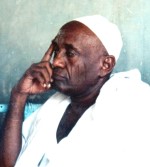
1985: Mahmoud Mohamed Taha, progressive Islamic theologian

On this date in 1985 progressive Islamic theologian Mahmoud Mohamed Taha was publicly hanged at a prison in Khartoum North, Sudan.

Seventy-five years old at his death, Taha spent his youth in the nationalist movement against British control of Sudan where he emerged as the standard-bearer of the liberal/secular Republican Party.

After Sudan won independence in 1956, both Taha and his party maintained — in the face of official hostility that waxed and waned with the changing regimes — nonviolent support for political openness, national unity between Muslims and non-Muslims, and a theology pointing to reform within Islam. Specifically, Taha embraced a women’s movement and opposed the imposition of sharia, at least in the absence of a radical modernization of the Islamic religious law.

The introduction of sharia in 1983 brought matters to a head, and not only with Taha: civil war broke out — the conflict between the Muslim north and the Christian and animist south only recently and imperfectly abated.

Taha and four other Republicans were tried for their intransigence in a two-hour trial under a seemingly muddled mixture of secular and religious law.

Among the hundreds of attendees of Taha’s hanging this day were his four “co-conspirators.” They were themselves under sentence of death to be carried out January 20th, unless they should recant. All four recanted. Hundreds of other Republicans were held around the country on lesser charges until they did likewise.

The next year, with a new government in place, the Sudanese Supreme Court declared the proceedings against the Republicans to have been in error.

Little of Taha’s work has been translated, but his Second Message of Islam is available in English and presents a conception of the faith so unfamiliar in the west that one reviewer mitigates his praise with the regret that “it is nonsensical to talk of reforming Islam, a religion which is doctrinally irreformable.”

Taha’s thought also has a scholarly evaluation in Quest for Divinity: A Critical Examination of the Thought of Mahmud Muhammad Taha. More information by and about Taha and the Republicans is here.

On this day..

1945: Josefa Llanes Escoda

On this day in 1945, Filipina suffragist Josefa Llanes Escoda was last seen before her presumed execution by the Japanese occupying troops holding her at Manila’s Far Eastern University.

Escoda came of age with her native archipelago under American colonization. An energetic and brilliant woman, Escoda lectured in sociology at the University of the Philippines, held several civil service posts, founded the Girl Scouts of the Philippines and helped win female suffrage.

During the Japanese occupation, her efforts to aid POWs — including those on the Bataan Death March — made her the “Florence Nightingale of the Philippines”.

But she declined to do so in the capacity of Japanese collaborator and she and her husband Antonio were arrested in 1944 and executed in the weeks following MacArthur’s return and push towards Manila.

Escoda is pictured on the Philippines’ current 1000-peso bill.


Escoda is in the center of the three figures on this banknote. Jose Abad Santos, also executed by the Japanese, is in the top left.

On this day..