1955: Ruth Ellis, the last woman hanged in England

On this date in 1955, Albert Pierrepoint escorted the alluringly tragic Ruth Ellis to the gallows at Holloway Prison — the last woman ever hanged in Great Britain.

The former hostess had tracked her inconstant and abusive lover David Blakely to a Hampstead pub a few months before — getting the ride, and the murder weapon, from her unrequited hanger-on Desmond Cussen — and shot Blakely dead on the street. Five bullets: the last, a coup de grace. (Another missed entirely and winged a passerby.)

A bitterly controversial case from the moment it entered the public eye, Ellis’s hanging bolstered the movement to abolish Britain’s death penalty. Juridically, however, it was resolved in the blink of an eye when a crown’s attorney cross-examined the murderess:

Christmas Humphreys: Mrs. Ellis, when you fired that revolver at close range into the body of David Blakely what did you intend to do?

Ellis: It was obvious that when I shot him I intended to kill him.

Book CoverThe jury, which never heard that Blakely regularly beat his killer (including once to induce a miscarriage), needed 14 minutes to convict her.

We’re pleased to mark this anniversary with Carol Ann Lee, author of a recent biography A Fine Day for a Hanging: The Real Ruth Ellis Story. (Here’s a review. Also check out two long pieces Lee wrote about Ruth Ellis for the Daily Mail: 1, 2)

ET: I think at a certain point in time, everyone in Great Britain would have known who Ruth Ellis was, and quite a few abroad, too. How true is that still, nearing 60 years after her execution?

I think her name is still quite familiar, to be honest.

When I began researching the book, everyone I discussed it with either already knew the very basic facts of Ruth’s story, and at the very least that she was the last woman to be hanged in England. The 1985 biopic Dance with a Stranger left a big impression too, even though it wasn’t entirely faithful to Ruth’s character, making her seem much more hysterical a personality than she actually was, although I thought Miranda Richardson was brilliant in the role — as she always is!

What led you to the Ruth Ellis story?

I’ve always been interested in Ruth and that period in history — and I vividly remember going to see ‘Dance with a Stranger’ when it came out in the cinemas here. But it always struck me that her full story had never been told, particularly the last few months of her life after she shot David Blakely. And a couple of years ago there was quite an intense debate about bringing back capital punishment; Ruth’s name was always mentioned in relation to that particular argument, and I really felt it was time to explore her whole story.

What are the greatest misconceptions people have of her? Have her previous biographies and screen portrayals fed those misconceptions?

Without doubt, many people see Ruth as she was shown in ‘Dance with a Stranger’ — very screechy, out of control and violently jealous.

I think it’s true to say that she and David were both deeply jealous of each other (both giving the other reason to be so), but Ruth was not as hysterical as she was portrayed in the film. In fact, it was quite the opposite — the men were hysterical and it was Ruth who usually vented a sort of quiet fury. There is one scene in the film which shows her smashing the windows of David’s car and screaming in the street. Reading the original police statement about that night reveals a very different story; she was described as very calm and rational. There was no screaming, and although she did damage the vehicle, it was not remotely as it was shown in the film.

I think other adaptations have also done her a disservice. Ironically, probably the most accurate portrayal is in the film ‘Pierrepoint,’ where the character of Ruth appears for no more than a minute or two on screen.

I get the sense that Ruth was always running uphill against her class position, trying to climb a little higher than she could reach — right up to the end where her lover is a well-off cad and the rivals for the lover’s affection are his middle-class friends. What role did England’s class relations have in Ruth Ellis’s life and death, and in the way that others perceived her? Do they still shape the way we talk about her all these years later?

Class and politics played a huge role in Ruth’s life generally.

England was distinctly class-led at the time and when the case hit the headlines, she was described as a working-class floozie who attached herself to the upper-class David Blakely purely in order to hoist herself up the class ladder.

That couldn’t have been further from the truth; if she was only interested in using men to better herself socially, she would surely have married her sometime-lover Desmond Cussen, who was a much steadier prospect with money and property and who wanted very much to marry her. Ruth worked hard to better herself but she didn’t use the men she loved to do so.

And when it came to her trial, the class values of the time were heavy in the courtroom with the male barristers and judge and so on all very much men of the upper classes — and who viewed her accordingly. I hope we have got beyond all that nonsense now — but it does add a very distinct dimension to discussions of her case.

She was working as a hostess when she met David Blakely. What would a hostess do, who worked in this trade, and who were the clientele? Was it usual for “real” relationships to evolve? Do people still have this job in the same form as Ruth had it?

Hostessing in the clubs in which Ruth worked was quite straightforward — or it should have been, but there was Morris Conley to contend with, and he was quite a character.

Ruth’s basic job description was to look good and to chat to customers (mostly men) in the clubs, laugh at their jokes and keep them buying food and drink for as long as possible. Most hostesses were in their late teens and early twenties, working-class girls who thought the lifestyle was more glamorous than toiling in a factory or in a shop.

They were usually paid badly and relied on tips to make ends meet, but were given a dress allowance so that they could look as alluring as possible. The clientele mainly consisted of demobbed servicemen who suddenly seemed to have lost their attractiveness to women after the war — where once they had been heroes, by the late 1940s many of them were down on their luck and working as door-to-door salesmen, very lonely and eager to talk to pretty young girls about their war exploits.

The girls who worked for Morris Conley, like Ruth, were expected to sleep with the clients if that was asked of them, and often had to sleep with ‘Morrie’ and his less than respectable friends too. Many of them were very poor young women who lived in flats owned by Conley and his wife — and if they didn’t toe the line, they lost their jobs and their homes in one fell swoop.

Did real relationships evolve? Yes, they did, but very rarely. There are girls all over the world doing very similar jobs today — from London to Japan and everywhere in between too, no doubt.

You have this quote from Ruth about David Blakely: ‘I thought the world of him; I put him on the highest of pedestals. He could do nothing wrong and I trusted him implicitly.’ Ruth had an alcoholic, abusive father, and then she had two children from marriages with two different men that both fell apart — one from bigamy and abandonment, the second from alcoholism and domestic violence. Blakely himself cheated on her. Why wasn’t she more cynical about Blakely? If you take away the tragic ending to this particular relationship, was something like this a pattern she was doomed to keep repeating ad infinitum?

She loved him — it’s really as simple as that.

Although she obviously had a good degree of self-awareness and knew what David was and always would be, she truly loved him and for a time believed they had a future together. As for a pattern — I don’t know. Perhaps if she had met one good, steady man to whom she was attracted as much as she was to David, her life — and David’s too of course — might have been very different.

I’m going to phrase this inelegantly: what is the DEAL with Desmond Cussen?

Good question! I really think that he was as confused and tormented by everything that was happening as a result of Ruth’s and David’s relationship as Ruth herself.

I think he did love Ruth, and he tried hard to make things work with her, but he knew her heart was with David. His apparent lack of self-respect and backbone is baffling — quite why he kept ferrying her across London and out to Buckinghamshire in pursuit of David is a bit mystifying. I did question in the book why no one seemed to query his state of mind as much as Ruth’s — and as to whether he gave her the gun or not, knowing what she intended to do … I am sure he did, even though he must have known where it would end for Ruth herself.

Perhaps he hoped that with David out of the way, she would be reprieved and they could then have a life together. But I really don’t know!

Ruth’s legal defence was legendarily feeble. That said, I’m very interested in the barrister’s attempt to frame its insanity defense around feminine hysteria — “the effect of jealousy upon a female mind can so work as to unseat the reason and can operate to a degree in which a male mind is quite incapable of operating.” This was bound to be undermined by Ruth’s own calm and the statements about her intent to kill that she gave to police and in court. Was it the case that the law at the time didn’t have the instruments to situate Ruth’s context and state of mind, other than hysterical/not? Or could an abler barrister have presented a different story?

I think part of the difficulty is obviously that the defence of diminished responsibility was not introduced in the courts here until 1957 — largely as a direct result of this particular case.

Ruth’s lawyers tried to argue this as a defence for her to some extent, but it just wasn’t possible legally. That said, I think they served her quite badly and didn’t bring out so much that might have enabled the jury to see her crime in context. There was no mention of the abuse in her childhood, no mention of the violence she had suffered at the hands of her ex-husband and very little said about David’s own brutal treatment of her.

But Ruth herself did not seem to care much what happened in the courtroom, once it became evident that the story as she saw it — David’s friends having, in her view, deliberately destroyed the relationship between them — was not going to come to light. She gave up, and volunteered nothing that could have helped her, minimizing the violence to which she had been subjected and dismissing most of the questions put to her in a short sentence or two.

She also infamously replied to the prosecution’s question of what she intended to do when she set out to find David with the gun, “It is obvious when I shot him I intended to kill him.” That one line completely sealed her fate.

Despite all this, the public did seem to be shocked by Ruth Ellis’s hanging, and it’s supposed to have boosted the anti-death penalty campaign. If one may phrase it this way, were people shocked for the right reasons? How much did the symbolic “Ruth Ellis” that even her supporters among the general public had in view have to do with the real person as you understand her?

I think any case is always immeasurably more complex than it is presented in newspaper columns and headlines.

I think, again, the outcry at her execution has to be seen in context — people were becoming more and more opposed to the death penalty and there had been some very high-profile, contentious cases that really did cause a great deal of debate, anger, and distress: the hanging of Timothy Evans in 1950 and of Derek Bentley in 1953 for instance (both of whom were posthumously pardoned).

The fact that Ruth was a young, attractive, lively woman with two small children caused many people to question the validity of capital punishment. It was her death on the scaffold that gave the abolition movement its emotional spur.

What became of Ruth Ellis’s body after her hanging? And what became of her family and the others who were part of the story?

Ruth was buried in the confines of Holloway Prison after her execution, sharing her unmarked grave with four other women who had been hanged there. In 1971, when the prison was demolished and rebuilt, her body was released to her son for burial.

He had hoped to lay his mother to rest alongside David Blakely at the Holy Trinity churchyard in Penn but the vicar there would not allow it. Ruth was instead buried in the churchyard of St Mary’s in Amersham, a few miles away.

As to what became of her family: her son Andre (who was ten when Ruth was executed) was diagnosed with schizophrenia as a very young man and never came to terms with the loss of his mother. He committed suicide in 1982. Ruth’s daughter, Georgina, had quite a colourful life, becoming a successful model who was in the newspapers fairly often as part of the George Best ‘set.’ She married and had children and worked hard to win a posthumous pardon for her mother, of whom she spoke often. She died of cancer at the age of only 50.

As for Desmond Cussen: he emigrated to Australia and opened a flower shop there. He never married and became an alcoholic, dying in Perth on 8 May 1991 of pneumonia and organ failure following a fracture dislocation of the neck in a fall at his home.

On this day..

1960: Manfred Smolka, East German border guard

On this date in 1960, Manfred Smolka was guillotined in Leipzig.

Smolka was among three million East Germans or more who escaped over the border to West Germany in the 16 years after the defeat of the Nazis divided the country.

In the earliest years, people sluiced over the long border just anywhere. By Smolka’s time, that perimeter was buffered by an “internal border” that made it difficult for ordinary people to approach near enough to West Germany to escape. Consequently, most emigration by the the late 1950s occurred in the divided city of Berlin — a flow that East Germany would finally stanch in 1961 with the ultimate in immigration reform, the Berlin Wall.


One of the Cold War’s iconic photographs: East Berlin border guard Conrad Schumann leaps over the barbed-wire barrier into West Berlin on Aug. 15, 1961, just days after construction of the Berlin Wall began.

Like that more famous later escapee, Manfred Smolka (German link, as are most that follow) was a border guard; indeed, he was an officer. That gave him the ability, in 1958, to be far enough within the “internal border” to defect into West Germany

The very next year, he arranged to meet his abandoned wife and daughter on the Bavaria-Thuringia frontier to smuggle them over, too. Alas, it was a trap (pdf) laid by the feared East German secret police, the Stasi.


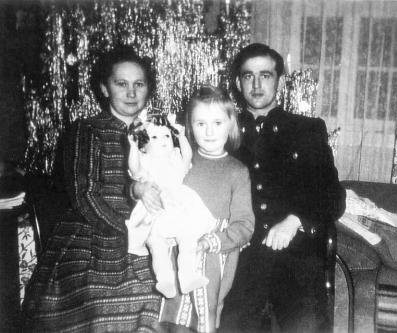
Happier times: Manfred Smolka with his wife and child.

According to press reports, Smolka was actually on West German soil when the Stasi men captured him.* (The Stasi were often up for a bit of kidnapping.)

West Germans were outraged by Smolka’s capture and subsequent death sentence for “military espionage,” but the case was deemed an apt one for the education of East Germany’s border security agents.

Only with post-Cold War German reunification could his family examine his file. “I am innocent, I can prove it a hundred times,” they read in the last letter the onetime defector wrote to his family — a letter which had never been delivered. “You need not be ashamed of me.” In 1993, a reunified, post-Cold War Germany officially agreed and posthumously rehabilitated Manfred Smolka.

There’s a few minutes of documentary video about him, in German, here.

* By a July 5, 1960 account in the London Times, Smolka was shot at and wounded as he crossed into East Germany but still managed to “crawl” back to West Germany — where his pursuers did not fear to follow him.

On this day..

1644: Joost Schouten, LGBT VOC VIP

On this date in 1644, Joost Schouten, the able merchant and diplomat of the Dutch East India Company, “was strangled and burned to ashes in my presence in Batavia [Jakarta] because of his gruesome sodomy.”

That’s the report of Gijsbert Heeck who, like Scouten, left a noteworthy memoir. Heeck allowed that Schouten “was a man of unusual knowledge and extraordinary intellect,” but despite his gifts remained “in his heart … a hypocritical villain and seducer of many, secretly using his prominence and great authority to force them away from the path of decency into the way of his shameful foulness, seeking thereby to satisfy his devilish lechery.”

Before all that devilish lechery stuff came to light, Joost Schouten (English Wikipedia link | Dutch) had enjoyed a brilliant two-decade career in the Far East, most notably in Siam. There, Schouten ingratiated himself with the Siamese king Prasat Thong,* winning lucrative trade concessions, personal honors, and a seat for himself on the East India Company’s executive organ, the Council of the Indies.

A report that Schouten initially wrote for that company surveying Siam’s geography, people, and politics was published in 1638 and translated into many tongues: he was the first general account of Siam for Europeans. While several others would follow (pdf) in the 17th century, Schouten’s Description remains an essential source for the period.

Schouten himself was no mere observer in the ferocious scramble for colonial position and trade leverage in East Asia. It’s for this august person that the explorer Abel Tasman (as in Tasmania) named Schouten Island (off the coast of Tasmania). That was on the voyage that Tasman undertook to circumnavigate Australia, and discover (for Europeans) New Zealand — a voyage outfitted by Joost Schouten. Given another decade, with Dutch commerce on the come, who knows what heights he might have attained.

But the envoy’s scintillating service record did him little good when a handsome French halberdier repulsed by Schouten’s advances entrapped him in June 1644. This was an offense the Company took incredibly seriously.

Schouten confessed the crime voluntarily, and the only consideration the judges showed him was a pre-burning mercy strangulation. Their verdict, according to Peter Boomgaard, evinced “fear for the punishing hand of God if those who ruled did not take drastic measures.” Schouten was an educated man; indeed, he himself had been a judge. All the worse that, where he had wrought his best service for the Dutch Republic, he had also consciously invited its undoing in a hail of fire and brimstone.

One could, on the other hand, say that it was the Company itself that tempted divine wrath. After all, those in its service routinely spent months in overwhelmingly male environments: ships at sea, and trading outposts that were by now barred to European women. (Local women were a different story, of course.) Nor was Schouten’s particular stomping-grounds of Siam near as virulent in its attitude towards homoeroticism as the Calvinists back home; Schouten’s own travelogue noted that “their Priests, as well as many of the Gentry, are much given to Sodomy, that unnatural passion, being esteemed no sin, nor shameful thing amongst them.” Abroad on the blooming East, coinpurse bursting with the commerce of nations: it must have been a heady experience.

Whether coming around to the Siamese “esteem” or having nurtured it from the start, Schouten had, he said, indulged same-sex encounters** with some 19 different men since putting to sea from a return visit to the mother country in 1637. At least three of those partners — a boatswain’s mate, a soldier, and a burgher — were to their sorrow alive and conveniently identifiable in the Indies.

“Those who were known [to have taken part in his deeds] were, either with him, or later … smothered under water since they were unworthy to continue living among humans,” concluded our eyewitness Gijsbert Heeck. “Which is a fitting recompense and retribution for their gruesome life on earth. In the hereafter, however, the worst is still to come. But it is not for us to judge.”

* Prasat Thong, a law-and-order type, is alleged by the account of another 17th century Dutchman to have personally conducted some executions.

** Schouten, 40ish at his death, said that he was always the “passive” (penetrated) partner in these affairs with much younger men. (This, and all the text that follows it in the post, is also as per Boomgaard.)

On this day..

1917: “John Nelson”, mystery man


(Salt Lake (Utah) Telegram, Dec. 31, 1916)

On this date in 1917, someone was electrocuted in Rockview, Pennsylvania.

“John Nelson”, the cipher alias by which authorities were eventually content to call him, was 5′ 8″ tall and 165 pounds, and looked like an African-American. (“Nelson” himself said that neither white men nor black were of his race.) Papers put this about quizzically because he was also utterly steadfast in refusing to identify himself or his background.

He eventually allowed that he came from Canton, Ohio (but who knows if that’s true). “He reads Shakespeare and seeks high grade newspapers and magazines,” ran news-of-the-weird wire copy all around the country. He boasts “long hair which bears the appearance of having been done up in kids to give a ‘Sis Hopkins’* effect” as well as “long gray whiskers, sideburns and a heavy mustache.” He looked maybe 60 years old.

Anyone?

Aw, heck.


The Scranton Times sent 5,000 of these postcards around the country hoping to scare up information about their mysterious murderer.

Tips poured in from all over — but nothing definitive. An upstate New York sheriff reported discharging a guy named John Nelson from jail a couple of years before. A woman in Butte, Montana recognized the picture and thought it might be her vanished father. The prisoner also resembled a missionary from Ohio and a bank president from Richmond, Va., also both missing; a Scranton woman thought he maybe used to be her gardener. (All but the last of these indefinite tips via Cheryl Kashuba’s two-part series on this case in the March 17 and March 24, 2013, issues of the Scranton Times-Tribune.)

Although nobody could figure out who he was, everyone was pretty sure what he’d done.

On the evening of Oct. 30, 1915, he’d trudged into Mill City, a Wyoming County township outside of Scranton, and made an unexplained sudden attack on three men lolling about a barbershop porch.

According to those three men’s story — and they’re all we have to work with since Nelson kept mum on this, too — a little white boy running down the darkened street bumped into the mystery pedestrian. At that, “Nelson” suddenly produced a knife and charged at the trio of nearby men, bellowing “White people in a tank town like this can’t run over me!”

J.M. Sickler, a prosperous local farmer, bravely intercepted the attacker before he reached Judge Robert Westlake, and suffered mortal stab wounds for his trouble. The attacker fled, but other locals roused by the commotion overpowered him as he escaped; Sickler lived long enough to give a deathbed positive identification.

Of course, it wasn’t really “positive” — that’s the whole point. And “John Nelson”, whoever he might have been, kept his nose in his Shakespeare and his lips enigmatically sealed on the crime and its causes; on his background and biography; on everything whatsoever. “I just wouldn’t care to talk about that,” he would reply when questioned, or similar versions of that polite deflection.

He kept his queer peace all the way to the electric chair.

* Maybe Mr. “Nelson” was just taking Sis Hopkins’ good advice: “There ain’t no sense in doin’ nothin’ for nobody what won’t do nothin’ for you.” As Nelson blithely put it (and who could contradict him?) any name at all would do for his circumstances.

On this day..

1920: Lee Monroe Betterton, three strikes and you’re out

(Thanks to Meaghan Good of the Charley Project for the guest post. -ed.)

On this day in 1920, Lee Monroe Betterton (addressed by his middle name) was electrocuted in Oklahoma for the murder of his wife, whose unusual name has been given variously as “Elzeana,” “Aldazia” and “Elzadah.” (This account will use the latter spelling, which was the one used in Betterton’s Oklahoma Court of Criminal Appeals syllabus.)

Little is known about Monroe Betterton’s background, other than that he was born in Missouri and was the seventh of twelve children, ten of whom survived to adulthood.

He was a heavy drinker and his violent nature was self-evident: Elzadah was, sadly, not the first wife Betterton killed. Nor was she even the second wife Betterton killed.

Betterton killed his first wife, Laura Elizabeth, in Barry County, Missouri in 1904. They had four young children together, two sons and two daughters. During an argument he beat her unconscious and she was taken to the hospital, where she soon died. For some reason, her husband was not prosecuted.

By 1908, Betterton had remarried and was living with Rosie, Wife #2, in Neosho, Missouri. They were walking to nearby Monett to visit some of his relatives when they started quarreling. Both of them had been drinking. About two miles outside of town, Betterton suddenly pulled out a knife and stabbed Rosie in the heart. She died instantly and he laid her body beside the railroad tracks.

This time he was arrested and charged with the crime. Betterton maintained that “I was guilty of that woman’s death, but it was an accident.” He got 99 years in prison, but served only ten before he was paroled in 1918.

He was 48 by then, and he returned to Monett and began courting Elzadah Lockwood, a widow close to his own age who was unfamiliar with the old adage that while once is a coincidence, twice is a trend. They got married, but their relationship turned rocky almost immediately and they argued constantly.

The couple separated after only a few months and filed for divorce. However, they reconciled after Betterton’s son Clifford married Elzadah’s daughter Mamie. In the first week of July 1919, a mere week after their divorce was final, Monroe and Elzadah remarried and settled in Vinita, Oklahoma.

Their previous problems resurfaced, however, and within days they were fighting like cats.

On July 9, 1919, Elzadah was preparing to leave her son-in-law Arthur Thomas’s house after yet another argument when Betterton shot her three times in the back. One of the bullets blew away the whole right side of her heart, and she was dead before authorities arrived at the scene.

When questioned, Betterton implicated everyone: the son Clifford; the son-in-law Arthur; even Elzadah herself as a phenomenally effective suicide. Mamie had been present at the scene, though. She and Elzadah’s eight-year-old son Raymond saw the whole thing, and both testified against their stepfather at his trial.

The case was pretty open-and-shut: As the Vinita Daily Journal noted, “The prisoner seems to be the least [a]ffected of the family and pays close attention to the testimony for or against him … There was practically no defense.”


Hobart (Okla.) Daily Republican, June 21, 1920.

Less than an hour before his execution, Betterton gave an interview in his cell and continued to assert his innocence: “I am not guilty of the crime with which I am charged. I am ready to die. I am ready to meet my God. I do not fear death, but I do not want to die for a crime which I did not commit.”

Approximately 100 people witnessed his execution. He had no final statement.

On this day..

1584: Anna Peihelsteinin, beheaded by Franz Schmidt

On this date in 1584, Nuremberg executioner Franz Schmidt beheaded Anna Peihelsteinin (Peyelstainin) for “lewdness and harlotry.” (Despite the image above, Schmidt notes that she was beheaded standing, not sitting.)

The married woman had been intimate with 21 other men, even including a father and a son. But Anna’s own husband was more understanding of her than the cruel law of the time; as the executioner recorded in his diary, the lonely widower Jerome — whipped out of town for countenancing her whoredom — left behind a miserable reproach scrawled on the wall of a church:

Father and son should have been treated as she was, and the panderers also. In the other world I shall summon and appeal to emperor and king because justice has not been done. I, poor man, suffer though innocent. Farewell and good night.

On this day..

1631: Giles Broadway and Lawrence Fitzpatrick, for consistency

On this date in 1631, Giles Broadway and Lawrence Fitzpatrick hanged at Tyburn.

Although the evidence against them was extremely questionable, their trial just nine days prior could hardly have turned out otherwise, for these men were the servants implicated in conniving with the Earl of Castlehaven in the scandalous debauch of his household.

This notorious case had that May resulted in Castlehaven’s execution (wonderfully guest-blogged in these pages by Courtney Thomas). The Earl appears to have run his household as a veritable den of sexual iniquity, but the actual facts upon which a capital conviction had been secured were sketchy and subject to no little public controversy. Castlehaven himself declared on the scaffold that he was a victim of a conspiracy by other members of his family to lay hands on his inheritance.

Manservants

Crucial to the Earl’s condemnation was the testimony of the servants Giles Broadway and Lawrence Fitzpatrick. Broadway owned, under pressure, that he had raped Castlehaven’s wife at the Earl’s direction. Fitzpatrick copped to having sexual relations with the Earl — but crucially claimed that those acts had not entailed actual penetration.

The whole scandal inspired no end of bodice-ripping broadsides and warring doggerel arguing the Earl’s perspective or his wife’s. Crude as this one is, it gets at the key legal issues at stake in the trial — to wit, whether the actual acts that took place in Castlehaven’s Sodom met the legal definition of buggery or of rape:

The prisoner nowe
had leave to shewe
concerninge the rape of his wife

How that hee did it not
but conceived it a plott
to take away him and his Life

But alas twas in vayne
himselfe for to straine
since the Judges delivered it Plano

that to knowe by the tuch
was eaven just as much
as if it had beene in Ano

Its thought their trunke hose
did alsoe suppose
that in concubilu cum faeminis

ther might bee a rape
if lust made an escape
per ejectionem seminis

Book CoverGiven that the court had found the ejectionem seminis here sufficient to lop off the head of a peer of the realm, the man’s low-born servants could hardly be acquitted in the same matter without undermining the verdict’s already tenuous public confidence. As the judges in the servants’ case put it, “We for our parts thought it to stand with the honor of common justice, that seeing their testimony had been taken to bring a peer of the realm to his death, for an offense as much theirs as his, that they should as well suffer for it as he did, lest any jealousy should arise about the truth of the fact, and the justness of the proceedings.” (Quoted in A House in Gross Disorder: Sex, Law, and the 2nd Earl of Castlehaven, a recent book on the scandal.)

Law Orifices

Broadway was the easier condemnation.

Desperately, he tried insisting that his “rape” of the Countess had not achieved actual penetration: the scare quotes here because the boundaries of a body constituted the bright line establishing whether the capital crime of rape had been committed. (Compare for instance this close call from the 18th century.) As the poem implies, Broadway suggested that he suffered premature ejaculation before he crossed the coital, and legal, threshold.

This circumstance required the victim to testify against him. Anne Stanley, fruit of an ancient and powerful family — she had once upon a time had a case as the heir to the throne of England — therefore had to present herself to attest that this mean person “had known her carnally, and that he did enter her body” while her late beheaded husband sadistically held her down. In court she could not bear to look at Broadway, she said, “but with a kind of indignation, and with shame, in regard of that which had been offered unto her, and she suffered by him.”

Fitzpatrick was a tougher trick.

Castlehaven himself had only been convicted by a bare majority on the sodomy charges, and that only by the dubious expedient of expanding the reading of the sodomy statute to compass all same-sex contact: previously, as with rape, penetration had been understood to constitute the crime.

When it came to Fitzpatrick’s trial, he argued vehemently that he could not be made his own accuser. Moreover, as he said in his dying address at the scaffold, “my lord Dorset had entrapped and ensnared him to his destruction; for saying upon his honour, and speaking it in the plural number (as the mouth of the whole [Privy Council]) that whatsoever he delivered should no ways prejudice himself, he thereby got him to declare the earl guilty of the sin of Buggery; wherein himself being a party, was the only cause he came now to suffer death.” That’s a right dirty trick, just another one of many compelling reasons never to talk to cops.

Broadway, for his part, charged under the gallows that his victim Anne Stanley — who remained in the twisted marriage for five-plus years despite having the means to escape it — was herself a principal despoiler of the household’s virtue, “the wickedest woman in the world.” Two other servants, he said, “lay with her commonly,” and one of them had “gotten a child upon her, which she, like a wicked woman, had made away,” leading that vengeful servant to rape at the Earl’s instigation Anne’s 12-year-old daughter by her previous marriage — for which purpose the Earl himself had to apply “oil to open her body.” Home sweet home.

(Young Elizabeth Barnham was dynastically married to her stepbrother James, who himself initiated the complaint against his father. Castlehaven appears to have hated his own son, and the son feared that the Earl’s largesse with his favorites and his apparent attempt to have his servant father on Elizabeth an heir that was not of the family’s own blood would destroy the Touchets. Castlehaven was not indicted on this specifically and the other charges against him were sufficient to the purpose. But it was surely a sensitive offense for his fellow-bluebloods. In his exhortation to the condemned Castlehaven, the Lord Steward scarcely mentioned the rape and sodomy stuff. “Although you die not for that,” he intoned, “you have abused your own daughter! And having both honour and fortune to leave behind you, you would have had the impious and spurious offspring of a harlot to inherit!” This quote, like all the quotes from the trials and scaffold, can be found here; this volume, however, proposes not “harlot” but the seemingly more suitable word varlet.)

On this day..

1655: Grete Adrian, Ruethen witch

On this date in 1655, Grete Adrian heard her final condemnation as a witch, then was ushered to the marketplace of Ruethen where she was beheaded and burned.

A remarried widow, Grete was the daughter of a woman who in her own day had been suspected of witchcraft; Grete had lost siblings to witch-hunts during the recent Thirty Years War.

The family history with devilry would help to implicate her when allegations arose that she had produced milk by conjuration and turned into a wolf to kill a neighbor’s horse. Grete didn’t stand up to the torture very long; within a couple of days she agreed that she had taken the devil as a lover, cast malevolent spells, attended witches’ covens, and all the usual Hexenprozesse stuff. All she asked was for quick execution.

In 2011, schoolchildren from Ruethen’s Friedrich-Spee-School — its namesake was a noted critic of torture and witch trials in the 17th century — successfully petitioned local authorities to issue a blanket posthumous pardon for 169 men, women and children executed for witchcraft between 1573 and 1660 … Grete Adrian included.

On this day..

1762: Crown Prince Sado, locked in a rice chest

On this date in 1762, the Korean king Yeongjo had his son and heir Crown Prince Sado immured in a rice chest — where he would die after eight excrutiating days.

This bizarre incident, attested by the memoirs of Sado’s widow Lady Hyegyeong, continues to perplex down to the present day.

In Lady Hyegyeong’s telling, the tyrannical father warped the sensitive son, sending the latter into a destructive spiral of madness. As the 1750s unfolded, Sado’s behavior grew erratic, violent, and delusional. He was prone to sudden fits of rage, stalked and raped court ladies, and wandered Seoul streets in disguise. He eventually murdered numerous servants, eunuchs, and miscellaneous commoners — even his own concubine. The court lived in terror of the mad prince’s impunity; the ruling dynasty itself stood in peril.

Many years later, the prince’s desperate wife in her autobiography remembered Sado’s own mother finally appealing to the king to do the necessary, unthinkable thing:

“Since the prince’s illness has become quite critical and his case is hopeless, it is only proper that you should protect yourself and the royal grandson, in order to keep the kingdom at peace. I request that you eliminate the prince, even though such a suggestion is outrageous and a sin against humanity.

“It would be terrible for a father to do this in view of the bond of affection between father and son; but it is his illness which is to be blamed for this disaster, and not the prince himself. Though you eliminate him, please exert your benevolence to save the royal grandson, and allow him and his mother to live in peace.

Perhaps to avoid spilling the prince’s blood, the royal lunatic was that very day forced into a sturdy chest in a palace courtyard. The ferocious prince entered it placidly, and his living eyes never again beheld the outside of that box: it was nailed shut and buried. (A recently discovered inscription, however, perhaps implies that the king didn’t actually mean for eight days locked in a box to be fatal. If so, it certainly lends credence to the idea that Sado’s mistreatment in childhood lies behind the later psychotic breaks.)

The royal grandson was indeed spared. When that child, Jeongjo of Joseon, finally succeeded to the throne upon his grandfather’s death in 1776, he wasted little time restoring the honor of his dead father.

On this day..

1969: Lee Soogeun, North Korean defector

On this date in 1969, alleged North Korean operative Lee Soogeun (other transliterations exist for his given name, such as Soo Keun or Soo-geun) was hanged at a Seoul prison for espionage.

A North Korean party elite, Lee was the Vice President of the North Korean Central News Agency.

On March 22, at the Military Armistice Commission meetings at the border outpost of Panmunjom, Lee suddenly leapt into a UN official’s vehicle and escaped over the frontier.

The high-profile defector got a hero’s welcome in the South. (A U.S. Army captain also copped a medal for helping him escape.)

Lee hit the lecture circuit critically discussing the situation north of the 38th parallel, and worked as an analyst for South Korean intelligence.

However, the KCIA also had Lee under surveillance, and came to believe that he was actually gathering intelligence to send to the north. Realizing his predicament, Lee fled with his niece for Cambodia. They were captured en route in Vietnam.

South Korea’s Truth and Reconciliation Commission has, while stopping short of exonerating Lee, ruled his confinement illegal, and the self-incriminating statements he made in that environment insufficient evidence, and urged his case be re-tried. Lee’s niece served 20 years of a life sentence as his accomplice, but was released in 1989 and eventually won a 6.8 billion won wrongful imprisonment suit.

On this day..