1471: Dmitry Isakevich Boretsky, son of Marfa Boretskaya

Muscovy’s long march to supremacy among the early Russian polities reached a decisive turn on 14 July 1471 when it defeated longtime rival Novgorod at the Battle of Shelon.

Ten days after that defeat, Novgorod’s commander Dmitry Isakevich Boretsky was put to death by the will of Ivan III.

Novgorod the Great had been losing ground to its neighbor for generations. Matters came in the end to the “Mayoress” Marfa Boretskaya, the widow of Novgorod’s former mayor (posadnik) Isaac Boretsky; she emerged in the 1460s as the charismatic leader of the hardline anti-Muscovite types.

Struggling to find a political foothold upon which to resist burgeoning Moscow, Marfa Boretskaya intrigued with the friendly — and similarly Muscophobic — Polish-Lithuanian Commonwealth. This drew Ivan III into what would prove to be the decisive military showdown between these venerable cities.

Marfa’s son Dmitry, our date’s unfortunate executed, would have stood to garner the glory of it had he prevailed.

He didn’t.


Bummer: Klavdy Lebedev‘s 1889 panorama of Marfa Boretskaya surveying the destruction of Novgorod.

Marfa Boretskaya was not put to death herself, but taken prisoner to Moscow upon Novgorod’s formal annexation in 1478 and socked away in a convent.

On this day..

1635: Hans Ulrich Schaffgotsch, man in the middle

On this date in 1635,* the German aristocrat and general Hans Ulrich [von] Schaffgotsch lost his head in Regensburg.

Schaffgotsch (German Wikipedia entry: most information about him online is in German) would have appeared to have won the birthright lottery. Sure, he was no king, but being born to a hereditary Silesian baron of distinguished blue-blood lineage, and being dynastically married to a princess, put him squarely within the 1 percent’s 1 percent.**

Schaffgotsch caught one very bad break: he was born to come of age during the Thirty Years’ War.

The Schaffgotsch family had different branches going, but Hans Ulrich’s was Protestant — and this was also the predominant faith in early 17th century Silesia. (It adhered to the unsuccessful Bohemian Revolt.)

Doctrinal differences aside, Schaffgotsch had favorable terms from the Catholic emperor. He also made himself good friends with a fantastically wealthy duke named Albrecht von Wallenstein. Wallenstein was a little shaky on the religion question himself; he’d been raised Protestant and converted to Catholicism for unknown reasons.

When the Thirty Years’ War came calling again late in the 1620s, Wallenstein used his capacious wealth to field a large army in service of Ferdinand, and Schaffgotsch went right along as the generalissimo’s able adjutant. But Ferdinand, who was short on both cash and troops to call his own, soon came to fear this capable general upon whom he overmuch depended. When the opportunity arose, the sovereign abruptly relieved Wallenstein of command in 1630 — only to have to reinstate him in 1632† when his replacement got killed.

It turns out Ferdinand did have good cause for suspicion. Wallenstein was dissatisfied with the emperor’s treatment as well, and covertly treated with the Protestant league to switch sides or overthrow the emperor and rule in Bohemia. The detection of these plans in Vienna led Ferdinand to have Wallenstein judged by a secret court, then assassinated in 1634.‡

As his aide, Schaffgotsch too was soon dealt with. Unlike the dangerous Wallenstein, Schaffgotsch was a small enough target to arrest and prosecute in the conventional way — which happened in 1635. Schaffgotsch obstinately refused under torture to admit any involvement in treason, but he was condemned to death all the same.

The Silesian aristocrat might have felt hard done by, but he relieved some annoyance with an old-fashioned shopping spree. Schaffgotsch went out in style (German link) by plumping for black drapings for the scaffold, ordering a custom coffin, doing up all his servants in black mourning garb, and bribing the executioner of Regensburg to behead him seated in a chair. (The lord rooted himself so firmly in his seat that his head flew off at the sword’s stroke without his body toppling over.)

Afterwards, Schaffgotsch’s body was laid out for last respects for two days in Regensburg Blauen Krebs inn, which still exists to this day. (And has the story on its website.)

* Gregorian date. With Catholic and Protestant powers both going at it, dating gets confusing in this period; it would have been July 13 per the Julian calendar still in use by most Protestants, and this date is also sometimes attributed.

** Click here for some appealing views of Kynast (Chojnik), one of Schaffgotsch’s castles.

† Wallenstein commanded Habsburg forces at the Battle of Lutzen in November 1632, where Sweden’s King Gustavus Adolphus was killed.

‡ Wallenstein’s treachery and death are the topic of Schiller’s play Wallenstein.

On this day..

1979: Saddam Hussein’s Ba’ath party coup

On this date in 1979, Saddam Hussein executed a terrifying purge of the Ba’ath party.

Hussein had come to power just six days before by forcing out his cousin Ahmed Hassan al-Bakr.

On this date, some 400-plus Ba’ath party leaders were summoned to a pavilion near the Iraqi presidential palace. The secret police locked the doors behind them.

As film rolled, a man named Muhyi Abdel-Hussein came to the stage. Until just days prior, he had been the general secretary of the Revolutionary Command Council, the executive committee that ran the state. For opposing Saddam Hussein’s accession, he’d been arrested and endured God knows what. It was enough to break him, and make him the star in a drama worthy of the old Soviet show trials.

Speaking deliberately, Muhyi Abdel-Hussein* stood at the podium and accused himself of involvement in a Syrian plot against the regime. He had, moreover, been joined in his treason by a number of men in that very room. And then as the names were read off to the stunned audience, Mukhabarat men arrested them and dragged them out of the hall. Colleagues gaped as their ranks were culled around them, each paralyzed with the same panicked thought: am I next? Realizing their vulnerability, some began to chant feverishly their loyalty: “Long live Saddam Hussein!”**

All the while, the emerging dictator — younger and trimmer than we remember him at the end — sat steps away at a simple little table, coolly puffing his cigar. He would be the unquestioned master of Iraq for the next 24 years.

In all, 68 people were hauled out of the room; they were tried immediately and sentenced within minutes: 22 to die, the rest to the dungeons.† The condemned were shot that very day: in a diabolical twist, a number of their former, as-yet-unpurged Ba’ath Party colleagues were detailed for firing squad duty.

Nor was this the end. A wider purge of potential rivals with potential influence — party members, union leaders, intelligentsia, businessmen — unfolded throughout that week; by August 1, several hundred (the exact figure will never be known) had been condemned to die. Muhyi Abdel-Hussein, whatever they promised him, was among them.

* “Al-Khalil gives the last name of Muhyi Abdel-Hussein as Rashid. Matar gives it as Mashhadi. Since Mashhad is a place in Iran, one can only assume that this name was bestowed on the unfortunate Abdel-Hussein posthumously, after it had been discovered that ‘he had reached his position through devious means and that he was originally Persian.'” (Source)

** The entire liturgy of terror was stage-managed by Taha Yasin Ramadan, who became Iraq’s vice president (and, like his president, was eventually hanged for his trouble). Also making an appearance: Barzan al-Tikriti, who was likewise destined to hang during the American occupation; on July 22, 1979, he was one of the judges on the kangaroo court that issued the death sentences.

† Different sources produce slight variations on the counts of 68 arrests and 22 executions.

On this day..

1813: Johann Christian Claudius Devaranne

Two centuries ago today, Johann Christian Claudius Devaranne got himself shot for resisting Napoleon’s draft in Germany.

The Corsican had fallen back following the debacle of occupying Moscow, but the attempts of Napoleon-allied forces to recoup dwindling numbers by conscription provoked fierce resistance in Solingen — where the draft board was driven out and recruiting materials destroyed.

This little flare-up goes by the excellent title of the “Russian Truncheon Insurgency,” but it soon ran into the bayonets of Napoleon’s German partners. On January 30, 1813, a week after draft riots first erupted, troops began suppressing it. Devaranne, a 29-year-old father of five, was seen as a leader in the resistance and a price put out on his head … a price his own maid collected when the fugitive innkeeper was reckless enough to sleep at home one night.

He was tried and shot at Dusseldorf months later, during a lull in the year’s bloody campaign season.

For the 120th anniversary of Devaranne’s execution — which was also six months into Adolf Hitler’s Chancellorship — Solingen dedicated a memorial plaque to Devaranne, claiming his nationalist martyrdom as its own.

“It is no accident that precisely the Third Reich celebrates the memory of this hero. The same spirit which animated Devaranne, animates our SA as well,” said the city’s Lord Mayor. (There was an SA honor guard on hand for the occasion.) “Then as now, we revolt against repression, then against the Corsican, today the SA’s revolution against the Marxists. We need the memory of our heroes to redirect us to their spirit in dark hours.”

The plaque went missing after the war, but Devaranne still has a street named after him in Solingen.

On this day..

1909: Dervish Vahdeti, for the 31 March Incident

EXECUTIONS IN CONSTANTINOPLE

(From our own correspondent.)

CONSTANTINOPLE July 19.

Cherkess Mehmet Pasha, popularly known as Kaba Sakal — i.e., “twisted beard,” the torturer and former aide-de-camp of [Sultan] Abdul Hamid, Yusuf Pasha, Commandant of Erzerum, the Dervish Vahdeti, chief of the Jemiyeti Mohammadeieh, Hakki Bey, the notorious spy, and eight officers and soldiers who took part in the recent mutiny, were publicly executed at dawn.

London Times, July 20, 1909

The Ottoman Empire in 1908 experienced the Young Turk Revolution, curbing the power of the sultan in a brief constitutional-monarchy era that would take the foundering state through the First World War.

Unsurprisingly, the reigning, formerly-supreme monarch was nonplussed at this brake on executive authority.

He backed the 31 Mart Vakasi, or 31 March Incident,* a counter-coup by conservative and Islamist elements in Istanbul to overthrow the Young Turks and re-establish the sultan’s power. Already the Porte was resorting to an assertion of Islamic political identity to hold the “sick man of Europe” together — and already that had resulted in some appalling atrocities.

For a few days the rightists, incited by Dervish Vahdeti, had Istanbul in hand. Vahdeti was a 40-year-old Cypriot who published Volkan, an Islamist newspaper in Istanbul; the 31 March Incident is sometimes also known as the Revolt of Dervish Vahdeti. (Biographical details source)

Once again, Armenian blood flowed. News of the revolt triggered an attack by Turks in the Anatolian city of Adana upon that city’s Armenian Christians. The resulting Adana Massacre claimed 15,000 to 30,000 lives throughout the Adana province.

Indeed, the Adana massacre quite outlasted the counter-coup, resulting in going debate over the extent to which the Young Turks themselves blessed the pogroms. These guys had their own fraught relations with Turkey’s Armenians; of course, they’d eventually have the Armenian genocide to answer for.

As for the event at hand, Second Army Corps and Third Army Corps dispatched Dervish Vahdeti’s revolt with ease. These units still loyal to the Young Turks reached Istanbul from Salonika within days of the uprising. (Among their number was the 27-year-old Mustafa Kemal — later known as Ataturk, the founding statesman of modern, post-Ottoman Turkey.)

The mutiny collapsed with little effective resistance upon this Macedonian intervention, and the military had the run of the place — not for sack but for a severe clamp-down on the Islamic party. According to Nader Sohrabi, “some two hundred movement participants were hanged en masse, on row after row of scaffolds erected in public space by the order of military courts” in the crackdown.

The 74 constitutionalist soldiers who died to put down the 31 March Incident are honored at a Monument of Liberty in Istanbul.

* The Ottomans were on the Julian calendar-based Rumi calendar, so March 31 in Istanbul corresponded to April 13 in western Europe. Similarly, this date’s hangings took place on July 6, not July 19, per the local Turkish date.

On this day..

2003: Lehlohonolo Bernard Kobedi

Ten years ago today, Botswana controversially hanged a South African national named Lehlohonolo Bernard Kobedi.

Kobedi was one of three men in a vehicle whose shootout with pursuing police left Sergeant Kebotsetswe Goepamang dead in the village of Palapye in 1993; despite insisting that the lethal bullet was not his, Kobedi was condemned for the homicide.

He resided thereafter on death row in relative obscurity. He was there in December 1999 when white South African emigre Mariette Bosch was sentenced to die, and he was still there 16 months later when she hanged. Bosch’s high-profile case, to hear Kobedi’s lawyer explain it, cast a pall over her client.

“I think it was at that very moment he started feeling that execution was a reality,” Themba Joina* told South African press. “You can imagine what he went through on realising that even international pressure and threats could not save Bosch.”

Kobedi would not enjoy such publicity. “The foreign media were only concerned about Bosch because she is white. Since she was hanged, we don’t see cameras in Botswana anymore,” Joina said.

Even so, he fought zealously for his client. Supported by the Botswana human rights organization DITSHWANELO, Joina mounted (pdf) both a claim of Kobedi’s actual innocence and a challenge to the constitutionality of Botswana’s death penalty. The country’s high court turned him down early in 2003.

It must have been a terrible ordeal for Kobedi. Packed four to a cell, and bracing every morning for the prospect of a sudden execution, the South African was finally put to death in secrecy the morning of July 18, 2003.

“I got cold. I had no hope at all,” one of his cellmates remembered of the hanging-day. But it’s a narrow space between life and death, and this fellow with only one frightening degree of separation from the gallows was the very next week cleared of his charges and released.

* Joina also happens to preside over a Marxist political party.

On this day..

1903: Dora Wright, in Indian Territory

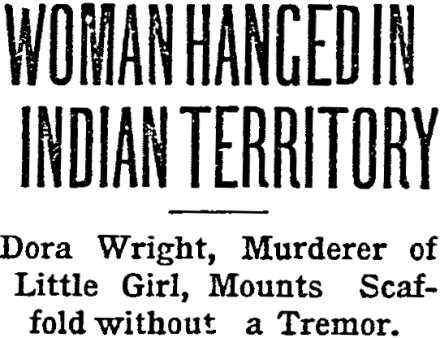
On this date in 1903, Dora Wright was hanged at McAlester in Indian Territory — the present-day U.S. state of Oklahoma.

Wright beat and tortured to death a 7-year-old orphan in her charge named Annie Williams. Wright tormented the little girl over several months until she finally succumbed to a thrashing in February 1903. It was, the local paper said, “the most horrible and outrageous” crime in memory in the area; Wright’s jury only needed 20 minutes’ deliberation to condemn her.

As Oklahoma was yet four years shy of statehood, “Indian Territory” jurisdiction — and with it any decision on executive clemency — fell to U.S. President Theodore Roosevelt. The inclination of the Rough Rider is aptly conveyed by the words of Attorney General Philander Knox‘s brief on the case to the President, which were released for press consumption:

The real facts in this case are that this woman tortured to death a little child seven years old, her niece, whom she was pretending to care for and support. She whipped the child most unmercifully with large switches, struck it about the hand and face so as to cause wounds sufficient to produce death, burned holes in its legs and thighs with a heated poker, and committed other nameless atrocities upon the person of the child. The testimony shows that the woman pursued a course of cruelty which was fiendish and barbarous … The only ground upon which her pardon is sought is that she is a woman, and that the infliction of the death penalty upon a woman would be a shock to the moral sense of the people in the community.

T.R. was incredulous at the feminine special pleading.

“If that woman was mean enough to do a thing like that,” Roosevelt said, “she ought to have the nerve to meet her punishment.”

Wright did have that nerve in the end, and was noted for the calm with which she comported herself on the scaffold. (She was hanged alongside another fellow, Charles Barrett, who shot a man dead in a robbery.)


From the Duluth (Minn.) News-Tribune, July 18, 1903.

On this day..

1793: Joseph Chalier, Jacobin martyr

On this date in 1793, Joseph Chalier was guillotined in Lyon(s).

Chalier (English Wikipedia entry | French*), a knockabout silk merchants’ agent from Lyon, oddly became that city’s exemplary Jacobin fire-eater and the leading spirit in its Jacobin clubs. He was elected to the Lyon municipal council in 1792, and while in Paris even took part in the August 10, 1792 insurrection deposing Louis XVI.

Lyon, France’s “second city” and the hub of a considerable silk-weaving industry, was not nearly so amenable as Paris to the French Revolution’s radicals: indeed, the wartime anathema most of Europe had laid upon regicidal France devastated the weaving trade, and the particular grievances of established silk weaver artisans were here advanced but there complicated by the advent of the Revolution.**

Consequently, liberal Girondins, merchant elites, some craftsmen, and even outright royalists made a formidable coalition checking radical Jacobins in municipal politics. (Chalier even warned the National Assembly of this dynamic.)

Jacobins could never quite get political control of the city, until political crisis toppled the Lyon government in March 1793 and finally put Chalier et al in the saddle. (They immediately erected a public guillotine, of course.)

Their brief ascendancy expired 80 days later, when a municipal revolt put Chalier and his allies in chains, and reasserted more moderate control — just as the moderate Gironde was being expelled from the National Convention. After terse negotiations between Lyon and Paris hit a quick impasse, Lyon guillotined Chalier. “My death will cost this city dear,” Chalier warned his tribunal.

The next month, it lay under a terrible siege by the central government.

In the aftermath of that conquest, the Committee of Public Safety ruthlessly suppressed the seditious Lyonnaise, even going so far as to decree (without effect) the forfeit of the city’s very name — henceforward to be known as Ville-Affranchie, the Liberated City.

Hastening to the city and then hastening back to make political hay of the bloodbath, Committee of Public Safety member Collot d’Herbois “sent to Paris — over and against Robespierre‘s religion — quite another god, a horrible fetish, the head of Chalier, thrice crushed by the Girondin blade.”† This ghastly relic was then paraded in triumph in Paris for Collot d’Herbois’s heroic homecoming, its former owner apotheosized into the Revolution’s martyrs’ pantheon alongside Marat.

As a result, one can still today see porcelain busts of Chalier, of the type widely manufactured in early 1794 for posturing in churches, homes, civic clubs, and anywhere else a display of conspicuous patriotic sentiment might be advisable.


Chalier’s bust. By David Monniaux (self photo) [GFDL (http://www.gnu.org/copyleft/fdl.html), CC-BY-SA-3.0 (http://creativecommons.org/licenses/by-sa/3.0/) or CC-BY-SA-2.5-2.0-1.0 (http://creativecommons.org/licenses/by-sa/2.5-2.0-1.0)], via Wikimedia Commons.

* One of the best biographical resources on Chalier is an 1887 French scholarly article available (for free) from JSTOR.

** See David Longfellow, “Silk Weavers and the Social Struggle in Lyon during the French Revolution, 1789-1794” in French Historical Studies, Spring 1981. Despite the title, this article also explicates the background of labor dynamics in the Lyon silk industry and its history of class conflict going back to the 17th century.

Jules Michelet, quoted by Chantal Thomas and David F. Bell in “Terror in Lyon”, SubStance, Vol. 27, No. 2, Issue 86: Special Issue: Reading Violence (1998).

On this day..

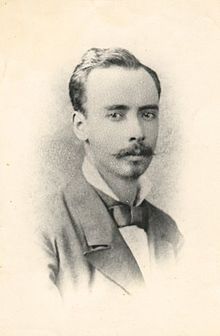
1883: Leoncio Prado, for defending his homeland

On this date in 1883, Leoncio Prado Gutierrez (English Wikipedia entry | the very much more extensive Spanish) was shot by the Chileans during the War of the Pacific.

Prado’s father, Manuel Ignacio Prado, was twice the president of Peru (1865-1868,* 1876-1879).

As a military man (Prado’s first presidency was as outright dictator), the old man naturally had his son on a soldierly track as well. Leoncio was all of 12 years old when he took part in the Battle of Callao in 1866, defending that city against a Spanish bombardment during the Chincha Islands War.

That war saw Peru and Chile cooperating against Spain, after the latter seized a lucrative cluster of guano islands.

But different resource rivalries put the two former allies at loggerheads in 1879. When Peru nationalized saltpeter mining in the border province of Tarapaca — dispossessing Chilean interests — and Bolivia took similar measures, the countries fought the three-way War of the Pacific, also known as the Saltpeter War.

Chile would win the war decisively, dramatically reshaping Latin America in the process. Peru lost most of Tarapaca to Chile, devastating Peru’s saltpeter industry and provoking a generation of instability and social crisis. Bolivia fared even worse, losing its only littoral province to Chile: Bolivia remains landlocked to this day.

So it’s safe to say that there was something at stake worth fighting for as hostilities commenced.

By this time Leoncio Prado was 26, and a veteran of the intervening years’ Cuban war for independence from Spain.

As the Saltpeter War got underway, Prado returned from the United States where he was preparing an expedition to help Philippines separatists, and formed a guerrilla force. Though this corps had its highlight moments, it was overwhelmed in a scrap with Chilean regulars in July 1880 and Prado taken prisoner.

Considering his lineage and his exploits, he was an honored captive for the Chileans who repeatedly offered to release him on his honor not to take up arms again.

Prado refused these offers for some time, but he finally accepted his parole at the start of 1882 — a low ebb for Peruvian fortunes, for his father had been deposed by a coup and 1881-82 saw leadership of the country violently contested. Prado’s only thought, notwithstanding his pledge to Chile, was for the defense of his country and he rallied another party of guerrillas to his banner. “The enemy’s bullets do not kill,” he cried. “For to die for the fatherland is to live in immortal glory!”

That has proved to be the case for Prado, who certainly stood out from the politicians of his time for his patriotic heroism.

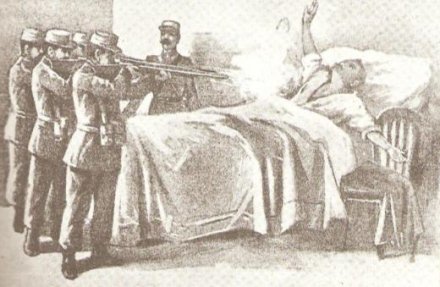
Captured during the decisive Chilean victory at the Battle of Huamachuco where a grenade shattered his thigh, the crippled Prado was regretfully executed in his bed for having broken his previous parole by resuming arms in the fight.

“We were all crying — all but Pradito,” recalled the Chilean captain tasked with overseeing the nasty business.

Six years after Prado’s execution, his aged father — the ex-president — sired yet another son, Manuel Prado Ugarteche. That son would also go on to hold the Peruvian presidency. While in office, he christened the Leoncio Prado Military Academy, an institution distinguished in literature as the setting for the Mario Vargas Llosa novel The Time of the Hero

* Prado pere was ousted from his first turn at the helm of state — a dictatorship — by Jose Balta, whose sad fate has adorned these macabre pages.

On this day..

1584: Balthasar Gerard, assassin of William the Silent

“If you succeed in your enterprise, the King will fulfill all his promises, and you will gain an immortal name besides.”

Christoffel d’Assonleville, to Balthasar Gérard

After 4 days of torture, on this date in 1584, Balthasar Gérard (Geeraerts) finally met his end by beheading on the wheel.
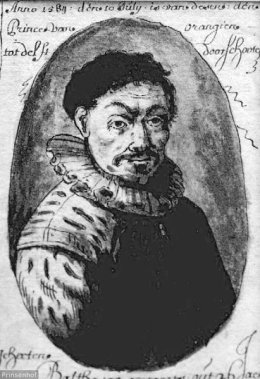
Gérard managed to be both historically important and wholly forgettable: an assassin working for Spain against the Netherlands, his regicide was met with a predictably stiff punishment. Then, no fault of his own, the subsequent course of history** pushed the assassin into obscurity while elevating his prey.

A lawyer by trade, Gérard was a fervent Catholic and supporter of the Spanish crown, which controlled the territory up the coast through the present-day Netherlands. At the peak of its power, Spain’s monarchy — led by King Philip II — had significant cause for concern at the rise in Protestantism.

The Spanish were Europe’s paladins of staunch Catholicism, and the sight of her troops did little to endear Spain to her colonized neighbors to the North.

For both religious reasons and political ones, the Dutch were looking for a way out from under the Spanish thumb, and a former noble named William, Duke of Orange, was a major instigator in the struggle. In his collected letters and addresses from the period, An apology or defence of William the First of Nassau, William states that, starting in 1559, he became increasingly concerned with plans against Protestants by the Spanish monarchy.

That also happens to be the year William was bestowed with stadtholdership of Holland, Zeeland, and Utrecht; in effect, he controlled the Dutch coast.

Though he was known as William the Silent, the Duke was endowed with both financial resources and widespread popularity, and he didn’t keep his mouth shut when it came to Inquisition courts in his realms.†

When the head enforcer of that policy, Cardinal Antoine Perrenot de Granvelle, left town, William got even noisier — declaring before the Council of State that Spanish policies were squelching religious freedom.

In 1566, the nobleman signed onto the Compromise of Nobles and began funding insurgencies across the northern provinces. As religious unrest grew, Calvinists and Protestants in the French and Germanic portions of Spain’s holdings quickly formed up behind William. An early attempt in 1568 to invade the Netherlands using German mercenaries and French Huguenots failed, but the resultant executions of Egmont and Hoorn put Spain on a long and winding road toward defeat.

The Dutch War was afoot, with William leading the way.

It would take and dozens of small-scale military victories over the next 15 years (during which William declared himself a Calvinist and fully broke his Spanish ties) for the Dutch to move to independence. The 1580 Union of Utrecht and 1581 Act of Abjuration officially ousted King Phillip II from the Netherlands and installed a new government.

Needless to say, Phillip reciprocated William’s love.

In 1580, Spain’s top man put a price on William’s head. Juan de Jáuregui tried to collect two years later by shooting the stadtholder, but the man holding the new title of Prince William I of Nassau recovered, while de Jáuregui was killed on the spot.

With 25,000 crowns at stake, there were bound to be other takers.

Our man Balthasar Gérard started looking for a close encounter with William the Target. At first, he joined the army in Luxembourg, which didn’t get him very far. It was time to gin up a real plot, which Gérard shopped to the Duke of Parma, Alessandro Farnese, in April 1584. Though the Duke offered no funding for the operation — Gérard ponied up the startup money he needed for the trip — and held out little hope that the lawyer would be successful, he gave Gérard assurances that his family would be taken care of in case of disaster.

Gérard first presented himself to William in June as the son of a martyred Calvinist from France. On 8 July, he returned and, badly in need of new clothes, managed to beg 50 crowns for a new set.

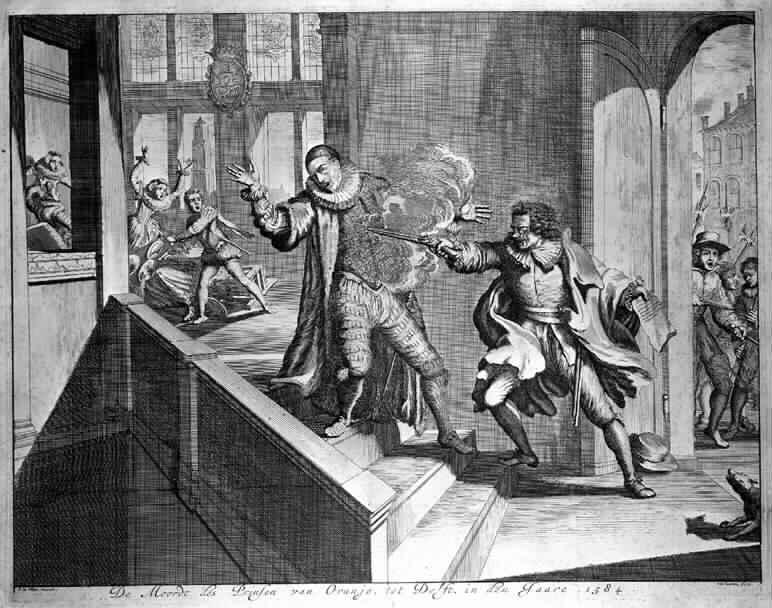
Instead, he bought a pair of pistols and, on 10 July, made history with a point-blank shot to William’s chest.
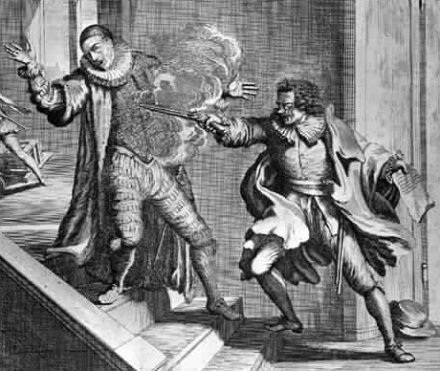

Detail view (click for the full image) of William the Silent’s 1585 assassination at the hands of Balthasar Gerard.

This assassination attempt didn’t fail. William became the second head of state to be killed by an assassin’s bullet,† — and his shooter the first such man to be juridically punished for the deed.

And, oh, how he was punished.

The regicide was beaten immediately after his capture, then subjected to a variety of cruelties, from wet leather boots which, when heated, both crushed and burned the feet, to daily floggings while hanging on a post outside the jail.

But on this day, his time of torture was up, and Gérard was finally put to death. You know, the usual:

It was decreed the right hand of Gerard should be burned off with a red-hot iron, that his flesh should be torn from his bones with pincers in six different places, that he should be quartered and disembowelled alive, that his heart should be torn from his bosom and flung in his face, and that, finally, his head should be taken off.


Gerard’s execution.

For all that he suffered as a regicide, Gérard left his family an impressive inheritance. Making good Parma’s assurances, King Phillip II gave them William’s former lands in three French provinces and took his siblings and their issue into his peerage.

Gérard’s cause carried on for another 60 years, until it was finally extinguished by the signing of the Peace of Münster by the Republic of the Seven United Netherlands and Spain.

* Foucault mistakenly identifies the torture as lasting 18 days, and the additional details he lays down for Gérard’s time on death row may be less-than-believable. However, all sources indicate that the tortures Gérard endured were quite spectacular, even by the standards of the day.

** See Dissident identities in the early modern Low Countries for a complete treatment of this period in The Netherlands and Belgium.

† For example, the city of Antwerp (Belgium), then under possession of the Spanish crown and considered the mercantile center of Europe for its vast sugar trade, featured over 100 executions for heresy from 1557-1562, twice as many as in all of Spain during that time.

‡ The first was James Stewart, 1st Earl of Moray, then Regent of Scotland. Stewart’s shooter, James Hamilton, escaped into exile, though others of the Hamilton clan answered for the murder.

On this day..