1977: Atnafu Abate, Mengistu’s last rival

On this date in 1977,* Ethiopian dictator Mengistu Haile Mariam eliminated one of his last political rivals with the execution of Atnafu Abate.

The men’s relationship had long been complex and unclear; Abate backed the Derg’s “Black Saturday” mass executions in 1974, and sometimes lined up as Mengistu’s ally over the succeeding years as part of the Derg military junta.

At the same time, there were rumors that things between Mengistu and Atnafu were so tense that they pulled guns at meetings.

Atnafu’s absence (by accident or design) during an early 1977 purge within the Derg left the conservative and Orthodox Atnafu officially second-in-command, and unofficially the last real or potential rival to Mengistu.

His elimination was widely expected, though exactly why it went down, when it went down has never been transparent. Mengistu’s grip on the country was already secure enough to have launched the Red Terror.

The New York Times‘ Nov. 15 report of this development captures a bit of the Alice-in-Wonderland political logic evidently at work.

The Ethiopian press agency, which made the announcement, also released what amounted to a six-page indictment listing “twelve specific antirevolutionary crimes,” and “five specific arch-reactionary stands” attributed to Colonel Atnafu, who had served as vice chairman of the provisional military administrative council.

The statement charged Colonel Atnafu with opposing “proclamations intensifying the revolution,” manifesting “a feudal arrogance while on visits to various provinces,” and consorting after working hours with what the statement called riff-raff of the aristocracy and military bourgeois, as well as “extremely dangerous imperialist agents — especially CIA agents.”

…

The statement also charged that “he had repeatedly confessed at meetings that he did not believe in the ideology of the working class.”

But perhaps the section of the statement that most accurately reflects the bewildering tone of political rhetoric and chaos in Addis Ababa, was one that charged that the proof of Colonel Atnafu’s “reactionary stands” was his placing of Ethiopian national interests before ideological considerations.

“At this time,” said the document, “when workers, farmers, the men in uniform and all the toiling masses are intensifying the revolutionary struggle guided by the principles of Marxism-Leninism, Lieut. Col. Atnafu has been antagonistic to the idea and has instead by way of dilatory tactic, argued that the interest of Ethiopia should be put before ideology.”

* As reported by the London Times gloss (articles Nov. 14 and Nov. 15) of a state radio report given in Ethiopia on Nov. 13. “A revolutionary measure” was the official euphemism for the action taken against Atnafu Abate.

On this day..

1865: Henry Wirz, for detainee abuse

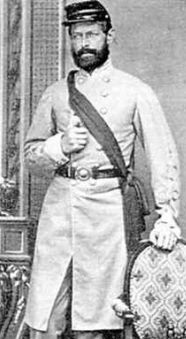
On this date in 1865, Henry Wirz was hanged in Washington, D.C. for running a notorious Confederate prison camp.

A Swiss-born doctor (“Henrich” was the real handle) whom time and tide found practicing in Louisiana at the onset of the Civil War, Wirz apparently got into the prison-guarding ranks when a war injury left him unfit for the front lines.

But it was front-line fitness in the northern army that would set the scene for his controversial hanging.

The North’s advantage in men and materiel shaped Union strategy as the war progressed, and it eventually caused the Union to halt prisoner exchanges. Exchanging casualty for casualty was a winning strategy on the battlefield, so why return to your enemy a man for a man? Besides,

[Grant] said that I would agree with him that by the exchange of prisoners we get no men fit to go into our army, and every soldier we gave the Confederates went immediately into theirs, so that the exchange was virtually so much aid to them and none to us.

–Benjamin Butler (we’ve met him before)

As designed, then, the South began piling up more and more POWs to maintain with its ever-straitened resources late in the war. And if exchange was out, that really only left one form of “release”.


Andersonville Prison survivor John L. Ransom’s view of the prison, from the Library of Congress.

Andersonville — officially, Camp Sumter, located near the tiny Georgia town of Andersonville — was only established in 1864, but acquired considerable notoriety in northern propaganda for the year and change that Wirz ran it. The prisoners didn’t enjoy it much, either.

Wuld that I was an artist & had the material to paint this camp & all its horors or the tounge of some eloquent Statesman and had the privleage of expresing my mind to our hon. rulers at Washington, I should gloery to describe this hell on earth where it takes 7 of its ocupiants to make a shadow.

–Union prisoner diary, July 1864. Note the prisoner’s anger at Washington — whose refusal to exchange naturally infuriated its stranded POWs

Out of some 45,000 prisoners held at Andersonville during its existence (not all at one time), nearly 13,000 succumbed to disease and malnutrition.* After the war, photos of wasted survivors inflamed (northern) public opinion, already tetchy over Abraham Lincoln’s assassination. Walt Whitman wrote of Andersonville,

There are deeds, crimes that may be forgiven but this is not among them. It steeps its perpetrators in blackest, escapeless, endless damnation.

Damnation is up to higher powers, of course, but the North wanted somebody to answer for Andersonville on this mortal coil. Lincoln’s successor Andrew Johnson overruled mooted charges against Confederate President Jefferson Davis and his Secretary of War James Seddon, leaving — in that great American tradition — Heinrich Wirz holding the bag.**

Shatner sighting!

The trial had an undeniable aspect of victor’s justice.† Even at the gallows, the Union guards chanted, “Wirz, remember Andersonville!” as the condemned man was readied for the noose, and then dropped. The hanging failed to break the man’s neck, and he strangled as the chant continued.

Southern efforts to reshape the story of Andersonville began in the lifetimes of Wirz’s contemporaries; this fulsome volume supporting the charges answered Jefferson Davis in terms that sound strikingly contemporary:

So long as Southern leaders continue to distort history (and rekindle embers in order to make the opportunity for distorting it), so long will there rise up defenders of the truth of history … To deny the horrors of Andersonville is to deny there was a rebellion. Both are historic facts placed beyond the realm of doubt.

But of course, it does not require denying the horrors of Andersonville to notice the circumstances — the privation of the entire South late in the war — and to wonder that Wirz and Wirz alone was held to account. Plenty of people think he got a bum rap.


Daughters of the Confederacy monument to Wirz. (cc) image from divemasterking2000.


Pro-Wirz marker in Andersonville, Ga. (Click for easier-on-the-eyes version, reading in part, “Had he been an angel from heaven, he could not have changed the pitiful tale of privation and hunger unless he had possessed the power to repeat the miracle of the loaves and fishes”). (cc) image from Mark D L.

Recommended for general reading: the UMKC Famous Trials page on this case, several of whose pages have been linked in this entry. A number of nineteenth-century texts by (or citing) Andersonville survivors are available from Google books, including:

Since this is a controversy of the Civil War — and one that can be engaged without having to get into that whole slavery thing — there have been thousands of published pages written about it, with many more sure to come in future years.

A few books about Henry Wirz and Andersonville

As an interesting aside, Civil War POW camps including Andersonville (but not only Andersonville) gave us the term “deadline,” which had a more startlingly literal definition in the 1860s — a perimeter beyond which prisoners would be shot on sight, which policy could make a handy stand-in for walls. Gratuitously killing an insane prisoner who crossed Camp Sumter’s “dead line” was one of the atrocities laid to Wirz, who we take it would not have been at home to the word’s decreasingly urgent appropriation in the wider culture.

* Wirz’s defense showed, to no avail, that the prisoners and the guards received the same rations, with similarly deleterious effects among both, and that the commandant was on record pleading with his superiors for more.

** Wirz’s attorney claimed that his man was offered (and refused to take) a last-minute pardon on November 9 in exchange for implicating Jefferson Davis.

† Wirz and borderlands guerrilla Champ Ferguson were the only Confederates executed for their “war crimes”. There was at least one other prison guard who faced similar charges of prisoner maltreatment, John Henry Gee; Gee was acquitted and released in 1866. (For more on the latter, see “A Little-known Case from the American Civil War: The War Crimes Trial of Major General John H. Gee” by Guénaël Mettraux in the Journal of International Criminal Justice, 2010.)

On this day..

555: Rusticus and John

On an uncertain date in the autumn of 555, a Byzantine commander and his brother were put to death for the treacherous murder of the vassal king of Lazica.

Rusticus, the commander, probably had good cause to be annoyed with Gubazes II, who ruled a borderlands realm on the eastern edge of the Black Sea, in modern-day Georgia.

Gubazes had gone from calling in Persian aid in 541 against Lazica’s Byzantine masters, to summoning Byzantine help against the Persians a few years later. Now, he was kvetching to Byzantine Emperor Justinian about the Byzantine generals he’d called for.

We’ll let J.B. Bury take it from here:

King Gubazes, who had been engaged in frequent quarrels with the Roman commanders, sent a complaint to Justinian accusing them of negligence in conducting the war. Bessas, Martin, and Rusticus were specially named. The Emperor deposed Bessas from his post, but assigned the chief command to martin and did not recall Rusticus. This Rusticus was the Emperor’s pursebearer who had been sent to bestow rewards on soldiers for special merit. He and Martin determined to remove Gubazes. To secure themselves from blame, they despatched John, brother of Rusticus, to Justinian with the false message that Gubazes was secretly favouring the Persians. Justinian was surprised, and determined to summon the king to Constantinople. “What,” asked John, “is to be done, if he refuses?” “Compel him,” said the Emperor; “he is our subject.” “But if he resist?” urged the conspirator. “Then treat him as a tyrant.” And will he who should slay him have naught to fear?” “Naught, if he act disobediently and be slain as an enemy.” Justinian signed a letter to this effect, and armed with it John returned to Colchis. The conspirators hastened to execute their treacherous design. Gubazes was invited to assist in an attack on the fortress of Onoguris, and with a few attendants he met the Roman army on the banks of the Chobus. An altercation arose between the king and Rusticus, and on the pretext that the gainsayer of a Roman general must necessarily be a friend of the enemy, John drew his dagger and plunged it in the royal breast. The wound was not mortal but it unhorsed the king, and when he attempted to rise from the ground, a blow from the squire of Rusticus killed him outright.

The Lazi silently buried their king according to their customs, and turned away in mute reproach from their Roman protectors. They no longer took part in the military operations, but hid themselves away as men who had lost their hereditary glory. The other commanders, Buzes and Justin the son of Germanus, concealed the indignation which they felt, supposing that the outrage had the Emperor’s authority. Some months later, when winter had begun, the Lazi met in secret council in some remote Caucasian ravine, and debated whether they should throw themselves on the protection of Chosroes. But their attachment to the Christian religion as well as their memory of Persian oppression forbade them to take this step, and they decided to appeal for justice and satisfaction to the Emperor, and at the same time to supplicate him to nominate Tzath, the younger brother of Gubazes, as their new king. Justinian promptly complied with both demands. Athanasius, a senator of high repute, was sent to investigate the circumstances of the assassination, and on his arrival he incarcerated Rusticus and John, pending a trial. In the spring (A.D. 555) Tzath arrived in royal state, and when the Lazi beheld the Roman army saluting him as he rode in royal apparel, a tunic embroidered with gold reaching to his feet, a white mantle with a gold stripe, red shoes, a turban adorned with gold and gems, and a crown, they forgot their sorrow and escorted him in a gay and brilliant procession. It was not till the ensuing autumn that the authors of the death of the late king were brought to justice, and the natives witnessed the solemn procedure of a Roman trial. Rusticus and John were executed. Martin’s complicity was not so clear, and the Emperor, to whom his case was referred, deposed him from his command in favour of his own cousin Justin, the son of Germanus. Martin perhaps would not have been acquitted if he had not been popular with the army and a highly competent general. (link)

“The historical importance of the Lazic War,” Bury says, “lay in the fact that if the Romans had not succeeded in holding the country and thwarting the design of Chosroes, the great Asiatic power would have had access to the Euxine and the Empire would have had a rival on the waters of that sea. The serious menace involved in this possibility was fully realised by the Imperial government and explains the comparative magnitude of the forces which were sent to the defence of the Lazic kingdom.”

On this day..

1920: James Daly, Connaught Rangers mutineer

The British Empire administered its last execution for mutiny on this date in 1920 — that of Irish Private James Daly of the Connaught Rangers.

A Dublin cemetery preserves a monument to Daly and his comrades.

You can take the Irishman out of Ireland, but not Ireland out of the Irishman. Something like that.

Daly was shot in Dagshai prison, India, but the reason for his death was that old familiar of his homeland’s history: nationalism.

Half a world away, London was playing the bad guys in the Irish War of Independence.

It was a conflict uniquely suited for dividing comrades; little wonder that it also divided comrades in arms.

Having lately bled for His Majesty in the War to End All Wars, plenty of Irish enlistees were nonplussed to see troops deployed to their own neighborhoods, Black and Tans shooting up their friends and family.*

From June 1920, a number of Irish Connaught Rangers “grounded arms” for their brethren in Eire, refusing to serve Britain while British troops occupied Ireland. One thing led to another, and a group (led by Daly, and his brother William) ended up trying to rush an armory to recover its weapons, opposed by other Rangers who remained loyal to the crown.

Fourteen death sentences were handed down for this show of indiscipline, but Daly’s was the only one actually carried out. The Rangers were disbanded two years later with the formation of the Irish Free State. And everyone lived happily ever after.

* Connaught Rangers had been used (without incident) to suppress the Easter Rising in 1916.

On this day..

1943: Six POWs, inscribed on a ouija board

Here lie the remains of 3529270 Pte T Jackson Manch Reg. CQMS C Anderson FMSVF, A S H Justice USS Houston. 33271– Pte Mar- … here the letters had been eaten away. At the bottom of the board there were several more words which it was not possible to decipher but still discernible were the words

Executed 1/11/43

The WW2 People’s War is an online archive of wartime memories contributed by members of the public and gathered by the BBC. The archive can be found at bbc.co.uk/ww2peopleswar.

This date’s execution — contributed to WW2 People’s War by Chris Comer of Stockport Libraries on behalf of Arthur Lane — concerns six Commonwealth POWs who were shot for attempting to escape at Thambazayat, a prison camp in Burma.

They’re remembered by a fellow-prisoner from their time at the Thailand prison camp Chungkai, where the prisoners pulled off a memorable caper with a ouija board and some of their guards.


Chungkai War Cemetery, on the site of camp’s POW burials. (From Australian War Memorial)

These executions did not reshape history. But this story of a few men under the shadow of a senseless death has the spark of humanity that animates these pages. Read it in its entirety here: part 1 | part 2.

On this day..

1941: Twenty Red Army officers


Top to bottom: Proskurov, Rychagov, Shtern, and Smushkevich.

“Quantity has a quality all its own.”

-Stalin

The aphoristic Uncle Joe doomed Soviet officers in both quantity and quality on this date in 1941, shooting 20 Soviet officers at the very moment when Mother Russia could have used them most.

This wouldn’t seem like the ideal time for a purge, but old habits are hard to break.

As the Wehrmacht closed in on Moscow, these prisoners had been evacuated to the Volga city of Kuybyshev (today, Samara). In this, they were already treated more courteously than some.

But any semblance of consideration for these fallen brass — to say nothing of bourgeois indulgences like due process — went out the window when an order arrived from Lavrenty Beria:

“Investigation to be stopped, all to be executed by firing squad without delay.”

They were.

Those “all” included:

Many of this day’s victims were rehabilitated after Stalin fell.

Cold comfort, perhaps, but for their survivors there was bloodier satisfaction: the personal order Beria gave to execute them was in turn used against Beria when he was purged.

It’s a bit tangential, but here‘s an interesting interview with one of their contemporaries in Soviet combat aviation, who managed to survive those terrible years (despite being “taken out to be shot on three occasions” while a POW in Spain). There are some pictures of the planes these men would have used in this thread of a Spanish-language military forum.

On this day..

1978: Seventeen officers in Somalia

Seventeen army officers were shot this day on the outskirts of Mogadishu for attempting to overthrow Somali dictator Siad Barre.

“The executions were carried out by by a firing squad formed of soldiers of the armed forces and were witnessed by thousands of people from all areas of Mogadishu,” said Mogadishu radio.

The abortive April 9 coup attempt seems to have been precipitated by Somalia’s ill-fated intervention in neighboring Ethiopia’s Ogaden region, a bloody little Cold War sideshow that saw both the U.S. (from Ethiopia, to Somalia) and Soviet Union (from Somalia, to Ethiopia) switch sides. Some of the officers concerned feared that Siad would come a-purgin’ after the last Somali forces slunk home on March 15, 1978.

The condemned (per this source) were:

  • Col Mohamed Sheikh Osman “Cirro”
  • Maj Siad Mohamed Jama
  • Maj Ibrahim Mohamed Hersi
  • Maj Siad Jama Nur
  • Capt Mohamed Ahmed Yusuf Aganeh
  • Capt Abdisalan Elmi Warsame
  • Capt Bashir Abshir Isa
  • Capt Abdillahi Hasan Nur
  • Lt Abdi Osman Ugas
  • Lt Abdirahman Maalin Bashir
  • Lt Adan Warsame Abdillahi
  • Lt Abdillahi Mahamud Guled
  • Lt Mohamed Abdullahi Husein (Gorod)
  • Lt Abdulwahab Ahmed Hashim
  • Lt Abdulqadir Gelle Omar
  • Sgt Farah Mohamed Halwo
  • Director Abdulqafar Warsame Abdilleh

But they’re perhaps most memorable for a coup participant not among their number, Abdullahi Yusuf Ahmed, who fled to Kenya and founded from exile the Somali Salvation Democratic Front, eventually one of the principal entities resisting the Barre regime. Ahmed served as President of Somalia from 2004 to 2008, but his government was unable to gain control of the notoriously fractious state or to end Somalia’s ongoing civil war.

On this day..

1943: Leonard Siffleet, beach beheading

On this date in 1943, Australian World War II commando Leonard Siffleet was beheaded on Aitape Beach in Papua New Guinea, along with two Ambonese, H. Pattiwal and M. Reharing

A photograph of the Japanese soldier Yasuno Chikao an instant before he strikes off Siffleet’s head was taken from the body of a Japanese casualty later in the war. Published in Life magazine, it became one of the war’s most iconic photos.

On this day..

1942: Three Doolittle raiders

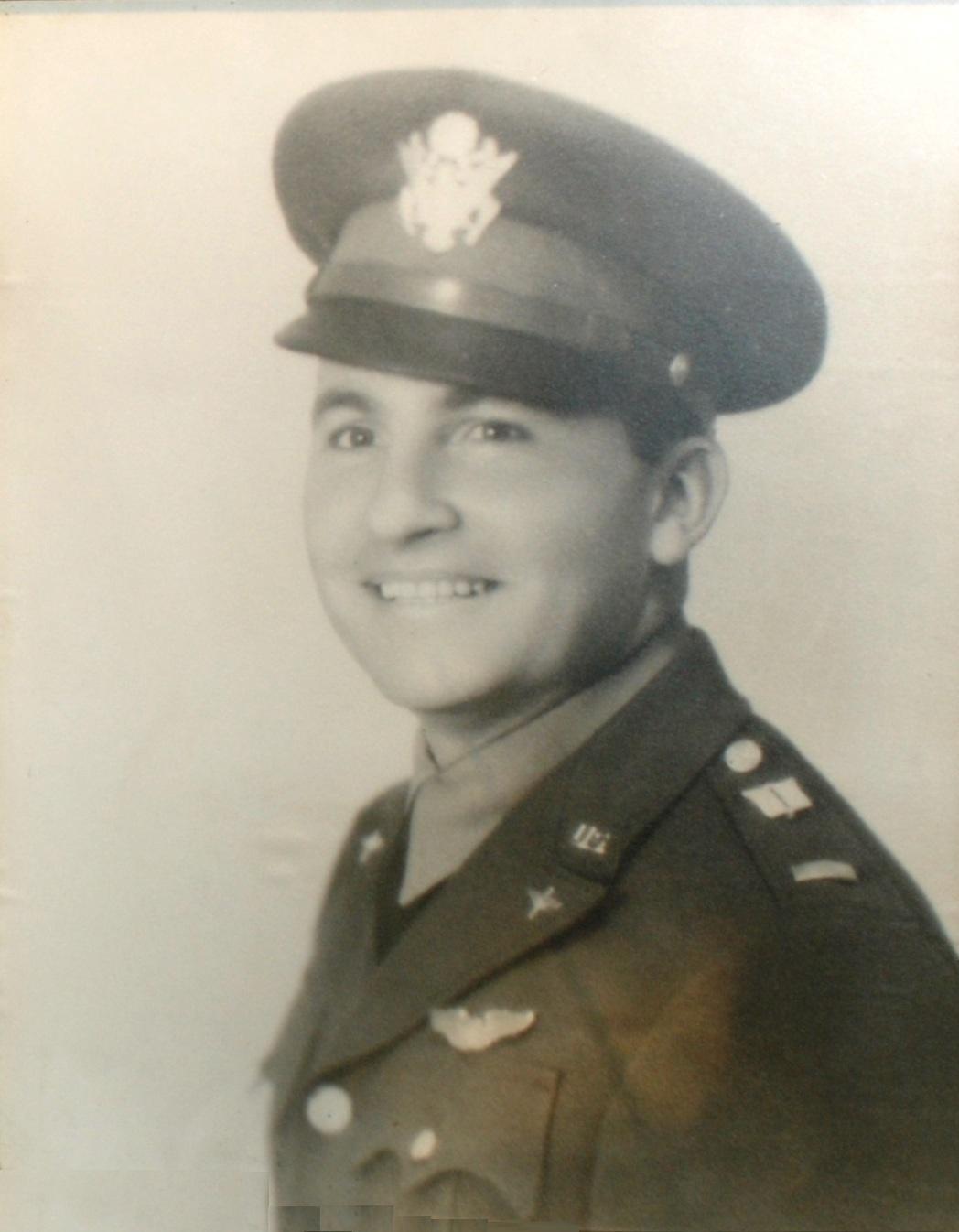
On this date in 1942, three captured American airmen who had bombed Japan in the Doolittle Raid were shot in Tokyo.

The Doolittle Raid — named for its commander, Jimmy Doolittle — was America’s April 1942 retaliation for the Japanese attack on Pearl Harbor a few months before.

The mission: bomb the Japanese homeland.

Later in the war, American advances in the Pacific would enable the Yankee to do this regularly. In 1942, it was all but a suicide mission.

The plan involved launching 16 B-25s from an aircraft carrier — an unprecedented feat in itself — to fly light with arms and heavy with fuel to just make it 400 miles to Honshu, and with any luck on to China before the tanks ran dry.

Considering that the bombers had to launch in a panic when the carrier group was spotted a couple hundred miles too early, the raid’s success was downright miraculous: all 16 bombers made it on to (or near enough) the mainland without being shot down, where the crews bailed out and, for the most part, escaped to allied forces. Jimmy Doolittle would title his autobiography I Could Never Be So Lucky Again.

But not all were quite as lucky as Lt. Col. (later, General) Doolittle.

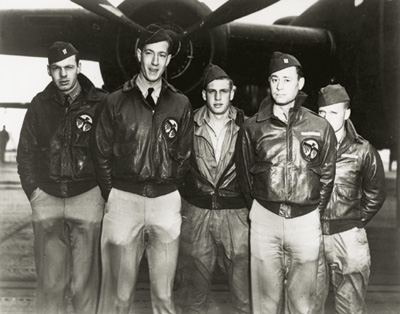
Farrow (left) and Hallmark. Spatz was a member of Farrow’s crew, and is pictured center in that plane’s crew shot here.

Two (out of eighty) drowned when their ride was ditched in the drink. Eight others were captured by the Japanese.

Four of those eight captives would survive the war to tell the tale. A fifth died in captivity. And the other three — pilots William Farrow and Dean Edward Hallmark, and (for somewhat unclear reasons) gunner Harold Spatz — were shot this day in a Shanghai cemetery following a sketchy military trial which condemned them for hitting civilian targets.

Designed largely for its psychological effect, the morale-boosting Doolittle raid has attracted interest from countless other sources who treat it in greater depth. DoolittleRaid.com and DoolittleRaider.com both provide detailed online information about the raid.

For more traditional media, one could do worse than bomber pilot Ted Lawson’s book, and its subsequent propaganda film adaptation, Thirty Seconds Over Tokyo.

On this day..

1565: Jean Ribault and the Huguenot colonists of Fort Caroline

On this date in 1565, the French Huguenot New World settlement plan was nipped in the bud when Spaniards executed en masse the inhabitants of Fort Caroline in present-day Jacksonville, Fla.

Jean Ribault.

During the late 16th century’s fractious French Wars of Religion, far-sighted Protestant admiral Gaspard de Coligny sponsored this like-minded colony in Florida — a sort of side bet on a satellite Protestant presence overseas, while the party in the mother country fought for its life.*

Jean Ribault (or Ribaut) was the loyal naval aide chosen to lead this colony. After an abortive attempt to plant a settlement in Charlestown, S.C., Ribault set up Fort Caroline and claimed greater Jacksonville for France.


Historical marker of Jean Ribaut/Ribault’s landing place, in Jacksonville, Fla. (cc) image from POsrUs.

French colonial projects further north enjoyed better success.

Down in Florida, both geopolitical and religious rivalry set Fort Caroline up for trouble. Ponce de Leon, questing for the Fountain of Youth, had planted the Spanish flag in Florida half a century before, and that country was none too pleased to find its continental rival jumping its claim. That it was Calvinist Frenchmen doing the usurping would prove downright intolerable to more-Catholic-than-the-Pope Spanish ruler Philip II.

The Spaniards attacked [Fort Caroline], hanged the colonists, and fastened above the heads of the corpses a placard on which was written, “Not because they were Frenchmen, but because they were heretics.” A French Catholic, de Gourgues, moved with righteous indignation, fitted out a ship and avenged this act by hanging their murderers, over whose bodies he put a similar placard, bearing the inscription, “Not because they were Spaniards, but because they were assassins.” But Coligny’s efforts failed, and he had to leave to the English race the realization of his dream of a great American Protestant state. (Source)

That great Protestant state, of course, eventually gobbled up Florida, and still owns it today.

There, it maintains Fort Matanzas National Monument, which takes its name for the Spanish term for what went down there on this date: matanzas, or slaughter.**

* It’s another country, another creed, and another century, but it reminds of the traffic between English New World settlements and England proper during the English Revolution.

** A different historical monument commemorates the failed South Carolina colony.

On this day..