Known simply as Sejanus, he was of equestrian stock who rose to prefect the Praetorian Guard when Tiberius succeeded Augustus as Rome’s first citizen.
It was not yet the “infamous Praetorian Guard”. Sejanus would make it so: his were the institutional aggrandizement — long outliving Sejanus — that would position the Guard to arbitrate imperial succession; his the persecutorial internal policing that made it a swords-and-sandals Gestapo.
Sejanus maneuvered skillfully towards supreme power in Rome — and ruthlessly enough that he is suspected of having murdered Tiberius’s son and heir Drusus. Though the Emperor refused a dynastic marriage with Drusus’s widow that would have set Sejanus up for official succession, the Praetorian had the purple in all but name in the late 20’s when Tiberius decamped for the dissolution of Capri.
The usual sort of thing ensued: spies, informers, purges and political murders.
The Republic had been down this road before. After the peace of Augustus, it was a chilling preview of Imperial Rome’s coming attractions.
Unlike most of those, the Sejanus issue was ultimately resolved without civil war. Finally wise to his captain’s game, Tiberius snuffed out the threat in a single blow without bestirring himself from his island retreat by sending word to convoke Sejanus and the Senate to elevate the soldier to the tribunate … and having a letter there read which demanded the soldier’s arrest.
That august old body — “men fit to be slaves,” in Tiberius’s estimation — took it from there. Sejanus was summarily executed this very evening, his body torn apart by the mob, and a witch hunt for his lieutenants and supporters immediately began.
On this date in 1660, the restored House of Stuart began a week of bloody justice against Charles I‘s regicides by hanging, drawing and quartering Thomas Harrison at Charing Cross.
Stuart Little
Charles’ son and heir Charles II had been stuck on the continent during the 1650’s, until the Commonwealth came apart from its own internal contradictions after the death of Oliver Cromwell.
The first thing on everyone’s mind was what to do about the little matter of having lopped off his dad’s head.
Political reality drove the settlement: nearly everyone in the English gentry had in some manner acquiesced to the Commonwealth during its decade-plus turn steering the ship of state; an expansive line on treason would be a nonstarter. At the same time, His Soon-To-Be-Royal-Again Majesty expected a few examples made to do right by the old man and keep king-killing well off his future subjects’ agenda.
Weeks of frantic negotiating between the parties and private settlements of borderline cases with the royalist camp preceded the action. But Thomas Harrison wasn’t part of any of it.
… Entrails you Lose.
The rigid Puritan, one of 59 who signed the last king’s death warrant and at one time the commander of England’s armies, had been on the outs with everyone since Cromwell set up the Protectorate in 1653. Godly Tom was a “Fifth Monarchist,” anticipating the imminent return of Christ perhaps in conjunction with the imminent year 1666 … and no government felt safe about these millenarians. He’d been imprisoned several times by the Protectorate, too.
Though many attainted regicides fled for Europe or America, Harrison (possibly motivated by age and infirmity) hung out, waited for arrest, and took his punishment stolidly.
God hath covered my head many times in the day of Battle. By God I have leaped over a wall, by God I have runned through a Troop, and by my God I will go through this death.
Specifically meaning, drawn on a hurdle from Newgate to Charing Cross (with a fine vantage for the doomed on Whitehall, where Charles I had met his end), hanged but revived, his genitalia cut off and bowels carved out and burned while still conscious, and finally beheaded and his body divided into quarters for gruesome public display around town.
You have selected regicide.
Harrison died on a Saturday, and his was the opening act of a busy week in the bowel-burning business; nine other fellow regicides condemned with him would share that fate during the week ahead:
John Carew, on Monday the 15th;
John Cook and Hugh Peters, on Tuesday the 16th;
Thomas Scot, Gregory Clemen, Adrian Scroop and John Jones, on Wednesday the 17th;
Francis Hacker and Daniel Axtel, on Friday the 19th.
[h]e was a fierce and bloody enthusiast. And it was believed, that, while the army was in doubt, whether it was fitter to kill the king privately, or to bring him to an open trial, that he offered, if a private way was settled on, to be the man that should do it. So he was begun with. But, however reasonable this might be in itself, it had a very ill effect: for he was a man of great heat and resolution, fixed in his principles, and so persuaded of them, that he never looked after any interests of his own, but had opposed Cromwell when he set up for himself. He went through all the indignities and severities of his execution, in which the letter of the law in cases of treason was punctually observed, with a calmness or rather a cheerfulness that astonished the spectators.
“As cheerful as any man could do in that condition”
And this coda is attested by the age’s famous diarist, Samuel Pepys, whose neat and oft-quoted summation of Harrison’s fate runs thus:
I went out to Charing Cross, to see Major-General Harrison hanged, drawn, and quartered; which was done there, he looking as cheerful as any man could do in that condition … Thus it was my chance to see the King beheaded at White Hall, and to see the first blood shed in revenge for the blood of the King at Charing Cross.
Who overcomes by force hath overcome but half his foe
As might be expected, vindicated royalists sought more blood than the handful of exemplars could furnish. What compromise could expiate the sin of regicide?
Poet and polemicist John Milton, having been propagandist-in-chief for the now-abortive revolution, endured the jeers of his enemies for the conspicuously apolitical stuff (a grammar book!) by which he would set his table in the years ahead.
Upon John Milton’s not suffering for his traiterous Book when the Tryers were executed, 1660.
That thou escaped’st that vengeance, which o’ertook,
Milton, thy regicides, and thy own book,
Was clemency in Charles beyond compare:
And yet thy doom doth prove more grievous far.
Old, sickly, poor, stark blind, thou writest for bread:
So for to live thoud’st call Salmasius from the dead.
The Argentinian-born doctor turned Cuban revolutionary icon and the man who wrote the book on guerrilla warfare had put abroad to foment insurgency. His efforts in the Congo foundered; his bid to replicate the Cuban revolution in Bolivia was doing likewise when he was captured.
After holding him overnight, the government sent a coded order to execute him in the field. Che had done the same thing with his own hands to several who betrayed the Sierra Maestra guerrillas.
CIA asset (and George Bush Sr. confidante) Felix Rodriguez took his watch as a trophy. The rest of Che Guevara belongs to the world.*
This site could hardly attempt a definitive rendering of such a towering and controversial figure, a task fit for two, three, many biographies.
Lengthy video documentaries are here and here. Many of Che’s own words are collected here. Declassified U.S. National Security Archive documents relating to his capture and death are here.
On this date in 1849, the shining lights of Hungary’s 1848 revolution met the Austrian Empire’s firing squadsexecutioners. (Correction: Most were hanged, not shot. See comments.)
Probably no polity in Europe stood more fundamentally in danger from the wave of 1848 revolutions than the Habsburg Empire. While governments would be overthrown and power renegotiated across the continent, the Austrian state’s dynastically welded hodgepodge of mingled ethnicities appeared existentially at odds with the nationalist stirrings afoot.
And none of those ethnicities answering to Vienna stirred as vigorously as the Hungarians.
The Hungarian Diet established a national government under Lajos Batthyány (English Wikipedia page | Hungarian) (or Louis Batthyani) in the spring of 1848* and soon pushed for more self-determination than Austria was prepared to countenance.
[T]he house of Hapsburg-Lorraine, as perjured in the sight of God and man, has forfeited its right to the Hungarian throne …
Three hundred years have passed since the Hungarian nation, by free election, placed the house of Austria upon its throne, in accordance with stipulations made on both sides, and ratified by treaty. These three hundred years have been, for the country, a period of uninterrupted suffering.
…
This dynasty … which can at no epoch point to a ruler who based his power on the freedom of the people, adopted a course toward this nation from father to son, which deserves the appellation of perjury.
The house of Austria has publicly used every effort to deprive the country of its legitimate independence and constitution, designing to reduce it to a level with the other provinces long since deprived of all freedom, and to unite all in a common link of slavery.
Guess how that turned out.
Lajos Batthyany portrait by Hungarian painter Miklos Barabas.
It wasn’t much of a contest in the field, leaving this day’s doings the shooting of Batthyany at Pest (the city later merged with Buda and Obuda to form Budapest) and 13 Hungarian generals — the so-called 13 martyrs of Arad — in a Translyvanian city that is today part of Romania.
This was not, however, the last the Habsburg dynasty would hear of Hungary’s frustrated national aspirations.
All that stuff we said about you Habsburgs? Bygones.
While becoming half of a dual capital opposite Vienna meant a late 19th-century renaissance for Budapest, this cure by the Empire for its internal pressures proved almost as harmful as the disease. The pressures immediately discharged would pale in comparison to the conflicts Hungarians’ now-privileged status helped provoke with Slavs and other ethnic minorities (exacerbated by Hungarians’ ability to block Austrian foreign policy). In an early preview of a now-familiar pattern, the proto-nation-state of Hungary was a nastier piece of work for its ethnic minorities than the decadent old melting-pot ruled from Vienna … and the road from this day’s executions to the Austro-Hungarian Compromise ran straight on to 1914 Sarajevo and the graveyard of Habsburg history.
As for the executions this day, Batthyany was saluted by the great Hungarian composer Franz Liszt in his Funerailles:
More prosaically and much more pervasively, a legend that Austrians were jovially toasting the death of the 13 Martyrs as they were being executed translated into a still-active tradition against clinking beer glasses in Hungary.
The Martyrs of Arad (Sixth of October) by Janos Thorma
** Franz Joseph was no mere abstract emblem of imperial absolutism: he had assumed the Austrian throne in December 1848 upon the abdication of his feebleminded uncle specifically to free the crown from the oaths his predecessor had taken to various reforms. From the Hungarian perspective — and the declaration excerpted above dwells at length on the perfidy of this maneuver — he was installed to crush the revolution.
On this date in 1795, the slave whose rebellion had shaken the Dutch Caribbean colony of Curaçao was publicly tortured to death with his chief confederates.
The Landhuis Knip commands the plantation where Tula’s revolt began — the dark history behind the Dutch Antilles’ charming facade.
On August 17, 1795 Tula (English Wikipedia page | Dutch) launched a well-planned insurrection on the island, one of the major transit points in the Atlantic slave trade.
Inspired by the Haitian Revolution — and reasoning that, since France occupied the Netherlands, that whole Declaration of the Rights of Man thing ought to be trickling down to Dutch colonies — the rebels freed slaves plantation to plantation and quickly swelled near 1,000.
Of course, Jean-Jacques Rousseau aside, the slaves were also irate that they were damn slaves.
Although the outside forces of international geopolitics played a role in inspiring the 1795 revolt, slaves could find sufficient justification for insurrection in the domestic policies that Dutch planters employed to keep their slaves laboring in Curacao. The planters maintained a harsh regime in which many privileges that had traditionally been bestowed upon slaves had been removed in order to heighten productivity and increase plantation profitability. By 1795, most slaves were being forced to work on Sundays, which had generally been a day of rest in the past, and many planters hired their slaves out to maximize profits by exploiting their labor. It had also become customary for all of the slaves on a plantation to be punished in response to the offense that an individual slave among them had committed. (Source)
A priest was sent as envoy from the worried white community to the rebel encampment, with an offer of amnesty for submission.
Tula (sometimes surnamed as Tula Rigaud) and fellow leaders Bastiaan Karpata (or Carpata), Pedro Wakao (or Wacao) and Louis Mercier received him politely, hosted him overnight, and told him to get lost. This is Tula:
Father, do not all the persons spring from Adam and Eve? Was I wrong in liberating twenty-two of my brothers who were unjustly imprisoned? Father, French liberty was a disaster for us. Each time one of us is punished, we are told: “Are you also looking for your freedom?” One day I was arrested, and I begged mercy for a poor slave; when I was liberated, my mouth was bleeding. I fell on my knees and I cried to God: “O Divine Majesty, O Most Pure Spirit, is it Your will that we are ill-treated? Father, they take better care of an animal.”
And subhuman was the torture Tula, Karpata and Wakao* bore for their insistence on freedom when a fellow slave finally — inevitably? — betrayed them.
At a spot now commemorated by a beachfront monument, the three had their bones systematically shattered with an iron rod, their heads lopped off, and their bodies tossed into the sea. (Despite the metadata on this post, it wasn’t precisely “breaking on the wheel” — but the bone-shattering was pretty much the same idea.)
Curacao remains today a Dutch possession; slavery was abolished there in 1863. August 17, the dawn of these Dutch slaves’ inspiring and fatal revolt for freedom, is now honored on the island — and off it.
* It’s unclear to me whether Mercier, who was captured earlier, was also executed with the others, or whether Mercier’s sentence had already been carried out by this time.
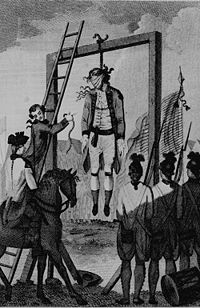
On this date in 1780, the honorable British Major John Andre got what Benedict Arnold had coming to him.
Piqued that his (quite considerable) brilliance in the field did not earn honors he thought his due, General Benedict Arnold contrived to betray West Point to the British during the American Revolution — the plot that made his name a synonym for treachery.
Enter Clinton’s adjutant John Andre, head of British Special Intelligence.
The dashing officer, well-liked in society on either side of the permeable divide between Tories and Patriots on the continent, slipped into Haverstraw, N.Y. to make the arrangements. On his way back — when he already thought himself safely clear of American-held territory — he was nabbed with the incriminating documents.
The narrowly-averted betrayal was mirrored by the narrowest of escapes: luckily for Benedict Arnold, Andre was received in custody by a subordinate officer of his, whose initial report to Arnold alerted the general to his danger and enabled him to escape to the British a whisker ahead of the law.
Treason, of the blackest dye, was yesterday discovered. General Arnold, who commanded at West Point, lost to every sentiment of honor, of private and public obligation, was about to deliver up that important post into the hands of the enemy. Such an event must have given the American cause a dangerous, if not a fatal wound; happily the treason has been timely discovered, to prevent the fatal misfortune. The providential train of circumstances which led to it, afford the most convincing proofs that the liberties of America are the object of Divine protection.
It was a gentlemanly war, and Andre didn’t seem like the guy to hang in the whole exchange. But his argument before a court-martial that he was merely availing “an advantage taken in war” by agreeing to talk to an enemy general who wanted to hand them the keys to a fort didn’t fly: he’d been behind enemy lines, out of uniform, sneaking around. That made him a spy.
And the British refused to obtain Andre’s liberty by trading the man the Americans really wanted to execute.
Instead, by year’s end, the hero of Saratoga was commanding redcoats in the field — perhaps a little nervously; when he asked a captured American what might happen to him should he be taken, the reply was “Cut off your right leg, bury it with full military honors, and then hang the rest of you on a gibbet.”
John Andre was left holding the bag, to the dismay of just about everyone American and British alike. This extended account of the luckless major’s last moments* is from the pen of Continental Army surgeon James Thacher.
Major Andre is no more among the living. I have just witnessed his exit. It was a tragical scene of the deepest interest. During his confinement and trial, he exhibited those proud and elevated sensibilities which designate greatness and dignity of mind. Not a murmur or a sigh ever escaped him, and the civilities and attentions bestowed on him were politely acknowledged…
The fatal hour having arrived, a large detachment of troops was paraded, and an immense concourse of people assembled; almost all our general and field officers, excepting his excellency [George Washington] and his staff, were present on horseback; melancholy and gloom pervaded all ranks, and the scene was affectingly awful … Major Andre walked from the stone house, in which he had been confined, between two of our subaltern officers, arm in arm; the eyes of the immense multitude were fixed on him, who, rising superior to the fears of death, appeared as if conscious of the dignified deportment which he displayed. He betrayed no want of fortitude, but retained a complacent smile on his countenance, and politely bowed to several gentlemen whom he knew, which was respectfully returned. It was his earnest desire to be shot, as being the mode of death most comformable to the feelings of a military man, and he had indulged the hope that his request would be granted. At the moment, therefore, when suddenly he came in view of the gallows, he involuntarily started backward, and made a pause. “Why this emotion, sir?” said an officer by his side. Instantly recovering his composure, he said, “I am reconciled to my death, but I detest the mode.” While waiting and standing near the gallows, I observed some degree of trepidation; placing his foot on a stone, and rolling it over and choking in his throat, as if attempting to swallow. So soon, however, as he perceived that things were in readiness, he stepped quickly into the wagon, and at this moment he appeared to shrink, but instantly elevating his head with firmness, he said, “It will be but a momentary pang,” and taking from his pocket two white handkerchiefs, the provost-marshal, with one, loosely pinioned his arms, and with the other, the victim, after taking off his had and stock, bandaged his own eyes with perfect firmness, which melted the hearts and moistened the cheeks, not only of his servant, but of the throng of spectators. The rope being appended to the gallows, he slipped the noose over his head and adjusted it to his neck, without the assistance of the awkward executioner. Colonel Scammel now informed him that he had an opportunity to speak, if he desired it; he raised the handkerchief from his eyes, and said, “I pray you to bear me witness that I meet my fate like a brave man.” The wagon being now removed from under him, he was suspended, and instantly expired; it proved indeed “but a momentary pang.” He was dressed in his royal regimentals and boots, and his remains, in the same dress, were placed in an ordinary coffin, and interred at the foot of the gallows; and the spot was consecrated by the tears of thousands.
Thus died, in the bloom of life, the accomplished Major Andre, the pride of the royal army, and the valued friend of Sir Henry Clinton. He was about twenty-nine years of age, in his person well proportioned, tall, genteel and graceful. His mien respectable and dignified. His countenance mild, expressive and prepossessing, indicative of an intelligent and amiable mind. … considered as a skilful, brave and enterprising officer, and he is reported to have been benevolent and humane to our people who have been prisoners in New York. … The heart of sensibility mourns when a life of so much worth is sacrified on a gibbet. General Washington was called to discharge a duty from which his soul revolted; and it is asserted that his hand could scarcely command his pen, when signing the warrant for the execution of Major Andre. … Could Arnold have been suspended on the gibbet erected for Andre, not a tear or a sigh would have been produced, but exultation and joy would have been visible on every countenance.
Andre makes a sort of loyalist counterpart to Nathan Hale. Interestingly, Thacher’s account — in which he uses his old diaries for a book that was published in 1823 — footnotes an extended narration of Nathan Hale in a comparative vein, complaining that “whilst almost every historian of the American Revolution has celebrated the virtues and lamented the fate of Andre, Hale has remained unnoticed, and it is scarcely known that such a character ever existed.” Today, in terms of their public recognizability, the two are rather reversed.
* Andre was to have been hanged October 1, but the matter was stayed when a British deputation arrived under flag of truce to make one last parley for their man’s life.
On this date in 1396, Ottoman Sultan Bayezid I put thousands of Christian Crusaders to the sword — and with them, Christians’ zest for holy war against the Turk.
The day after crushing a European Crusading expedition at the Battle of Nicopolis — where Christ’s multinational divisions might have crippled themselves by opting for political reasons to go with gloryhounding French knights’ demand for a heavy cavalry charge as opposed to sneakier tactics — Bayezid was mighty sore to find that the invaders had executed en masse Muslim prisoners from their last engagement.
The defeat was followed by a frightful sequel. As Bajazet toured the battlefield … he was “torn by grief” at the sight of his losses, which outnumbered the Christian. He swore he would not leave their blood unavenged, and the discovery of the massacre of the prisoners of Rachowa augmented his rage. He ordered all prisoners to be brought before him next morning. … [T]he leading nobles … were … spared [for ransom], as well as all those judged to be under twenty for forced service with the Turks.
The rest, an uncertain figure of several thousand, were marched naked before the Sultan, bound together in groups of three or four, with hands tied and ropes around their necks. Bajazet looked at them briefly, then signed to the executioners to set to work. They decapitated the captives group by group, in some cases cut their throats or severed their limbs until corpses and killers alike were awash in blood. [The Christian nobles being spared] were forced to stand by the Sultan and watch the heads of their companions fall under the scimitars and the blood spurt from their headless trunks…. The killing continued from early morning to late afternoon until Bajazet, himself sickened at the sight or, as some say, persuaded by his ministers that too much rage in Christendom would be raised against him, called off the executioners.
In truth, the era of the Crusade as most readily conceived — a bid to conquer the Holy Land — was long past by this time. But it had been under that tattered old banner that Christendom summoned its vassals to check the rising Ottoman Empire, which by this time had reduced Byzantium to a rump state around Constantinople.
The battle that precipitated this day’s* feast of carrion occurred in Bulgaria, where the Turks’ growing European footprint (and this affair essentially pinched out the Bulgarian Empire of the day) exercised the European courts in figurative as well as literal ways. Though other ventures would hoist the crusading pennant, there would be no major offensive incursions against the Turks until “crusades” had fallen well out of fashion.
None of this gory affair is to be confused with Indiana Jones and the Last Crusade, where a leap of faith proved more felicitous.
* Most sources place the Battle of Nicopolis at September 25, although some say September 28 — the latter date would obviously place this massacre on September 29.
On this date in 1776, Revolutionary spy Nathan Hale was hanged by the British in Manhattan — allegedly uttering the immortal last words, “I only regret that I have but one life to lose for my country.”
Nathan Hale statuary (with bound feet and hands) ironically stationed at Washington D.C.’s Department of Justice. Like statues are at the Chicago Tribune building and the Yale University campus; dueling plaques in New York contend to mark the execution spot.
Two years out of Yale when the Revolution broke out in 1775, the Connecticut-born Hale hitched onto the Continental Army and was directly promoted to captain.
When British Gen. William Howe landed at New York in the summer of 1776, Nathan Hale volunteered to slip behind enemy lines and reconnoiter enemy strength for George Washington. It turned out to be his mission into eternity.
As one might suspect, there’s a great deal more to Nathan Hale than his last words — and a fair bit of uncertainty about what his last words really were. Hale’s Wikipedia page retails many versions of the line from many sources.
The sentiment commonly attributed him (formulated in slight variations, e.g., “I only regret that I have but one life to give to my country”) was supposed to have been reported by a British officer attending him; it’s certainly a punchier version than, e.g., a Revolutionary War era report of “I am so satisfied with the cause in which I have engaged, that my only regret is, that I have not more lives than one to offer in its service.” Gah.
If all these presumably paraphrased reports have the gist right, it’s possible the 21-year-old recited an identical sentiment in the tragic play Cato:*
How beautiful is death, when earn’d by virtue!
Who would not be that youth? What pity is it
That we can die but once to serve our country.
There’s much more about this short-lived character and his larger-than-life transfiguration in mythologia Americana. The Library of Congress has a collection of links, and William Phelps recently penned this new (and surprisingly, first) biography of the revolutionary legend.
* The play was all the rage among patriots; Patrick Henry might have plucked his immortal “give me liberty or give me death” line from it, too. (“It is not now time to talk of aught/But chains or conquest, liberty or death.”)
On this date in 1822, four sergeants from La Rochelle were guillotined at the Place de Greve with “Vive la liberte! on their lips for plotting to overthrow the restored Bourbon monarchy.
And in a right-wing reaction following a royal assassination, Louis found himself in the anomalous position of having a government more monarchist than he himself. Though not renowned for his sagacity, the sovereign had the wit to see that completely reversing the Revolution was a nonstarter. His ultra-royalist deputies, however, wanted nothing less than the full restoration of an absolute monarchy.
The Chief Minister [Villele] had the merit of keeping constantly in mind the fact that his friends owed their power to the forces of reaction and alarm, aroused in the country by the dagger of an assassin who had mortally wounded a member of the royal family. To keep this fear awake, in order to establish his authority, was his first care. In this he succeeded. The Liberals, finding themselves compelled to prudence, organized themselves into secret societies; and the Republcians, imitating the Neapolitans, actually formed in 1821 the Charbonnerie francaise, which avowedly aimed at giving back “to the French nation the free exercise of the right to choose its sovereign.” In order to give battle to the ancien regime and its Bourbon protectors, they recruited their soldiers and captains without hesitation from among the officers, commissioned and non-commissioned, of the old Imperial army. Villele showed particular skill in the discovery, exaggeration, and signal punishment of these conspiracies … With a magistracy obedient to its orders, the Ministry devoted itself assiduously to representing isolated movements no sooner known than crushed, as forming part of a permanent conspiracy organized by the Liberals, not only against the monarchy, but against society itself.
Les quatre sergents de La Rochelle — by the names of Bories, Goubin, Pommier and Raoulx — comprised perhaps the most egregious such case.
Driven underground (the link is French) like the rest of the Liberal opposition, they had joined the charbonnerie, a loose network modeled on Naples’ carbonari. (Lower-level officers were prime recruits for the dissidents, since their career prospects were truncated by aristocratic privilege in the upper brass.)
It was never clear that their subversiveness extended to anything beyond their affiliation with a criminalized ideology, and they kept their own peace to protect other associates in the charbonnerie. Guillotining them on this basis conformed neatly to the principles of, say, an Ann Coulter: “We need to execute [these] people … in order to physically intimidate liberals, by making them realize that they can be killed, too. Otherwise, they will turn out to be outright traitors.”
Back to The Cambridge Modern History:
It seemed that the Ministers were eager to multiply these trials and executions. Since certain deputies of the Liberal Opposition, Lafayette* among others, and D’Argenson, had openly associated themselves with these enterprises, which otherwise were devoid of danger, this supplied a fair pretext for exhibiting them publicly as criminals. The indictment with the King’s Procurator, Marchangy, formulated, in order to obtain the condemnation of the four sergeants of La Rochelle, left no doubt as to the intentions of the Government. Its chief aim was to terrorise the French people “by this vast conspiracy against social order, against the families of citizens, which threatened to plunge them once more into all the horrors of anarchy.” While keeping up the appearance of saving society, Villele gained forthwith the power to govern it in accordance with the wishes of his friends. The threat of anarchy, exploited by the judges in his service, allowed him to organise a despotism.
The public execution reportedly had its onlookers appalled, (more French) and as word of the young men’s heroic deaths got around, they elbowed into the vast host of (somebody’s) martyrs. (In Balzac’s Human Comedy, the courtesan Aquilina is said to have been involved with one of the four sergeants; in her appearances after the executions, she always commemorates him by wearing something red.) The Lantern Tower in their garrison’s city — depicted below in a 1927 Paul Signac painting — was renamed in their honor, Tour de Quatre Sergents.
On an uncertain date around this time — sort of — in 46 B.C.E., the Gallic chief Vercingetorix was marched as Julius Caesar’s star captive in Rome, then strangled in prison.
A nobleman who in the course of things would have been destined for that class of domestic elites bought off by Rome for orderly management of conquered provinces, Vercingetorix instead mounted a massive and effective semi-guerrilla resistance. A few months after Caesar had declared “Mission Accomplished” and Gaul at peace, it rose in arms … and, as Vercingetorix rolled out a scorched-earth defense, in flames.
Julius Caesar, then serving a long and lucrative career as Governor of Gaul, managed only with difficulty — and staggering bloodshed — to pacify the province at the Battle of Alesia. It was a signal military engagement in the development of the Roman Empire, cementing Roman power in Gaul for centuries to come.
The wily barbarian’s revolt and the very serious danger it posed to Caesar’s ambitions are the subject of a five-part BBC documentary.
Vercingetorix’s allegedly theatrical surrender to Caesar essentially ended the Gauls stubborn, centuries-long resistance to Roman dominion.
Yes, that’s the Highlander, Christopher Lambert, playing the French Braveheart version of barbarian heroism in Druids. HBO’s series Rome went with a less romantic version:
Either way, the once-intractable province became the bastion from which Caesar would overthrow the foundering Roman Republic.
Political rivals in the capital for whom Caesar’s Gallic campaign was nothing to celebrate denied Caesar a ceremonial Triumph and maneuvered to check the ambitious general. When the conflict came to a head in 49 B.C.E., Caesar’s bold move from the provincial borders of Gaul into Italy — crossing the Rubicon — ignited civil war in Rome.
Vercingetorix languished in Roman chains all along, until Caesar finally mopped up his enemies in the field and returned to Rome, where he celebrated an extravagant quadruple Triumph for his various military achievements.
when he returned to Rome he had four triumphs together: one for his Gallic wars, in which he had added many great nations to the Roman sway and subdued others that had revolted; one for the Pontic war against Pharnaces;* one for the war in Africa against the African allies of L. Scipio, in which the historian Juba (the son of King Juba), then an infant, was led a captive. Between the Gallic and the Pontic triumphs he introduced a kind of Egyptian triumph, in which he led some captives taken in the naval engagement on the Nile.** Although he took care not to inscribe any Roman names in his triumph (as it would have been unseemly in his eyes and base and inauspicious in those of the Roman people to triumph over fellow-citizens), yet all these misfortunes were represented in the processions and the men also by various images and pictures, all except Pompey, whom alone he did not venture to exhibit, since he was still greatly regretted by all. The people, although restrained by fear, groaned over their domestic ills, especially when they saw the picture of Lucius Scipio, the general-in-chief, wounded in the breast by his own hand, casting himself into the sea, and Petreius committing self-destruction at the banquet, and Cato torn apart by himself like a wild beast. They applauded the death of Achillas and Pothinus, and laughed at the flight of Pharnaces.
It is said that money to the amount of 60,500 silver talents was borne in the procession and 2822 crowns of gold weighing 20,414 pounds, from which wealth Caesar made apportionments immediately after the triumph, paying the army all that he had promised and more. Each soldier received 5000 Attic drachmas, each centurion double, and each tribune of infantry and perfect of cavalry fourfold that sum. To each plebeian citizen also was given an Attic mina. He gave also various spectacles with horses and music, a combat of foot-soldiers, 1000 on each side, and a cavalry fight of 200 on each side. There was also another combat of horse and foot together. There was a combat of elephants, twenty against twenty, and a naval engagement of 4000 oarsmen, where 1000 fighting men contended on each side. He erected the temple to Venus, his ancestress, as he had vowed to do when he was about to begin the Battle of Pharsalus, and he laid out ground around the temple which he intended to be a forum for the Roman people, not for buying and selling, but a meeting-place for the transaction of public business, like the public squares of the Persians, where the people assemble to seek justice or to learn the laws. He placed a beautiful image of Cleopatra by the side of the goddess, which stands there to this day. He caused an enumeration of the people to be made, and it is said that it was found to be only one half of the number existing before this war.
War is hell.
At the Gallic triumph, Vercingetorix — by far the most fearsome enemy Caesar had to display vis-a-vis a five-year-old child and the sister of his lover — was at last the center of attention again for a day. Still defiant, he was marched through the Eternal City, then strangled at the Tullianum, or Mamertine Prison.
But which day? The bare fact is that we just don’t know, but this one has more than the typical imprecision that characterizes dating ancient events. This footnote on a page about Egyptian royalty grapples with the timing.
four times in one month, each Triumph succeeding the former by an interval of a few days.
Since Cassius Dio claims that Caesar dedicated the Temple of Venus (datable to late September of 46) on the last day of the last Triumph, that presumably makes September the “one month” of the various celebrations.
That’s about as close as it gets, but even “September” comes with a caveat. During his few months in Rome between campaigns, Caesar accomplished a frenetic civil agenda (it helps to be dictator). Perhaps none is of such recognizable consequence for posterity as reform of the wacky solar-lunar hybrid Roman calendar — and 46 B.C.E. was the very year he implemented it.
Disdaining incrementalism, Caesar tackled the mess the Roman calendar had become at once, by stuffing the year 46 up to 445 days. As a result, 365 days after the execution of Vercingetorix was not September of 45, but July (or possibly June) — and those months are sometimes given for the dates of Caesar’s Triumphs on this basis. Since Caesar actually won his decisive battle in April of 46 B.C.E. and returned to Rome that July, the potential for confusion multiplies: if you’re not accounting for the exceptional calendar, July Triumphs appear initially plausible.
It is here that one beholds the essential subjectivity behind a putatively mechanistic device like a calendar: if Vercingetorix was executed in spring or summer, was he executed in September?
Whenever it was that he was throttled in the Mamertine, Vercingetorix did not go quietly. If his cause of resistance to Roman authority was doomed for the time being, the eternal allure of rebellion — and, as the Gallic lands later germinated France, the proto-nationalism of his cause — secured him his own symbolic immortality.
Napoleon III, with his complex relationship to the Gallic and Italic dreams of another age, was just the man to put up this statue of Vercingetorix where the barbarian was thought to have made his last stand. Its inscription reads:
La Gaule unie
Formant une seule nation
Animée d’un même esprit,
Peut défier l’Univers.




 As the scheme ripened, the turncoat asked

 In the

