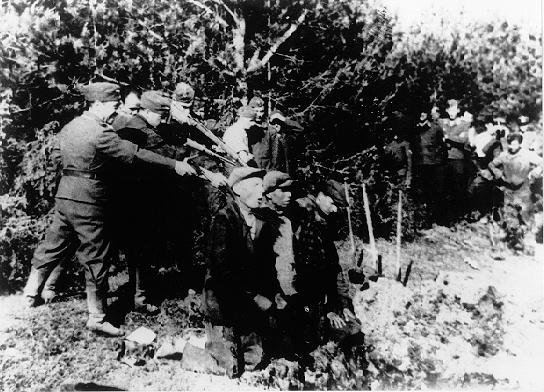
1942: Partisans by the Sonderbataillon Dirlewanger

On an uncertain date in November 1942, this photograph of an SS unit executing anti-Nazi partisans in Belarus was taken.

Behind this striking but all too typical image of brutal field executions on the eastern front lies the sordid story of one of the strangest military formations in the Nazi service.

The Dirlewanger brigade was formed under a man whose fortuitous early enrollment in the NSDAP had enabled him to pull strings to get himself out of Dachau, where he had been sent after his second molestation conviction, and where unfolding events could have easily seen him on the other end of the firing squad.

Instead, Oskar Dirlewanger formed a unit of criminals and reprobates: poachers at first, and eventually, as it grew into the SS-Sonderbatallion Dirlewanger, men culled from the camps or soldiers condemned by the army, some literally trading the likelihood of execution themselves for service under one of the most disreputable commanders in the field.

Oh, and, just incidentally — it stuck them into a lawless environment where they could probably practice and refine their pathologies unchecked. Some “rehabilitation.”

As of this relatively early date, the convict floodgates weren’t yet entirely open, and the existing German volunteers were supplemented by a goodly portion of Soviet citizens recruited in the occupied territories. From 1942 to 1944, they hung around Belarus hunting guerrillas and doing to them — well, you know. (The original notion of using poachers was to exploit their ranger-like woodsman talents for anti-partisan warfare.)

Oh, and civilians. Tens of thousands of civilians. That almost goes without saying.

Sadly for Dr. Dirlewanger, events further south were undoing all his bloody work, for it was also in the November 1942 that the Red Army decisively turned the tide of the war with its counterattack at Stalingrad — in fact, it was this very date in 1942 that it completed its encirclement, stranding a quarter-million freezing Wehrmacht regulars on the banks of the Volga, only a handful ever to see Germany again.

The Dirlewanger brigade would have its own turn being minced by the Soviet war machine, though not before it had a notorious hand in drowning the Warsaw Uprising in blood.

Dirlewanger himself was tortured to death by Polish guards a few weeks after the war ended.

Part of the Themed Set: The “Ex” Stands For “Extrajudicial”.

On this day..

284: Aper, by Diocletian

On this date* in 284, one of Rome’s greatest emperors claimed the purple by summarily executing his rival before the approving army in Anatolia.

The Emperor Diocletian christened his reign with a bit of scaffold theatricality, but he might have been the real perp.

For half a century, the Roman Empire had waded through crisis. In its political manifestation, a parade of forgettable emperors had marched through the throne room, each to be assassinated, overthrown, or otherwise disposed of by some equally forgettable aspirant en route to a similarly unenviable end.

At length, out of this unpropitious bunch, rose one Diocles, a low-born Dalmatian of classical education whose martial gifts saw him rise through the legions. His opportunity came when the emperor Carus, barely a year on from succeeding his assassinated predecessor, died on campaign against Persia allegedly struck by lightning (quite possibly a euphemism for something more dagger-like), leaving his son Numerian in charge.

As the army meandered back to the friendly confines, Numerian secluded himself in his litter. And after a while, the litter started to stink.

Sometime on the journey, he’d been secretly killed — but by whom?

The principals this day are our leading suspects. (And it’s a little mystifying in either case just what was gained by leaving the body hidden so long.) We turn to Gibbon to narrate what must have been a riveting — not to mention definitive — proceeding adjudicating between them a few kilometers past Nicomedia (moder Izmit, Turkey) towards Chalcedon (now the Kadikoy district of Istanbul).

A general assembly of the army was appointed to be held at Chalcedon, whither Aper was transported in chains, as a prisoner and a criminal. A vacant tribunal was erected in the midst of the camp, and the generals and tribunes formed a great military council. They soon announced to the multitude that their choice had fallen on Diocletian, commander of the domestics or body-guards, as the person the most capable of revenging and succeeding their beloved emperor. The future fortunes of the candidate depended on the chance or conduct of the present hour. Conscious that the station which he had filled exposed him to some suspicions, Diocletian ascended the tribunal, and raising his eyes towards the Sun, made a solemn profession of his own innocence, in the presence of that all-seeing Deity. Then, assuming the tone of a sovereign and a judge, he commanded that Aper should be brought in chains to the foot of the tribunal. “This man,” said he, “is the murderer of Numerian;” and without giving him time to enter on a dangerous justification, drew his sword, and buried it in the breast of the unfortunate praefect.** A charge supported by such decisive proof was admitted without contradiction, and the legions, with repeated acclamations, acknowledged the justice and authority of the emperor Diocletian.

Though there isn’t any direct evidence of it, posterity is entitled to suspect on grounds of means, motive and opportunity, that the eventual beneficiary of Numerian’s demise — the emperor henceforth known as Diocletian — was its true author.

Whether obtained by fair means or foul, Diocletian put the laurels of state to good use, stabilizing government by introducing the “Tetrarchy” — the rule of the empire’s eastern and western halves by two emperors (“Augusti”) each aided by a “Caesar” who was also the heir apparent.

Diocletian’s two decades in power before his anomalous voluntary retirement constitute a watershed in the late history of Rome, and not only because the cycle of imperial assassinations and civil war took a welcome generation-long hiatus.

Although he’s also remembered for initiating the last major persecution of Christians, his administration set the stage for the rise of Constantine the Great, the Galilean’s first imperial champion. Constantine’s father was one of the original tetrarchs, the Caesar of the west.

And in the longer term, Diocletian’s division of the empire between east and west would sow the seed of the later separation of Byzantium and Rome, and the corresponding division in the Christian world. No surprise, then, that the first ruler profiled in Lars Brownworth’s 12 Byzantine Rulers podcast is this date’s executioner:

[audio:http://www.12byzantinerulers.com/audio/02-Diocletian.mp3]

More audiophilia about Diocletian and the tetrarchs in this lecture from Isabelle Pafford’s UC-Berkeley course on Roman history. (The first 6:45 or so consists of class business and carryover from previous lectures.)

[audio:http://webcast.berkeley.edu/media/s2008/hist106b/hist106b_20080425.mp3]

* As with much in the ancient world, sourcing is tenuous, and there is some scholarly debate over whether the events in this post should be ascribed to November 20, or to November 17, or to September 17, or to some other date. Since this blog, notwithstanding its title, embraces the occasional execution whose date is uncertain, I am prepared to wave aside textual uncertainty in the interest of a ripping good story.

** According to the Historia Augusta, Diocletian had a superstitious reason to carry out this bloodthirsty act personally.

This story my grandfather related to me, having heard it from Diocletian himself. “When Diocletian,” he said, “while still serving in a minor post, was stopping at a certain tavern in the land of the Tungri in Gaul, and was making up his daily reckoning with a woman, who was a Druidess, she said to him, ‘Diocletian, you are far too greedy and far too stingy,’ to which Diocletian replied, it is said, not in earnest, but only in jest, ‘I shall be generous enough when I become emperor.’ At this the Druidess said, so he related, ‘Do not jest, Diocletian, for you will become emperor when you have slain a Boar (Latin: Aper).’ ” … It is now well known and a common story that when he had killed Aper, the prefect of the guard, he declared, it is said, “At last I have killed my fated Boar.” My grandfather also used to say that Diocletian himself declared that he had no other reason for killing him with his own hand than to fulfill the Druidess’ prophecy and to ensure his own rule. For he would not have wished to become known for such cruelty, especially in the first few days of his power, if Fate had not impelled him to this brutal act of murder.

Part of the Themed Set: The “Ex” Stands For “Extrajudicial”.

On this day..

1869: Hamiora Pere, Maori “traitor” to the Queen

On this date in 1869, Hamiora Pere became the only New Zealander ever executed for treason.

Maurice Shadbolt’s Season of the Jew is a historical novel of the conflict that doomed Hamiora Pere. It’s told from the standpoint of Te Kooti, who liked to compare the Maori cause to that of the Israelites resisting Egypt, and founded a religious sect that still persists today.

Pere* came by the distinction quite accidentally — even setting aside the queer circumstance of his “betraying” a state on the opposite side of the globe by resisting its claim to his ancestral homeland.

Hamiora Pere was one of five Maori prisoners from the Siege of Ngatapa during Te Kooti’s War — an indigenous resistance against British colonization — to face the fatal charge.

The crown handled these cases carefully.

Though all five men drew death sentences (mandatory for treason), the government was evidently trying to stay out of the martyr-making business — as revealed by a judge’s comment during official deliberations.

I believe the result is the very best that could have been arrived at. I am glad to know that Mr McLean thinks that one execution will be useful as more would have been by way of example and caution.

Unfortunately for Hamiora Pere, the one of those five who was most likely set up to be the “example,” Wi Tamararo, committed suicide in prison shortly after his sentence.

Pere seemingly became the next in line for hanging because he was associated with murders in a noteworthy massacre at Matawhero that slew 33 Europeans and 37 of their Maori allies. Notably, however, the charge of murder actually filed against him was dropped prior to trial since he could be placed at the scene of the attack, but not directly shown to have killed anyone. Even off the indictment, it may have been the thing that doomed him.

Whatever the nature of the deliberations — and this report (pdf) of New Zealand’s Waitangi Tribunal inconclusively attempts to unpack the story with the patchy evidence available — the remaining convicts got clemency. Four years later, they were pardoned outright.

Pere got the noose at Wellington, and the accidental historical footnote. He would seem destined to maintain his unusual distinction indefinitely, since New Zealand has abolished the death penalty altogether.

Fear of Death

It is the circumstantial distinction of his case that earns Pere his place in this blog out of the numberless thousands to meet his same fate.

But in the end, he faced the gallows in that existential nakedness common to all us mortal wretches beholding death. Many in these pages meet their ceremonial end with with bravado; Hamiora Pere, by contrast, suffered all the pitiably human torments of fear, according to the report of the Daily Southern Cross:

He received the notice of his approaching death with calmness, and it was not until the morning before the execution that he gave any outward sign that he realised his terrible position. … [after his last farewell with his family he] became terribly distressed. He evidently fully recognised his position; he knew that he had looked for the last time on those from whom only he had any right to expect sympathy; every incident was reminding him how rapidly his term of life was decreasing, and it was not until his spiritual adviser … had been with him some time, that he became more composed.

…

[on the morning of the execution, Pere’s] responses [to his spiritual advisor] were accompanied by a peculiar moaning, and by convulsive sobbing. … the prisoner, quite a young man, and with nothing in his general appearance worthy of special remark, was sobbing bitterly, and was evidently suffering from intense mental agony; he looked anxiously around, yet stood firm and erect while he was being pinioned, repeating, as well as his trembling voice would allow, the prayers that were being offered on his behalf. … At the foot of the steps [to the gallows] the prisoner halted a moment, but, being led up, was quickly placed in the centre of the platform, under the noose, which was immediately fixed round his neck. From the time the prisoner left his room, until the rope was adjusted, he continued praying in a low moaning tone, interrupted frequently by violent sobbing …

* Also spelled “Peri” and, occasionally, “Pera”.

On this day..

1944: Hannah Szenes, who gambled on what mattered most

On this date in 1944, Hannah Szenes was shot by the Nazis in her native city of Budapest — a city she had left five years before, and to which she had returned as a British special operative.

Hannah Szenes (alternatively, “Chana Senesh” or “Hannah Senesh”) grew up in interwar Hungary.

Reaching adulthood in a period of rising anti-semitism in the late 1930’s, she became a Zionist and emigrated to British-controlled Palestine.

But with the onset of war, she signed up with the British Special Operations Executive and was parachuted behind German lines in March 1944.

Her brief: to save both Jews and downed Allied pilots. It is often described as the only military expedition to relieve European Jewry during World War II.

And it was as dangerous as it sounds.

[flv:http://www.blessedisthematch.com/BITMclip4.flv 425 344]

Hannah was nabbed crossing into Hungary on a mission that her colleagues (rightly, it seems) deemed too perilous to attempt, and withstood months of torture without divulging her codes.

By the time she went in the dock for treason, Nazi control of Hungary was collapsing and judicial administration itself was breaking down to the timpani of falling shells. Her sentencing November 4 was postponed; on November 7, an officer peremptorily informed her that she had been condemned to death. It’s believed that she was actually never formally sentenced, merely mopped up ahead of the unstoppable Red Army, which on this very day first entered Budapest’s suburbs.

A writer as well as a fighter, Szenes’ poetry survived as her monument to life — like the present-day Israeli standard “Blessed is the Match”, also the title of the documentary excerpted above; and, her “Halikha LeKesariya” (“A Walk to Caesarea”), also known as “Eli, Eli” (“My God, My God”). Here it is sung by Regina Spektor.

These lines were reportedly her last-known verses from prison:

One – two – three … eight feet long
Two strides across, the rest is dark …
Life is a fleeting question mark
One – two – three … maybe another week.
Or the next month may still find me here,
But death, I feel is very near.
I could have been 23 next July
I gambled on what mattered most, the dice were cast. I lost.

On this day..

1730: Hans Hermann von Katte, Frederick the Great’s lover

On this date in 1730, Prussia’s greatest king watched his boyhood lover put to death at his father’s order.

Happy families are all alike; every unhappy family is unhappy in its own way. Most of those ways were explored at some point by a Hohenzollern.

The 18-year-old prince Frederick had a thoroughly frosty relationship with the old man. Surly Frederick William I — “the soldier king” — didn’t have much use for his sensitive, music-loving son. An “effeminate fool,” dad thought the boy, and did not scruple to beat him publicly as he forcibly molded the unwilling heir into a military man.

Now, blue bloods have often had rocky relationships with their sires, but running away is not the usual option for a prince of the realm.

But Frederick contrived to hit the bricks, and 26-year-old officer Hans Hermann von Katte had the bad luck to be his best friend (and presumed homosexual lover). When Frederick turned to him for help, they started plotting flight.

Both were apprehended and imprisoned, and Frederick was himself in some danger of being executed by command of his own father. Dad softened up enough to keep his son’s head attached to his shoulders.

Von Katte wasn’t so lucky: sentenced only to imprisonment, the verdict was upgraded by the vindictive monarch — and as part of Frederick William’s ongoing project to break his son, he made the kid watch his friend’s beheading from close enough proximity to beg (and receive) von Katte’s forgiveness.

Here’s a melodramatic interpretation from a short film called Der Tod des Hans Hermann von Katte:

Frederick spent the next decade under the father’s thumb, chafing but bending himself to the austere demands of Prussian statecraft.

Well did he absorb them, for upon succeeding in 1740, he far surpassed his father in the martial pursuits, and for the half-century span of his reign was Europe’s acknowledged battlefield master. Known to posterity as Frederich the Great — and more familiarly as der alte Fritz, “old Fritz” — his augmentation of the empire vaulted Prussia into Europe’s great powers club and set the stage for German unification.

[flv:http://play-mcvideos.howstuffworks.com/2008-07/31/12211.flv 425 344]

Frederick scarcely ever spoke again of von Katte, but neither did he lose his native intelligence, and he kept up a long-running correspondence with Voltaire.

It gives an achingly tragic cast to the boy who suffered the horrible loss of his intimate this day — who dutifully delivered to his country genius as a commander and statesman, at the uncomplaining sacrifice of the life he yearned to lead.

UC-Berkeley professor Margaret Anderson’s wonderful “Rise and Fall of the Second Reich” course podcast situates Frederick in the arc of Prussia’s development out of the Middle Ages —

[audio:http://webcast.berkeley.edu/media/f2007/hist167b/hist167b_20070904.mp3]

— and treats his adroit foreign policy and active mind in the age of the Enlightenment.

[audio:http://webcast.berkeley.edu/media/f2007/hist167b/hist167b_20070906.mp3]

On this day..

1941: Arndt Pekurinen, conscientious objector

On this date in 1941, Finnish pacifist Arndt Pekurinen was executed at the front for refusing to fight.

Initially conscripted in the 1920’s, Pekurinen had refused to serve under arms and spent 1929-31 in prison for his troubles. He was a minor cause celebre; British MPs and big international names like Einstein and H.G. Wells pressed for his release.

A change in the Finnish conscription law — the bill was called the “Lex Pekurinen” — finally saw him freed to civilian life, but he was drafted anew to fight the Soviet Union in the “Continuation War”. When he again refused, he was shot at Suomussalmi without trial — though two men refused to do it before someone finally agreed to be the executioner.

“Kun ihmisiä ei syödä, on niitä turha teurastaa.”
(“As people are not eaten, butchering them is of no use.”)

A neglected figure during the Cold War, he’s enjoyed a latter-day rediscovery since the 1998 Erno Paasilinna book Courage: The life and execution of Arndt Pekurinen. In the decade since, Pekurinen has become a household name and a widely-admired figure. (The link is in Finnish.) A park in Helsinki was recently named for him. (Finnish again.)

Tangentially, the Nordic stock of our day’s victim and his era of militarism call to mind the hero of e.e. cummings’ “i sing of Olaf glad and big”. The allusions of this poem are American, and there’s no reason to associate it directly with Pekurinen — but it so happens that it was published in 1931, the year international pressure forced the end of Pekunin’s first prison stint:

i sing of Olaf glad and big
whose warmest heart recoiled at war:
a conscientious object-or

his wellbelovéd colonel(trig
westpointer most succinctly bred)
took erring Olaf soon in hand;
but–though an host of overjoyed
noncoms(first knocking on the head
him)do through icy waters roll
that helplessness which others stroke
with brushes recently employed
anent this muddy toiletbowl,
while kindred intellects evoke
allegiance per blunt instruments–
Olaf(being to all intents
a corpse and wanting any rag
upon what God unto him gave)
responds,without getting annoyed
“I will not kiss your fucking flag”

straightway the silver bird looked grave
(departing hurriedly to shave)

but–though all kinds of officers
(a yearning nation’s blueeyed pride)
their passive prey did kick and curse
until for wear their clarion
voices and boots were much the worse,
and egged the firstclassprivates on
his rectum wickedly to tease
by means of skilfully applied
bayonets roasted hot with heat–
Olaf(upon what were once knees)
does almost ceaselessly repeat
“there is some shit I will not eat”

our president,being of which
assertions duly notified
threw the yellowsonofabitch
into a dungeon,where he died

Christ(of His mercy infinite)
i pray to see;and Olaf,too

preponderatingly because
unless statistics lie he was
more brave than me:more blond than you.

On this day..

1841: Hermano Pule and his surviving followers

On this date in 1841, Apolinario de la Cruz was shot at Tayabas for leading a revolt against Spanish occupation of the Philippines.

Known to history as Hermano Pule, the young de la Cruz had dreamt of entering the priesthood — but finding that most barred native Filipinos, he founded the Cofradia de San José (Confraternity of St. Joseph).

Organizing secretly and outside of the approved channels, it gained the enmity of both civilian and religious authorities, though it doesn’t on the surface look like a seditious entity; rather, it attracted Filipinos (and Filipinas) excluded from the official organs. Suddenly, that looked like trouble to Spain.

Condemnation helped the Confradia’s numbers burgeon, and forced its programme towards radicalism: where freedom of religion was forbidden, worship was a revolutionary act.

Matters came to a head when a government raid precipitated armed resistance by Pule and his followers, with the inevitable closing act postponed by an inspiring but short-lived rebel victory at arms. Pule and his followers were overrun on Nov. 1, rounded up as fugitives by the next day, and put to death outside the Tayabas courthouse — with Pule’s head, hands and feet cut off for salutary public display in his adjacent hometown of Lucban (or Lukban).

On this day..

1618: Walter Raleigh, age of exploration adventurer

On this date in 1618, schemer, explorer, and lover Walter Raleigh fell permanently out of favor.

One of the biggest wheels of Elizabethan England, Raleigh (who also rendered his name Rawleigh, Rawley, and most commonly, Ralegh) charmed his way into the Queen’s inner circle, and possibly her pants, and was even thought to be a contender for her hand.

In between gorging on royal monopolies, scribbling poetry, popularizing tobacco, and introducing the potato to Ireland [allegedly], Raleigh got his New World on by attempting to colonize Virginia,* helping fund it with privateering operations against England’s rivals in the land-grab game. The city of Raleigh, North Carolina — present-day North Carolina was part of the Virginia Colony back in the day — is named for him.

Proud, powerful, and the queenie’s pet. Just the sort of courtier other noble suckups loved to hate.

When the palace fave secretly dallied with one of the Queen’s ladies-in-waiting, he went on the royal outs and got real familiar with the Tower of London. Though he managed to patch up with Elizabeth, things were never quite the same for Sir Walter. Elizabeth’s successor James I put him back in prison (suspending a death sentence) for supposedly participating in the Main Plot.

Raleigh passed the time under lock and key burnishing his Renaissance man rep by writing various poetry and treatises, including an account of his voyage to Guyana. Convinced the legendary city of El Dorado was in the vicinity, Raleigh eventually prevailed upon James to release him to make another run at it.

But a dust-up with a Spanish outpost in South America left his son dead, and the Spanish ambassador hopping mad. Raleigh was arrested upon his return, and the death sentence reinstated.

At 66 years of age or so, Walter Raleigh had had a pretty good run.

He took his punishment with equanimity, writing tenderly to his wife, and examining the blade that would take off his head on the scaffold with the observation,

“This is a sharp Medicine, but it is a Physician for all Diseases.”

His wife creepily kept the severed head for the remaining 29 years of her life.

There’s a more detailed tour of Raleigh’s life here, and a site linking many works by and about Raleigh here.

* As Governor of Virginia, Raleigh forbade injuring Indians on pain of death, according to Giles Milton’s Big Chief Elizabeth. Raleigh’s “imperialism with a human face” policy had exchange programs of Indians visiting England, most notably Pocahontas.

On this day..

1864: Klatsassin and four fellow Tsilhqot’ins

On this date in 1864, five Tsilhqot’in warriors were hanged as common criminals in Quesnel, British Columbia, for resisting white incursion during the Chilcotin War.

The only possibly authentic image of Klatsassin extant. (From this image archive.)

An indigenous nation in northern B.C., the Tsilhqot’in or Chilcotin* had been relatively insulated — though not completely isolated; they had well-established fur-trading contacts from the early 19th century — from the colonization that had swept the continent over the preceding centuries.

In 1862, two cataclysms turned that world upside down.

First, a smallpox epidemic sweeping out of mining camps decimated the Tsilhqot’in population.

Second, gold was discovered in the adjacent inland Cariboo region — and the ensuing gold rush to the inaccessible vein saw whites laying multiple roads through Tsilhqot’in territory. At least one of the entrepreneurs racing to complete the first road might have exploited tribal labor and forced women into prostitution.

The specific internal mechanisms and deliberations that triggered the response are lost to us, but the community must have felt itself under siege — and certainly the building projects, unchecked, would serve to project crown authority into the tribal land. The roads, too, are a specific trigger in the European encounter with North American natives. If it had not been gold, it would have been something else, and soon.

The Chilcotin War or Chilcotin Uprising erupted in April 1864 when a Tsilhqot’in party slew a civilian road-building crew. Bloodthirsty rumors (sometimes unreliable) of Indian atrocities quickly set abroad in the colonial capitals.

Despite almost limitless land to disappear into, the leader, Klatsassin (or Klattasine, or Klatsassan), was captured that August with seven of his followers by the expedient of luring him under assurance that they would be treated as prisoners of war.

Instead, they were tried as common murderers. Five were condemned — including both Klatsassin and his son. (Two others were arrested the following year, and one of them hanged as well.)

In 1993, the government of British Columbia apologized for the executions.

There’s an out-of-print (but available used) book, The Chilcotin War by a descendant of one of the whites killed in it. Several links in this piece go to the excellent canadianmysteries.ca site on this incident, which contains a trove of text from primary documents of the time.

And “Canadian Mysteries” is the apt title. “Klatsassin,” in the native tongue, simply means, “we do not know his name.”


The peak in the center of this photograph is “Mount Klattasine,” and the glacier stretching towards the upper right is also named for the hanged war chief.

* Many other transliterations are possible: e.g., Tsilqut’in, T?inlhqot’in, Chilkhodin, Tsilkótin, Tsilkotin.

On this day..

1865: Champ Ferguson, Confederate guerrilla

On this date in 1865, Champ Ferguson was controversially hanged at Nashville for the “murders” he committed as a Confederate guerrilla.

There seems to be some slight difference of opinion (and do click that link) over Champ‘s role in the War Between the States.

Had the Confederate cause prevailed, he probably would have been a hero. Since history is written by the winners … here he is instead.

For reasons that lie in the uncertain junction between personal enmity and sectional loyalty, the war’s start saw Ferguson terrorizing Union supporters in the Kentucky-Tennessee borderlands, operating primarily around Sparta, Tenn.

These were not only state borders, but borders between the rival federal and Confederate territories. Civil War borders, obviously, were hazy and violently contested affairs: Kentucky was northern-controlled but claimed by both sides (it had rival governments); Tennessee seceded only after Fort Sumter.

Loyalties within Kentucky and Tennessee were divided as well. Ferguson’s own brother died fighting for the Union, and his cousin was killed by Ferguson’s own men. But the main battles were fought far away, leaving the conflict to play out locally.

In many cases … guerrillas identifying with the Confederacy operated well outside Confederate lines and Confederate control, leading to a certain ambiguity in official attitudes, since they did have their uses.

…

Guerrilla activity was … a feature of those up-country or back-country areas of states like North Carolina, Georgia, Alabama, Tennessee and Kentucky, in which there were significant internal divisions in terms of sympathy for Confederacy or Union … guerrilla conflict was the only direct face of war experienced by many in Tennessee and Kentucky, since the movements of the main armies remained distant from them throughout. Unionist guerrillas, for example, controlled many of the counties of eastern Tennessee, while Confederate guerrillas disputed Union control of western Kentucky and middle Tennessee. One of the ironies of the situation in the Appalachians, the Cumberlands and the Ozarks was that, while these areas of rugged terrain were favoured by Confederate guerrillas, they were also the very areas within the Confederacy which most Union sympathisers inhabited

-Ian Beckett, Modern Insurgencies and Counter-Insurgencies

That was Ferguson — a “legendary Confederate partisan and guerrilla” or little better than a bandit, depending on your point of view. Either way, he was feared by area Unionists and renowned for killing prisoners. Stories of his savagery — severing heads and the like — made the rounds. Ferguson would argue (and did) that he did nothing his enemies weren’t also doing. (The New York Times printed a lengthy account (.pdf) of Ferguson’s versions of the many killings he was accused of — disputing some, frankly acknowledging many.)

That brings us back to winners and losers.

Ferguson, of course, got the losers’ treatment after the war; while vendettas against rank and file Confederate officers were not on the agenda, Ferguson’s irregular status and unbecoming reputation set him up for a war crimes trial. All attempts to claim wartime protections were rejected.

The Times account of his hanging this day — witnessed by his wife and 16-year-old daughter; their alleged rape is sometimes given as the reason for Ferguson’s campaign — is picturesque. (.pdf)

He stood composedly on the drop some twenty minutes, while the charges, specifications and sentence were read by Col. Shafter. He nodded recognition to several persons in the crowd, and shifted his position in an impatient manner while the sentence was being read. To some specifications he inclined his head in assent. To others he shook his head. That about Elam Huddleston caused him to say, “I can tell it better than that.” When the speaker read, “To all of which the prisoner pleads not guilty,” he said, “I don’t now.”


An 1865 Harper’s illustration of the hanging. See the way the troops surround the scaffold? There’s a bit of folklore that the military did that in order to fake the hanging and cut him down still alive.

Along with Henry Wirz, commandant of the notorious Confederate prison Andersonville, Ferguson was the only Confederate executed for Civil War “war crimes.”

Arguably somewhat neglected as a Civil War figure, Ferguson still has a few books detailing his life. An interview with the a author of the newly-published Cumberland Blood: Champ Ferguson’s Civil War is here.

A few books about Champ Ferguson

On this day..