On an unknown date in (perhaps) the 860s, Norse raider Ragnar Lodbrok (or Ragnar Lothbrok) was allegedly put to death in the Indiana Jones-esque manner of being cast into a pit of snakes.
Ragnar is a half-legendary character who plundered France and Britain in the mid-ninth century, the heyday of Viking marauders; he’s also the lead character of the cable TV series Vikings.
He’s known from Scandinavian sagas, like the Ragnarssona Þattr, which describes Ragnar’s final battle after shipwrecking in Northumbria.
At that time, there was a king called Ælla ruling over Northumbria in England. And when he learns that raiders have come to his kingdom, he musters a mighty force and marches against Ragnar with an overwhelming host, and hard and terrible battle ensues. King Ragnar was clad in the silken jacket Aslaug had given him at their parting. But as the defending army was so big that nothing could withstand them, so almost all his men were killed, but he himself charged four times through the ranks of King Aella, and iron just glanced off his silk shirt. Finally he was taken captive and put in a snake-pit, but the snakes wouldn’t come near him. King Aella had seen during the day, as they fought, that iron didn’t bite him, and now the snakes won’t harm him. So he had him stripped of the clothes that he’d been wearing on the day, and at once snakes were hanging off him on all sides, and he left his life there with much courage.
Here’s Ernest Borgnine as Ragnar in the 1958 film The Vikings, dying in a pit full of wild dogs, not snakes. Well, it’s the same animal kingdom.
“How the little pigs would grunt if they knew how the old boar suffers!” he’s supposed to have exclaimed, keeping to the nature theme.
Although Vikings didn’t really seem to need a casus belli to pillage England, the little pigs would in fact do some serious grunting when they found out about the boar: Ragnar’s sons punitive sorties against England martyred the Christian king St. Edmund.
Update: When this post was first written in 2011, information about this distant Viking captain was not all that plentiful. Ragnar’s starring turn in a TV serial since that time has somewhat broadened his cultural footprint.
(There’s a BBC page preserving a good deal of the original coverage here.)
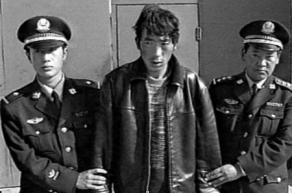
Loyak, one of those executed Oct. 20, 2009.
The two most prominent prisoners — in fact, the only two confirmed in some of the first media reports — were Lhasa residents Lobsang Gyaltsen and Loyak. A court spokesperson said both had been “given death penalties had committed extremely serious crimes and have to be executed to assuage the people’s anger.”
Specifically, both had been convicted of torching shops during the Lhasa riots, which arsons both led to deaths.
The other two executed, a woman named Penki (also for arson) and an unnamed man, received less comment, although they might have been executed despite having been condemned only to a “suspended” death sentence, which for China is generally no death sentence at all.
Executions in Tibet turn out to be relatively rare; these were the first known Tibetan executions since early 2003. Widely condemned abroad, this date’s events were barely or not at all reported internally by Chinese state media.
On this date in 1985, poet Benjamin Moloise was hanged in Pretoria for murdering a (black) policeman in apartheid South Africa.
Moloise’s controversial execution occurred in the context of violent resistance to apartheid in South Africa’s black townships and an ultimately fatal crisis for the apartheid state.
The black majority, long treated as second-class citizens by the white powers-that-be, turned to increasingly confrontational tactics aiming to break official power at the township level. Attacks on black officials and police officers who administered state authority at that level were part and parcel.
Moloise was convicted in a plot to kill such an officer in 1983. (The African National Congress claimed responsibility for the killing, and said that Moloise wasn’t involved.)
His hanging approached as the township rising grew into a mass movement that the hardline government of P.W. Botha answered mostly with force* — so, little surprise that Botha spurned both American and Soviet entreaties not to hang Moloise and little surprise that the execution further escalated racial violence.
Furious black protesters rioted in downtown Johannesburg itself, which (like much of white South Africa) had theretofore remained mostly immune to the violence gripping the townships. Here’s a French news report on Moloise’s execution and its aftermath.
All of which dovetailed with a dramatic fall in South Africa’s international position, vividly symbolized by the months-long collapse of the rand — which bled about three-quarters of its value in 1985. International outrage at the blood shed to enforce South Africa’s color line subjected it to a cascade of diplomatic and economic sanctions in the mid-1980s.
Apartheid went out with the Cold War at the end of the decade — vindicating Moloise’s poetic final message, subsequently a staple message at anti-apartheid rallies.
I am proud to be what I am …
The storm of oppression will be followed
By the rain of my blood
I am proud to give my life
My one solitary life.
* It had implemented a state of emergency that very summer. At the same time, Botha pursued tweaks around the edges of apartheid to preserve it: weeding out “petty apartheid” provocations like whites-only/coloreds-only facilities, and implementing a new constitution with a tricameral, race-based parliament.
On this date in 1964, South Vietnam executed a 17-year-old Communist for a plot to assassinate American Secretary of Defense Robert McNamara.
The young electrical worker and Viet Cong urban guerrilla Nguyen Van Troi was nabbed in the spring of 1963 trying to off both McNamara, famous for the megatonnage he would bestow on Southeast Asia, and U.S. ambassador Henry Cabot Lodge, Jr.
(Later, when the South Vietnamese client president whose guests these men ostensibly were was being shot in an armored personnel carrier with the Americans’ blessing, Ngo Dinh Diem might have had cause to wish this youth’s inhospitable gesture had not been undone by his men. Lodge was a particularly vocal advocate in the Kennedy administration for overthrowing Diem.)
For the months leading up to his public shooting, he became an international cause celebre; North Vietnam would later milk his martyrdom with a postage stamp, an award, and numerous public streets.
The international reach of his case was underscored when a Venezuelan revolutionary cell kidnapped an American officer shortly before Troi’s execution, and threatened to shoot him in retaliation. (They didn’t.)
Against this, South Vietnam counterposed the unedifying spectacle of a 17-year-old patriot put to death, energetically declaiming at the stake while cameras rolled,
It is the Americans who have committed aggression on our country, it is they who have been killing our people with planes and bombs…. I have never acted against the will of my people. It is against the Americans that I have taken action.
Naturally, he became a worldwide leftist martyr. There’s an Estadio Nguyen Van Troi in Cuba; American actor Troy Garity, son of Jane Fonda from her “Hanoi Jane” days, is also named for Nguyen Van Troi.
Robert McNamara, meanwhile, had many, many years yet to live, and many, many more Vietnamese deaths to burden his conscience.Troi’s widow wrote a 1965 book about him, out of print but still available on the used book market.
On this date in 1878, “gunfighter” Bill Longley was hanged for murder in Giddings, Texas.
This flim-flam man was an anti-hero of the Wild West, a near-exact caricature of everything disreputable about his milieu. Remorselessly homicidal, virulently racist, and pathologically unfaithful to any bond of honor or friendship: “an idle boaster, a notorious liar and a man of low instinct and habits,” in the estimation of an officer of the army cavalry regiment from which Longley deserted.
And he was a relentless self-promoter pleased to exaggerate both the quantity and the valor of his sixguns’ conquests.
Longley’s end at the end of a rope — for murdering his childhood friend in solidarity with some uncle’s ill-founded grudge — makes a fittingly puerile end to a repulsive career, and not least because Longley’s family later circulated rumors* that Longley had connived with his executioners to escape the noose and been spirited away under a false name.
Recent DNA testing proved that story false, but most of the Longley mythos is regrettably forensic-proof.
The outlaw himself was his own Homer, perhaps consciously playing catch-up with the legendary bandits already afoot in the land.** It’s certainly the case that he was a wanted killer, and a renowned marksman. Upon these gifts, Longley spun preposterous tales of his exploits in 1860s-70s Texas: being shot out of a noose at an attempted lynching;† slaughtering men and women (particularly blacks: his favored prey) in bunches; riding with the Cullen Baker gang; killing people in fair fights and not for their money.
“His hot temper, his fondness for liquor, and unsettled conditions during reconstruction led him to become one of the most daring gunslingers of his day,” is how a Texas state grave marker reckons him, with a warmth the Lone Star State does not reserve for its present-day “daring gunslingers.” No doubt “unsettled conditions” have been involved in many of those crime sprees as well.
Anyway, such of Longley’s record that can be substantiated better resembles a string of ambushes and uncomplicated murders, perpetrated to start with against freedmen during Reconstruction (Longley’s first known killing was of an uppity former slave in 1867, during a highway stickup), and then almost willy-nilly for plunder, race hatred, or personal pique against defenseless targets misfortunate enough to cross his path. His most “romantic” exploit was over a love rivalry … not a Capulet-and-Montague affray, but the killer bursting in on the reverend father of the girl who frustrated his designs, and wasting him with a shotgun.‡ (His actual rival got off with a pistol-whipping.)
Longley’s last arrest in 1877 removed him from these pursuits long enough to burden the local Giddings Tribune (and anybody else who would listen) with a steady supply of letters trumpeting his ferocity … and as his fate became apparent, his eventual treacly and apparently sincere contrition. “My first step was disobedience; next whisky drinking; next, carrying pistols; next, gambling, and then murder, and I suppose the next step will be the gallows.” The classic fall and redemption story.
After an escape attempt and a foiled scheme to bribe the guards, Longley gamely took his redemption in a botched hanging that dropped him so far that his feet reached the ground. The executioners had to muscle the rope back up into the air and keep it there for 11 minutes to get him where he could choke to death.
There’s an excellent HistoryNet article describing “Bloody Bill” Longley’s times and crimes in great detail here. There’s a wee genealogy, including the interesting tidbit that Longley’s father helped bury the dead of Goliad, here.
* Apparent cause of the rumor: the mom couldn’t deal with Longley’s wicked character and dishonorable death, so the family deceived her, even forging letters from “Bill Longley”.
** Most particularly, John Wesley Hardin. Longley eagerly claimed responsibility for killings that might not even have happened, in an apparent attempt to top Hardin’s body count (27 or 28) with his own (allegedly, 32). Just prior to his execution, influenced by redemption or hope for clemency or whatever, Longley downgraded his career notch count to “only” eight.
† This most famous and fantastic of all Longley’s “exploits” seems to be sourced to nobody but Longley himself; notwithstanding that prima facie credibility deficit, it’s still retailed as fact on a number of online Longley bios.
‡ This last episode was among the crimes of Longley’s last three years’ liberty that might have been prevented had not the Lone Star State refused in 1874 to honor a reward posted on the outlaw by that carpetbaggers’ Reconstruction regime. Un-paid, Longley’s captors simply turned him loose instead. That’s federalism at its finest.
This “greatest American short story … a flawless example of American genius” (according to Kurt Vonnegut) was 1890 product of puissant wordsmith Ambrose Bierce.
In this non-chronological story, Peyton Farquhar, “a well to do planter, of an old and highly respected Alabama family,” is entrapped by a Union spy purporting to be a Confederate agent to attempt an act of sabotage in the face of a hanging warning issued by the Union army.
It can be ballparked in late August or early September based on its location in northern Alabama, which essentially didn’t see Civil War activity until the very end of the war. Except, that is, for the maneuvering building up to the Battle of Chickamauga fought just over the border in southeastern Tennessee September 19-20, 1863.* That also squares with seasonal indicators in the text pointing to summer, e.g.: “the flood of last winter had lodged a great quantity of driftwood against the wooden pier at this end of the bridge. It is now dry and would burn like tinder.”
At any rate, the story begins with Farquhar stationed on Owl Creek Bridge awaiting execution … but the rope snaps as he falls, giving him a bid for freedom. As for what happens next: read the story, or take in this economical screen adaptation by French director Robert Enrico aired for American audiences on The Twilight Zone.
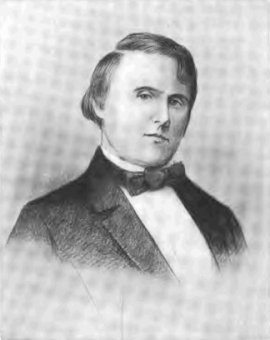
“An American kneels only to his God, and always faces his enemy,”* declared William Logan Crittenden, refusing to kneel before his executioners in Havana this date in 1851.
This well-bred** Kentuckian veteran of the Mexican-American War ditched a New Orleans customs-house gig when Narciso Lopez formed a private filibustering expedition to try to steal Cuba from the Spanish.
Placed at the head of one of Lopez’s three battalions, Crittenden’s force was cut off and overwhelmed by the Spanish. (The detailed progress of the campaign is described here.)
He and 50 of his command captured with him were all ordered for immediate execution, six at a time, as pirates, with just a few hours’ allowance to take down official statements and scribble their hasty goodbyes. With “not the heart to write to any of my family,” Crittenden sent one to a friend giving his farewells … then, just before the end, dashed off another addressed to the Attorney General of the United States — his uncle, John J. Crittenden.†
Dear Uncle: In a few moments some fifty of us will be shot. We came with Lopez. You will do me the justice to believe that my motive was a good one. I was deceived by Lopez — he, as well as the public press,‡ assured me tat the island was in a state of prosperous revolution.
I am commanded to finish writing at once.
Your nephew,
W.L. Crittenden
I will die like a man
(Some other affecting last letters from Crittenden’s party can be perused here.)
All this scene, including a post-mortem mutilation by the enraged mob of onlookers, became a bloody banner for U.S. Southerners — since expanding the slave power was core to the entire filibustering project.
When word of the shootings reached New Orleans, a crowd sacked the Spanish consulate.
But in the international relations game, the U.S. had disavowed filibustering and its raiders enjoyed no special diplomatic protection. When a number of the later prisoners were returned in chains to Spain, the Millard Fillmore administration asked their release, but had no grounds to demand it. It was a touchy diplomatic situation … one that our late Crittenden’s uncle, as a member of cabinet, was right in the middle of.
Fillmore eventually secured the captives’ release, atoning the insult to the European power’s agents by causing the Spanish colors to be saluted in New Orleans in honor of the birth of the Infanta Isabella.
All this mincing instead of brawling struck a certain variety of hothead as distinctly unmanful.
Our flag has been wantonly insulted in the Caribbean sea … captured citizens of our country [were] sent in a slave ship to the coast of Spain, fettered, according to the custom of that inhuman traffic, and released, not as an acknowledgement of wrong on demand of our government, but as a gracious boon accorded to a friendly suit … Whilst the dying words of Crittenden yet rung in the American ear, and the heart turned sickening away from the mutilated remains of his liberty-loving followers; whilst public indignation yet swelled at the torture which had been inflicted on our captive countrymen, even then we were called upon to witness a further manifestation of the truckling spirit of the administration …
William Crittenden’s brother Thomas Theodore Crittenden fought on the Union side of the Civil War, and became Governor of Missouri in 1881. He’s noteworthy for having issued the bounty on outlaw Jesse James that led to the latter’s assassination by Robert Ford.
† Family in the president’s cabinet was just no guarantee of preferential treatment, abroad or at home; just a few years before, a son of the sitting Secretary of War had been hanged at sea for mutiny.
‡ The Spanish press likewise excoriated American yellow journalism in terms that no few present-day scribes would also deserve.
New Orleans papers, there is your work! There is the result of your diragations, of your iniquitous falsehoods, of your placards with large black letters, and your detestable extras … This blood must flow, drop by drop, upon your heads — this blood will torment you in your sleep, for they have lost their lives when you were in security in your houses.
On this date in 1947, three members of an Irgun commando team who had engineered a massive prison break of Zionist terrorists were hanged for the affair.
A team of guerrillas attacked the prison from the outside, coordinating with imprisoned Irgun and Stern Gang operatives who had explosives smuggled into their cells to help detonate their way through the walls. Hundreds of prisoners — most of them Arabs availing the opportunity — escaped.
According to the London Times (May 6, 1947), 16 escaping prisoners were slain in the affray, with eight British guards and police wounded.
More crucially for our purposes, five of the guerrillas who assailed the prison were captured. Three — Haviv Avshalom, Yaakov Weiss, and Meir Nakar — were taken armed, and sentenced to death by the British.
To browse the contemporaneous western press coverage is to visit a Holy Land very familiar to the present-day reader, filled with “terrorists” and “extremists” and “fanatics” and “murderers” abetted by “those who incite them from a safe distance and supply the funds and the weapons which they put to such deadly use.”* Except that this discourse was directed at Jews, not Arabs.
One good way to earn such an imprecation would be to kidnap two British soldiers and hold them hostage against the execution of the sentence. That’s exactly what the Irgun did.
The British searched for their men, but disdained to stoop the majesty of the law at the pleasure of some seditious blackmailer. So, early this morning at that same Acre Prison they had lately helped to liberate, Avshalom, Weiss, and Nakar went to the gallows.
Left to right: Avshalom, Weiss, and Nakar.
Palestine awaited with anxiety the expected discovery of two kidnaped British sergeants whom the Irgunists have vowed to kill in retaliation. The Mosaic law of vengeance applies and any show of clemency would be regarded by the extremists as evidence of cowardly submission.
The Irgun had already applied that Mosaic law of vengeance.
On the evening of that same July 29, it hanged its two hostages, intelligence corps sergeants Clifford Martin and Marvin Paice. The bodies were moved and strung up in a Eucalyptus grove near Netanya, to be discovered the next day, booby-trapped with a land mine. A scornful note announced their condemnation for “criminal anti-Hebrew activities.”
The bodies of Sgts. Clifford Martin and Marvin Paice, as discovered on July 31, 1947, hanging from Eucalyptus trees.
Moderate, mainline Zionists were horrified.
Of all the crimes that took place till this day on this land, this is the most grievous and disgusting one and will stain the purity of our peoples struggle for freedom. May this act of hanging remain as a sign of Cain on the doers of this disgraceful deed! The heavens and the earth are my witnesses that most of our population took desperate measures to free the hostages and prevent this shame.
Said disgraceful deed-doers were far from apologetic.
And you could say they had a point, since although the threat did not prevent the death sentences at hand from being carried into execution, its example proved to be a lively deterrent: Avshalom, Weiss, and Nakar were the last Zionists executed by the British. Then-Irgun leader, and later Israeli Prime Minister, Menachem Begin made no bones about the trade.
A Times editorial for Friday, Aug. 1 fulminated against “the violent deeds of the Palestine terrorists [that] will not readily be effaced,” comparing them to “the bestialities practised by the Nazis themselves.”**
Over the ensuing long weekend’s summer bank holiday, racist riots against Jews shook Britain. Jewish businesses, cemeteries, and synagogues were smashed up and vandalized all over the island, to the horror this time of milquetoast liberals like the Manchester Guardian, with again-familiar lines like: “to answer terrorism in Palestine with terrorism in England is sheer Hitlerism. We must be desperately careful to see that we do not let ourselves be infected with the poison of the disease we had thought to eradicate.”
Fine points for debate in Britain, which within months was bugging out of the Levant as open war engulfed Palestine — the violent birth pangs of modern Israel and its embrace of its own subject populace with its own frustrated national ambitions pursued by its own violent extremists.
* London Times editorial, May 21, 1947.
** Irgun propaganda’s riposte: “We recognize no one-sided laws of war. If the British are determined that their way out of the country should be lined by an avenue of gallows and of weeping fathers, mothers, wives, and sweethearts, we shall see to it that in this there is no racial discrimination.”
On this date in 1934, in the coda to Hitler’s Night of the Long Knives purge of the Nazi party, the emerging dictator had his longtime ally shot.
Bavarian World War I veteran Ernst Röhm (Roehm) had been a National Socialist brawler of the earliest vintage: after the armistice, he was among the Freikorps paramilitaries to topple the short-lived Munich Soviet. He joined the NSDAP’s predecessor, the German Workers’ Party, before Hitler himself, and he stood trial with the future Fuhrer after helping Hitler attempt the Beer Hall Putsch. They were so tight, Hitler politely ignored Röhm’s open homosexuality.
But most importantly, Röhm was the energetic organizer of the Sturmabteilung, or SA — the party’s private army ready at arms for street battles with Communists, roughing up Jews, Praetorian Guard duty for party brass, and various and sundry other unpleasantries.
An SA brownshirt tosses a book on the pyre at a May 10, 1933 book burning.
Röhm grew the SA like a weed. At well over 4 million men by the time of Hitler’s Chancellorship, it greatly outnumbered the army itself.
This gave Röhm personal designs on absorbing the army into his paramilitary instead of the other way around, and it gave Röhm the literal boots on the ground to manifest his own commitment to the “Socialist” bits of the “National Socialist” project. His noises about the “second revolution” to come after the Nazis had already obtained state power were most unwelcome.
“One often hears voices in the bourgeois camp to the effect that the SA have lost any reason for existence, but I will tell these gentlemen that the old bureaucratic spirit must yet be changed in a gentle or, if need be, an ungentle manner.”
Well, those gentlemen weren’t about to wait around to be changed in an ungentle manner. Hitler was induced to sacrifice the man who raised him to power in favor of those who could keep him there, personally arrested his old friend and aide-de-camp as the June 30 purge got underway.
A sucker for nostalgia, Hitler didn’t have Röhm killed outright — the fate of many others in those terrible hours — but instead shipped him to Stadelheim Prison in Munich.* After due consideration, though, the treacherous chancellor did what he was always going to do.
Hitler ordered a revolver to be left in his cell, but Röhm refused to use it: “If I am to be killed, let Adolf do it himself.” According to an eyewitness at the 1957 Munich trial of those involved, he was shot by two S.S. officers who emptied their revolvers into him at point blank range. “Röhm wanted to say something but the S.S. officer told him to shut up. Then Röhm stood at attention — he was stripped to the waist — with his face full of contempt.”
A nice twist of the Long Knife by its wielders: they justified the purge on the grounds of an imminent coup attempt by the dead SA boss,** branding the murders of Röhm and his comrades … the Röhm-putsch.
In the dark hours this date in 1934, a bargain with the devil was sealed in blood.
Months before, even mere hours before, it was still possible for longstanding adherents of the National Socialist Workers’ Party to demand the “Socialist” part of the program.
The SA and the SS will not tolerate the German revolution going to sleep and being betrayed at the half-way stage by non-combatants. … It is in fact high time the national revolution stopped and became the National Socialist one. Whether [the bourgeoisie] like it or not, we will continue our struggle — if they understand at last what it is about — with them; if they are unwilling — without them; and if necessary — against them.
Populist, not Bolshevik. (In fact, stridently anti-communist.) Nevertheless, a distinct menace by the have-nots against the haves.*
Especially so because they were the words not of some impotent scribbler but of Ernst Roehm, commander of the the Nazis’ paramilitary brownshirts. And threatening, too, for Adolf Hitler for this same reason: his ascension the previous year to the Chancellorship had entailed terms with a German elite who needed but mistrusted the man’s mass party. Something was going to have to give.
The Communist exile Leon Trotsky’s 1933 analysis of the infant Nazi Germany’s dynamics proved prescient.
The banner of National Socialism was raised by upstarts from the lower and middle commanding ranks of the old army. Decorated with medals for distinguished service, commissioned and noncommissioned officers could not believe that their heroism and sufferings for the Fatherland had not only come to naught, but also gave them no special claims to gratitude. Hence their hatred of the revolution and the proletariat. At the same time, they did not want to reconcile themselves to being sent by the bankers, industrialists, and ministers back to the modest posts of bookkeepers, engineers, postal clerks, and schoolteachers. Hence their “socialism.”
…
German fascism, like Italian fascism, raised itself to power on the backs of the petty bourgeoisie, which it turned into a battering ram against the organizations of the working class and the institutions of democracy. But fascism in power is least of all the rule of the petty bourgeoisie. On the contrary, it is the most ruthless dictatorship of monopoly capital. … The “socialist” revolution pictured by the petty-bourgeois masses as a necessary supplement to the national revolution is officially liquidated and condemned.
The Night of the Long Knives this date took those blades to the “socialists”, to the men like Roehm whose dreams of redistribution were reckless enough to picture his working-class militia supplanting the German army proper.
As its price of power, the Nazi leadership purged these dangerous elements.
At 2 a.m. this date, Hitler flew to Munich to personally arrest Roehm on the pretext of averting an imminent coup by Roehm’s SA.** Elsewhere in the Reich, coordinated arrests and summary executions destroyed the Nazi party’s “left”, and throughout this date, and continuing into the next, did not scruple to sweep up whatever other conservative elements Hitler considered unreliable.
It was a dangerous but ultimately decisive move. Albert Speer saw Hitler on July 1, and remembered him ebullient at the triumph.
Hitler was extremely excited and, as I believe to this day, inwardly convinced that he had come through a great danger. … Evidently he believed that his personal action had averted a disaster at the last minute: “I alone was able to solve this problem. No one else!”
The final death toll is uncertain. Hitler copped to 77 in a speech to the Reichstag two weeks later which chillingly claimed that “in this hour I was responsible for the fate of the German people, and thereby I became the supreme judge”; it is likely that the true number is much higher. But its effect went far beyond those immediately killed: it tamed the SA’s independence, and permanently subordinated it to the military; and, it brought Adolf Hitler the dictatorial power that would make the succeeding years so fruitful for this blog.
Roehm himself died on July 2, initially spared for his many good offices for the Nazi cause before Hitler realized he could not leave him alive.
The armed forces, apparently the day’s big winner, would pay a price of their own for the arrangement.
“In making common cause with” the murderous purge, observed William Shirer in The Rise and Fall of the Third Reich, “the generals were putting themselves in a position in which they could never oppose future acts of Nazi terrorism.” As the quid for the quo, soldiers were soon required to swear “unconditional obedience” to Adolf Hitler, and this oath would give countless Wehrmacht officers sufficient reason or excuse to eschew resistance to their leader until much too late.
Barely a month after the Night of the Long Knives, the ancient German President Hindenburg died in office. Hitler, who now commanded the clear allegiance of his nation’s elites and had savagely mastered his own party besides, succeeded the powers of Hindenburg’s vacant office along with those of his own Chancellorship and became the German Fuehrer.
* When the Nazis were knee high to the Weimar Republic, their party program sought such radical stuff as abolition of rentier income, generous old-age pensions, and nationalizing trusts.
** The historicity of any actual coup plot is generally dismissed, although the event is still known in German by the expedient sobriquet the Nazi leadership gave it, Roehm-putsch.


 Moloise’s controversial execution occurred in the context of
  The young electrical worker and Viet Cong urban guerrilla
  This flim-flam man was an anti-hero of the Wild West, a near-exact caricature of everything disreputable about his milieu. Remorselessly homicidal, virulently racist, and pathologically unfaithful to any bond of honor or friendship: “an idle boaster, a notorious liar and a man of low instinct and habits,” in the estimation of an officer of the
  This “greatest American short story … a flawless example of American genius” (
 This well-bred** Kentuckian veteran of the Mexican-American War ditched a New Orleans customs-house gig when


 Bavarian World War I veteran

