1685: Elizabeth Gaunt, for refuge

(Thanks to Thomas Babington Macaulay for the guest post on “the blackest [case] which disgraced the sessions” prosecuting the Rye House Plot to kidnap and murder King Charles II and his Catholic brother soon-to-be-heir James. It originally appeared in Macaulay’s History of England. -ed.)

Among the persons concerned in the Rye House plot was a man named James Burton. By his own confession he had been present when the design of assassination was discussed by his accomplices.

When the conspiracy was detected, a reward was offered for his apprehension. He was saved from death by an ancient matron of the Baptist persuasion, named Elizabeth Gaunt.

This woman, with the peculiar manners and phraseology which then distinguished her sect, had a large charity. Her life was passed in relieving the unhappy of all religious denominations, and she was well known as a constant visitor of the gaols.

Her political and theological opinions, as well as her compassionate disposition, led her to do everything in her power for Burton. She procured a boat which took him to Gravesend, where he got on board of a ship bound for Amsterdam. At the moment of parting she put into his hand a sum of money which, for her means, was very large.

Burton, after living some time in exile, returned to England with Monmouth, fought at Sedgemoor, fled to London, and took refuge in the house of John Fernley, a barber in Whitechapel.

Fernley was very poor. He was besieged by creditors. He knew that a reward of a hundred pounds had been offered by the government for the apprehension of Burton. But the honest man was incapable of betraying one who, in extreme peril, had come under the shadow of his roof.

Unhappily it was soon noised abroad that the anger of James was more strongly excited against those who harboured rebels than against the rebels themselves. He had publicly declared that of all forms of treason the hiding of traitors from his vengeance was the most unpardonable. Burton knew this. He delivered himself up to the government; and he gave information against Fernley and Elizabeth Gaunt.

They were brought to trial. The villain whose life they had preserved had the heart and the forehead to appear as the principal witness against them.

They were convicted. Fernley was sentenced to the gallows, Elizabeth Gaunt to the stake. Even after all the horrors of that year, many thought it impossible that these judgments should be carried into execution. But the King was without pity. Fernley was hanged. Elizabeth Gaunt was burned alive at Tyburn on the same day on which Cornish suffered death in Cheapside.

She left a paper written, indeed, in no graceful style, yet such as was read by many thousands with compassion and horror. “My fault,” she said, “was one which a prince might well have forgiven. I did but relieve a poor family; and lo! I must die for it.”

She complained of the insolence of the judges, of the ferocity of the gaoler, and of the tyranny of him, the great one of all, to whose pleasure she and so many other victims had been sacrificed. In so far as they had injured herself, she forgave them: but, in that they were implacable enemies of that good cause which would yet revive and flourish, she left them to the judgment of the King of Kings.

To the last she preserved a tranquil courage, which reminded the spectators of the most heroic deaths of which they had read in Fox. William Penn, for whom exhibitions which humane men generally avoid seem to have had a strong attraction, hastened from Cheapside, where he had seen Cornish hanged, to Tyburn, in order to see Elizabeth Gaunt burned. He afterwards related that, when she calmly disposed the straw about her in such a manner as to shorten her sufferings, all the bystanders burst into tears.

It was much noticed that, while the foulest judicial murder which had disgraced even those times was perpetrating, a tempest burst forth, such as had not been known since that great hurricane which had raged round the deathbed of Oliver. The oppressed Puritans reckoned up, not without a gloomy satisfaction the houses which had been blown down, and the ships which had been cast away, and derived some consolation from thinking that heaven was bearing awful testimony against the iniquity which afflicted the earth. Since that terrible day no woman has suffered death in England for any political offence.


Newgate, 22d of Octob. 1685.

Mrs. Gaunt’s Speech, written the Day before her Sufferings.

Not knowing whether I should be suffered or able, because of Weaknesses that are upon me through my hard and close Imprisonment, to speak at the Place of Execution; I writ these few Lines to signifie, That I am well reconciled to the Way of my God towards me, though it be in Ways I looked not for; and by Terrible Things, yet in Righteousness; having given me Life, he ought to have the disposing of it, when and how he pleases to call for it; and I desire to offer up my AH to him, it being but my reasonable Service; and also the first Terms that Jesus Christ offers, that he that will be his Disciple, must forsake all, and follow all; and therefore let none think hard, or be discouraged at what hath happened at me; for he doth nothing without Cause, in all he hath done to us, he being holy in all his Ways, and righteous in all his Works; and ’tis but my Lot in common with poor desolate Sion at this Day.

Neither do I find in my Heart the least Regret for what I have done in the Service of my Lord and Master Jesus Christ, in succouring and securing any of his poor Sufferers, that have shewed Favour to his righteous Cause: Which Cause, though now it be fallen and trampled upon, as if it had not been anointed, yet it shall revive, and God will plead it at another Rate than ever he hath done yet, and reckon with all its Opposers and malicious Haters; and therefore let all that love and fear him, not omit the least Duty that comes to Hand, or lyes before them, knowing that now it hath need of them, and expects they shall serve him.

And I desire to bless his holy Name, that he hath made me useful in my Generation to the Comfort and Relief of many Desolate Ones, and the Blessing of those that are ready to perish has come upon me, and being helpt to make the Heart of the Widow to sing. And I bless his holy Name, that in all this, together with what I was charged with, I can approve my Heart to him, that I have done His Will; tho’ it does cross Man’s Will, and the Scriptures that satisfie me are. Isaiah 16. 4, Hide the Outcasts, betray not him that wandereth. And Obad. 13 14, Thou shouldst not have.given up those of his that did escape in the Day of his Distress.

But man says, You shall give them up, or you shall die for it. Now who to obey, judge ye.

So that I have Cause to rejoyce and be exceeding glad, in that I suffer for Righteousness Sake, and that I am accounted worthy to suffer for Well-doing, and that God has accepted any Service from me, which has been done in Sincerity, tho’ mixed with manifold Infirmities, which he hath been pleased for Christ’s Sake to cover and forgive.

And now as concerning my Fact, as it is called, alas it was but a little one, and might well become a Prince to forgive; but he that shews no Mercy, shall find none: And I may say of it in the Language of Jonathan, I did but taste a little Honey, and lo I must die for it. I did but relieve an unworthy, poor, distressed Family, and lo I must die for it.

Well, I desire in the Lamb-like Gospel Spirit to forgive all that are concerned, and to say, Lord, lay it not to their Charge; but I fear he will not: Nay, I believe when he comes to make Inquisition for Blood, it will be found at the Door of the furious Judge; who, because I could not remember Things through my Dauntedness at Burton’s Wife’s and Daughter’s Vileness, and my Ignorance, took Advantage thereat, and would not hear me, when I had called to Mind that which I am sure would have invalidated their Evidence; tho’ he granted something of the same Nature to another, yet denied it to me.

My Blood will also be found at the Door of the unrighteous Jury, who found me Guilty upon the single Oath of an Out-lawed Man; for there was none but his Oath about the Money, who is no legal Witness, though he be pardoned, his Out-lawry not being’ recalled; and also the Law requires two Witnesses in Point of Life: And then about my going with him to the Place mentioned, ’twas by his own Words, before he was Out-lawed, for ’twas two Months after his absconding; and tho’ in a Proclamation, yet not High Treason, as I have heard; so that I am clearly murdered by you.

And also Bloody Mr. A. who has so insatiably hunted after my Life; and though it is no Profit to him, through the ill Will he bore me, left no Stone unturned, as I have Ground to believe, till he brought it to this; and shewed Favour to Burton, who ought to have died for his own Fault, and not bought his own Life with mine; and Capt. R. who is cruel and severe to all under my Circumstances, and did at that Time, without all mercy or Pity, hasten my Sentence, and held up my Hand, that it might be given; all which, together with the Great One of all, by whose Power all these, and a Multitude more of Cruelties are done, I do heartily and freely forgive, as against me; but as it is done in an implacable Mind against the Lord Christ, and his righteous Cause and Followers, I leave it to him who is the Avenger of all such Wrongs, who will tread upon Princes as upon Mortar, and be terrible to the Kings of the Earth: And know this also, that though ye are seemingly fixt, and because of the Power in your Hand, are writing out your Violence, and dealing with a despiteful Hand, because of the old and new Hatred; by impoverishing and every Way distressing of those you have got under you; yet unless you can secure Jesus Christ, and all his Holy Angels, you shall never do your Business, nor your Hands accomplish your Enterprizes; for he will be upon you ere you are aware; and therefore, O that you would be wise, instructed and learn, is the Desire of her that finds no Mercy from you,

Elizabeth Gaunt.

On this day..

1685: Rebecca Fowler, Chesapeake witch

From The Penguin Book of Witches concerning the milestone execution of the rare Maryland “witch” Rebecca Fowler on this date in 1685; italicized text is the modern writer’s commentary.


One of the rare Chesapeake witches, Fowler was accused of being led by the Devil to injure a man named Francis Sandsbury using witchcraft and sorcery. She was hanged. Usually Chesapeake witchcraft cases were milder than their New England equivalents, often limited to bad-mouthing and rumor. Accused witches in the South were fewer in number and were usually acquitted. Fowler is thought to be the only witch executed in the Maryland colony, though a man named John Cowman was accused of witchcraft, condemned, and then begged a stay of execution.

Court Records of Rebecca Fowler

At a meeting of the provincial court on the 29th day of September, 1685, Rebecca Fowler was indicted by a grand jury.

For that she, the said Rebecca Fowler, the last day of August in the year of our Lord, 1685, and at diverse other days and times, as well before and after, having not the fear of God before her eyes, but being led by the instigation of the Devil certain evil and diabolical arts, called witchcrafts, enchantments, charms, and sorceries, then wickedly, devilishly, and feloniously, at Mount Calvert Hundred and several other places in Calvert County of her malice forethought feloniously did use, practice, and exercise, in, upon, and against one Francis Sandsbury, late of Calvert County aforesaid, laborer, and several other persons of the said county, whereby the said Francis Sandsbury and several others, as aforesaid, the last day of August, in the year aforesaid and several other days and times as well before as after, at Mount Calvert Hundred and several other places in the said county, in his and their bodies were very much the worse, consumed, pined, and lamed again the peace, et cetera, and against the form of the statute in this case made and provided.

To this indictment Rebecca pleaded not guilty. She was tried before a jury who rendered the following verdict:

We find that Rebecca Fowler is guilty of the matters of fact charge din the indictment against her and if the court finds the matters contained in the indictment make her guilty of witchcraft, charms, and sorceries, et cetera, then they find her guilty. And if the court finds those matters contained in the indictment do not make her guilty of witchcraft, charms, sorceries, et cetera, then they find her not guilty.

In view of this finding of the jury, judgment was “respited” until the court had time to further consider the case. After the court reconvened a few days later, Rebecca was again brought to the bar and the judges having “advised themselves of and upon the premises, it is considered by the court that the said Rebecca Fowler be hanged by the neck until she be dead, which was performed the ninth day of October aforesaid.”

On this day..

1909: Martha Rendell

For the last time ever, Western Australia executed a woman on this date in 1909. Her name was Martha Rendell, and she had allegedly murdered up to three of her partner’s five* children.

Although they never got the legal document, we might as well call Rendell and Thomas Nicholls Morris man and wife: the two moved in after Morris’s previous marriage failed, presented themselves as one another’s spouses, and had the four kids call Rendell “mom”. They lived together in a downscale district in east Perth, steps away from an open drain fed by industrial runoff.

And if what they charged her with is true — for Rendell would always deny it and her denials have had found traction with some from her time to ours — then nasty stepmothers of fairy tales might have sued Martha Rendell for defamation of character. Indeed, her step-motherliness clearly weighed against her in the public mind.

In 1907, four of the children took ill with diphtheria. After a relapse, seven-year-old Annie died; the death certificate would put it down to “epilepsy and cardiac weakness” (both diphtheria symptoms). Her little sister Olive, still weakened by her bout with diphtheria, contracted typhoid and bled and vomited to death in August of that same year. The doctors who treated these girls didn’t suspect anything untoward but the following year when yet a third of the children (Arthur, 14) also died of apparent typhoid. Doctors on this occasion conducted an autopsy, curious to find evidence of poisoning — an autopsy that Rendell attended and ordered halted partway through, an action that would play very culpably at her eventual trial.**

Said trial was not to be triggered until the following spring, when another son, George, fled the house to the protection of his natural mother, and told a nightmare tale of the mean stepmother painting the children’s throats with hydrochloric acid and serving them suspicious bitter tea that sent them to their sickbeds.

“In hindsight George’s story seems highly implausible, the feverish imagining of a vengeful mother and stepson newly reunited,” argues a Rendell defender who situates the Morris household’s catastrophe amid a wider social panic over the corruption of Perth’s feminine mores, embracing everything from prostitution to baby farming.

The horrific caustic action of hydrochloric acid was not the sort of stealthy killer chosen by poisoners nor did it fit with the gradual wasting noted by the children’s doctor. And how could the woman have forced a youth of fifteen to submit to such cruelty? If Rendell had used diluted solutions of the acid (and it came to light after the trial that this was a home remedy used as a mild antiseptic and sometimes applied to the throat to treat diphtheria) then how had this uneducated woman calibrated the children’s dosages to create symptoms to fool Perth’s most respected doctors?

The strength of feeling bordering on mass hysteria that lay at the heart of public frenzy about this woman was exhibited in the shrill crowds of Perth women demanding her hanging and worse. Some women even invaded the Morris cottage when it was opened up to auction the contents and souvenired every household item, even the auctioneer’s hat so that only ten pounds were raised for the couple’s legal defence.

Little concrete evidence was ever produced against her — was it thanks to that aborted autopsy? — but neighbors grown prejudiced against the scarlet villainess would color remembrances of her conduct in testimony that also told on themselves as peeping toms: this time a failure to nurture and that time a glow of outright pleasure at a crying child.

Much subtext surfaced in text. The arresting officer noted her “delighted in seeing her victims writhe in agony, and from it derived sexual satisfaction.” One appalling newspaper editorial reviled her as “a type that is seldom encountered in English speaking races … she represents a reversion to the primitive stage of humanity when destructive proclivities are uppermost. Like aboriginals, the Martha Rendells of this world must kill.” It was scarcely a novel formula for anathematizing the female criminal.

It was only Arthur for whom she was formally condemned but after the five-day trial she was popularly understood as responsible for all three of her dead stepchildren. But not all the public, for a vigorous albeit unsuccessful clemency campaign specifically citing doubts about the case’s evidence grew around her during her few short weeks awaiting the gallows. Those doubts have never since been categorically dispelled.

Legend holds that Martha Rendell still haunts Fremantle Prison where she hanged, in the form of a ghostly apparition of her face peering out from a stained-glass window.

* There were five children still in the house. Thomas Morris also had four older children, making nine total.

** Martha Rendell had also fallen ill during the course of treating her children. This of course was read by prosecutors as a feint to deflect suspicion.

On this day..

1972: Helenira Rezende, Brazil guerrilla

Brazilian Communist guerrilla Helenira Rezende was summarily executed in the field on this date in 1972.

“Preta” to her comrades, she was a silver-tongued student activist at the University of Sao Paulo who had been clapped in prison by the dictatorship.

Rezende was amnestied in December 1968 and went underground, eventually joining the guerrilla movement in the Araguaia River basin.

The 80 or so guerrillas operating in the eastern Amazon aspired to run that Che Guevara rural-insurgency playbook, as it announced in a May 1972 manifesto. It didn’t work: the Brazilian military successfully suppressed the revolution in a series of campaigns over the next two-plus years. Only about 20 of the guerrillas survived.

One of those lucky ones, Angelo Arroyo,* gave an account of her death:

On September 29, there was an ambush that resulted in the death of Helenira Resende. She, along with another companion, was on guard at a high point in the woods. On that occasion, troops came along the road. As they found the passage dangerous, they sent scouts to explore the side of the road, precisely where Helenira and the other companion were. The latter, when he saw the soldiers, fired the machine gun, which did not work. He ran and Helenira did not realize what was happening. When she saw the soldiers were already in front of her. Helenira fired a 16-round shotgun. The other soldier gave a blast of machine-gun fire that struck her. Injured, she pulled out the revolver and shot the soldier, who must have been hit. She was arrested and tortured to death.

Her bayoneted body was secretly buried by sympathetic campesinos and has never been recovered; officially, she’s still considered a fugitive. Her unit adopted the tributary name Destacamento Helenira Rezende; more recently, the University of Sao Paulo’s postgraduate association has been named in her honor.

* He wasn’t lucky for long: Arroyo was assassinated with a fellow Communist leader by military officials in Sao Paulo in 1976.

On this day..

1714: Geczy Julianna, the White Woman of Locse

On this date in 1714, Geczy Julianna was executed in the marketplace of Gyor as a traitor.

“The White Woman of Locse” — which is also the title of an 1884 romantic novel about her life by Mor Jokai — this woman allegedly betrayed that place* into the hands of imperial Habsburg troops during Hungary’s unsuccessful 1703-1711 rebellion. Sober historians view her as simply a person trusted to serve as the emissary between the garrison and its Habsburg besiegers which role would eventually entail her communicating the defenders’ surrender.

She salvaged her reputation for posterity — and set herself up for torture and execution — by paying the betrayal forward to the empire when she destroyed a number of documents sought by the imperial marshal Janos Palffy that could have incriminated Kuruc nobles in plotting for a renewal of hostilities.

“How can a woman sacrifice her whole country for a kiss, and then sacrifice her handsome head for the same country?” Jokai mused of his paradoxical subject. “What reconciles the heaven and hell in the character of a woman?”

* Formerly part of Hungary’s northern reaches, this town today resides in Slovakia.

On this day..

1730: Cathrine M’Canna, mother’s daughter

Original Dublin broadsheet via James Kelly’s Gallows Speeches: From Eighteenth-Century Ireland:


THE LAST SPEECH, CONFESSION AND DYEING WORDS OF

CATHRINE M’CANNA

who is to be Executed near St. Stephens Green, this present Wednesday being the 23d of this Instant September 1730. She being Guilty of several Robberies, in and about the City of Dublin.

Good People,

Since the just Hand of Almighty God has at length over reach’d me, and that I must be cut off in the midst of my Transgressions, I shall in a few Words give you a short Narrative of my base and vicious Life, which is as follows, viz.

I drew my first Breath in this City, and descended of very honest Parents, but I wicked wretch about ten Years ago committed a Robbery, and the said Robbery being found with me, I Swore it was my poor Mother gave it me, upon the same she was Hanged, tho’ Innocent of the fact; and had I never been Guilty of no other offence but that, I doubt were I to live a thousand Years, I should not be able to make Restitution for that one Crime; and if so, Oh my God! what shall become of me, who have spent my time in Whoring and Thieving since I came to the Knowledge of committing either, yet my God will I not Despair in thy Mercies, tho’ I must Confess thou have been over and above good to me, in saving my Life when I was to be Hang’d at Killmainham not long since, that thy saying might be fulfilled, who desireth not the Death of a Sinner, but that he should live and save his Soul alive. But it was not so with me, for I no sooner got my Liberty, but (Dog like return’d to his Vomit,) I follow’d my old Trade again, spearing neither Rich nor Poor. Thus I ran on till about the beginning of August last, I went to the Pyde Bull in St. Thomas Street, and Stole thereout the vallue of five Pounds in Linnen and other things, belonging to one Mr. Murphy in said House, but I was soon taken and committed to Newgate, but when I was Try’d and lawfully convicted for the same, I began to plead my Belly, thinking to save my life but all was in vain, for my Jury of Mattrons would not forswear them selves for me, so I must Dye this Day.

Having no more to say, but beg of all Children to be more Dutiful to their Parents than I have been, I also beg the Prayers of all good Christian, [sic] I dye a Roman Catholick, in the 38th Year of my Age, and the Lord Receive my Soul. Amen.

On this day..

1943: Jarmila Zivcova, correspondent

In the early morning hours on this date in 1943, Jarmila Zivcova, her husband Vaclav Zivec, and their friend Ruzena Kodadova were beheaded in Berlin. These Czechoslovakians had been condemned for complicity in the assassination of Reinhard Heydrich.

Their deaths were part of the mass of executions ordered by the Reich after Allied bombing damaged Berlin’s Plotzensee Prison, but we notice them via this thread on the information-dense Axis History Forum, thanks to the unusual circumstance of having their “last letters to their families” — a palliative exercise whose product was often destroyed rather than delivered — rescued by Karel RameÅ”. In his Zaluji: Pankracka Kalvarie, he gives the text of Jarmila Zivcova’s heartbreaking last missives, as translated by a forum poster:

9 September 1943:

Dear Mrs Taskova:

We are here with Ruzena in the preparation cell and at 4:30 we will be executed – us two, and my husband. We believed till the last moment that this would not happen, but unfortunately this morning we had to hear the awful truth that we must die. You were deceived if they promised you that we will be saved. Ruzena is very devastated, her hands shake, so she cannot even…

… and, scrawled on the back of a photograph of Vaclav and Jarmila’s son:

9/9/43, from your mom and dad:

My dear Jiri, keep this picture, kissed thousand times, in memory of your mother who found solace in it even in the saddest moments.

These aren’t names rich with search hits, but a German volume called Berufswunsch Henker contributes this letter from friends on the harrowing experience of proximity to the fallbeil:

We have seen our best friends go — Rosa Kodakova, Jarmila Zivcova, and many others. We can hear the severed heads crash onto the floor. We hear every detail in the vicinity of our cell. We hear the gate of the preparation cell open, then the executioner’s footsteps to the door; we hear his helpers grab the victim, shove her on the wooden bench, and cut off the head. Then they carry the body away without a head. They place the body in a rough coffin, their chopped-off head thrown between the dead man’s legs. The whole thing is then transported away somewhere for burning. By now we all know the whole story by heart.

On this day..

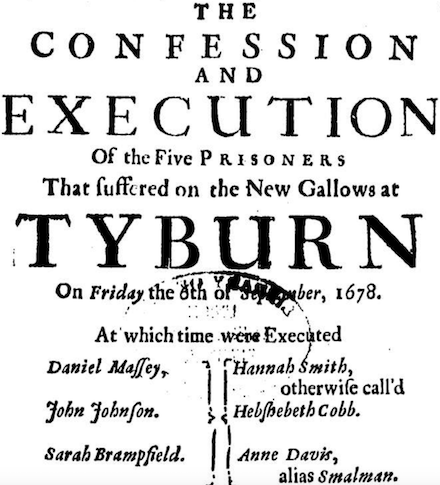
1678: Five at Tyburn

Three men and two women hanged at Tyburn on this date in 1678.

Our text here is one of the earliest of the Ordinary’s Accounts, a far shorter and less ostentatious affair than examples of the genre even a few years later from the hand of a clergyman who has scarcely begun to grasp his true calling, moving copy.


THE CONFESSION AND EXECUTION Of the Five PRISONERS That suffered on the New Gallows at TYBURN On Friday the 6th of September 1678.

At which time were Executed

Daniel Massey. John Johnson. Sarah Brampfield. Hannah Smith, otherwise call'd Hebshebeth Cobb. Anne Davis, alias Smalman.

With Brief Notes of Two SERMONS Preached before them after Condemnation, their Carriage in Prison, and last Speeches at the place of Execution.

The Confession & Execution of the several Prisoners that suffered on the New Gallows at Tyburn, on Friday the 6th of September 1678.

AT the last Sessions there were in all Ten persons Condemned to die; Four menf or Robberies on the Highway, and Six women for Felonies here in Town, either Lifting (as they call it) of Goods out of Shops, or else Robbing those whom they pretended to serve: both which wicked Practises are become so common, and more than once followed by these incorrigible Prisoners, that it was highly necessary to make them Exemplary. Two of the before-mentioned men, viz. those concerned in that barbarous Assault and Robbery, whereof a particular Narrative hath been made publick by the unexpected Mediation of some generous Friends; and the women whose Crimes had not been so great and obstinately continued in as the others, obtained his Majesties gracious Reprieve: and another woman, immediately after she stood attainted, was reprieved by the Court, in reguard she was found by a Female Jury to be quick with Childe.

The Rest came this day to suffer, being charitably indulged in pity to their Souls, so long time to sit and prepare themselves for their great and terrible Change. In order to which, on the Lords-day before, there were two Sermons on most suitable Texts preached before them in the Chappel of Newgate. That in the Forenoon on the fifth verse of the 38 Psalm — My wounds stink and are corrupt, because of my foolishness: Wherein the Minister very pathetically laid open the deplorable Condition such sinners are in by Nature, wallowing not onely in their original Depravity and Corruption, but in continued actual Transgressions against the holy Laws of God; whereby they become abominable, and as a loathsome stench in the Nostrils of that pure Majesty and all good men; and all this occasioned by their own foolishness, that is, their wilful rebellion and obstinacy against all the dictates of Reason, offers of Grace, and impulses of the Holy Spirit upon their Consciences. Which having, like a true Bonaerges, hereby endeavoured to awaken, and put them into a serious sense and apprehension of their lost, undone, and perishing Estate, without speedy and sincere Repentance.

In the Afternoon, as a Son of Consolation, from the 147 Psalm, vers. 3. He healeth the broken in heart, and bindeth up their wounds, he came to shew them the infinite Mercies of God, and Love of Jesus Christ, if they would come in and accept of Pardon and Salvation upon Gospel-terms. That although they had made their wounds to fester and rankle by their foolishness, and had Souls all over bespread with a filthy Leprosie, yet there was Balm in Gilead, an Almighty Physician, both able and willing to heal them, if they would submit to his Prescriptions. In order to which, he gave them divers most necessary and excellent Directions; Not to deceive themselves with a false and palliated Cure, but to close with Christ on his own Terms, and in all his Offices, as their King to Rule them, and their Prophet to Guide them, as well as their Priest to Intercede and make Atonement for them. To hate Sin more, because it was displeasing to God, than because it brought upon them temporal or eternal Punishments. To be as desirous to be Holy as to be Happy; because none can be justified until they are sanctified, Etc.

During the whole time of Religious Worship, and the Sermons, they behaved themselves very Reverently and Attentively; nor was the Minister wanting afterwards, daily to visit them, with pressing Exhortations, and necessary directions to sit them for their last end; especially charging them to disburthen their Consciences, and give glory to God by a free and hearty Confession of their Sins; which had so good an effect, as to bring them to an Acknowledgment; not only in general term, but particularly bewailing the Ill Courses of their past Lives; in neglect of the publick Divine Worship, Violation of the Lords day, Drunkenness, Swearing, and continual practises of Lascivious Debauchery; Two of them above the rest abounding in expressions of Penitence, and endeavouring to improve those few moments of their Lives, to work out their Salvation, and make their peace with God; begging heartily forgiveness from his most holy Majesty, for their Rebellion against his Precepts, and of all those whom they had wronged, by violent taking away their Temporal Goods.

Some of the Women had been Condemned before, and would often bewail the wickedness of their Hearts, that would take no warning thereby: the Men alleadged, they were ignorantly drawn in to that ill Fact, for which they suffer’d, being their first of that kind, and rather by the unhappy operation of too much Drink, than any premeditated design; yet confessed, they had more than once deserved to Dye, and freely acknowledged the justice of the punishment they were to suffer.

At the place of Execution they said little, besides those common, but too much neglected Exhortations, desiring all present to take Warning by them, and remember their Creator in the days of their youth; Not to suffer themselves to be seduced by Ill Company, or sensual pleasures, which had been the means of their destruction, and would be so of all, that did not continually keep a reverent fear of God, and his Worship and Laws in their Hearts.

Thus heartily praying to God for Forgiveness, and to receive their Souls for the alone Merits of his blessed Son; and desiring all good people to joyn with them and for them in those Supplications, they submitted to the Sentence, and taking their leave of all things in this world, were wasted into the unfathomable Regions of Eternity.

FINIS.

On this day..

1781: Beata Dolores, the last victim of the Spanish Inquisition

(Thanks to Henry Charles Lea for the guest post on the last person done to death by the Spanish Inquisition, “Beata Dolores”, who on August 24 of 1781* became in Seville the last person ever sent to the stake by the Spanish Inquisition. Lea’s summary first appeared in his Chapters from the Religious History of Spain Connected with the Inquisition. -ed.)

More remarkable in every respect was the case of Maria de los Dolores Lopez, known as the Beata Dolores, who suffered as a Molinist, in 1781, at Seville.

She was, or pretended to be, blind and ascribed her ability to read and write and embroider to miraculous interposition. At the age of twelve she left her father’s house to live as a concubine with her confessor. Four years later he died, when she went to Marchena and assumed the habit of a beata [a nun -ed.] which she continued to wear.

Her quick intelligence gained for her a high reputation among the people, who imagined that only supernatural gifts could enable a blind person to divine things so readily. The fame of her sanctity and of the special graces enjoyed by her spread far and wide; she held long conversations with her guardian angel, after the fashion of Josepha de San Luis Beltran, but her career at Marchena was brought to an end by her corrupting her confessor. He was relegated to a convent of rigid observance and she went to Seville, where she followed the same hypocritical life for twelve years till, in July, 1779, one of her confessors, pricked by conscience, denounced both herself and himself to the Inquisition, and abundant evidence as to her scandals was easily obtained.

The trial lasted for two years, for she resolutely maintained the truth of her pretensions; since the age of four she had been the object of special grace, she had continual and familiar intercourse with the Virgin, she had been married in heaven to the child Jesus with St. Joseph and St. Augustin as witnesses, she had liberated millions of souls from purgatory, and much more of the same sort.

Had she been content to confess herself an impostor she would have escaped with the customary moderate punishment of reclusion, but she rendered herself guilty of formal and obstinate heresy by maintaining the so-called Molinist doctrine that evil actions cease to be sinful when God so wills it.

Every effort was made to convert her. The most eminent theologians were summoned and vainly exhausted their learning and eloquence; Fray Diego de Cadiz preached to her constantly for two months. She was equally unmoved by the threat of burning; God, she said, had revealed to her that she would die a martyr, after which he would in three days prove her innocence.

Burning was going out of fashion, and the Inquisition honestly endeavored to escape its necessity, but her obstinacy admitted of no alternative, and on August 22, 1781, she was finally condemned and abandoned to the secular arm. She listened unmoved to the sentence, after which, in place of being as usual hurried at once to the stake, she was, as a supreme effort, kept for three days [sic] in the chapel with holy men exhorting her to no purpose.

Then at the auto de fe every one was melted to pity on seeing her with the mitre of flames and demons, while she alone remained impassible during the sermon and ceremony — in fact she had to be gagged to suppress her blasphemy. Finally however on her way to the stake she weakened, she burst into tears and asked for a confessor. The execution was postponed for some hours and her punishment was mitigated, according to rule, with preliminary strangulation.

* Three hundred years after Seville had the first Inquisition auto-de-fe, both events the discerning traveler can explore at the city’s Museo Del Castillo De San Jorge. For reasons that I’m unable to determine there are a number of citations abroad placing this execution on November 7, 1781. I’m affirming the 24th of August based on primary documentation such as this archival document cited by Lea, or the August 25 correspondence reporting the events of the preceding day addressed to Gaspar Melchor de Jovellanos. This detailed account is quoted in full in Jovellanos: vida y pensamiento; alternately, this Spanish-language page summarizes the day hour by hour based on that same source. -ed.

On this day..

1927: Madame Klepikoff, wife of the spy

From the London Times, Aug. 25, 1927. (See also reports from public newspaper archives such as California’s.)

I could not find any source that directly provided the full names of the Klepikoffs. Based on the brief description of events in this Russian book, the husband approached by a foreign agent to spy for Great Britain was one “E. Klepikoff”; this chance genealogy page might relate that name to Efram and Nadezhda Klepikoff.

SOVIET EXECUTIONS.

OFFICER’S WIFE SHOT.

(From our correspondent.)

RIGA, AUG. 24.

The Soviet authorities of Leningrad yesterday, following the rejection of her appeal by the Soviet Government, shot Mme. Klepikoff, who, after a second trial, was condemned to death by a Soviet Court for not betraying to the authorities her husband’s alleged “espionage in favour of England.” The husband, a former captain in the Russian Navy, was shot a few weeks ago.

Yesterday, also, the Soviet authorities shot three Customs officials, Zykoff, Peterleiter, and Borisovsky, and a trader, Kivman, who were condemned last week for defrauding the Customs. They appealed against the sentence, but the Government refused to stay the executioner’s hand.

Meanwhile, officially arranged meetings throughout the U.S.S.R. continue to pass violent resolutions, almost all of which proclaim that August 23 will remain marked in their calendars until they have taken full vengeance for Sacco and Vanzetti.

MOSCOW, Aug. 23. — The Central Executive Committee of the U.S.S.R. has suspended the execution of the sentence on General Annenkov and General Denisov, who, at the sitting of the Military Collegium of the Supreme Court at Semipalatinsk, were condemned to be shot.

The two generals, it was alleged, were implicated in the shooting down of the entire population of villages during the civil war that followed the Russian Revolution. –Reuter.

* On June 16 the tribunal sentenced Klepikoff to death and his wife to three years’ imprisonment. The Soviet authorities, dissatisfied with the sentence on the wife, ordered her re-trial “under conditions involving the death penalty.” The Court assembled on July 12 and passed sentence of death on her.

On this day..