1572: The Martyrs of Gorkum

On this date in 1572, Dutch Calvinists fighting to break away from Spanish domination hanged 19 Catholics at Brielle.


The Martyrs of Gorkum, by Cesare Fracassini.

The heretofore abortive — and severely suppressed — Dutch Revolt blossomed in 1572 with the April 1 capture of Brielle by the Protestant raiders nicknamed Sea Beggars.

Dutch schoolchildren learn the occasion with the punny rhyme — bril, “glasses”, is a near-homophone for Brielle —

“Op 1 april verloor Alva zijn bril”

On April 1st, the Duke of Alva lost his glasses

The mailed fist of imperial Spain in the Low Countries, the Duke of Alva (or Alba) would be forced by Calvinist gains this year onto the back foot; despite a vigorous counterattack that regained some lost territory in 1573, he was soon forced into retirement.

This was still just the opening saga of the Eighty Years’ War, but the Dutch Revolt would weave together theology and nationalism for Netherlands separatists. It already had.

So, small surprise that weeks after nicking the Duke of Alva’s glasses, Dutch rebels conquering other towns started making prisoners of Catholic clergy whose loyalties were suspiciously Habsburgish. Our day’s principals (here are their names; a batch of Franciscans taken are the largest contingent, to which various lay brothers, parish priests, and others were appended) were seized at and around Gorkum (Gorinchem).

The author of this intrepid iconoclastic incursion, William II de la Marck, was likewise the author of these Catholic martyrs’ doom once they had been removed back to Brielle. They were hanged without benefit of trial at an abandoned monastery.

Every sectarian propagandist of 16th century Europe made lurid heroes of his own side’s martyrs, and these were no exception to the pattern; we read in this Catholic source (perhaps while contemplating this devotional image) that

[i]t was on the 9th July 1572 when the execution of the pious sufferers began. On their side they had fully prepared themselves for it by confession and prayer. The executioner went so slowly to work that two hours had elapsed ere the last of the martyrs had taken his place on the gallows, and many of them still lived when morning broke. But the fury of the soldiers was not yet satisfied. They mutilated the dead bodies, cut off their noses and ears, and other limbs, and, alas, shame seems to touch the pen with which we write, bound them to their hats, and returned with these melancholy trophies in triumph into the city!

The location where this day’s unfortunates suffered became a pilgrimage destination, and they were formally enrolled in the minor leagues of Rome’s competitive hagiography circuit in the 19th century.

On this day..

1533: John Frith and Andrew Hewet, Protestants

Life is all about timing.

Death too.

This date in 1533 saw John Frith and Andrew Hewet burned to ashes at Smithfield for Protestantism … just a week before Henry VIII himself was excommunicated from the Catholic Church.

A Cambridge man who’d picked up some heresy in Lutheran Germany, Frith was a friend of William Tyndale and did a couple of turns in English prisons for his various transgressions of orthodoxy.

He was finally nabbed by a warrant of then-Chancellor Thomas More before he could escape to the continent, and hailed before a doctrinal court for sacramentarianism.

During his examination by the bishops, Frith stated that he could not agree with them that it was an article of faith that he must believe, under pain of damnation, that when a priest prayed during the mass, the substance of the bread and wine were changed into the actual body and blood of our Savior Jesus Christ, even though their appearance remained the same. And even if this was so, which he did not believe it was, it should not be an article of faith.

–Foxe’s Book of Martyrs

(Said transubstantiation hypothesis remains Catholic doctrine to this day, but at least it’s no longer worth your life to dispute it.)

All the pieces were in place for this radical theology to become orthodoxy over the succeeding generation. The newly-designated Archbishop of Canterbury — still for the moment within the Catholic fold — was reformer Thomas Cranmer. Despite his sympathy for a shared evangelical cause, Cranmer passed a guilty verdict after trying to talk Frith out of his belief. In the event, however, it was the Inquisitor who was converted: Cranmer over the course of the 1530s adopted Frith’s own view. He would eventually enshrine it in the Book of Common Prayer.

All of which, of course, was made possible by Henry’s insistence on ditching his first wife in favor of Anne Boleyn, and Cranmer’s support for that action. On July 11, both the king and his pliant prelate were excommunicated by Pope Clement VII.

Still, it must be allowed that this fact scarcely gave carte blanche to Protestant reformers in England. Maybe Frith was made for the flames regardless: as timing goes, the 1530s were great for religious martyrdom.

Andrew Hewet, our poor footnote, had no part in these august affairs save the victim’s. Hewet was a tailor’s apprentice who was just caught up with an anti-heretical accusation at the wrong time. In prison, he too refused to acknowledge transubstantiation — saying, “I believe as John Frith believes.” For so believing, he burned as Frith burned.

On this day..

1591: Euphane MacCalzean, witch

If there’s one thing King James VI of Scotland (eventually to also become James I of England) worried a lot about, it was witches.

The Al Qaeda of the 16th century imagination, those shadowy yet omnipresent necromancers were especially feared around this time for their powers of supernatural mayhem, and you can take your pick on the phenomenon’s psychosocial explanation. (It was hardly limited to Scotland.)

Whatever it was, King James had it in spades.

The son of one executed monarch and father of another, James kept head tightly fixed to shoulders all his own days, and he used it to write the (well, a) book on witch-hunting.

THE fearefull aboundinge at this time in this countrie, of these detestable slaues of the Deuill, the Witches or enchaunters, hath moved me (beloued reader) to dispatch in post, this following treatise of mine, not in any wise (as I protest) to serue for a shew of my learning & ingine, but onely (mooued of conscience) to preasse / thereby, so farre as I can, to resolue the doubting harts of many; both that such assaultes of Sathan are most certainly practized, & that the instrumentes thereof, merits most severly to be punished: against the damnable opinions … not ashamed in publike print to deny, that ther can be such a thing as Witch-craft.

–Daemonologie

You couldn’t fault the guy for a lot of daylight between his principles and his practices.


With a deft political touch, Shakespeare wrote Macbeth after James ascended the English throne as James I.

In 1589, Jamie sailed to Denmark to wed a Danish princess. When ferocious storms nearly wrecked the royal convoy on its return trip, there was only one possible explanation: witchcraft. And security theater for 16th century Scotland wasn’t taking your shoes off when ferrying across the nearby loch — it was publicly burning human beings to death for consorting with the devil.

So once the king made it back home, he initiated the North Berwick Witch Trials, the first notable witch-hunt of his reign.

It was what you’d expect. Seventy people accused, the doomed tortured into confessions like Jack Bauer would do, and a respectable harvest of souls, most famously (because interrogated by the king himself) Agnes Sampson. “Most of the winter of 1591,” writes one chronicler, “was spent in the discovery and examination of witches and sorcerers.”

Our day’s principal, whose name has various different renderings (such as Eufame Mackalzeane), was the last to suffer for some months.

Euphan McCalzeane was a lady possessed of a considerable estate in her own right. She was the daughter of Thomas McCalzeane, lord Cliftenhall, one of the senators of the college of justice, whose death in the year 1581 spared him the disgrace and misery of seeing his daughter fall by the hands of the executioner. She was married to a gentleman of her own name, by whom she had three children. She was accused of treasonably conspiring of the king; of raising storms to hinder his return from Denmark; and of various other articles of witchcraft. She was heard by counsel in her defense; was found guilty by the jury, which consisted of landed gentlemen of note; and her punishment was still severer than that commonly inflicted on the weyward sisters; she was burned alive, and her estate confiscated. Her children, however, after being thus barbarously robbed of their mother, were restored by act of parliament against the forfeiture. The act does not say that the sentence was unjust, but that the king was touched in honour and conscience to restore the children. But to move the wheels of his majesty’s conscience, the children had to grease them, by a payment of five thousand merks to the donator of escheat, and by relinquishing the estate of Cliftonhall, which the king gave to sir James Sandilands, of Slamanno.

As a striking picture of the state of justice, humanity, and science, in those times, it may be remarked, that this sir James Sandilands, a favourite of the king’s, ex interiore principis familiaritate, who got this estate, which the daughter of one lord of session forfeited, on account of being a witch, did that very year murder another lord of session in the suburbs of Edinburgh, in the public street, without undergoing either trial or punishment. (Source

Like any number of other executed “witches,” this one professed innocence at the scaffold.

Before she was strangled and burnt, the poor woman “tooke it on her conscience that she was innocent of all the crymes layed to her charge.”

On this day..

1529: Jacob Kaiser, launching the First War of Kappel

On this date in 1529, Zwinglian missionary Jacob Kaiser was burnt at the stake in the Catholic Swiss canton of Schwyz.

His Protestant evangelizing was a violation of the unwritten Cuius regio, eius religio policy keeping peace among the cantons. (Later, it would become written.)

This otherwise routine Reformation martyrdom led Ulrich Zwingli, then Grossmünster of Zurich, to make war on the Catholic cantons, seeking to pry them open for further Protestant inroads.

Let us be firm and fear not to take up arms. This peace, which some desire so much, is not peace, but war; while the war that we call for, is not war, but peace. We thirst for no man’s blood, but we will cut the nerves of the oligarchy. If we shun it, the truth of the gospel and the ministers’ lives will never be secure among us.

–Zwingli, channeling Orwell

The short-lived Erster Kappelerkrieg — the First War of Kappel — was won within weeks, swiftly concluded by a truce favorable to Zwingli’s Protestant alliance.

(Legend has it that the treaty was concluded over a shared pot of milk soup picturesquely resting on the Catholic-Protestant border, the Kappeler Milchsuppe.)

Die Kappeler Milchsuppe (1869) by Gemälde von Albert Anker.

But this initially favorable return on poor Jacob Kaiser’s sacrifice was soon squandered.

Hostilities between the two camps continued, eventually flaring into the Second War of Kappel. Zwingli was again spoiling for the fight, but his under-prepared Protestants were trounced by a Catholic league in October 1531. Zwingli himself died on the battlefield.

On this day..

1222: An apostate deacon

Thirteenth century England was a dicey place for theological heterodoxy.

On this date in 1222, Archbishop of Canterbury Stephen Langton held at Oxford a provincial council that ordered for immediate execution

an apostate deacon, who for the love of a Jewess had circumcised himself. When he had been degraded he was burnt by the servants of the lord Fawkes.

The story of this nameless and foreskinless deacon — and the link includes several congruent descriptions from primary sources — is sometimes conflated with that of Robert of Reading, another Christian divine who converted in the late 13th century.

Robert’s fate — or Haggai’s, to use the new name he took — seems to be officially unknown, and might have unfolded overseas: Edward I expelled Jews from England in 1290. Nevertheless, the mixed Robert-anonymous deacon story was commemorated with a plaque at Osney Abbey.

Whomever this date’s deacon really was, he wasn’t the only one for whom this council ordained a dreadful end for having the wrong idea about the Almighty.

And there was brought thither into the council an unbelieving youth along with two women, whom the archdeacon of the district accused of the most criminal unbelief, namely that the youth would not enter a church nor be present at the blessed sacraments, nor obey the injunctions of the Catholic Father, but had suffered himself to be crucified, and still bearing in his body the marks of the wounds had been pleased to have himself called Jesus by the aforesaid women. And one of the women, an old woman, was accused of having long been given to incantations and having by her magic arts brought the aforesaid youth to this height of madness. So both being convicted of this gross crime, were condemned to be imprisoned between two walls until they died. But the other woman, who was the youth’s sister, was let go free, for she had revealed the impious deed.

Our source thinks this means life imprisonment rather than being bricked up behind the amontillado. Whatever. It’s not every day we get to use the “immured” tag.

On this day..

Jesus of Nazareth, King of the Jews

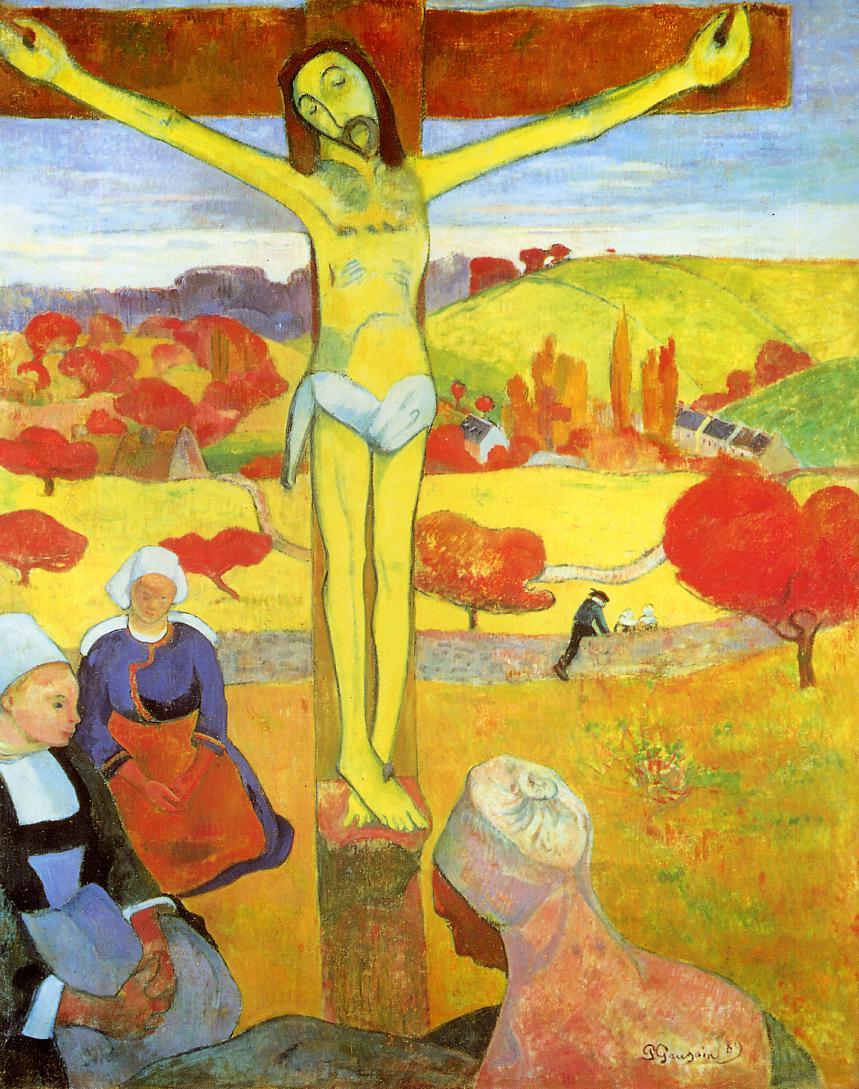
Images of the Crucifixion


(Thanks to Jeffrey Fisher [jeffreyfisher at me.com] for the guest post.)

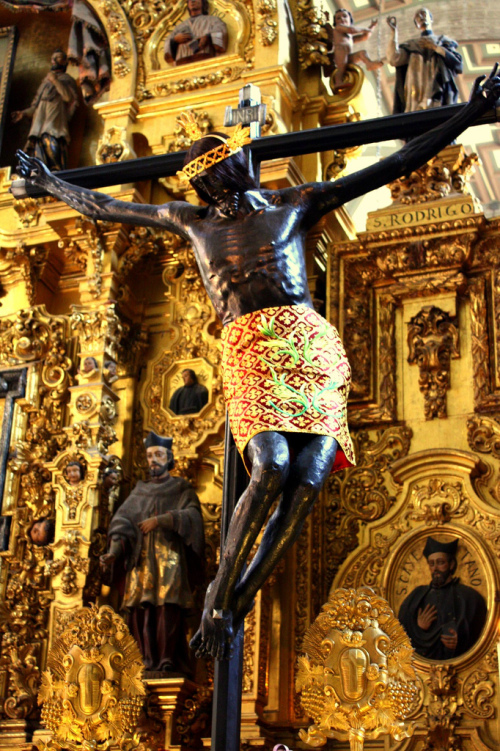
On Good Friday every year,* Christians around the world commemorate the death by crucifixion of Jesus of Nazareth, rabbi, prophet, Son of God, Son of Man, messiah, and all-around trouble-maker.

The truth is that very little is known of Jesus’ life and teachings from verifiable accounts, but this has not stopped generation after generation of Christians from telling his story, beginning with Jesus’ semi-official biographers, the evangelists of the New Testament. Almost everything we know about the life and teachings of the physical human being Jesus are in those writings, which do not portray him always in compatible ways, and which are almost entirely unconfirmed by any external source. The Roman historian Tacitus mentions (with disdain if not disgust) Jesus’ cult following, as does the Jewish historian and philosopher Josephus, but neither gives us anything to work with as historians (or, for that matter, as theologians). For the record, Suetonius and Pliny also talk about Christians, but these piecemeal sources tell us much more about Roman perceptions of Christians than about Christ and his teachings, or even necessarily Christian beliefs and practices.

What, then, can we reasonably say about Jesus?

It is almost impossible to find universal agreement around anything more than a few basics, including most importantly Jesus’ crucifixion. The Gospels narrate it; Paul the Apostle (who never met Jesus in the flesh, as it were) hangs his theology on it, together with the equally important resurrection; and no contemporary sources (Christian or otherwise) dispute it.

But it’s when we ask why Jesus was crucified that things start to get interesting.

What did he do? The two men he is traditionally said to have been crucified with are commonly understood to be “robbers,” but that they were common criminals is highly unlikely. Crucifixion is a horrible death designed to make a very public statement about the crucified, the sort of thing you use on gladiator-slave rebels like Spartacus, not on pickpockets and roustabouts. The Greek term used for these two men (lestai) is consistent with the description of the released Barabbas as one who had participated in rebellious activities, whose “criminality” was related to his revolutionary business. Moreover, the name “Barabbas” means literally “son of the father,” a purely symbolic and surely entirely fictional name, and that the people choose to have him released indicates their affinity for him as a thorn in the side of the Romans. He is thus contrasted with Jesus, the other son of the father, the peaceful (apocalyptic) revolutionary.

So Jesus would have been crucified as a political criminal, a rebel. This would make sense of accounts of his having been identified by the Romans as “Iesus Nazarenus Rex Iudaeorum”: “Jesus of Nazareth, King of the Jews.” Anyone claiming to be king (and “son of God” was a Jewish way of talking about the king of Israel recorded clearly in Psalm 2), would, if taken seriously, be understood as challenging Roman authority.

Insofar as Jesus seems to have been deliberately poking the Romans’ local running dogs, the Sadducees and the Temple priests, his seizure and termination were surely inevitable. If his teaching is as opposed to violence and unconcerned with “politics” as it seems to have been, it’s hard to believe the Romans would have noticed him without some prodding, this coming not from the “crowd,” but from the leadership (who in Mark and Matthew incite the crowd). Indeed, the priests and scribes look for ways to arrest him when the crowds are not around, because they fear a riot.

If we take the Gospel of Mark at all seriously, Jesus was preaching a new kingdom of God, an apocalyptic redemption of the people of the earth by God’s direct intervention (and with Jesus as the sacrificial pesach lamb). If we take the Gospel of Luke seriously, Jesus spoke in a classic prophetic mode, calling people — Jew and Gentile both — to care for the oppressed of the earth, the poor and the hungry and the helpless. Both Jesuses called for people to be better to each other, to love each other, and indeed to love each other when love was, according to common sense, the foolish thing.

Why would this get you executed?

Well, in itself, it wouldn’t. But the Gospel of Mark tells us of Jesus speaking with a man who realizes that all the animal sacrifices in the world don’t amount to a hill of beans (in that crazy world). When love counts more than sacrifice, we are undermining the Temple. When we go into the Temple, start knocking things over, and say it’s become about robbing the poor and not about loving God and one’s neighbor, we are undermining the Temple. And to undermine the Temple’s authority is also to undermine Rome’s authority, and Rome’s cash flow.

Jesus, like the Essenes he may or may not have associated with, was a purist.

The Temple was full of collaborators and exploiters, the kind seen before in the history of Israel (and berated by prophets like Isaiah and Amos), the kind hated also by the Dead Sea community of apocalyptic purists awaiting a final showdown between God and evil (i.e., the Roman Empire and their local potentates, the Temple authorities).

Jesus, like other Jewish prophets before him, thought that Judaism was about something. That it was somehow about justice and not just about following rules or waiting around for things to get better: that it was about our making the world a better place, and not just making our own lives better.

Start talking that way and get people on your side, and you’re fairly likely to get killed, even twenty centuries later.

* Though the actual date (even the year) of the execution marked by the movable feast of Good Friday is fundamentally unknowable, there are some present-day astronomer types who’d like to sell you April 3, 33 A.D.

On this day..

1314: Jacques de Molay, last Templar Grand Master

On this date in 1314, the last Grand Master of the Knights Templar was burned in Paris.


Illustration of Jacques de Molay and Geoffroi de Charney burning on Paris’s Île de la Cité.

In a boring materialist history, Jacques de Molay was simply the head of an overrich military order whose crusading raison d’etre had become passe* with the Templars’ expulsion from the Holy Land.

Scores of trumped-up heresy charges did the work of ecclesiastical assassination for this renowned brotherhood originally founded to safeguard pilgrims in the Holy Land. (There’s a fine podcast episode on the Templars’ history here.)

This appears to be some sort of legitimate history. How droll!

Ruthless French King Philip the Fair, who owed the Templar banks a ton of cash, mounted in 1307 a, um, surprise nationalization — with the magnificently coordinated arrest of hundreds of members of the order on Friday, Oct. 13, 1307.**

This was, on the face of it, quite an infringement by the secular power upon the Church, but since Pope Clement V was Philip’s very own sock puppet — to the extent of relocating the papacy to Avignon the better to attend to his master — it was all good. Plus, of course, everyone made out with a big pile of loot.

As the interested parties jockeyed over those confiscated estates, there ensued for the once-powerful, now-proscribed order a years-long saga of torture, burnings (of lower-ranking Templars), salacious Baphomet-worship revelations, juridical maneuvering, and, finally, a compromise life-saving confession which Molay and his associate Geoffroi de Charney dramatically spurned.

The cardinals dallied with their duty until March 1314, when, on a scaffold in front of Notre Dame, Jacques de Molay, Templar Grand Master, Geoffroi de Charney, Master of Normandy, Ilugues de Peraud, Visitor of France, and Godefroi de Gonneville, Master of Aquitaine, were brought forth from the jail in which for nearly seven years they had lain, to receive the sentence agreed upon by the cardinals, in conjunction with the Archbishop of Sens and some other prelates whom they had called in. Considering the offences which the culprits had confessed and confirmed, the penance imposed was in accordance with rule—that of perpetual imprisonment. The affair was supposed to be concluded when, to the dismay of the prelates and wonderment of the assembled crowd, de Molay and Geoffroi de Charney arose. They had been guilty, they said, not of the crimes imputed to them, but of basely betraying their Order to save their own lives. It was pure and holy; the charges were fictitious and the confessions false. Hastily the cardinals delivered them to the Prevot of Paris, and retired to deliberate on this unexpected contingency, but they were saved all trouble. ‘When the news was carried to Philippe he was furious. A short consultation with his council only was required. The canons pronounced that a relapsed heretic was to be burned without a hearing; the facts were notorious and no formal judgment by the papal commission need be waited for. That same day, by sunset, a pile was erected on a small island in the Seine, the Isle des Juifs, near the palace garden. There de Molay and de Charney were slowly burned to death, refusing all offers of pardon for retraction, and bearing their torment with a composure which won for them the reputation of martyrs among the people, who reverently collected their ashes as relics.’

–A History of the Inquisition of the Middle Ages, Vol III

Not bad, but the for a real plot twist, check the Templars’ turn — most famously in Dan Brown’s leaden bestseller The Da Vinci Code, but more entertainingly rendered as nonfiction “speculative history” in Holy Blood, Holy Grail — as mystic guardians of Christological secrets.†

Their most sensational secret: the Holy Grail.

In this reworking, the Cup of Christ is not the San Greal but the Sang Real, God’s own royal bloodline, by way (for some reason) of the French Merovingian dynasty.

The Templars and Jacques de Molay himself, this story goes, are just part of a centuries-long vanguard of Christianity’s mystical underground. Say, is that Jacques on the Shroud of Turin?

Thither this blog dares not venture, but those with the requisite inclination towards the occult will find limitless explorations of the theme for ready sale. All we ask, gentle reader, is that you kindly cut us in on the action by using our handy affiliate links.

In what may be yet another mystical just-so story, Molay is said to have foretold, as the flames consumed him, the deaths of his persecutors.

Pope Clement, Chevalier Guillaume de Nogaret [the prosecuting inquisitor], King Philip! I summon you to the Tribunal of Heaven before the year is out!

The curse worked: none of those gentlemen lived to see 1315. Someone, somewhere, has also attributed every bum turn for the French crown since then to Molay’s anathema. There’s a legend that an onlooker at Louis XVI‘s execution dipped his handkerchief in Citizen Capet’s Sang Real and cried out, “Jacques de Molay, tu es vengé!”

* Other expeditions called “Crusades” did continue after the Templars, but Christendom’s occupation of the Holy Land was toast until Lawrence of Arabia days.

** The date of this action is a possible origin of the whole paraskevidekatriaphobia superstition, but probably not really.

† It is a fact that these guys liked sweeping their crusading conquests for supposed holy relics, like this Roman nail recently unveiled from a Templar fort that was reverentially “handled by a lot of people over a long period of time.”

On this day..

1535: Etienne de la Forge, John Calvin’s friend

On this date in 1535, as a 25-year-old religious dissident named John Calvin fled Paris, the merchant who had hosted his circle’s Protestant salons was reduced to ashes in Paris.

Though France would ultimately remain Catholic, the Protestant Reformation found rich soil and enjoyed a measure of early official tolerance for reasons of statecraft.

But a sharp crackdown was provoked when Protestants engineered the placement of anti-Catholic posters in several towns during a single night in October 1534 — the so-called Affair of the Placards.

This spelled the end of the circle of dissidents who met at the Rue Saint-Martin.* Young Calvin high-tailed it out of town — a period of wandering and living incognito that would wash him up on the shores of Lake Geneva — but the owner of that Rue Saint-Martin house, Etienne de la Forge (aka Stephanus Forgeus) was denounced to the authorities.

The date for this execution comes from The Century of the Renaissance, a public domain book available free from Google. It’s also backed in the roster of execution dates from Michelet’s Histoire de France. This looks to me as if it comes from primary documentation, but Feb. 15 is sometimes also reported.

* Calvin apparently had an appointment during this period in Paris to meet a scholar he would later execute, Michael Servetus, but the tete-a-tete never came off.

On this day..

1619: Lucilio Vanini, aka Giulio Cesare

On this date* in 1619, Italian freethinker Lucilio Vanini was adorned with a placard reading ‘Ateiste et blasphemateur du nom de Dieu’ and taken to Toulouse’s Place du Salin where he had his blasphemous tongue cut out,** then was strangled and burned at the stake.

You can think of Vanini as a sort of Giordano Bruno mini-me — a bit less intellectually distinguished, a bit less famous, but doing the same peripatetic, pantheistic act before orthodoxy ran him down.

Ordained a priest (like Bruno), Vanini’s 34 years were spent perambulating (like Bruno): France, Switzerland, the Low Countries, even England, where he briefly auditioned Anglicanism.

Alas, (like Bruno) the libertine monk’s occult philosophy had no real home; he fled Paris for Toulouse (the place Bruno earned his doctorate), and was there charged with blasphemy.

Vanini veiled his dangerous speculations in nominally pietistic cant, but he probably could have done better misdirection than a title like De Admirandis Naturae Reginae Deaeque Mortalium Arcanis (Of the Marvelous Secrets of the Queen and Goddess Nature — available in Latin from Google books).

Vanini was bold enough to suggest an equivalency between human and animal souls, and reckon both mortal. Though his works purported to prove the existence of God, and he even made to his accusers a version of the “first cause” argument, they thought (probably rightly) he wasn’t being serious.

They also thought (again, probably rightly) Vanini and his aristocratic patrons were debauched; Vanini’s execution kicked off a dangerous crisis for hedonists in France and elsewhere in the 1620s.

There’s much more about Vanini in French here, and in English in this chapter of the public-domain The Skeptics of the Italian Renaissance.

* Some sources report Feb. 19. The source of this discrepancy isn’t clear to me; the then-10-day gap between the Julian and Gregorian calendars is an obvious suspect, but as this execution took place in Catholic France, the modern Gregorian calendar had been adopted decades before.

In any event, primary documentation appears to me to support the 9th.

” le samedi neuvième du mois de février … fut donné arrêt au rapport de M. de Catel, conseiller au parlement, par lequel il [Vanini] fut condamné à être traîné sur une claie, droit à l’Eglise Saint-Etienne, où il serait dépouillé en chemise, tenant un flambeau ardent en main, la hart [la corde avec laquelle on étranglait les criminels.] au col, et, tout à genoux devant la grande porte de la dite église, demanderait pardon à Dieu, au roi, à la justice, et de là … serait conduit à la place du Salin où, assis sur un poteau, la langue lui serait coupée, puis serait étranglé, son corps brûlé et réduit en cendres; ce qui fut exécuté le même jour.”

** “Before putting fire to the stake, Vanini was ordered to put forth his sacrilegious tongue for the knife. He refused; it was necessary to employ pincers to draw it forth, and when the executioner’s instrument seized and cut it off never was heard a more horrible cry. One might have thought that he heard the bellowing of an ox which was being slaughtered.” (Source) This account of the magistrate Gramont has to be considered in view of his interest in showing the condemned inadequate to his jaunty resolve, “Let us go, let us go joyfully to die, as becomes a philosopher.”

On this day..

1529: Ludwig Haetzer, Anabaptist

On this date in 1529, Biblical translator Ludwig Hätzer (or Haetzer, or Hetzer) had his head lopped off with a sword in the town square Konstanz (Constance) where he had first been ordained a priest. The charge against him was adultery … but his real crime was his Protestant radicalism.

Haetzer, a Hebrew scholar, was of that first generation of church reformers who pushed dangerously beyond the reforms intended by more respectable types like Luther and Zwingli.

The latter actually took Haetzer under his wing in 1523 for his erudite denunciation of religious imagery, and tapped him to help translate the Old Testament.

But Haetzer started rolling with wilder-eyed types like Michael Sattler and getting thrown out of cities and the like. The young priest’s own thinking evolved over the 1520s towards a rejection of infant baptism, and sacraments, and marriage.

There was also a sect among them the members of which wished, together with all things else, to have their wives in common; but they were soon suppressed by the other Brethren of the community, and driven out. Many inculpated Hut and Hätzer as leaders of this sect. If this be true, these men at all events atoned for their sin.

According to Alcohol: A Social and Cultural History, Haetzer was even the first divine to publicly denounce boozing — in a German treatise available free online, On Evangelical Drinking.

He wasn’t opposed to all corporal diversions, however.

Protestant authorities in Constance arrested him for living in sin with Anna Regel.

After his execution for sexual impropriety, anti-Trinitarian writings were discovered and judiciously destroyed; this biography claims that some Unitarians view him as their proto-martyr.

On this day..