1761: Gabriel Malagrida, Jesuit nutter

On this date in 1761,* the Jesuit Gabriel Malagrida became a late casualty of the Tavora Affair and the Lisbon earthquake when he was garroted for heresy.
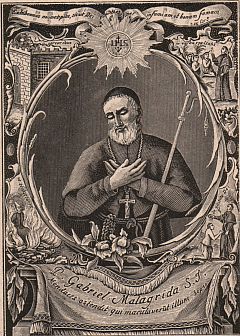
Malagrida (English Wikipedia entry | Portuguese) was a 72-year-old Italian with decades of missionary service to the Portuguese New World colonies under his belt.

He had, in his time, been a prominent exponent of the Jesuits missions’ policy in the Amazon, which amounted to asserting their own jurisdiction against the secular government’s attempt to order its overseas territories. (There’s more on that conflict here.)

And this only exacerbated his principal sin of being a Jesuit — an order whose diminution was eagerly sought by the rising statesman of Enlightenment Portugal, the Marquis of Pombal.

The shock of the 1755 Lisbon earthquake would deal Pombal the trump hand he needed to start reshaping both city and society to his liking.

Malagrida, meanwhile, carped that the earthquake’s causes

“are not comets, are not stars, are not vapors or exhalations,** are not phenomena, they are not natural contingencies or causes; but they are solely our intolerable sins … I do not know how a Catholic subject dares to attribute the present calamity of this tragic earthquake to causes and natural contingencies. Do not these Catholics understand this world is not a house without an owner?”

This published pamphlet merely echoed what many of the order were saying in the pulpits, and Pombal was not about to let the backwards, superstitious crowd** own the catastrophe.

Malagrida was banished from Lisbon: and, when the Tavora family was implicated in an attempt to assassinate the Portuguese king, Malagrida, their confessor, found himself clapped in prison.

Though the now-septuagenarian priest did not share the Tavoras’ grisly public butchery, he was left to molder. A couple years in a dungeon saw him go a bit strange, and supposedly he published treatises with such eccentric features as God’s personal instructions to Malagrida, and Malagrida’s fascination with St. Anne’s uterus. Catholic sources, which consider Malagrida a martyr, doubt that he ever published any such thing; if he did, it seems apparent that it was dementia rather than heresy that afflicted the old man.

But Pombal had installed his own brother as judge of the tribunal, so the matter was prearranged. The execution itself was

staged in a dramatic way, even to the point of Malagrida’s appearing on the scaffold in Jesuit habit, to impress upon the Portuguese and the world at large that an old order had come to an end and a new one was to be established … one might say that … symbolism at the cost of one human life was a relatively humane procedure in comparison with the symbolic elimination of whole classes of society in the twentieth century.


Detail view (click for the full image) of Malagrida executed at a Lisbon auto de fe. CC image from Ricardo Mealha, original provenance unknown.

Pitying the superstitious Jesuit at the stake, Enlightenment secularist Voltaire inveighed against Enlightenment secularist Pombal for conducting the execution … just part of Voltaire’s queer ideas about not killing people over their religious beliefs.

“It is all pity and horror,” Voltaire wrote in a private correspondence. “The Inquisition has found the secret to inspire compassion for the Jesuits.”

Voltaire’s appraisal in Candide (already published by this time) of a country in the grip of religious superstition unjustly stands as one of the lasting literary monuments to an event that actually rolled back clerical influence: “the sages of [Portugal] could think of no means more effectual to prevent utter ruin than to give the people a beautiful auto-da-fé; for … the burning of a few people alive by a slow fire, and with great ceremony, is an infallible secret to hinder the earth from quaking.” That the philosophe who penned those words waxed so immoderately outraged at the demonstrative chastisement of a man who preached precisely all that hocus-pocus — that Voltaire ascribed his execution to “the Inquisition” — plants the cherry on the irony sundae.‡

But Pombal’s expedient use of the Inquisition’s medieval machinery to make an example of Father Malagrida would not be the start of a pattern; the Pombaline reforms of the years to come brought the Inquisition sharply to heel, and it was Malagrida himself who was its last victim (pdf) in Portugal in its classical ecclesiastic form.


The house where Malagrida was born in Menaggio, Italy is marked with a plaque. Image (c) kallipyg and used with permission.

* Some sources give September 20 as the date.

** The “God is pissed” hypothesis was posited against theories of earth’s vapors promulgated by the Pombal-sponsored scientist Ribeiro Sanches.

† Anti-Jesuit sentiment was widely abroad in Europe at this time; increasingly resented as political manipulators, the Society would be suppressed by papal order in 1773, only to revive during the post-Napoleonic reaction.

‡ Malagrida was well-known to contemporaries in Europe, but that does not mean sympathy for him was universal. The British pol Lord Shelburne was satirized as “Malagrida” for his putative duplicity.

On this day..

1586: Anthony Babington and fellow plotters, Walsingham’d

The recently completed papal visit to England has summoned many a recollection of that country’s traumatic break from the Church. (As well as more recent embarrassments.)

While we know the schism from the comfort of retrospection, those present for its 16th century inception (and long afterward) had the task of sorting out winners and losers on blood-soaked scaffolds.

So we pause this date to note the extirpation September 20 and 21 of the Babington Plot, a half-baked scheme to re-establish the Old Faith that turned into one of history’s signature achievements of espionage.

Its namesake, young Sir Anthony Babington, was a secret Catholic with more money than sense; like many a Catholic of this time, he bristled under the rule of Elizabeth I, the daughter of the very woman who started all this English Reformation trouble.

Besotted with fellow-Catholic Mary Queen of Scots after having served as her page in his youth, Babington was easy prey for the fellow invariably described as Elizabeth’s “spymaster” — Francis Walsingham.

Not one for scruples where his own security or his sovereign’s was concerned, Walsingham had long considered Mary Queen of Scots too dangerous to be left alive: every Catholic plot against Elizabeth intended to replace her on the throne with this Catholic cousin.

Trying to overcome Elizabeth’s reluctance to off fellow royalty — dangerous precedent, in these dangerous times — Walsingham entrapped Babington and a coterie of other Catholics into designing and documenting a scheme to assassinate Elizabeth and support a Spanish invasion.

And most importantly to Walsingham, they got Mary to sign off on it.

Though the design was grandiose, the real danger was pretty much nil — since Walsingham, a Renaissance reconnaissance man famous for his continent-spanning intelligence network, had penetrated the circle months before.* Walsingham let the conspiracy ripen long after he had the goods on the likes of Babington, intending to make it the instrument of Mary’s destruction. He succeeded.

Coded correspondence that Mary thought she was smuggling in and out of her cell was in fact being intercepted and decrypted.

When Babington wrote to her, alluding to his intent with “six noble gentlemen” to murder Queen Elizabeth, Mary doomed herself with a favorable reply:

The affair being thus prepared, and forces in readiness both within and without the realm, then shall it be time to set the six gentlemen to work; taking order upon the accomplishment of their design, I may be suddenly transported out of this place.

Within days, all — Mary, Babington, six gentlemen, and more — were in chains, and the commoners were being tortured into confessions and implications.**

The reckoning for Mary Queen of Scots would not arrive for some months yet.

But those of lesser breeding were dispatched with dispatch. Tried in two bunches, there were 14 in all condemned; on this date, Babington, was hanged, drawn and quartered for treason, along with accomplices John Ballard, Thomas Salisbury, Robert Barnewell, John Savage, Henry Donn and Chidiock Tichborne — the last of these leaving behind this doleful poetic adieu:

Elegy

My prime of youth is but a frost of cares,
My feast of joy is but a dish of pain,
My crop of corn is but a field of tares,
And all my good is but vain hope of gain;
The day is past, and yet I saw no sun,
And now I live, and now my life is done.
The spring is past, and yet it hath not sprung;
The fruit is dead, and yet the leaves be green,
My youth is gone and yet I am but young,
I saw the world and yet I was not seen;
My thread is cut and yet it is not spun,
And now I live, and now my life is done.
I sought my death and found it in my womb,
I looked for life and saw it was a shade,
I trod the earth and knew it was my tomb,
And now I die, and now I am but made;
My glass is full, and now my glass is run,
And now I live, and now my life is done.

-Chidiock Tichborne

(Hear this bummer of a verse read aloud here and here.)

The torture these first seven unfortunates endured as their entrails were ripped from their still-living bodies was so horrible that Elizabeth ordered the seven others awaiting execution the next day simply to be hanged to death before all the disemboweling business.†

A few books about spymaster Francis Walsingham

* Walsingham had plenty of plots to contend with, but did Elizabeth even greater service keeping tabs on the buildup of the Spanish Armada through a spy network in Italy — even using it to delay the invasion by a crucial extra year by drying up Spain’s credit line with Italian bankers. (Source, via (pdf))

Incidentally, and completely off topic: the subversive, forward-thinking philosopher Giordano Bruno — an Italian who was eventually executed by the Inquisition — has been alleged to be one in Walsingham’s employ.

** Luckily for Elizabeth, the treasonous Protestants who supported her back when she was at the mercy of her Catholic half-sister Mary Tudor were better able to hold their tongues under duress.

† One of those executed on September 21, Charles Tilney, has an oblique Shakespeare connection: he’s one possible author of the play Locrine, which Shakespeare might have revised and/or staged; Locrine is in the Shakespeare Apocrypha.

On this day..

1944: Six Jesuits in Palau

On this date in 1944, six Spanish Jesuit missionaries were executed in Palau by the island’s increasingly desperate Japanese defenders.

Fr. Elias Fernandez Gonzalez, Fr. Marino de la Hoz, and Br. Emilio del Villar were on hand to spread Catholicism in the island, which fell into Japan’s lap at the end of World War I and was therefore incorporated into the Asian hegemon’s economic plans.

Taking no chances with these foreign proselytizers, Japan had them confined when the Pacific War broke out in 1941.

By 1944, with the writing clearly visible on the wall, they were joined by three other Jesuits captured from nearby Yap, now a part of the Federated States of Micronesia, Fr. Luis Blanco Suarez, Fr. Bernardo de Espriella, and Br. Francisco Hernandez.

After a few months’ confinement, all six were summarily executed. Their remains have never been recovered; they were allegedly exhumed and burned shortly before Allied occupation, a bit of evidence-destruction similar to Wake Island.

There was a Japanese officer arrested for these executions and other war crimes, but he committed suicide before he could face judgment.

On this day..

1437: Jan Rohác z Dubé, Hussite marshal

On this date in 1437, Hussite marshal Jan Rohác z Dubé was hanged in Prague.

The Bohemian commander had upheld throughout the Hussite Wars the cause of its namesake heretical priest. (There’s a Czech biography of Rohac here.)
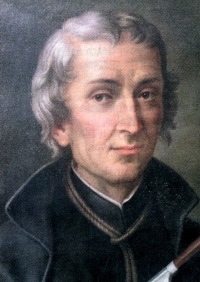
The Hussites had a nice run in the 1420s — no less a personage than Joan of Arc took time out from French battlefields to dictate an anti-Hussite jeremiad threatening to “remove your madness and foul superstition, taking away either your heresy or your lives” — but eventually succumbed to repeated papal onslaughts.

They were decisively crushed at the 1434 Battle of Lipany … but Rohac survived it, and “emerg[ed] from the ashes” like “a phoenix”, the last champion of the forbidden sect.

Rohac rallied the remnants of his partisans to a fortress named Sion* near Kutna Hora, where they were besieged and ultimately overwhelmed.

Days later, he was demonstratively executed in Prague, where all this Hussite trouble had started.

The people of Prague, as an act of intimidation directed at dissenters, were forced … to watch the gruesome display. Clad in his red baronial robes, with a sign draped around his neck stating his condemnation, Rohac was hung by a gold chain from the top of a three-story gallows. Beneath him hung the bodies of the Sion garrison.

Present-day Jan Rohac appreciation is best done Czech.

This bio is available reprinted from a public domain source. There’s also a 1947 Czechoslovakian film (appropriately titled Jan Rohác z Dubé, but also known in English as Warriors of Faith) celebrating Rohac’s exploits.

* No truth to the rumor that the Hussites’ doings in doomed Sion inspired the techno rave scene in the city of the same name in The Matrix.

On this day..

1679: St. David Lewis, the last Welsh martyr

On this date in 1679, the Jesuit David Lewis was hanged, drawn and quartered.

Lewis suffered just days after a fellow priest and fellow victim of Titus Oates’ “Popish Plot” concoctions, John Kemble.

Lewis was arrested at the Wales town of Llantarnam where he was Tad y Tlodion, “father of the poor”; hauled to London’s Newgate Prison, he was returned to Usk, also in Wales, for execution.

As with Kemble, Lewis “discover the plot I could not, as I knew of none; and conform I would not, for it was against my conscience.” Where terroristic plotting could not be established, taking Holy Orders in the church would do just as well.

Lewis is not actually the last Catholic martyr in Britain* — Oliver Plunkett earned that distinction in 1681 — but at this late date he goes down as the last Welsh martyr, which is also the title of an energetic Catholic blog all about the man and his milieu.

Seems that site has a virtual pilgrimage to go along with the annual meatspace tradition that takes place this year on Sunday, August 29. The faithful might also enjoy friendsofsaintdavidlewis.co.uk.

* An inventory of martyrs for the faith in the Isles is here.

On this day..

1679: St. John Kemble, 80-year-old priest

On this date in 1679, 80-year-old Catholic priest John Kemble was martyred for the faith at Hereford.

Kemble had been discreetly performing the offices of his faith — still illicit, but less liable to get you killed at this late date — for over five decades since ordination.

Unhappily, Titus Oates and his tall tales of a Popish Plot to assassinate King Charles II came along at the end of that run. In the ensuing anti-Catholic spasm, Kemble was one of the unlucky ones rousted.

Even in the hysteria of the times, nobody could make an actual conspiracy charge stick against this ancient cleric, but in the hands of a sufficiently hostile judiciary, his demonstrable exercise of the priesthood could be enough to make him a traitor. And at his age, the opportunity to buy his life at the cost of his conscience didn’t look the bargain:

According to the course of nature I have but a few years to live. It will be an advantage to suffer for my religion and therefore I will not abscond.

He got the mild consolation of hanging to death before the unpleasant drawing-and-quartering bits were executed upon him, and calmly puffed a pipe and shared a bowl of wine with the sympathetic representatives of the law before it all happened. As a result, Herefordshire long called the comforts enjoyed before a parting a “Kemble pipe” and “Kemble cup”.

He’s been elevated to sainthood on the strength of his posthumous miracles, like healing the jailer’s daughter of throat cancer; the holy man’s severed hand, held at St. Francis Xavier’s in Hereford, is supposed to have saved a man from death as recently as 1995.

(The rest of St. John Kemble reposes at Welsh Newton, and is venerated at an annual pilgrimage.)

Kemble was among the last of the Forty Martyrs of England to die for the Catholic faith; a fellow-inmate, David Lewis, paid his own penalty just five days later.

On this day..

1936: The Sacred Heart, by Spanish leftists

On this date in 1936, anticlerical leftists in the Spanish Civil War allegedly subjected a monumental statue of Christ to a ritual “execution”.


“This picture, taken by a Paramount News-reel representative and received by air from Madrid yesterday, illustrates an outrage which has no parallel in the photographs published by “The Daily Mail” of the Spanish Reds’ war on religion. It shows a Communist firing squad aiming at the colossal Monument of the Sacred Heart on the Cerro de los Angeles, a hill a few miles south of Madrid which is regarded as the exact centre of Spain.” (Source)

This outstandingly incendiary image made for great recruiting for the Francoist enemies of the “firing squad” and gave credence to a “crusade” lexicology that insured the devout would break overwhelmingly against the Republic. (Nearly 7,000 men and women in religious orders whose deaths during the war are charged to the Republican account also helped.)

Maybe that was inevitable, anyway.

George Orwell, the English leftist who volunteered for the Spanish Republicans, noted in his Homage to Catalonia that

the people in this part of Spain must be genuinely without religious feeling — religious feeling, I mean, in the orthodox sense. It is curious that all the time I was in Spain I never once saw a person cross himself; yet you would think such a movement would become instinctive, revolution or no revolution. Obviously the Spanish Church will come back (as the saying goes, night and the Jesuits always return), but there is no doubt that at the outbreak of the revolution it collapsed and was smashed up to an extent that would be unthinkable even for the moribund C. of E. in like circumstances. To the Spanish people, at any rate in Catalonia and Aragon, the Church was a racket pure and simple. And possibly Christian belief was replaced to some extent by Anarchism, whose influence is widely spread and which undoubtedly has a religious tinge.

Be that as it may, Republican types suspected photographic fakery.

Just like its inspiration is reported to have done, this statue survived its “execution” in fine shapewas resurrected by public subscription, and can still be seen at Cerro de los Angeles outside Madrid.


The “executed” statue today. (cc) image from bigchus.

On this day..

Feast Day of the Holy Maccabees

This is the feast date, in both the Orthodox and Catholic traditions, of the Woman with Seven Sons — each of whom is supposed to have been put to death for refusing to break the Mosaic law by eating pork.

Although they are Jewish martyrs more than a century before Christ, they are revered most especially by the Christian faith that elbowed Judaism aside. Their story comes from 2 Maccabees, a “deuterocanonical” text that is part of the Old Testament but not part of the Hebrew Bible — for reasons having to do with the contingent process of formulating the canon.* (Short explanation | Long explanation)

Whether sent from the Lord or not, this story features the righteous resistance of the faithful family against Antiochus IV Epiphanes, ruler of the Seleucid Empire, which was one of the successor Hellenistic states to Alexander the Great’s conquests.

In 2 Maccabees (and also in 1 Maccabees, which covers the same period, though not this specific martyrdom), Antiochus IV is making an unwelcome pro-heathen intervention in a Jewish civil war on the side of the hellenizers as against the hidebound traditionalists. This comes to attempting “to compel the Jews to depart from the laws of their fathers, and not to live after the laws of God: And to pollute also the temple in Jerusalem, and to call it the temple of Jupiter Olympius.” (2 Maccabees 6:1-2; this chapter features a Whitman’s sampler of other faithful traditionalists slaughtered for various forms of adherence to the Law.)

Same deal with the dietary laws, whose countermanding edict Antiochus (being a wicked heathen king) is pleased to enforce by the most ghastly tortures.

Here’s the description of the martyrdom from 2 Maccabees chapter 7:

Das Martyrium der sieben Makkabaer, by Antonio Ciseri, in an aptly classical setting.

1: It came to pass also, that seven brethren with their mother were taken, and compelled by the king against the law to taste swine’s flesh, and were tormented with scourges and whips.
2: But one of them that spake first said thus, What wouldest thou ask or learn of us? we are ready to die, rather than to transgress the laws of our fathers.
3: Then the king, being in a rage, commanded pans and caldrons to be made hot:
4: Which forthwith being heated, he commanded to cut out the tongue of him that spake first, and to cut off the utmost parts of his body, the rest of his brethren and his mother looking on.
5: Now when he was thus maimed in all his members, he commanded him being yet alive to be brought to the fire, and to be fried in the pan: and as the vapour of the pan was for a good space dispersed, they exhorted one another with the mother to die manfully, saying thus,
6: The Lord God looketh upon us, and in truth hath comfort in us, as Moses in his song, which witnessed to their faces, declared, saying, And he shall be comforted in his servants.
7: So when the first was dead after this number, they brought the second to make him a mocking stock: and when they had pulled off the skin of his head with the hair, they asked him, Wilt thou eat, before thou be punished throughout every member of thy body?
8: But he answered in his own language, and said, No. Wherefore he also received the next torment in order, as the former did.
9: And when he was at the last gasp, he said, Thou like a fury takest us out of this present life, but the King of the world shall raise us up, who have died for his laws, unto everlasting life.
10: After him was the third made a mocking stock: and when he was required, he put out his tongue, and that right soon, holding forth his hands manfully.
11: And said courageously, These I had from heaven; and for his laws I despise them; and from him I hope to receive them again.
12: Insomuch that the king, and they that were with him, marvelled at the young man’s courage, for that he nothing regarded the pains.
13: Now when this man was dead also, they tormented and mangled the fourth in like manner.
14: So when he was ready to die he said thus, It is good, being put to death by men, to look for hope from God to be raised up again by him: as for thee, thou shalt have no resurrection to life.
15: Afterward they brought the fifth also, and mangled him.
16: Then looked he unto the king, and said, Thou hast power over men, thou art corruptible, thou doest what thou wilt; yet think not that our nation is forsaken of God;
17: But abide a while, and behold his great power, how he will torment thee and thy seed.
18: After him also they brought the sixth, who being ready to die said, Be not deceived without cause: for we suffer these things for ourselves, having sinned against our God: therefore marvellous things are done unto us.
19: But think not thou, that takest in hand to strive against God, that thou shalt escape unpunished.
20: But the mother was marvellous above all, and worthy of honourable memory: for when she saw her seven sons slain within the space of one day, she bare it with a good courage, because of the hope that she had in the Lord.
21: Yea, she exhorted every one of them in her own language, filled with courageous spirits; and stirring up her womanish thoughts with a manly stomach, she said unto them,
22: I cannot tell how ye came into my womb: for I neither gave you breath nor life, neither was it I that formed the members of every one of you;
23: But doubtless the Creator of the world, who formed the generation of man, and found out the beginning of all things, will also of his own mercy give you breath and life again, as ye now regard not your own selves for his laws’ sake.
24: Now Antiochus, thinking himself despised, and suspecting it to be a reproachful speech, whilst the youngest was yet alive, did not only exhort him by words, but also assured him with oaths, that he would make him both a rich and a happy man, if he would turn from the laws of his fathers; and that also he would take him for his friend, and trust him with affairs.
25: But when the young man would in no case hearken unto him, the king called his mother, and exhorted her that she would counsel the young man to save his life.
26: And when he had exhorted her with many words, she promised him that she would counsel her son.
27: But she bowing herself toward him, laughing the cruel tyrant to scorn, spake in her country language on this manner; O my son, have pity upon me that bare thee nine months in my womb, and gave thee such three years, and nourished thee, and brought thee up unto this age, and endured the troubles of education.
28: I beseech thee, my son, look upon the heaven and the earth, and all that is therein, and consider that God made them of things that were not; and so was mankind made likewise.
29: Fear not this tormentor, but, being worthy of thy brethren, take thy death that I may receive thee again in mercy with thy brethren.
30: Whiles she was yet speaking these words, the young man said, Whom wait ye for? I will not obey the king’s commandment: but I will obey the commandment of the law that was given unto our fathers by Moses.
31: And thou, that hast been the author of all mischief against the Hebrews, shalt not escape the hands of God.
32: For we suffer because of our sins.
33: And though the living Lord be angry with us a little while for our chastening and correction, yet shall he be at one again with his servants.
34: But thou, O godless man, and of all other most wicked, be not lifted up without a cause, nor puffed up with uncertain hopes, lifting up thy hand against the servants of God:
35: For thou hast not yet escaped the judgment of Almighty God, who seeth all things.
36: For our brethren, who now have suffered a short pain, are dead under God’s covenant of everlasting life: but thou, through the judgment of God, shalt receive just punishment for thy pride.
37: But I, as my brethren, offer up my body and life for the laws of our fathers, beseeching God that he would speedily be merciful unto our nation; and that thou by torments and plagues mayest confess, that he alone is God;
38: And that in me and my brethren the wrath of the Almighty, which is justly brought upon our nation, may cease.
39: Than the king’ being in a rage, handed him worse than all the rest, and took it grievously that he was mocked.
40: So this man died undefiled, and put his whole trust in the Lord.
41: Last of all after the sons the mother died.
42: Let this be enough now to have spoken concerning the idolatrous feasts, and the extreme tortures.

The upshot of the Maccabees texts is the revolt of Judas Maccabeus against the Seleucids, the episode that gives us Hanukkah, when that “temple of Jupiter Olympius” was rededicated back to YHWH.

And though not specifically because of the Holy Maccabees, the start of that revolt is the very next thing to occur in the text,** at the start of chapter 8:

1: Then Judas Maccabeus, and they that were with him, went privily into the towns, and called their kinsfolks together, and took unto them all such as continued in the Jews’ religion, and assembled about six thousand men.
2: And they called upon the Lord, that he would look upon the people that was trodden down of all; and also pity the temple profaned of ungodly men.
3: And that he would have compassion upon the city, sore defaced, and ready to be made even with the ground; and hear the blood that cried unto him,
4: And remember the wicked slaughter of harmless infants, and the blasphemies committed against his name; and that he would shew his hatred against the wicked.

And then, of course, it’s the good guys’ turn to start killing.

* It is worth noting that deuterocanonical books aren’t part of the Old Testament for most Protestants; Martin Luther declared himself “so great an enemy to the second book of the Maccabees, and to Esther, that I wish they had not come to us at all, for they have too many heathen unnaturalities.”

** The book’s chronology is scarcely rigorous, but if the episode is considered historical, it would have occurred in 167 B.C.E. (the year the Maccabean revolt began) or the few years before, reaching back to Antiochus’s anti-Mosaic injunctions c. 175 B.C.E.

On this day..

1419: The (first) Defenestration of Prague

(Thanks to Meaghan Good of the Charley Project for the guest post. -ed.)

On this day in 1419, an angry mob of Hussite peasant rebels stormed the town hall on Charles Square in Prague and threw the judge, the mayor and several city council members (either seven or thirteen; accounts differ) out the window. They all either died in the fall or were killed by the crowd outside.

The event has been the subject of several paintings, as well as being beautifully illustrated in Lego form and also reenacted.

Hussites followed a Christian reformer, Jan Hus, who was one of the forerunners of the Protestant Reformation. Hus was eventually excommunicated and burned as a heretic. The cause of the July 30 riot was the city council’s refusal to release from custody several Hussite prisoners.

The mob, led by the Hussite priest Jan Želivský and future general Jan Žižka, marched to the town hall, but they only became violent after someone inside the building threw a stone at them. After that there was no stopping them.

The riot had far-reaching consequences, inasmuch as it is seen as the start of the Hussite Wars, which lasted until 1434 or so and involved government-sponsored military action against the Hussites as well as Hussites fighting amongst themselves.

This event has come to be known as the First Defenestration of Prague. That is, I’m sure we all can agree, an AWESOME name, and probably the principal reason the riot is still remembered today. The word “defenestration” comes from Latin: de-, meaning “out of,” and fenestra, “window.”

The Czechs have a habit of throwing people out of windows at critical junctures in history; since 1419 there has been at least one more (nonfatal, but more famous) Defenestration of Prague, in 1618. A couple of similar events since then have sometimes been called the Third Defenestration of Prague, though this is not universally agreed upon.

On this day..

1501: Antonio Rinaldeschi, bad gambler

This date in 1501,* the Italian city-state of Florence celebrated a “double feast”: that of St. Mary Magdalene, which marked a civic carnival every July 22; and, the hanging of sacrilegious gambler Antonio Rinaldeschi on the walls of the Bargello.

Eleven days prior, Rinaldeschi was having a bad run of wagering at The Fig Tree tavern.

Like Jesus is some people’s co-pilot, the Virgin Mary must have been Rinaldeschi’s card-counter — for, stalking out of the premises much the poorer, our doomed punter blasphemously uttered “words that are better kept silent” about her. Then, passing an image of Holy Mother at the piazza Santa Maria de Alberighi, he gathered up some nearby dung and flung it at the sacred pic.

This dry poo maybe should have just slid right off, but the Lord works in mysterious ways.

Write William Connell and Giles Constable in “Sacrilege and Redemption in Renaissance Florence: The Case of Antonio Rinaldeschi” (Journal of the Warburg and Courtauld Institutes, vol. 61 (1998), and the source of most of this entry’s narrative),

a portion of it, resembling a rosette (‘quasi pareva una rosetta secha’), stuck to the Virgin’s diadem, above the nape of her neck. The dirtied image drew much attention. The archbishop came to look. Candles and votive images were brought before the fresco, which quickly became an object of popular devotion.

Someone saw something and the trail led back to the ill-tempered cardsharp within days, who tried to stab himself to death when he realized what was about to go down. He copped to the crime pretty quickly (at least one source says it was so that he could be executed in preference to being lynched), and his corpse dangling out the Bargello window decorated the other Mary’s regularly-scheduled homage of parades and horse-races.

(And, now that it was no longer needed as evidence, the miraculous ordure was cleaned off the statue.)

Florence at the dawn of the 16th century was truly a place where religion could get you killed. This was the city that had elevated severe Dominican friar Savonarola to dictator and morals enforcer in the 1490s (Savonarola especially hated gambling), then overthrew and burned him in 1498.

Our authors think there’s some evidence that the first couple years of the 1500s were a period when the populist religious fanatics who once grooved on Savonarola’s violent party pooper act were back on the march as against, say, the more out-of-touch syphilitic reckless gambling blasphemer element that was now, post-Savonarola, enjoying free run of the town. Having one of the latter excrement-ize a Marian monument is the sort of thing that would have led the Florentine Fox News: naturally, he had to be made an example of.

To help you bear that example in mind, a nine-panel painting, “The History of Antonio Rinaldeschi”, attributed to the hanged man’s contemporary Filippo Dolciati, can be seen in Firenze’s Stibbert Museum.

Madonna + manure, meanwhile, has its own art legacy … and the combination is still good for raising a ruckus to this day.


The Holy Virgin Mary, by Chris Ofili: a black Mary smeared with elephant dung.

* The primary sourcing on the chronology of the execution is sketchy enough that it’s possible Rinaldeschi was hanged on July 21, before midnight — rather than in the dark early hours of July 22.

On this day..