On this date in 1685, Robert Pollack and Robert Millar (or Pollock and Miller) were hanged in Edinburgh as Covenanters.
An East Kilbride shoemaker and a Rutherglen mason, respectively, they were a tick and a tock in the Killing Time — lost like tears in rain amid the torrent of Presbyterian martyrs.
These adhered to James Renwick‘s subversive doctrine of Scottish presbyter control against the overweening Anglican Episcopacy, a conflict of characteristically comingling religious and political characters.
Since most of the Covenanter-killing was being done summarily by soldiers in the field, these Roberts were actually the rare gallows-birds to be condemned in civil court, for which trouble they strangled at the Gallowlee on the road from Edinburgh to Peith.
Their last testaments can be read here, along with those of many other such martyrs.
Forsake not the assembling of yourselves together, and employ your strength in the holding up of the fallen-down standard of our Lord, and if ye be found real in this duty, ye shall either be a temple, which shall be a glorious sight, or else ye shall be transported, and be a member of the Church triumphant; so ye shall be no loser, but a noble gainer either of the ways.
This blog wants for both patience and seriousness, so we’ll sum up that Venneret al were the holy rollers of the day, the true whack-jobs in the millenarian hustle of Cromwellian England.
Venner himself was born in New England, and there’s a zippy bio of him in The New England Historical and Genealogical Register. The North American colonies and Parliamentarian Britain helped to incubate political/religious heterodoxy for one another, and Venner was not the only budding religious zealot in the distant marches to emigrate to London after Charles I lost his head.
There the cooper became an outspoken apostle of the Fifth Monarchists, a part of Cromwell’s coalition made for disappointment with the mundane machinations of statecraft. Relieved in time of any a share in General Ironsides’ burden of helming the state in choppy waters, the men of the Fifth Monarchy were at liberty, to retire with their slide rules and philosopher’s stones to calculate the (imminent) date of the apocalypse foretold by Daniel and pursue the maxim not yet born that, starting with a mistake, a remorseless logician can end up in Bedlam.
At any rate, our Bostonian tradesman became such an outspoken prophet of the return of “King Jesus” that Cromwell was obliged to clap him in irons.
Venner didn’t take the hint well, nor other more salutary warnings, and Venner instigated a riot of his few dozen followers at the start of January 1661 that took London unawares and did some damage before it was put down.
[a] thing that never was heard of, that so few men should dare and do so much mischief. Their word was, “The King Jesus, and the heads upon the gates.” Few of them would receive any quarter, but such as were taken by force and kept alive; expecting Jesus to come here and reign in the world presently, and will not believe yet but their work will be carried on though they do die.
Thomas Venner and his compatriot Roger Hodgkins died that traitor’s death this day, along with William Oxman and Giles Pritchard, the latter two having their sentences commuted to simple hanging and posthumous beheading. The remaining survivors of his band climbed the scaffold two days later.
* e.g., “Then shall the Oppressor cease and no more complaining be heard in the streets. Taxes should be no more. And Trade and industry should abound. … The poor should have bread, and the Army no more in Arrears. Prison doors should be open and Debtors satisfied without Arrests … then peace and safety, plenty and prosperity, should overflow the land.” (Cited by Brown)
The wise were forced to live as the mad were accustomed, in order to shun death, such that the greatest lunatic now possesses the royal burdens. The wise now lived alone with their wisdom, behind closed doors, applauding only in public the others’ mad and twisted caprices.
-Tommaso Campanella
On this date in 1603, freaky-deaky Dominican philosopher Tommaso Campanella drew a life sentence — avoiding execution by dint of a painfully convincing performance of insanity.
Campanella had some problematically heterodox notions about the sun (namely, that it was going to consume the earth) and everything under it, and had had a recent scrape with the Inquisition.
What really got him in trouble was trucking with a Calabrian conspiracy to overthrow Spanish domination, apparently a product of the monk’s millenarian anticipation of a sort of proto-communist revolution.
Campanella was a strange guy, but this was quite a far-out plot.
This took place, let it be noted, after he had written two works advocating a Papal monarchy for Italy and the world and two works promoting the interests of the Spanish Empire also in Italy and throughout the world.
Past performance is no guarantee of future returns. Once the conspiracy was betrayed,
Campanella was imprisoned … in the Castel Nuovo, one of the principal fortresses in which the Spaniards maintained a military garrison. He was arraigned before the civil tribunal for rebellion and before the ecclesiastical tribunal for heresy. His “examination” which began in January 1600 was gruesome. He claimed innocence in his first interrogation before the civil tribunal, was thrown into a dungeon, actually a cleft in the bedrock of the Castle, to remain there for seven days. Then followed torture. He “confessed,” admitting that he preached about the coming political upheaval but denying that he was part of a conspiracy to bring it about …
His desperation at this point can be gauged by the fact that by April of 1600 he began to feign madness. The ecclesiastical action against him began now, and he persisted in this attitude of insanity through three interrogations, including an hour of torture … On the fourth and fifth of June 1601, he was subjected to the cruel torture of “the vigil” to test whether his insanity was genuine. This was the usual torture of the rope, suspending the body of the victim by his tied hands over a blade which cut into his flesh whenever he yielded to the strain of holding himself in the air; but the vigil refined this cruelty by continuing it for forty hours. Campanella endured the ordeal without breaking.
And it wasn’t just a feat of toughness to beat the torturer at his own game, impressive as it is on those terms alone: Campanella pulled off a genius gambit exploiting the Inquisition’s own legal machinery to duck the separate capital charges he faced in civil and ecclesiastical court.
Joseph Scalzo’s “Campanella, Foucault, and Madness in Late-Sixteenth Century Italy”,* an academic paper that reads like a thriller, narrates Campanella’s “dangerous competition” with his persecutors.
In fine: on Easter Sunday 1600,** as he was approaching conviction and condemnation in his state trial for treason, Campanella began his insanity ploy, successfully forcing a delay in that case and initiating his separate church trial for heresy.
Then, by remaining stubbornly committed to what most of his examiners believed was a charade, Campanella won … by forcing them to inflict that juridically determinative 40-hour “vigil” torture.
the jurisprudence of the time accorded torture so much force, such as to annul all other proofs and “to purge circumstantial evidence”; if the torture had been vigorous and unusual. The accused came, all the more to avail himself of the result obtained, according to the scholarship of the criminologists most in vogue. Thus, Campanella had judicially to be regarded as insane, although everyone was persuaded that he probably simulated insanity. The consequence, in the tribunal of the Holy Office, was not indifferent: He was a “relapsed heretic,” and even if repentant, he would have been disgraced and consigned to the secular court of justice, which would have executed him; being mad, he could no longer suffer condemnation, and in the circumstance in which he might already have been condemned, he would have been spared the death penalty, to reason and repent.
(this is Scalzo’s quotation of Luigi Amabile, an Italian who wrote the book on Campanella; I have been unable to find the Amabile original online.)
Home free.
Having reached this judicial safe haven, Campanella soon — in fact, according to the man who tortured him, literally on the walk from the vigil back to his cell — resumed a recognizable rationality.
He’d languish in prison until 1626 (a few years after he got out, he had to flee to France), but he made the most of it. Campanella wrote his magnum opus, the utopian City of the Sun, while awaiting his sentence in 1602. A number of other works on a wide array of subjects — science, philosophy, theology, political governance (he returned to giving the Spanish empire supportive advice), a vigorous defense of Galileo — were also composed during his 27 years under lock and key.
Campanella’s visionary anticipation of radical egalitarianism would, like Thomas More‘s, help shape the utopian literary genre. But Campanella’s take, while still a theocratic one, lent itself to distinctly more subversive interpretation.†
For example, this Brezhnev-era Soviet essay‡ (unearthed and translated by Executed Today friend and sometime guest-blogger Sonechka) decants the Dominican’s heretical notions into Marxist orthodoxy.
How many times were the communists denounced by their enemies for this “commonality of wives”! Scientific communism, certainly, is not responsible for the figments of a monk like Campanella. But it is instructive to penetrate his logic. It is not commodification or dehumanization that hides behind Campanella’s “commonality of wives”. The women of the “City of Sun” have the same rights as men … The “commonality of women” is equivalent to the “commonality of men” on the basis of mutual equality. That is why, though [we are] decisively rejecting this type of family-free communism, it is necessary to consider who stands on the higher moral grounds — Campanella’s woman, alien to deceit and pretense, or a false bourgeois woman, whose lot in life is adultery and legalized prostitution.
Ultimately, this wild man not only got the high moral ground: he got to die in bed. Once in a while, we get a happy(ish) ending.
So although it actually has nothing to do with Tommaso, “La Campanella” — “Little Bell”, a Paganini violin concerto — allows us here at this blog (in common with our day’s hero) an atypically soothing* denouement.
* Joseph Scalzo, “Campanella, Foucault, and Madness in Late-Sixteenth Century Italy”, The Sixteenth Century Journal, Vol. 21, No. 3 (Autumn, 1990)
** Campanella’s Easter 1600 madness was initiated only a few weeks after fellow intellectual omnivore Giordano Bruno was burned for heresy up the road in Rome. Strictly coincidence.
† Since so much of Campanella’s work was produced while the author was under duress — fighting capital charges, applying for clemency and release — it remains disputable just which parts of it can be taken to represent his real beliefs.
‡ L. Vorob’ev. “Utopija i dejstvitelnost”. (“Utopia and Reality”) in Utopicheskij roman XVI-XVII vekov (Utopian Novel of XVI-XVII century); Series “Biblioteka vsemirnoj literatury”, Khudozhestevnnaja literature, Moscow, 1971, p. 19.
St. Stephen is well-known as the “protomartyr”, the first Christian to die for his faith. (Jesus doesn’t count.) There’s a St. Stephen’s Gate in Jerusalem so named for its supposed proximity to the site of the protomartyrdom.
We get the Stephen story from the New Testament Acts of the Apostles, as given in this from the Tyndale-derived King James Version (Acts 6:8 – 8:3)
And Stephen, full of faith and power, did great wonders and miracles among the people. Then there arose certain of the synagogue, which is called the synagogue of the Libertines, and Cyrenians, and Alexandrians, and of them of Cilicia and of Asia, disputing with Stephen. And they were not able to resist the wisdom and the spirit by which he spake.
Then they suborned men, which said, We have heard him speak blasphemous words against Moses, and against God. And they stirred up the people, and the elders, and the scribes, and came upon him, and caught him, and brought him to the council, and set up false witnesses, which said, This man ceaseth not to speak blasphemous words against this holy place, and the law: For we have heard him say, that this Jesus of Nazareth shall destroy this place, and shall change the customs which Moses delivered us. And all that sat in the council, looking stedfastly on him, saw his face as it had been the face of an angel.
Then said the high priest, Are these things so? … [elided; Stephen preaches on at great length before he comes to the point]
Howbeit the most High dwelleth not in temples made with hands; as saith the prophet, Heaven is my throne, and earth is my footstool: what house will ye build me? saith the Lord: or what is the place of my rest? Hath not my hand made all these things?
Ye stiffnecked and uncircumcised in heart and ears, ye do always resist the Holy Ghost: as your fathers did, so do ye. Which of the prophets have not your fathers persecuted? and they have slain them which shewed before of the coming of the Just One; of whom ye have been now the betrayers and murderers: Who have received the law by the disposition of angels, and have not kept it.
When they heard these things, they were cut to the heart, and they gnashed on him with their teeth.
But he, being full of the Holy Ghost, looked up stedfastly into heaven, and saw the glory of God, and Jesus standing on the right hand of God, and said, Behold, I see the heavens opened, and the Son of man standing on the right hand of God.
Then they cried out with a loud voice, and stopped their ears, and ran upon him with one accord, and cast him out of the city, and stoned him: and the witnesses laid down their clothes at a young man’s feet, whose name was Saul.
And they stoned Stephen, calling upon God, and saying, Lord Jesus, receive my spirit. And he kneeled down, and cried with a loud voice, Lord, lay not this sin to their charge. And when he had said this, he fell asleep.
And Saul was consenting unto his death. And at that time there was a great persecution against the church which was at Jerusalem; and they were all scattered abroad throughout the regions of Judaea and Samaria, except the apostles. And devout men carried Stephen to his burial, and made great lamentation over him.
As for Saul, he made havock of the church, entering into every house, and haling men and women committed them to prison.
The persecuting “Saul” at the end of this text is, of course, Saul of Tarsus, the future St. Paul.
Here’s a set of Catholic devotionals for the day, and here’s a more secular vibe on the day’s various quirky Anglo traditions.
As for that song …
Good King Wencesla(u)s, a tenth-century Bohemian ruler, is himself a saint — the patron saint of the Czechs, as a matter of fact.
Wenceslas was murdered in a palace coup, supposedly leading his servant Podevin to avenge that death, for which said Podevin was in turn executed. The lyrics of the song “Good King Wenceslas” celebrate the king and his loyal page undertaking together the charitable works they were famous for.
“Mark my footsteps, my good page
Tread thou in them boldly
Thou shalt find the winter’s rage
Freeze thy blood less coldly.”
In his master’s steps he trod
Where the snow lay dinted
Heat was in the very sod
Which the Saint had printed
Therefore, Christian men, be sure
Wealth or rank possessing
Ye who now will bless the poor
Shall yourselves find blessing.
* At least, it’s the Feast of St. Stephen in the Latin rite. The occasion is observed on Dec. 27 in the Orthodox tradition.
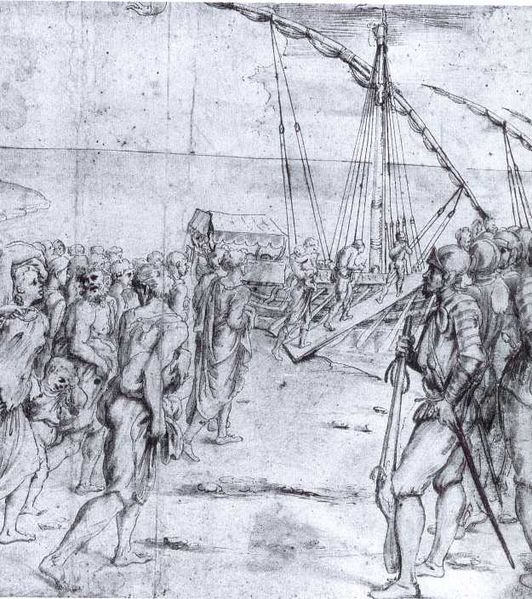
La Expulsión de los Moriscos, by Vincenzo Carducci (Vicente Carducho).
Having taken the trouble over the preceding century to eliminate (or force underground) its substantial Muslim population by forcibly converting it to Christianity, Spain in the early 1600s bethought itself to complete the operation upon its recently minted fellow-Christians by ejecting these Moriscos from Spain altogether.
When the edict for this radical act of expulsion first came down in the heavily Morisco area of Valencia, some of its victims reportedly embraced the prospect of deportation to a land where their dress, language, and religion were no longer forbidden.
the Muela de Cortes (Spanish link), an almost inexpugnable spot, being a deep valley surrounded by precipitous heights, of which the passes were easily defensible. The Moriscoes of that region … were in a state of excitement and were readily persuaded to rise by an outlaw named Pablillo Ubcar. They elected as king Vicente Turixi, who sent a proclamation through the sierra for all to join him under pain of treason. From their strongholds they made raids on the surrounding country, gathering cattle and provisions, burning villages, and desecrating churches.
[Ethnic cleansing coordinator Don Agustin] Mexia, absorbed in the work of embarkation and fearing to interrupt it, for awhile paid no attention to these movements … who could readily be reduced when the time came.
His provisions were justified … those of the Muela de Cortes … lost heart when they heard of the defeat of those of Aguar, and were disappointed as to the appearance of the Moor Alfatami on his green horse, whom tradition reported to be concealed under the mountain since the days of King Jayme … It was agreed that they [the rebels, surrendering] should be safe in person and property, provided they would go to embark within three days.
The rapacious soldiery, who had promised themselves abundant plunder, in their disappointment threw off all discipline; they sacked the village of Royaya, outraged the women and seized numbers of children as slaves. Only three thousand Moriscoes were brought to the port of embarkation, the rest having scattered and taken to the mountains to escape the fury of the soldiers.
These, estimated at two thousand in number, for several years gave infinite trouble, killing all the Christians they met and committing constant depredations. At one time the Governor of Jativa induced many of them to come down, but finding that they were to be enslaved they fled back to the mountains.
A reward was offered for King Turixi, dead or alive; he was tracked to a cave, captured, and brought to the city, when he was sentenced to have hands and ears cut off, to be drawn, torn with pincers, hanged and quartered; but at the execution, December 18th, the cutting of hands and ears was omitted. He had been confessed twice and reconciled twice, and died as a good Christian, making a most edifying end, for we are told that he had been a liberal almsgiver and devoted to the Virgin and the religious Orders.
The miserable remnants were hunted down gradually, the viceroy paying twenty ducats a head for them as galley-slaves.
The armed resistance in Valencia — where Moriscos were most numerous, and the expulsion was first decreed — was actually much less than had been feared, which gave the Spanish authorities all the encouragement they would need to enforce it elsewhere, too.
“Seeing that the whole body of our nation is tainted and corrupt, he applies to it the cautery that burns rather than the salve that soothes; and thus, by prudence, sagacity, care and the fear he inspires, he has borne on his mighty shoulders the weight of this great policy and carried it into effect, all our schemes and plots, importunities and wiles, being ineffectual to blind his Argus eyes, ever on the watch lest one of us should remain behind in concealment, and like a hidden root come in course of time to sprout and bear poisonous fruit in Spain, now cleansed, and relieved of the fear in which our vast numbers kept it.”
(Thanks to Jonathan Shipley of A Writer’s Desk for the guest post. -ed.)
Solomon Molcho, a Portuguese mystic, burned at the stake on this date in 1532 for apostasy.
Solomon Molcho’s Shel Silverstein-esque stylized signature. You can see his robe in Prague, or here.
He was in Regensberg, Germany with Jewish messianic adventurer David Reubeni meeting with Emperor Charles V hoping to persuade the ruler of the Holy Roman Empire to arm Marranos (Sephardic Jews forced to adopt Christianity) against the Turkish onslaught.
Charles imprisoned them both, turning them over to the Inquisition in Mantau, Italy. Reubeni died in prison, possibly poisoned. Molcho, who chose at the stake not to return to Christianity, burned.
Molcho’s life ended in flame but started in the warm bosom of the high echelons of Portuguese society. Born Christian to Marrano parents around 1500, Molcho held the post of royal secretary in the high court of Portuguese justice.
That is, until Reubeni visited Portugal on a political mission.
Enamored with Reubeni, who claimed to be a prince descended from the tribe of Reuben, and who had gained favor with Pope Clement VII, Molcho wanted to join Reubeni in the adventurer’s travels. Reubeni refused. Molcho circumcised himself in hopes of gaining Reubeni’s favor. It was all for naught, and so Reubeni emigrated to Turkey.
Soon Molcho was wandering through the Land of Israel, a preacher who predicted the Messianic Kingdom would come in 1540. He, too, gained favor with Pope Clement VII and, after studying the Kabbalah, predicted natural disasters like a flood in Rome in 1530 and an earthquake in Portugal in 1531. After those predictions, and dabbling in strange experiments, Molcho claimed himself to be a precursor to the coming Messiah, if not the Messiah himself.
This troubled many. Now traveling with Reubeni — one a Kabbalist mystical messianic preacher, the other a peripatetic Jewish dwarf — they sermonized, and allied themselves, where they could.
But not with the emperor.
Molcho, in the provincial capital of Mantua, south of Lake Garda in the Po plain, was given one last opportunity to convert back to Catholicism. Asking instead for a martyr’s death, Molcho got it.
10- or 11-year-old Hansel Pappenheimer was made to provide some of the testimony that condemned his parents and older siblings to a torturous public death. Then, he was made to watch.
This child was being monitored by the authorities for any sign of infernal possession himself, so his heartbreaking exclamations as the butchery unfolded — “Look how they’re thumping my father’s arms!” as the man was broken on the wheel; “My mother is squirming!” as she burned alive — were recorded.
That’s just about as horrible as the annals of execution get.
The only thing that would make it more horrible would be the coda the Bavarian duchy added this date in 1600, when it burned little Hansel Pappenheimer too.
On this date in 1864, the sins of the father were visited upon the son when the Qing Dynasty dealt a coup de grace in what is perhaps history’s bloodiest civil war, executing the luckless teenager to whom leadership of the Taiping Rebellion had fallen.
Strangely little-known, the Taiping Rebellion shook the weakened Chinese state through the middle of the 19th century, nearly to its very foundations.
From 1851 until the 1864 death of its queer leader figure, prophetic Christian convert Hong Xiuquan, it maintained its own state in southern China, the Taiping Heavenly Kingdom.
China’s defeat in the First Opium War in the 1840’s set the stage for Hong Xiuquan’s movement, and not only geopolitically: western powers had pried open the Orient to proselytizers as well as poppies, and though Christianity would find a rough go of it in China, it did win over Hong.
Fired by his supposed divine vision, Hong’s Heavenly Kingdom conquered the Yangtze Valley and much of the south, with an outlook radically progressive as against the hidebound Qing: egalitarian land distribution and gender equity (the Kingdom’s administrative acumen is less generously accounted). Naturally, the “real” Christian missionaries abhorred it, which sincere theology happily comported with the policy of their national statesmen who abhorred the Taiping’s encumbrance upon the opium trade.
This illustrated podcast does creditable coverage of the Qing’s twilight century; from about 14:17, it covers Hong Xiuquan and the Taiping Rebellion specifically.
The rebellion waxed while the Qing lost a second Opium War to the west, but a Taiping bid to capture Shanghai fell short in 1860. By this time, westerners had the Qing by the short-and-curlies and were not eager to see the client dynasty they had so painstakingly browbeaten supplanted by a bunch of millenarian Levellers without the common courtesy to promulgate smack; accordingly, China’s recent Opium War antagonists now helped China field the forces necessary to suppress the rebellion.
We’ve reached the end here and only just met our day’s principal, the son and heir who at 15 was handed the helm of the collapsing state by his visionary father. (Hong Xiuquan conveniently proceeded to kick the bucket just before the Qing finished off the rebellion.)
Officially the second (and obviously the last) ruler of the Heavenly Kingdom, Hong Tianguifu had no juice with his military or administration, and no time to enjoy the more prosaic perquisites of regal authority, but was available as the object of official vengeance. (Thanks, dad.)
Less exalted Taiping Rebellion prisoners, from here (click through the pages for a detailed history of the rebellion).
The Taiping Rebellion features in the 2007 Chinese flick Tau ming chong (The Warlods), which represents a Qing-Taiping battle in the fine cinematic bloodbath below. Some 20 to 30 million people are thought to have perished in this civil war, which was also one of the last significant conflicts fought primarily with blades rather than bullets.
Pleaseth it your lordship to be advertised, that … the same 15th day [of November] the late abbot of Glastonbury went from Wells to Glastonbury, and there was drawn through the town upon a hurdle to the hill called the Torre, where he was put to execution; at which time he asked God mercy and the king for his great offences towards his highness, and also desired my servants then being there present to see the execution done, that they would be meane [communicate] to my lord president and to me that we should desire the king’s highness of his merciful goodness and in the way of charity to forgive him his great offences by him committed and done against his grace, and thereupon took his death very patiently, and his head and body bestowed in like manner as I certified your lordship in my last letter. And likewise the other two monks [John Thorne and Roger James, executed with Richard Whiting] desired like forgiveness, and took their death very patiently, whose souls God pardon.
And whereas I at my last being with your lordship at London moved your lordship for my brother Paulett, desiring your lordship to be a mean that he might have the surveyorship of Glastonbury, which I doubt not but he will use and exercise the said office to the king’s most profit and advantage, and your lordship’s goodness herein to him to be shown he shall recompense to his little power, I assure your lordship he hath been very diligent, and divers others by his means, to serve the king at this time, according to his duty and right…
the late abbot of Glastonbury, afore his execution, was examined upon divers articles and interrogatories to him ministered by me, but he could accuse no man but himself of any offence against the king’s highness, nor he would confess no more gold nor silver nor any other thing more than he did before your lordship in the Tower …
Once one of the greatest religious houses in England (and the legendary burial place of King Arthur), Glastonbury Abbey today is a picturesque ruin. Cornell University has published some 19th century photos of the abbey’s remains in a less manicured, more gorgeously overgrown situation.
Pollard had just a few weeks before exonerated the monastery of any profligacy, and the abbot seems perhaps not to have even been properly charged or attainted … but as one can discern in Pollard’s cloying appeal to keep the surveying position in the family, the practical henchman had no qualms as events unfolded about taking a commercial position on the end of the Abbot of Glastonbury.
On this date* in 1534, a crippled shoemaker’s son went to the stake … the harbinger of many a pyre that would swallow many a French soul in the internecine struggle over religion that lay ahead.
A relatively chilled-out start to the Protestant Reformation under the tolerant King Francis I had the moderate reformers thinking go-along, get-along.
But churchbound Frenchmen and -women on Sunday, Oct. 18 in Paris and a number of towns around France found that someone had engineered the simultaneous posting of incendiary anti-Catholic placards denouncing the “idolatrous rite” of mass. In an ominous breach of security, one was even left outside the monarch’s own bedchamber.
The Affaire des Placards was a public relations master stroke by any standard … and it got Catholic France up in arms against the heretics in its midst. Overnight, every evangelical had become a terrorist.
[R]umors spread like wildfire throughout the city. Some said that the heretics were going to burn down the churches and massacre the faithful during mass; others that the Louvre would be sacked. Foreigners, especially those who spoke German, were targeted by frightened Parisians, and a Flemish merchant was lynched by a mob.
Many with the means and the prudence fled; it was this event drove John Calvin from Paris to Switzerland, there to root out heresies of his own.
Those that stayed saw several of their number burn.
Milon (didactic French link), paralyzed from the waist down, was the first. He had been found with the treasonable poster in his possession.
As the martyrology filled in the years ahead and France hurtled towards the Wars of Religion that would shape the 16th century, the Affair of the Placards in retrospect came to mark** a decisive turning point for the House of Valois towards an ultimately self-defeating violent repression of Protestantism.
* Some sources (this one French) give November 12 as Milon’s execution date.
** Perhaps somewhat glibly; the state’s wavering policies on the day’s religious conflict tracked the everyday vicissitudes of statecraft — competing factions in the court; competing geopolitical priorities abroad.